Nisyros: risk assessment, risk perception and thinking beyond the ‘Wow!’ factor

Back to proper walking on Monday.  I have been delaying going down on the floor of the main crater since I arrived on  Nisyros because it is one of great things to do. From my perspective it’s a mistake to do all the best stuff first, better to savour the prospect of some things for later.  I don’t think that a visit to the floor of the Stephanos volcanic crater on Nisyros is in the book “1000 things to do before you die”  ….. but it should be.

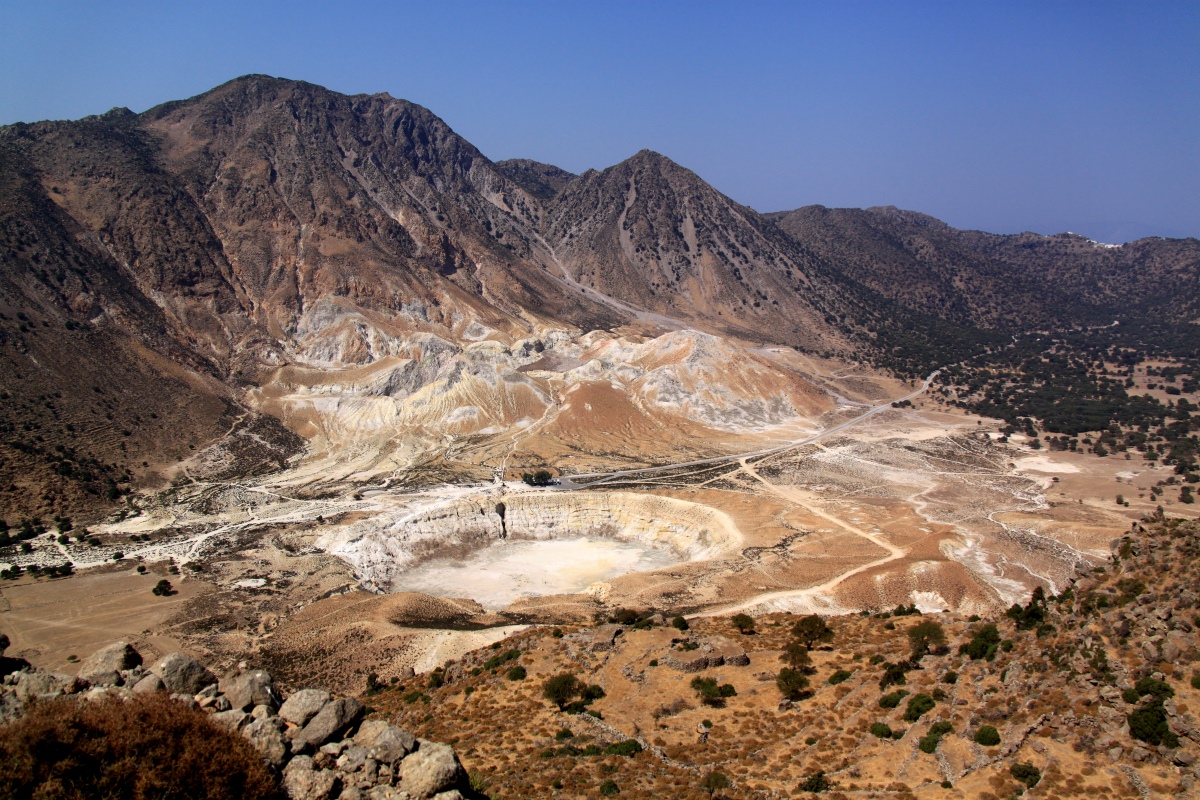
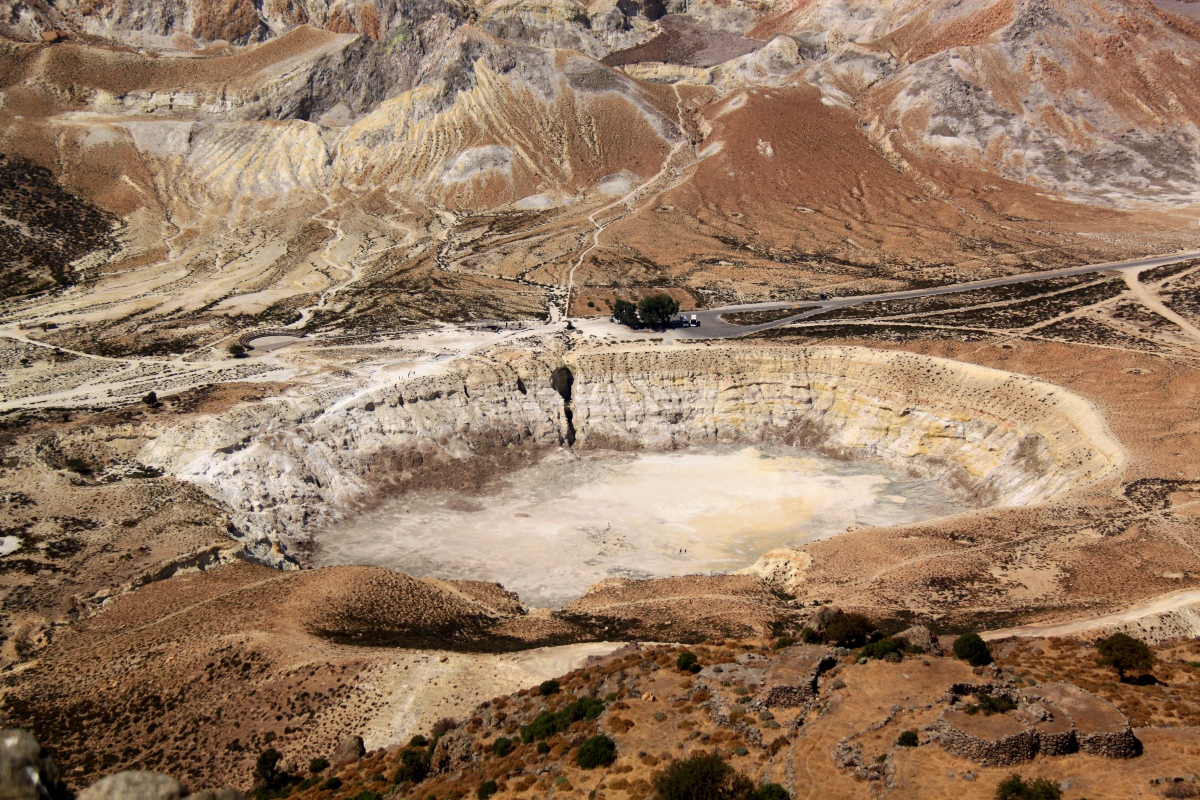
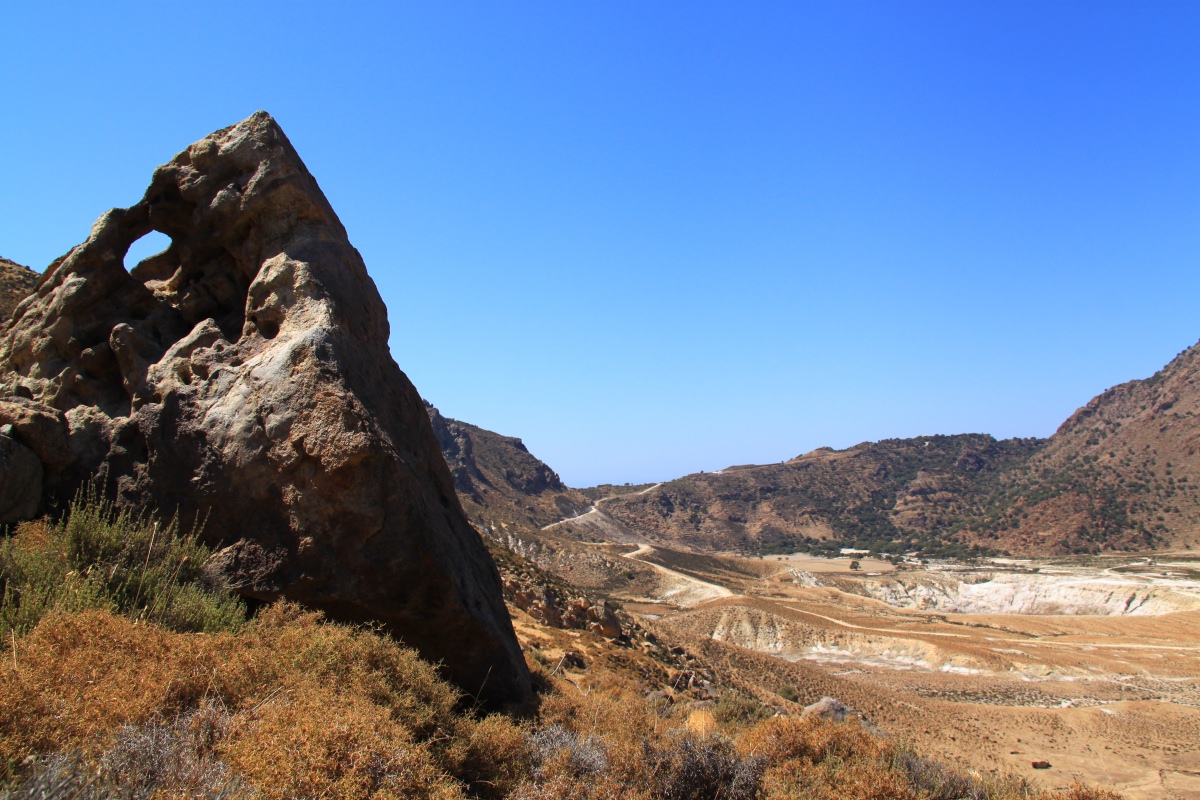
You can go there on any one of a fleet of air-conditioned coaches from the harbour but where’s the achievement in that?  It took me less than 2 hours to walk there from the hotel in Mandraki, by now a reasonably familiar but always interesting route and still with a few surprises if you keep your eyes open.  But this isn’t about the walk, it’s about the Stephanos Crater, the biggest, most dramatic and most visited crater in the 4 kilometre-long Nisyros caldera.

It’s very dramatic when seen from around the caldera rim as I hope those who have seen photos of it in earlier blogs will agree.  It’s very dramatic when viewed from the rim of the crater itself.  But it’s only by going down the steep, zig-zagging, blindingly white sulphur path to the crater floor that the true awesomeness of Stephanos grabs you.  For a start it becomes significantly hotter as you go down, not only from the reduction in the breeze, but also from the reflection of the sun from a cloudless sky ….. and from the heat coming up through the floor of the crater.  Believe me, you can feel it through the soles of yours sandals/shoes/boots.

On first impression it looks pretty benign because the bottom of the path emerges in a fairly inactive area.  However, the smell of sulphur has become considerably stronger than it is on the crater rim and following the edge of the floor around to the left it soon becomes apparent why.  There are dozens, maybe hundreds, of small fumaroles constantly hissing and now and again pouring out steam and sulphur gas.  They are surrounded by sulphur crystals, too fine and fragile to take as souvenirs, though crudely smashed bits of fumarole edge attest to the fact that some have tried.

Go around to the far side of the crater and there are countless more sulphur-emitting holes but here there are also holes with boiling mud or water as well.  The configuration changes every year because in winter the floor gets a covering of water which leaves a thin crust of sediment as it dries and then the heat from underneath breaks out at weak points.

And that’s where issue of risk assessment versus risk perception comes in.  Just how safe it wandering around on the thin-crust floor of an active volcano?  How safe is it being anywhere near it?  Talk to some people and they will get no closer than peering over the rim close to the taverna and the safety of the coach.

The given-reasons for not going down to the crater itself are that it’s not safe and the smell is objectionable.  Yet many then go and sit in the taverna and have a cigarette.  That’s perceived risk from the crater versus the perceived risk from smoking.  I’ve never bet on a horse, or anything else, but it seems to me that it’s the difference between a 1000:1 outsider and a sure fire certainty.  Despite the worst endeavours of the tobacco industry it’s now established beyond reasonable doubt that the risks to health from smoking are considerable.  And the smell!!  You stick the things in your mouth and set fire to them in order to inhale the smoke.  Give me the crater floor anyday!

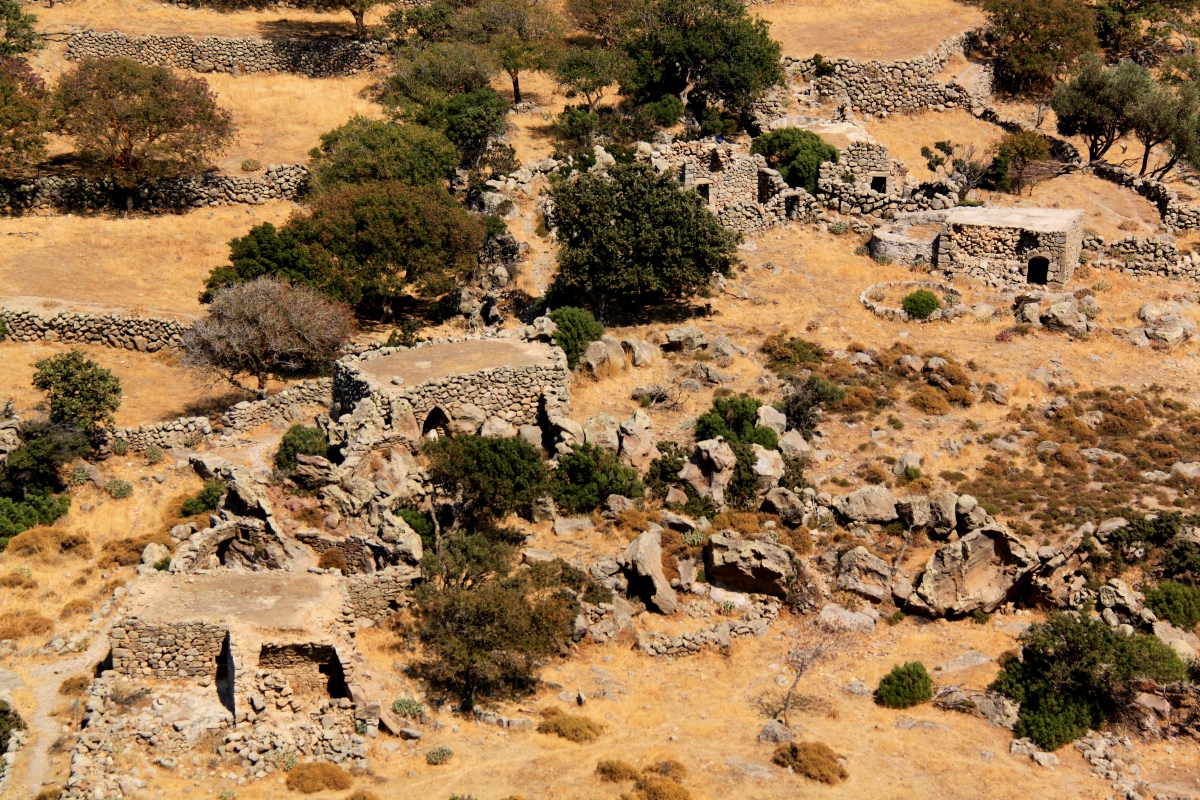
Volcanoes all over the world have for millennia attracted dense settlement of people close to them because of the good-living they offer.  Nisyros has been no exception.  As I have mentioned before the island was once agriculturally very prosperous because of the rich volcanic soils with steep terraces within the caldera and within spitting distance of the main crater.   The people who lived there would have known the risk. The latest major eruption was in 1888 but yet on Saturday I saw houses with dates of 1903 and 1920 carved into the door lintels.  They were still building 15 years later.

It wasn’t that the people couldn’t move.  When the climate changed and the rains failed they left in droves as the wealth of agriculture shrivelled.  Rather, while the living was good they chose to stay.

Risk assessment is scientific, risk perception is largely emotional.  The differences are far too complex to go into in a  short blog.  One factor is that people regard risk with a high statistical probability of happening as acceptable if they feel that they have choice over it, mistakenly seeing ‘choice’ as ‘control’.  There are countless examples.  There is always a huge outcry over the fear of MRSA affecting hospital patients yet many of them are at far greater risk from a lifetime of smoking, or getting to the hospital by car.

When people are on holiday they just want to enjoy themselves and if that means the ‘Wow!’ of walking on the floor of an active volcano in flip-flops then that’s fine.  “It’s my choice.  I’ll do what I want”.

What are the risks?

It is likely that at some point the volcano will erupt again.  One research study concluded that “When looked at in comparison to US volcanoes both scores (detailed in the paper – URL below) place Nisyros in the “Very High Threat (VHT)” category, grouping it with volcanoes such as Redoubt, Mount Ranier and Crater Lake”.  BUT the man-on-the-crater-floor reasons “True! But the likelihood of it happening while I’m here are pretty small”.  Statistically that makes some sense.  However, to be brutally honest, I guess most people don’t think about it at all, assuming blindly “a coach brought me here so it must be safe”.  A little more of which later.

Why there is logic in going to the crater floor of an active volcano is rooted in part in the monitoring of seismic activity.  The people who lived and farmed inside the caldera would have been switched-on to the prescience of wildlife and livestock to there being ‘something brewing’.  I have no doubt that wildlife and even domestic animals are more sensitive to changes than we are, whether it be minute changes in the atmosphere, ground vibration, or whatever.  When our culture stopped being rooted in the land and the environment we lost touch with all kinds of sensitive indicators of pending danger.  But at least we have universities which use all sorts of sophisticated monitoring equipment to give us warning. If there are no warning signs, we feel free to go ahead.  Or rather, if we are not TOLD that there are warning signs we feel free to go ahead.  Don’t forget the film ‘Jaws’ when profit outweighed science and prescience.

But that’s to do with the volcano ‘blowing its top’.  What is NOT taken into account is the very personal and much higher risk of breaking through the thin crust of the crater floor.  It happened a few years ago on Nisyros.  A woman taking photos got too close to a fumarole and the crust broke plunging her leg into boiling water.  She had boots on which limited the damage.  On Monday I saw a young girl in shorts and flip flops within a couple of inches of a hole of bubbling water taking a photo with her mobile phone.

I don’t think anyone would describe me as risk averse.   Our paragliding instructor called the  group of us from the mountaineering club on the training course a bunch of gung-ho idiots (‘idiots’ wasn’t the word but I can’t publish what he did say).  We had T-shirts made with “The Gung-Ho Paragliding Team” emblazoned across the front.

Back to the present, on Monday I was very suspicious of the stability of the crater crust and stayed well away from clusters of fumaroles on the floor itself.  On several occasions I got a blast of very hot air onto my toes from tiny fissures I hadn’t even seen.  Once I nearly stepped in a shallow pool of clear boiling water.  Much of the crust just felt weak and unstable underfoot.

The hordes of day-trippers from Kos who descended onto the crater floor by the coach-load were obviously very impressed by what they saw and posed for photos squatting down next to bubbling or smoking fumaroles clearly oblivious to any risk.  Some put their hands over the openings only to withdraw them again very quickly amid multilingual expletives.

Now here’s a thought, picking up on something mentioned earlier.  Is it that we are so used to risk assessment being carried out for us and checked by government agencies that if we are not explicitly prevented from going somewhere or doing something ‘for safety reasons’ we assume that it’s OK.  Little Jimmy Somewhere fell off a swing and hurt his head. The courts found the local authority responsible, damages were paid, playgrounds across the UK were closed overnight, many never reopened.  Surely better to teach Little Jimmy not to fall off the swing.  We have lost the instinct, the inclination and the ability to assess risk for ourselves.  After all, we can always sue!

Peace and quiet, blue sea, blue sky as I left Mandraki

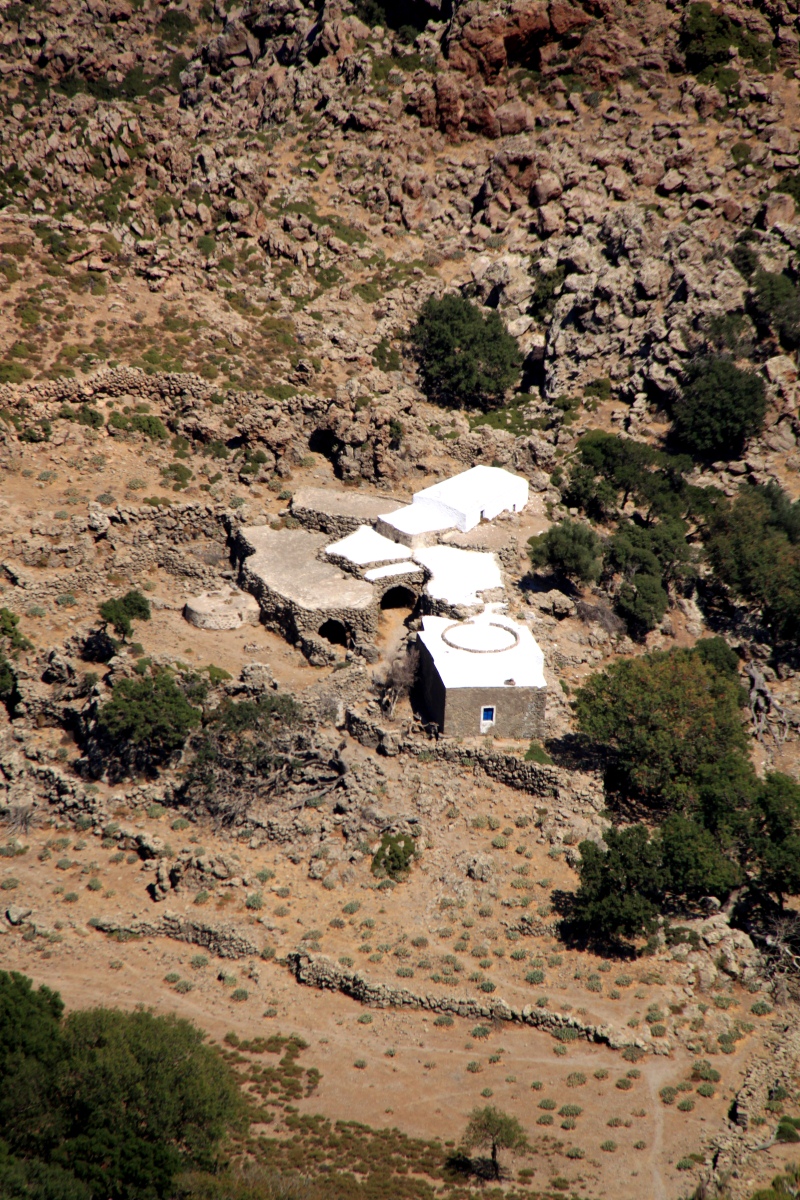
Terraced fields and roof-top threshing floor in sight of the main crater

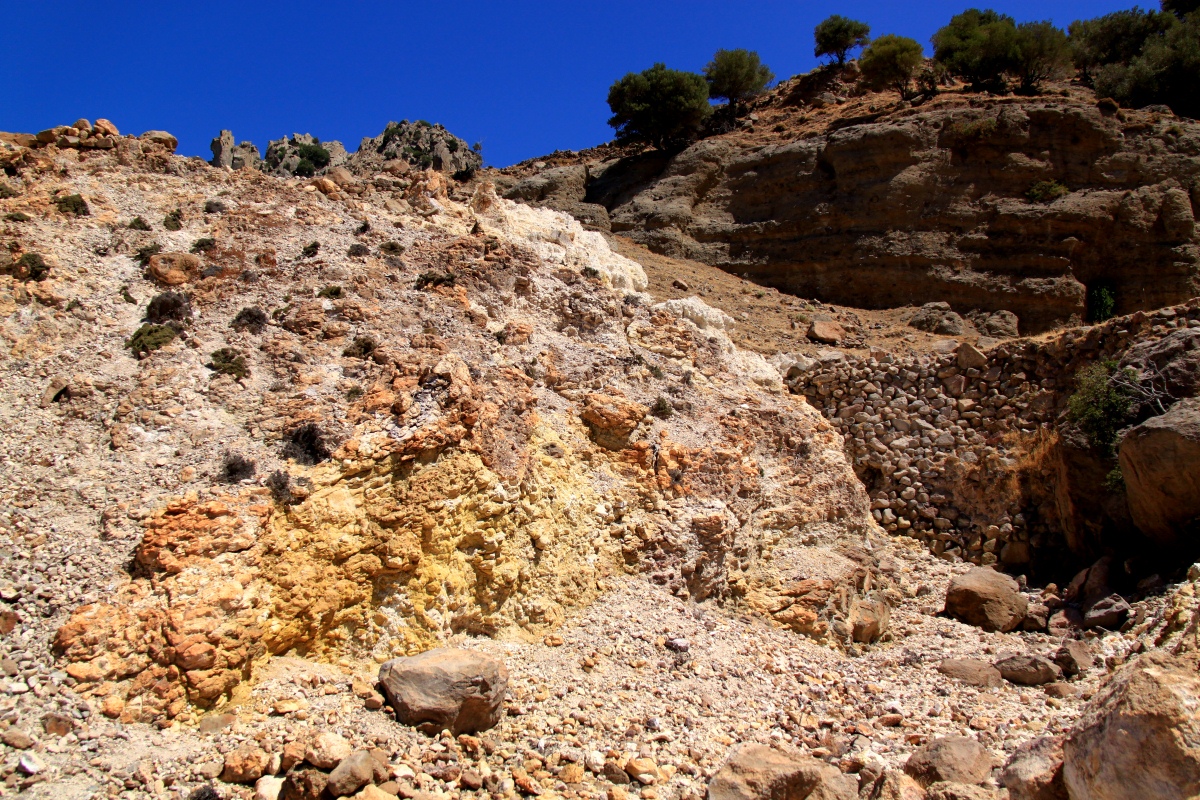
Red and yellow sulphur deposits on the path down to the crater

On the floor of the crater

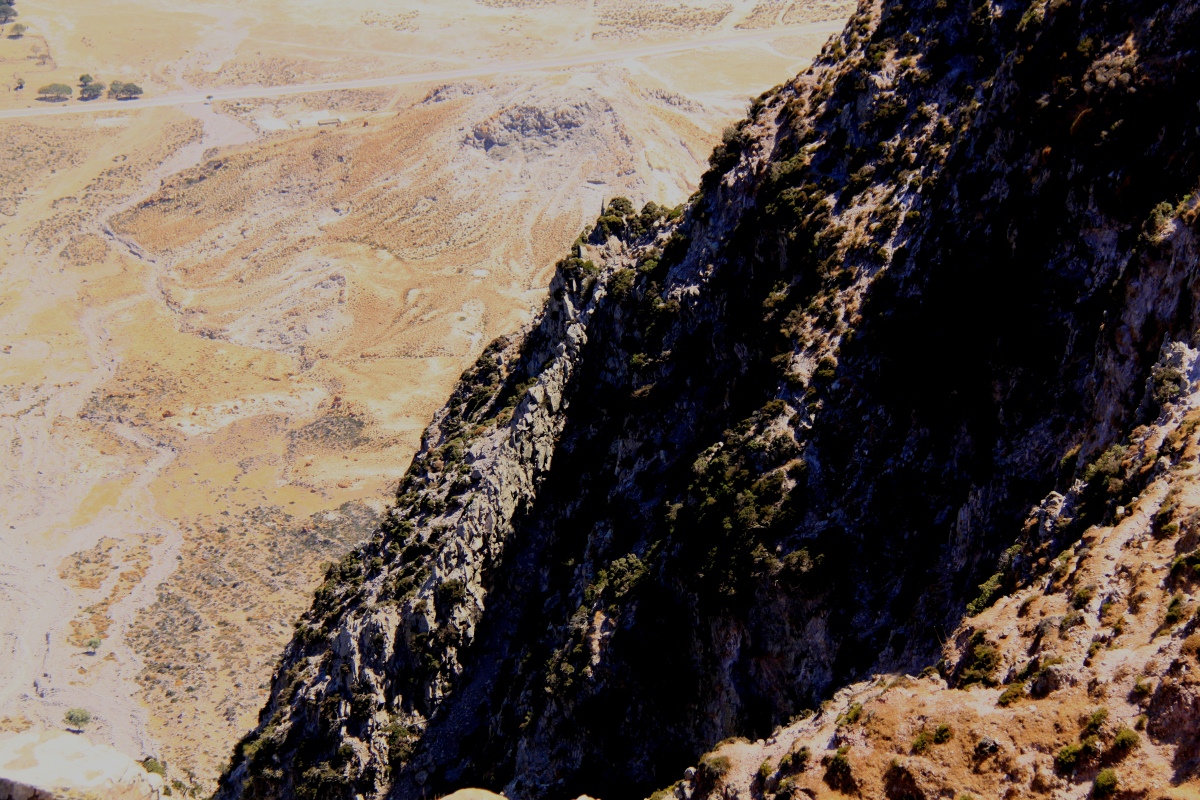
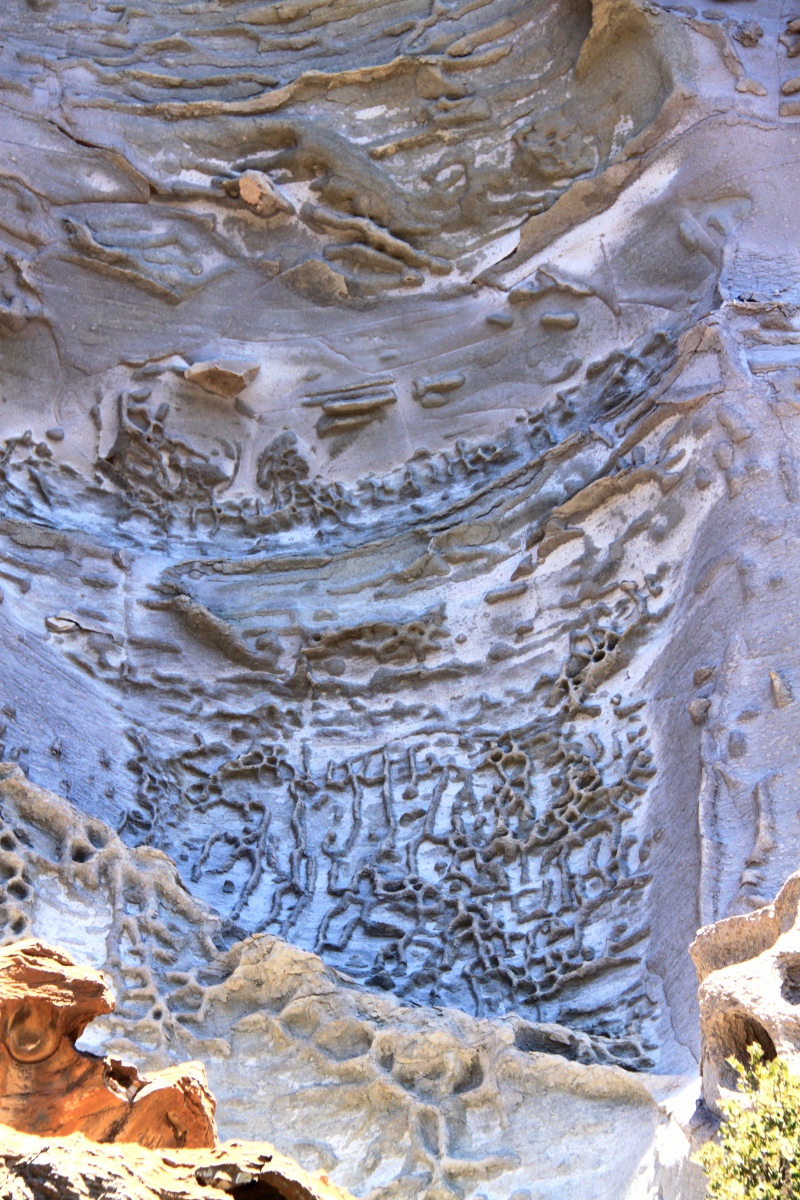
Close-up of part of the crater wall

Monitoring station
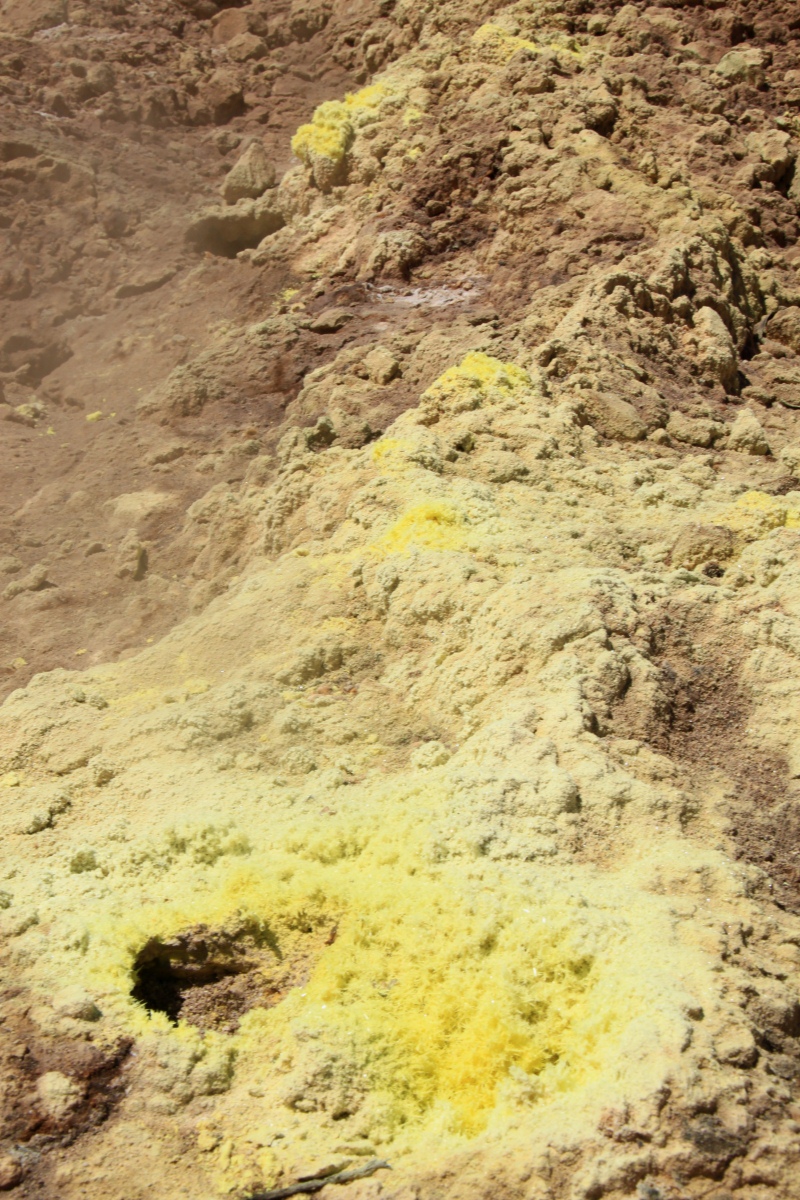
slightly raised fumaroles
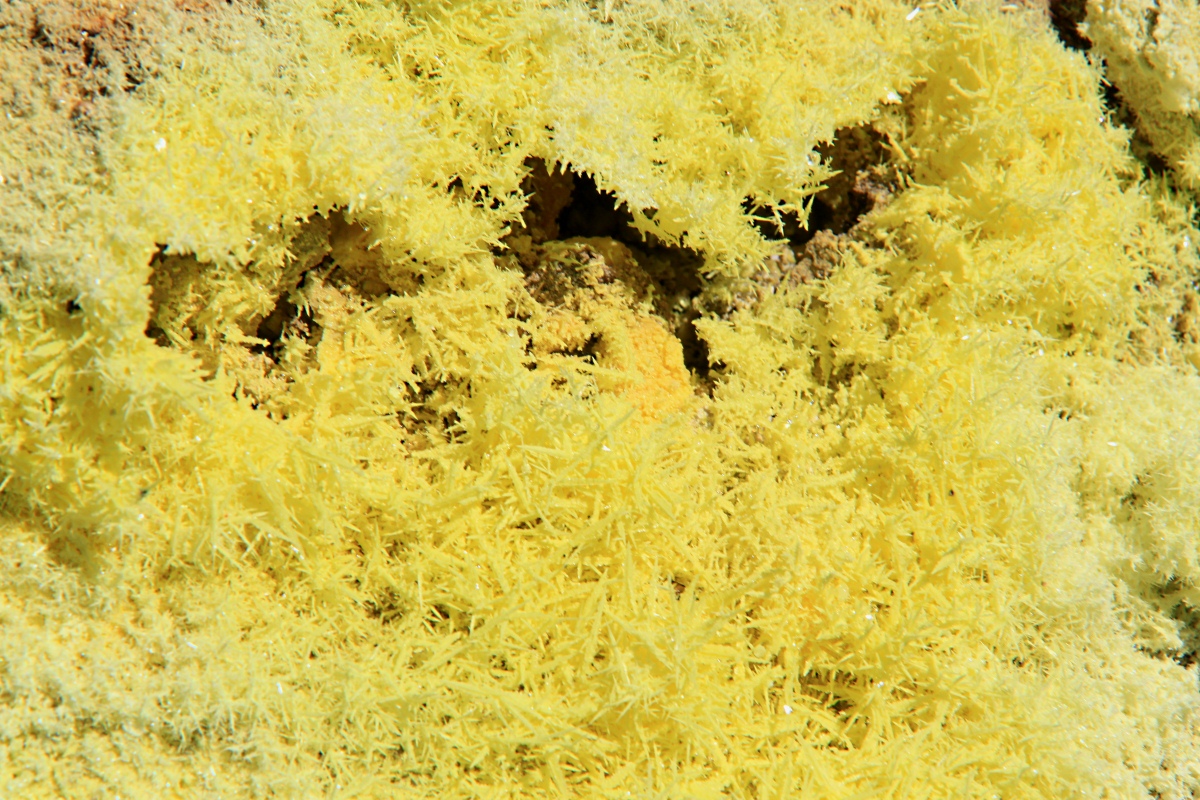
Sulphur crystals around hissing fumarole
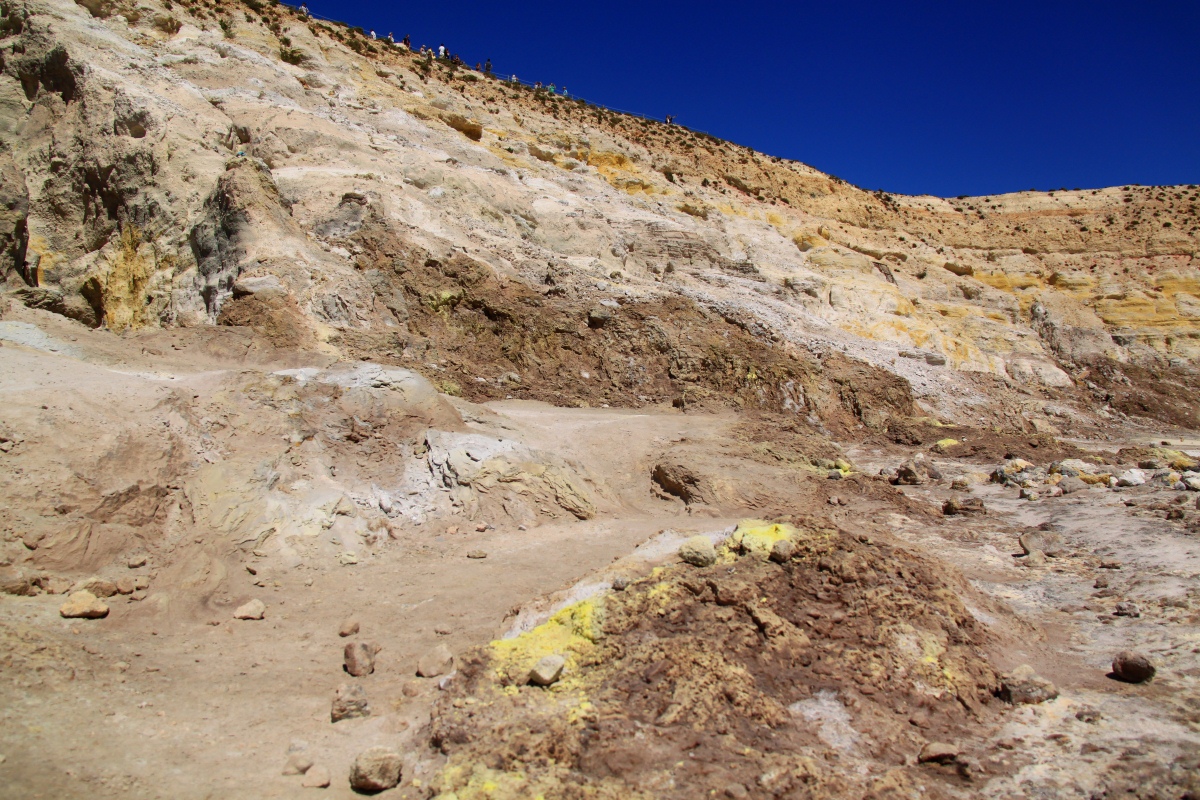
Scale: trippers view the crater from its rim, fumarole below

Fuming fumarole
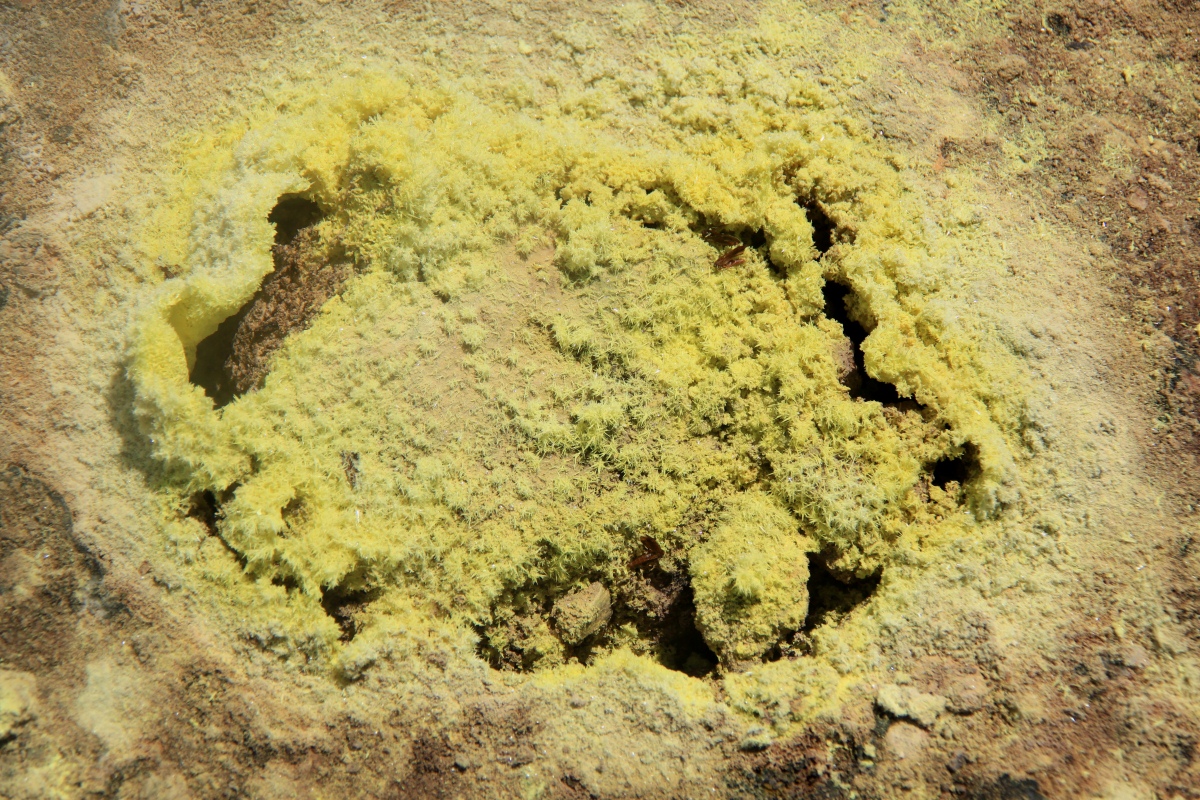
Fumarole encrusted with sulphur
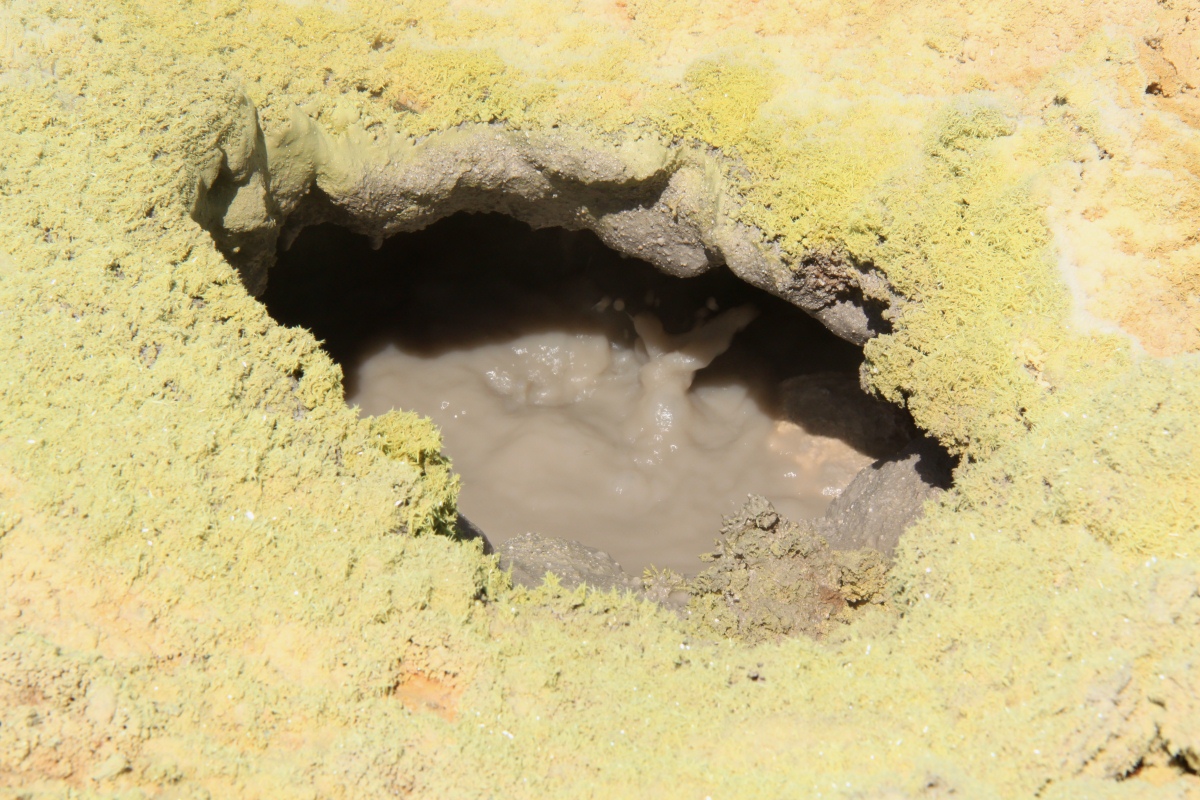
Sound like a kettle boiling vigorously

… and one with the lid off
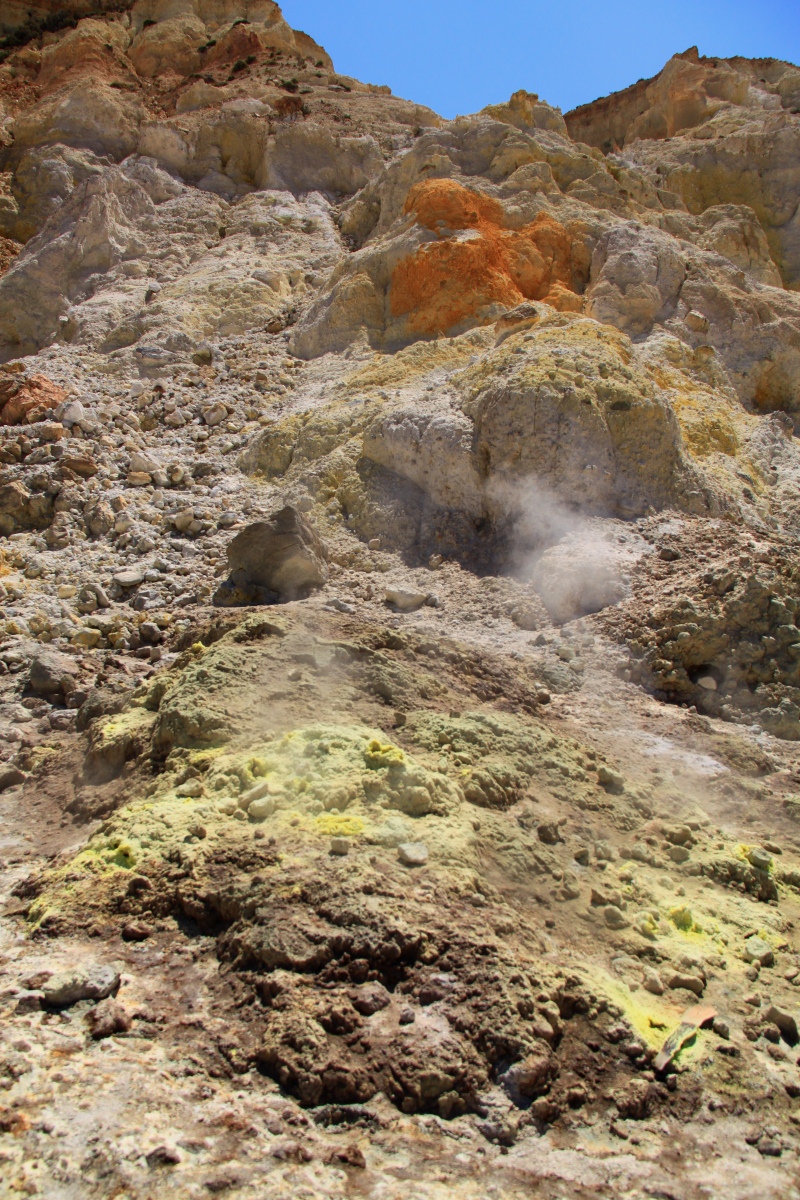
More fumes and crater wall
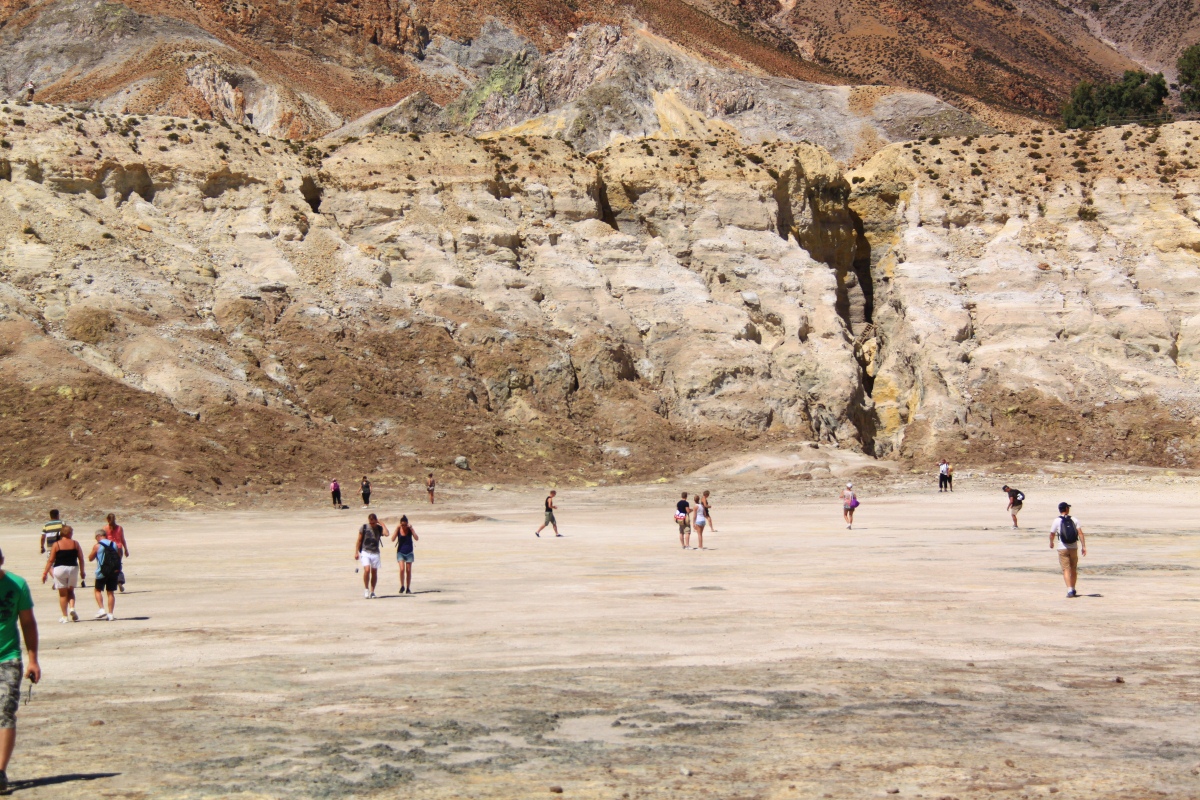
Visitors to the crater floor


Analysis of volcanic threat from Nisyros Island, Greece, with implications for aviation and population exposure.  H. S. Kinvig, A. Winson and J. Gottsmann

http://www.nat-hazards-earth-syst-sci.net/10/1101/2010/nhess-10-1101-2010.pdf

Posted in Greece | Leave a comment

Nisyros: the unusual and surrealistic

After two weeks of pretty intense walking every day in the mountains I decided that this Sunday was going to be a day of rest.  The decision was unanimous, if only because it was  unilateral.  For once I was absolutely sure that I needed a day-off from strenuous exercise  and  so I set out my day accordingly.  I only covered about 10kms.

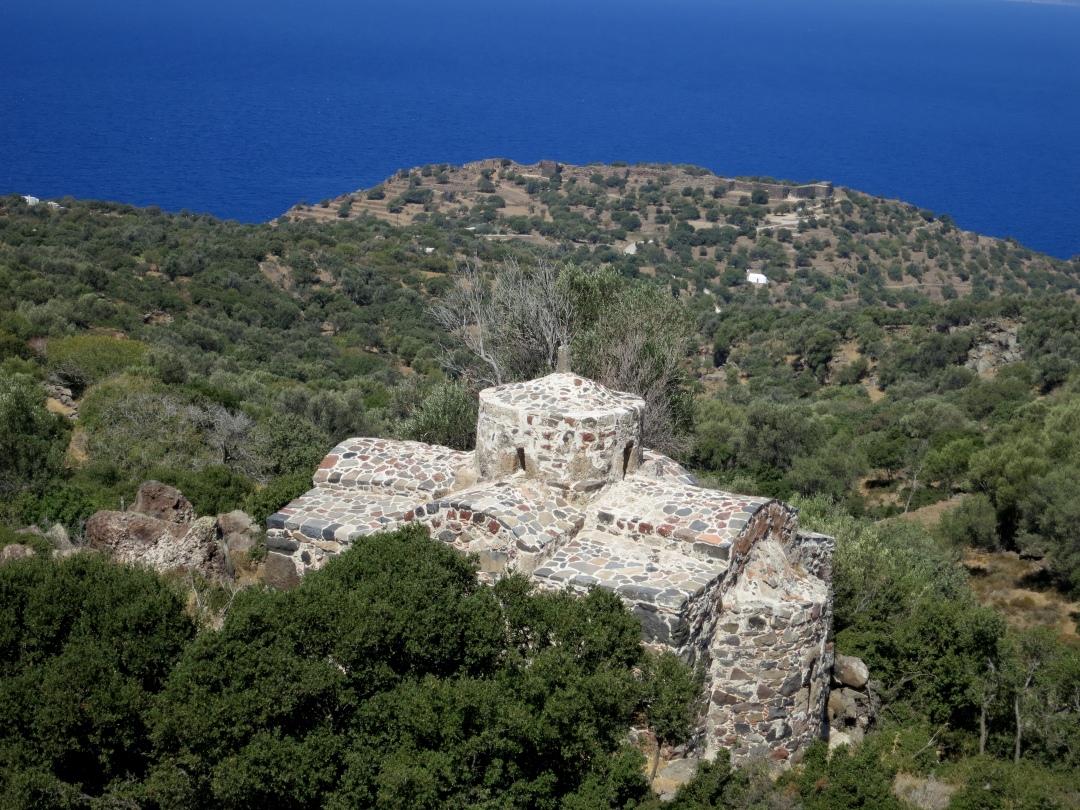
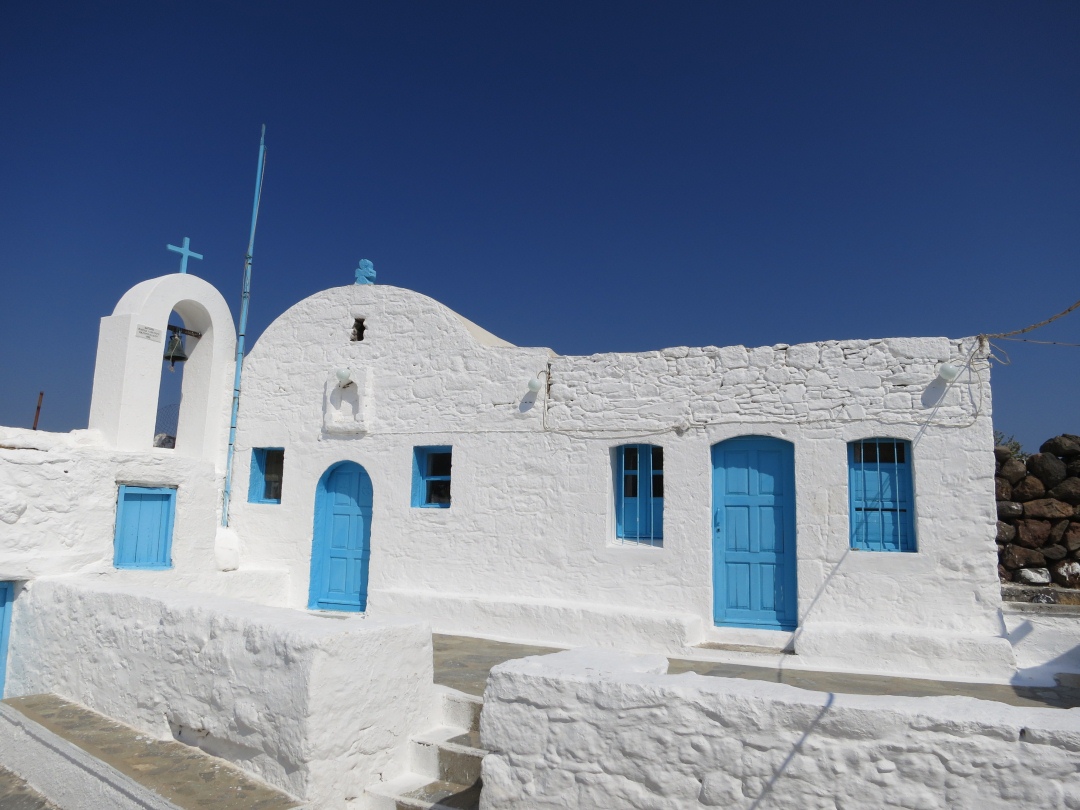
Unfortunately I find that I can’t ‘amble’ anymore so I shot at fairly high speed up to the tiny church of Panagia Faneromeni about 4 kms from the town in the foothills of the mountains.  It’s a stone-built basilica type structure, one of a kind here on Nisyros and recently renovated.  The door was padlocked so I couldn’t go inside but sat on the step outside in the shade for a time of quiet.  Very peaceful.

Then I climbed up some great chunks of volcanic rock nearby to get a better perspective for photos and while down-climbing took the skin off my shin …. again!!  It’s similar to the “grass is always greener on the other side of the hill”  mentality.  I suffer from “the best photos are always from a vantage point you can’t quite get to” syndrome.  I’ve got the scars to prove it.  And a few slightly better photos.  The spot where I did it can be easily identified as the air surrounding the rock is very blue and there are expletives and exclamation marks trapped in the thorn bushes.

I always carry a pretty comprehensive first aid kit so was able to staunch the stream of blood and effect a repair but it will ruin the tan on my leg!  To facilitate the ‘staunching the flow of blood’ bit I climbed up another rock, ate a banana and lay on the top in the sun with the injured limb elevated for half an hour.  Sometimes it just has to be done!

I wasn’t so much feeling sorry for myself as cross and grumpy.  The worst thing is feeling stupid for doing it in the first place.  A guy I used to canoe with painted on the underside of his canoe “I know I’m upside down!” for when he capsized in rapids and was slow rolling up again.  I’m thinking of ordering wound dressings with “I know I’ve cut my leg” printed on them.

The church of Panagia Fanoremeni seen from the top of a rock

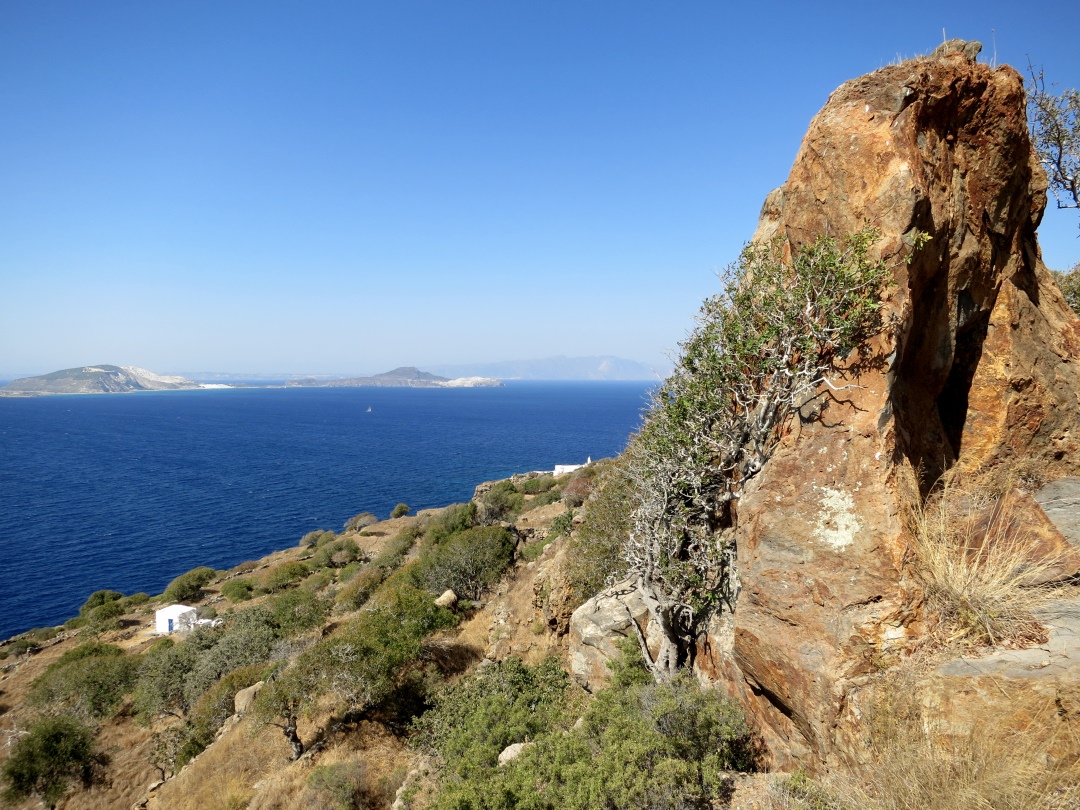
…. and from the top of another rock. The Paleocastro is on the headland in the distance

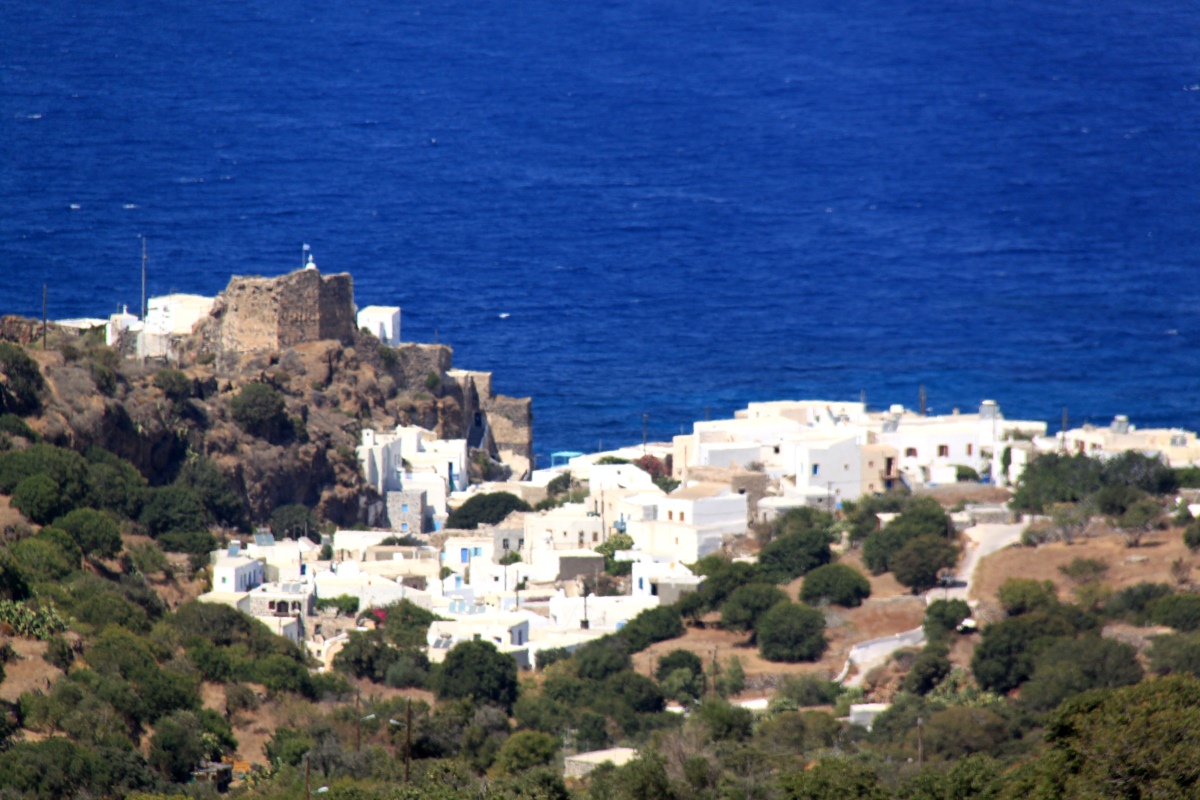
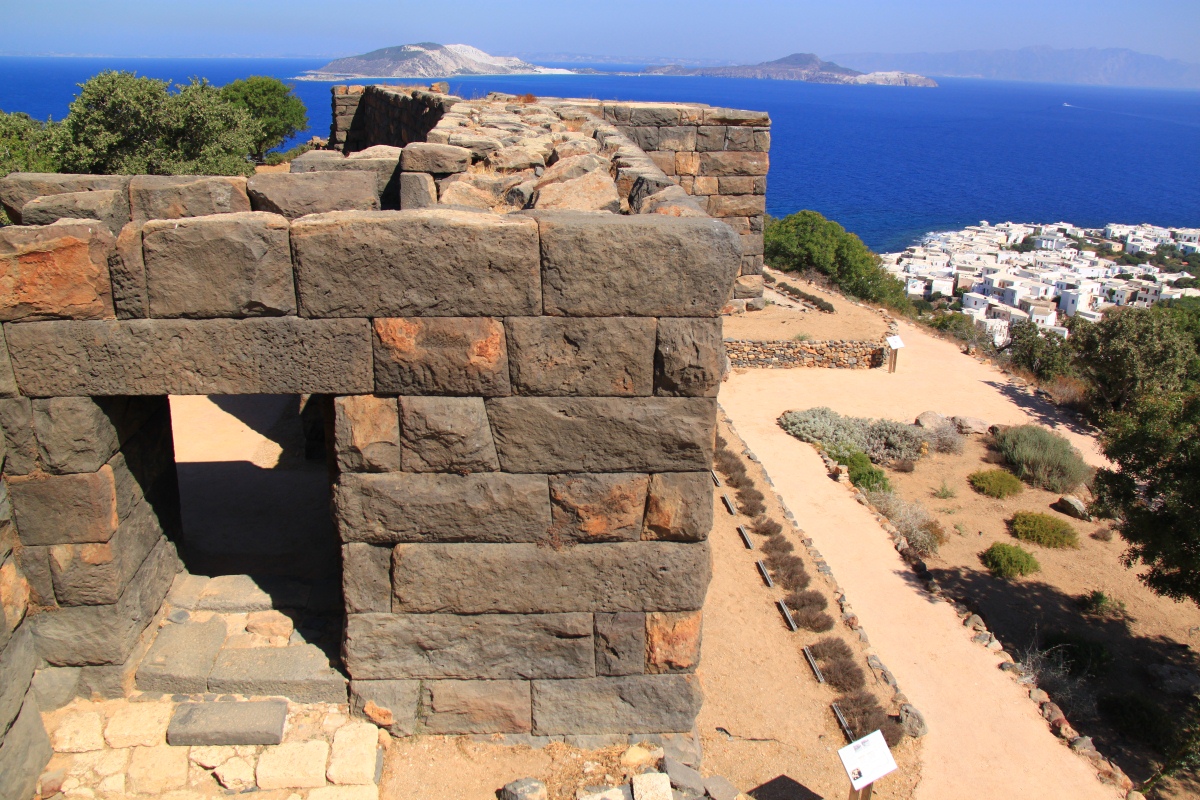
From the church of Faneromeni there are clear views down to the Paleocastro on the hilltop above the town and the full extent of it can be better appreciated.  So after sunning myself on top of the rock I climbed down, without further scathing, slightly less grumpy and dropped back down to the Paleocastro.

The Paleocastro fills the entire width of the headland

View down to Mandraki

One of our old haunts there is around the far side of the site where the very old fortifications are built into and on top of the huge volcanic rocks.  It’s not on part of the built pathway in Paleocastro but there is a rough path to clamber down to a very pleasant area by a large volcanic outcrop where you can sit on smooth rock slabs in total peace and quiet to appreciate the stillness and the history.  They blocks are not cut neatly and precisely as the ones in the main part of the fortification, being mostly large natural but very rough boulders almost like large-scale clinker out of a blast furnace.  They go back to a much earlier time in history.

One of the volcanic crags in the old part of the Paleocastro

I got back to Mandraki about 16.30 but, because of a stupidly acquired hole in the shin I didn’t go for the customary swim.  I have become a very loosely acknowledged part of a small group of people of a certain age, all locals except me, who go for a dip from steps at the side of the ‘town beach’ about 16.30-17.00 every day.  Today I hunched down in the exceptionally comfortable armchairs outside a nearby taverna, sipping a frappé and watching the faithful take to the waters, hoping that they wouldn’t spot me playing truant.

I don’t usually mention the evenings because they are much the same.  Meal in Irini’s restaurant in the main square followed by an ouzo nightcap in a taverna on the seafront ‘Heroes’ Square’, both very laid back and pleasant.  Last week there was a performance by a dance and music group from the island of Leros in Heroes’ Square.  Very enjoyable.   This Sunday there was a showing of ‘Zorba the Greek’ projected onto the side of a house at the side of the square.  It was the original version with Greek or English subtitles as appropriate to the language spoken.  Given that there were scooters and 3-wheel vehicles buzzing around and that there was a soccer match on the TV in the taverna the subtitles were very useful.  Surprisingly I could follow much of the Greek subtitles.  A truly surrealistic evening to follow a very unusual day.

Posted in Greece | Tagged , , , | Leave a comment

Nisyros: old settlements

There are few things more boring than listening to/reading someone blarting on about how great a time they are having when you don’t know the place and the reality is denied by distance and experience.

I had a great time on Friday, walked a long distance in the mountains in fabulous weather.  But I’ll just focus on what was new.

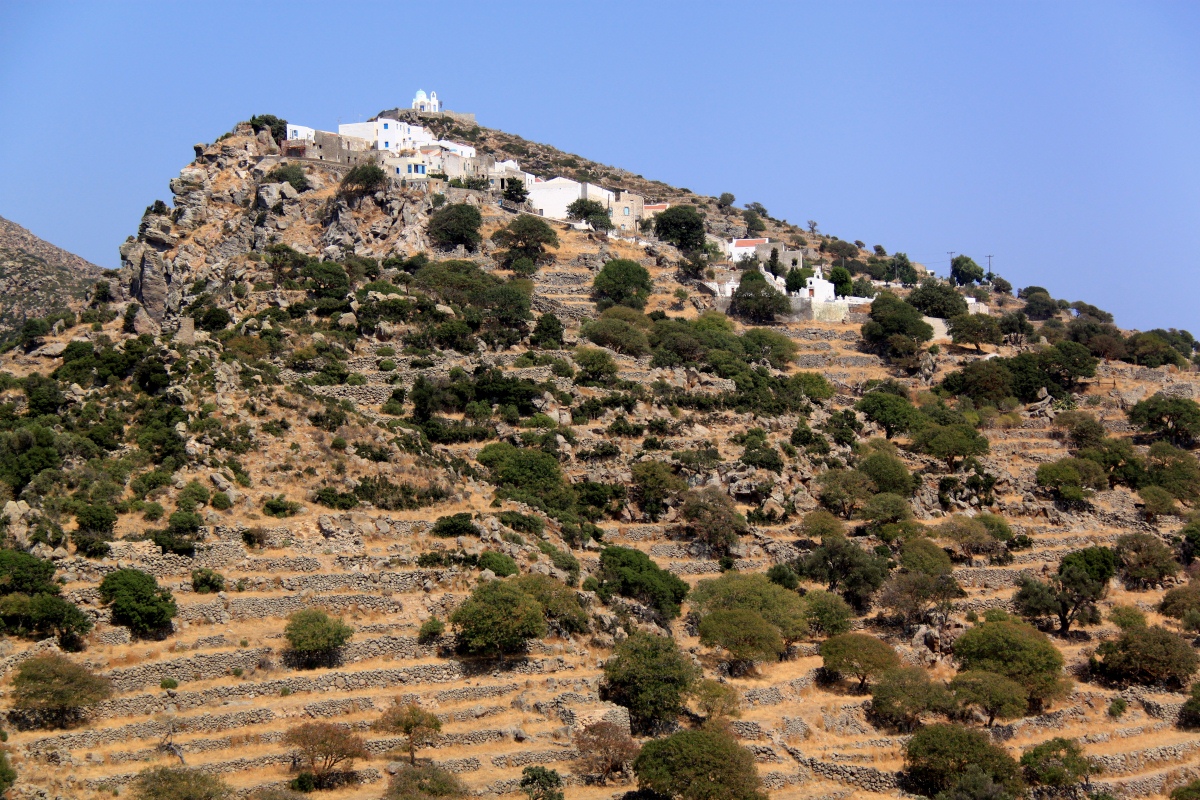
The plan was to walk across the island via the caldera to the crater-rim village of Nikia and then explore an abandoned village and climb up to an old windmill on top of an adjoining mountain before the walk back.

It all went well.  I won’t bore you with the details but just to make the point that it was about 20 kilometres with close to 1000 metres of ascent.  I’m getting fitter and enjoyed making rapid progress.  I got to Nikia and a welcome frappé in 2 hours

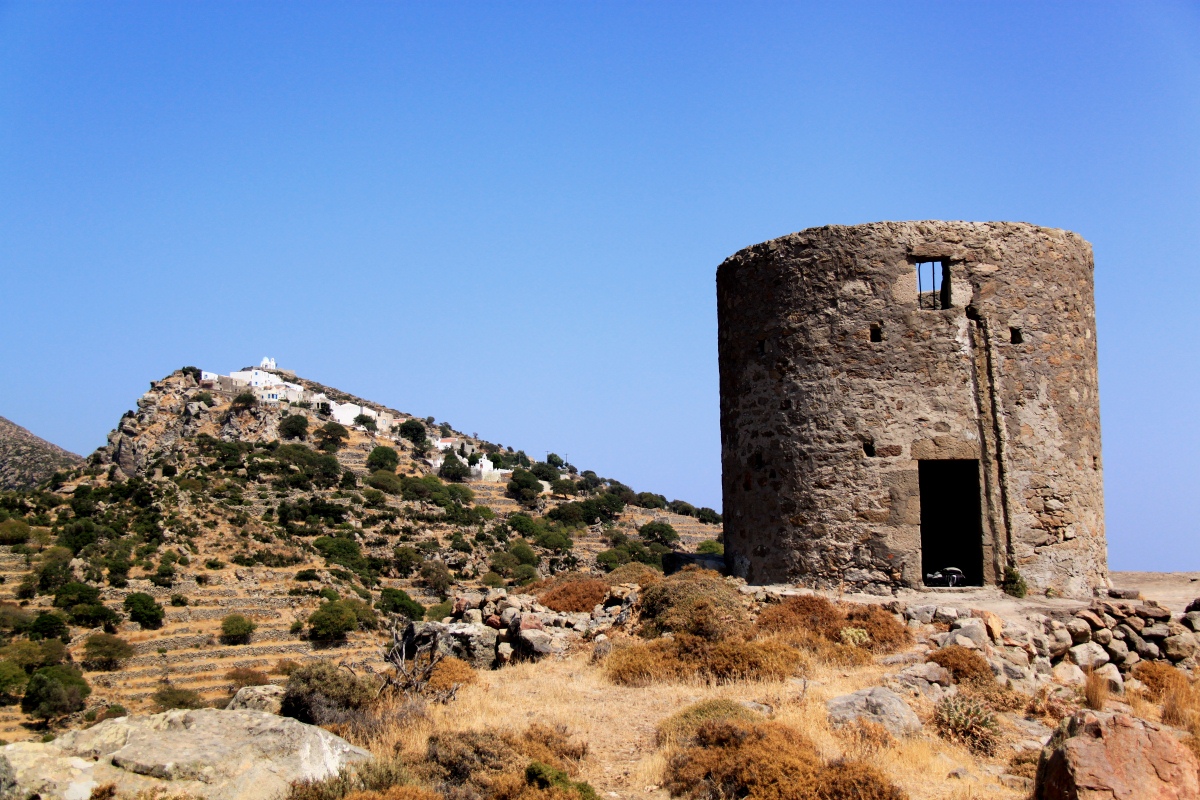
From Nikia I continued on for the real objective of the day, the abandoned settlement and the old mill just below the village to the west, again on the rim of the caldera.

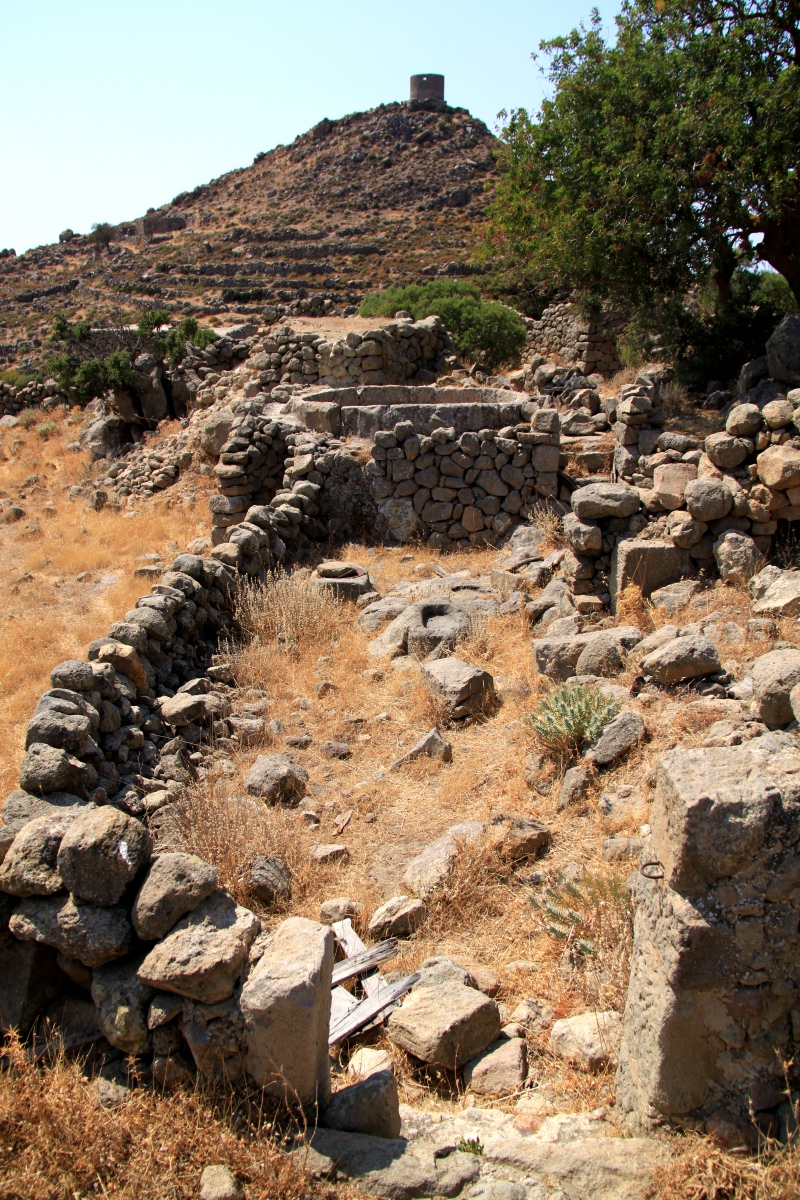
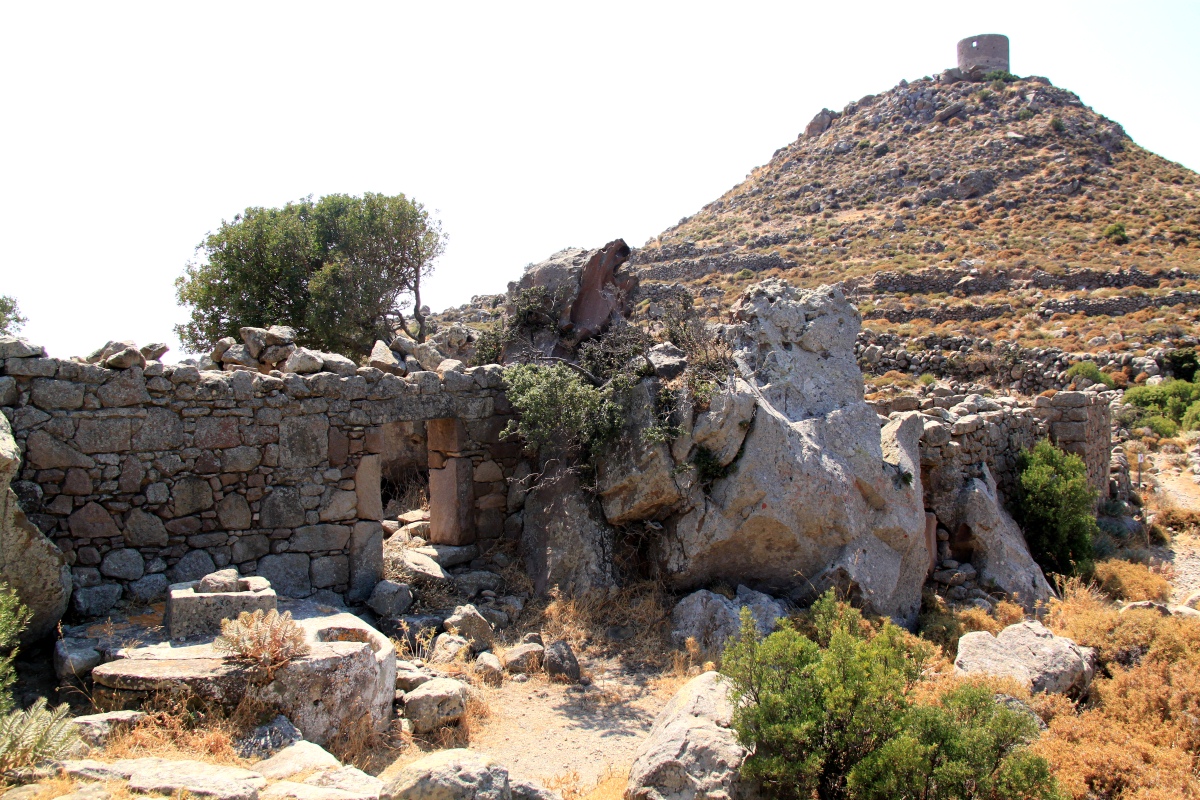
Stone pillars at the entrance to one of the living spaces with sterna and stone bowl, threshing circle on the roof, and the mill behind

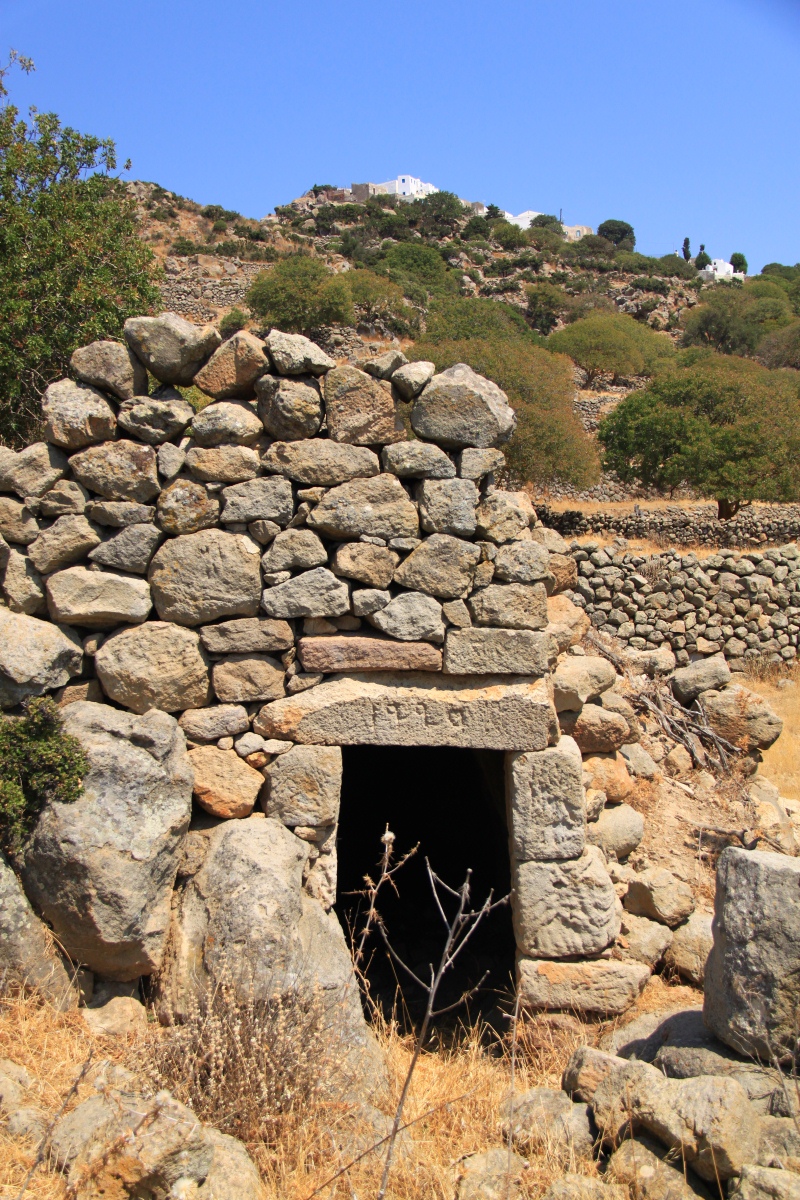
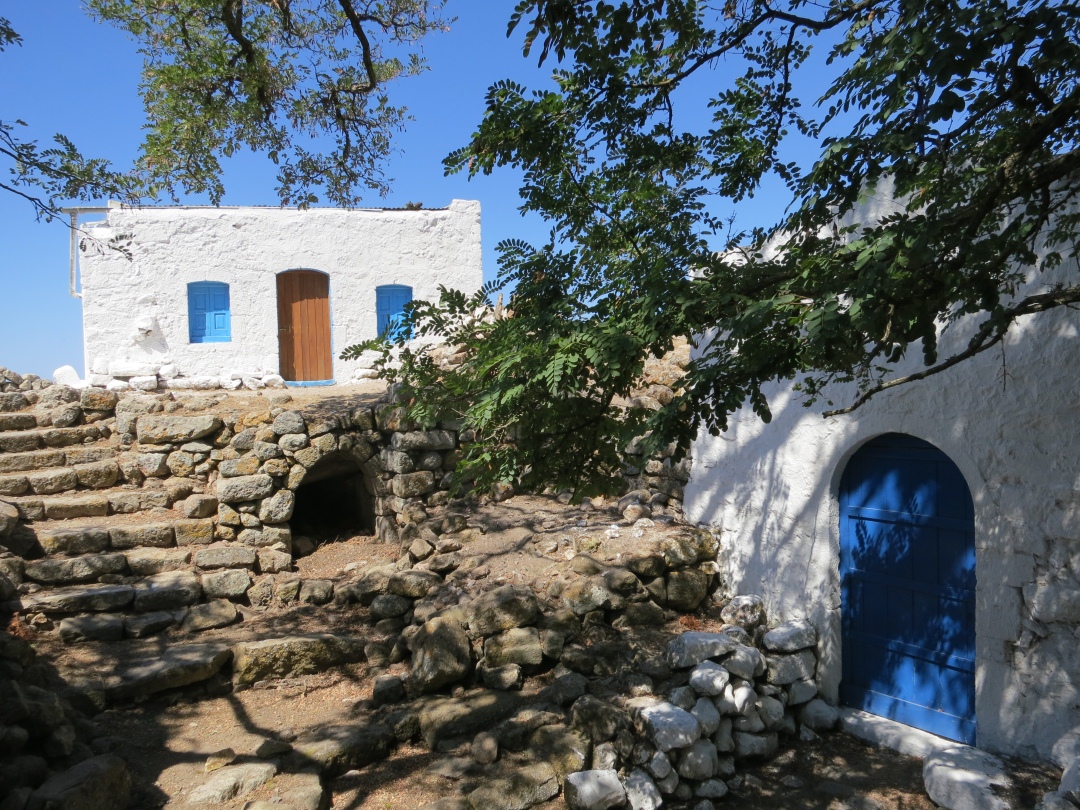
Entrance to the house, ‘1920’ carved in the stone lintel

Sterna and stone trough outside the settlement walls

Entrance to one of the larger houses with a small ‘porch’

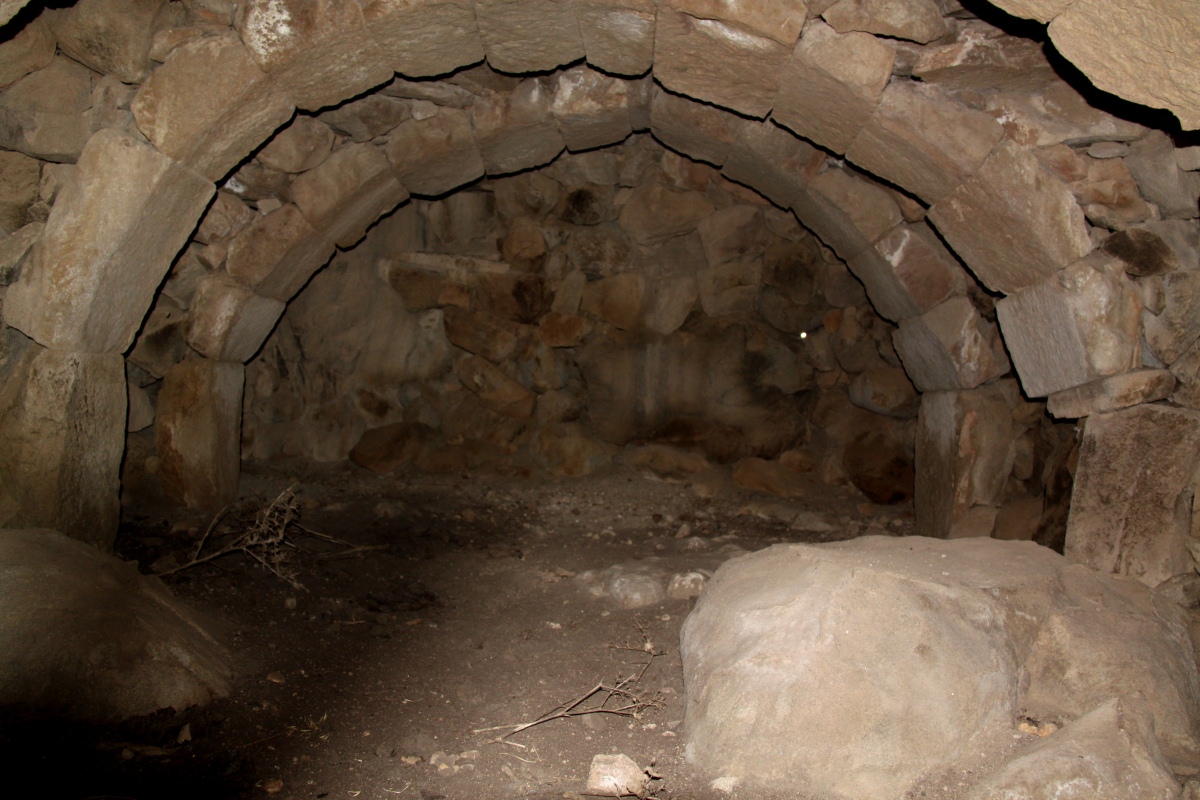
Inside the house

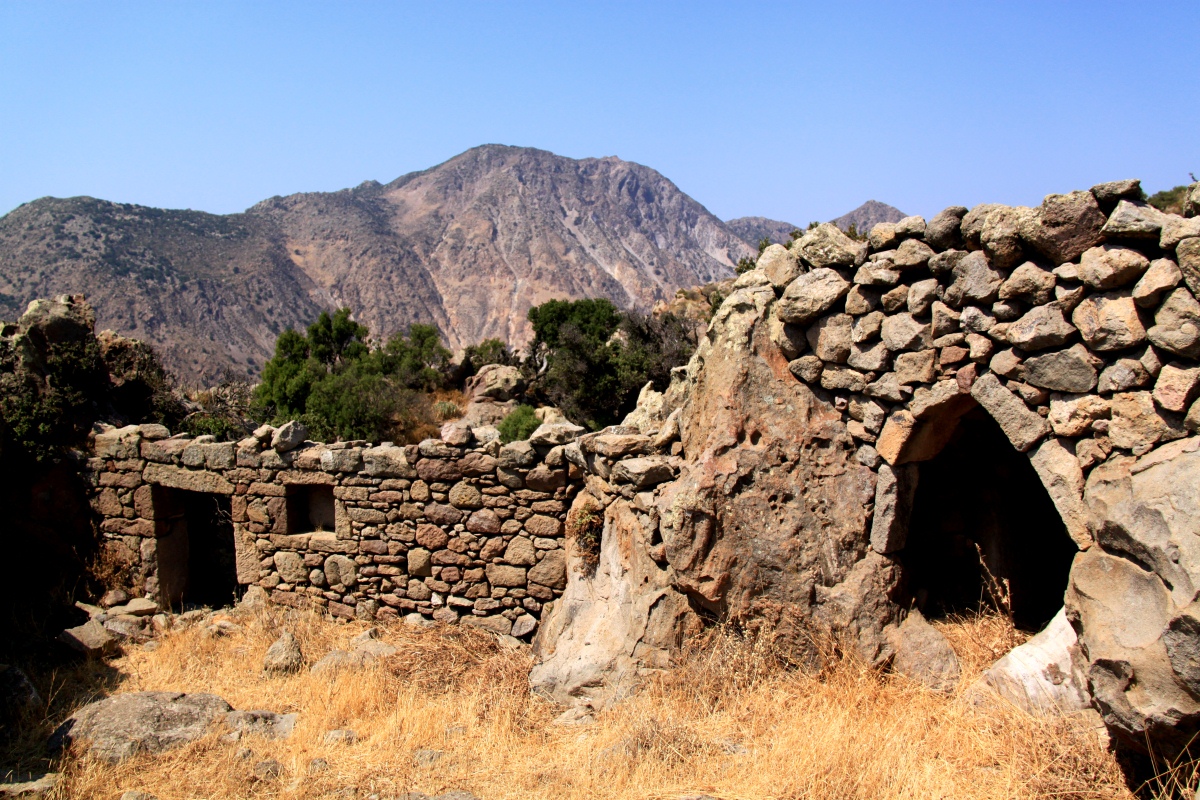
The settlement gives the impression of being very old and probably much of it is.  Each house is a single room which is stone-built, of barrel-arch construction with an earth floor and either soil over the top or a threshing floor on the roof.  Sternas (water tanks) are buried under the buildings and the terraces in which they are set with a small covered hole on top for drawing water.  Despite the appearance of great age there are dates over some of the door thresholds presumably indicating date of construction, the most recent I saw being 1920.

There are very many terraced houses in Britain considerably older than that with 2 reception rooms and a ‘scullery’/kitchen, 3 bedrooms, indoor bathroom and piped water and electricity.  And windows!!  I don’t know about the settlement I was looking at but certainly some of these houses were only abandoned post WW2.  Many of the inhabitants would have moved off the island as they saw their agricultural livelihood collapsing with increasing drought rendering the rich volcanic soil unproductive.  The remainder would have moved to Nikia on the crater rim or down to Mandraki on the coast.

The climb up to the mill wasn’t difficult despite the fact that any path there might have been is long since overgrown with aggressive vegetation.  It had been very windy for most of the previous 3 hours of walking but around the mill it was necessary to bend double to avoid the danger of being blown over the edge of the precipitous drops.

The mill itself was of mild interest and had been fairly recently refurbished with a new concrete floor at the top and a rickety ladder to climb up onto the roof.  The views from up there were breathtaking.  Or was that the wind?

The abandoned settlement seen from the top of the mill

Nikia from the top of the mill

The mill

The craters seen from the mill

Zooming in on the Stephanos crater

Yet another long, hard walk on Saturday so I think  a more relaxing Sunday is called for.

A brief stop on the way back at the Stavros monastery perched on the caldera rim


Posted in Greece | Tagged , , , | Leave a comment

Nisyros: old ways, new routes

I feel a right long ramble coming on  here.  So if you read the blog, be warned.

Many years ago when I started work as a town planner with Monmouthshire County Council (the proper Monmouthshire, not the present vestigial pretension.  The one which used to be ‘Wales and Monmouthshire’) my far-sighted boss told me to spend a few days driving around the county to familiarise myself with it.  There are a few things which I still remember vividly from that 3 days of paid fun ‘exploration’.  One was driving into Ebbw Vale when they were oxidising the blast furnaces in the steel works, the whole town enveloped in a pall of thick orange smoke, and seeing an advert on the gable end of a terrace of houses proclaiming “ Persil washes whiter”.  Another was driving up the steep hill into Bargoed from Aberbargoed on the other side of the valley and seeing ahead of me the Bargoed Emporium.

Fast backwards to many years before, I don’t know how many, when the inhabitants of the small harbour village of Palloi on Nisyros got fed up with being raided by pirates and so moved uphill to the crater rim and called their new settlement Emborios.

Same word.  It basically means ‘place of commerce’.

Friday, and I decided just before I walked out of the door that I was going to walk up to Emborios via the spectacular direct route from Mandraki which climbs the rim of the  Kato Laki caldera, then follows the inside rim of the main Laki caldera and from Emborios drop down to the harbour at Palloi.

It’s a great walk both to and from Emborios but the path down to Palloi I had failed to find twice in previous years.  The first section of it is, for the most part, a very clear, stone paved kalderimi.  Then it intersects the modern tarmac road and beyond that is bandit country, wild and unkempt with paths blocked by fallen trees and collapsed stone walls.  Much like the walk into Argos on Thursday. But it was the success of the foray into Argos which fired my optimism.

My reasoning was that the original inhabitants would have needed a well established route from the coast up to their new lair if they were basically a trading people and so there must have been a decent path at one time.

A clear section of path as it passes beneath a huge lava boulder

Cutting a long story short, the tactic which I employed in Argos worked a treat on the second part of the drop down to Palloi: namely, when the walled path gets blocked climb up to the terraces alongside and follow the path at a higher level and drop down again when possible/necessary.  BUT FOLLOW THE LINE OF PATH.  Great success!  I kept to the path, which doubled as a stream bed for much of the way, including a 20 foot high dry waterfall, all the way down to the coast west of  Palloi.  Triumph!  Elation!

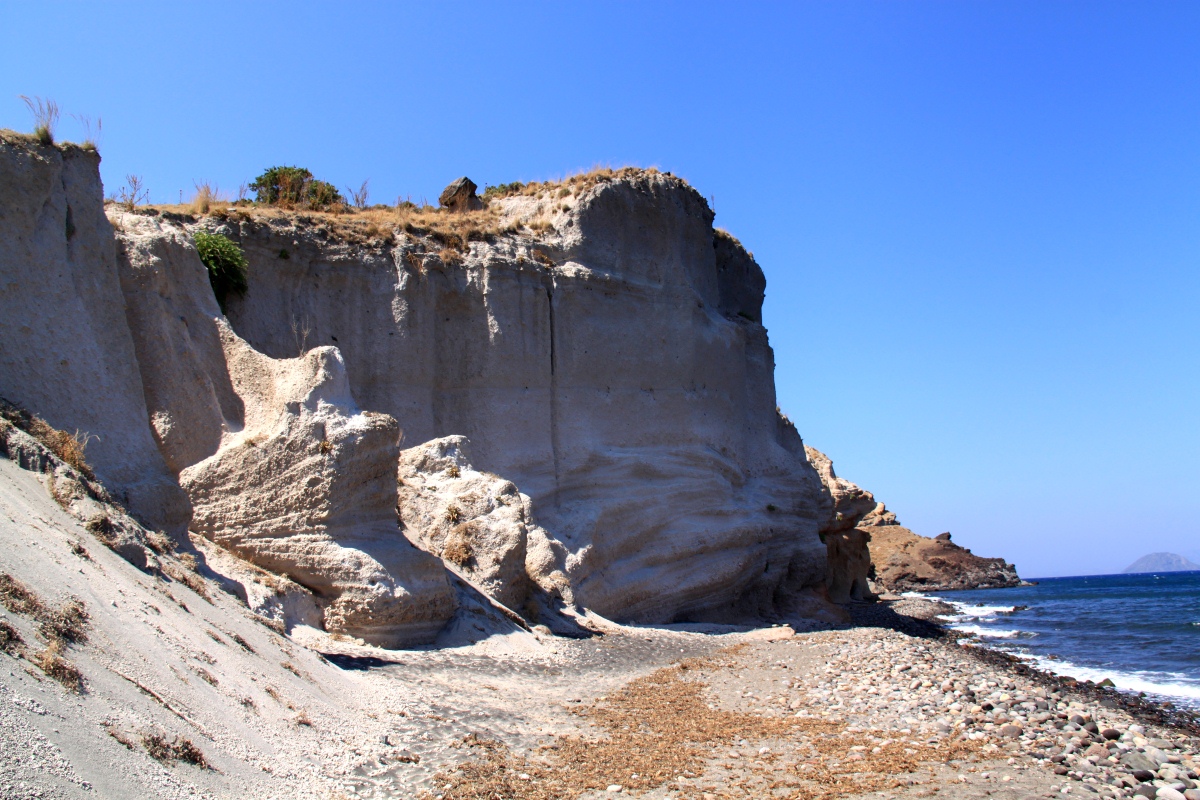
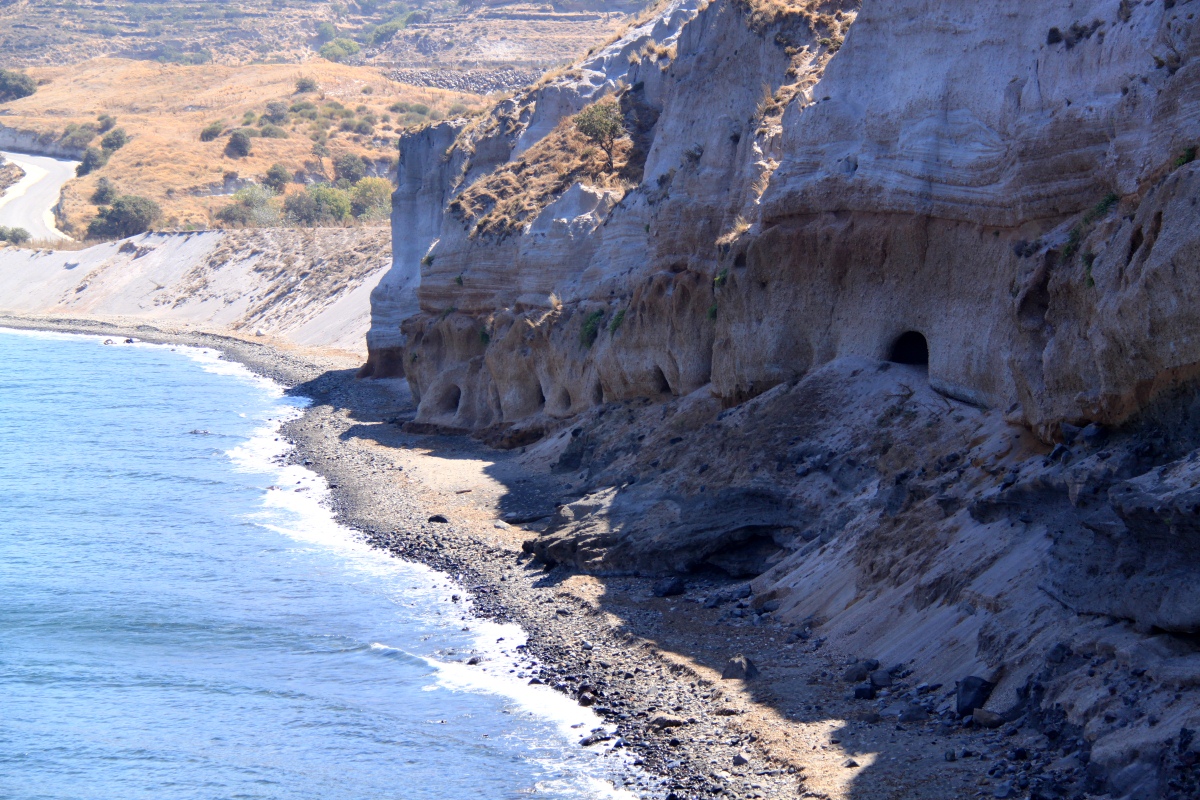
Instead of turning east to go to Palloi and then back to Mandraki I turned west to get onto the foreshore on the far side of an amazing geological formation.  There are high pumice cliffs with a rising line of shallow caves culminating in a headland of lava protruding like a clam shell into the sea.  I had recommended that section of coast to someone else but am glad they didn’t follow my advice.

The path has always been across loose pumice scree, about as unstable as you can get scree.  This year the winter storms have rendered it almost impassable. Instead of a slightly compressed path of pumice the width of a foot (NOT a foot/30 cms wide!) there is now the barest indication of a line across it.  My first attempt to climb up to a line to follow dislodged a lava boulder nearly a metre cube which I had thought pretty solid.  I got my leg out of the way just in time and tested every single embedded rock after that. The only way to do the traverse was with my chest to the cliff to minimise outward pressure on the loose slope.  Exhilarating!

Photos are very poor I’m afraid because it was the end of the afternoon and the whole cliff face was in deep shade with the sun behind.  Just a couple to give an impression.  I need to go back in the early morning.

Approaching the pumice cliffs and the lava ‘clam shell’ along the narrow beach

Closer view of the lava clam shell

Close up of the pumice cliffs

One of the shallow caves

The ‘path’ follows the line of darker pumice diagonally up to the secure platform on the lava shell

The rising line of caves

The lava clam shell with the sun behind

The edge of the lava as it dips into the sea

Once I dropped back down from the top of the lava clam shell it was a pleasant amble along the side of the beach to Palloi.  This is the only place I know where in September there are many clumps of sea daffodils in full, very dramatic flower, thriving in the sandy pumice soil.

Sea daffodil

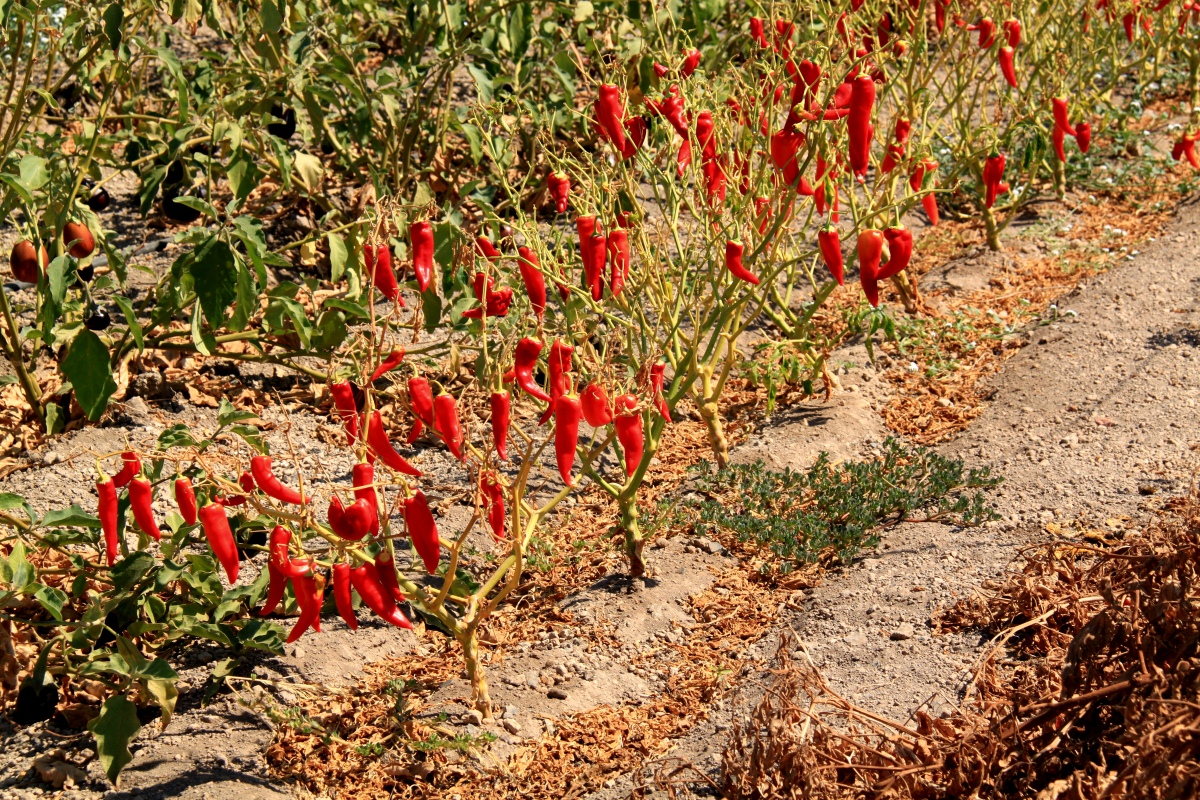
I wish I could grow peppers like that in my garden

Whatever else, the one connection between everything on Nisyros is the volcano.  One connection between Emborios and Palloi is thermic activity.

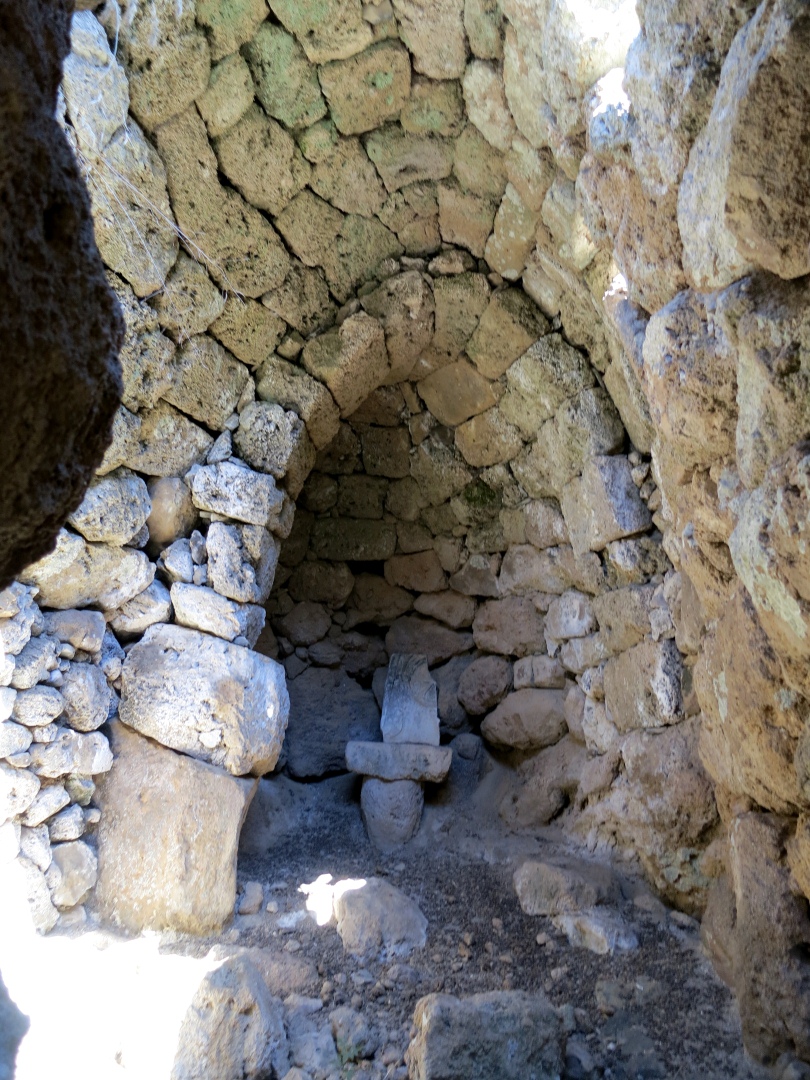
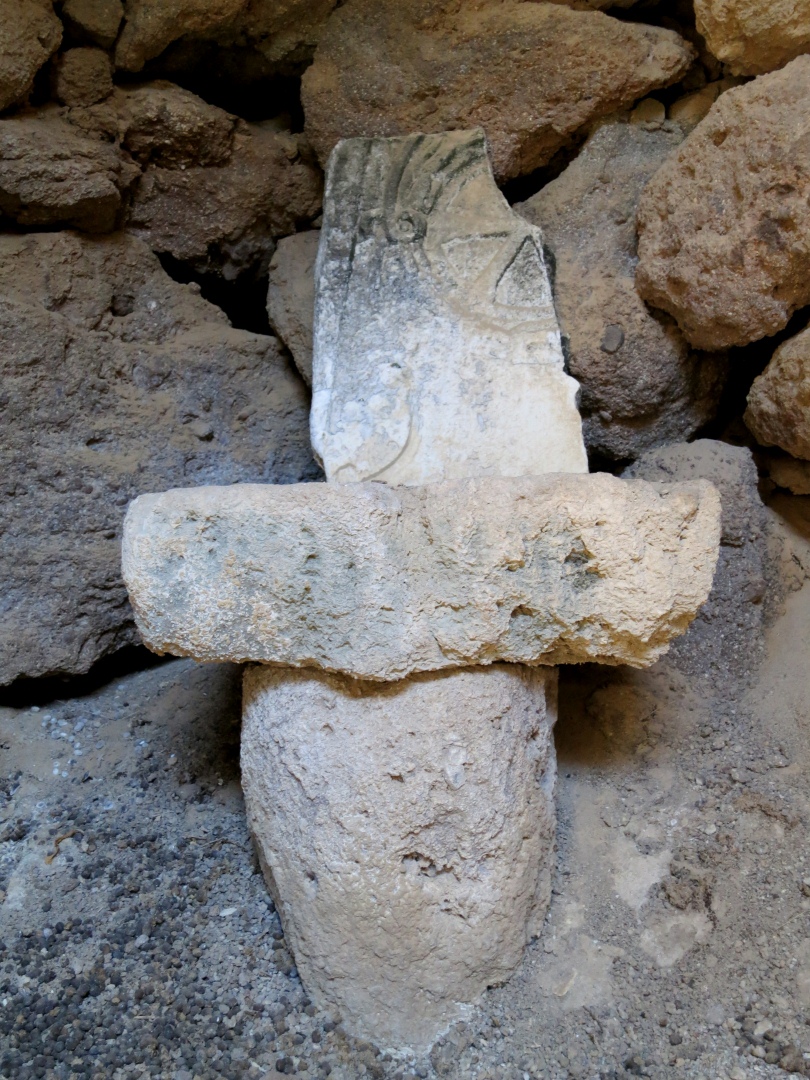
Another digression.  Hippocrates, he of The Oath, lived, had a clinic and taught medicine on Kos.  One of his cures/remedies was to send patients for treatment to thermal springs ….. on Nisyros.  It is thought that one of the places his patients came was Palloi which has a thermal spring in a cave behind an ‘underground’ church.  It is known to date back to Roman times and probably much earlier.  Small but fascinating.

The underground church with the cave containing the thermal spring to the left

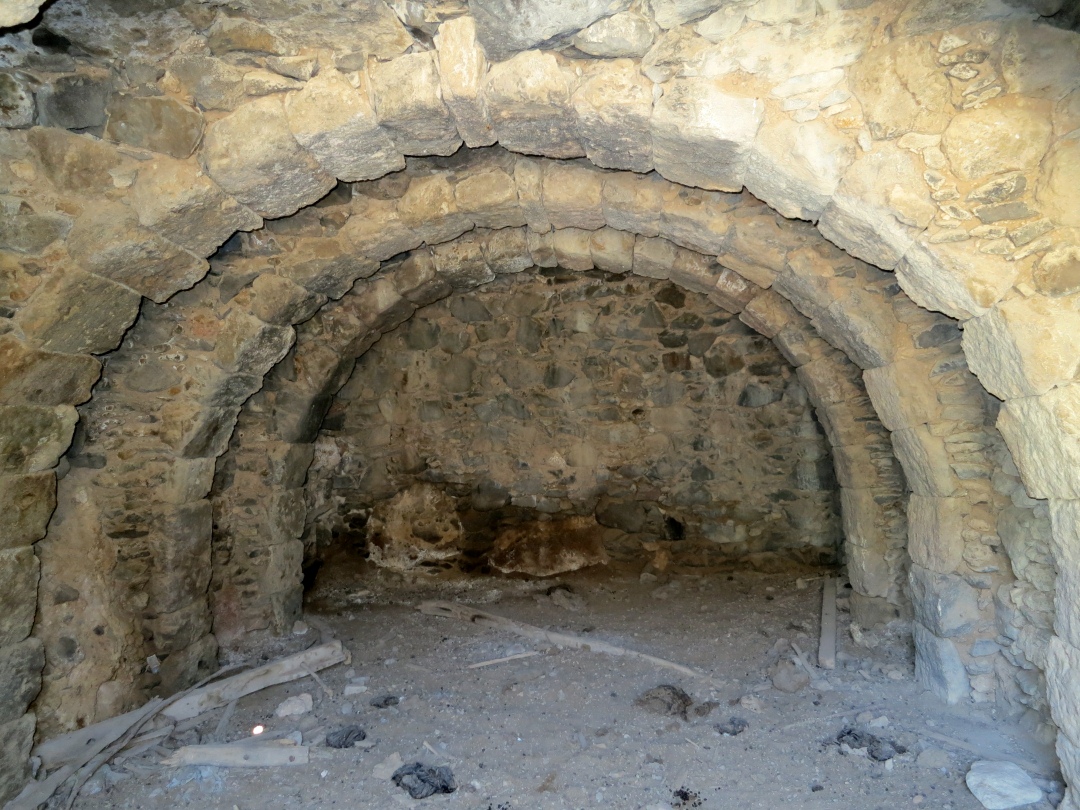
The entrance to the part-collapsed vaulted roof under which the church and the thermal spring sit

The thermal spring in the cave at the back

I’m amazed that despite the fact I have spent a lot of time on Nisyros, the stuff I have already seen on previous visits is so dramatic that it still quickens the pulse, still has that ‘Wow!’ factor.  As well as that, every day so far this year I have seen new stuff I haven’t seen before.  How good is that!!

Bargoed Emporium:  http://www.francisfrith.com/bargoed/photos/the-emporium-c1955_b300021/#utmcsr=google.com&utmcmd=referral&utmccn=google.com

Hippocratic Oath:  http://en.wikipedia.org/wiki/Hippocratic_Oath


Posted in Greece | Tagged , , , , , , , | Leave a comment

Nisyros: Lava landscapes and making a living from a volcano.

Wednesday I had decided to go off the page and into the past.  Thursday I had got a taste for it.

Parts of the island are very little explored now despite the fact that once they were densely populated and so served with ancient footpaths.  The route I walked on Wednesday between Siones and Evangelistra is one such and is only glimpsed from the path to the top of Oros Diavatis.  Another unexplored area, known as ‘Argos’, and can be clearly seen from the dirt track leading to the monastery of Stavros, spread out expansively stretching down to the coast far distant below with Agia Irini on a small headland way to the south.  The information sheet ‘Geotrail 6’, which I had bought from the Volcanological Museum in Nikia, gives a very brief description of the area and shows the outline of a route albeit on a tiny scale.

So that’s what I aimed to do, explore Argos and try to find the geotrail.

The first part of the path is a paved kalderimi and clear to follow, if somewhat covered in loose stones and gravel.  But as it drops down it becomes increasingly awkward, in one place completely blocked by a shed-sized rock, obstructed frequently by overhanging trees, in many places obstructed by long-dead trees, victims of drought.  The path was mostly easy to spot, contained within stone walls which had collapsed onto it,  distinguished it from the surrounding terraces which were surprisingly clear of stones and invasive vegetation.

The beginning of the kalderimi down into Argos

Path blocked by rock the size of a shed and dead trees

I persevered for about 45 minutes.  Then, at the top of a deeply incised canyon, I had enough of walking bent double under dead overhanging branches of olive trees killed by marauding goats, stumbling over loose rocks, so I struck off along one of the terraces following a clear goat path.

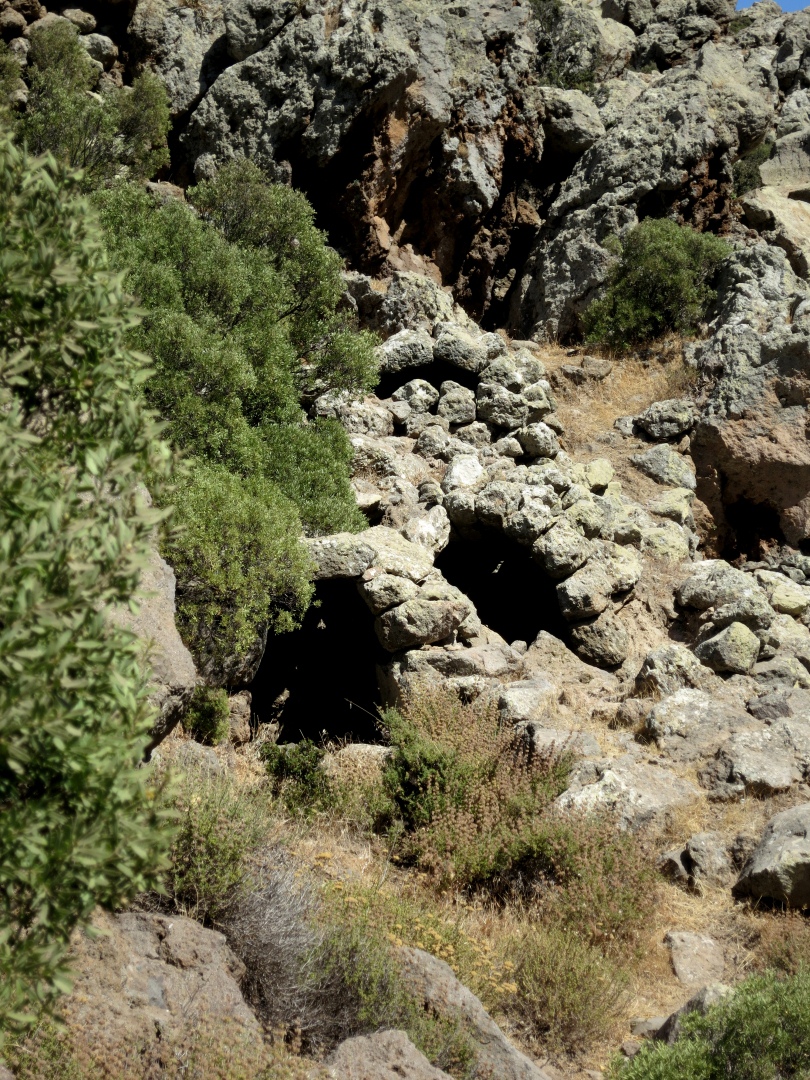
From then on the walking became pleasant and considerably easier.  I knew where I was heading and simply picked goat paths which took me in that general direction.  It was fascinating.  As I meandered down through and along terrace after terrace, passing dozens of abandoned single-room stone houses it struck me how many people must have lived here to maintain all this infrastructure and farm the terraced fields, all obviously worked entirely by hand. Some of the dwellings are thought to date back to Neolithic times, others to the first part of the 20th Century.  Closer to the coast there are tunnels or galleries cut into the rock to disguise them from pirates who roamed the seas round here.

Semi-detached stone-built houses. Restoration opportunity

Typical arch construction make the houses resistant to the earth tremors associated with the volcano

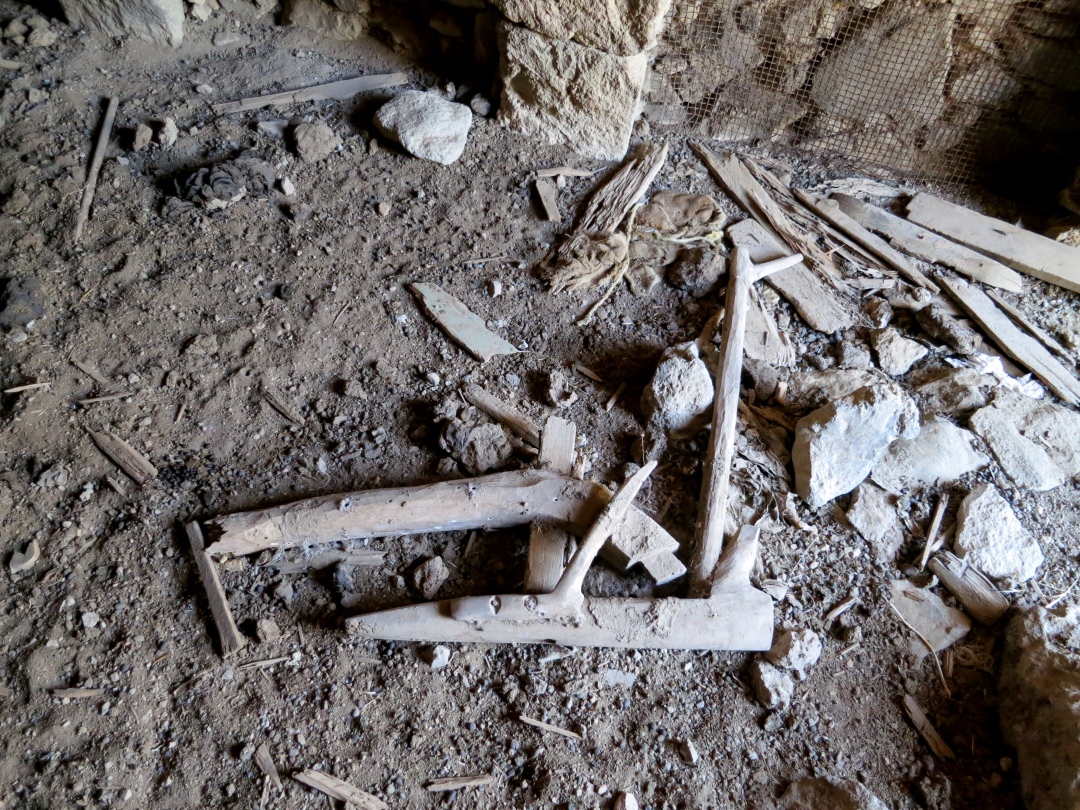
Inside one of the houses, wooden plough which would have been used on the fields outside

Threshing circle on the roof

Closer to the coast different volcanic rocks used in construction, lava outcrops on the mountains behind

Nisyros had the reputation of being at one time the richest agricultural island in this part of the Mediterranean and that would have been down to the richness of the volcanic soil.  Terraces stretch up to the tops of mountains, houses are built under the terraces to conserve the land for farming, threshing circles are built on rooftops.  The volcano supported a large agricultural population.  My guess is that there was a dramatic shift when the climate changed and there was nolonger enough water for the crops or the population.  The population would then have moved out in search of an easier life, or just plain survival.

The history of the area was fascinating but so too was the landscape.  Wherever possible much of the land has been formed into terraces for farming but everywhere there are huge, spectacular outcrops of lava on the jagged mountain and down into the sea.

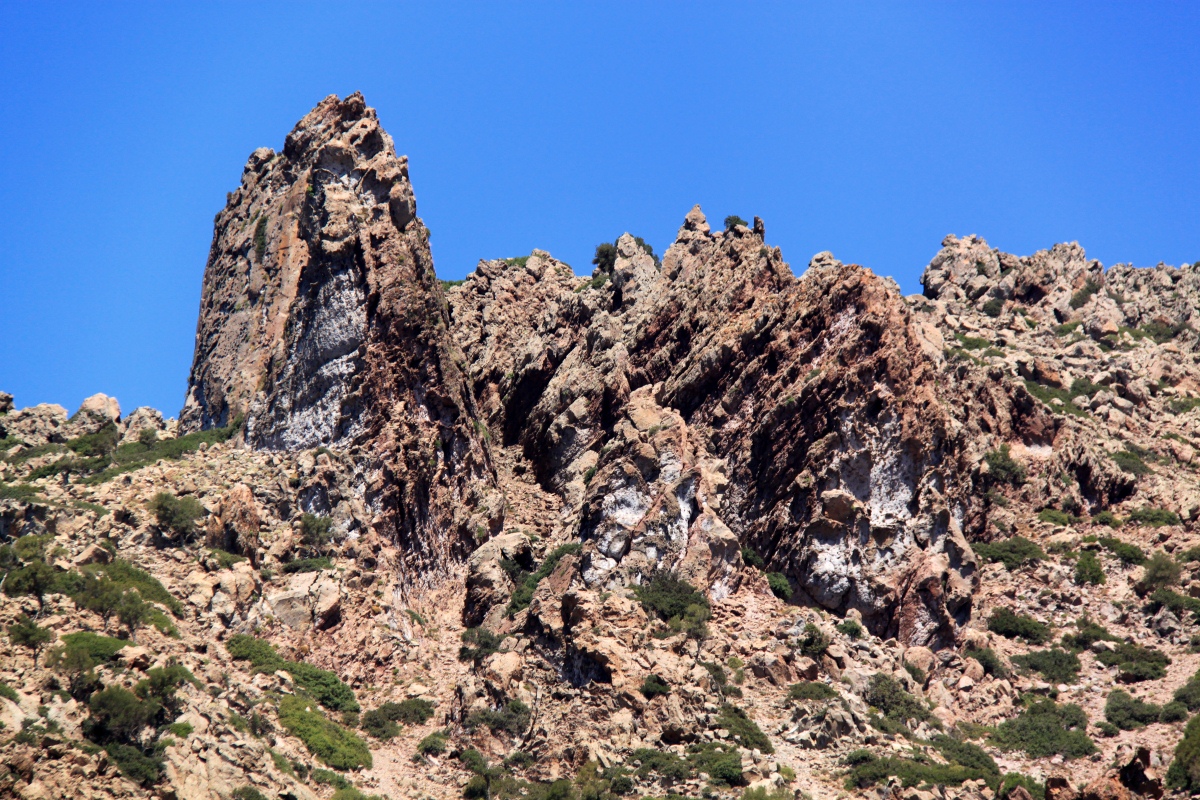
One of the lava outcrops high on the ridge

…. and another

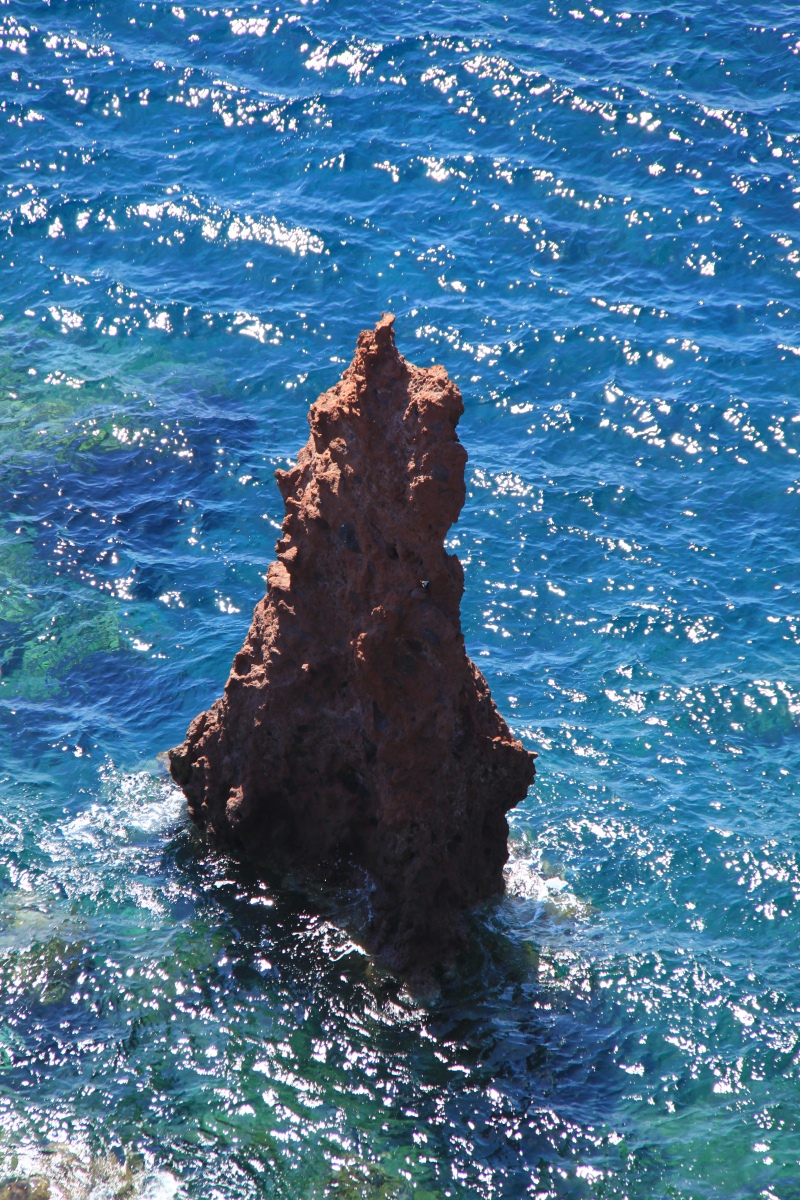
Lava outcrops in the sea

…. close up

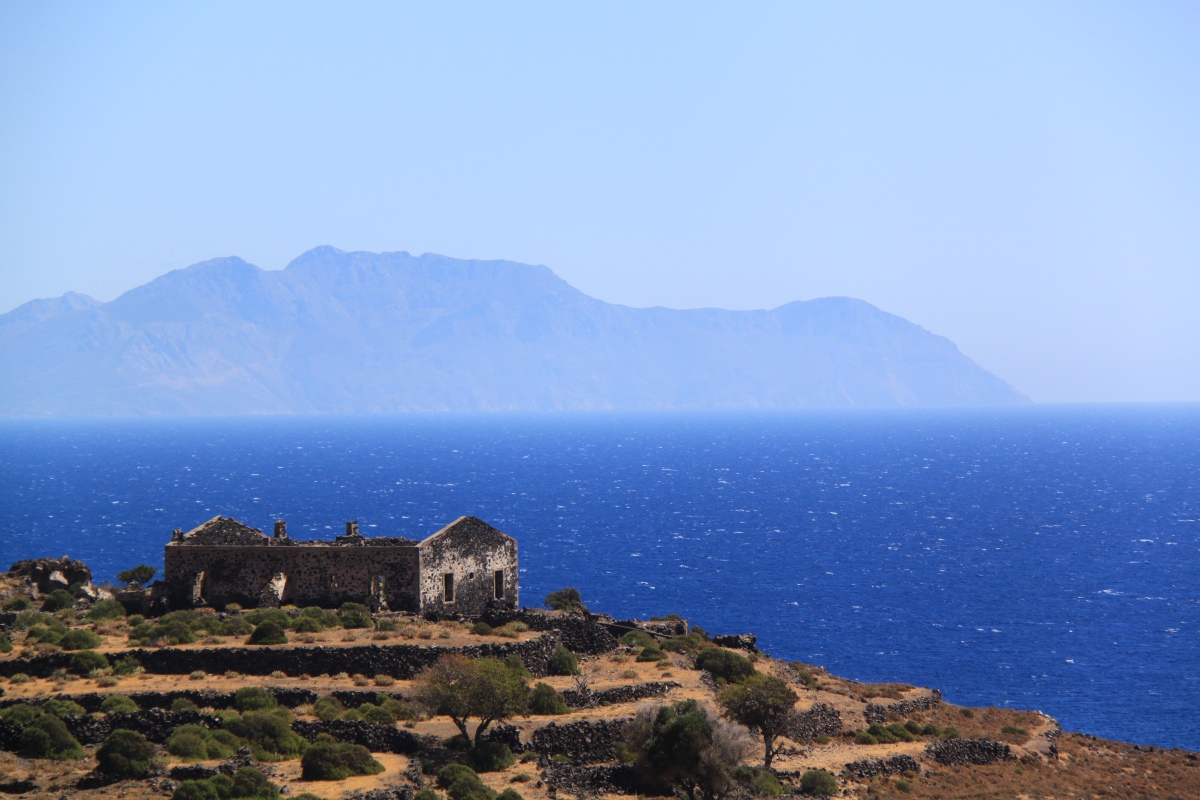
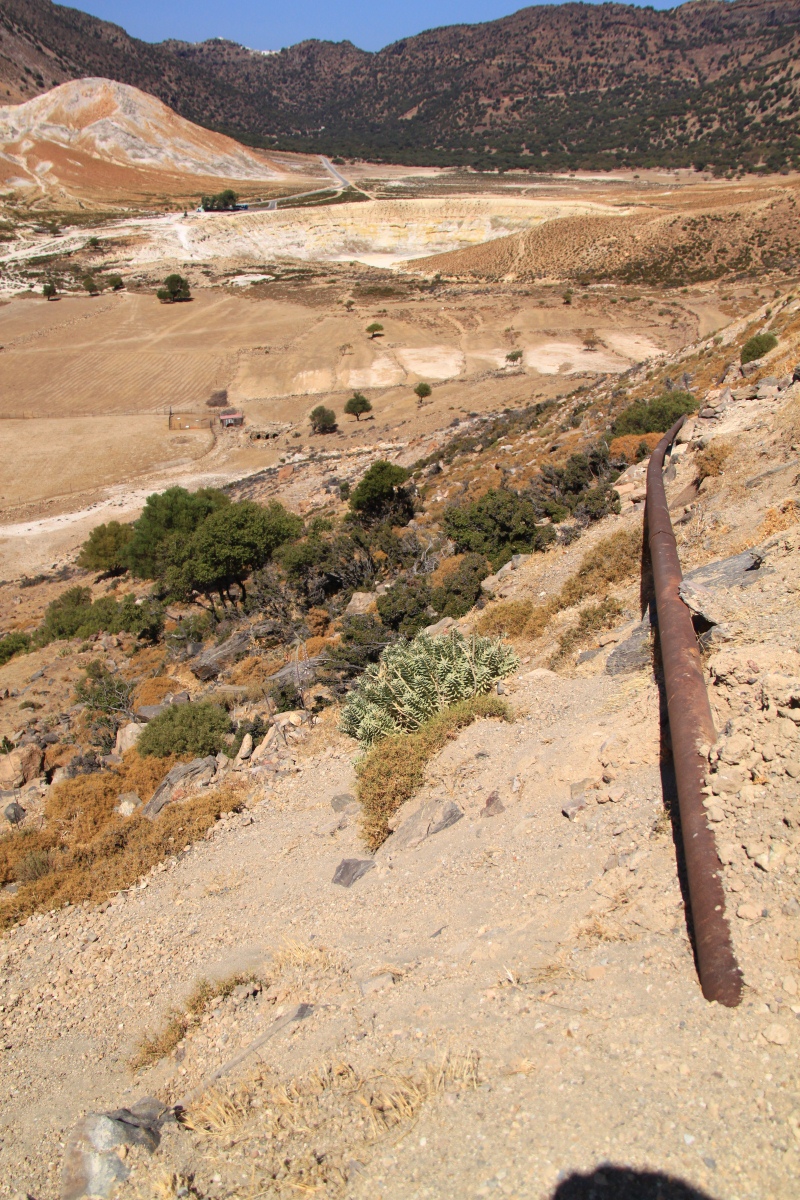
Approaching Agia Irini there is the reminder of yet another way in which people made a living from the volcano.  Perched on a headland looking out towards Tilos is the remains of a building which would once have housed some the workers in the sulphur exporting plant at the tiny harbour below.  Built in 1879 it piped sulphur out of the crater over the rime of the caldera and down to a small processing plant at Agia Irini.  It was then exported to other parts of the Mediterranean for treating vines to prevent disease.  It lasted in operation only 10 years but the remains are still there, stark reminders that industrial dereliction is found in attractive locations too.

Above Agia Irini

From the coast the rough track from Agia Irini crosses and recrosses the pipeline until it reaches the rim of the caldera and then drops down into it.

The sulphur pipeline climbs out of the caldera

I stopped for a frappé in the taverna at the edge of the crater with its coach park and bits of sulphur and obsidian on sale, and mused that most people think that the only way that money is made out a volcano is from tourism.

A long and tiring walk but good pay-back on the effort.

Posted in Greece | Tagged , , , , | Leave a comment

Nisyros: off the page and into the past.

Wednesday I decided to go off the page and into the past.  It kind of fitted the book which I’m reading, ‘The Eyre Affair’ by Jasper Fforde in which fiction and time are fluid and therefore changeable.

First off I went to the Paleocastro (meaning ‘Old Castle’ or ‘Fortress’) which is mind-bendingly massive and dates back to at least the 5th Century BC.  We first came to Nisyros in 2001 on a day trip on a hydrofoil from Tilos.  After a quick bus trip to ‘The  Volcano’ which blew our minds, rather than spend the remaining 3 hours looking around trinket shops before the ferry back, we chose instead to explore the winding , narrow streets of the town and, finding a footpath, decided to follow it because it went  ‘up’ (again that urge to get to the top of something).  It led to the Paleocastro and we couldn’t believe our eyes, the whole place was just massive.

It has been a ‘must visit’ ever since.  Normally the first thing we always did on arriving on Nisyros but this time I had decided to ‘save it for later’.  Wednesday was the day.  It was to be a trip into the past and the Paleocastro was en route.

I still take photos of it.  Always trying to capture the essence of it a little more.  A symptom of Repetitive Photo Syndrome stretching back more than a decade.  I nostalged and clicked away for nearly an hour before continuing on up into the mountains to the next destination, the ancient monastery of Siones.

Main entrance to the Paleocastro. Each stone block is about 1 metre high

Showing the thickness of the walls and the town stretched out below

The only map I know which shows the location of Siones, or the way to it, is the diagrammatic but latitude/longitude referenced map prepared by a German couple,  and made available free of charge both on the island and on the internet.

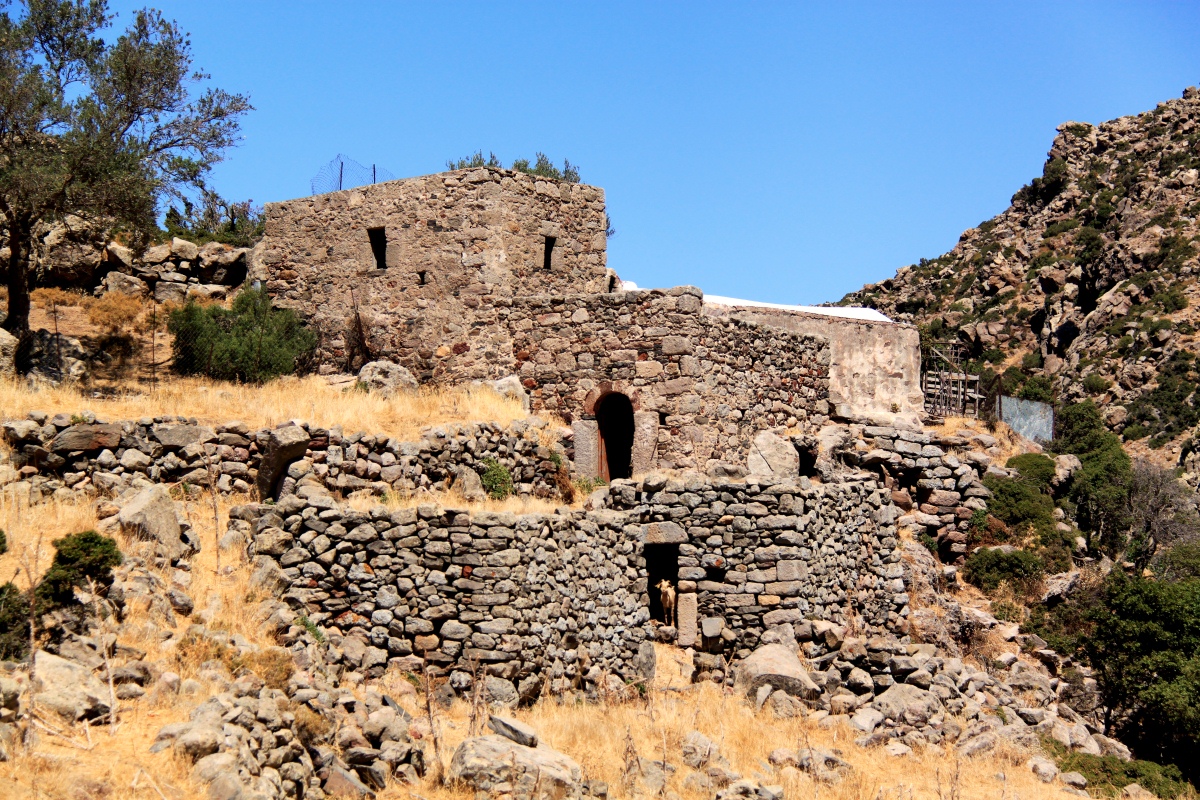
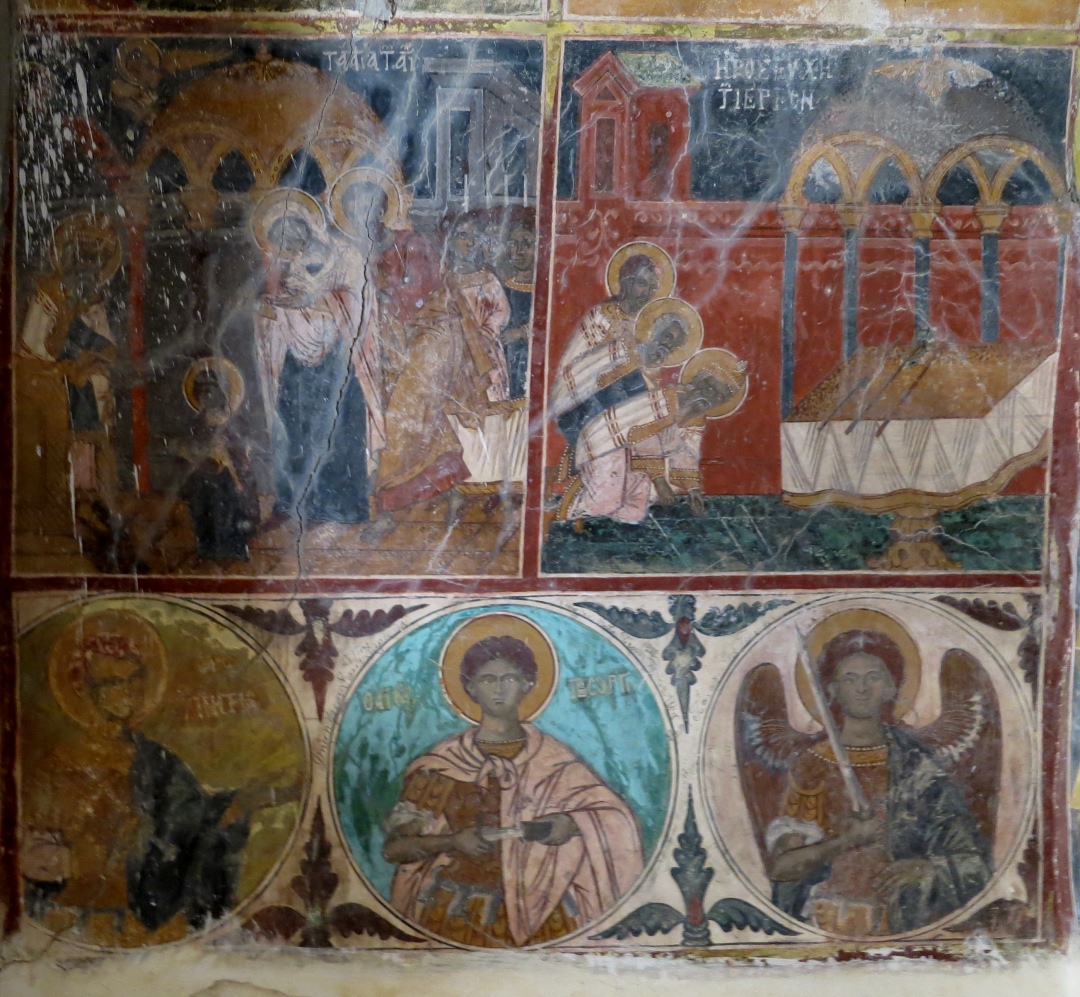
Like the Paleocastro, visiting Siones is like being in a time warp.  It a small complex of tightly enclosed buildings clustered around a tiny multi-level courtyard or ‘Avli’.  The earliest construction was obviously built onto a cave before it was added to and fortified.   I don’t know how old it is but the frescoes in the church are said to have been renovated in 1733.   The last couple of years the church has been in a very sorry state of repair with significant water damage from a cracked and leaking roof and evidence of rats having taken up residence.  Very pleased to see that the roof has been repaired and the detritus and rat mess cleared from the inside.  The frescoes are damaged but with the repaired roof hopefull will not experience further deterioration.

Approaching Siones

The inside of the church

Part of the frescoes

Inside on e of the dwellings: note the IKEA style storage unit next to the fireplace

The ‘avli’

… and looking the other way

The map also shows a route between Siones and Evangelistra but indicates that there is no path.  Too right!  There are ancient agricultural routeways which have fallen into disrepair and in many places are blocked by aggressive vegetation.  BUT there is no path.  It’s a great walk.  Climbing up and then dropping down through ancient stone-built terraces the world outside is another planet, another time.

The route goes through two ‘valleys’, neither of which is a valley but really old caldera/craters which are nolonger active.  Initially the route picks a way climbing up to the end of the caldera which Siones sits in and then drops down steeply and dramatically into another, larger one.  Between the two is a clear ‘watershed’, except it isn’t water cut, it’s the boundary between the two craters and the rim is marked by a stone wall dividing the ancient agricultural terraces on each side. I couldn’t help but wonder how many people these terraces were home to when they were farmed.

The only indication that either caldera has been visited in modern times are metal signs saying ‘Hunting is Forbidden’ (in Greek of course), the bullet holes in the signs, and the shotgun cartridges scattered about.  The only way in or out is on foot and that is becoming increasingly difficult despite faded blue spots which someone put to trace a route.  I think I might buy a pair of secateurs and revisit just to make life a little easier for time travellers..

Standing at the high point between the two calderas looking down through the steep terraces

Part of one of the ancient pathways through the terraces with huge rock on the left

Photographer on top of a rock looking towards the end of the caldera

The lowest part of the caldera floor with the steep climb out through the terraces at the end

The map of Nisyros showing Siones and the route to it and onward to Evangelistra:  http://www.bjfranke.privat.t-online.de/nisyros/map/wk-e.htm

Just a little local colour

Posted in Greece | Tagged , , , , , , , | Leave a comment

Nisyros: looking down on the world.

Information on the history of mountaineering is easier to pin down than the motivations behind it.  The term ‘mountaineering’ implies a motivation of climbing mountains purely for the sake of getting to the top rather than for religious or practical reasons (look-out towers, TeleCom masts).  According to Wikipedia the Emperor Hadrian climbed the 3,350 metre Mt Etna in order to see the sun rise in 121 AD.  If true, that’s impressive even if he didn’t do it before breakfast.

http://en.wikipedia.org/wiki/Mountaineering#History

It seems that many have climbed mountains throughout history but mostly for practical or religious reasons.  ‘Mountaineering’, climbing a mountain simply for the sake of getting to the top, seems to seems to stem from Northern Europe (which I take to include the Italian Alpine region). Historically in Greece, and I think Mediterranean countries generally, the attitude towards climbing to the top of something purely for the fun of it is “Why?”

Initially in the early days of mountaineering, 19th Century onwards, it was only those from an upper class background, i.e. those who didn’t have to work for  a living, who could indulge fantasies to relieve the tedium of life.  However by the second part of the 20th Century the urge to climb mountains had spread to the middle and, thankfully for me, even the working classes.  This was due in large part in the UK to the National Parks and Access to the Countryside Act of 1949.

When I came discovered the mountains of the Peak District in  the 1950’s it was becoming ingrained in a whole cross section of society.  Sherpa Tensing and Edmund Hillary got to the top of Everest in May 1953 ……….. and lived to tell the tale.  Before that Mallory and Irvine’s attempt had been seen as heroic failure though it’s now thought that they reached the top but perished on the way down. Suddenly, getting to the top ‘because it’s there’ became common parlance and a widespread ambition.

It’s certainly ingrained in me.  I have climbed to the top of the highest and many other mountains in Wales, England and Ireland and most Greek islands I have visited.  It’s a compulsion, a drive, something that nags away at me until I’ve done it.

Nisyros is no exception.  I have savoured the anticipation of the pleasure of climbing Oros Diavatis until today (Tuesday).  Sometimes I’m ambivalent about which walk I will do.  Something familiar? Something new?  Occasionally I only decide when I go out of the door.  But Tuesday was the day to go up Oros Diavatis. At just short of 700 metres it’s not a huge mountain but it’s straight up from sea level and is a sustained uphill climb all the way to the top.

On top is a small church dedicated, as is so often the case in Greece, to the prophet Elijah and because of that there is a path all the way up.  Much of it is stone paved but the final section to the top is very loose.  It’s another of the Greek Island Walks I’ve written up:

http://www.aartworld.com/Walks/Nisyros/Nisyros%20walk%20option%202.pdf

It was a great day for it.  Cloudless sky (isn’t every day!) with a good breeze to take the hammer out of the sun.  From the hotel in Mandraki to the top in 1 hour 45 minutes, including buying bananas on the way.

I clambered around all over the top part of the mountain for about 2 hours in order to get better views from subsidiary peaks and had a thoroughly enjoyable time.  The views are stunning.  Down into the caldera of which the mountain is the highest part of the rim; across to the village of Nikia on the other side and beyond that to the island of Tilos; northwards across the pumice island of Yiali to Kos and if the visibility is good to Kalymnos beyond.  Within Nisyros there are views east to the caldera rim village of  Emborios and the lava bubbles I walked past a few days ago and almost vertically straight down to the ancient settlement of Nifios.

As I find so often on mountain tops everywhere, having spent the energy getting up there it seemed a shame to go down again.  But go down I had to …. and then a swim in the sea.  There is great satisfaction swimming on your back in the sea and looking up to the top of the mountain and thinking  “I was just up there”, smug in the knowledge that no-one else splashing around you had been.

At the bottom of the path to the top: I suppose the same two questions: How? and Why?

It has certainly been there at least 10 years

… and so to the top of the mountain, a place full pf nostalgia for me.

Looking eastwards, red boxed areas in the next 3 photos

Zooming in on the ancient settlement of Nifios

Zooming in on the crater-rim village of Emborios

Zooming in on the lava cliff with the bubbles ….

…. and enlarging the bubbles. Remember the photos from the footpath and the neck-bending scale. Puts it in context.

Looking down to the craters. Last year I climbed this gully to the top.

Zooming in on a section of the caldera with the seismic fissure ….

…. and enlarging it.

On the way back down, the Diavatis monastery perched on the edge

Simple. Tranquil


Posted in Greece | Tagged , , , , , , , | Leave a comment

Nisyros: rock hopping along the coast

I can’t remember how many times I’ve seen the Disney film ‘The Jungle Book’.  I saw it 5 times in cinemas before I could use having children, and now grandchildren, as an excuse for watching it on video.  I can close my eyes and see Balu spinning the fruit of a prickly pear cactus and warning Mowgli to ”use the claw”.

This is prickly pear fruit season on Nisyros and tree-sized cacti are loaded down with bright red, ripe fruit. So at the finish of the walk back from the crater on Sunday I decided to pick one which was overhanging the path at head height.  I grow them in the Blue House at home and know the spines are a nightmare to extract.  Therefore, being a clever sort of a guy, I used my Swiss Army Knife to scrape off the spines before attempting to touch it.  Unfortunately, NOT being such a  clever sort of a guy, I didn’t put on my reading glasses so couldn’t see how well I had cleared them of spines.  You very definitely need reading glasses to deal with prickly pear fruit.

I spent an hour on Sunday evening trying to get the spines out of my hands with a tweezers.  One problem was that I couldn’t tell the difference between the sun-bleached hairs on the back of my hand and the cactus spines.  Painful! Monday morning and every time the fingers on my left hand touched each other I could feel the discomfort of prickly pear stubble and touching anything unyielding with the ends of my fingers was painful.  Monday evening was little different.

That, however, had nothing to do with my decision to forego the mountains on Monday and walk along the coast.  I have been up in the mountains for the last week and thought that it was time to prove that this is an island …. with a coast and not just a hole in the middle.

It wasn’t a cliff path walk, there is no such thing as a cliff path here.  Not a beach-walk because only the first short distance is ‘beach’.  More long-distance rock-hopping or maybe more accurately, ‘boulder-hopping’.

I hopped along the coast about 3-4 kilometres and then back but it took about 5 hours.  Partly that was because of the need to be careful.  There had been a great deal of ‘cliff-fall’ since last year and the massive rocks hadn’t been ground around by winter storms to make them stable.  Even boulders the size of a table could be delicately balanced and teeter alarmingly, potentially disastrously,  as you hopped onto them.

But the slow progress was more to do with the fact that I kept stopping to look at and photograph rocks and views.  The waves along this bit of coast are usually pretty large and on Monday the breaking waves were very dramatic.  Between the two things progress was very slow.

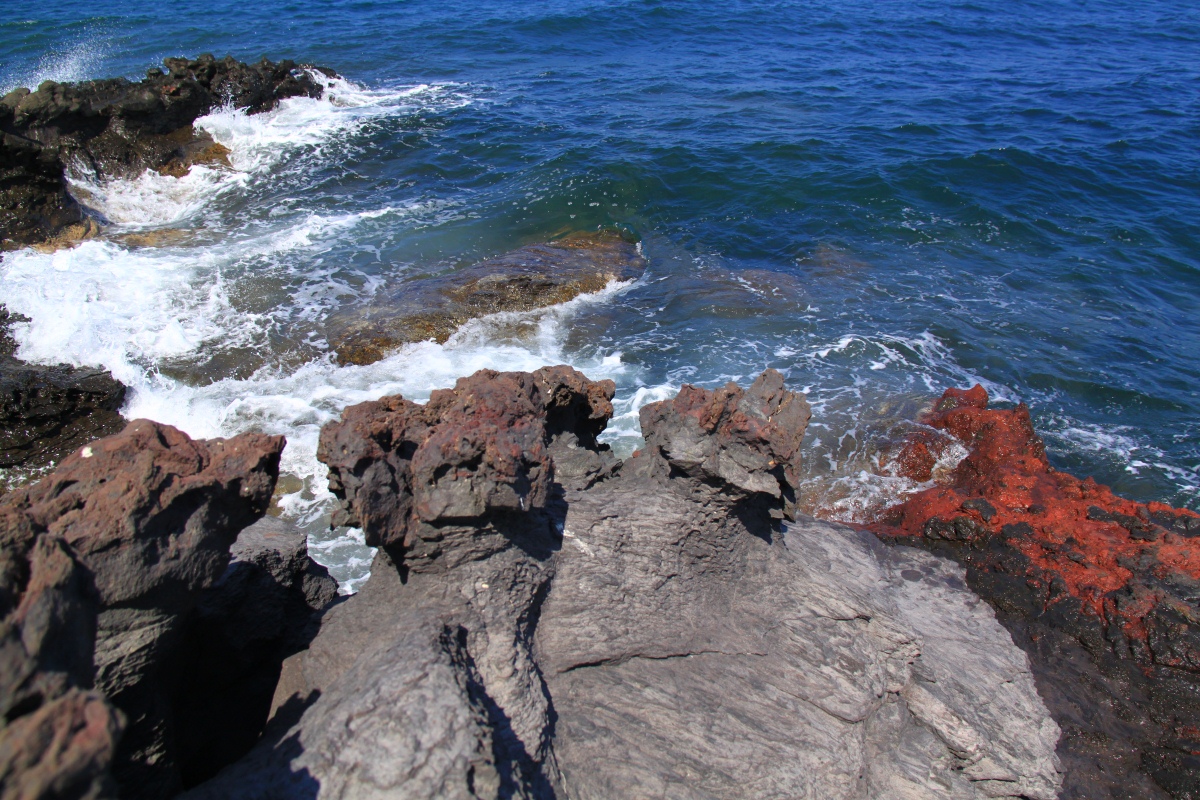
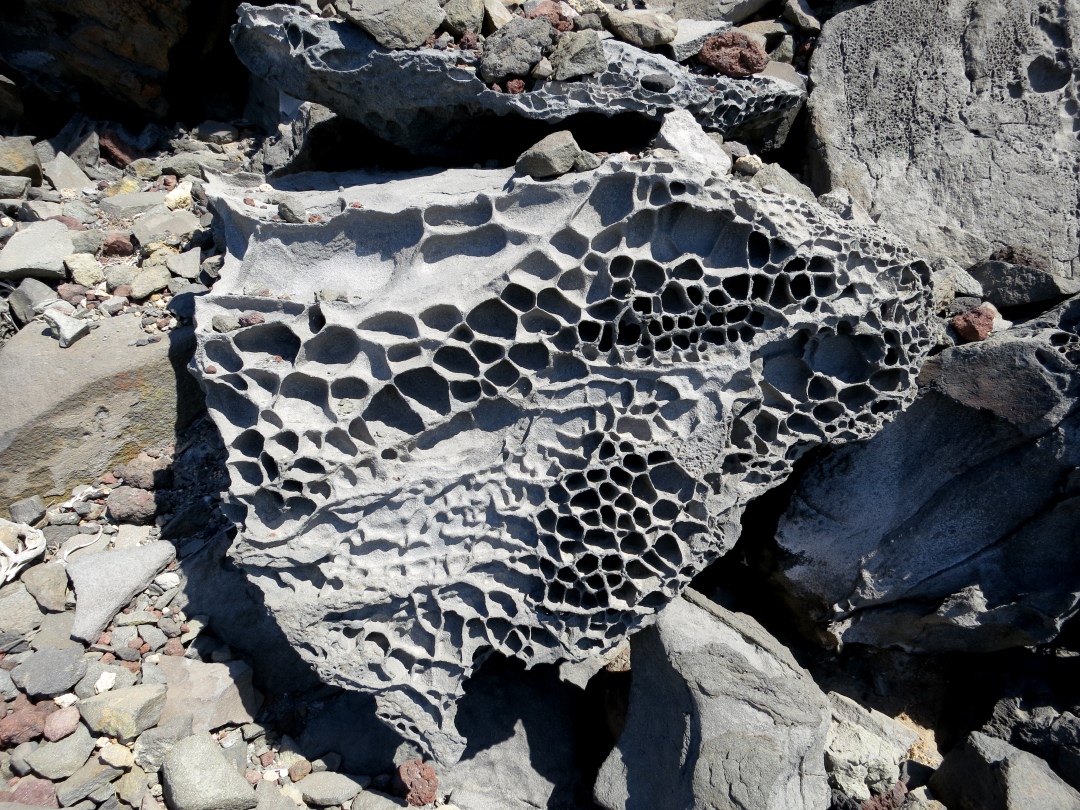
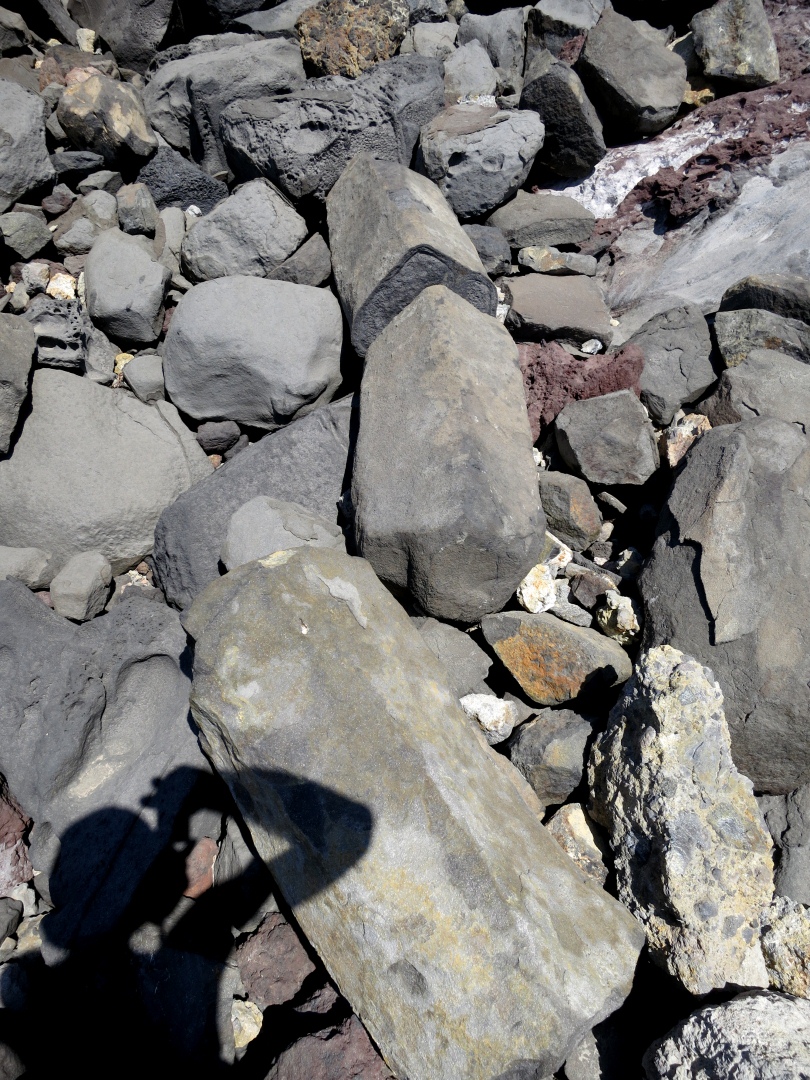
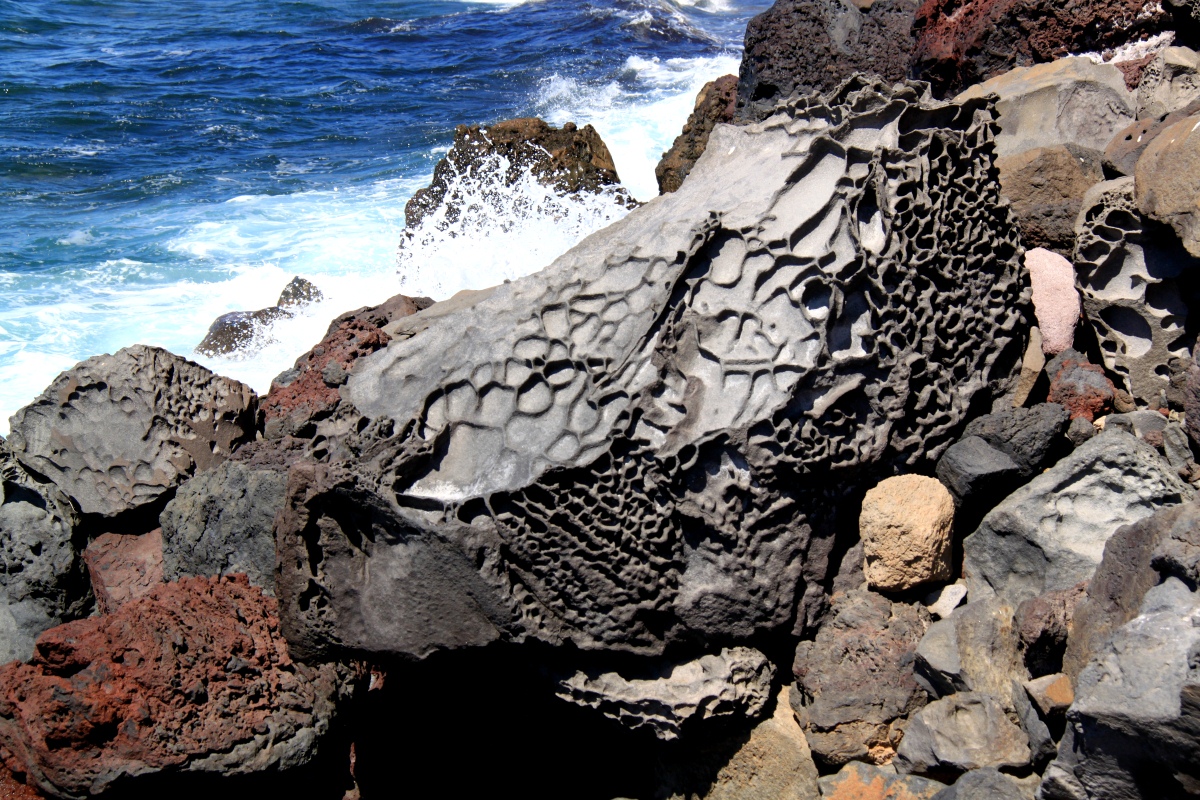
The rocks were obviously all volcanic.  Rocks/stones/pebble/sand on the foreshore and beaches here are all ‘locally sourced’, there is no major movement of eroded materials along the cost as there is in the UK.  Though all volcanic, the variety of rocks was amazing: black, grey, red, purple, brown, sulphur-yellow, white.  Lava which was intricately honey-combed or extremely gnarly; igneous rocks which were smooth and square; some were in long columns as if carved by a master stone mason.  All had come tumbling out of the cliffs, some as big as a shed.  They were so distracting that it was difficult to focus on staying safe.  But I did.

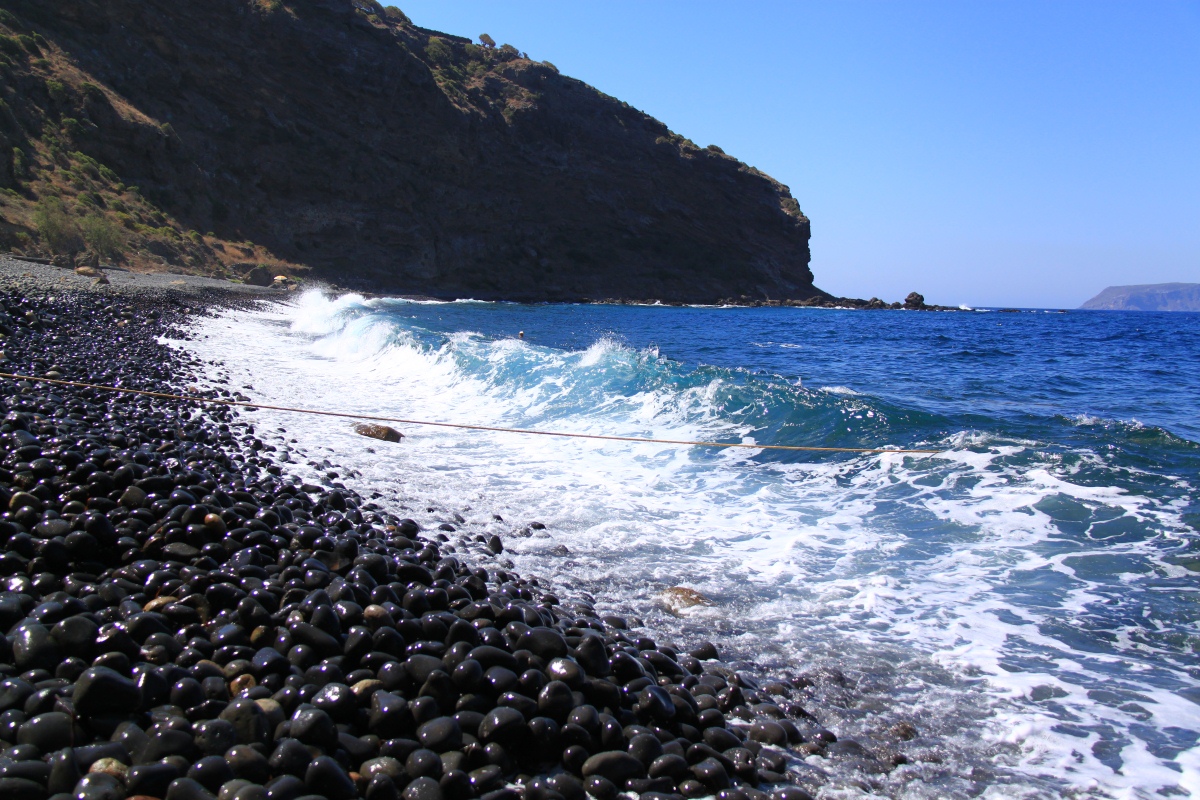
Looking across Hochlakos beach at the start of the walk. The rope across the foreground is so that people can pull themselves out and float above the thermal hot spring which emerges here.

A huge finger of rock conveniently points to the only place where the cliff can be scaled

This is the nature of the foreshore I hopped along

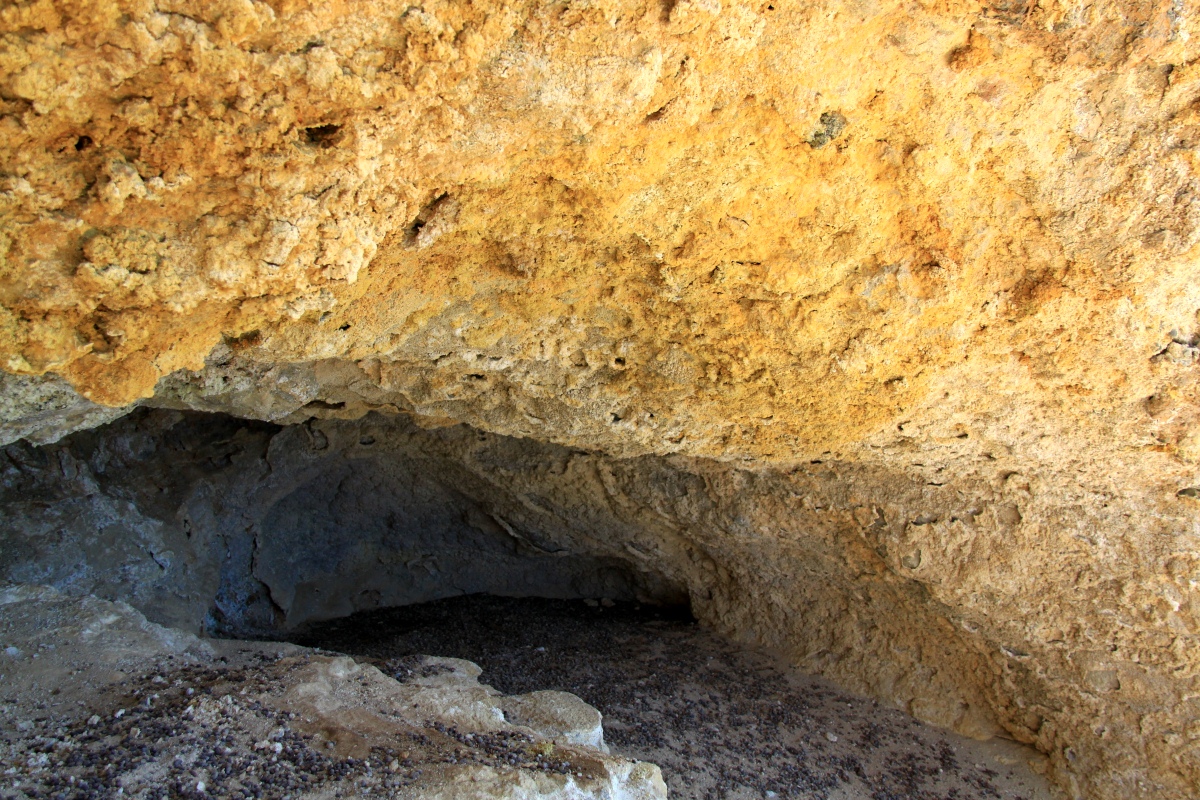
A small cave above the headland which was my target

The ‘ceiling’ of the cave is encrusted in sulphur

…. close up

Even the flowers outside the cave were sulphur-yellow

And so to the rocks. Dramatic colour variations everywhere.

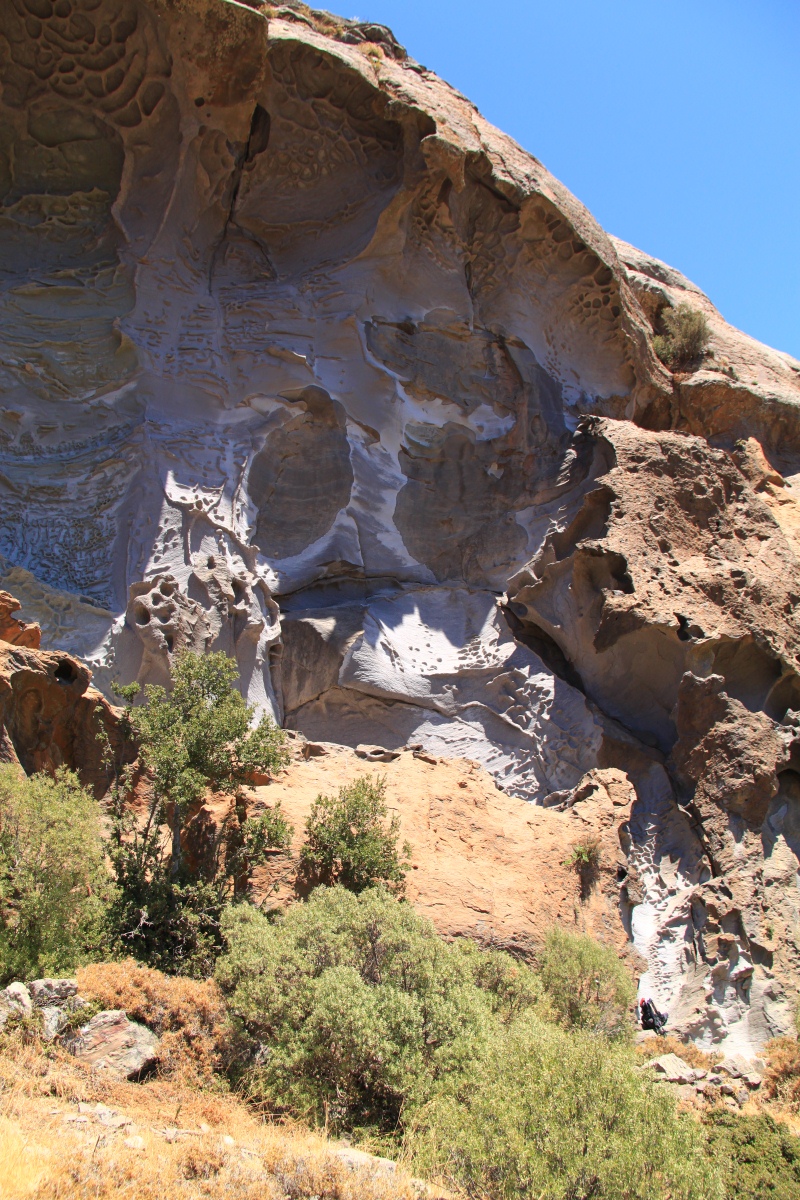
Blocks of honeycombed lava

Stretched like molten toffee

… in fact all kinds of contorted shapes

…. and colours

Columns as if cut by a stone mason

Just to prove that this is all next to the sea and not in the crater

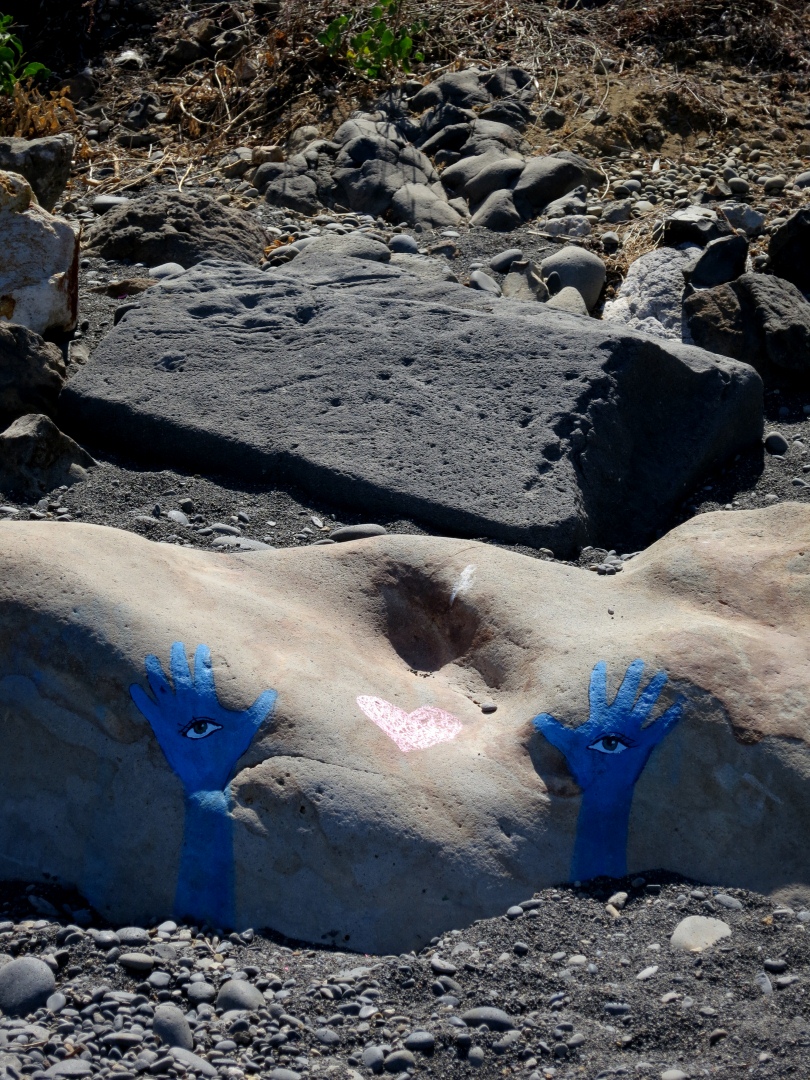
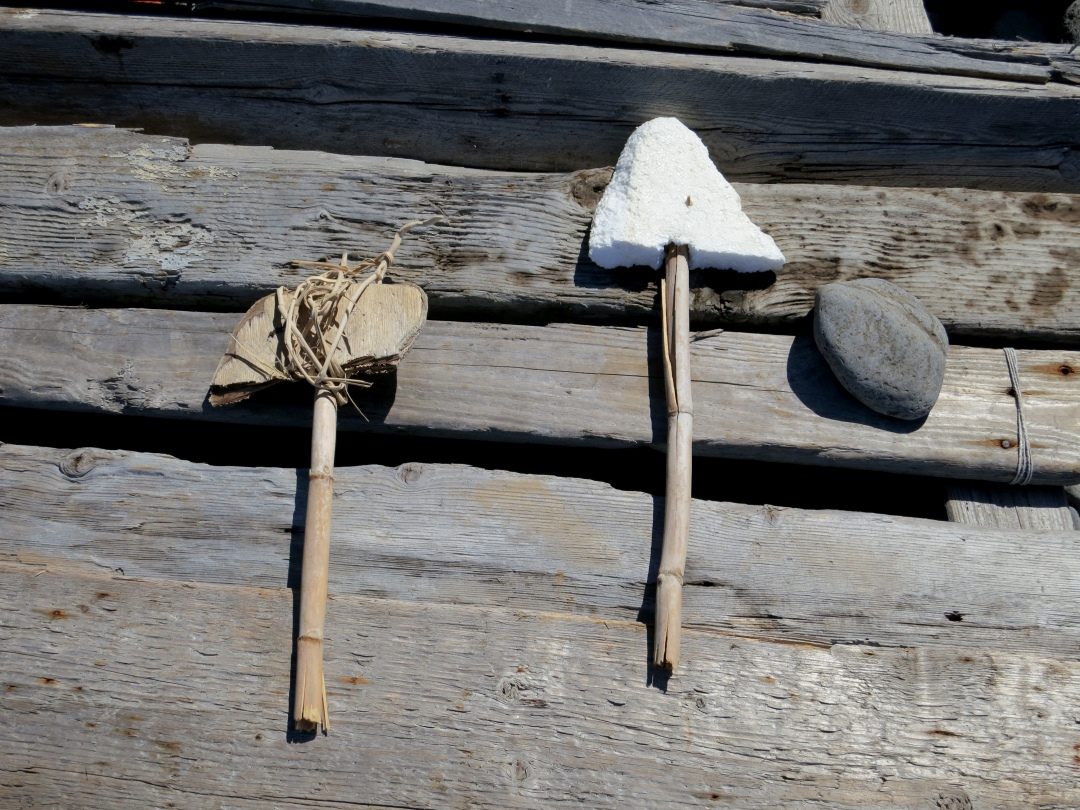
Great to see art and a sense of humour

… and again

Looking across Hochlakos beach at the end of the walk. Monastery and castle on the headland


Posted in Greece | Tagged , , , , | Leave a comment

Nisyros: seismic!

Sunday was the last day with the bus service at useable times for walking.  Schools start back on Monday and the buses revert to 07.00 and 14.15.  An 07.00 start may be good to avoid walking in the heat of the day but it means I miss breakfast in the hotel which is from 07.30.  More importantly it means I hit the brick wall of my metabolism.  I can  be ‘up and doing’ at that time, if necessary, and in fact I used to be in the office every work day at 07.00.   It’s just that my body doesn’t kick into gear for physical exercise  that early in the morning.  I used to go running regularly when I was in college and once decided to run before breakfast.  I was so ill that I decided never to attempt it again.

I caught the 11.00 bus to Nikia at the furthest side of the caldera rim with a plan to explore a couple of the smaller craters on that side of the caldera and try to plot the extent of the seismic fissure which opened up in 2003 before walking back via the col.

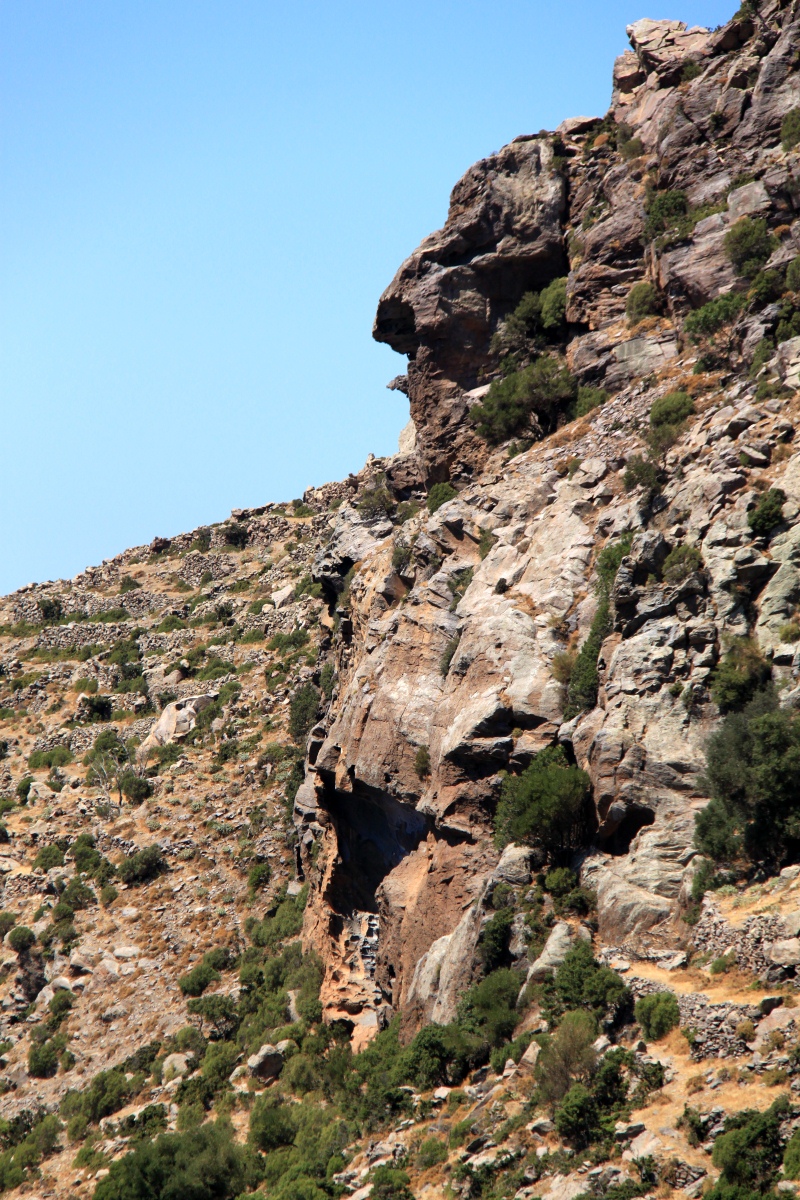
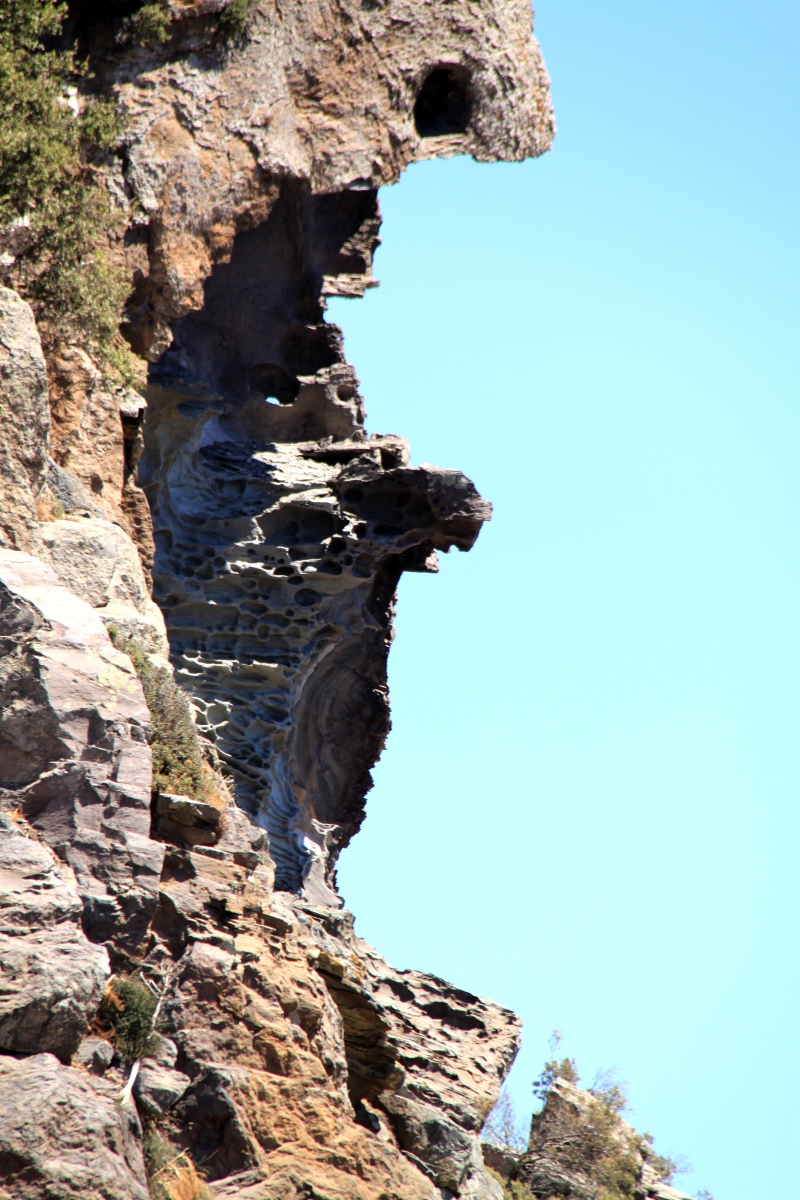
The start of the path from Nikia down to the caldera is looked over by another of those giant lava pinnacles resembling some prehistoric monster

Looking from part way down the path to the Parletia lava pinnacles with it’s castle remains

…. and looking towards the crater

The direct path down to the caldera is one of the best I know anywhere.  It is clear, in places very well paved with stone, and with dramatic views the whole way down.  It’s Walk 3 on Nisyros on my Greek Island Walks website:

http://www.aartworld.com/Walks/Nisyros/Nisyros%20walk%203.pdf
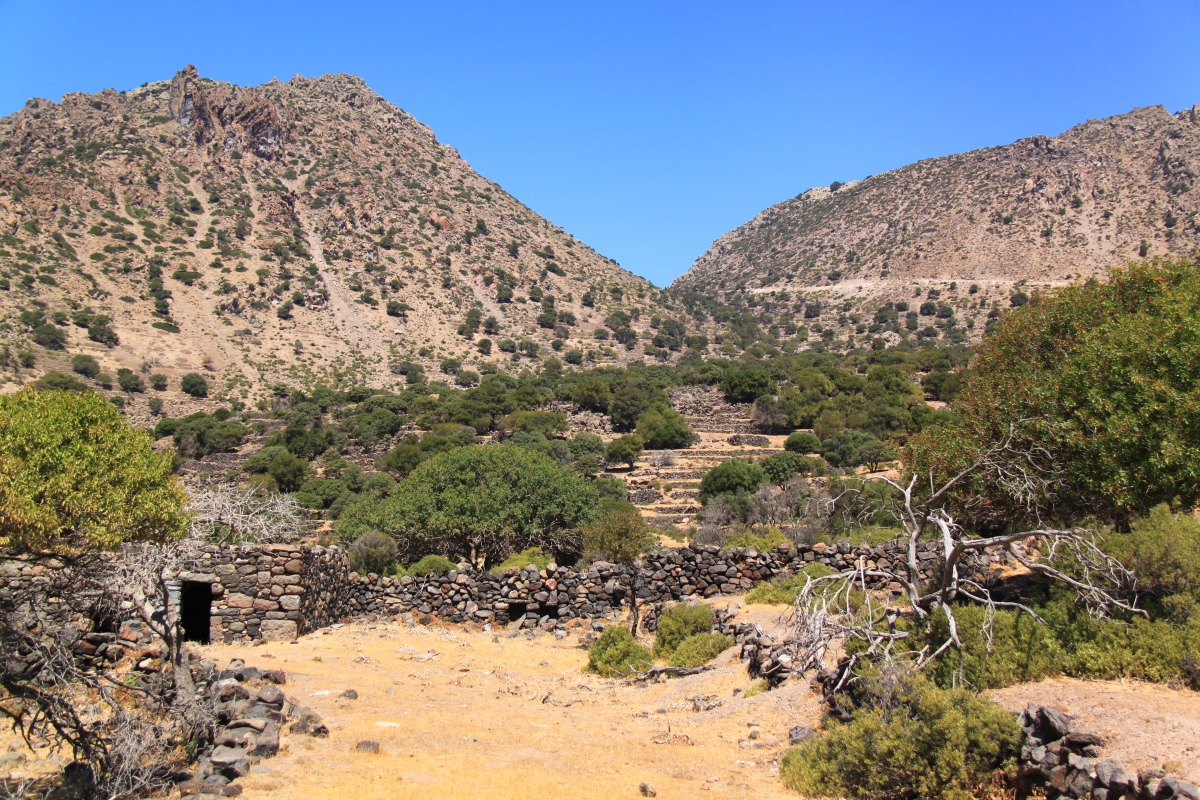
Towards the bottom it passes alongside small craters and on Sunday as is often the case there was a strong smell of sulphur gas as you approach.  The craters are small and not as dramatic as Stephanos or Polyvotis but are none the less very interesting. And still seismically active albeit on a ’ticking over’ scale.  One of them is in a small valley with a dry waterfall feeding into it and massive stone-built terrace walls to create farmable land.  Sulphur encrusts the rock and the smell of the gas is very strong. So an hour or so mooching around with the camera was all I could manage.
Sulphur encrusted cliff

….. and another

Looking up the small crater to the huge stone retaining wall topped by farmland

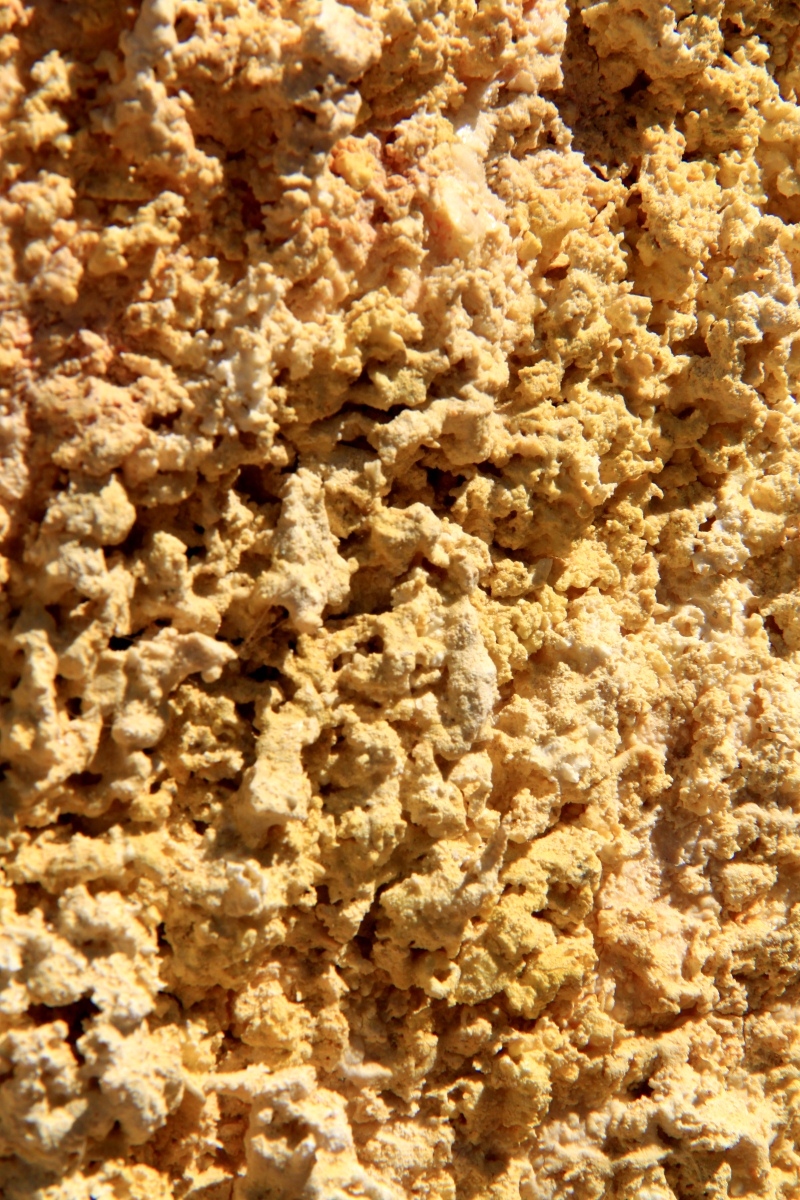
Close-up of sulphur encrustation

No! It’s not popcorn.

Then I perched on a rock in the shade of a tree to eat my banana and nutbar before setting out across the caldera floor in search of the seismic fissure.

Two key landmarks for navigating across the caldera, abandoned church and Parletia pinnacles

“I don’t care what you say, I’m not sticking around until Christmas!”

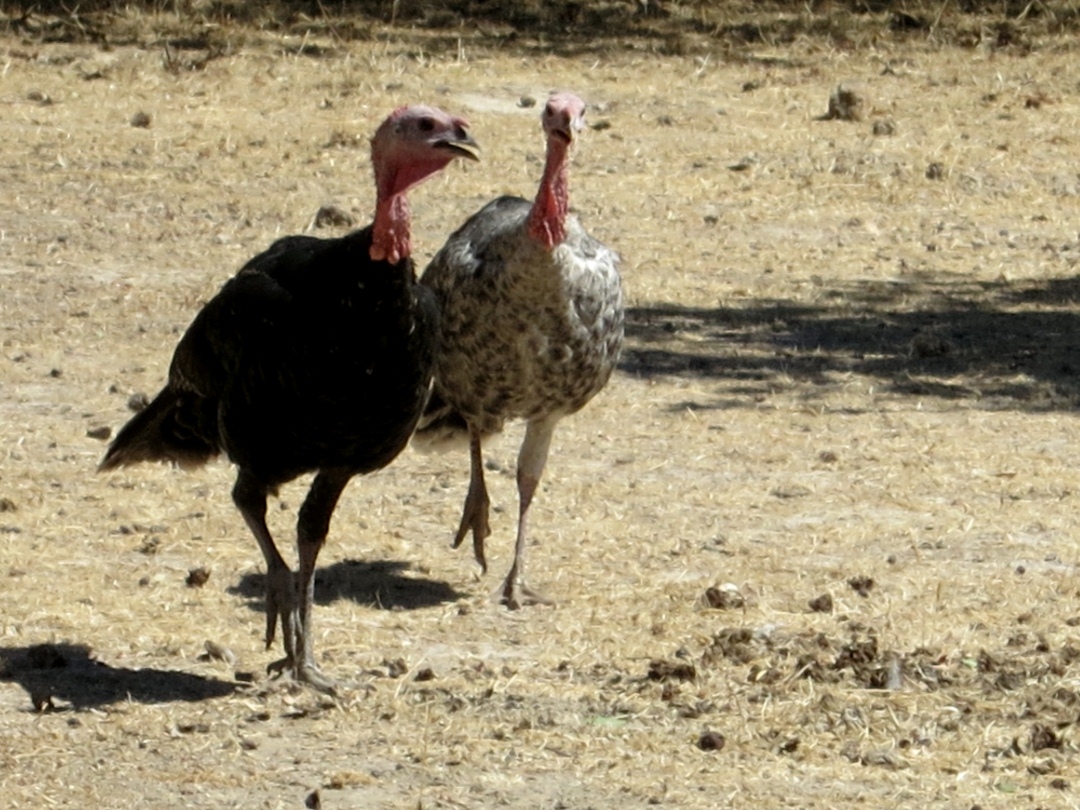
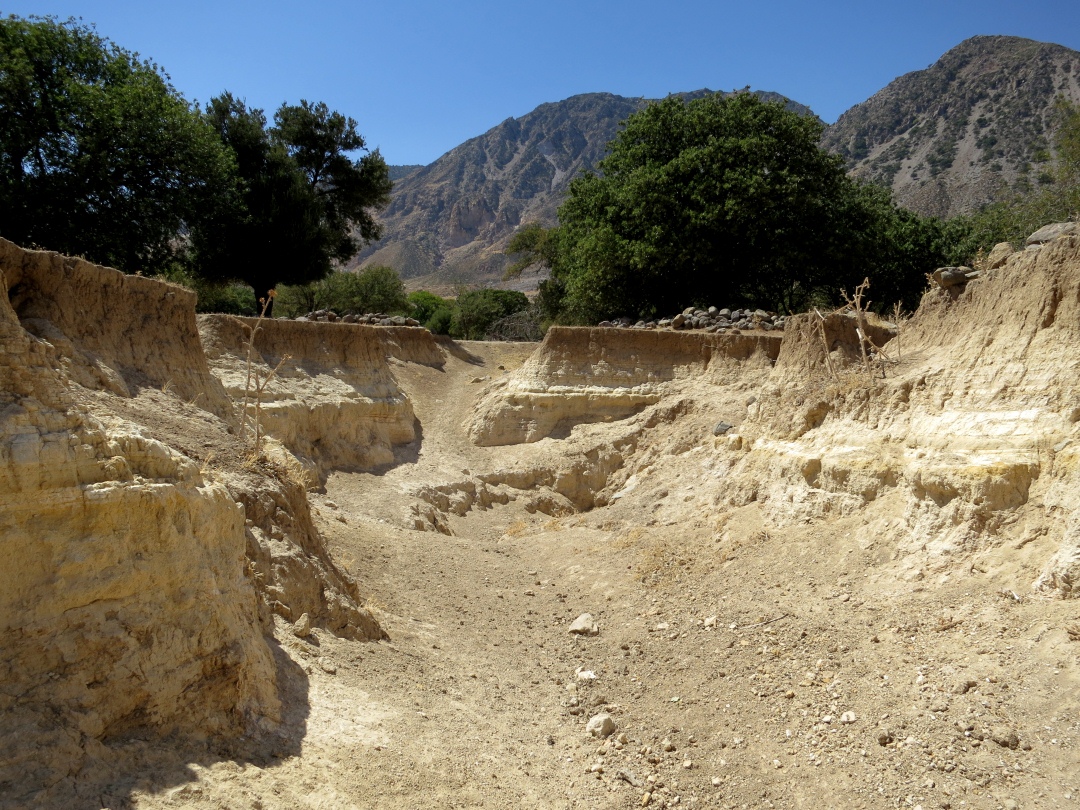
I found it part way along its length and so backtracked to find where it began but soon discovered that it was far more extensive and bigger than I had thought.  It’s not continuous or consistent but it must be at least 2 kilometres long, varying in depth from a 30 cms or so to about 5 metres and varying in width up to 10 metres.  Nor is it a single fissure.  In places it’s like a series of interconnected small canyons.  It’s so extensive that animals, including free-ranging goats, cows, pigs and turkeys have established crossing points.

I soon realised that any hope I had entertained of plotting it on a map was just too big a task for mid-walk.  So I stuck to taking photos and determined to check it out on Google Earth ….. if the resolution for Nisyros allows.

Inside one of the fissures: note the sulphur horizon in the soil

Inside another

Though enthused by the sheer magnitude of  the fissure I couldn’t help but be a bit disappointed that I hadn’t been able to mark it on a map.

Next stopping point was the abandoned ancient settlement at the top of the col between the Lakki and Kato Lakki calderas.  It’s a great place to reach and take a break in the breeze from the heat of the long climb up.  Hidden away in the rocks are a number of very old arch-construction houses.  One I particularly like is built into the rocks with 3 interconnecting rooms the rearmost of which is a small church still with its altar and a fragment of marble carving.  I’m amazed that that hasn’t been looted for someone’s garden decoration so I’ll keep its location a secret.

Dwellings built into the rocks

The rearmost of which is a small church

The altar

Then back down to Mandraki and a swim.

Posted in Greece | Tagged , , , , | 1 Comment

Nisyros: buses, bubbles and toe holds.

The public bus service on Nisyros isn’t what it used to be.  When we first stayed on the island in 2001 and for a few years after that there were 5 buses a day to the crater-rim villages and it was a free service.  Last year and this there are only two buses a day.  At the moment they leave the harbour at 11.00 and either 14.15 (weekdays) or 15.15 (weekends) and there is a charge of €2 or €3 depending on destination.  A few days ago there was near riot on the bus as one of the locals objected to paying anything for the service.   The Greeks are very passionate about some things and this was evidently one.  The argument seemed to run “why should I pay anything” as against “if we don’t pay we lose the service”.  I guess this is one effect of the austerity measures reaching out to the furthest corners of Greece.

The reason I mention the bus service now is that it is due to change anyday soon so I decided to take advantage of it while it is still running at reasonable hours and go back up to Emborios in order to have plenty of time to mooch around the mountain in the vicinity of the lava bubble.  I was nearly thwarted as the bus broke down before it left the harbour and the driver had to set-to and effect a Heath-Robinson repair to a water-hose with tape and jubilee clips.  A very smartly dressed lady onlooker getting  a little too close to see what was going on was roped in to hold her finger on the offending pipe while the driver ran off to find an appropriate sized clip.  I think she might have been Dutch so knew what to do.

Fairplay to the driver, and his assistant, he got it sorted and we left only 5 minutes late.  In the UK we would have sat there while the repair team were sent for.

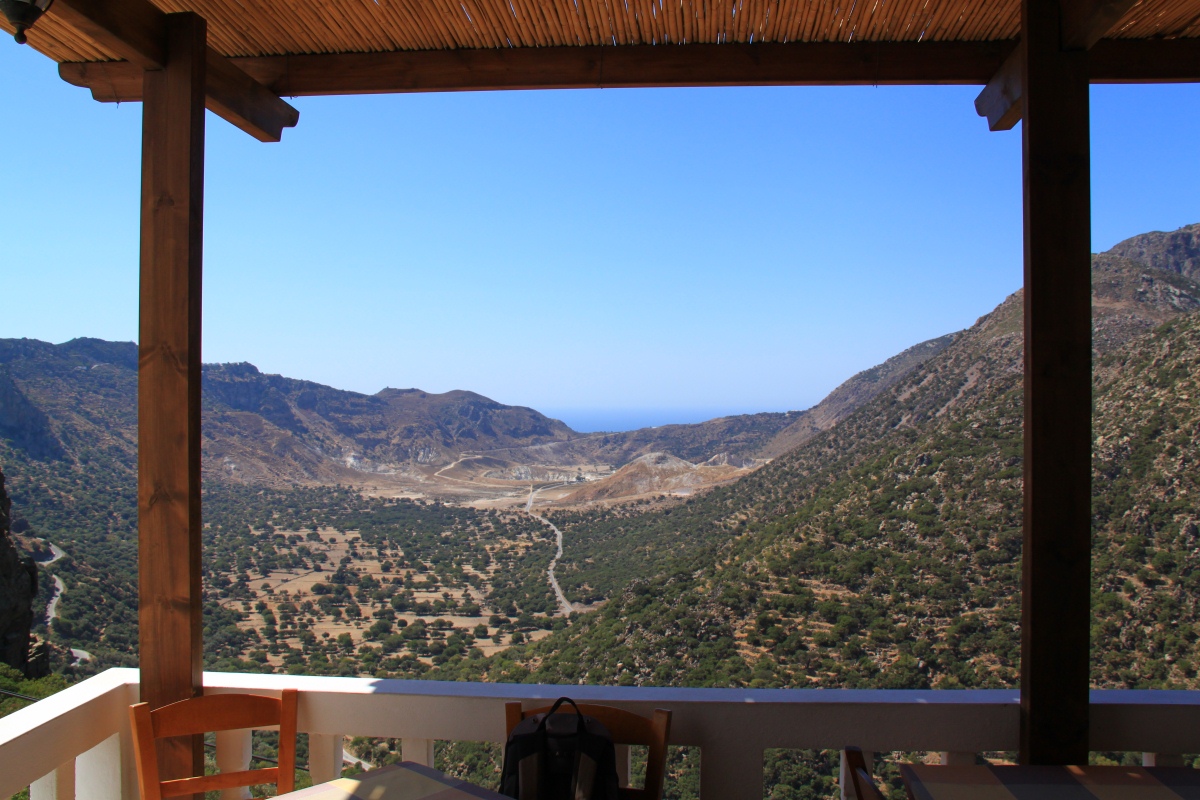
After the drama, as soon as we reached Emborios I headed for the Balcony Taverna for a frappé.  I think it’s the most dramatic location for a drink I have been.

The Balcony Taverna and its great view into the caldera

Once again caffeine-up I headed along the path to the lava bubble and spent a good while trying to improve on angles for photos.  The problem is that the mountainside drops away very steeply on loose scree so you can’t step back to improve the width of the view.  The lava bubble rises very spectacularly about 50-60 feet up from the path but there is clearly more out of site higher up again.

Approaching the lava bubble from Emborios

Rucksack for scale at the bottom

Standing back, the rucksack can be just about seen, bottom right

Looking straight up at the ‘roof’

Zooming in on detail

So, having done what I could from close to the path, and with plenty of time in hand, I decided to go ‘off-piste’ and climb up the side of the bubble to get shots from higher up.  It was a combination of scrambling and climbing, in places trying to move more quickly than the looses scree and collapsing stone walls of terraces obeyed gravity and slid downwards.  Every step and handhold had to be tested very gingerly before trusting it.  Great fun and the reward was a perspective on the lava bubble probably not seen since the folk who lived up here abandoned the terraces and moved to where life was easier and safer.

Looking across the top section of the lava bubble with Emborios beyond

Zooming in

….. and in detail

Having safely extricated myself from my toe-holds I headed back down to the coast and a visit to Hochlakos Beach for a refreshing swim.

Hot springs from the volcano come out at Hochlakos as evidenced by the sulphur deposits on the cliff and the path

…. and so to the beach


Posted in Greece | Tagged , , , | Leave a comment