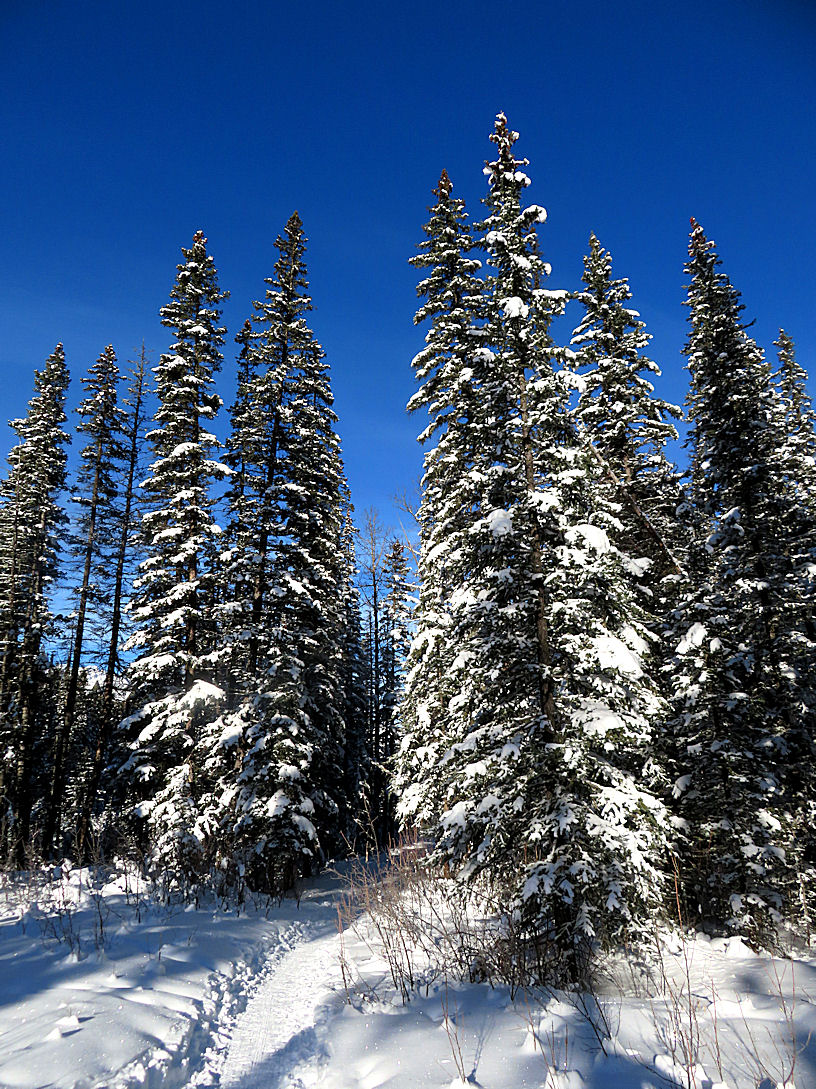
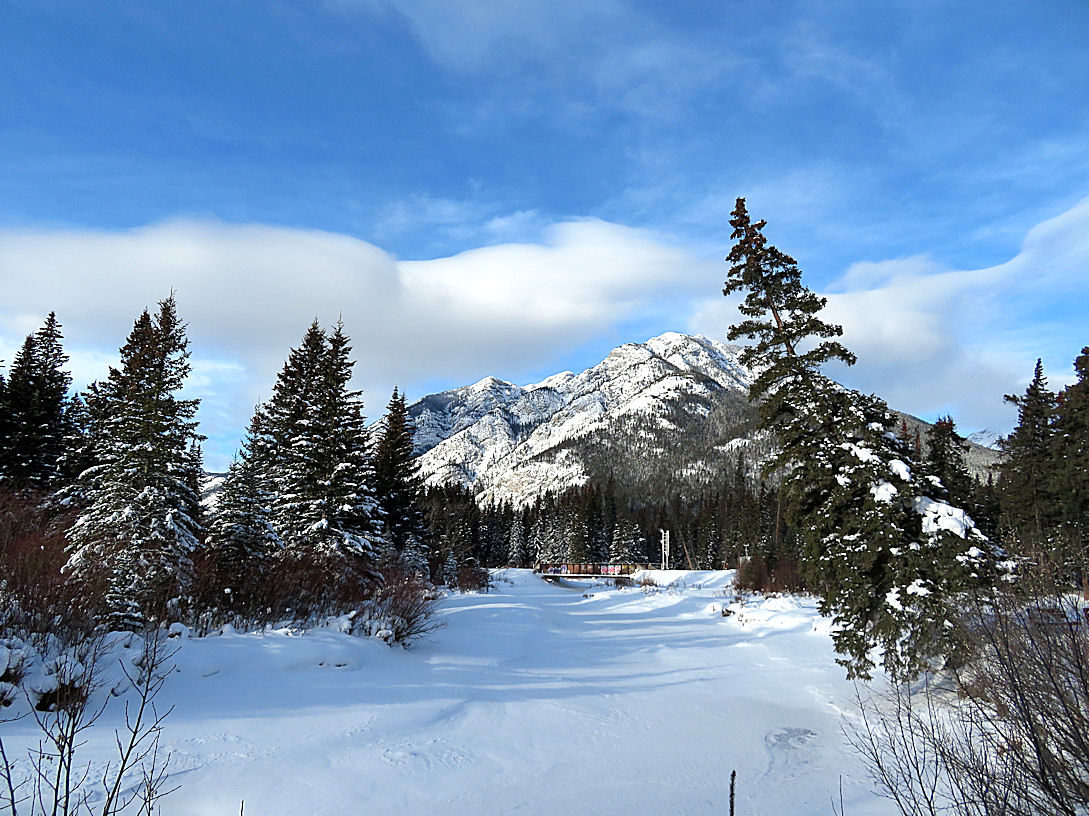
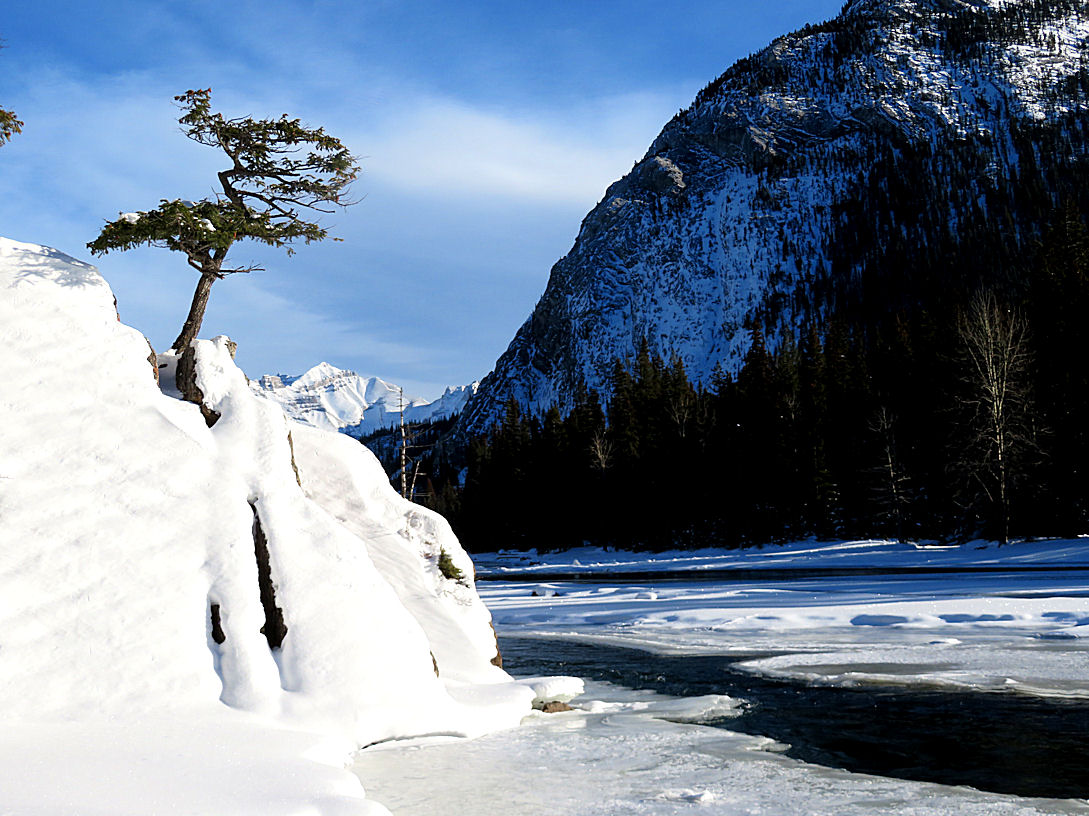
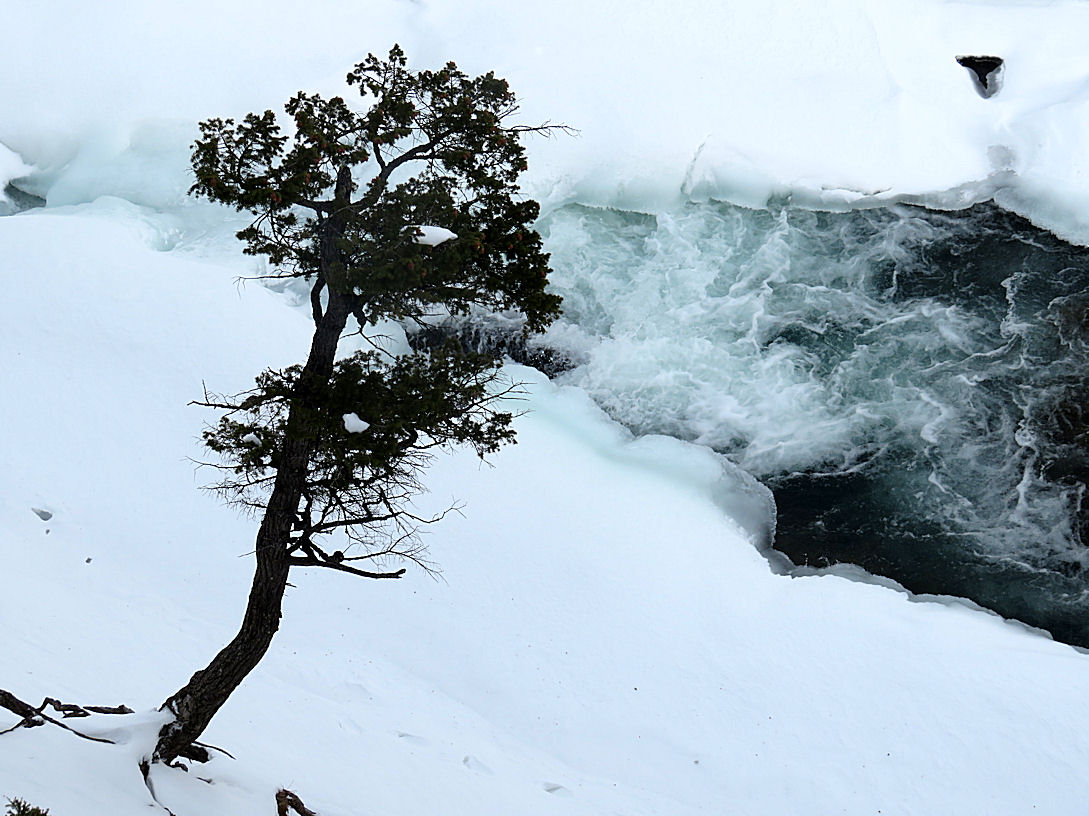
Some things can’t be neglected.

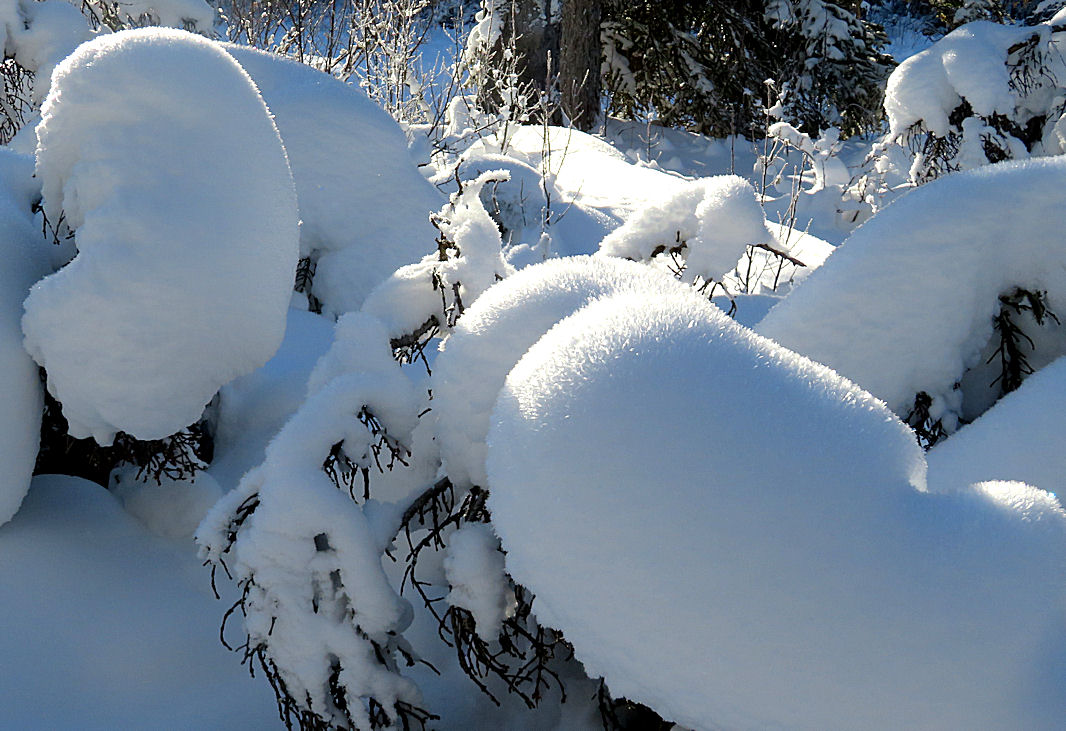
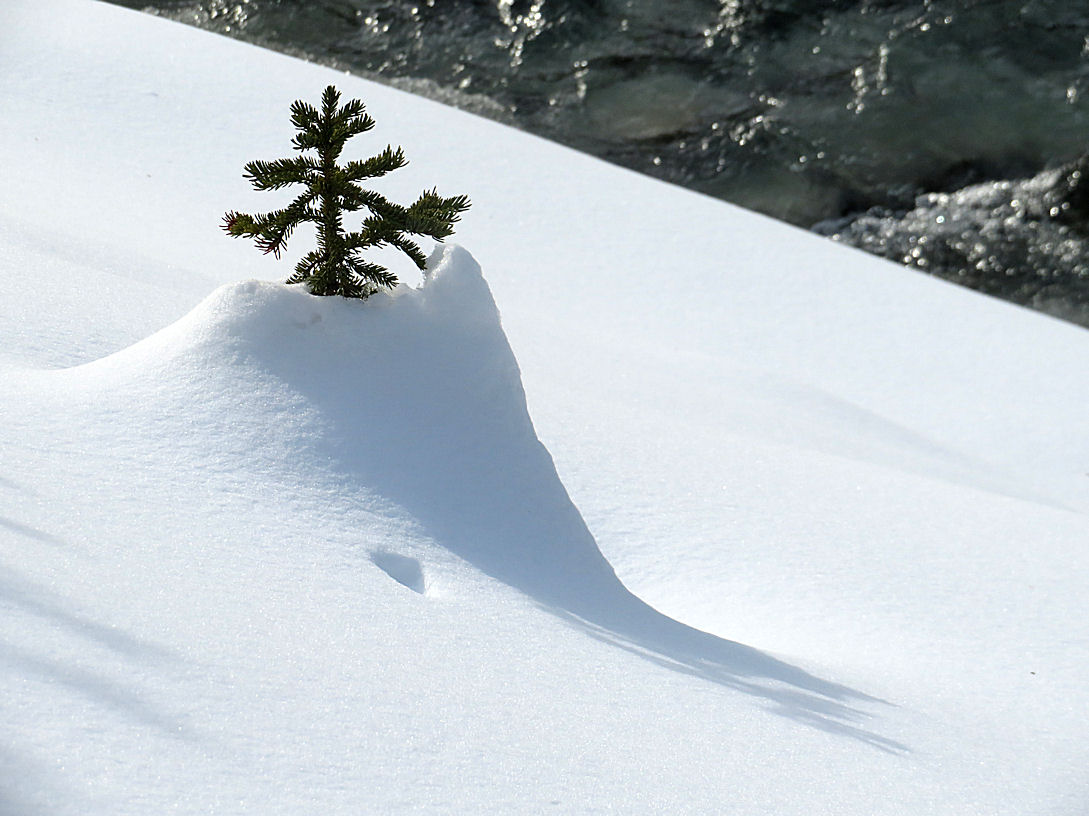
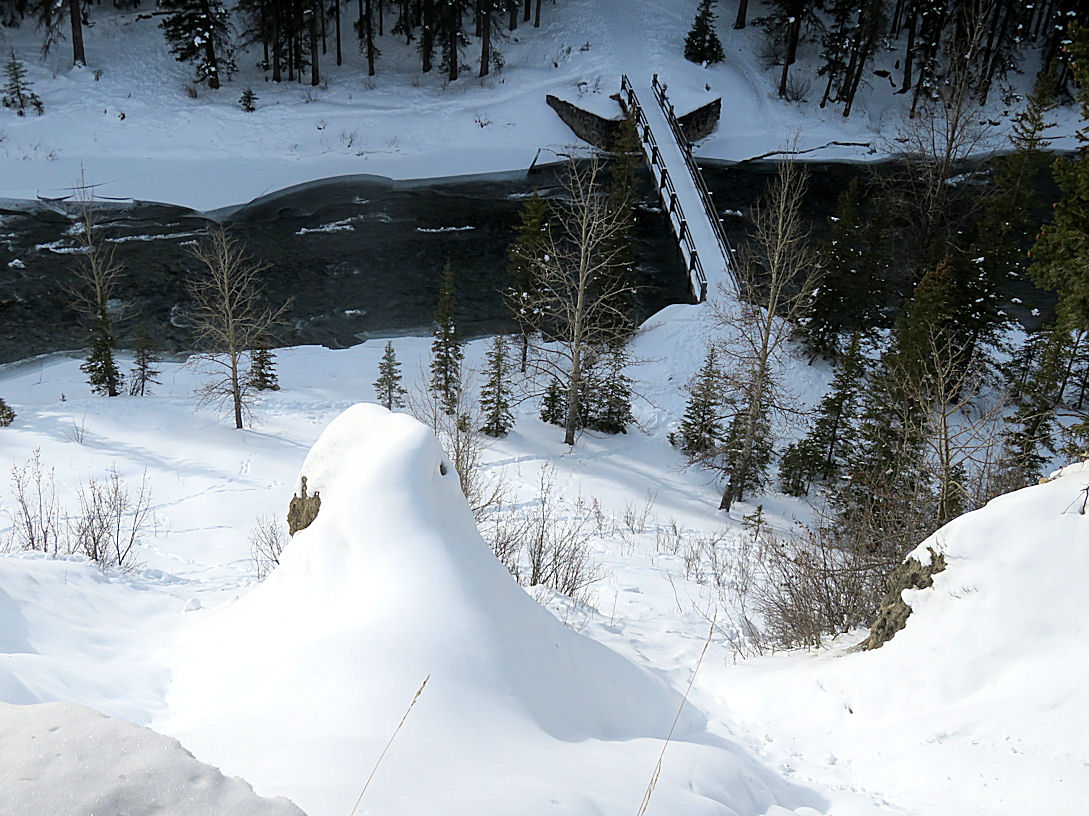
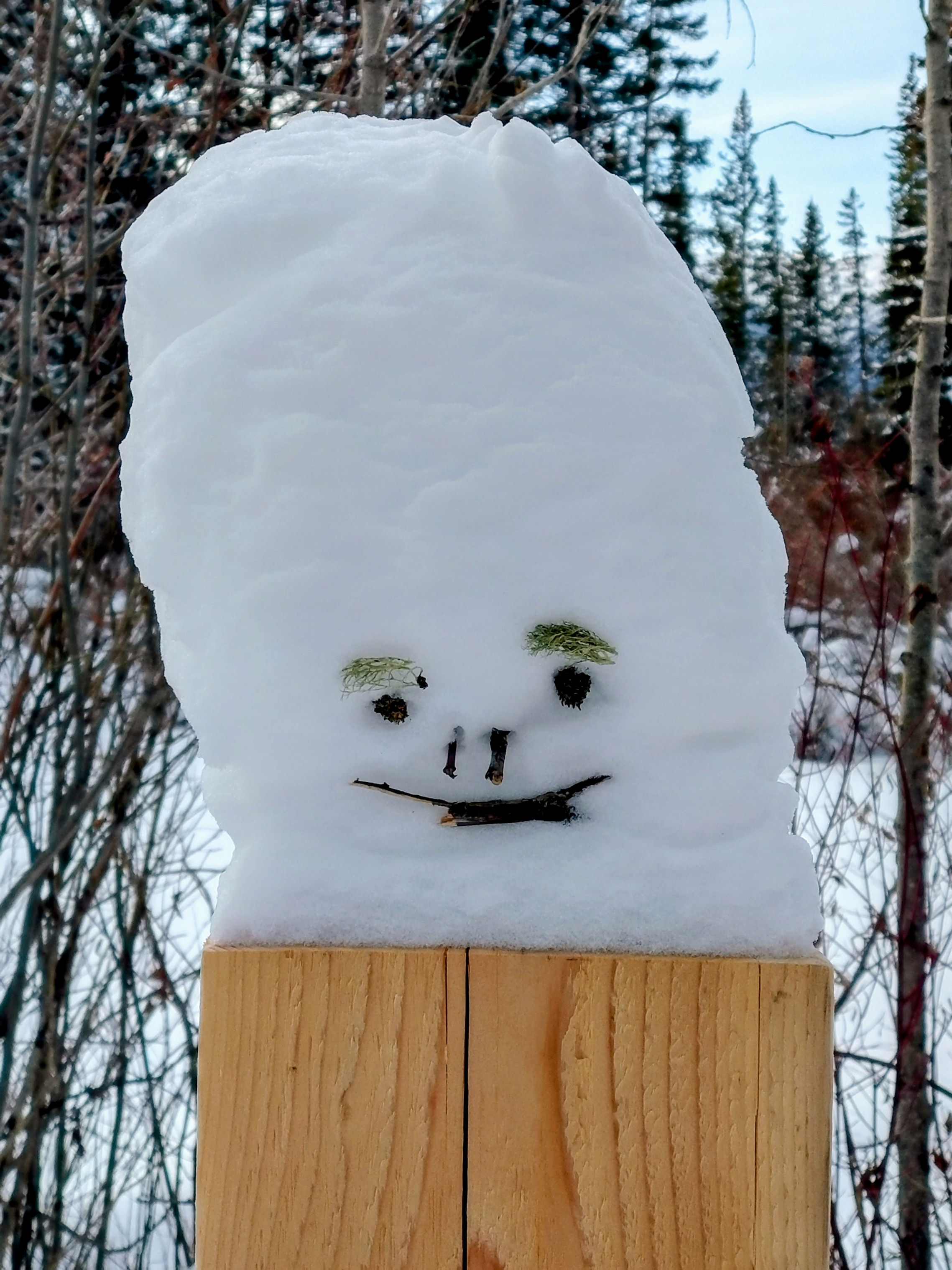
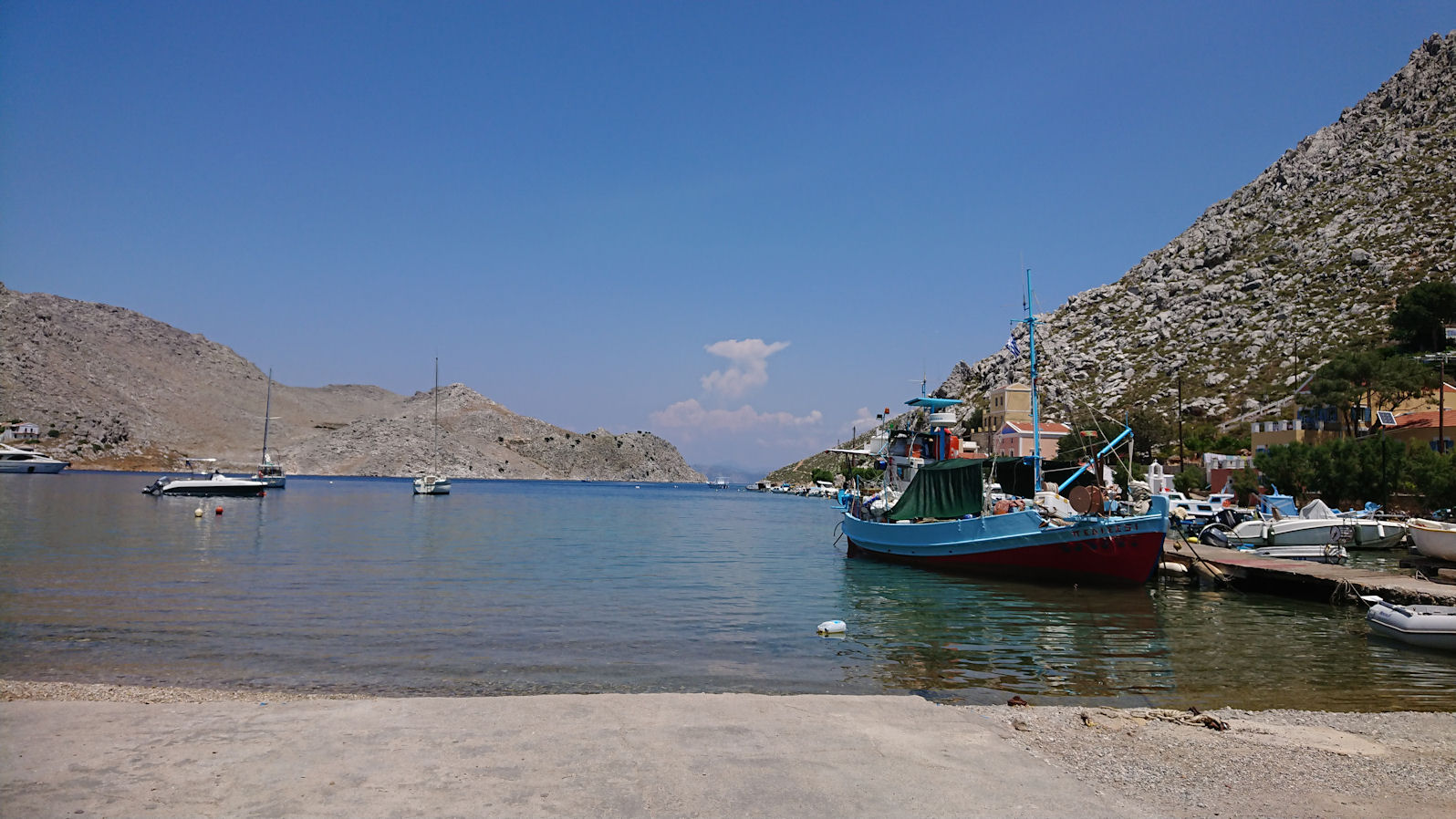
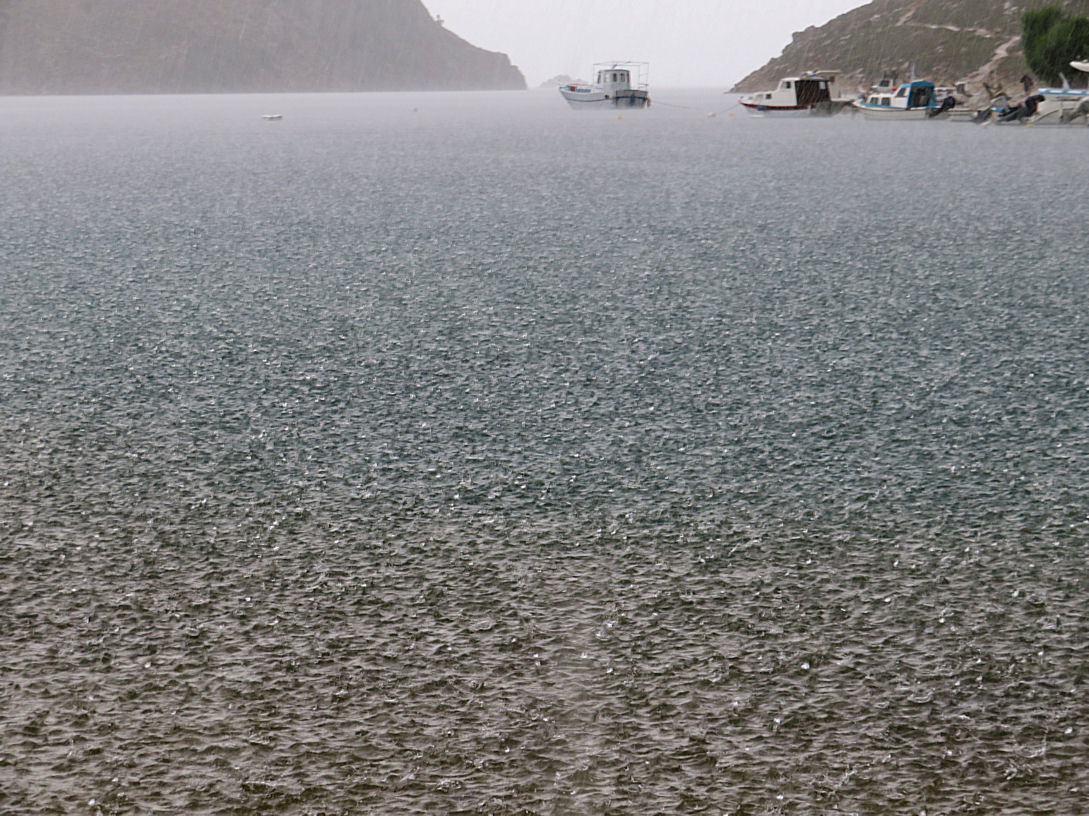
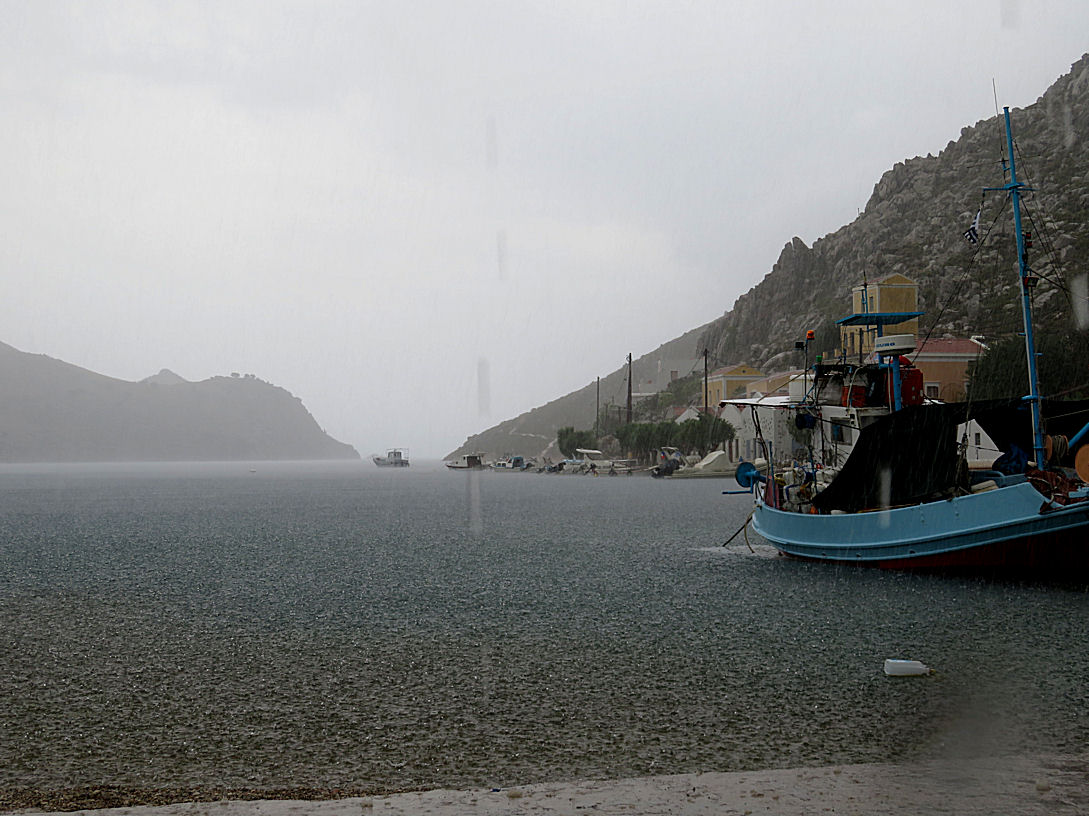
A small patch of blue sky sneaking up behind. Ten minutes later it rained

I have neglected posting blogs recently. But some things can’t be neglected. It’s been sixteen years now.

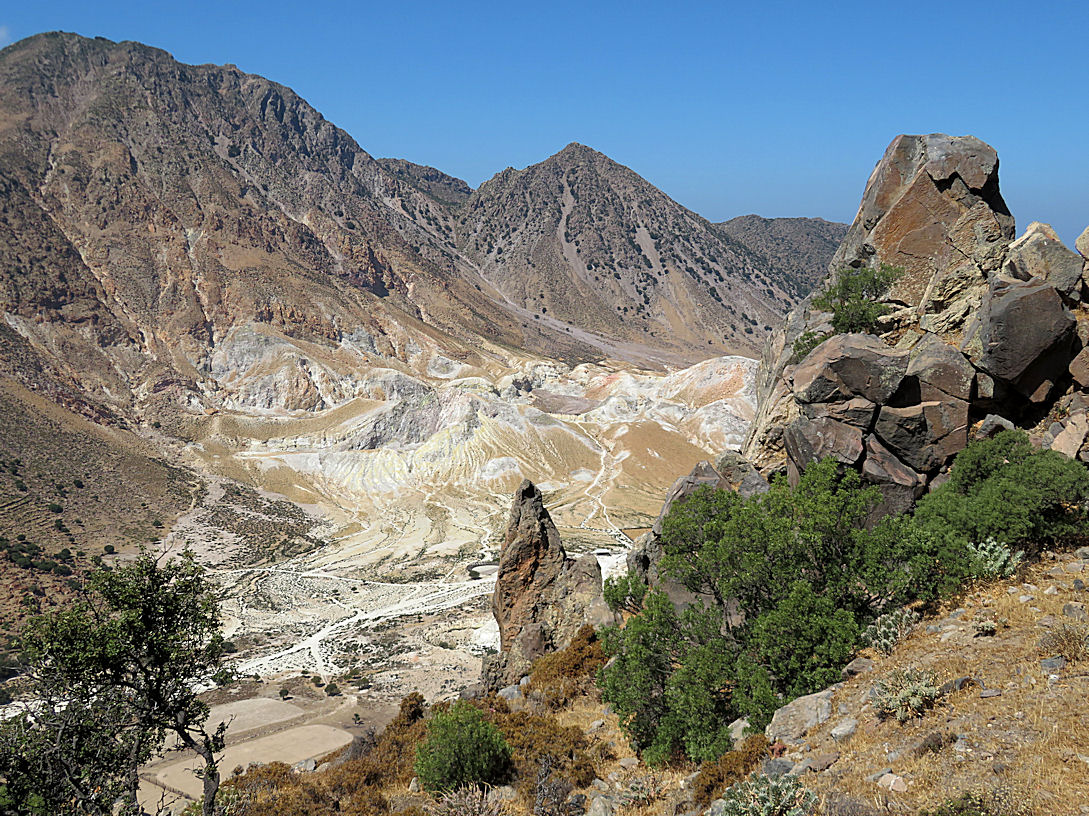
Hopefully, before I head for the Canadian Rockies I will post photos of the cave on Symi taken in April and a walk around the inside of the caldera rim looking down at the craters on Nisyros taken in September.

Posted in Uncategorized | 1 Comment

Canadian Rockies in winter

Where to begin.  The contrast between the Greek islands in summer and the Canadian Rockies in the middle of winter couldn’t be more stark.  Truth is, I love extremes of weather, can’t be doing with never-ending greyness.

True, the latest trip to Banff wasn’t as cold as it has been in the past.  Indeed, locals say that December ’24 was one of the mildest they can remember.  January ’25 was warmest worldwide. I went to Banff first in mid-December 2010 when an idea of how cold it would be could be gauged by how far across the car park you got before icicles formed on your nasal hairs.  That was the year I took a selfie which was used for the cover of a book.

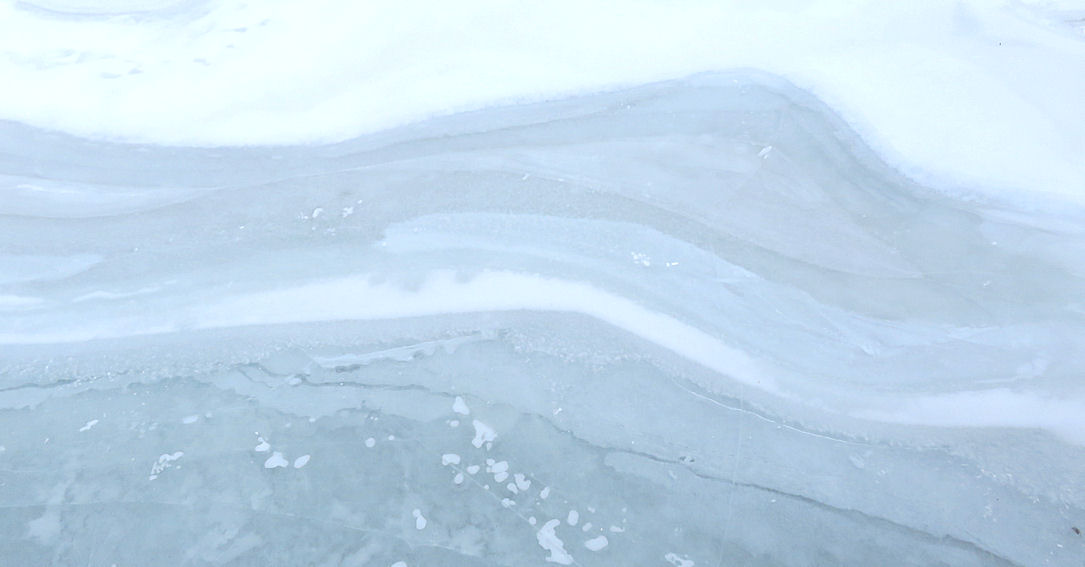
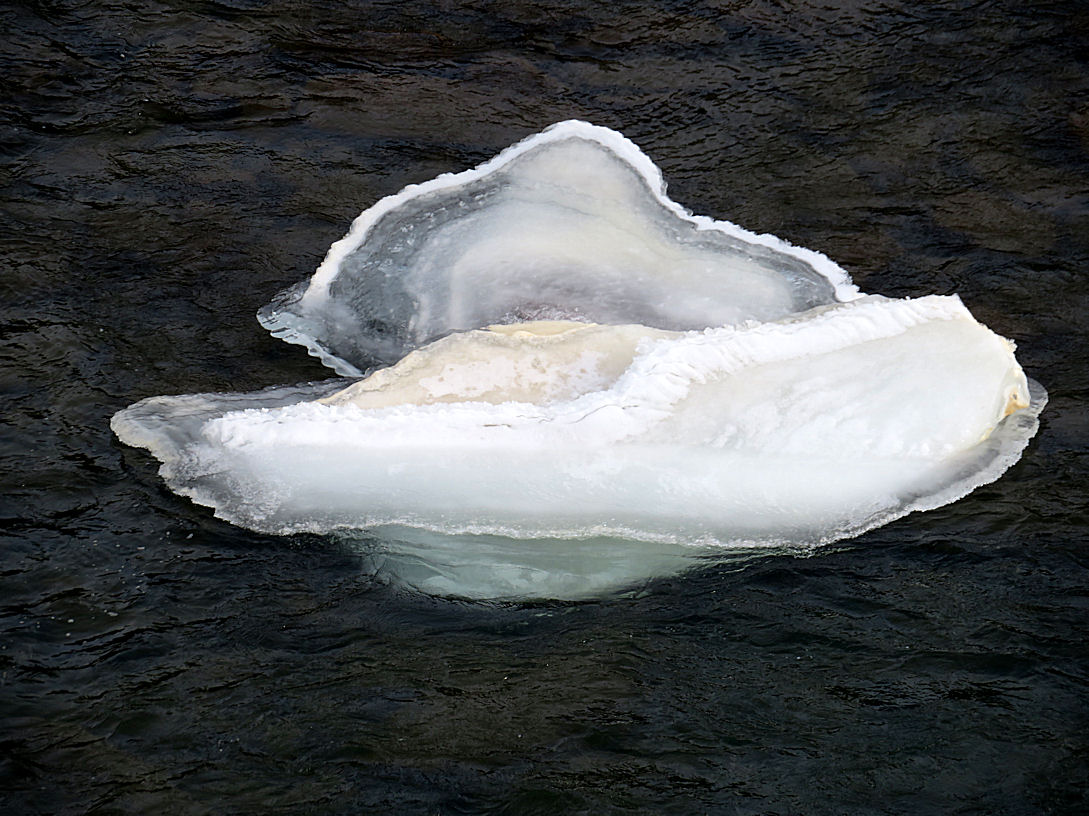
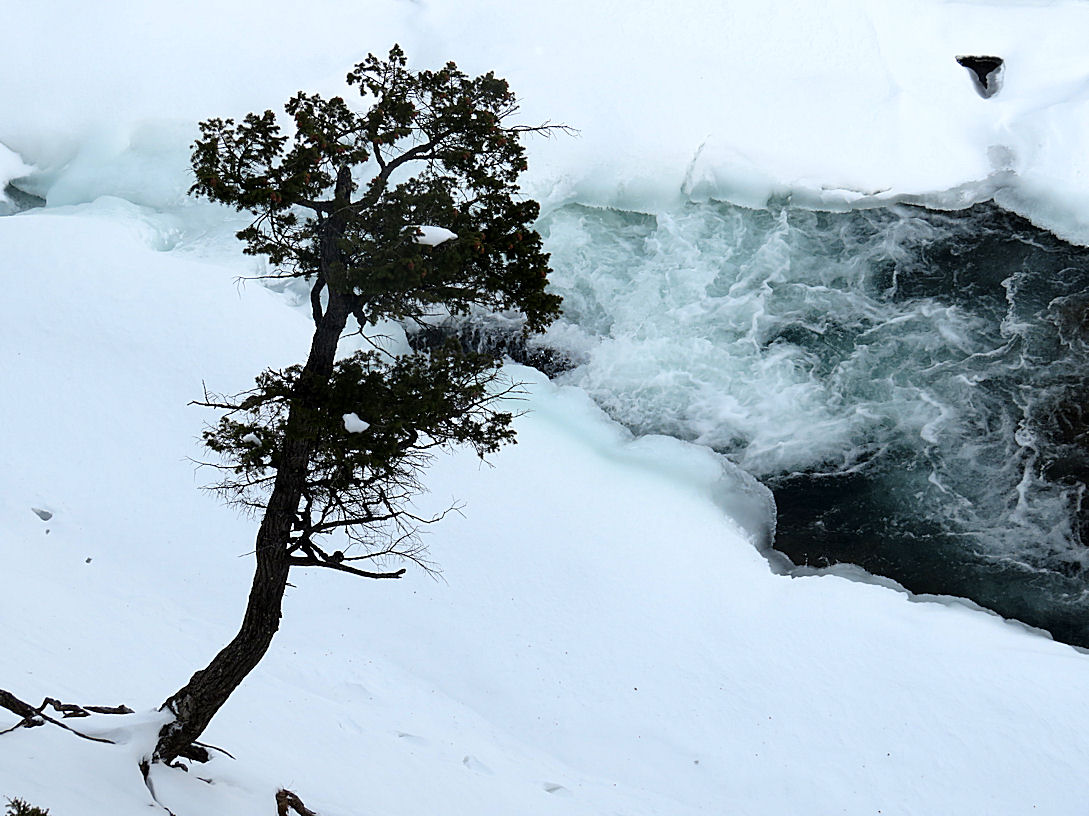
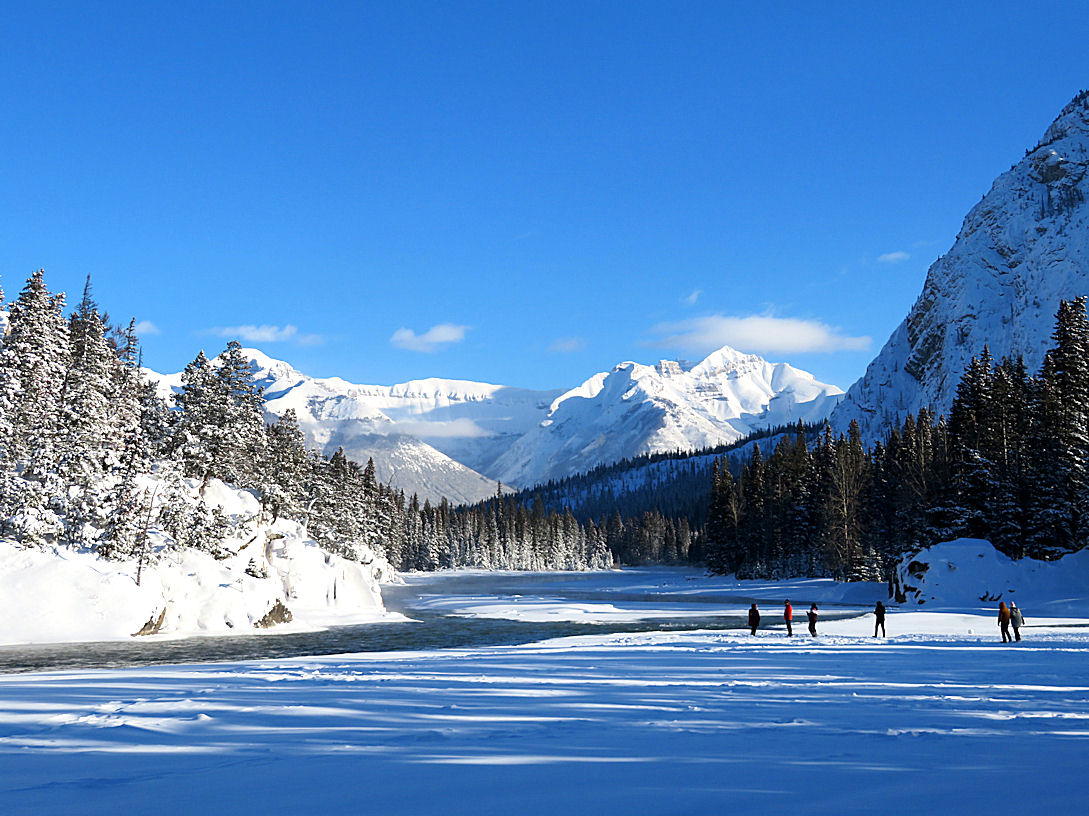
Though it had been warm before we arrived, with afternoon temperatures a degree or two above zero on a few days, thankfully it soon turned cold, dropping to minus 20.  There was more open water on the Bow River and in the Falls than I have seen on any previous trip, though still rushing down through broken icefloes as it speeded up on approach to the Falls.

Soon after we arrived, the warm weather began to change, temperatures plummeted.

With this drop in temperature, in order to acclimatise to both the cold and the altitude (Banff is at 1400 metres ASL), and in acknowledgement of my lack of fitness, one of the first walks I did was out to the Cave and Basin Natural Historic Site to witness a strange phenomenon.

Though known to, indigenous peoples for thousands of years, the ‘discovery’ of a hot geothermal spring by three railway workers in 1883 led to the creation of Canada’s first National Park, and the development of the town of Banff. The warm and welcoming visitor and interpretation centre are well worth a visit, but that isn’t what I went to see.

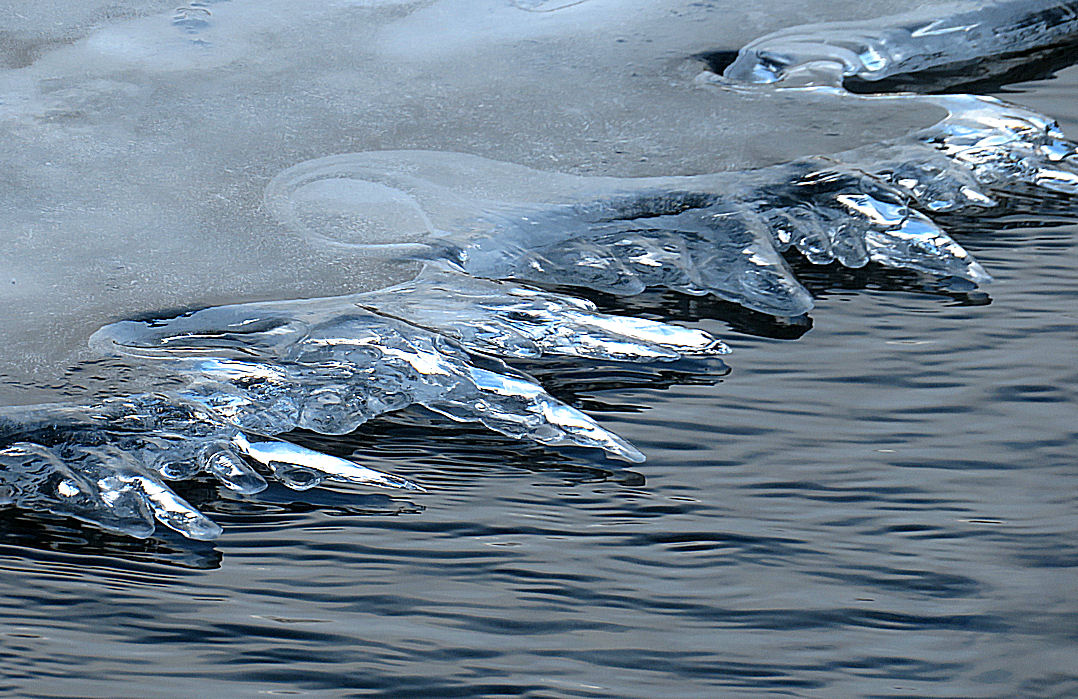
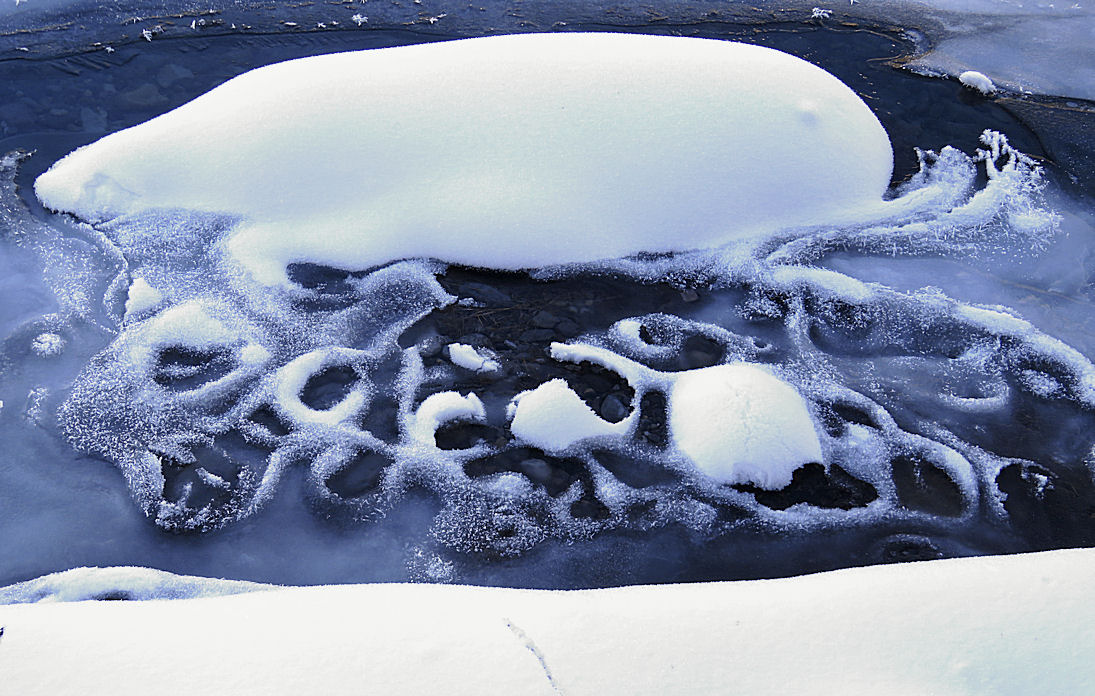
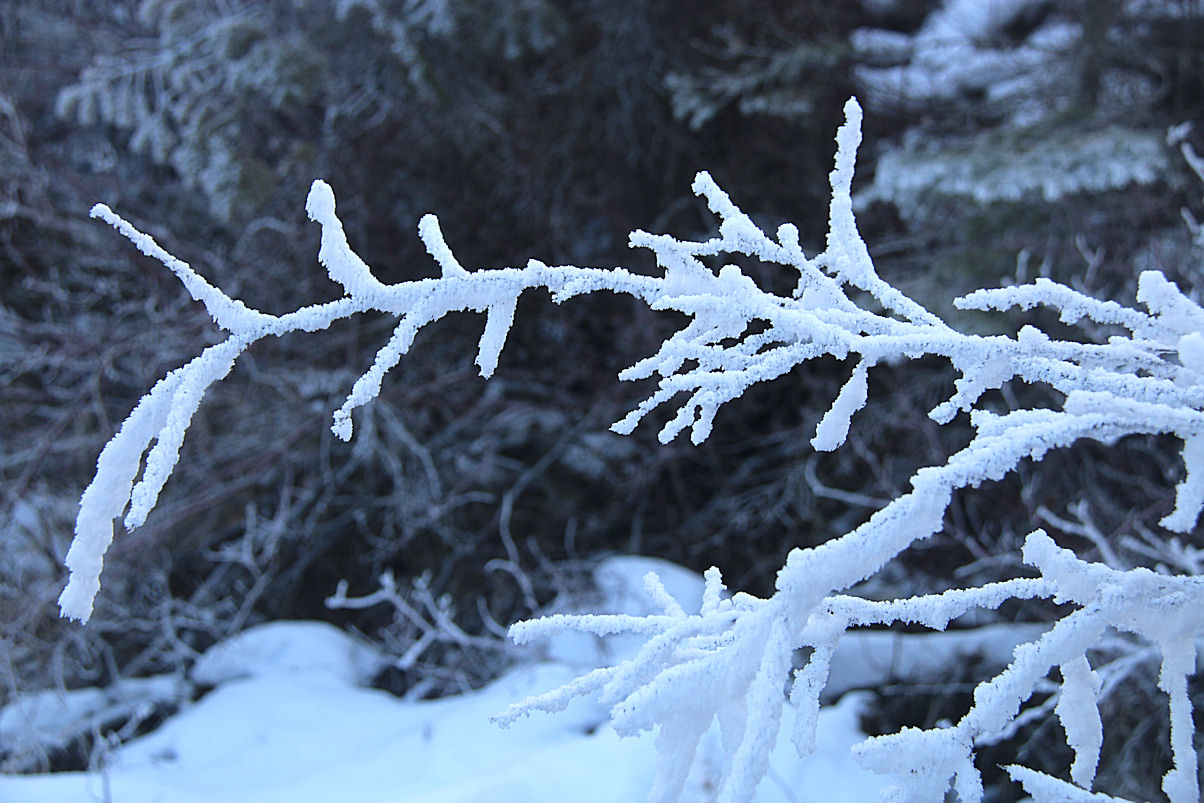
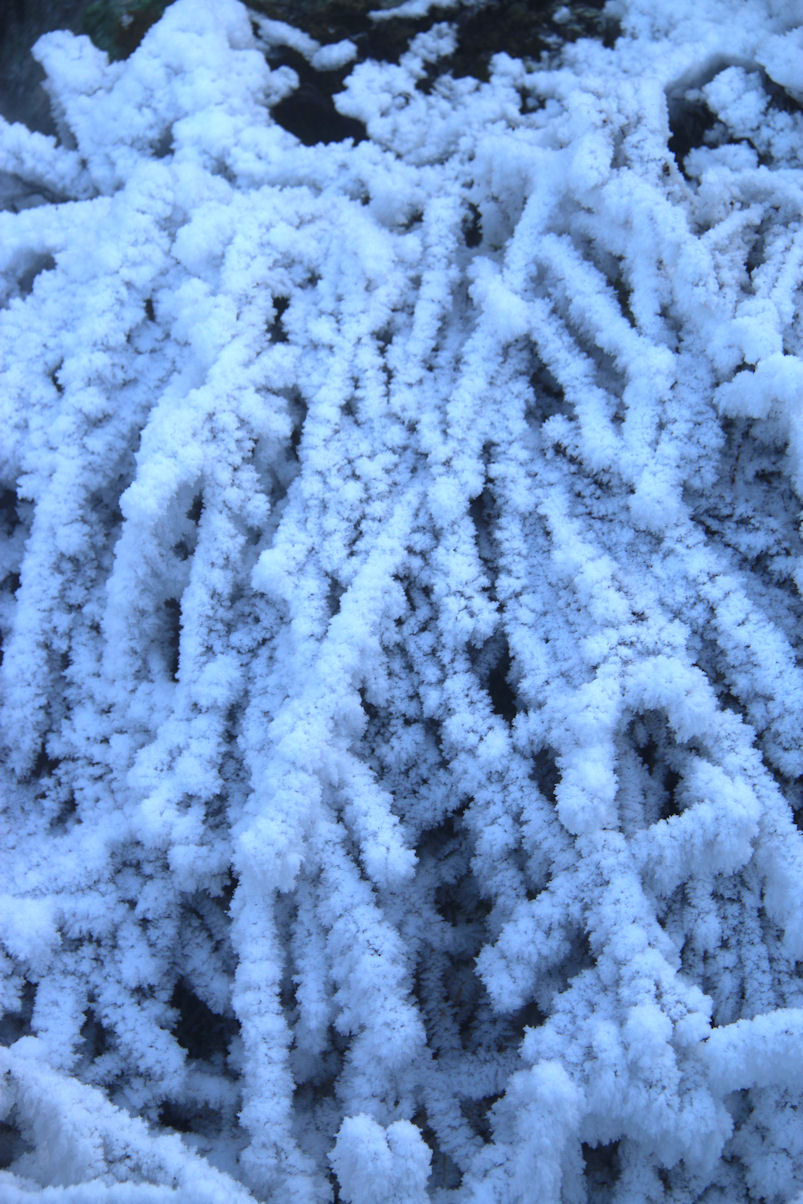
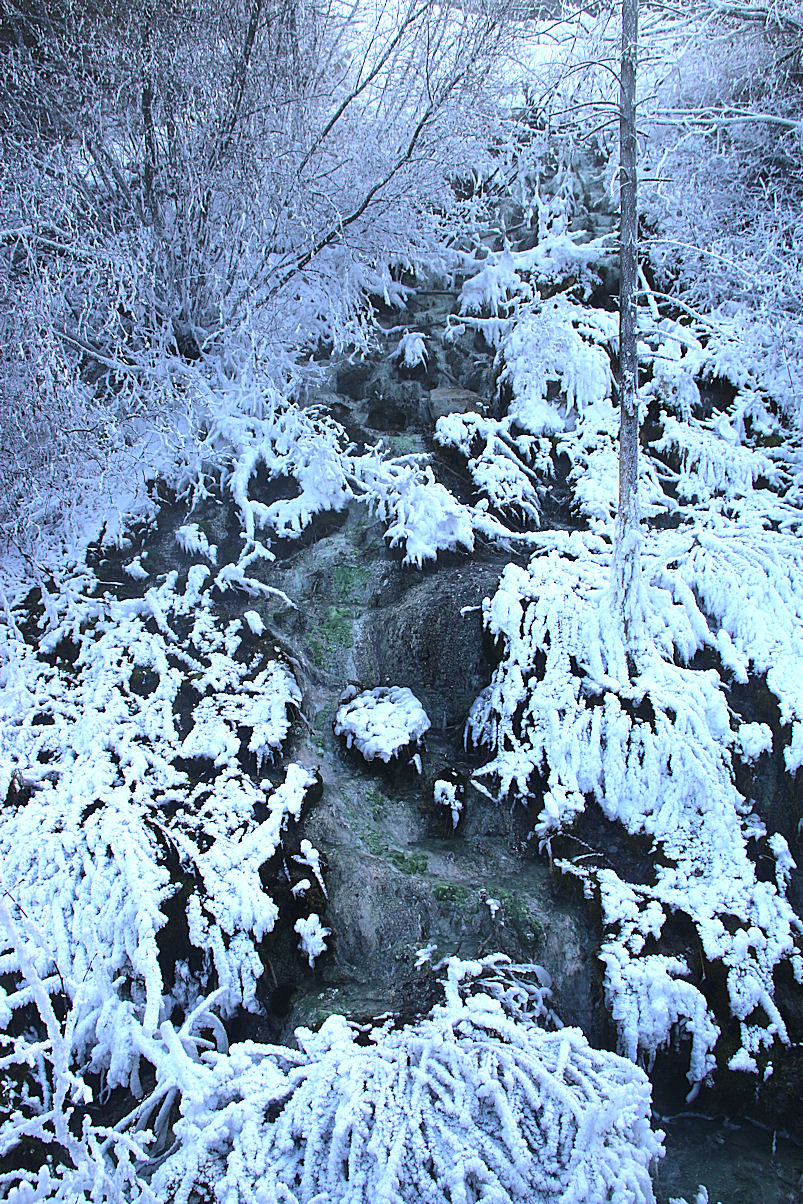
The sulphurous hot springs are constantly flowing and obviously cannot be contained within the site.  They emerge as a heated stream which flows out below the centre, meandering down to the frozen river, steaming lightly.  When air temperature drops well below freezing, this freezes on vegetation, creating an other-worldly environment. Because of low-angled winter sun, it’s in the shadow of Sulphur Mountain all day.  The exaggerated hoar frost is spectacular. My guess was with the sudden plunge in temperature, high of minus 15 in the day, low of minus 20 at night, the creation of this other-world would have begun.  It had.  Not as spectacular as in the colder weather of previous years, but still dramatic.

The water flows no matter how cold it becomes, (I have been there in minus 30-35), and it has it’s own aquatic flora and fauna.  Parks Canada have built boardwalks through it and down over the marshy margins of the river.  Many years ago, small tropical fish were illegally introduced and have survived and thrived, replacing native species. A globally unique snail survives in the warm water but is now classed as ‘endangered’.  It’s well worth a visit if you are prepared to put up with the extreme cold.  Because of the water vapour in the air, it feels much colder than the very dry atmosphere of the rest of this part of the Rockies in winter.  The cold seemed even more so because the view out over the marsh and river was to high peaks in full sun.

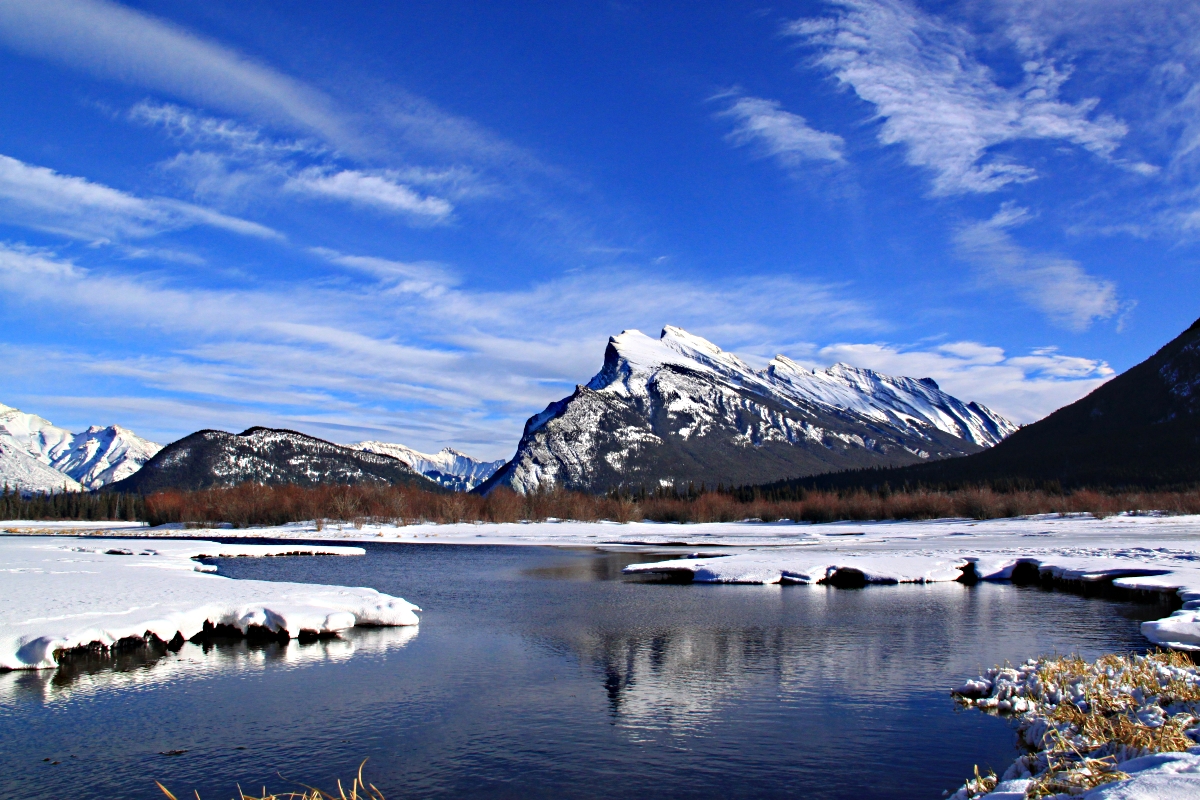
Some years ago, I found a another thermal spring feature part way along the frozen Vermillion Lakes.  A pond with fish and bird life.  No ice on the surface, flowing out into the ice of the lake and keeping a channel open in the ice for a good distance across it.  It was still like that on my last visit two years ago.  Now it has been changed dramatically.  An earth bund has been built, making the pond larger in area and deeper. It nolonger flows into the ice of the lake so no open channel and one end of the pond now has a thin ice cover.  It’s also nolonger possible to walk around it so see it from many perspectives, the edges barred by dense brushwood. A disappointment.

January 2016

January 2025

What price Grey Britain compared to this?!?!

Posted in Canada, Grey Britain, Hiking, Landscape, Mountains, Nature, Photography, Reflections, Weather, Wildlife, Winter | Tagged , , , , , , , , , , , , | 1 Comment

Remembering

15 years

The view/prospect says it all

Posted in Uncategorized | 3 Comments

Symi: Summertime blues …. and getting it wrong again.

I began this post at the end of May

Written in 1935 for Porgy and Bess, George Gerswin’s ‘Summertime’ is the most covered song in the world, probably in excess of 25,000 times.  Eddie Cochran wrote and sang ‘Summertime Blues’ in 1958, a song of regret, also covered by many artists since.

We yearn for summertime.  It holds out promise, yet the experience frequently falls short.  It is the anticipation of blue skies and warm seas which for many makes the drudgery of work in Grey Britain bearable. Maybe because the reality rarely matches up to the expectation, the melancholy of both songs strikes such a profound chord.

Though I don’t have the drudgery of work any longer, I do feel the depressing effect of Grey Britain.  Therefore, like most, I look forward to escaping to the sun each summer. Spring in the Greek islands is often warmer and sunnier than most UK summers, with the added bonus of spring colour which surpasses even the Pembrokeshire Coastal Path.

So, mid-April, I set off for Symi.  I took a tumble on Nisyros last year which dented my confidence. Given that I’m conscious that my balance is not what it used to be, and given that a couple of weeks before I was due to go, I had what was diagnosed as a ruptured Baker’s Cyst behind my right knee, I was a little apprehensive.

But all was well.  The pain and swelling from the burst cyst continued to decline. I was slower than usual but still walking well. After the first couple of days the sun shone from cloudless blue sky.  The wind which delayed my ferry for 24 hours gave way to breezes which took the edge off the heat at midday. The spring flowers were a joy. 

A friend, Steve, joined me with the intention, apart from trekking around the mountains, of photographing and recording the Dafni Cave.  We had left climbing/caving kit with friends on the island and took out more.  After a few days acclimatising we hired a car, and drove to the other end of the island. Using climbing protection (I’m a climber), we rigged up better-placed anchor points, joined two caving ladders together and dropped them down the pot (Steve’s a caver). More climbing protection gave a good anchor for a safety rope.  As he hadn’t been down the cave before, Steve went for a preliminary look with the intention of returning in a couple of days to do the business with cameras and digital measurements.

It was in the intervening days that things went pear-shaped. We were walking towards Gria, the abandoned village above Pedi, moving well, having passed the section that some people find scary, when I took another tumble. Maybe feeling a little smug about how well I was moving, I pitched headlong and twisted. I don’t bounce as well as I used to and the pain in my right thigh was excruciating, 2 out of 10 when sitting down, 9 out of 10 when I tried to stand. We were nearly at the abandoned village so I sat on the narrow path between the oregano while Steve went to look for something to use as a walking stick.

He came back with an oar.  No, that isn’t an autocorrect error.  At several hundred feet above sea level he found an oar, about 2 metres long. It was perfect for the job.  It took a long time over the extremely rough ground but with the aid of the oar I made it back to the Zoodohou monastery and the beginning of the track.

After that, though I could walk on level surfaces I couldn’t go up or down stairs, never mind mountains.  Meant I returned home after 2 weeks instead of the intended 4. Summertime Blues. More than that, I knew I had to rethink, reassess what I did. Given deteriorating balance and slowed reactions as I got older, was it sensible to continue to trek the rugged terrain of the Greek islands in extreme temperatures on my own? I needed to get past the gloom of returning early to Grey Britain before I made any decisions.

….. and completed it towards the end of June.

That’s when my minor mishaps were put into perspective. My problems were trivial compared to what happened to Dr Michael Moseley who went missing on Symi.  I know the area he went missing in very well, having got it wrong heading for Agia Marina some years earlier.  It is near-desert landscape of sharp rocks, low, prickly vegetation and offering no shade at all.  The rise up to the col is steep and what at first appears to be a path is nothing more than a route picked out by feral goats.  Anyone fallen down would be difficult to spot.

The route Dr Mosely followed would have been exactly the same as the one I followed and wrote about years before. I remembered the incident but had forgotten that I wrote about it in a post on this blog.  Others found the post, in tens of thousands, and many wrote to me asking what I could do to help.  Sadly, nothing, I was in regular touch with one of the leaders of the search but couldn’t take part myself.

I’m not going to speculate here as to what went wrong for Dr Mosely, what he should or should have not have done. I’m certainly not going to criticise him as some have.  The fact that he got so far and so close to safety is at the same time a tragedy and testament to his toughness. I have been trekking in extreme terrain and temperatures for many years. For anyone not used to it, it can be potentially, or in this case actually, lethal.

But because of this tragedy and the accidents I had last September and again recently in April, I had begun to re-assess my own activities now I’m nolonger in the prime of middle-age. Is it time to give up walking in the mountains on my own and settle down to a more sedentary existence – carpet slippers and a pint?  Friends have been urging me to pack it in.  Family are becoming concerned. Media ‘experts’ stood around on Symi in office clothes and pronounced walking in theses conditions too dangerous.  “Round objects”, as a civil servant scribbled in the margin of a memo to Churchill which he disagreed with. (Churchill is reputed to have asked “Who is Round and why does he object”).  But is it time to call a halt?

Alexander the Great said ‘Life is only made worthwhile by challenge’, though I guess he said it in Greek. Certainly for me, , for many, it’s the driving force.

I revisited the ‘Afterword’ in my book ‘A Small Life in Twenty Memories’ in which I addressed this issue. I’m not trying to promote sales of the book off the back of this tragedy. I tried and failed with my limited technical skills to copy a link to the Afterword. as a PDF, so it’s in plain text at the end of the blog.

Some conclusions I have drawn.  I’m not giving up walking in the mountains in Greece on my own.  Nor snow-shoeing in Canada   Solitary walking is not what I do, it’s what I am.  It’s me. I have always picked routes with an eye to the conditions and my level of fitness but recognise as I get older that I can’t take on what I used to. 

Dr Mosely would have known this far better than I do.  There are two critical issues, ambient temperature and hydration. If temperature is forecast to be 400C, that is above blood temperature (370C) and the body is stressed, struggling to cope.  But forecast temperature is in the shade.  In the sun, which is where we walk, it’s likely to be 550C. Hydration is difficult to judge as the amount of sweating is masked if there is any breeze.  Sorry to be brutal, but you need to monitor the colour of your pee.  When you become dehydrated it affects not only your physical performance but, perhaps more critically, your decision-making ability.

I researched the issue some years ago and found there is good scientific evidence that the body adjusts to extreme conditions of heat (or cold) but it takes time.  Heart rate initially increases by about 10% to control body temperature but then settles back. The chemistry of the blood changes, amount of perspiration and chemical composition of sweat changes.  And so on. Ever wonder why locals are wearing ski jackets on the Greek Islands in May while you are roasting?  Their metabolism is adjusted to the heat.  You have just flown in from single figure temperatures in Grey Britain.  No hope of adjusting in a week before flying home.  It takes several weeks to adjust.  One of the many downsides of Brexit is that Brits spend less time in the sunshine, suffer more in the extreme heat we are increasingly experiencing.

So, apart from the usual precautions I have taken for years – a minimum of 1½ litres of cold water in insulated sleeve, small snack of honey and almonds, comprehensive first aid/emergency kit, I have added take two additional precautions.  I now carry a folding trekking pole in my rucksack as I can’t rely on finding an oar on the top of every mountain.  And my family know where I am at all times thanks to Google Maps so they can pinpoint my body if necessary.  Or tell that I’m still in the hotel having a morning off – like today.  Or spending too long in the taverna over a post-trek pint.

That isn’t to say I’m indestructible.  Far from it.  But I continue to do what makes me, me.  I am back on Nisyros.  A week walking with friends, two weeks on my own.

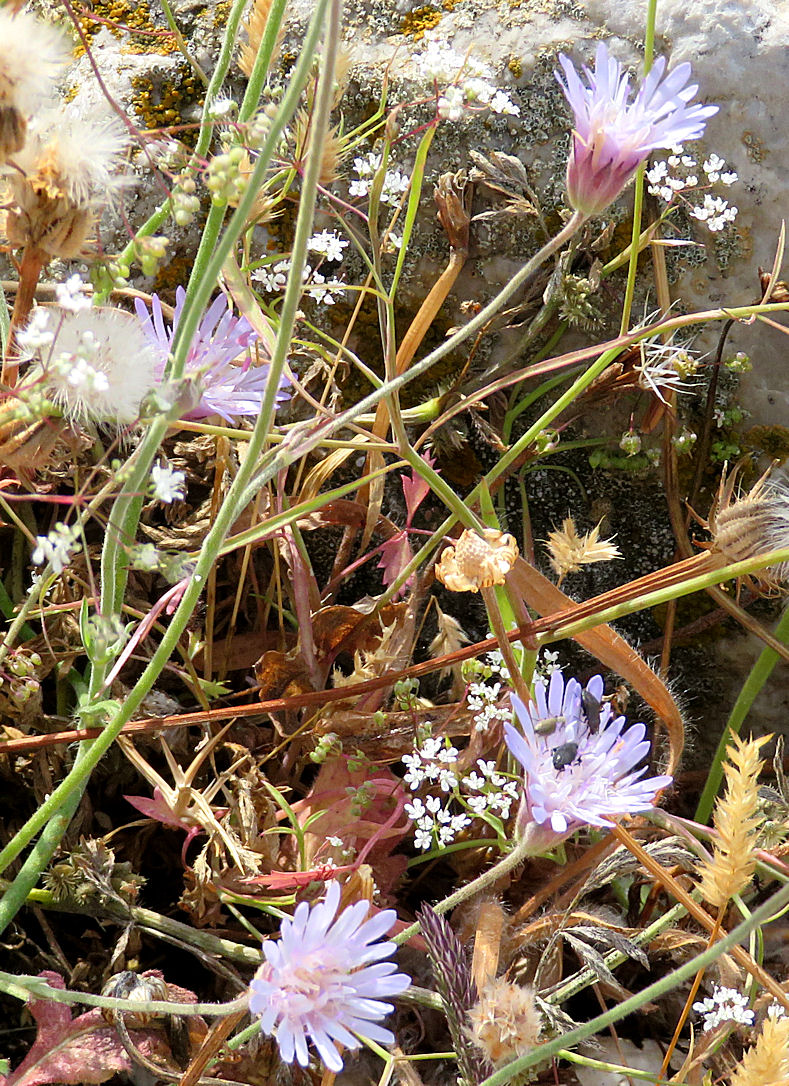
I had originally planned a post with lots of photos of spring flowers but that hardly seems appropriate now.  I’ll save those for the end of next winter to encourage people to visit the Greek Islands in Spring.


Afterword
“You’re weird!” The reaction of a colleague during a discussion
about what we had been doing over the weekend. I can’t recall
the weekend’s activities but what struck me was the assumption
that I was ‘weird’ because what I had been doing was completely
different from what everyone else had been doing. Pub, TV,
watching rugby, shopping seemed to be the norm. Because I
went paragliding, or kayaking, or climbing I was categorised as
abnormal, verging on deranged.
Apart from doing different things to the ‘norm’ I guess I was
regarded as odd because the activities I preferred were seen as
risky and often involved being out in adverse weather. Being in
the mountains, on river-rapids, on the sea in ‘extreme’
conditions – raining, windy, snowing, freezing or heatwave – or
crawling into dark, cold, wet, holes in the ground, doesn’t
appeal to many. Thankfully so, or the outdoor world would be
cluttered, solitude, ‘head-space’ difficult to find.
But it brought me alive. Since early teens I had been an
‘outdoors’ person, trying one thing after another simply
because they grabbed my interest. In those days a lot of what I
did was very amateurish but it whetted my appetite.
As my enthusiasm built, increasingly often I went on my own.
We did very little as a family, certainly nothing involving the
remotest hint of exercise. I had an introduction to the
mountains when I was a Scout but their activities were very
limited.
Just to be clear, I didn’t get into outdoor pursuits just because
they are ‘different’ but because they became my passion. If
doing different things to what the majority do is ‘weird’, then,
yes, I guess I am, and have been most of my life. Not that I
Afterword
revel in being ‘different’, for the sake of it. It’s a matter of
indifference to me. What would bother me is not doing them.
Once I had been introduced to the outdoors and the world
beyond the man-made confines of urban space, I was driven.
There was a pull I couldn’t resist. I was more at home on the
top of a mountain in a blizzard than in a disco. I soon realised it
wasn’t so much what I did, it’s what I was. And still am.
I remember years later being button-holed by the wife of one of
our top pilots at a Christmas Dinner when I was chairman of the
local hang-gliding and paragliding club and subjected to an
aggressive tirade. “You’re all irresponsible. John is married with a
family. We rely on him. What happens to us if he’s injured or
killed?”.
I tried reasoning with her that he was pilot before they got
together and that flying not only helped make him what he was
but that he would not, could not, be the same person if he
packed it in. “I’ve flown with John and know he’s a very sensible
pilot. I’m married with two kids but my wife wouldn’t dream of
trying to make me give up flying (or climbing, or kayaking or
…..) She knows it’s what keeps me sane, that it’s what I am.”
I was thinking on my feet, with a termagant, claws-out, in my
face, but reassessed what I had said afterwards. I could
understand the concerns of a mother for her family but could
also appreciate that it’s essential to be yourself, true to your
nature. Even after reflection, I would take none of it back.
There is something about being ‘in the wild’ relying on your
skill and wit to fly/climb/canoe which is irreplaceable.
But what about the risk-taking?
I had taken our daughter back to university and was spending a
couple of days walking in the Derbyshire Peak District, centred
around Hayfield and Kinder Scout. I wasn’t born at the time,
Afterword
my parents hadn’t even met, but the 1932 Kinder Trespass which
led to the opening up of mountain areas in the UK to the public
by the National Park and Access to the Countryside Act of 1949
was spoken of in hushed tones of respect when I was a young
teenager newly escaped form the Salford slum where I and my
contemporaries were brought up.
Out of nostalgia, during the day I had walked the route of the
Trespass and now I was sitting by a log fire in the lounge bar of
the Lantern Pike Inn in Little Hayfield, mesmerised by the
flickering flames, the heat radiating from the embers comforting
chilled bones and tired muscles. A pint of well-kept real ale at
my elbow, all was well with this small corner of the world. I
picked up the copy of The Manchester Evening News lying on
the table and started leafing through the pages, brain idling,
increasingly soporific in front of the fire. Mildly interesting but
nothing attention-grabbing.
Until I reached the centre pages and was instantly snatched from
the grip of Morpheus. It was a centre-spread dealing with the
issue of the Peak District Mountain Rescue Team being
overstretched because of call-outs from people who were either
not in serious trouble (“can you bring me some water, I’ve run
out”) or had gone into the mountains ill-equipped (“I don’t
know where I am and haven’t got a map”). Idiots feeling
liberated by their mobile phones.
Going into the mountains since the age of 12, often on my
own, I had gained a fair amount of experience, learned a bit of
‘mountain-craft’. But there was something far more
fundamental fermenting at the back of my brain and starting to
crystallise into formulated-thought. Especially so after this
encounter with the Manchester Evening News.
The key? The fundamental! What I had been doing for years:
“Take responsibility for your actions.” That meant dealing with
Afterword
whatever circumstances arise when things go wrong and learning
from the experience to reduce the chances of the same thing
happening again. Above all, not committing to something with
the intention of calling on others to get me out of the mess I
had got myself into.
The approach is rational. Over many years I learned that it’s
important to both separately and jointly assess ‘risk’ and
‘consequence’. The ‘risk’ is the likelihood of something going
wrong. The ‘consequence’ is what will happen if it does. You
balance the two.
Sometimes the assessment is of high risk and serious
consequence. Then you knock it on the head, find a
contingency solution, maybe do something else. What you
commit to is refined by experience. The assessment applies to
life not just ‘extreme sports’.
After Pordenone, (Chapter 4), I reduced the risk of the serious
consequence of losing my passport by keeping it in a zipped
pocket when I’m out-and-about in Greece, Canada or anywhere
else outside the UK. More recently, and most certainly, I keep it
in a rucksack between the bed and the door at night rather than
in a hotel safe (no safe is safe if the room is destroyed (Chapter
20)). Most recently, again after a mishap, I make sure to take it
out of the rucksack pocket before putting said rucksack in the
washing machine to get rid of 6 weeks grime before flying
home.
Make the risk assessment, take steps to mitigate the
consequences, but, whether in the mountains or urban streets, if
things go wrong, as will inevitably happen occasionally, be able
to work out contingencies and solutions. It’s the eskimo roll of
life, how to right yourself when you capsize. How to focus
attention and action on ways to get out of the pit rather than
dig it deeper.
Afterword
On a practical level, I carry a pretty comprehensive emergency
kit, not just a few sticking plasters, and know how to put myself
back together if necessary. However, most important is to be
able to think laterally, get outside the box. Sometimes very
rapidly to avoid crashing into that roof (Chapter 17).
But learning how to deal with things when they go wrong can
only go so far. Friends say to me “You shouldn’t go into the
mountains on your own (or do this or do that ‘extreme’ sport.
You’re lucky to be alive.). I guess I am. There have been near-misses. Miscalculations. Unexpected twists. But from my
perspective it’s not ‘luck’, it’s the providence of God.
Not that I deserve it, nor presume God is always going to get
me out of a pickle. Centremost when I commit to something is
to assess the risk/consequence balance. However, because
neither I nor anyone else has complete knowledge of the
conditions and circumstances in any situation, occasionally
something goes wrong, rises up and bites me in the bum. The
finger-hold I’m counting on may after centuries as part of the
solid rock, suddenly give way when I’m hanging on it. I may
have miscalculated the balance between dehydration and the
amount of water I’m carrying in the mountains in Greek
summer. So far it has panned out OK. Providence.
But what if it doesn’t pan out OK? We all “have to go
sometime” – or any other euphemism you care to use. A friend
and colleague who was one of the founder members of the local
mountaineering club died of a heart attack on a post-prandial
walk in the Brecon Beacons one Sunday afternoon. He was
found sitting on a rock on the mountainside. Others in the
office, non-mountaineers, were of a mind “He should have
known better than to go out on his own”. How wrong!! He
knew the risks and the consequences. He died doing something
he loved in an environment he loved.
Afterword
If I had to choose between going that way or in a nursing home
unable to wipe my own arse and drowning in my drool, I know
which I would choose. Not that I’m looking for it. Statistically
I’m far more likely to pop my clogs in a household mishap or
traffic accident. The actuarial data proves it conclusively. In his
book ‘Notes from a Big Country’, Bill Bryson notes that
400,000 Americans are injured each year by their bedding.
I’m safer in the mountains. I like to think that though my
family and friends would be sad to be finally faced with my
inevitable demise, they would prefer me to go out with dignity,
doing stuff in places that I love.
I’ve had threequarters of a century of learning by experience,
calculating risk and consequence, making mistakes, and
knowing there are things beyond my control. Rich memories.
But what about the future?
The ageing process inevitably means that some of the things I
did 30 years ago I can’t do any more. Stamina decreases. Body
strength decreases. Suppleness and dexterity decrease. Reactions
slow. Because of diminishing abilities, the ‘risk’ aspect of the
calculation has shifted and will continue to do so but the
calculation is still made every time. Fading faculties may reduce
to the point where activity is nolonger viable and horizons are
pulled back rather than expanded.
But until then, what is the alternative? Medical opinion is clear,
keep as physically and mentally as active as you can to offset
ageing – which generally begins at age 35. I’m more than
double that now but I can look back on having done far more
since 35 than I did before. I only took up skiing when I was 65.
Apart from keeping active to offset creeping decrepitude,
maintaining my sanity, I can’t help myself now any more than I
could as a young teenager in the Peak District. I have no
Afterword
alternative. I’m still driven. I have to push myself as far and
often as I can.
I’m grateful for friends who care enough to counsel me to slow
down, pull back from what they see as the risky stuff. But I
wouldn’t be me if I did. Horizons and activity may be reduced
because of age, illness or circumstances, but limits are always
there to be pushed.
I know that at some point like everyone else I’m going to pop
my clogs, shuffle off this mortal coil, whatever cliché you want
to use. The only thing which causes me any concern is that I
don’t want it to be as a result of making a stupid mistake. It
would be good if it were to happen doing something heroic,
though that is very unlikely. The probability is that, like most
people, it will be unremarkable, inconsequential. A small end to
a small life. But what a lot of memories in the meantime.
Posted in Greece, Grey Britain, Grumpy Old Men, Health and humour, Hiking, Mountains, Reflections | Tagged , , , , , , , , , , , , | 7 Comments

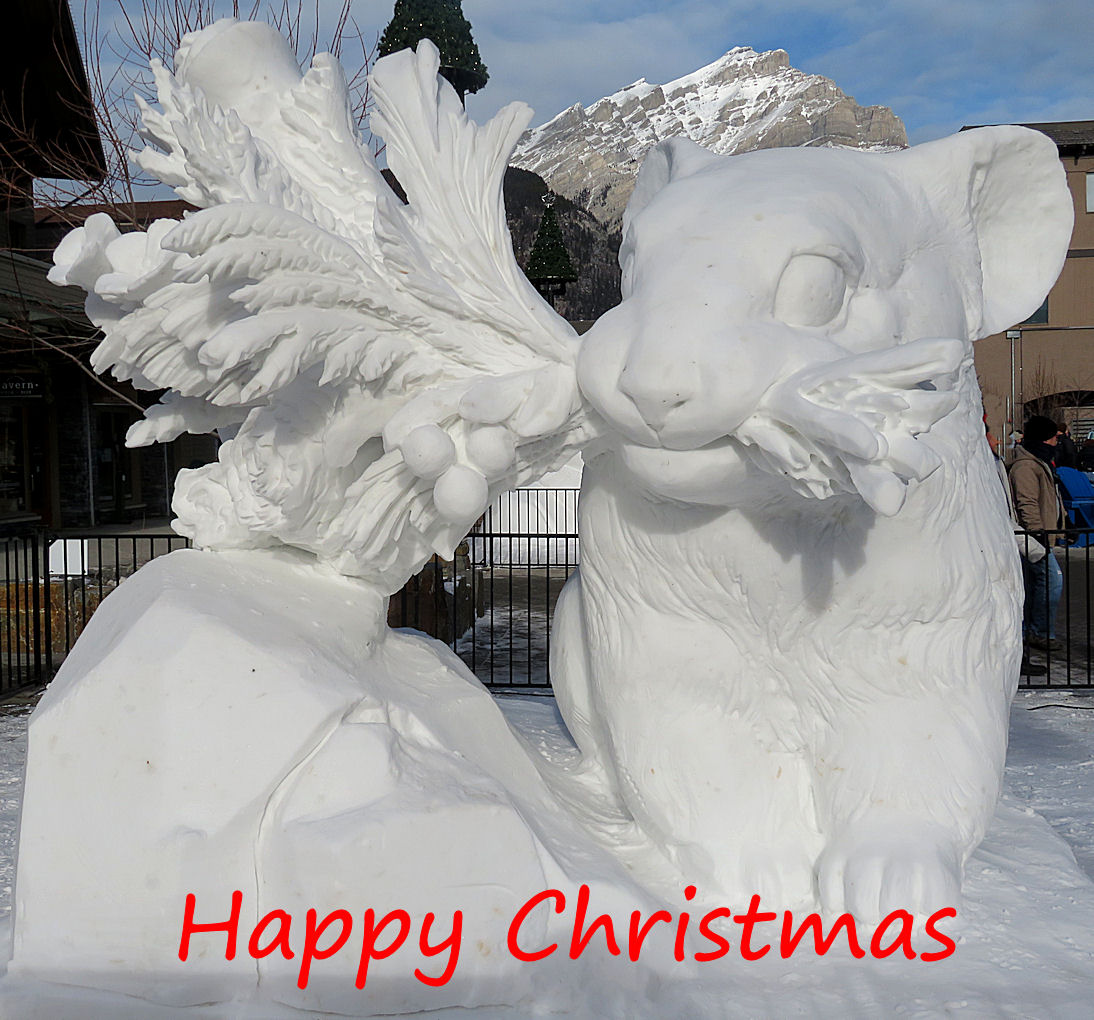
Christmas Greetings

I’m not going to Canada this winter so no proper weather and therefore no current photos.

This is a photo I took a few years ago.

Have a great Christmas and best wishes for the coming year.

Posted in Uncategorized | 5 Comments

Nisyros: cause and philosophical effect

When the mythical apple mythically fell on Isaac Newton’s head, he formulated the Law of Gravitation, hypothesizing that not only did the apple descend to his head but that the earth on which he was sitting, rose up to meet the apple, albeit immeasurably slightly.  The incident sparked a thought of genius.

When I slipped and fell on my first afternoon on Nisyros, stripping a layer of skin off my forearm and embedding a quantity of black volcanic grit in it, the incident sparked a more mundane conclusion, formulated as Barry’s Second Hypothesis (Barry’s First Hypothesis is to do with politics and I won’t bore you with that).

The Second Hypothesis states that if you do dangerous stuff (white water kayaking, climbing, paragliding, skiing, tree felling …..), or use sharp things (chainsaws, axes, power tools ….. ) then at some point you are going to get hurt. The second part of the hypothesis states that this is most likely to happen when you have done the really dangerous bit and lose focus, albeit momentarily.  This second part is writ large in my experience. – I shot Bala Mill Falls on the Tryweryn and capsized in the pool below, skied down a difficult run (for me) and then went base-over-apex on the glide down Easy Street to the lodge, dislocating my shoulder. And many more.

I arrived on Nisyros in time to dump my stuff in the hotel, change and catch the midday bus to Emborios on the caldera rim for the pleasant and in places very spectacular walk back to Mandraki (Walk 1 on the Greek Island Walks page of the blog).  Like some of the other paths on Nisyros, this one has degenerated significantly in recent years, with some sections potentially dangerous, especially high up near the village. The kalderimi is supported by high stone walls and increasing number of collapses and landslides threaten an uncontrolled descent of ten or more feet on loose soil and gravel.  I originally graded this section of the walk as ‘Moderate’ but it is now ‘Difficult”.  The old adage “if you want to look at the view, stop”, is never truer than here.  Given that my balance has deteriorated from what it used to be, I was well pleased to get past the whole of the difficult part, and took a break in the shade at the Evangelistria monastery.

A brief siesta, piece of nutbar and swig of water, and I was set for the easy 45-minute walk down to Mandraki and a welcome beer. I categorised this section of the route as ‘Easy’ but, to put it in context, that’s not easy like a Sunday afternoon walk in the park, it’s ‘easy’ for those used to walking in the mountains.

The early part of the summer on Symi and Nisyros had been unusually cool (see), and I returned home at the end of the UK heatwave in time for the dire weather of July and August.  First day back in Greece and it was properly hot.  I took account of this and paced myself, so swung out confidently on this final downhill stretch. Dropping nearly vertically from the road to the first section of path has become a little more awkward and potentially difficult because of a fallen fig tree, but focus and caution got me down safely onto the loose pumice of the path.  No problem.

In the last few years, an injection of private capital into some of the islands – Symi and Nisyros certainly – has seen a number of formerly derelict houses renovated to a high standard, some as second homes, some as Airbandb rentals. A handful of these are adjacent to the path I was on though relatively close to the road and parking places.  A couple of them have improved the path from the road to the house, given that it is loose and steep and couldn’t take the extra and more frequent foot-traffic. But the occupants of one such house have simply tied a bit of rope between trees at the side, bypassing the loose pumice and creating a new line, now over-used.  

Greek mythology has it that those who display hubris incur the displeasure of the gods and suffer for it.  I displayed an excess of confidence. Hubris. The difficult part of the route behind me, I spurned the rope, I wasn’t some namby-pamby townie.  Nothing to do with mythological gods, all to do with not concentrating.  My feet slipped on the loose soil/volcanic grit, I put my right hand down behind me, my feet continued to slide and my forearm ground into the grit.  It dug deeply into my palm, stripped the skin off the arm from elbow to wrist and embedded itself in flesh.

I carry a pretty comprehensive first aid kit and when I reached the sanctuary of a lump of rock some metres further down, cleaned up the mess, applied dressings, and continued to the harbour.

I sat in the taverna in Heroes Square looking out to sea, feeling both sorry for myself and angry at myself for being so careless.  This was the third minor accident in not much more than a month. It was there I formulated Barry’s Second Hypothesis.

I tell myself, and tell others, about the need to beware of losing focus on the easy bit near the end of any trip. But what now finally crept to the front of my consciousness, albeit somewhat late in life, is that there is an inevitability about it.  If you do this stuff, at some point it will bite back. It doesn’t mean that you stop doing it, you try harder to maintain focus, especially when you are tempted to relax.  And you put up with the consequences if it goes wrong.

I continued trekking around the mountains on Nisyros for two weeks and then on Symi for another three weeks.  My confidence had been damaged, I was more cautious than usual, but I went out every day in the mountains, including three or four ‘finishes’ down the same section of path.  By the end my arm had scabbed over and was healing. I’m left with a 6 inch (15 cm) scar as a reminder.

A blog post isn’t complete without photos of the great landscapes I walk through.  So, after the cautionary tale and the exposition of Barry’s Second Hypothesis , here are some images of a great walk around the caldera rim from Nikia, Walk 6 on the Greek Island Walks page..

Any walk from Nikia, perched high on the rim of the caldera, isn’t complete unless it starts with a frappe or fresh orange juice in the square at the top of the village.

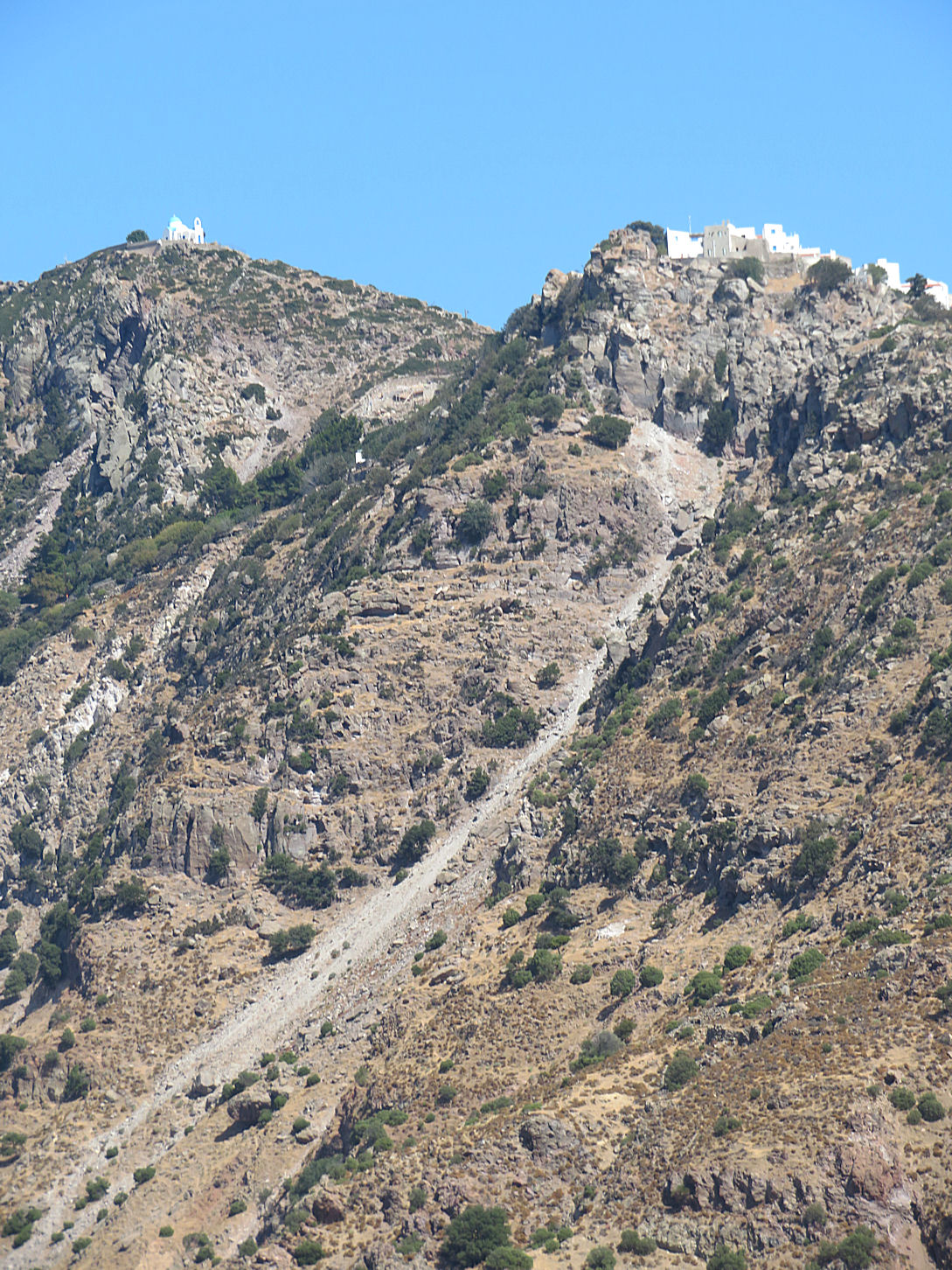
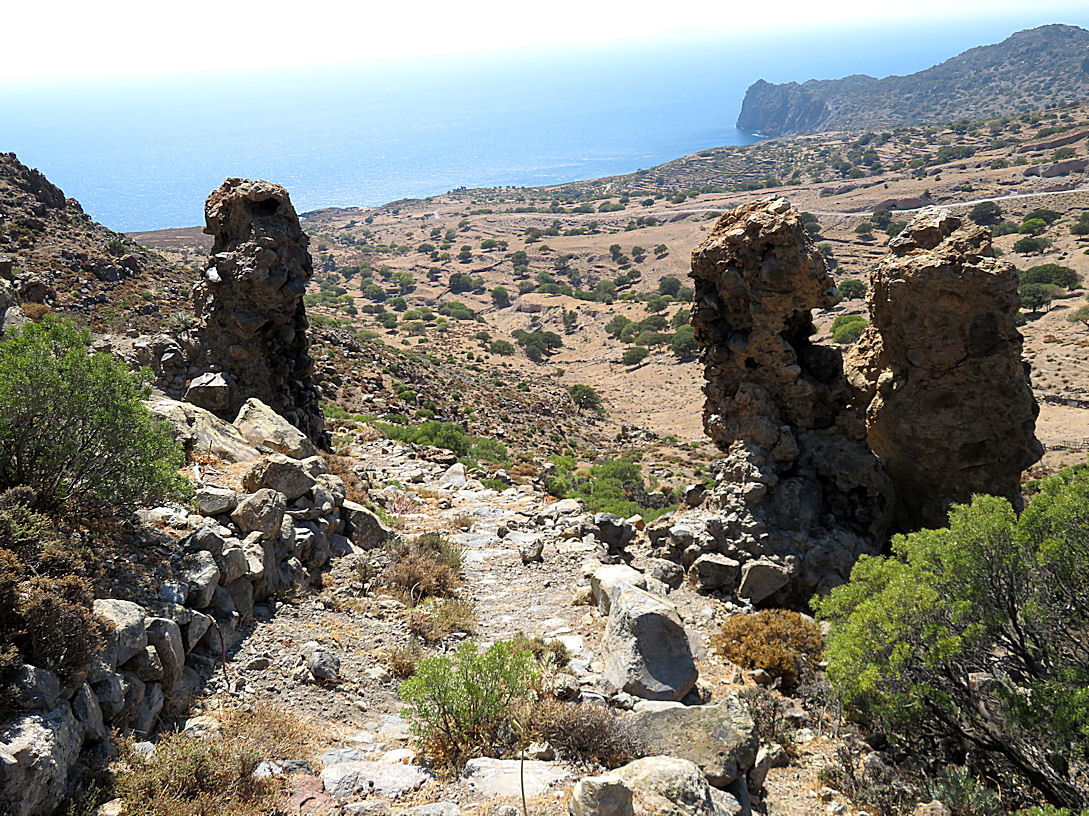
The route passes through an abandoned village …

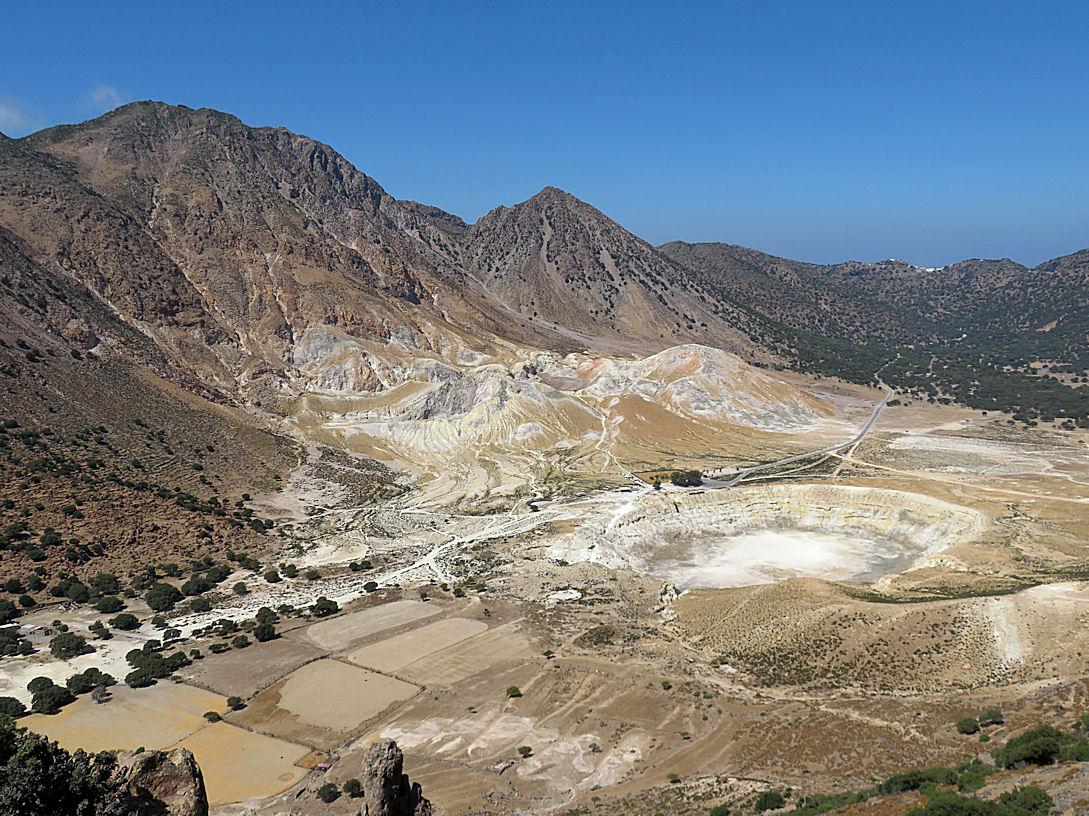
follows the caldera rim with spectacular views down into the craters …..

views back towards Nikia  …..

partly on a stone-paved kalderimi …..

and as it rises up from the low point in a col, along the 3 kilometres of the caldera to Emborios, the other village on the rim at the far end ….

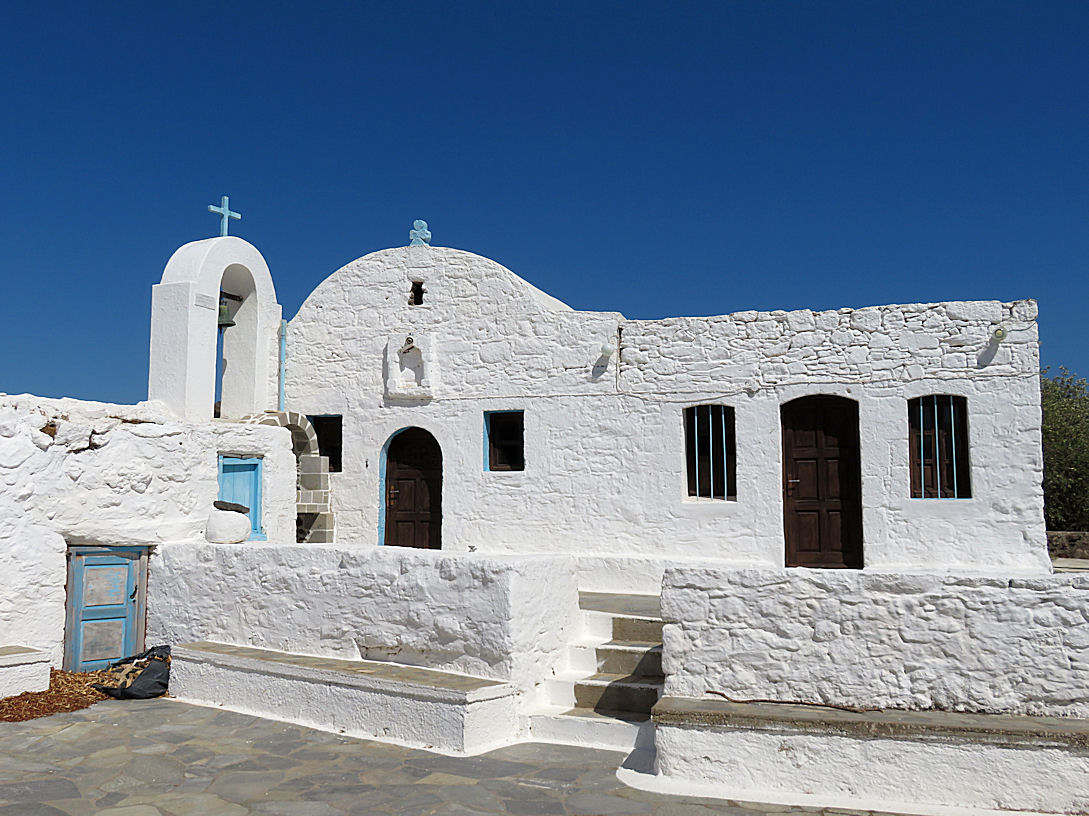
until it reaches Stavros monastery, the last point with views into the craters and the first and last place to find any shade  ….

Posted in Greece, Health and humour, Hiking, Landscape, Mountains, Nature, Photography, Reflections, Uncategorized, Weather | Tagged , , , , , , , , | 5 Comments

Remembering

Together forty years, Apart fourteen years. Skies still grey.

Posted in Uncategorized | 2 Comments

Symi: and now for something ……… unexpected

One of the things I have learned over the years visiting, travelling and trekking around Greece, and make a point of in my book ‘Greece Unpackaged’, is to deal with the unexpected. If things don’t go as planned, find a solution, regard it as an opportunity, enjoy it!

I returned to Symi at the end of the third week in May.  I prefer coming mid-April because the flowers are in full throttle, wildlife is more active, and because the body can more readily make the chemical changes to acclimatise to the heat before high summer.  Brexit put an end to that.  Visits are now limited to 90 days out of 180, so I try to do 6 weeks early summer and 6 at the end.

By the end of May temperatures on The Hot Rock are ramping up, the colour of wild flowers has largely gone, vegetation is parched.  But at least ‘weather’ has changed to ‘climate’, with blue sky every day, no need to check the forecast before heading into the mountains.  Just set a challenge, decide how much ice to put in the water bottle, check the nut-bar, and go.

Not this year.  End of May and into June, weather was still unsettled, temperatures significantly lower than usual. The thunder clouds which tower in the distance over Turkey and Rhodes, built over Symi as well.  The Lightening Tracker app on the phone worked overtime.  For the first few weeks it was prudent to check the weather forecast before committing to any route, and to check the sky and wind direction.  Locals were going around in padded jackets.

Two advantages of the unusual conditions were that cooler temperatures gave an opportunity to acclimatise, not normally possible with an end-of-May start, and the colour of wild flowers was still very much in evidence.   There were no fields swathed in Crown Daisies (known, amongst other things as Edible Chrysanthemum – because they are), but there were far more colours on display.

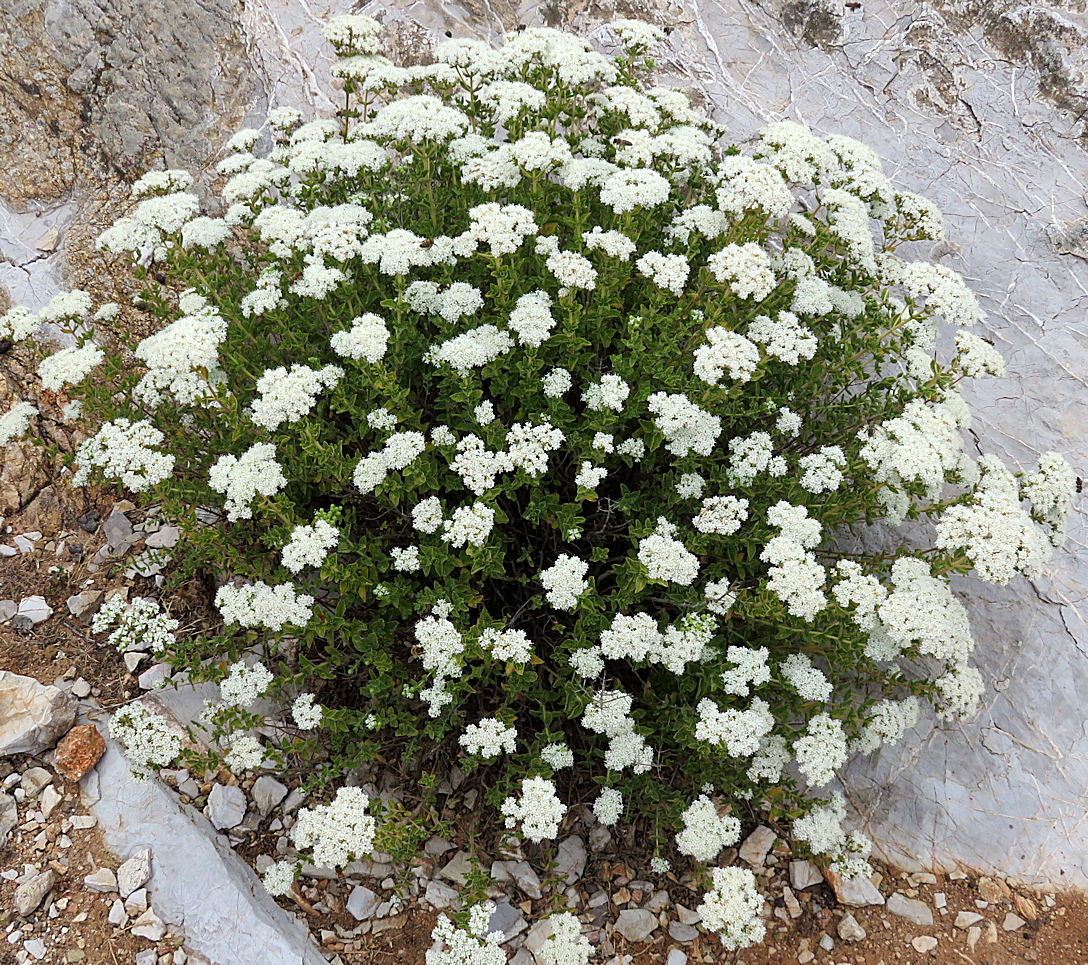
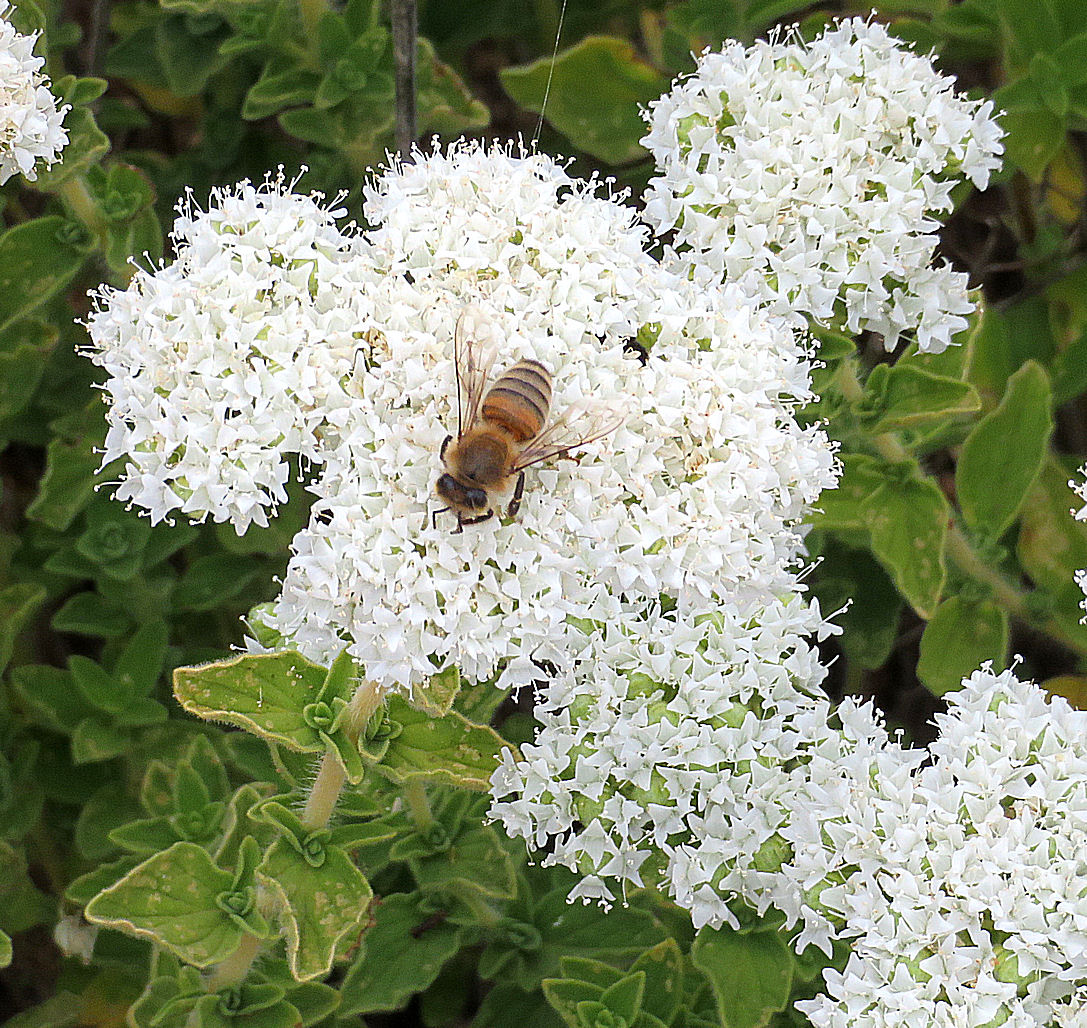
I pick Greek Oregano every year to dry and take home.  Arriving middle of May onwards makes this problematic as flowering has finished and the fresh green shoots, best for flavour when dried, are turning brown and wizened.  This year, no problem, plenty of fresh growth thanks to lower temperatures and more rain. 
As the oregano is finishing flowering, thyme is coming into full bloom, creating a problem walking some routes as huge numbers of beehives are shipped in to maximise the ‘crop’ of much sought-after Thyme Honey.  Great for the bees, great for the beekeepers, bad for walkers. Some of the routes are along paths the width of your foot surrounded by ankle-height buzzing activity.  One route reaches the ridge-top in the middle of scores of hives and bees make it quite clear by deliberately and repeatedly flying into your head that you are regarded as a threat.  Not normally a problem if you know which routes to avoid.  This year, not problem at all because the thyme was late flowering.  One route which I normally only do late April/early May, or at the end of Summer, I did three times in 10 days with not a thyme in flower or bee in sight.

On a few days I didn’t commit to long walks or go particularly high in the mountains because of forecasts for heavy showers and cloud blanketing ridges.  I have an umbrella on Symi because of the possibility of heavy rain in Autumn.  This year, for the first time in Summer, on a couple of days I carried it in my rucksack, though never deployed it.

One such was Sunday 28 May.  I decided on a short mid-level walk because of the forecast and clouds scooting around.  I went to Gria, an abandoned village with a permanent pond high above Pedi but completely hidden from it by rocky crags. After a climb on a road up to the monastery of Zoodohou Pigis (The Spring of the Waters of Life), the onward path immediately becomes narrow and vertiginous.  I’m often asked by people I meet if I’ll take them to ‘The Pond’.  I watch them closely on that stretch of path because if they are hesitant or have difficulty there, there is no possibility they will cope with the final part of the route down to Pedi – which is a drop of a few hundred feet down a series of waterfalls.

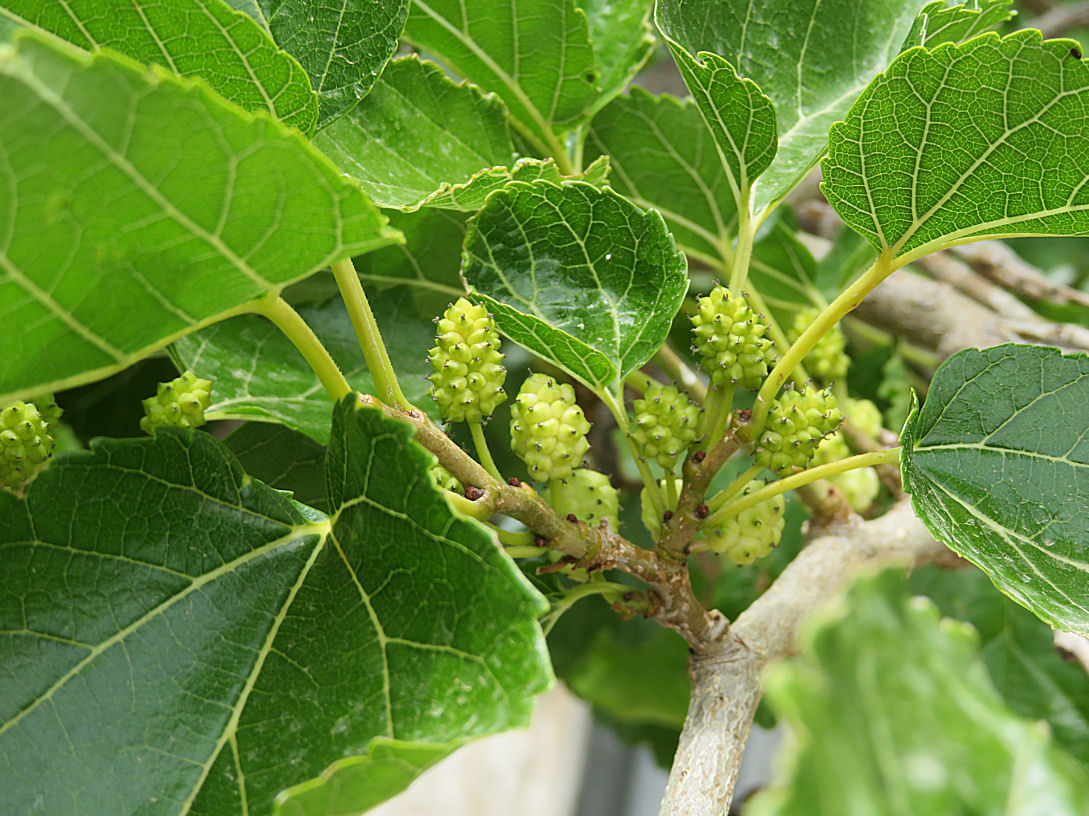
I wanted to visit to Gria to take photos of the inside of one of the abandoned houses, the communal bread oven and the white mulberry growing alongside it. 

Task completed, I checked the sky again.  One of the characteristics of thunder clouds is that they don’t drift on the wind like other clouds.  They suck clouds from all directions so you can’t judge how the Cumulus Nimbus is moving.  It was clear that one was forming more or less overhead.  If you know what you are doing and where to go, the descent of the waterfall only takes about 15 minutes.  The sky becoming significantly darker, I didn’t hang about.

Relieved to reach Pedi, I met up with friends for a beer in the Kamares Taverna on the edge of the sea.  Fifteen minutes later, it rained.  If ever there was an understatement, that was it.  Within minutes there was a stream flowing down each side of the taverna and into the sea.  The area in front of the taverna was under water.  A few days earlier I had sat in the same place looking out at Turkey beyond the end of the bay.  Now I couldn’t see even half way along the bay, the usually placid sea was viciously stippled and almost black.

I was thankful I wasn’t still trying to get down that waterfall.

*******************

Want some summer reading on Kindle?  You could try my book ‘A Small Life in Twenty Memories’

Or ‘Greece Unpackaged’

Posted in Greece, Health and humour, Hiking, Landscape, Mountains, Nature, Photography, Weather, Wildlife | Tagged , , , , , , , | 1 Comment

Wales, Canada, Greece – Looking back, looking forward.

A few weeks ago, we had snow at home.  First time in 2 years.  They had snow on Symi since we had any!! I woke up with 2 inches on the ground and still snowing heavily.  I checked the forecast and, needless to say, dressed for the conditions and went straight out.  After fuelling up on toast and coffee of course.

Big, wet flakes which didn’t portend well.  I guessed the temperature was hovering around zero degrees, probably slightly above.  Great walk up to The Folly Tower in falling snow, then down the ridge to The Grotto before dropping into Pontypool Park en route to buy bread in the supermarket.  Nearly 300 metres lower, air temperature a couple of degrees higher and the panic buyers had churned up the car park into a dirty, grey slush.  Bread shelves bare.

By next morning the snow had all but gone.

It made me nostalgic.  I looked back a few weeks to days snowshoeing in the Canadian Rockies. One of the great things about Banff is that there are many winter trails for days when not skiing.

Spray River

Follow the Bow River from the Town Bridge down to Bow Falls.  Even though the temperature had gone up from the unusually cold spell before we arrived (minus 40-450C) it was still pleasantly well below freezing with good snow depth. Walking on the snow-covered ice at the right-angle bend in the river below the jarringly pseudo-gothic Banff Springs Hotel, showed the Falls to be more than usually frozen, just a narrow band of water bursting through. View downriver towards the Fairholme Range, of the confluence with the Spray River there was no sign as it joined the Bow.  Completely frozen over and snow-covered.  Even so, safer to cross the river at this point by the bridge between the hotel and the golf course.

The well-used Quarry Loop Trail follows the right bank of the river (by convention, the ‘handedness’ of a river is always taken facing downstream) to a footbridge for the loop back.  Instead of crossing the bridge, keep following the river and the compacted trail is now only the width of a snowshoe.  I find it easier in cleats. The river on the right, the old quarried face high on the left from which came the stone for the hotel. Soon the trail rises up to join the wide Spray River Trail, with well-grooved tracks of cross-country skis.  I usually turn left and go back high above the river before re-joining at the confluence with the Bow.

Sundance Canyon

Start this trek at the Banff Canoe Club Dock at the confluence of the Bow River with Forty Mile Creek. For obvious reasons closed in winter (you can’t canoe on ice), the Dock is a good place to strap on snowshoes after the walk through town. The Bow upstream of the town Bridge is well frozen and snow covered, though the Creek is not always so. Snow on the ice is of variable depth, in places stripped by the wind, in places a foot or more deep.

The river is broad, meandering widely, so I take the inside of bends crossing and re-crossing between the tree-lined banks. The major difference between the wildlife in the Rockies and in the UK is that here, it might eat you.  Therefore, it’s prudent to keep eyes and ears alert and to take note of tracks as they cross the river.  Rule of thumb, tracks which follow the river are human, those which cross it are animal.  It’s common to see deer or caribou tracks crossing from one bank to the other.  Occasionally I have seen what I think are Lynx tracks, smaller than the more worrying cougar whose tracks are apparently the size of my hand.  Coyote tracks are not uncommon, more worrying than wolves whose tracks are again significantly larger, though I believe wolves are less likely to attack. This trip I saw the remains of a deer, the only part left, the bloodied backbone and skull being picked over by ravens.

Vermillion Lakes

Again begin at the Canoe Dock but this time don’t take to the river, follow the trail along Forty Mile Creek, crossing the railway line and then onto Fenland Loop.  If there is a train coming you may be in for a long wait as they are two kilometres long, travel through the town at slow speed, and take a long time to pass.  On Boxing Day 2014 a train derailed at this point, three trucks plunging into Forty Mile Creek and taking days to clear.  I know, I was there.

At the furthest point leave Fenland Trail and cross a footbridge up to the Vermillion Lakes Road.  After a few hundred metres drop down to the lakeside, strap on snowshoes and take to the vast area of the frozen lakes.  It’s a huge area to explore.

Keep parallel with the road and come to a couple of areas of open water where thermal springs emerge into the lake.  At the far side of the largest of these, on the Second Vermillion Lake, push through bushes and find a pond with fish and bird life.  I suspect it never freezes over.

One of these days I’m going to trek to the far side of the lake and try to cross the railway track to get to the Bow River and follow that back.  It’s a long way and a hard slog with uncertainty of battling through the trees.  Not such hard work, but far more technically skilful is kite-skiing, which I saw on the lake for the first time this winter.  I have done a lot of paragliding, a similar shaped wing, but I suspect kite-skiing is more difficult and not something I could master in a relatively short visit along with spending time skiing and snowshoeing.

The Hoodoos

For many, a half-day activity is to take the car up to Surprise Corner, on the opposite side of the Bow River to the Banff Springs Hotel and high above the Bow Falls.  It’s certainly a great viewpoint.

It’s also the starting point of the Hoodoos Trail. A path drops down from the car park, to water level.  The trail then follows the spectacular frozen swirls of the river as it splits and meanders, below first Mount Rundle and then the imposing crag of Tunnel Mountain.  For some reason this section always seems to me to be more isolated than other treks, maybe because it’s rarely used in winter and there are no other trails nearby, but more probably because this is where a couple of years ago, I came across two coyotes howling mournfully at each other.  Nose, eyes and ears are hyper-alert for danger.

Eventually, the trail rises up to join Tunnel Mountain Road near the Campground and a trail paralleling the road leading to The Hoodoos Viewpoint.  A handful of cars use the car parks or travel past on the road.  It’s comforting that there are others around but yet I’m left feeling somehow soiled that they have got here in hermetically sealed bubbles rather than by their own efforts and in the real world.  Like getting to the top of Yr Wyddfa via the knife-edge of Grib Goch and finding the train disgorging passengers into the café.

A trail parallel with but not always in sight of the road, leads to Tunnel Mountain Resort.  Here there is a choice.  Wait for the regular bus service back to town, or walk along Tunnel Mountain Drive.  Deep snow cover means the Drive is closed in winter.  The sense of isolation is just as deep as on the other side of the mountain.  But my nerves are jangling and senses even more alert.  Cougars are ambush predators and the short cliff on the upslope side is a prime opportunity.  There have been attacks along here, targeting people as well as deer.  Periodically the area is closed by the National Park Authority to allow cougars to hunt – and move on.

Needless to say, I’ve got away with it so far.

That was all in December and January. It’s good to look back but it’s important to look ahead.  Towards the end of May I head back to the Greek Islands.  Mostly staying on Symi, the plan is also to return to the dramatic volcanic landscapes of Nisyros. There are many treks here, some distinctly off-piste.  Even some sections of the old paths are becoming almost off-piste as they collapse down the steep mountain sides, a process accentuated by feral goats burrowing for plant roots.

One of my favourite routes is from the crater-rim village of Nikia around the crater and then back to Mandraki on the remains of a kalderimi, in part savaged by road construction to access a failed geothermal energy project.

Why not check out my book on travelling independently in Greece – ‘Greece Unpackaged’

Or a brief look at the past; ‘A small life in twenty memories’

Posted in Canada, Greece, Grey Britain, Hiking, History, Landscape, Mountains, Nature, Photography, Pontypool, Wales, Weather, Wildlife, Winter | Tagged , , , , , , , , , , , , , , , | 2 Comments

Banff, Canadian Rockies:  ….. and now for something else completely different.

We arrived after the cold snap, For a couple of weeks temperatures had dropped down as low as -40oC.  And that was in town at 1,400 metres.  Even colder on the ski slopes going up to nearly double that altitude.  Some days ski lifts were closed, too cold to ski and too cold to be sure of the effect on steel structures.  Telling folks that it had been cold in the UK, temperatures having dropped to about -10oC, didn’t cut much ice.

We arrived in a balmy -15oC, warming up at times to -5oC and, on the odd occasion, to 0.  A bit fresher than the +30oC when I left Symi in mid-October.

The usual pilgrimage along the river to the Bow Falls was as spectacular as always.  The trail over the crags was lethal without cleats on boots, people hanging on to the handrails and sliding. Still, a sign warned us: “Trail not maintained in winter.  Use at own Risk”

Upstream of the town bridge the river was frozen across and snow-covered as usual.

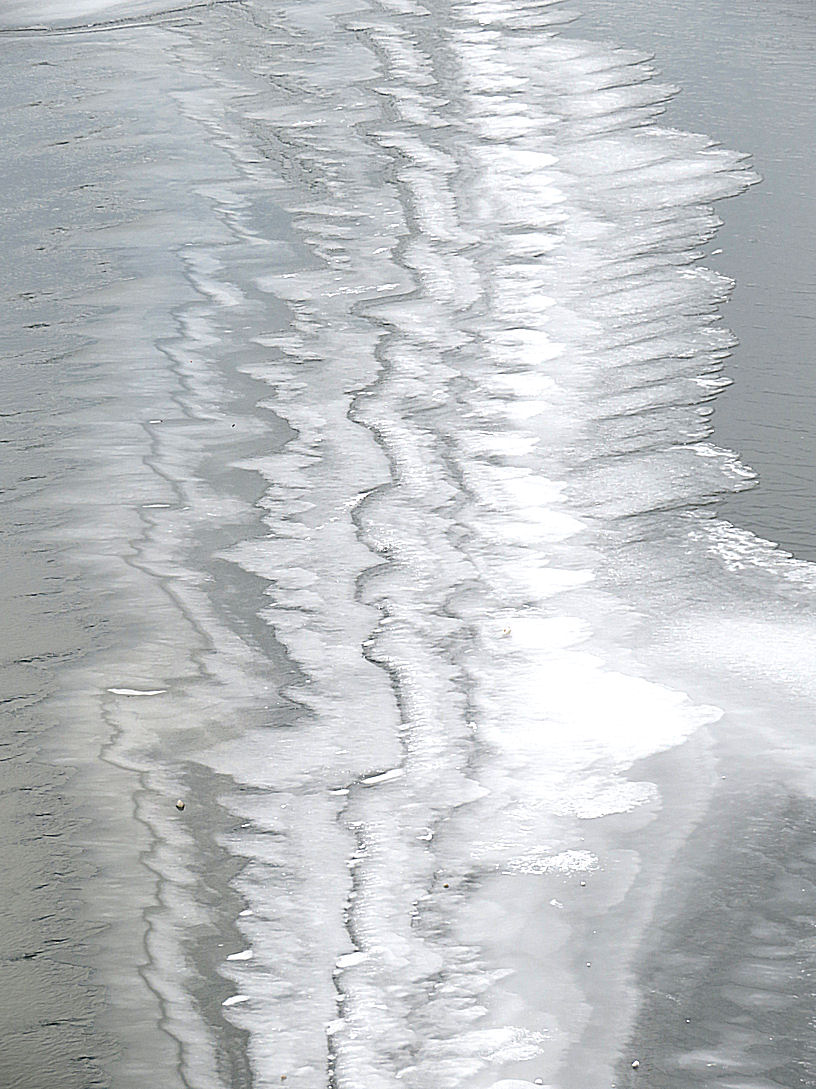
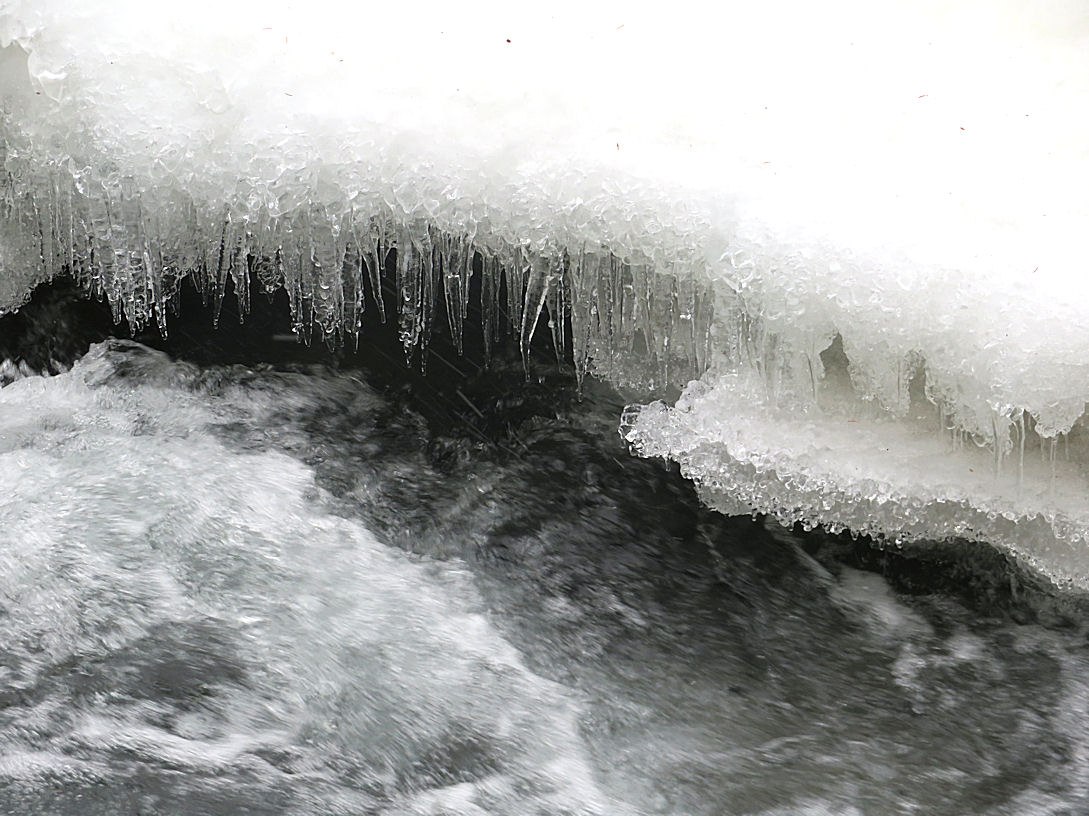
Because of the weeks of very low temperatures, downstream of the town bridge where the river flows faster and maintains a clear channel, there was less open water than the last few times I was here (2019, 1BC) and more ice.   The ice fractures as it is pushed towards the falls, tilts in huge slabs and piles up as if pushed by a juggernaut. Large sink holes disappear into the frothing abyss below.

The Canadian Rockies and hard winter have other interests as well as dramatic scenery.  Wildlife can be elusive in winter but the ‘warmer’ weather recently has seen much red squirrel activity in the pine forests around Banff.  They not only forage pinecones for food but chase each other on the forest floor, around and up trees, between trees – and all at breakneck speed making capturing them in a photo very difficult.  Not sure whether this high-speed activity is aggressive or amorous in intent, or simply for fun.

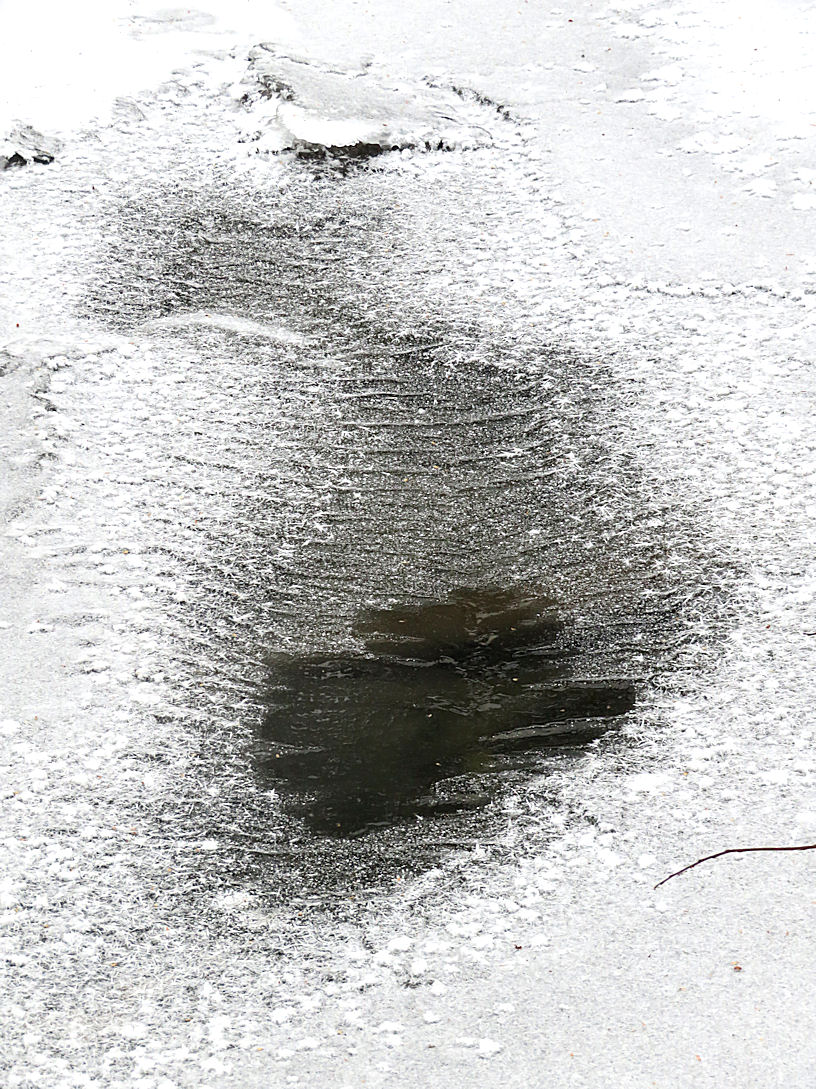
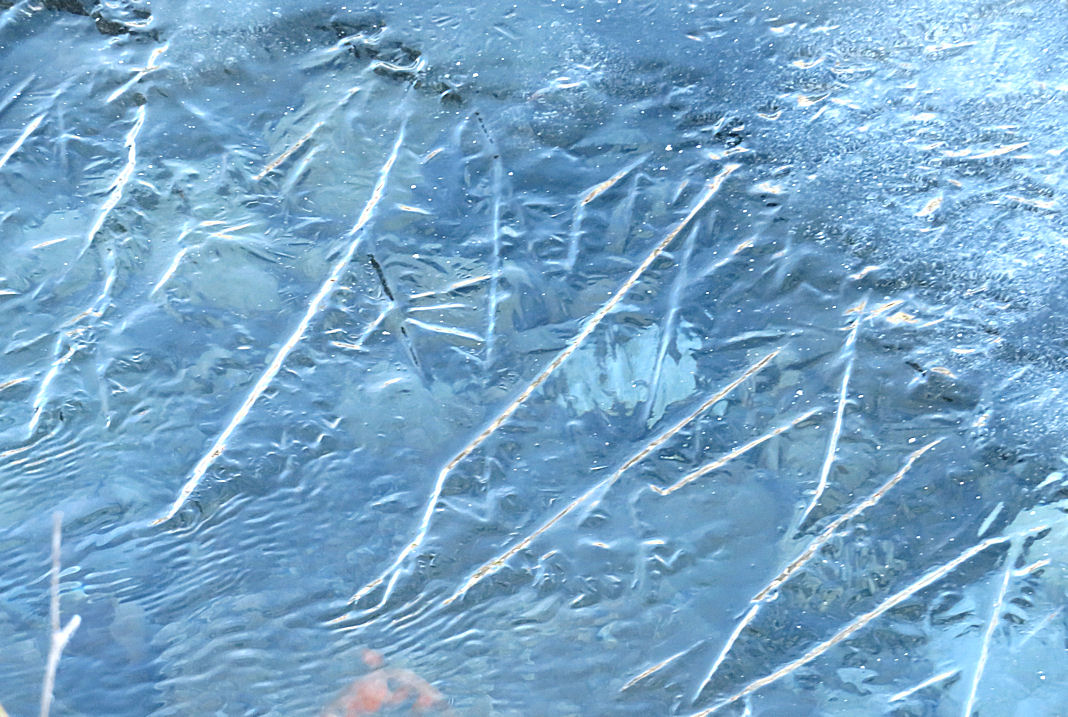
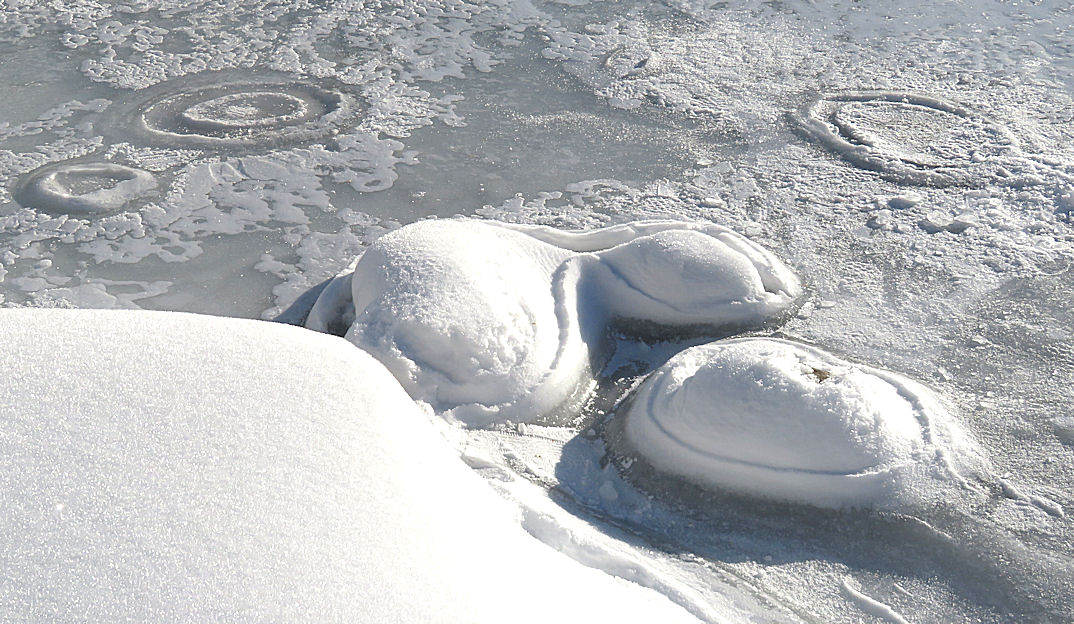
There is beauty at the micro level too.  In the bitter cold, ice crystals form on the outside of windows, growing and changing day-by-day, hour-by-hour.  Overnight temperatures down to -20oC produce nocturnal works of art.

1,5,6,7,8

CLICK ON ANY IMAGE TO ENLARGE

Posted in Canada, Hiking, Landscape, Mountains, Nature, Photography, Weather, Wildlife, Winter | Tagged , , , , , , , , | 2 Comments