Wild walks in Greece on hold

My diary for Sunday 2 June reads “16.35  Aegean Airways flight A3603, arrive Athens 22.10”.  But I won’t be on it.

This was to be the start of a 2 month trip around mountains, gorges and waterfalls in the Peloponnese.  Travelling by bus, route roughly planned with plenty of flexibility built in to explore the unexpected, a combination of new places and the best of those already visited.  No flight home booked as I didn’t know where or when I would end up.

Circumstances change and so plans have to be adjusted.  There is complete uncertainty as to when, or even whether, I’ll get back to Greece this summer so my wild walks are likely to be in Wales with maybe a trip to revisit old haunts in the Lake District if the weather is good.  Maybe head for Langdale and Borrowdale.

When I began the blog, just before my first summer in Greece in 2010, I quoted the Book of Proverbs in the Bible.  Always true but perhaps particularly apt right now: Many are the plans in a man’s heart but it is the Lord’s purpose that prevails”. (Proverbs chapter 19 verse 21).  So, to resort to clichés, I’ll play it by ear, suck it and see, see how things pan out.

As far as the blog is concerned, maybe I’ll revisit some of my previous trips to Greece and write up some of the memorable incidents and encounters.

Langdale in the Lake District, taken many years ago with a film camera and scanned in to the computer.

Langdale in the Lake District, taken many years ago with a film camera and scanned in to the computer.

x

Posted in Greece, Grey Britain, Mountains, Reflections, Wales | Tagged , , , , , , | 1 Comment

A Welsh Spring and clichés of violence

Back in Wales and spring has at last arrived.  Before I left Arctic blasts whipped across the tops of the mountain ridges dumping snow and lowering temperatures so that buds stayed tight shut long past their usual seasonal opening time.  During the short time that I was in Greece there has been an explosion of growth, leaves have erupted fresh-green from buds, blossom has burst open and hedgerows are a riot of colour.

Plants wait for environmental triggers – temperature, rainfall, sunlight – so prolonged winter means delay, queues form and then everything happens at once with dramatic if short-lived effect.  Bees are immobile at temperatures below 7-10oC (depending on species) and are most active at 20-22oC so when temperatures finally rise and blossom opens all at once pollination finally gets underway with a vengeance and it’s dynamite for fruit production.  In the garden I already have a heavy set of red and black currants and gooseberries and I’m hopeful of a bumper apple crop.

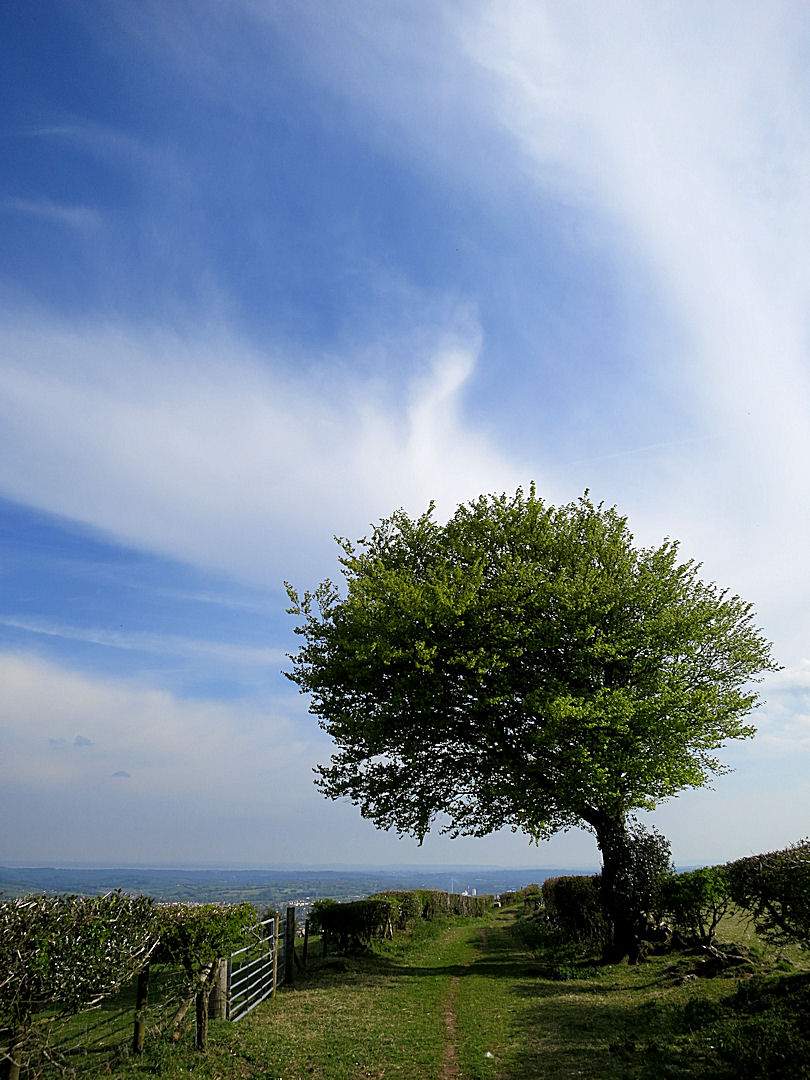
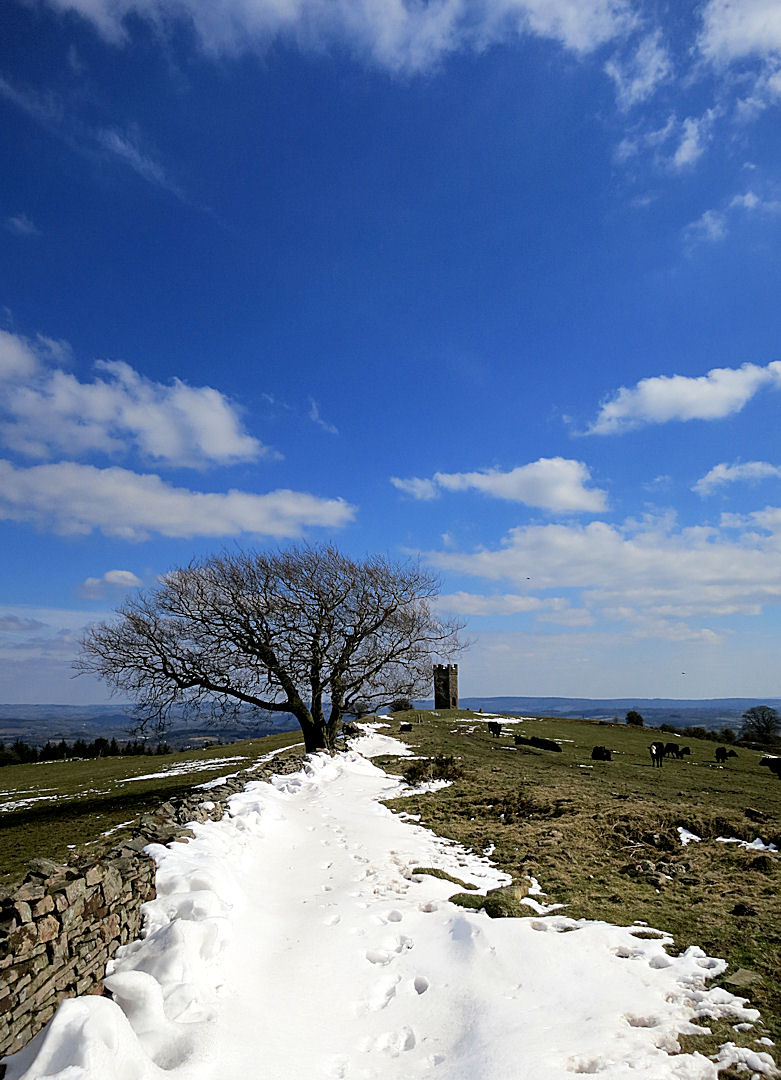
The ridge-top path before I went to Greece ...

The ridge-top path before I went to Greece …

... and when I arrived back

… and when I arrived back

The Folly Tower before I went to Greece ....

The Folly Tower before I went to Greece ….

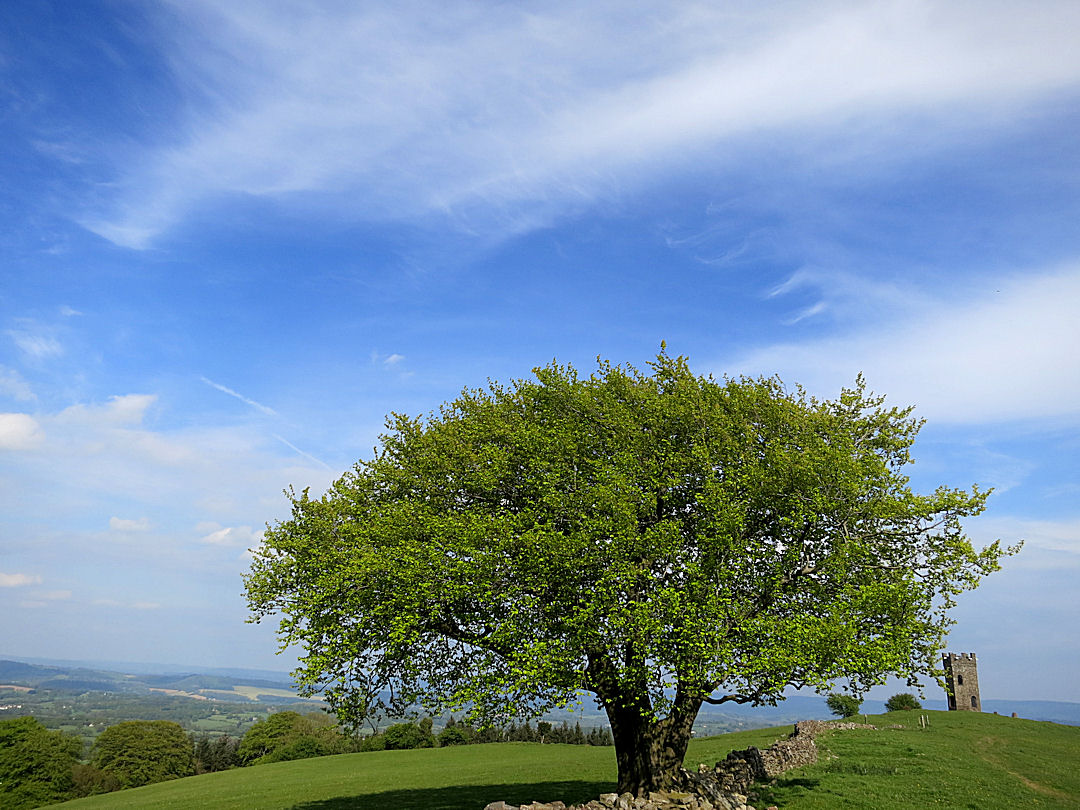
.... and when I got back

…. and when I got back

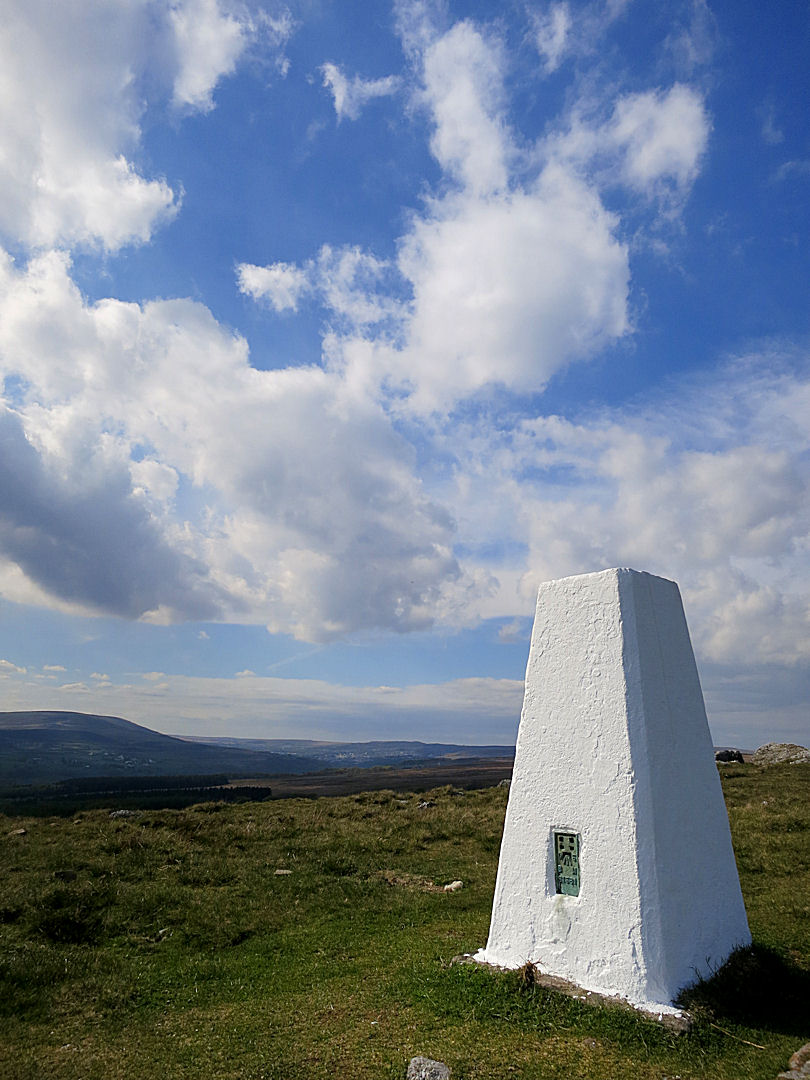
I gave the 'White Stone', as Mynydd Garn Wen is known locally, a fresh coat of paint

I gave the ‘White Stone’, as Mynydd Garn Wen is known locally, a fresh coat of paint

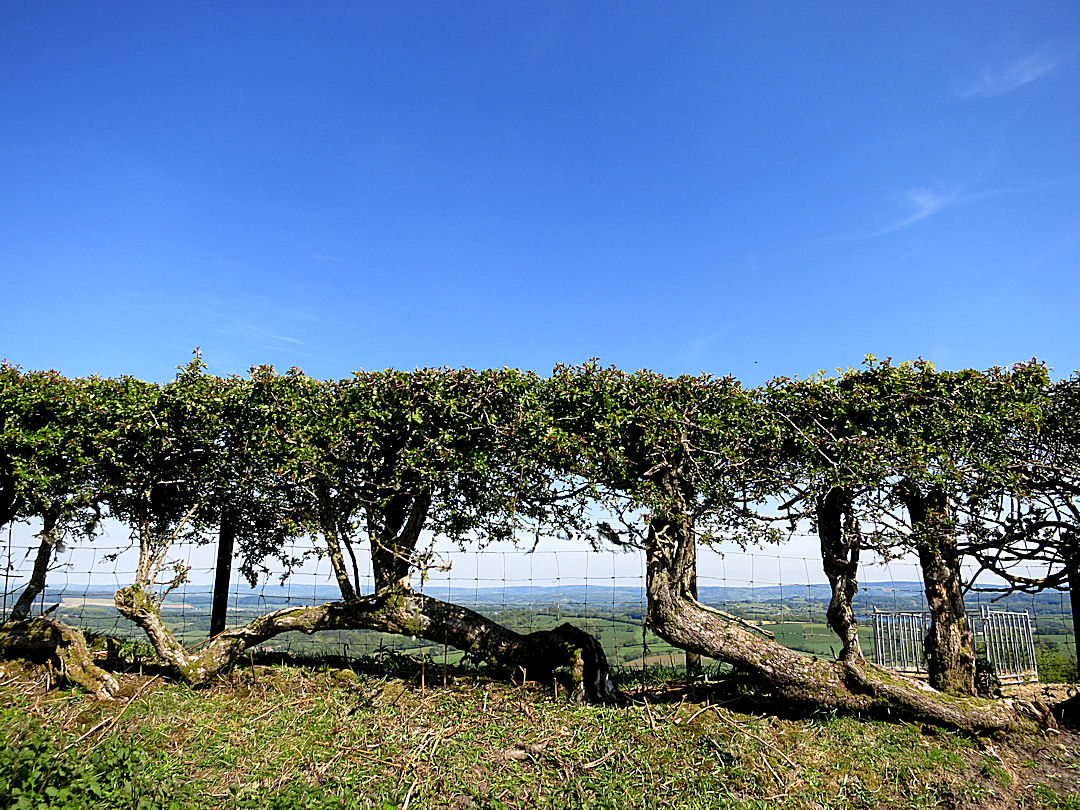
Hedges were once properly 'laid' but are now scalped once a year by machine, stock control now achieved by wire fencing

Hedges were once properly ‘laid’ but are now scalped once a year by machine, stock control achieved by wire fencing

Bluebells are suddenly rampant and very fragrant

Bluebells are suddenly rampant and very fragrant

Leaves on oak trees open later than most and are yellow/green rather than bright 'spring' green

Leaves on oak trees open later than most and are yellow/green rather than bright ‘spring’ green

A digression from rambling in the mountains to verbal rambling .  Have you noticed that many of the clichés of description are words of violence?  Blast, whipped, dump, explosion, burst, riot, trigger, vengeance, dynamite …. to list just the few I used above.

I mention this as  a follow-on thought from the  hypothesis that I tested in the last post on the blog, namely that using ‘explosives’ and associated words as tags significantly increases the number of hits on the blog.  Since I started writing about the recreational use of explosive devices on Kalymnos the hits on the blog have increased dramatically.  After the last post the blog has had the largest number of hits in one day since I began writing it 4 years ago, the average daily total of hits has doubled or even trebled, and the monthly total of hits exceeded the previous highest with more than a week still to go.

This could be interest in the island of Kalymnos, and if it were it would be good sign for the island’s economy, …. but I suspect not.

I find it sad that people resort to violence to achieve their political/religious/monetary/life-style ends but in some ways I find it even sadder that there is such an avid and widespread interest in violence.  This is clearly evidenced by films, TV documentaries, newspaper features …. but that is another story and one that I find too depressing to tell.

Posted in Greece, Monmouthshire, Mountains, Pontypool, Reflections, Spring, Wales | Tagged , , , , , , , , , , , , , , , , , , , , , , | Leave a comment

Kalymnos: last walk, last explosion

I was unusually apprehensive setting out for the mountains on Wednesday.

Since I arrived in Greece towards the end of April the weather had been hot and sunny, more so than might be expected for early summer when it can be ‘unsettled’ even in the Dodecanese.  Skies had been virtually cloudless, afternoon temperatures around 25oC, rarely below 15oC overnight.  Very comfortable, very pleasant but the trek to the top of the mountain on Tuesday had been tiring, I was relieved when I sat down at the end.

The walk I planned for Wednesday was a final challenge before heading home on Thursday.  It would only be about 12 km but I knew it would be hard work, crossing the main ridge of the island from Chora, dropping down to the floor of the Vathys valley and then recrossing the ridge to Pothia, the island’s main harbour.

The cloud that greeted me when I opened the door to the balcony on Wednesday morning was unexpected.  As a heliophile (‘sun lover’ from the Greek ‘ήλιος’ – sun and ‘φίλος’ – friend or lover) it was initially a disappointment.  I would have liked sunshine for my last day but on reflection it was not entirely unwelcome.  I was conscious of both my lack of fitness and lack of acclimatisation to the heat. The abnormally long 2012-13 winter in the UK, with snow and below-freezing temperatures continuing until mid April, barely a week before I left, meant that I was far less prepared physically than in recent years.

I had worked out a rough timetable for the walk. An hour to the top of the first col1, 2 hours to negotiate the flank of the mountain down to the valley floor and along to the return path, an hour to the top of the next col and an hour from there to Pothia.  I had a 7 hour time-slot between buses so that gave me a two-hour margin for error and held out the prospect of a beer on the harbour side if I kept to time.  I reckoned that I might need the two hours not just because of my lack of fitness but also the problem of route-finding.

The path up the gorge to the top of the col is rough but well marked because it is the start of the way to the top of Profitis Ilias where there is an annual celebration on 20 July, attended by half the population of the island so one guy told me.  Somehow I doubt that estimate.  but at least the path has to be fit for church dignitaries in their regalia.  It was a steady pull to the col and despite stops for photographic opportunities it took exactly an hour.  On target so far.

13Kalymnos031w1576jpg

One of the cave remnants in the gorge

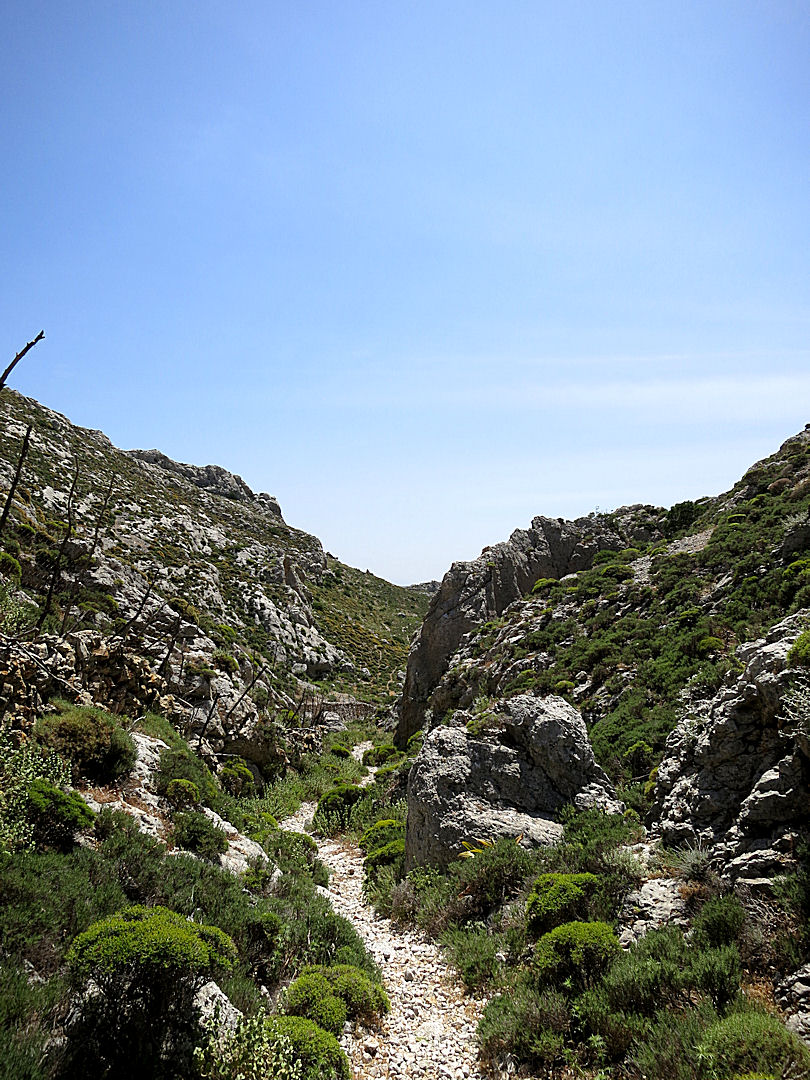
Narrow but clear section of path in the mid section of the gorge

Narrow but clear section of path in the mid section of the gorge

Looking back down the gorge

Looking back down the gorge

The top of the col

The top of the col

Even though from the col it was downhill to the valley floor the next section was the longest and most difficult part of the walk.  Once passed the turn off to the top of Profitis Ilias, the route degenerates to no more than a goat path.  Obvious in some places, especially where it reaches a fence and so has to go through a Greek Gate, much of the upper section of the path is very difficult to find as it zigzaggs narrowly downwards, negotiating gulleys and scree.  Thankfully Red Spot Man had been busy fairly recently and small, fresh-painted red dots about 2cm across confirmed periodically that I was indeed following the preferred route.  On a couple of occasions I had to cast around to find the continuation but no real problems.

The start of the downhill path.  Once through the Greek gate it degenerates to a goat, in places barely discernible

The start of the downhill path. Once through the Greek gate it degenerates to a goat path, in places barely discernible

Another Greek Gate at the top of a steep gully

Another Greek Gate at the top of a steep gully

It was something of a relief to reach the track on the valley floor at the end of the path and to be able to get into a steady stride and set a good pace for half an hour. In estimating the time I had allowed for the difficulty of route-finding and was pleased to find that I had 10 minutes in hand.

From the track looking back up the flank of the mountain to the col (the one on the right was the starting point)

From the track looking back up the flank of the mountain to the col

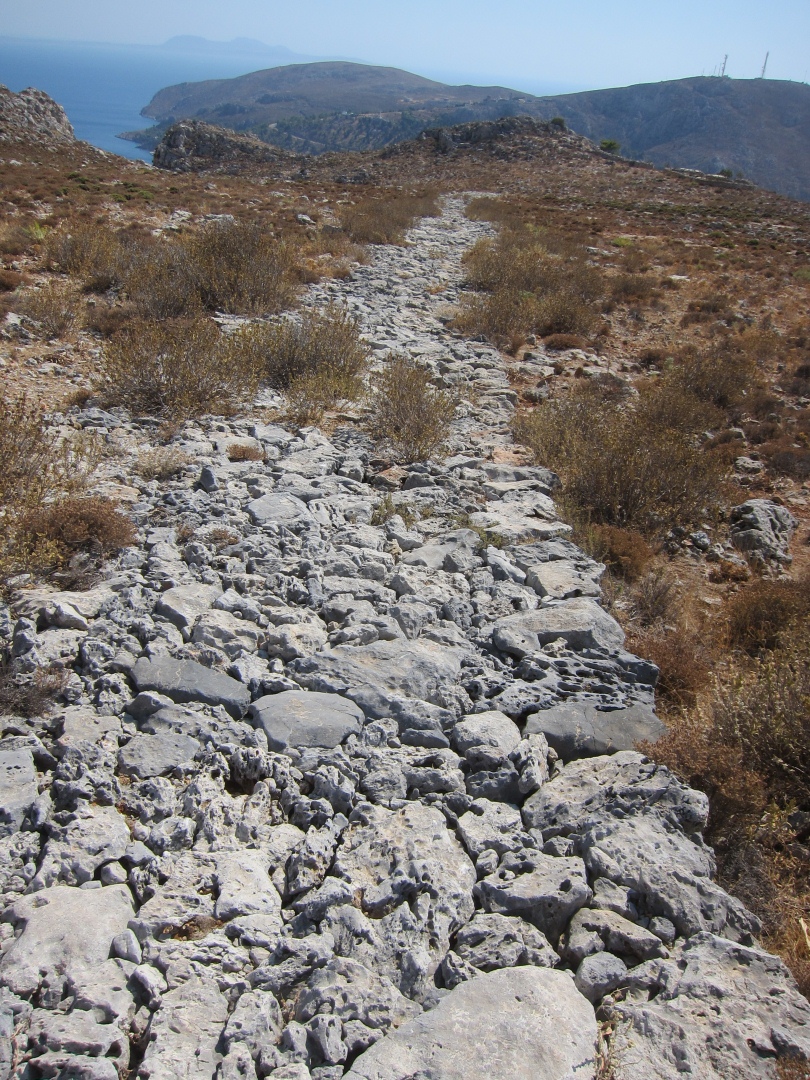
Unfortunately I lost that time scratching around to find the beginning of the path back up the mountain but that only put me a few minutes behind target.  The route to Pothia was the ‘Italian Path’, so called because it was built during the Italian occupation of the Dodecanese.  Probably one of the best paths in the Aegean, it is very well engineered to give a comfortable gradient, much of it rough-paved in limestone.  The long climb to the top was tiring after 4 hours of non-stop walking but I reached the col more or less on time.

It was now 14.00, my bus was at 17.00 and it was an hour downhill on a clear, well surfaced path.  So I took advantage of a plank in the lee of a stone wall to sit for half an hour, eat a banana, dried apricots and almonds, admire the view and just revel in being in the mountains.  I nostalged. 2

The Italian Path across the top of the mountain between Pothia and Vathys

The Italian Path across the top of the mountain between Pothia and Vathys

Relaxing in a taverna on the harbourside in Pothia at the end of the walk, resting tired muscles, my ears were once again assaulted by explosions. Nowhere near as numerous as on Tuesday but still the odd ‘thump’ of dynamite.

I mused idly whether these explosive devices are ‘bombs’.  They would certainly come within the dictionary definition of “a container filled with explosive or incendiary material designed to explode” (abbreviated from the Oxford English Dictionary).  Ignoring the complication of differentiating bombs from fireworks and non-explosive bombs such as pyroclasts (volcanic bombs), there is an implication that a bomb is intended to do harm to people or property and this certainly does not apply on Kalymnos.  The fact is that to Kalymnians throwing dynamite is purely recreational.  The larger and more numerous the explosions, the greater the fun.

Apart from the fascination of the practise, I mention this again to test the hypothesis that using ‘explosives’ as a tag significantly increases the number of hits on the blog.  From the interest which the last two posts have aroused I half expect shoe-bombers coming to look for supplies or MI5 to knock on the door and search the garden shed.  Don’t waste your time guys.

1  Don’t know what a ‘col’ is?  Check out http://en.wikipedia.org/wiki/Col

2  ‘to nostalge’  a new verb introduced to the language last year :
https://barryh2.wordpress.com/2012/06/27/areopoli-last-day-in-the-mani-a-grumble-about-footpaths-and-a-new-word-for-the-language/

Posted in Greece, Reflections | Tagged , , , , , , , , , , , , | Leave a comment

Kalymnos: mountains and traditions

After the Easter celebrations it was back to the mountains and a change of plan.

On Tuesday I caught the morning bus to Chora, the old village above the harbour, then set out to walk up a narrow gorge and to the top of the highest mountain on the island, Profitis Ilias.   Mountains in Greece rarely have paths to the top unless there is a reason to go there.  Climbing to the top of something just “because it’s there” doesn’t cut much ice with most Greeks but building monasteries and churches on the top of mountains does, particularly if it happens to be the highest mountain on the island, or in an area on the mainland.  If there is a monastery there will be a path.

Passing through the narrowest part of the gorge, towering cliffs topped by the 4th Century castle rebuilt by the Knights of St John in the 15th on my right, I heard behind me the deep thump of an explosion.  There had been many explosions in Pothia on Monday which I took to be devices left over from Sunday evening but I didn’t expected it to continue on Tuesday.  This was a deeper sound than the others and the percussion wave seemed to roll up the main valley possibly indicating a larger amount of explosive charge.

The narrow part of the gorge, Chora below

The narrow part of the gorge, Chora below

The ramparts of the Crusader castle on the top of the crag

The ramparts of the Crusader castle on the top of the crag

Climbing higher and looking back towards the castle crag

Climbing higher and looking back towards the castle crag

Looking back over my shoulder I saw that the island’s quarry was opposite and, knowing a little about these things from monitoring quarry blasts as part of my work, I put it down to resumption of activity after the Easter Weekend holiday.  A few minutes later there was another.  And then another.  In my experience quarries don’t work like that, two maybe three blasts a day at most even when supplying large contracts.  This was more dynamite throwing but the sound was different, a fact that I put down to the greater distance attenuating the higher frequencies, only the deeper rumbling carrying this far.

It was a hot day and the climb sustained, the path becoming steeper and more rugged the higher it went.  I left the main path and followed the goat-track alternative, scrambling up dramatic rocky outcrops while  trying to spot the goatherd above me whistling to his animals to collect them together.  The bells around the goats’ necks gave a flat, tinny ‘clank’ as they moved but on the jagged, broken mountainside I could see neither them nor their keeper.

High on the mountain I reached a small pasture, fresh-green with Spring growth rather than the crisped brown of high summer, around a cluster of wells fenced off for safety.  The goats, numbers depleted by the traditional Easter Sunday feast of Μουούρι) (Mouri, whole goat stuffed and roasted in a large clay oven) were being gathered.  No sign of the goatherd though I could still hear his whistling.

Looking from the wells to the summit

Looking from the wells to the summit

Looking down on the small area of pasture around a cluster of wells,

Looking down on the small area of pasture around a cluster of wells,

More colourful and more typical of the mountain

More colourful and more typical of the mountain

I am still very unfit and not yet acclimatised to the heat but I got to the top in 1½ hours, relieved to find a bit of shade on steps at the side of the monastery in which to sit to eat my banana and nuts.  ‘Filoxenia’, traditional Greek welcome and hospitality for strangers,  was shown by the fact that not only were the monastery and the church open but there was a cupboard containing all the necessary ingredients and kit for making coffee, with a notice saying so in English as well as Greek.

Another guy reached the summit as I was leaving, fully kitted out in big leather boots, thick woollen socks up to his knees, thick twill trousers and a thick long sleeved shirt.  I was wearing my customary sandals, shorts and singlet and on the way up had been perspiring profusely in the end-of-morning sun; this guy must have sweated pints.  He was English of course.

The Earth's surface tilted slightly as I reached the monastery on the top of the mountain

The Earth’s surface tilted slightly as I reached the monastery on the top of the mountain

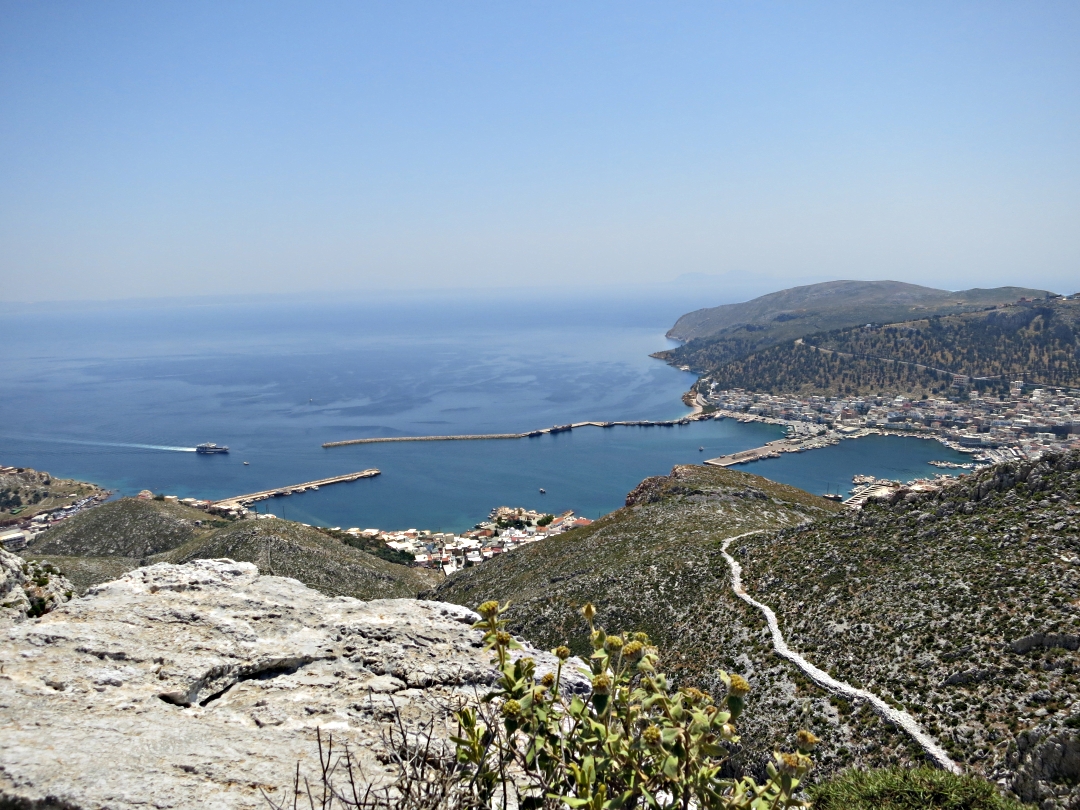
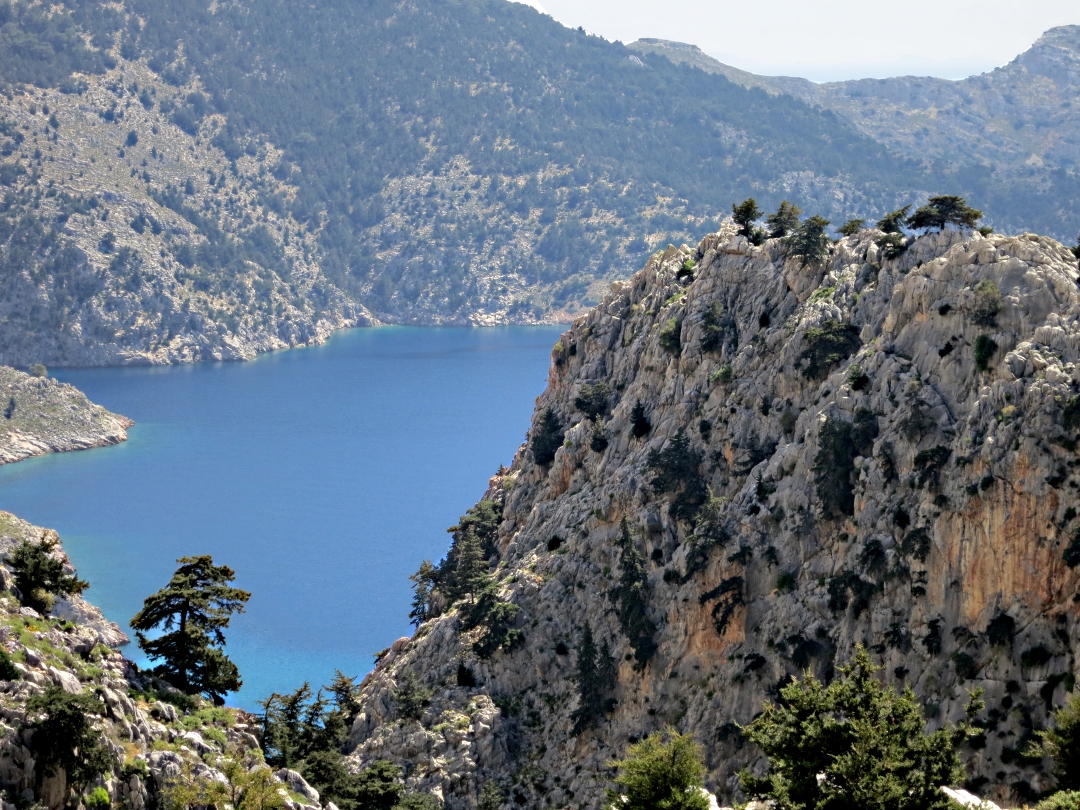
View down the ridge to the Vathys valley and the fjord-like harbour

View down the ridge to the Vathys valley and the fjord-like harbour

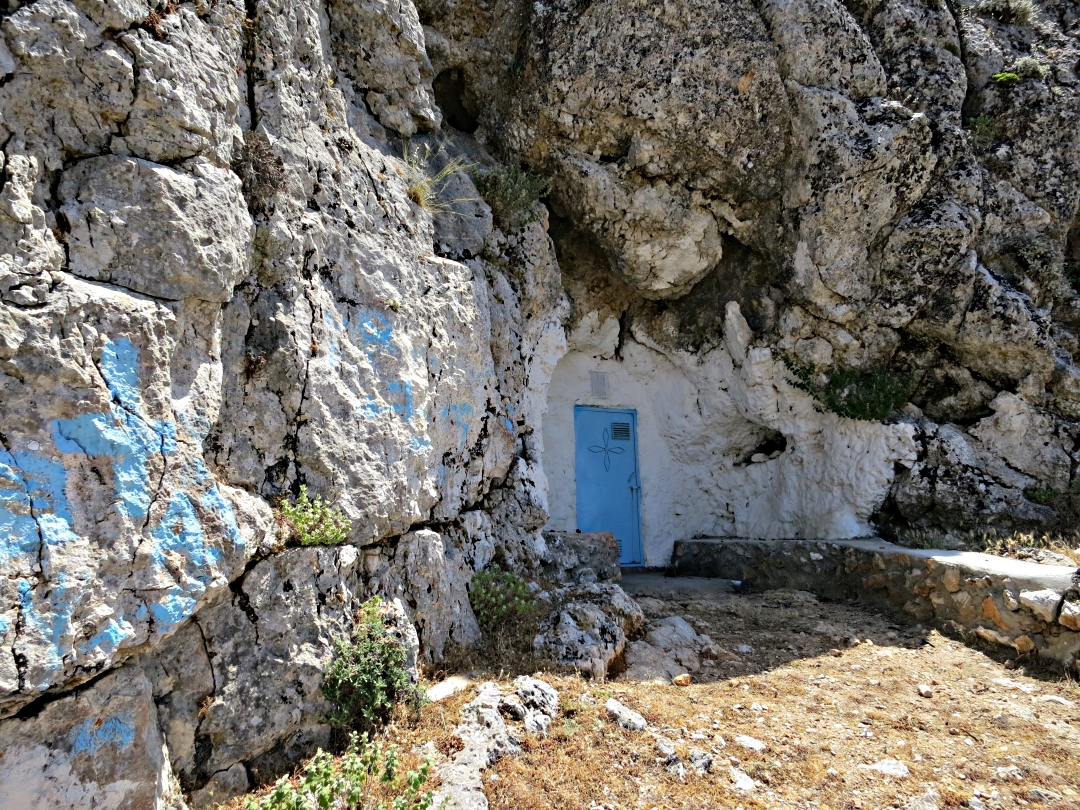
On the way back down I visited the tiny chapel of Agios Ioannis Theologos (St John the Theologian) built onto a cave with a very simple white-washed interior.  Small and isolated though the chapel is it is still kept clean and candles are obviously lit regularly.

Built into the mountain, the tiny chapel of Agios Ioannis Theologos

Built into the mountain, the tiny chapel of Agios Ioannis Theologos

Simple white-washed rock of the interior

Simple white-washed rock of the interior

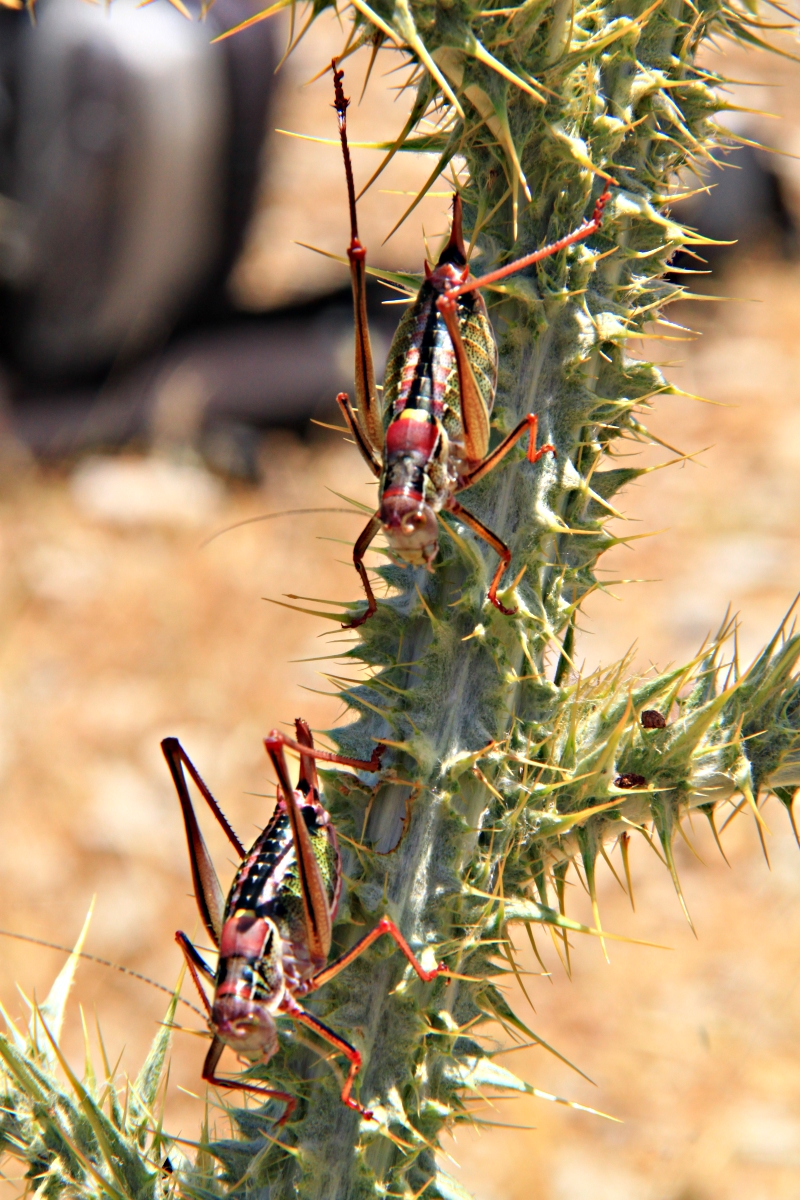
I went back down via the main path, a little longer but easier going than the goat-track, making it a more or less circular walk rather than out-and-back, pausing to inspect local wildlife.

Spider

Spider lurking on  aggressive thistle

Cricket

Cricket’s  contemplating other things below.  Next day I passed the same spot and the spider was  feasting on one of them

Arriving back at Chora with plenty of time to kill before the second bus of the day to Emborio I decided to go down to Pothia for a well earned beer.  I had heard explosions rumbling around the rocky slopes on and off all morning and into the afternoon.    Down in the town they were a whole lot louder and, as the afternoon wore on, became more frequent.  These were not firecrackers but dynamite explosions.  At times there would be a rapid salvo of some ten or a dozen in quick succession.  I wandered along the seafront to try to locate the source and they seemed to be coming from houses at the northern corner of the harbour, the location given away by the tell-tale puffs of smoke after each.

Some guys getting together to drink beer and have a party.  Using explosives left over from Sunday.”  said Dimitri later.  They are only small, about 300 grams.  Still enough to blow your head off” . Though small by the standards of Sunday evening, exploding a few feet above the harbour they would certainly make any party go with a bang.  Must have been a ‘Bring Some Dynamite’ party.  Close your eyes and looking upwards you could see through your eyelids the curving flash of light streaking rapidly overhead in advance of the slower sound wave.  Kalymnians like throwing explosives and around Easter it seems they are reluctant to let tradition go.

Another, longer walk on Wednesday, more about which in another post.

Change of Plan?  For various reasons I returned to the UK earlier than expected.  Now back in the grey and wet but reluctant to let go the memory of the sunshine and the warmth of the hospitality.

Posted in Greece | Tagged , , , , , , , , , , , , , , , , , , , , , , , , , , , | 1 Comment

Kalymnos: Easter with a bang … or two

Clean Friday

Pothia, the main town and harbour of Kalymnos on Good Friday, ‘Big Friday’ or ‘Clean Friday’ as it is known in Greek gave a faint inkling of what it must be like in a besieged city like Sarajevo during the Balkan conflict or Damascus today.  Not that there was any killing but there were explosions just about every minute of the day.  They varied between the sniper-like ‘crack’ of fire-crackers, ‘bangers’ as we knew them as kids, and the occasional deep thump of dynamite which reverberated through the body.

Small children threw bangers from their doorstep and covered their ears as the explosion echoed and amplified in the narrow streets.  Now and again a really meaty explosion seemed to come from the harbour itself.

“They’re just practising for Sunday” said Dimitri.  I thought to myself “if there are this many explosions on Friday what is the main event going to be like on Sunday”. Nobody turned a hair, just carried on chatting normally, the noise hardly seeming to register.

Apparently there are fireworks in most places in Greece at midnight before Easter Sunday to celebrate the Resurrection of Christ after the sombre crucifixion of ‘Clean Friday’ but in Kalymnos they traditionally take the celebration to a whole different level with large-scale throwing of dynamite from the craggy mountain overlooking the town to the south.

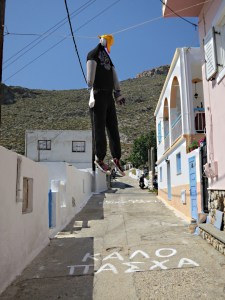
As I walked through the narrow streets and alleys up to the shoulder of the mountain to the north of the town time and again I came across “ΚΑΛΟ ΠΑΣΧΑ” (Good Easter) and “ΚΑΛΗ ΑΝΑΣΤΑΣΗ” (Good Resurrection) painted in large letters across the road.  In a couple of places there were crudely made stuffed dummies hanging from posts or wires across the road.  To British eyes they looked like Guy Fawkes effigies but I guess that they were meant to represent Christ on the cross, to be taken down at midnight on Saturday.

It was very alien to my own church background but it didn’t cause me any problems.  On the contrary it brought home to me as I trudged up the mountain that it was a visualisation of the fact that Christ did hang on the cross, shown by a tradition dating back centuries to when symbolism was a major form of communication for the mass of people who couldn’t read or write in the same way that frescoes in many of the old churches are.  What is important is to go beyond the symbolism to the reality of what is being portrayed.

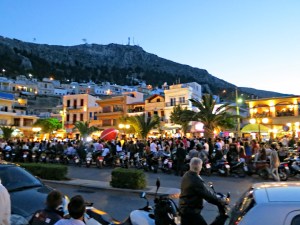
Traditionally Easter is a much bigger festival than Christmas in Greece.  Theologically this makes sense in that the crucifixion and resurrection are more important than the birth of Christ.  Certainly Clean Friday, was big in Pothia on Kalymnos.  When I got back to town from the mountain the bars and restaurants along the harbour front had gradually filled to capacity as families came from church, dressed in their best for the occasion, and sat to eat at long tables, friends chatted over a frappé or a beer.  The roadside was packed with parked cars, motorbikes and scooters.  There was a distinct buzz between the bangs.
Pothia, a very Greek harbour
Pothia, a very Greek harbour

13Kalymnos010w1495jpg

Symbolism to celebrate Easter, KALO PASKA painted everywhere
Pothia, a very Greek harbour

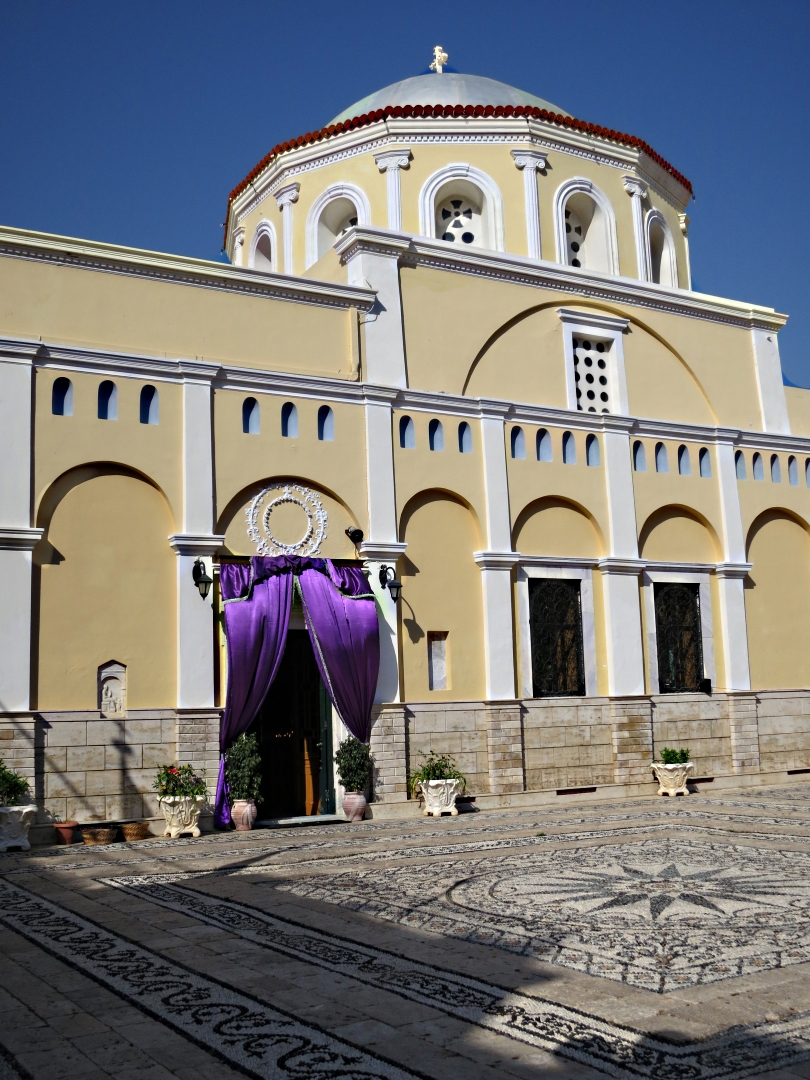
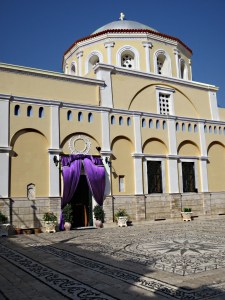
Main church in the centre of Pothia dressed up for Easter

I couldn't decide if this represents an Easter Egg, a bomb. or a bomb disguised as  an Easter Egg

I couldn’t decide if this represents an Easter Egg, a bomb. or a bomb disguised as an Easter Egg

... but there is no mistaking this powder mark where a small device exploded feet from crowded restaurants

… but there is no mistaking this powder mark where a small device exploded feet from crowded restaurants

Easter Saturday

Saturday was considerably quieter than Friday but that was because I was in Emborios rather than in Pothia.  Had I been in Pothia it would have been considerably noisier. I know this because as I sat tapping away at the keyboard on my balcony I could hear the explosions rumbling like thunder in the distance at a few second intervals for nearly an hour from noon onwards.

Dimitri had explained.  “There are two Resurrections celebrated in Greece.  The first is at noon on Saturday.  That is to remember when Mary Magdalene and the other women went to wash Jesus’ body and found the tomb empty.  On Kalymnos we celebrate that with dynamite but only small charges.  That’s for the youngsters learning the trade.  There are more explosions at noon on Sunday to celebrate the Second Resurrection but the biggest explosions are towards dusk on Sunday when they can be seen best.”

He showed me some footage filmed among those throwing the dynamite.  It was very impressive, more so than what is on YouTube.

In Emborios there were periodic small bangs but “they are just firecrackers thrown by children” said Dimitri somewhat disparagingly.  I walked up to the Kastri high in the crags and the crack of explosions echoed around the small rocky amphitheatre.

Towards midnight it’s time for church service to welcome the Resurrection and then the return back to homes carrying a lighted candle, the Holy Light, lit from a candle jn the church in turn lit from a candle flown by jet to Athens from Jerusalem where it is lit ‘miraculously’ in Jesus’ Tomb.  Back in the house it is used to light another, bigger candle.

There then follows the traditional cracking of red-painted Easter eggs one on the other.  There are few of the chocolate variety in evidence in the shops unlike the UK.  The holder of the egg which remains uncracked is said to have good luck for the year.  My egg was cracked at both ends fairly early on so I’m spared from expecting anything.  The eggs, hard boiled of course, are then eaten as the precursor to a meal of soup made from the entrails including the lungs and stomach-lining (tripe) removed before the goat is put in a traditional clay oven to cook slowly for 12 hours or so, the traditional ‘Mouri’.  The soup is to break the Lenten fast and prepare the stomach for the feasting to follow on Sunday.

Before the gathering breaks up at close to 2 in the morning I am advised that “from tomorrow morning and for the next 40 days we don’t say κάλη μέρα’ (good day) when we greet each other.  Instead we say Χριστός ανέστη! (Christ is risen) and the response is Αλήθεια ο Κύριος (Truly He is Lord).

I don’t know how much of this reflects personal faith in Christ but at least the traditions remain and are wholesome.   
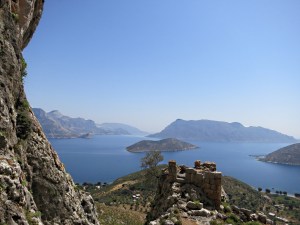
Peace and quiet at the Kastri

Peace and quiet at the Kastri

Easter Sunday

Sunday begins quietly and slowly after the night before.  In the kitchen preparations go on for the feast.  The goat is brought from the oven and sampled, then cut up and mixed with herbs and rice.  The previously removed heart, lungs and kidneys are wrapped in intestinal membrane and sinew into small parcels, dressed with oregano, threaded onto a spit and roasted slowly.  There are dolmades with vine leaves from the garden, stuffed mushrooms, and a large Greek salad.  Around the middle of the day the family gather for the meal at a long, shady table in the garden  I’m welcomed, privileged to join them.  It’s not rushed, it’s enjoyed, savoured.

In the evening I get on the back of Dimitri’s motorbike and we go to Pothia for the Big Bang.  We plan to watch from the main square on the harbourside and it’s already packed, only able to park the bike in the narrow side streets leading from the harbour.

Perfect timing, we arrive as the very first explosion of the evening goes off.  The compression wave is felt through the body even though the explosion is several hundred feet above the town.  “The small ones are about 3 kilos” says Dimitri, “The larger ones go up to about 12 kilos.  There are not so many this year because the price of the explosive has gone up quite a lot.  The larger ones cost about  €50 each.  Probably only about 2000 this year .”

He explains the techniques and the ethos.  How it’s imperative to be precise and calm particularly when lighting the fuses in strong wind like tonight.  How the satisfaction, the thrill, is watching the device leave your hand and arc through the air. How no one except the throwers are allowed on the mountain.

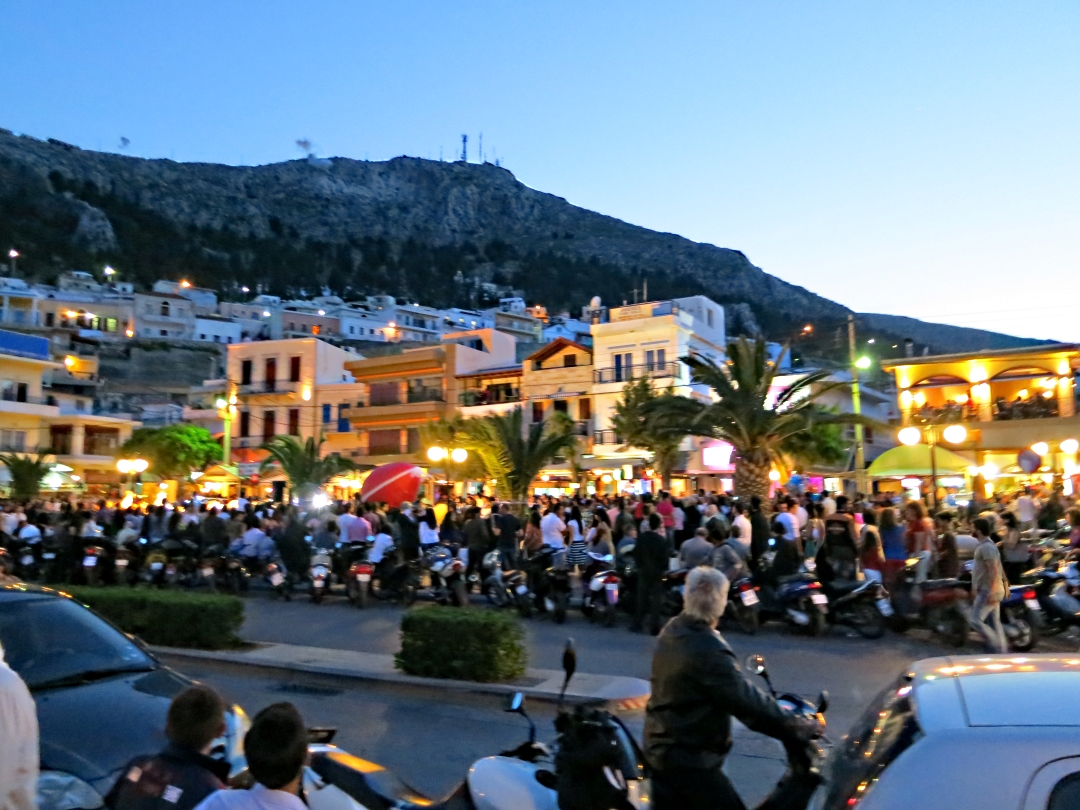
It’s carnival time in Pothia.  Vendors with strings of helium filled balloons wander through the crowd.  All the tables in the many seafront bars, tavernas and restaurants are full.  We stand with hundreds of others watching device after device explode, feeling most of them compress the cavities in our bodies.  Some are single explosions, others are  coordinated to go off in rapid sequence.  Depending on the explosive used the smoke is either white or brown.  The flash becomes more vivid as darkness descends, each lasting microseconds, most effective in coordinated sequence. I set the SLR to servo drive and at 3 frames per second shoot over 250 frames in short bursts, capturing just a handful of flashes.

13Kalymnos015w9729jpg

Dynamite throwers line the rim of the mountain

13Kalymnos016w9743jpg

The flashes seem to get brighter, the explosions bigger

13Kalymnos017w9827jpg

……… and bigger

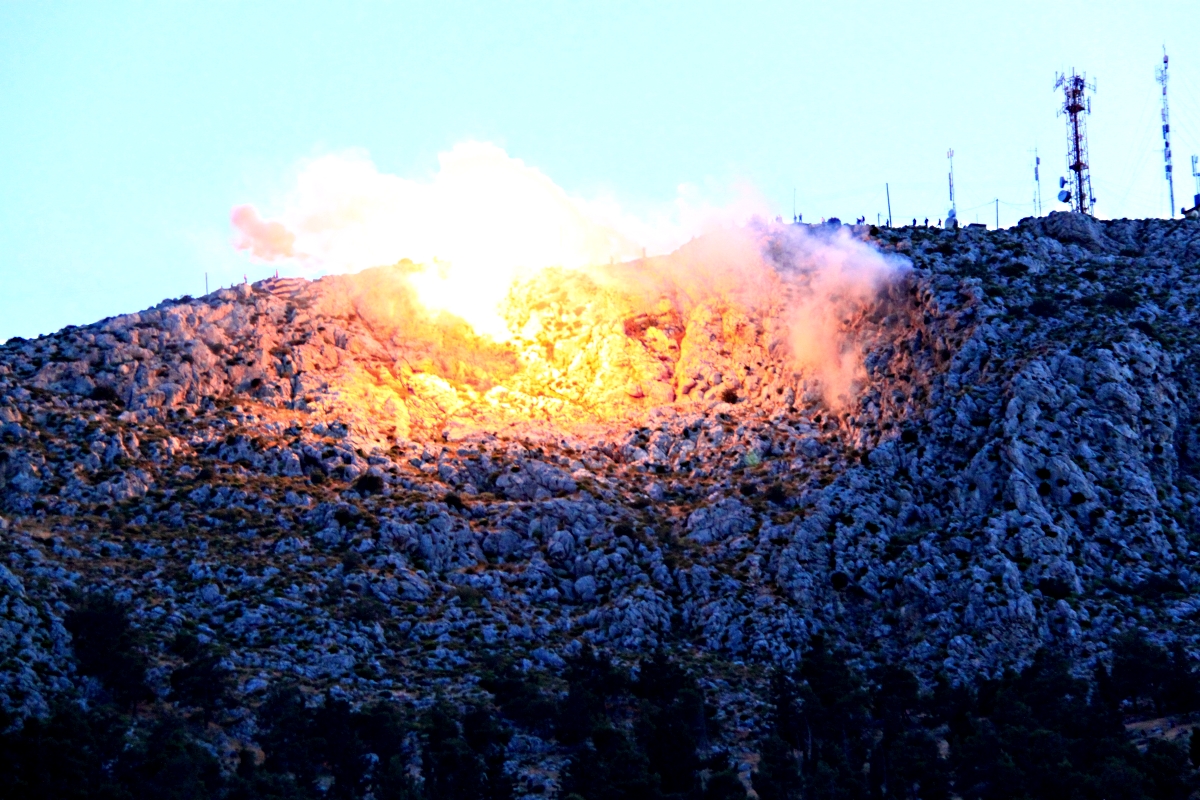
Carnival time in Pothia, looking up to the Exploding Mountain

Carnival time in Pothia, looking up to the Exploding Mountain

I have been to many pyrotechnic displays in European countries but have seen nothing this. Easter on Kalymnos certainly goes with a bang … or 2000.
Posted in Greece | Tagged , , , , , , , , , , , , | 1 Comment

Kalymnos: rock and more rock

The main thing which strikes you about Kalymnos is …. rock.  Craggy mountains rise steeply above the harbour and are the dominant backbone the whole length of the island.  Much of the rock is precipitous and this plus warm, sunny weather attracts climbers from all over Europe, especially at this time of year before the weather gets too hot.  Climbing with the sun on your back is not only energy sapping but also means sweaty, greasy fingers which a chalk-bag can only do so much to remedy.
At the moment hire cars and scooters are zooming around taking climbers to the many parking places which the island council has provided close to the climbing crags to successfully encourage the sport to the benefit of the island’s economy.

I’m not doing much climbing myself as I don’t have my kit here and no climbing partner but I do take advantage of my limited climbing ability to try to get better perspectives for photos, occasionally leaning out from the rock holding on by one hand while operating the SLR with the other.

Just a few rocky shots below.

Following the 'Italian Path' from the main town, zigzagging steeply up between towering crags

Following the ‘Italian Path’ from the main town, zigzagging steeply up between towering crags

.... climbing the crag on the right of the path for a perch on top to eat a banana

…. climbing the crag on the right of the path for a perch on top to eat a banana

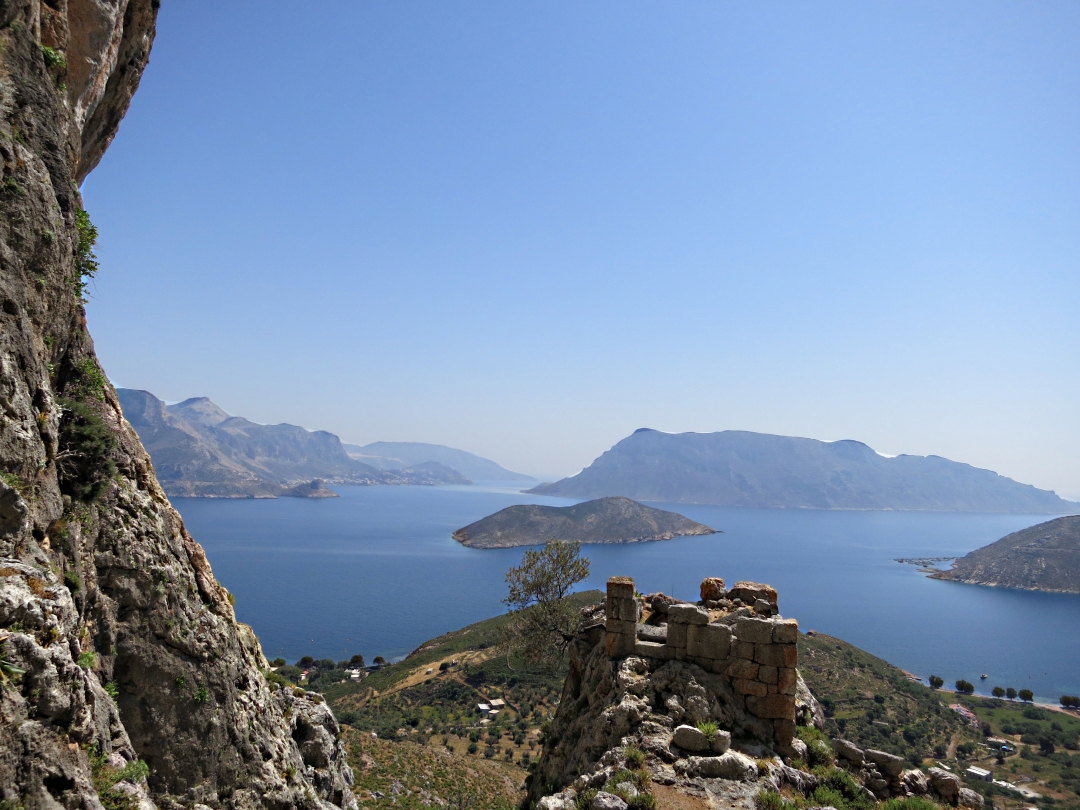
Looking through an 'eye' in the rock along the channel between Telendos Island and Kalymnos

Looking through an ‘eye’ in the rock along the channel between Telendos Island and Kalymnos

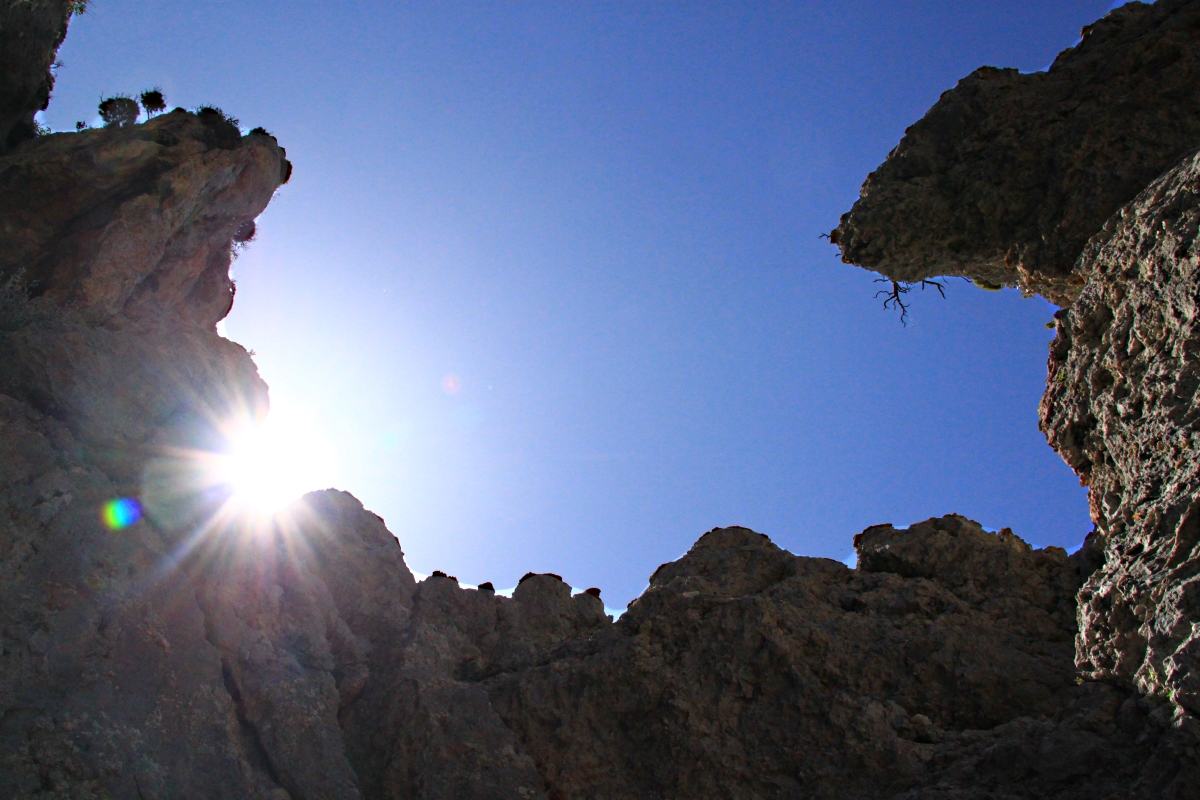
The sun peeping over the top of towering crags

The sun peeping over the top of towering crags

The 'Kastri' above Emborios, ancient fortress built into the crags

The ‘Kastri’ above Emborios, ancient fortress built into the crags

Another angle on the Kastri, ancient olive perss in the foreground

Another angle on the Kastri, ancient olive perss in the foreground

High among the crags, the local variant of the 'Stink Lily' smells like excrement rather than corpses

High among the crags, the local variant of the ‘Stink Lily’ smells like excrement rather than corpses

x

Posted in Greece | Tagged , , , , , , , , | Leave a comment

From Symi to Kalymnos: from peace and quiet to tranquility

On my one full day on Symi I walked across the island to Agios Vasilios, a bay on the far side with a tiny monastery nestled into the cliffs.  It was always a favourite with my late wife and I not only because it is such a beautiful place but because it offered complete peace and solitude.  Only occasionally did other walkers trek over there and the beach was plenty big enough to accommodate the few who did.  In recent years however boat trips around the island from the main harbour have taken to making it one of the stopping-off anchorages for a swim and high speed boats zoom in for a picnic lunch.  

On Monday I had the walk and the beach entirely to myself.  The trip boats have not yet started business for the season and there were no power boats around.  The only sign of life was the very occasional fishing boat drifting across the entrance to the bay, almost silent except for one playing Greek basouki music loudly as the fisherman went about his tasks.

Flat calm sea, peace and quiet in Yialos, the main harbour on Symi, stark contrast with the yachts and gin palaces crammed in during the summer.

Flat calm sea, peace and quiet in Yialos, the main harbour on Symi, stark contrast with the yachts and gin palaces crammed in during the summer.


First glimpse of Lapathos Bay, usually known as Agios Vasilios

First glimpse of Lapathos Bay, usually known as Agios Vasilios

Looking down to Lapathos Bay with the monastery of Agios Vasilios built into the rock and perched precipitously on the edge of the cliff

Looking down to Lapathos Bay with the monastery of Agios Vasilios built into the rock and perched precipitously on the edge of the cliff

Peace and quiet on the beach at Lapathos Bay

Peace and quiet on the beach at Lapathos Bay

On the way back to Horio from Agios Vasilios.  The view down to the harbour one of the most dramatic in the Aegean.

On the way back to Horio from Agios Vasilios. The view down to the harbour one of the most dramatic in the Aegean.

Tuesday and my brief stay on Symi was at an end.  The 09.30 high speed cat took just over two hours to race north to Kos and then to Kalymnos and a different world.  The main town, Pothia, was bustling, there seeming to be far more motorbikes and scooters than I remember, probably because many Kalymnians who have moved to neighbouring islands or Athens come back for the dramatic Easter celebrations for which the island is famous.

Not that I’m staying in the main town, so the noise was only temporary.  I took a bus to the other end of the island and the tiny village of Emporios.  It has two buses a day, no ADSL and no 3G signal.  This presents communication problems and will severely curtail posts on the blog.  But as a place to stay it’s about as tranquil as you can find, best defined by the Greek word ‘ησυχία’ (isihia).

The bay at Emborios on Kalymnos, about as tranquil as it gets.

The bay at Emborios on Kalymnos, about as tranquil as it gets.

By contrast, ‘ησυχία’ is not what is on offer for the Easter celebrations.  But that is another story.

Posted in Greece | Tagged , , , , , , , , , , , , | Leave a comment

From Rhodes to Symi: new beginnings and a whiff of death.

No problem getting to Rhodes’ Colonna harbour for the 08.30 high speed cat to Symi , nor in buying a ticket (more about which in a later blog …. maybe).  On the way it was heart warming to see a local fisherman tenderising an octopus on the harbourside just inside the port gates, fingers inserted inside the body lifting it to arms-length overhead and then splatting it down on the stone wall in a 5-second iterative rhythm.  Apologies for offending the sensitivities of vegetarians but I’m encouraged by generations- if not millennia-old traditions being kept up.  (I must add that I don’t extend the same tolerance to the likes of fox hunting, only to food production, matters of personal/family/community survival).

Arrived on Symi 09.30 and, only pausing to greet my old friend Takis (in traditional Old South Wales he would be known as ‘Takis the Leather’.  Great guy.  Fabulous craft and art.  Now a TV personality), I shouldered my 30 kilograms of baggage and walked up the 100 metres of steps of the Kali Strata to Horio and the Hotel Fiona.

Many of the businesses around the harbour are not yet open but everywhere there was the sound of frantic sawing, hammering, sanding and the smell of painting as preparations are made for the coming summer which in weather terms has arrived unexpectedly.  For a small island like Symi, after a winter with no income, the cleaning, painting, freshening all carry the frisson of excitement of a New Beginning.  “Maybe this year things will pick up!!”

Until the last few days it has been wet and dreary in the Dodecanese but now it has gone straight to summer.  Cloudless sky and temperatures rising rapidly from overnight 20oC made the task of preparation possible as well as urgent with Easter looming.

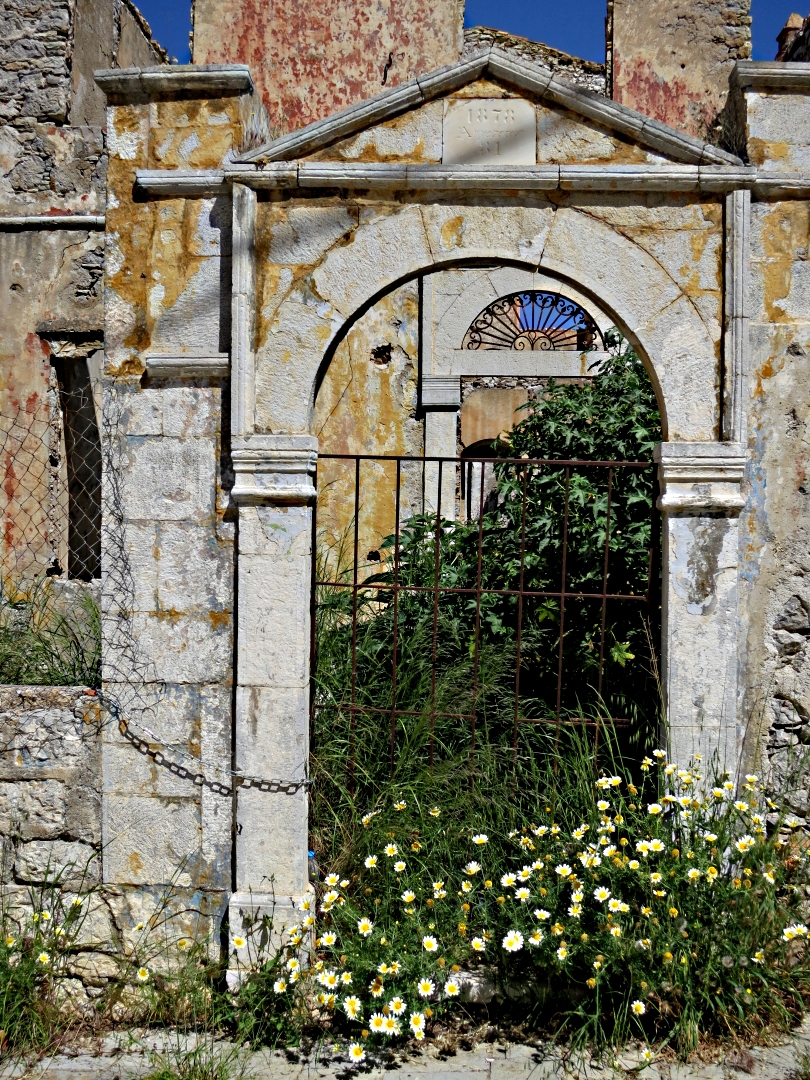
Built in the 19th Century, derelict since damage in WW2, today brightened by floral threshold

Built in the 19th Century, derelict since damage in WW2, today brightened by floral threshold

13Symi002w1338

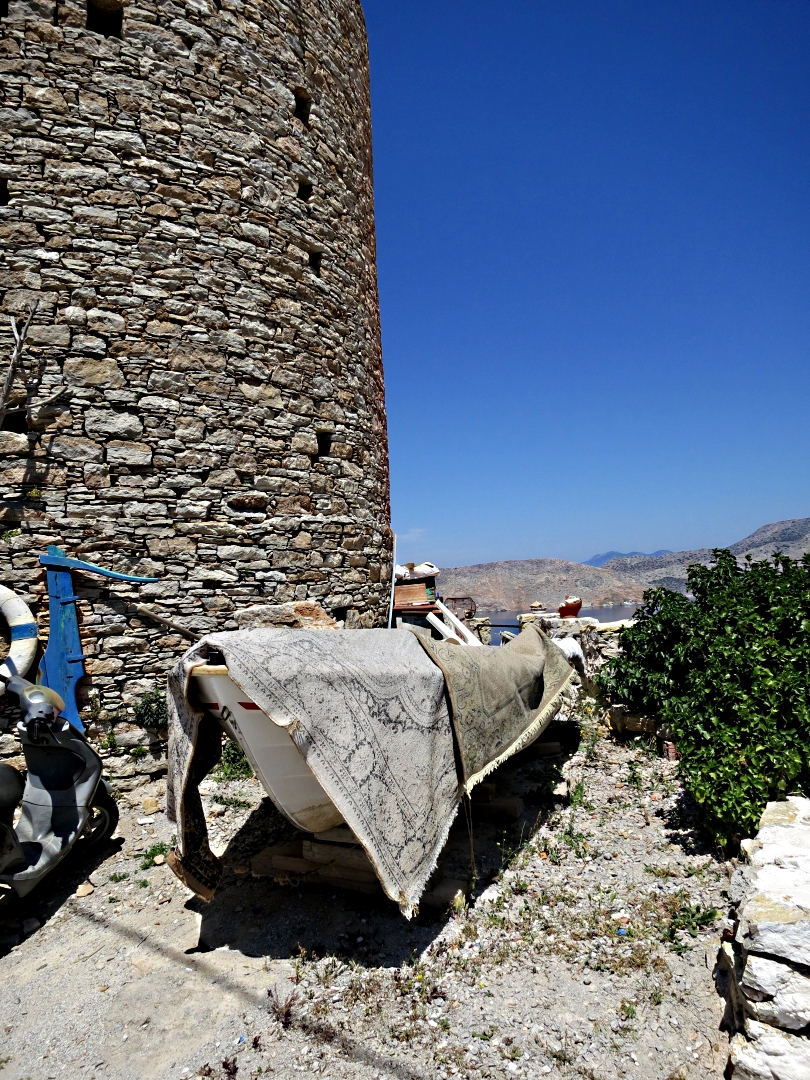
carpets dragged outside a restored windmill to ‘air’ after a wet winter indoors, just one of many signs of getting ready for summer

The arrival of summer in April also made the walk up the Kali Strata ‘interesting’ in the mountaineering sense.  I may have shrunk slightly from 6 foot tall but I’m of slight build  and 30 kilos is not far short of half my body weight.  Coming straight from temperatures closer to zero in the UK with little opportunity to get out walking in the mountains meant I am not only unfit but not acclimatised to the heat.  Presumptuous I know but surviving 100 metres of laden step-climbing confirmed my assumption that whatever I die of it’s unlikely to be a heart attack. Though, despite the old adage, I sweated like a horse rather than perspired like a man (a lady would have merely glowed but I couldn’t bring myself to ask a lady to carry my bags).

After cooling off and changing into walking gear I headed off to walk to Agia Marina, a small beach at the end of the headland between Yialos harbour and Pedi Bay for those who know or want to look it up on the internet.

The route is very rocky and the island council has done its best to make it impassable by planting alien shrub species which now threaten to block the path.  But the over-riding impression of the walk today was that the smell of death was all around.

This is the earliest in the year I have been in the Dodecanese islands and the difference is dramatic.  During the height of summer and through September everywhere is parched-brown and shrivelled to a crisp.  Today it was a different place.  After the unusually wet weather everywhere is greener and flowers are profuse and vivid.

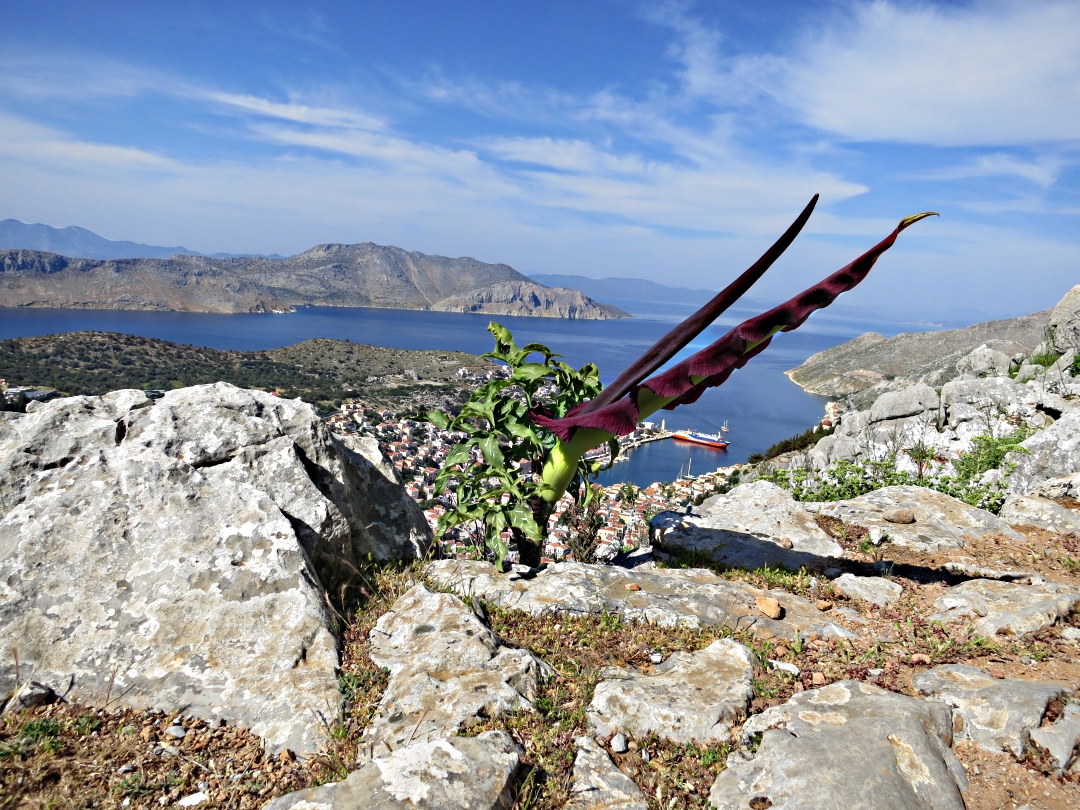
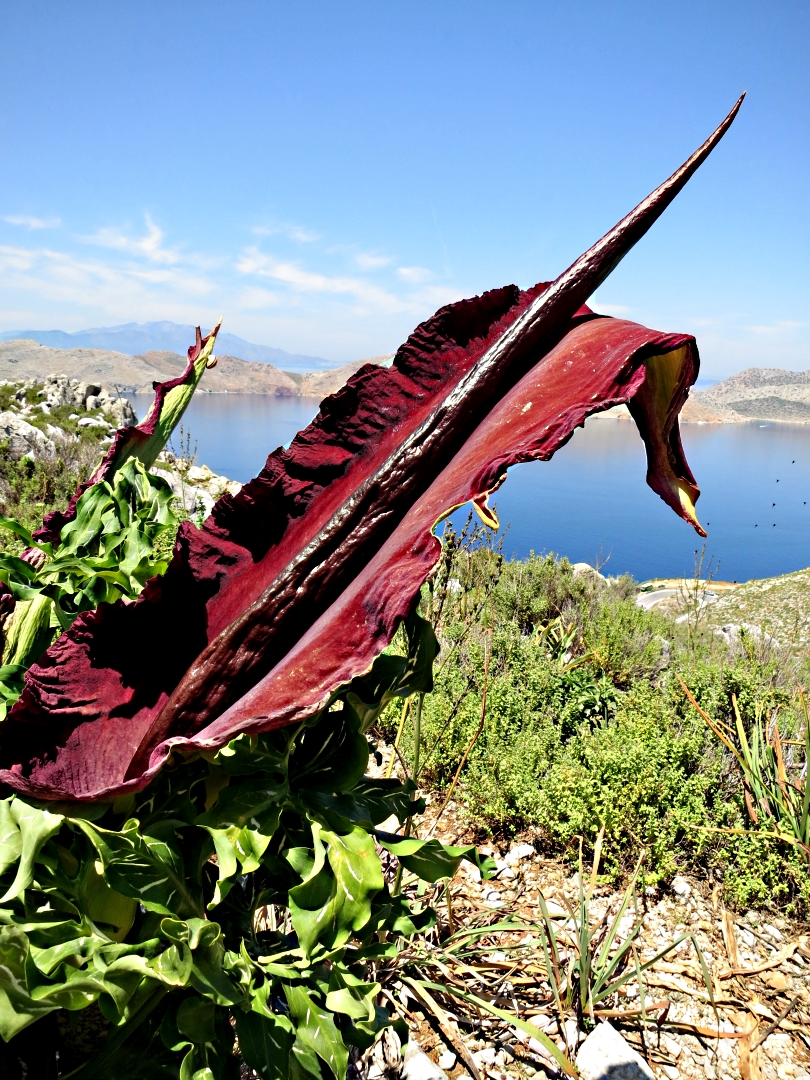
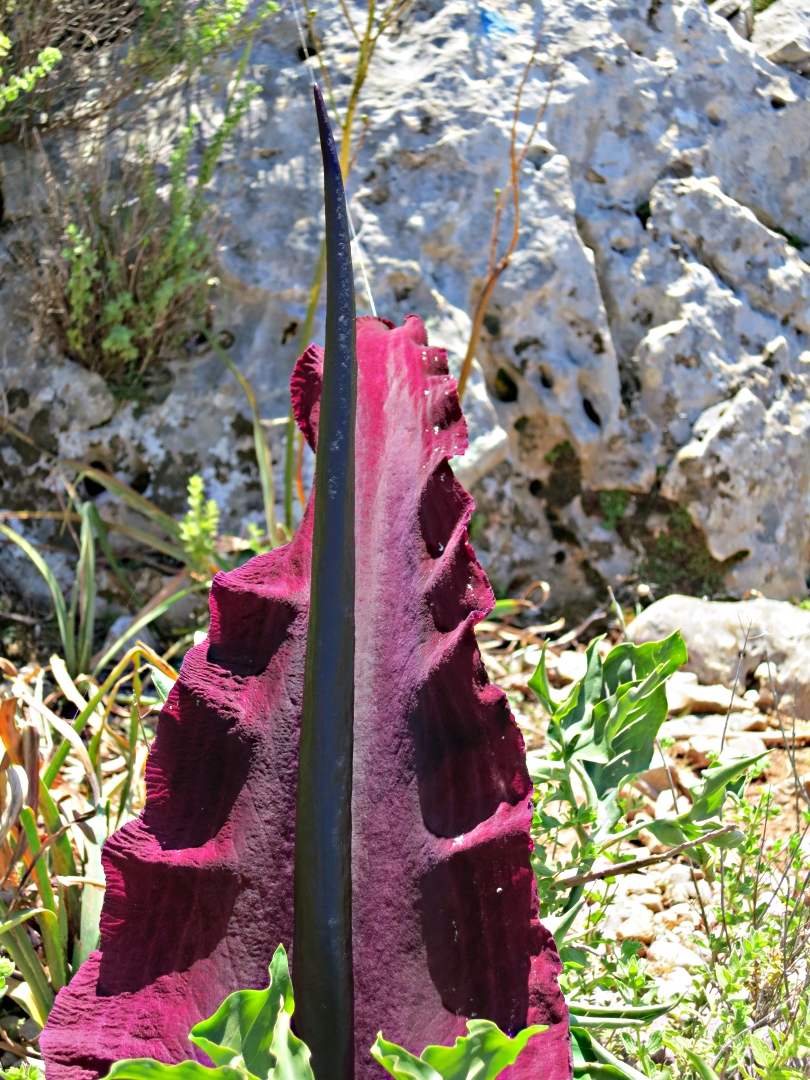
The most dramatic flowers by a mile were the Dracunculus vulgaris known by many names including perhaps the most descriptive, ‘Stink Lily’.  Really an Arum not a lily, each flower can be over two feet long with a spadix ( the bit in the middle) supposed in Greece to represent a dragons tail (hence another name ‘Dragon Lily’), the beast sleeping inside the flower, tail hanging out.  If the flowers themselves were not dramatic enough the smell is even more so.  Just as a raven overhead is immediately and unquestionably identified by its basso profundo ‘croink’ so Dracunculus vulgaris is identified by its very distinctive and very offensive smell of rotting flesh.   It is rumoured that vultures circle overhead looking for the feast and even dig the plant up the find the meat.

The spadix on this specimen is nearly a metre long

The spadix on this specimen is nearly a metre long

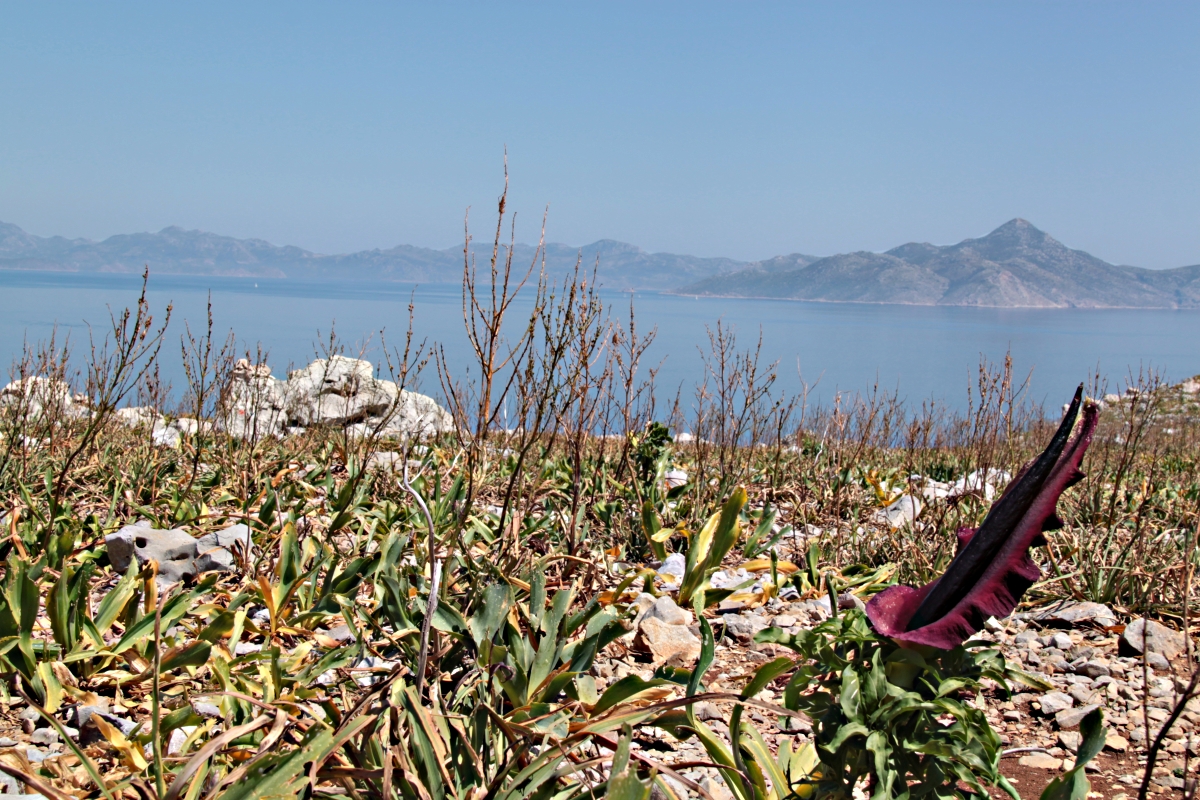
In sight of the sea

In sight of Asia Minor just across the water

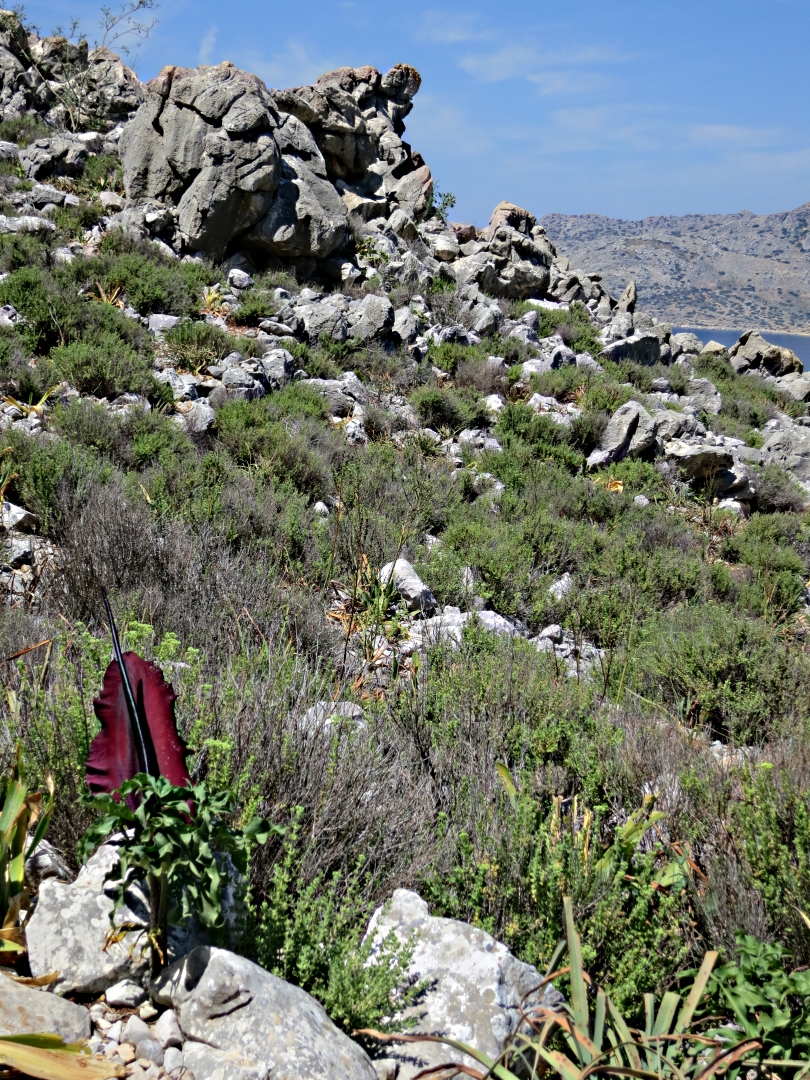
Large enough to make a visual impact even in this dominantly rocky landscape

Large enough to make a visual impact even in this dominantly rocky landscape

Dramatically deep purple

Dramatically deep purple

Whatever the truth of that, one thing is certain, the smell attracts flies, the plant’s pollinators, which in turn attract spiders, which attract lizards ….  A whole ecosystem is generated on Death Mountain.  The smell close to the plants is truly appalling for their short, one or two day flowering.  Definitely not suited to life as a house plant.

And I can attest to the proliferation of spiders.  The path is narrow with few alternatives and spiders spin webs of high-tensile adhesive silk from chest to head height on (slightly shrinking) 6-foot Welshmen.  Thankfully the spiders are not yet approaching the anthropiverous dimensions of the spiders in the Mani Peninsula but it is no fun being wrapped in spider-silk.  My hi-tech solution was to find a stick about two feet long and wield it in front of me to remove the web before I walked into it.  I reasoned that it was better to be thought a mad orchestral conductor rather than someone trying to pluck himself like a chicken as I tried to unwind the adhesive silk from my head, face and torso.

There were many more flowers species than Stink Lilies and many more creatures than spiders.

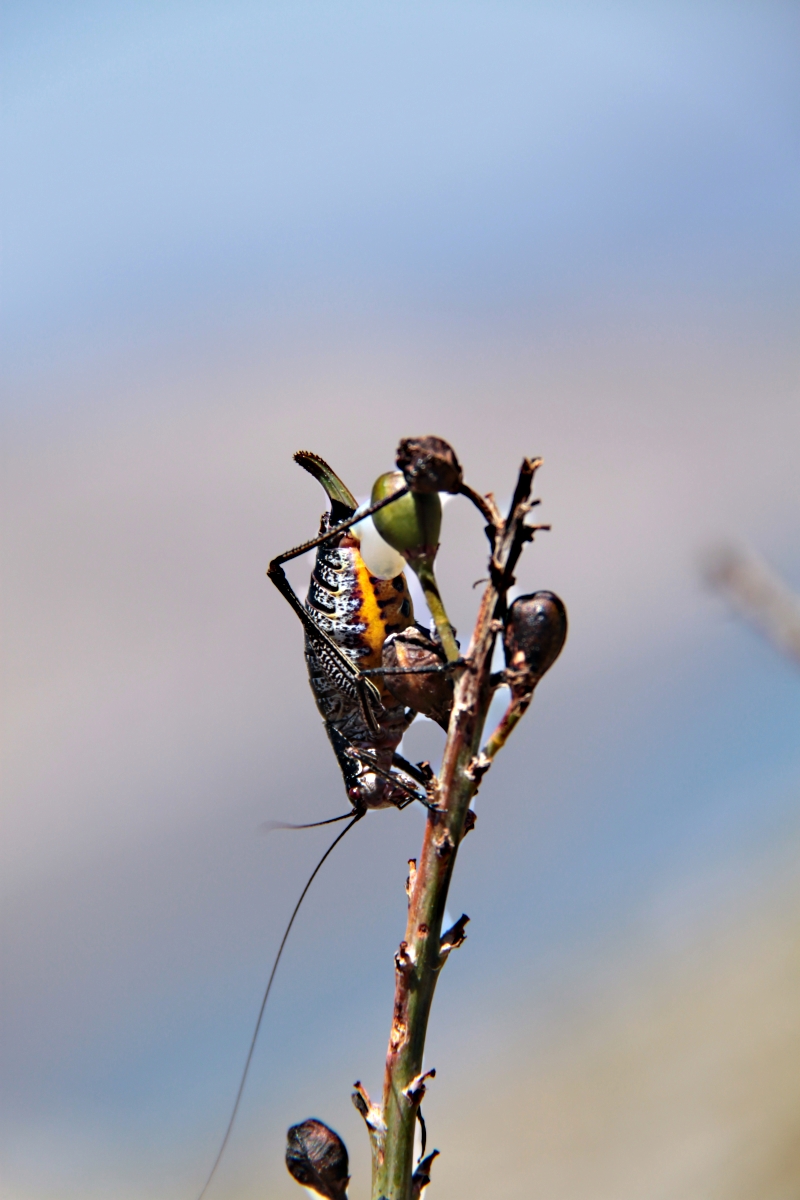
One of the many cricket-like creatures getting ready to ensure the continuation of its species

One of the many cricket-like creatures getting ready to ensure the continuation of its species

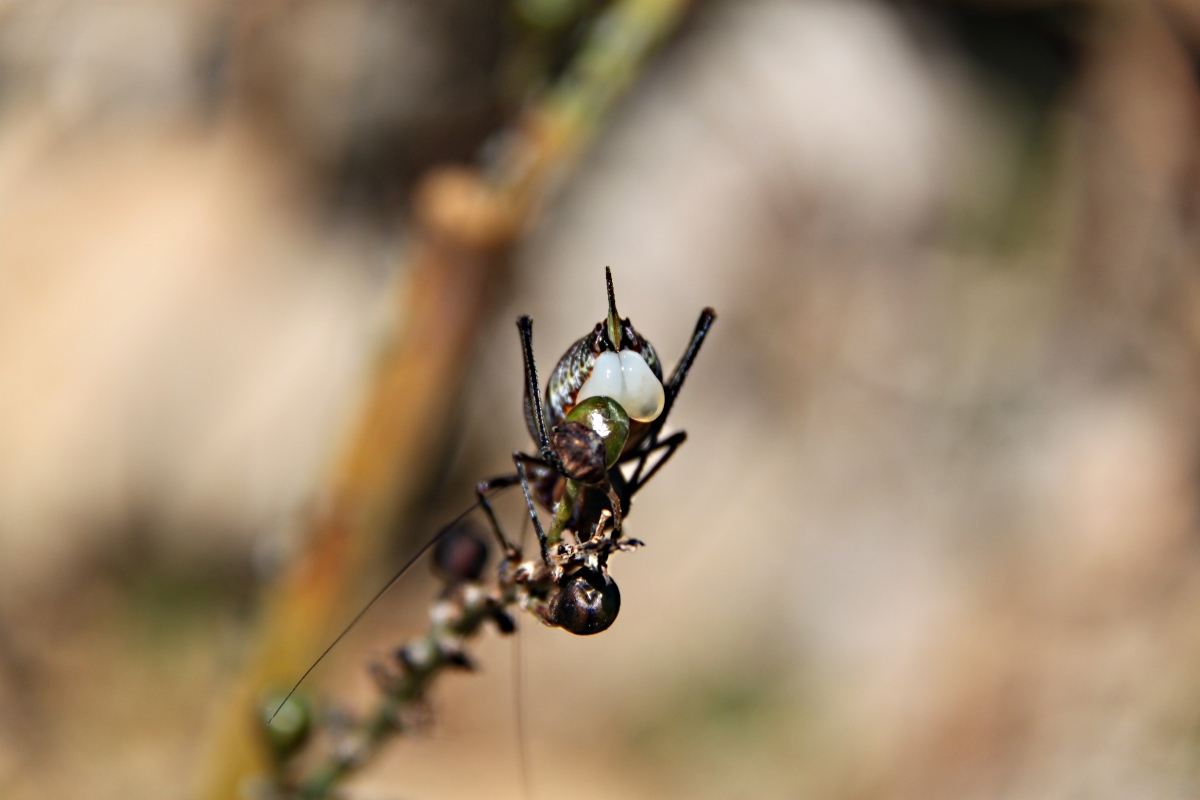
From another, more personal angle

From another, more personal angle

Altogether it was a fascinating walk, rewarded at Agia Marina by the opportunity for a swim.  For the first time ever I had the place to myself, the only other people there were painting ready for the imminent start of the season.

Agia Marina as I've never seen it before

Agia Marina as I’ve never seen it before

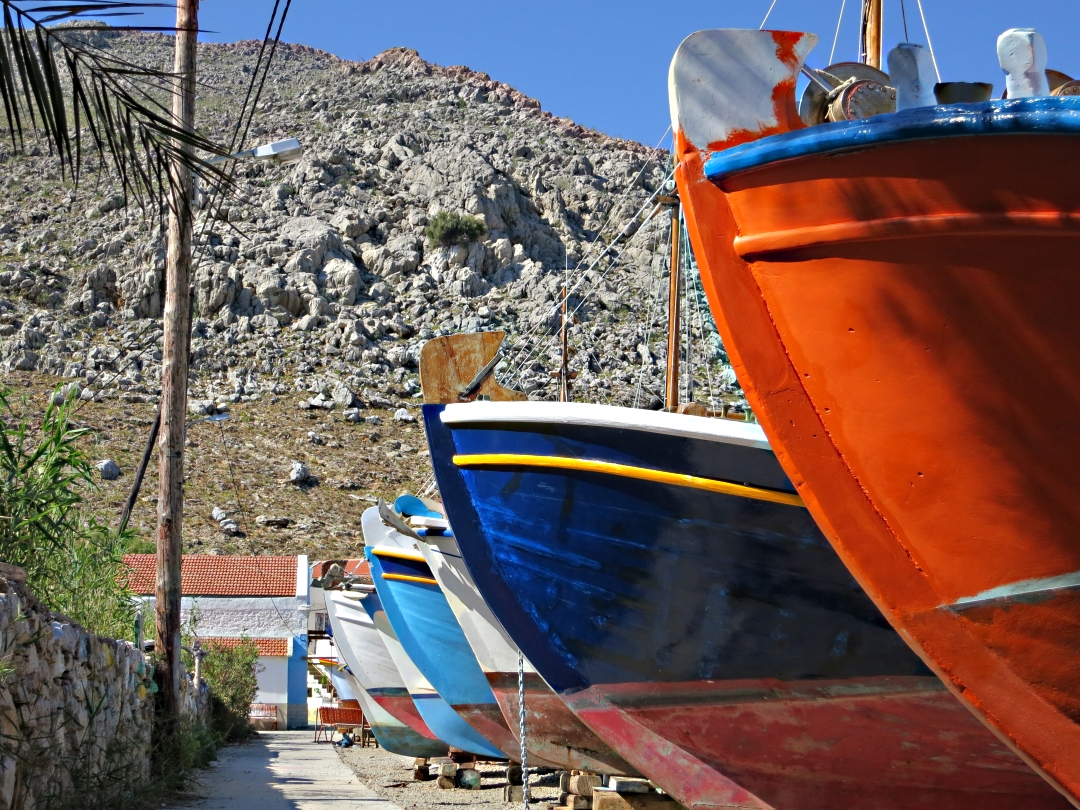
The way back was via Pedi Bay which was completely devoid of the usual yachts floating at anchor or motoring around trying to get the anchor to bite in the deceptively deep water of the fjord.  The ferocity of the winter gales was very clearly evidenced by the shingle thrown up over the road.   In stark contrast to the summer months, local boats were pulled carefully and colourfully up on the shingle for storage out of reach of the winter gales and for painting ready for a new season.

Boats dragged up on the foreshore at Pedi

Boats dragged up on the foreshore at Pedi

I was tired when I got back to the hotel but at least I hadn’t become prey for frustrated vultures.

Posted in Greece | Tagged , , , , , , , , , , | Leave a comment

Greece: a beginning in Rhodes.

I left the cold and April showers of Manchester and landed in Rhodes in temperatures still above 20oC at near midnight.  Very pleasant.

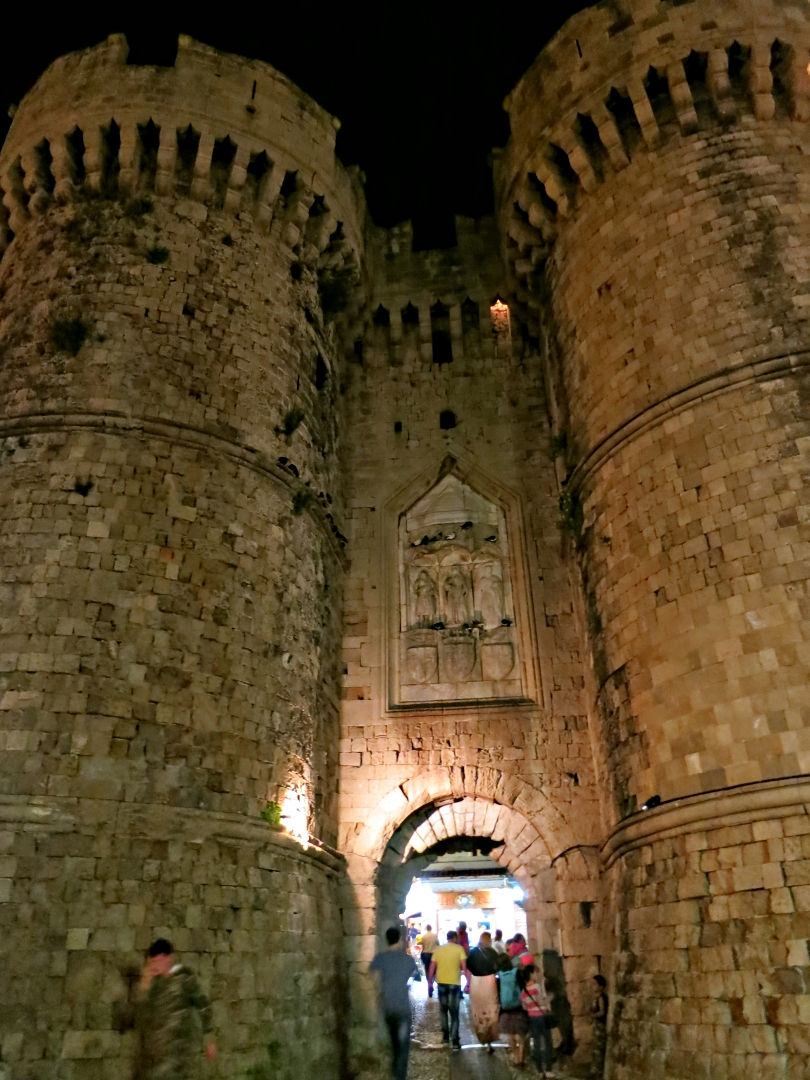
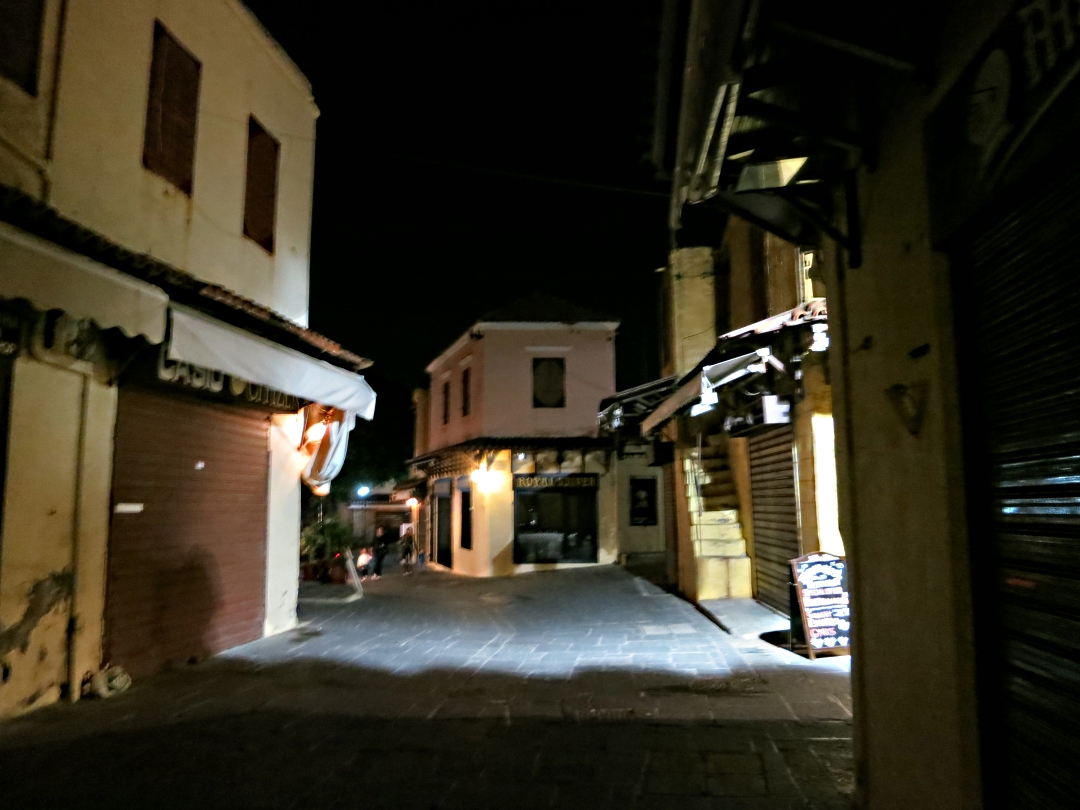
It is still pre-season over here and the Old Town, which in the summer makes Blackpool at Illumination time seem like a rest cure, is virtually deserted.  There are few tourists around, many of the bars and restaurants are shut and those which are open seem to be catering for locals.

I’m only here overnight, catching a high speed cat to Symi at 08.30 tomorrow (Sunday) morning for a couple of days before heading to Kalymnos for Easter.


Entrance to the Old Town from the Commercial Harbour

Entrance to the Old Town from the Commercial Harbour

Inside the town walls most shops and restaurants are closed

Inside the town walls most shops and restaurants are closed

The moon rises above the town walls along the harbourtside

The moon rises above the town walls along the harbourside

One of many old eschucheons from the crusader era

One of many old eschucheons from the crusader era

However quiet it may be the gin palaces are still parked up here

However quiet it may be the gin palaces are still parked up here

x


Posted in Greece | Tagged , , , | Leave a comment

Greece: on the edge

Apologies. The last week or so I have been rushing around like the proverbial, if biologically unidentified, blue arsed fly.  Constantly under time pressure. 

The main reason for being in Grey Britain these days is to be with family and friends so I have prioritised meeting up with people before I jet off to Greece, warmer temperatures  and sunshine.  Great to see them all.

Another priority has been trying to sort out the garden ready to leave.  A growing season delayed 3 weeks by unusually cold weather has made preparation somewhat difficult but I have planted 3 varieties of potatoes, sprouts, red cabbage, swedes and turnips. I have sown beetroot and parsnips in the ground and leeks in toilet-roll tubes ready to plant out later.  With the grandchildren we have planted peas, lettuce, potatoes and strawberries in their bit of the garden.  The soil is still too cold for planting but I had little choice.  Take the opportunity or forget it.  Nature will catch up on growing cycles ………….  or not.

Time in the mountains to get ready for walking in Greece has been severely constrained.  However I did get up to the top of Mynydd Garn Wen twice to repaint the trig point.  At the end of July last year I decided that the trig point on the top of my local mountain, part of the Brecon Beacons National Park, should be restored to its traditional white.  Triangulation pillars always used to be painted white until satellite technology rendered them superfluous and tightening purse strings abandoned them to the elements and a grey future. The Welsh name of the mountain translates into English as ‘Mountain of the White Rock’ so really there was little choice but to restore its dignity.

With the harsh conditions on the top of the mountain last year’s paint had begun to look drab so time for a refresher.  On Wednesday I left breakfast in the sunshine on the balcony and set out with paint pot and brushes to apply the first coat.  It was so windy on top that in shorts and sandals I soon got cold and the paint was blown off the brush on the way from the pot to the pillar.  For the second coat on Tuesday it was grey and cloudy, the wind even stronger and paint went flying around the mountain top but I was at least dressed appropriately…. in thermals and a boiler suit.

I carefully applied masking tape over the copper inlays so they stayed appropriately green and conveyed their one-time-important information.  Nolonger of any functional value, triangulation pillars are listed on the internet for those who want to go and ‘bag’ them.  Not a sport for me but if you want to check my handiwork its reference number and location are below:

S1581

Pillar

TUK

3

Mynydd Garn Wen

SO 28916 04319

Now, bags packed, I’m on the edge of going back to Greece.  Time to do my bit to support the flagging, beleaguered, much maligned Greek economy.

2012 revamp of the Garn Wen trig point:
https://barryh2.wordpress.com/2012/07/30/just-add-sunshine-gardens-cacti-thistles-brecon-beacons-trig-points/

Posted in Greece, Monmouthshire, Mountains, Pontypool, Wales | Tagged , , , , , , , , , , , , , , | 1 Comment