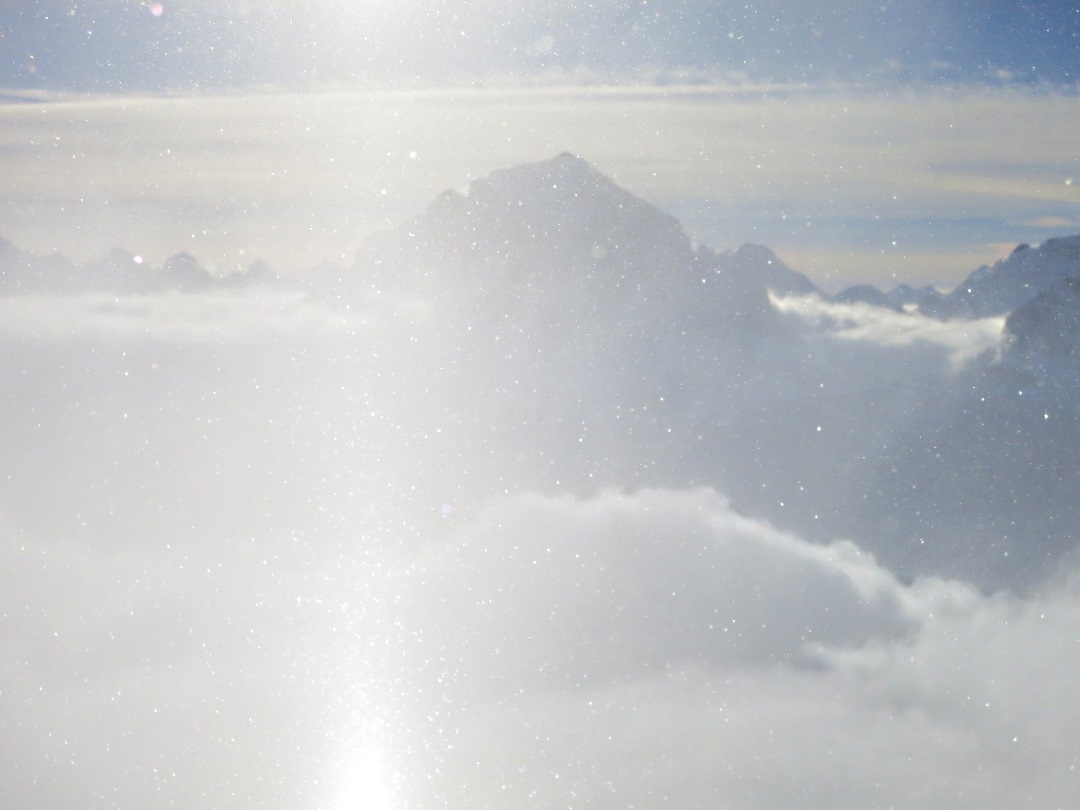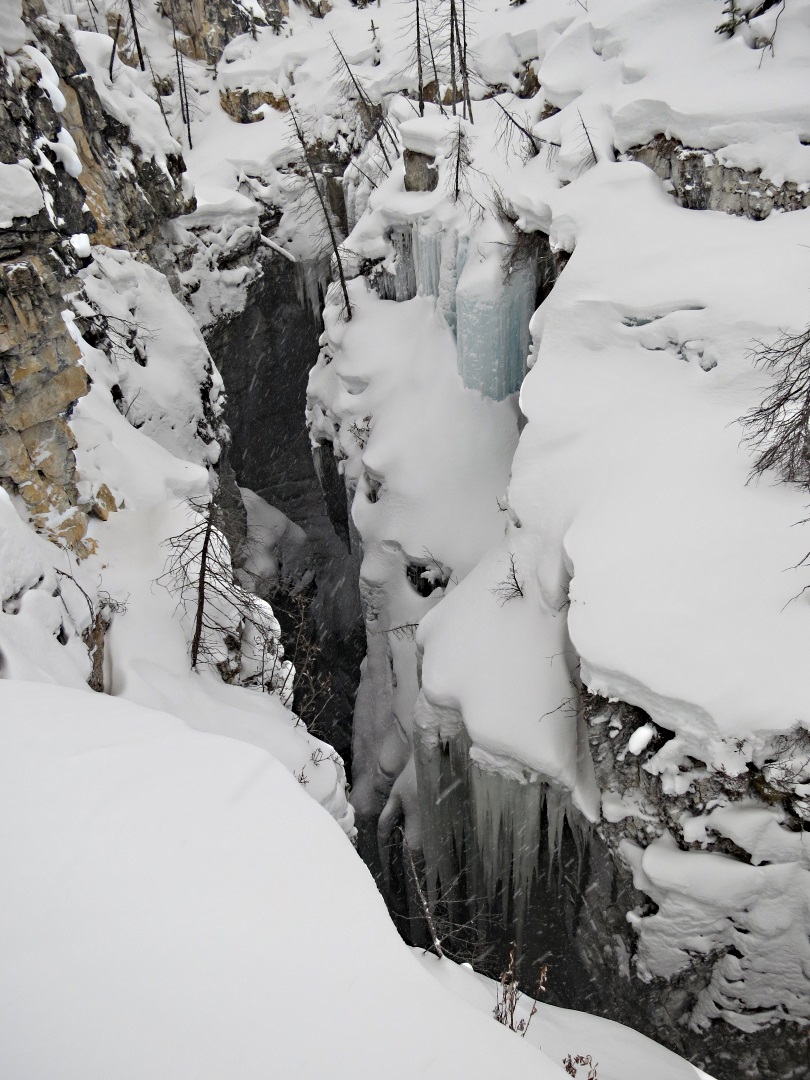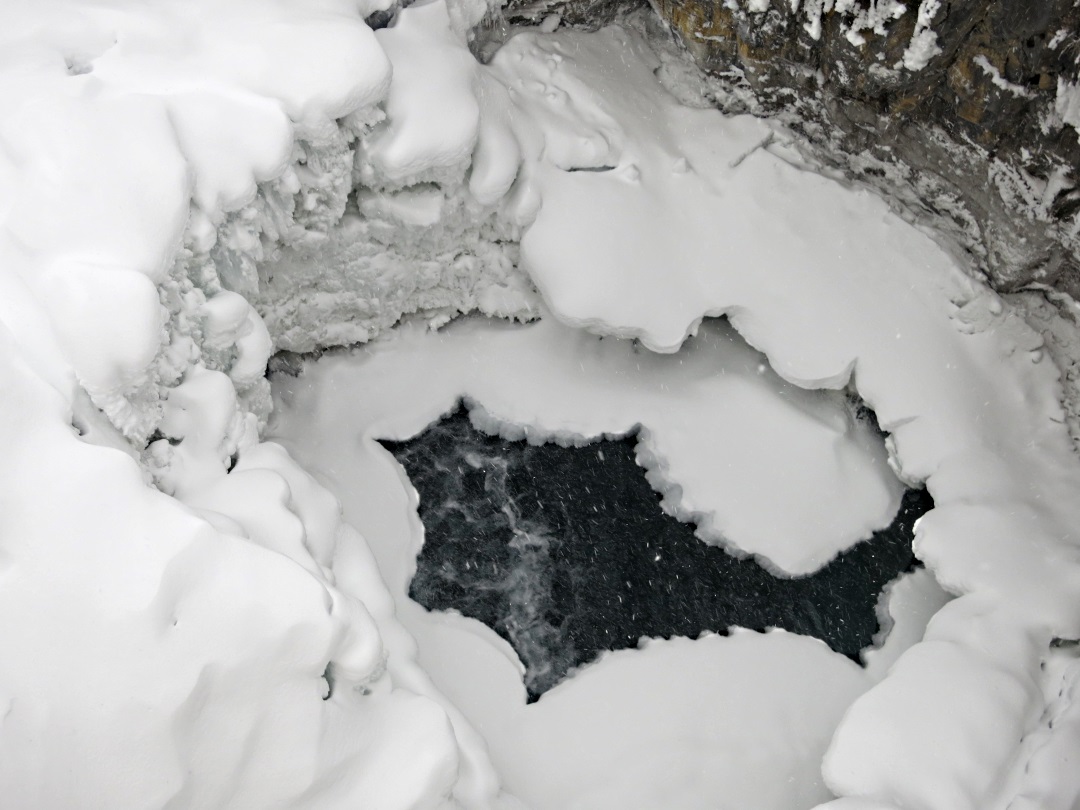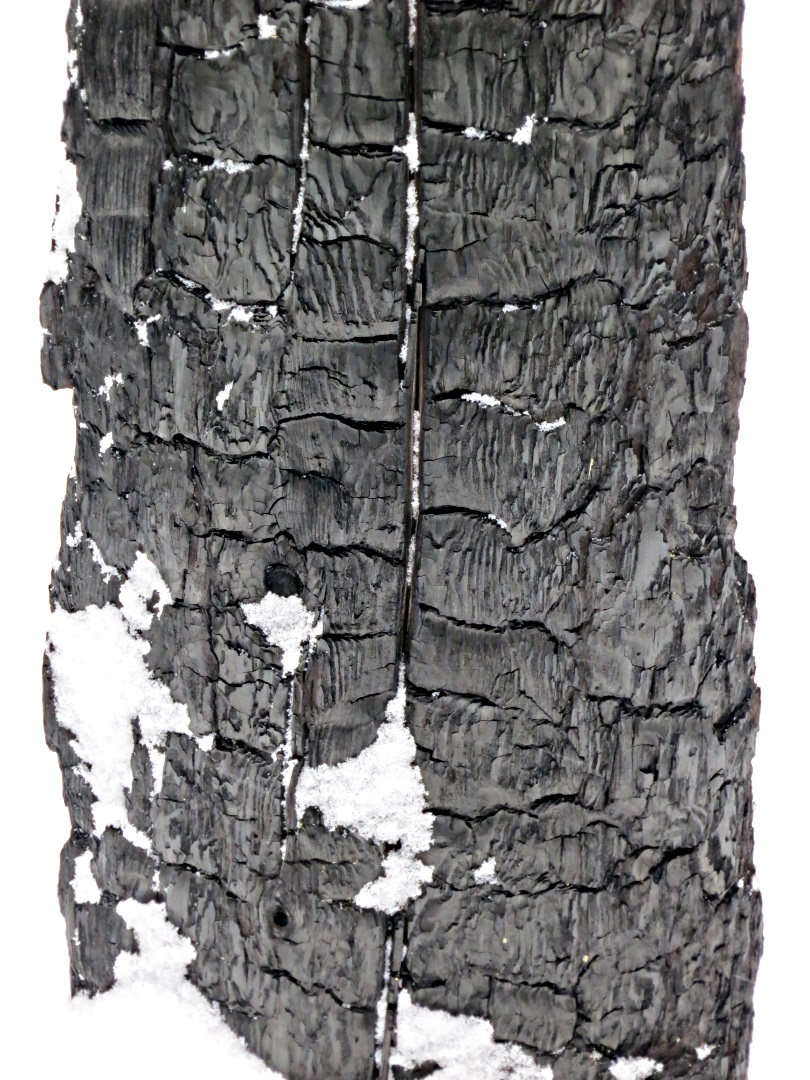
Canadian Rockies: walking slightly nervously on the wild side.

Almost at the end of my stay in Canada, on the last of my days off from skiing, I set out to trek along the Bow River to the Hoodoos, thin pinnacles eroded in soft sedimentary rock.

It was 4 years almost to the day that I first walked the Hoodoos Trail, the trek memorable for a number of reasons, not least of which was encountering coyotes howling to each other from the ice on the frozen river barely 100 metres from where I stood.  I had heard barking up ahead and assumed it to be dogs taking their people for a walk. When I rounded a bend and saw them on the river I felt comfortable thinking them to be wolves rather than the more unpredictable coyotes and stopped to take photographs.  Thankfully they were more interested in each other than in making a meal of me but I was a little unnerved when I found out what they really were.

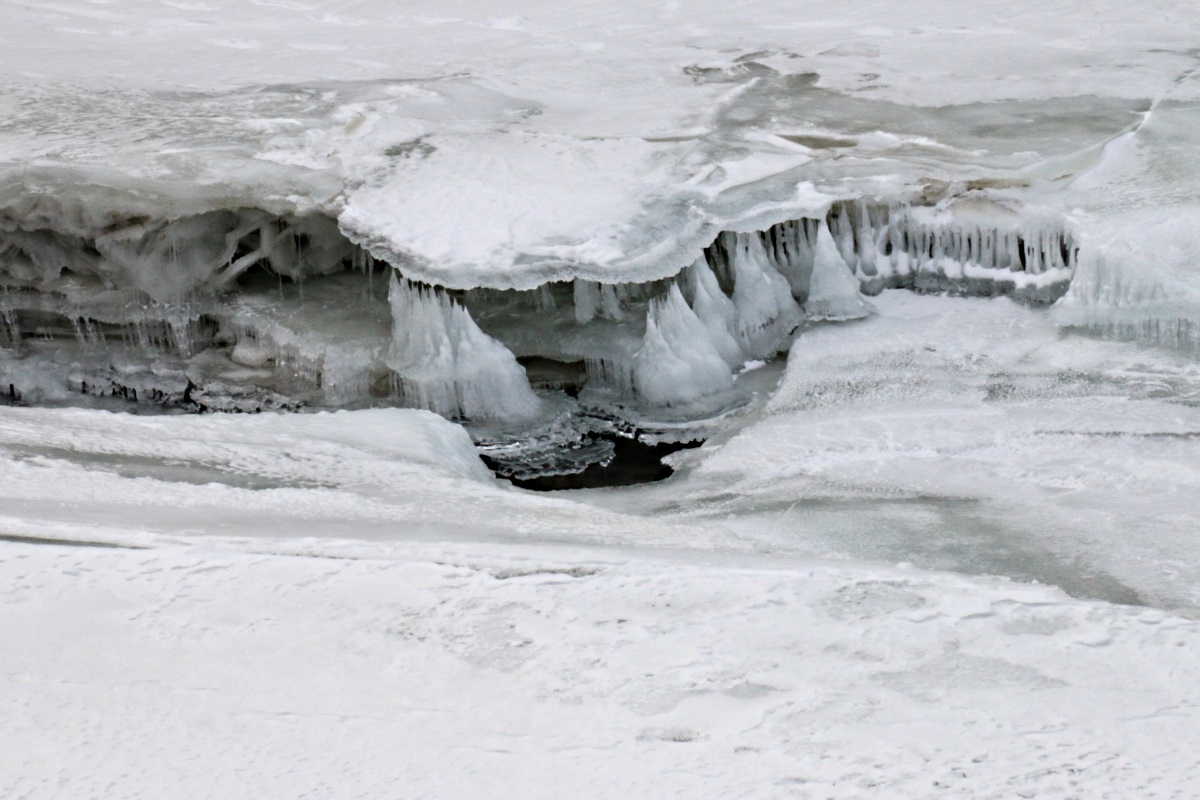
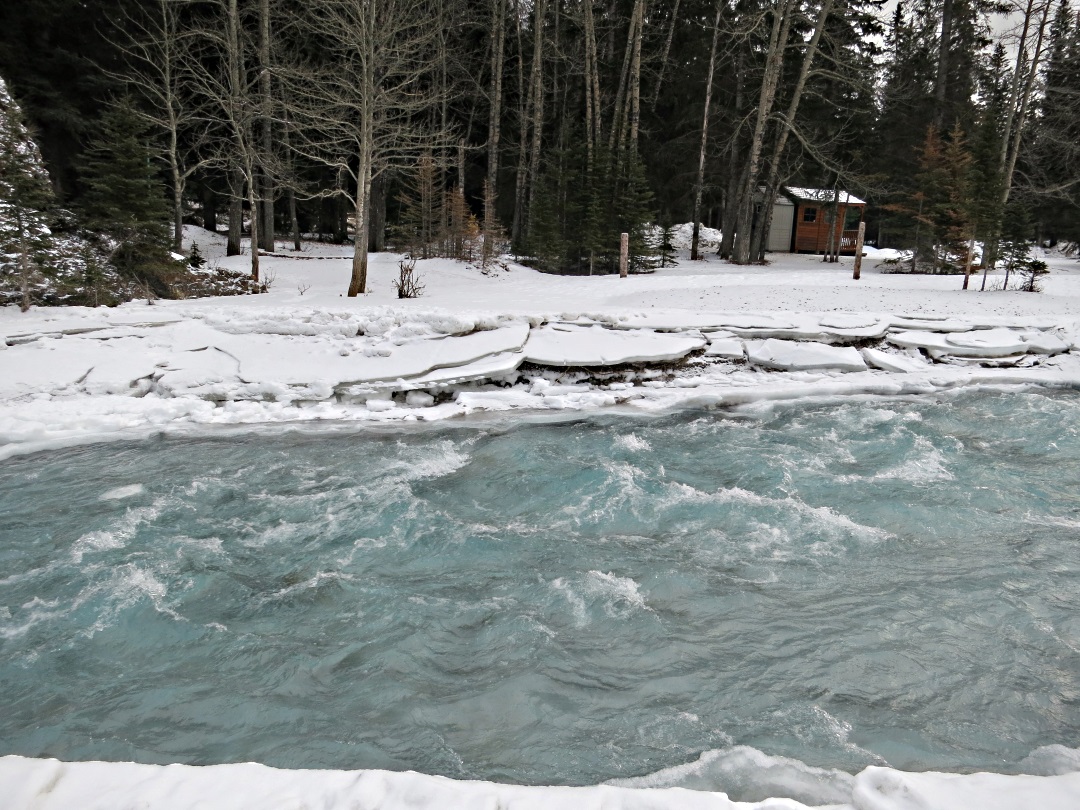
The first part of the route is on the Bow River Trail to Surprise Corner Viewpoint high above Bow Falls.   Initially a surfaced footpath passing large expensive riverside houses, the trail soon leaves the built-up area, climbing steps to go along the road but with cleats over my boots I preferred to walk along the edge of the cliff looking down on the fractured ice as the flow accelerates towards the falls.  The river had frozen earlier in the winter but when it warmed up to just a few degrees below zero, the ice had collapsed as the water level dropped, refreezing as temperatures dropped again.

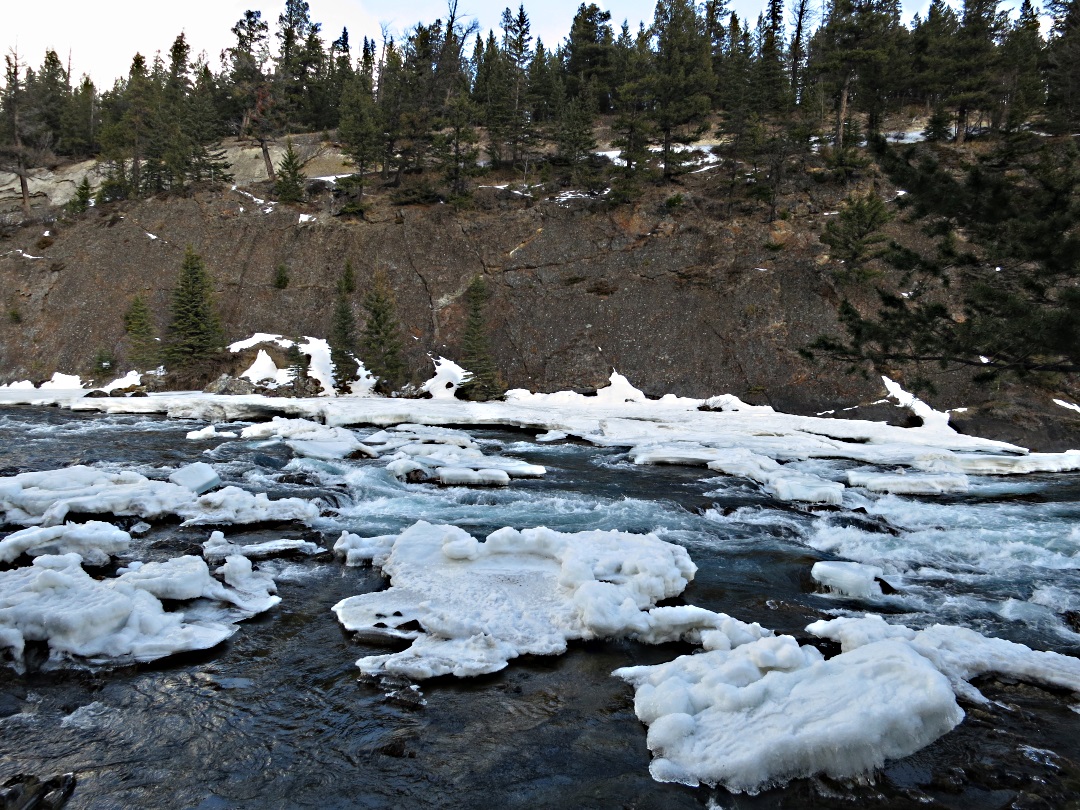
Looking downstream towards Bow Falls across the fractured ice

Looking downstream towards Bow Falls across the fractured ice

... a closer look

… a closer look

... and zooming in on the icicle formations as the river level dropped.

… and zooming in on the icicle formations as the river level dropped.

From the car park at Surprise Corner the trail drops steeply to river level just below the falls and opposite the point where the Spray River joins the Bow.  The trail then turns sharply winding its way north-eastwards following one of the channels of the braided river, Tunnel Mountain rising to 5,500 feet towering above on the left, Mount Rundle 4,000 feet even higher on the right.

The river flows from the Bow Glacier and the Wapta Icefield, the melt-water giving the ice a pale green tinge in places, the fine Alberta snow blown off by strong winds.  There is still a narrow open flow of water close to the opposite bank and with widespread signs of collapsed ice I don’t trust it to walk on.

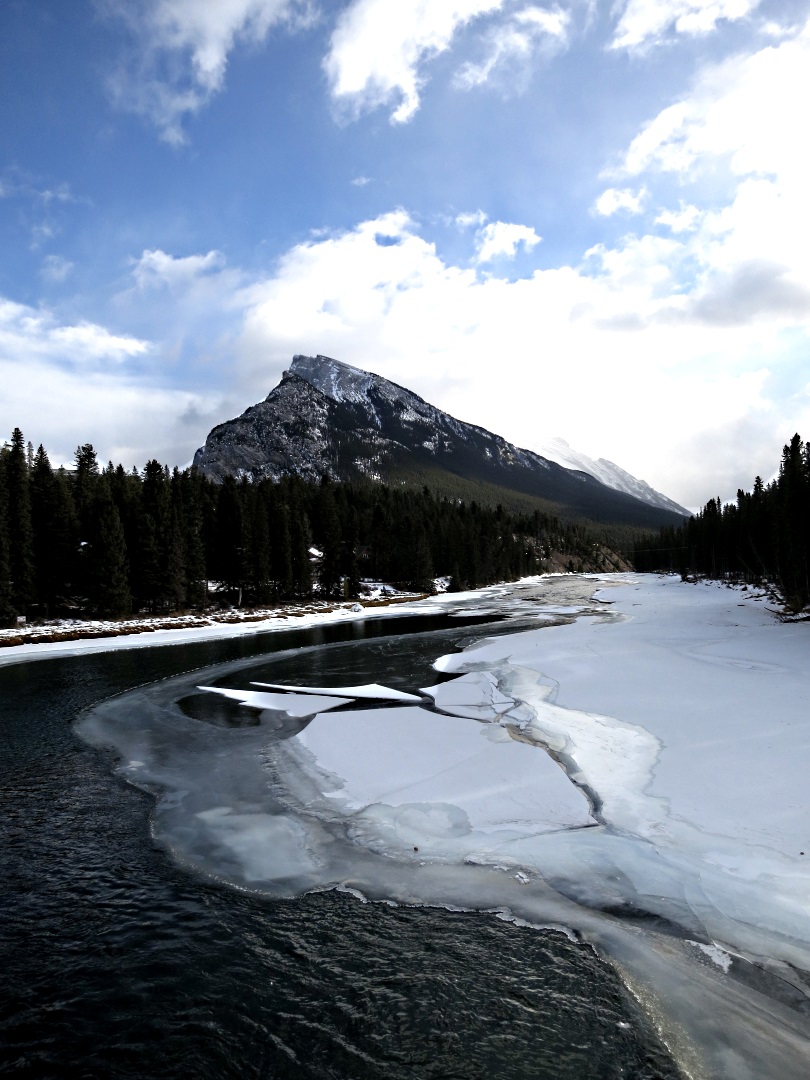
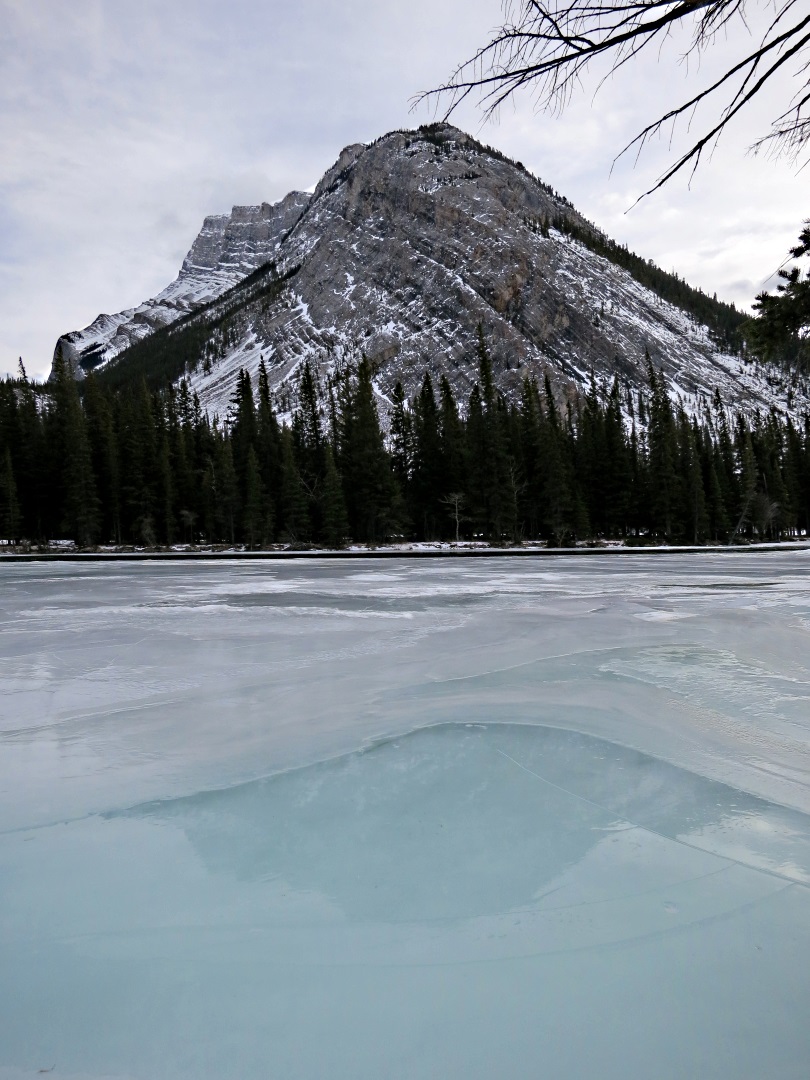
Looking across shiny ice to Rundle Mountian, the ice having collapsed as the river level lowered
Looking across shiny ice to Rundle Mountian, the ice having collapsed as the river level lowered

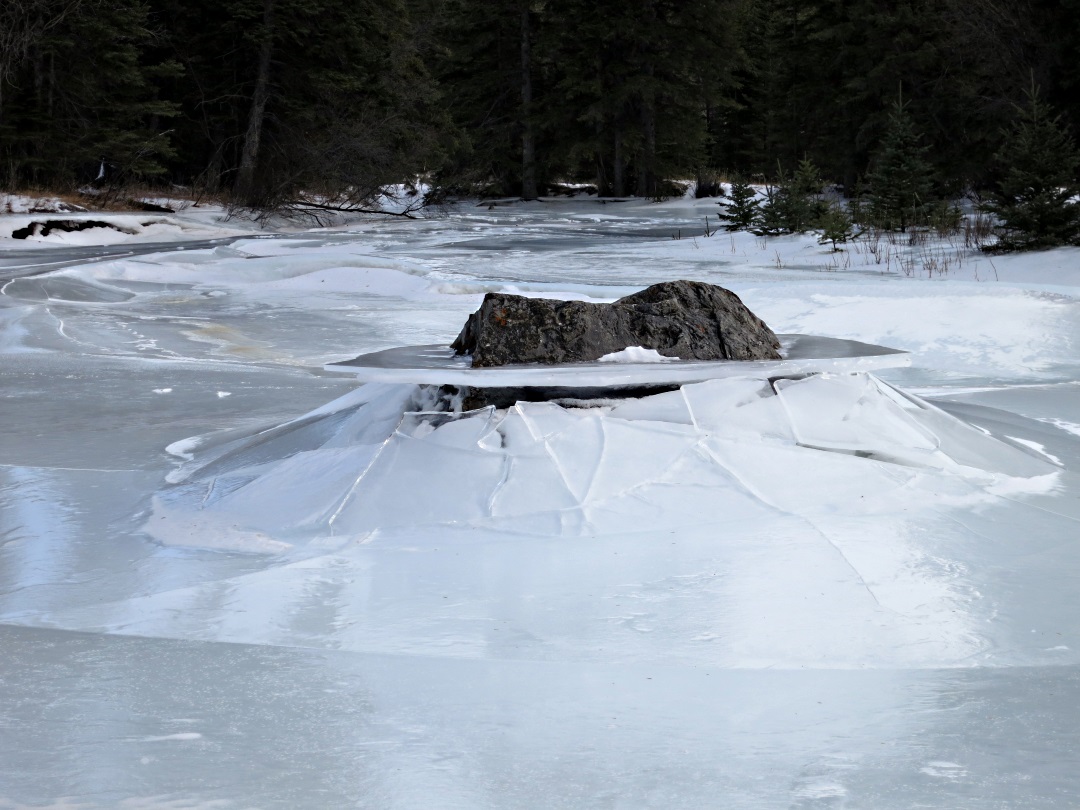
... leaving a flying saucer like-formation

… leaving a flying saucer like-formation

Wide river iced over except for a very narrow channel close to the far bank
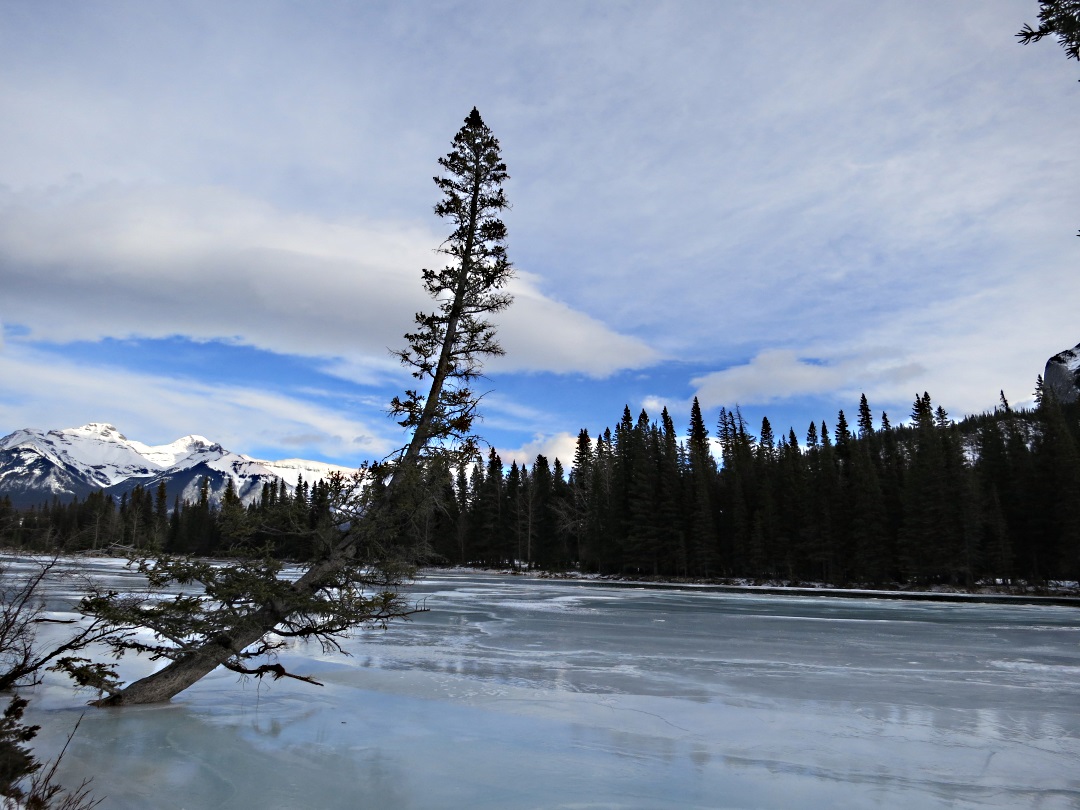
Wide river iced over except for a very narrow channel close to the far bank

Ice originally having formed when the river was in flood
Ice originally having formed when the river was in flood

Mount Rundle reflected in green meltwater nice

Mount Rundle reflected in green meltwater ice

Across the narrow open channel towards the Fairholme Range

Across the narrow open channel towards the Fairholme Range

The trail has been trodden since the last snowfall and so is easy to walk with cleats but in places it has flooded and then frozen leaving the surface glass-smooth ice needing care.  Go even slightly off the trodden line and the powder snow is deep and hard work.

I keep my eyes open for tracks in the soft snow.  There were plenty of deer and elk prints but I was looking for coyote and cougar.  The main difference between coyote and wolf prints is the size, the wolf’s being significantly larger.  I soon spot what could be coyote prints but I suspect are dog’s because they are parallel to and close alongside the trail rather than randomly across it.  I soon catch up with the guy who is walking his Alaskan Malmute and heave a sigh of relief.  “Beautiful dog.  Very pleased to see it”.  The guy looks puzzled so I explain why.

A major difference between the prints of the dog family and those of big cats is that the former have leave claw marks. Dogs’ claws are always out, cats withdraw theirs so they don’t get blunted.  There are a number of indeterminate prints in deep snow but the fine powder has flowed into the depressions so as an amateur I have no idea what they are.

Gradually the trail winds its way upwards about 200 feet and turns eastwards to reach the Hoodoos Viewpoint above a large bend in the river with panoramic views back along the valley.

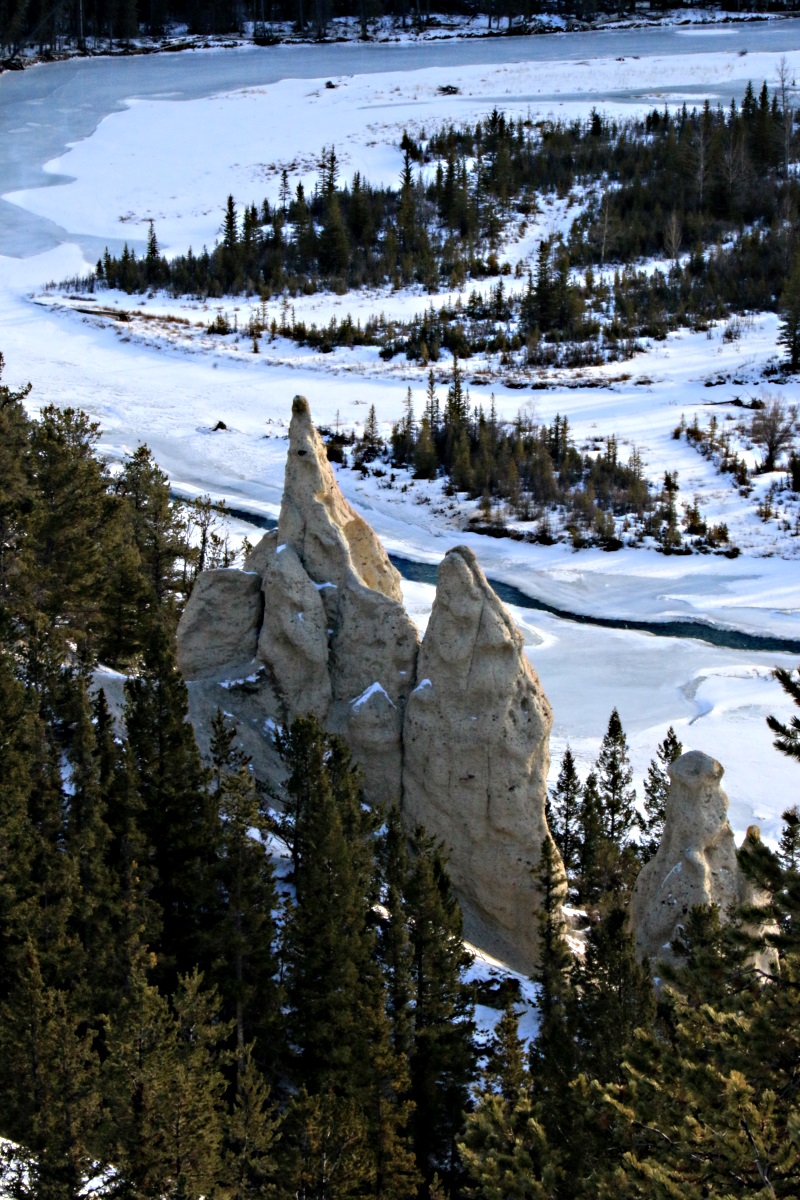
Only a few of the Hoodoos are visible from this vantage point and they are well down the steep slope towards the river.  They seem insignificant against the scale of the mountain backdrop but I packed my SLR in the backpack so can zoom in on them.
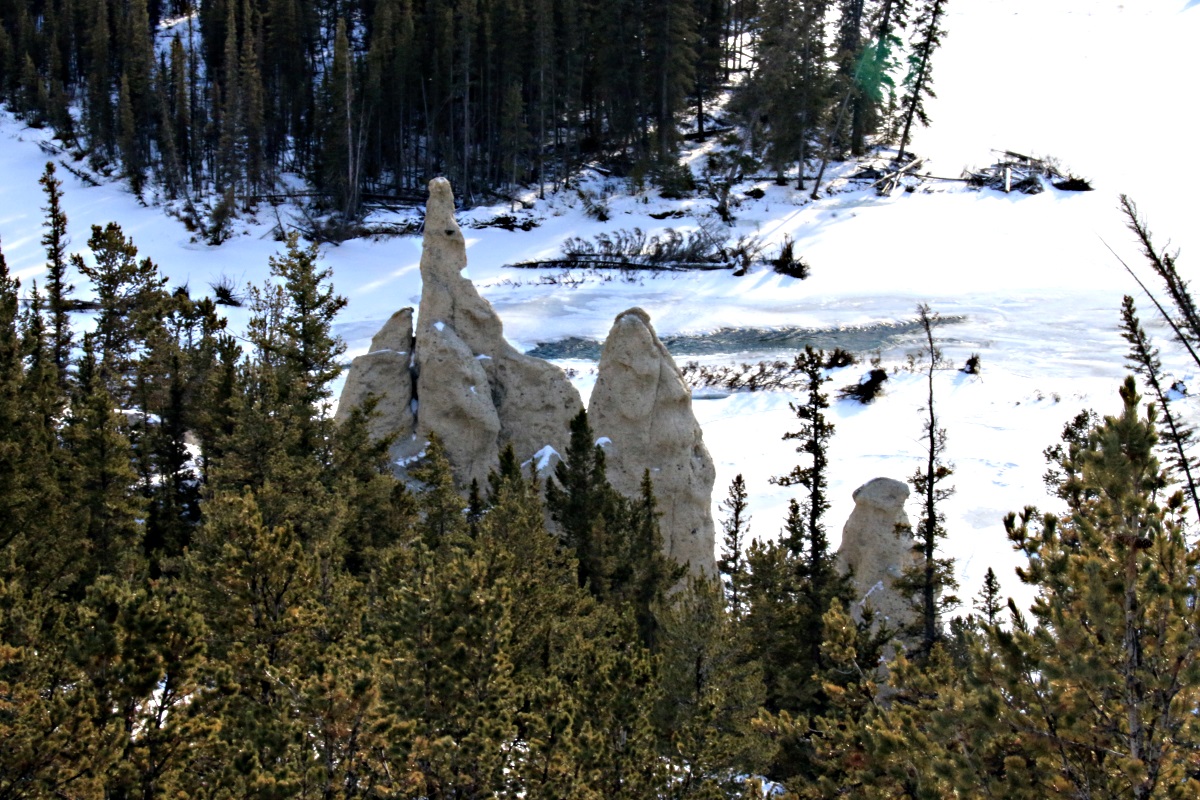
These Hoodoos lack the cap typical of the formation

These Hoodoos lack the cap typical of the formation

A broader perspective
A broader perspective

Zooming in

Zooming in

From the Hoodoos I head back via a trail closely parallel to Tunnel Mountain Drive and spot that cars are stopping on the road with hazard warning lights on.  The road is covered in ice so I assume that there has been a bump but as I get closer it’s clear that they have stopped to look at a herd of 50-60 elk in amongst the trees.

The elk, alternatively and gloriously named the wapiti (Cervus canadensis) is one of the largest species of the deer family in the world, second in size only to the moose. They are only a few yards away.   Most of them are females.  The dominant male, easy to spot with a large set of antlers, lifts his head, gives me a haughty look, decides I’m not a contender for his harem, not worthy of his attention, and carries on grazing, moving casually further into the trees away from prying eyes before I can deploy the camera with hands now cold from using the SLR at the Hoodoos.

At the edge of the herd is a young male, not moving with the rest, looking as if he wouldn’t mind having a rumble, typical of young males of all species I suppose.  I’m more wary of him than any of the others but pass by without trouble.

The elk herd moves gently off further into the woodland

The elk herd moves gently off further into the woodland

Young stag looking fr a rumble

Young stag looking for a rumble

Soon afterwards I turned off onto Tunnel Mountain Drive.  Classed as a ‘scenic route’ it’s closed to traffic in winter. It soon becomes apparent why.  Apart from the amount of snow on it there has obviously been a flow of water across it in various places from the crags on the uphill side which has frozen into sheets of thick glassy ice, slippery (‘slick’ as they say in Canada) to walk on, impossible to drive on.

I’m not a nervous guy, once being dubbed a “gung-ho XXXX” by my paraglider instructor because of a propensity to launch in marginal conditions, but as I walked along the road admiring the view over the town far below, I glance periodically at the crags on the left.  When I researched cougar attacks last year I found that a cyclist had been knocked off his mountain bike on this stretch of road by a cougar leaping on him from behind as he toiled uphill.  He was saved only by falling down the bank into a tree with his bike on top of him which he used to fend off the beast until his mates arrived and they all waved their bikes at it.  It was later shot by the Park Rangers.

I don’t like walking along roads but in winter conditions this was great, even though I didn’t have a bike with which to defend myself.  In fact the whole walk was great.  I need to find a way to visit the other Hoodoos near Banff.  Maybe next year.

Posted in Canada, Hiking, Landscape, Mountains, Nature, Photography, Wildlife, Winter | Tagged , , , , , , , , , , , , , , , , , , , | 1 Comment

Canadian Rockies: Snow, mountains and blue sky reflections

When I’m not skiing I like to follow one of the many winter trails around Banff, some longer and more arduous than others.  One Sunday afternoon I took my camera and new snowshoes for a gentle 6-mile trek out along 40 Mile Creek on the ‘Fenland Loop’ and then onto the Vermillion Lakes.

Much of the lakes (there are three of them, imaginatively numbered 1, 2 and 3) are hard-frozen in winter with a covering of snow so a combination of the flotation of the snowshoes on the fine powder of Alberta snow and the integral crampons on the near-bare ice worked well.

The town of Banff and the Banff National Park came into being because of the discovery of the Hot Springs in 1893.  But the thermal springs around the town are not confined to the Cave and Basin area of the original discovery.  There are a number of smaller, perhaps not-so-hot maybe just warm, springs.  Some of these drain into the Vermillion Lakes and where they do they continue to trickle down even in the coldest of temperatures, flowing water amidst snow and ice, maintaining open pools and channels into the frozen lakes.

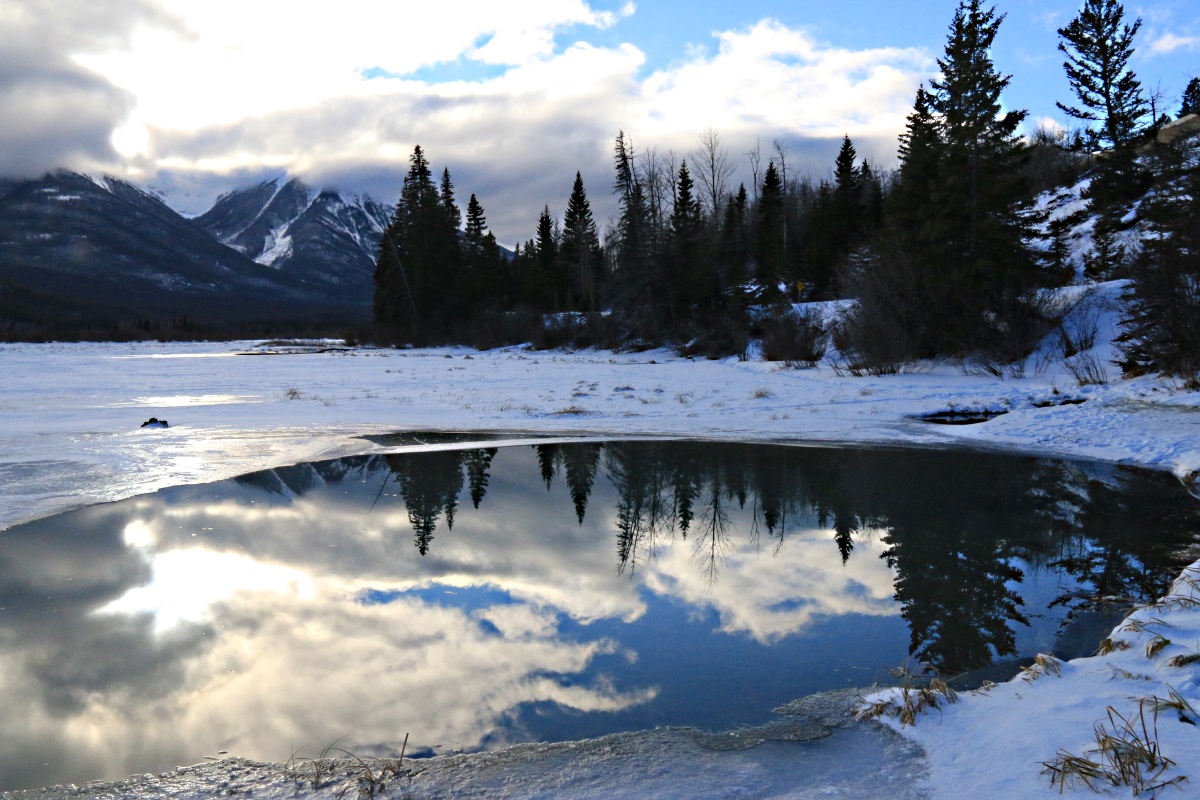
Get the right angle and the right conditions and these pools and channels reflect the blue skies and snow capped mountains which surround them.

A footbridge crossing 40 Mile Creek at the top end of the Fenland Loop with open water reflecting gracefully bending Lodgepole Pine.  This is stretch is normally frozen over at this time of year.
A footbridge crossing 40 Mile Creek at the top end of the Fenland Loop with open water reflecting gracefully bending Lodgepole Pine.  This is stretch is normally frozen over at this time of year.

An almost insignificant trickle from a warm spring keeps a small pool open in the ice of the lake reflecting the Massive Range to the west and beyond that cloud over British Columbia.

An almost insignificant trickle from a warm spring keeps a small pool open in the ice of the lake reflecting the Massive Range to the west and beyond that cloud over British Columbia.

From the other side of the pool, a reflection of the Fairholme Range which turns the Bow River sharply south-eastwards past the Hoodoos (more about which another time)

From the other side of the pool, a reflection of the Fairholme Range which turns the Bow River sharply south-eastwards past the Hoodoos (more about which another time)

Moving further around the edge of Second Vermillion Lake is a pond at a slightly higher level which I have not yet seen frozen

Moving further around the edge of Second Vermillion Lake is a pond at a slightly higher level which I have not yet seen frozen

..... because it is fed by a thermal spring

….. because it is fed by a thermal spring

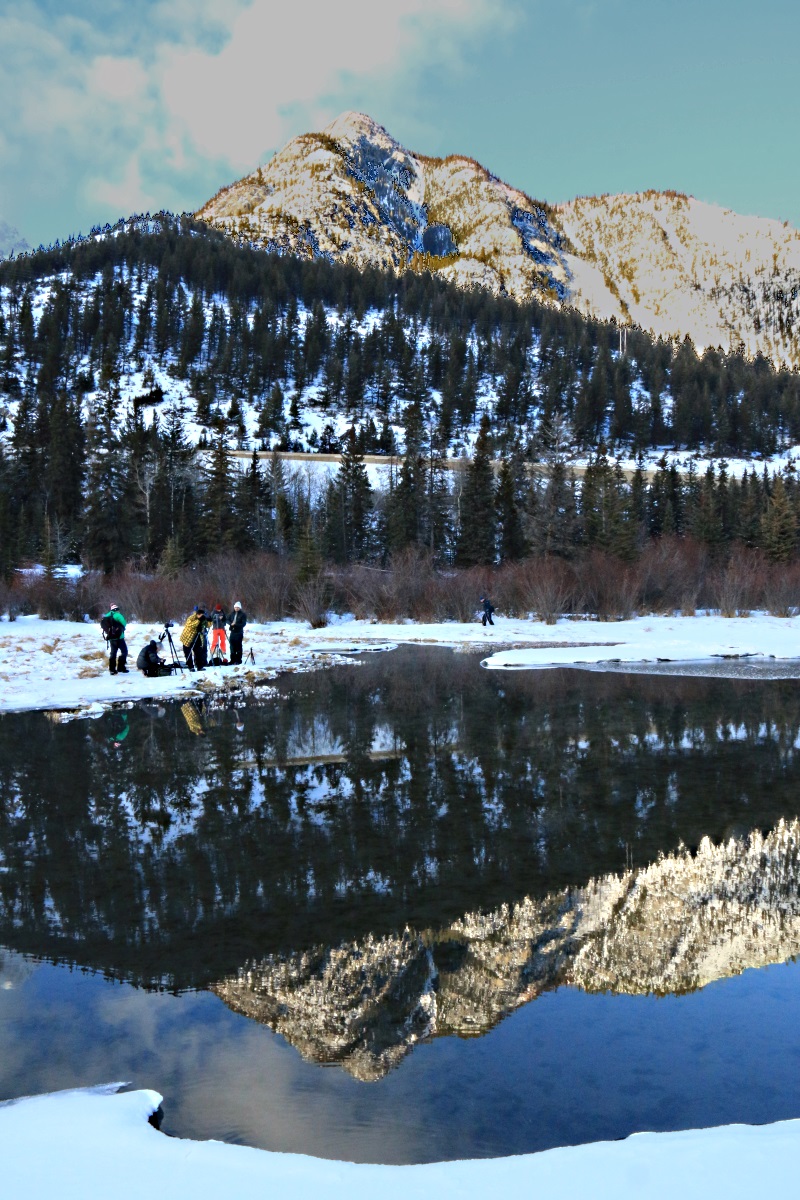
The pond drains into the lake creating a broad open channel in the ice, the flat-calm water reflecting Mount Rundle and the diminutive Tunnel Mountain

The pond drains into the lake creating a broad open channel in the ice, the flat-calm water reflecting Mount Rundle and the diminutive Tunnel Mountain

As I moved on from the last shot around the icy edge of the open water an organised ‘photographic trip’ arrive at exactly the same spot, dumped large bags of gear and set up tripods.  They had been dropped off by minibus close to the location.  No sense of adventure !!!

As I moved on from the last shot around the icy edge of the open water an organised ‘photographic trip’ arrive at exactly the same spot, dumped large bags of gear and set up tripods.  They had been dropped off by minibus close to the location.  No sense of adventure !!!

... the edge of Mount Norquay and beyond that Cascade Mountain

… the edge of Mount Norquay and beyond that Cascade Mountain

 Zooming in on the reflection of Cascade Mountain

Zooming in on the reflection of Cascade Mountain

x

Posted in Canada, Hiking, Landscape, Mountains, Photography, Reflections, Winter | Tagged , , , , , , , , , , , , , , | 2 Comments

Canadian Rockies: Blue sky skiing

It hasn’t been blue sky the whole time I’ve been in Banff  but a good number of days have had a good amount of sunshine.  Sometimes that has coincided with very low temperatures when photographing the stunning mountain views has had to be sacrificed to maintaining finger count to 9½.  Sometimes it has coincided with a balmy -5oC  to -10oC and an attack of Repetitive Photo Syndrome out of sheer relief.

I also have to confess to foregoing photo opportunities to trying to improve my pretty poor skiing.  One 2-hour lesson with a top instructor at Lake Louise did a huge amount as I subsequently applied what I learned from him to improve my level from basic intermediate to just-about-competent intermediate.

The side-effect was unfortunately the loss of some potentially great photographic shots as I tried to instil into my brain and body by repetition the habit, the instinct, of transferring my weight onto the outside ski to initiate a turn, lowering my body at the bottom of the turn , and turning the outside foot to a greater or lesser extent across the slope to control speed depending how steep or slick (icy) the run.  My instinct from both kayaking and paragliding is to initiate and maintain a turn by weight-shift, transferring weight onto the inside of the turn.  When I told this to the instructor he immediately worked out a way to overcome this long-ingrained habit.  No wonder he’s now one of 10 instructors representing Canada at Interski, the coming together of the world’s top ski instructors in Argentina in September.

But I do manage a few shots with the camera.  I have to admit that my main enjoyment is being in the high mountains in winter.  They are beautiful, majestic, awe-inspiring …. any number of clichés.  It puts you closer to God.  Skiing is a great way to be loose in the mountains.

Since The Lesson, skiing has become an enjoyable a part of the experience.  Not an end in itself but deeply satisfying as I manage to stay on my feet on ever steeper slopes at ever faster speeds.  Wednesday and I skied one Green, one Blue and 5 Blacks before the midday stop.  “Get a grip.  Don’t get overconfident!!!!”  I kept telling myself.  Last time I got carried away I damaged my MCL.

Zooming down increasingly difficult runs I stop in places, slither down or shuffle to a better framed shot, take my outer gloves off, ferret the Canon compact out of a tightly zipped pocket and click away into the blinding sun hoping that one at least will turn out reasonably well.

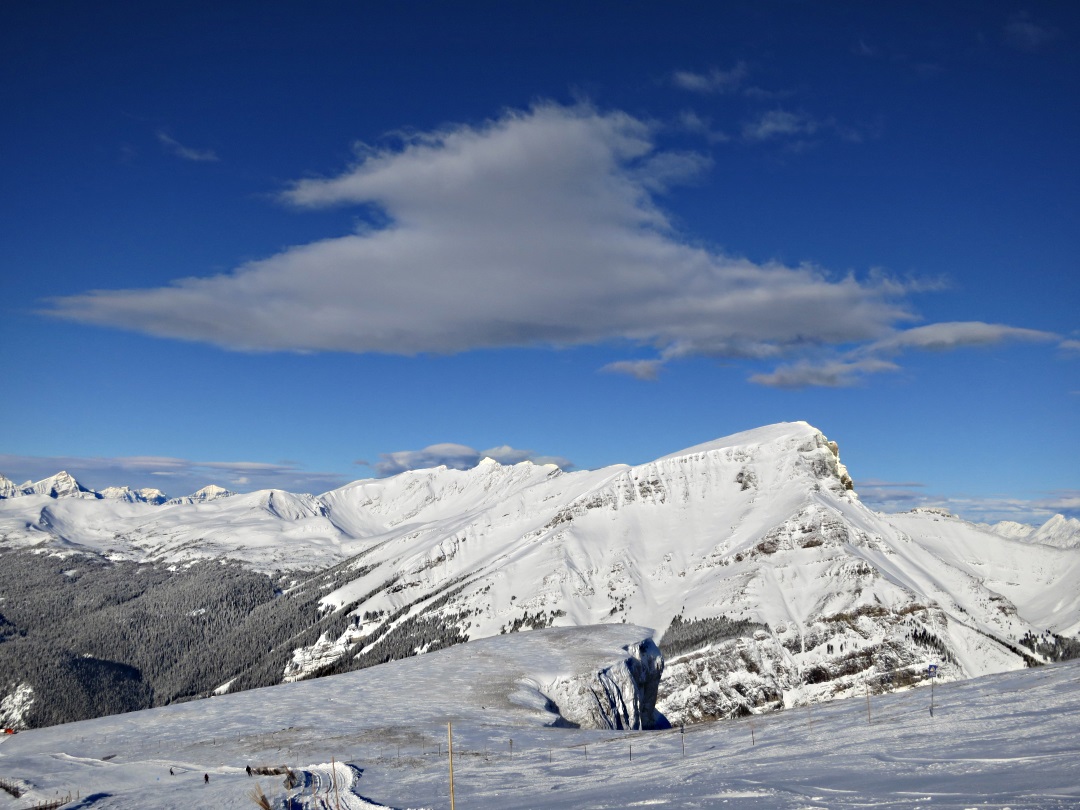
The easy part of a run close to the top of Goat’s Eye Mountain,  2806 metres (9,200 feet), looking across neighbouring and distant peaks

The easy part of a run close to the top of Goat’s Eye Mountain, 2806 metres (9,200 feet), looking across neighbouring and distant peaks

Zooming in on the cliff-edge just to the right of the run

Zooming in on the cliff-edge just to the right of the run

Even though it’s midday, as I drop down the run the sun drops behind the ridge with strong wind blowing loose snow off it

Even though it’s midday, as I drop down the run the sun drops behind the ridge with strong wind blowing loose snow off it

Coasting back to base after the steep section

Coasting back to base after the steep section

At Lake Louise thin bands of cloud across the valley

At Lake Louise thin bands of cloud across the valley

At the top of the ridge above the cloud bands, tiny ice crystals visible against the blue, a shaft of light like a laser beam lit by the sun shafting down through the cloud which is made up of the ice crystals.

At the top of the ridge above the cloud bands, tiny ice crystals visible against the blue, a shaft of light like a laser beam lit by the sun shafting down through the cloud which is made up of the ice crystals.

..... billions of them

….. billions of them

Early morning freezing cloud lifts leaving a fairyland

Early morning freezing cloud lifts leaving a fairyland

In the middle of the run down Sunshine Coast

In the middle of the run down Sunshine Coast

A combination of sun and cloud makes jagged peaks more dramatic

A combination of sun and cloud makes jagged peaks more dramatic

x

Posted in Canada, Landscape, Mountains, Weather, Winter | Tagged , , , , , , , , , , | 6 Comments

Canadian Rockies: Snowshoes and maple taffy

I have always loved walking in the snow despite having to put up with what I now know is Reynaud’s Phenomenon, painfully cold hands with ‘White Finger’ even in summer.  I used to go walking in the Derbyshire Peak District whenever I could if there had been snowfall.  I almost met my demise as a young teenager on one such occasion, a memory revisited on a trek up Sundance Canyon near Banff in 2011.  Read about it below if you like:

Escapes

A few years ago I went walking with a friend at the southern tip of the Brecon Beacons, the ridge behind the house, after a heavy snowfall.  He had been on a snowshoeing holiday in Iceland and was armed with new snowshoes and so floated over the mountain.  I floundered along behind.

Impressed by this, while I was in Banff in February this year I intended to go on an organised snowshoe trek but lack of fresh snow made it not worthwhile.  However, heavy overnight snow a week ago, coinciding with a day-off from skiing, meant I signed up with Discover Banff Tours for a 4-hour trip to Marble Canyon in British Columbia.  I prefer doing my own thing, going my own pace, but as well as providing necessary equipment (snowshoes in this case) and transport to interesting places (necessary without a car) an organised tour has the advantage of knowledgeable guides.

We left the Trans Canada Highway and Banff National Park and heading southwest on Highway 93 into Kootenay National Park, turning into the car park just over the AB/BC provincial border at the start of Marble Canyon.

Just as there is no tunnel through Tunnel Mountain, so there is no marble in Marble Canyon.  But there was plenty of fresh snow.  A significant amount had fallen on the Alberta side of the Rockies but, as is usually the case, across the Continental Divide to the west in British Columbia, moist air from the Pacific hitting the cold of the high mountains had dropped even more.

It was snowing as the 18 of us on the trip shivered out of the warm minibus and struggled with the unfamiliar attachments to strap on the one-size snowshoes over our winter boots, then set off along the trail.

Unlike the treks up Grotto Canyon and Johnson Canyon which I did with the same company a couple of years ago, this was not along the frozen bed of the river, for the simple reason that it was not frozen.  Not enough of it anyway.  So the trail wound gradually up the side of the canyon, crossing and recrossing it on numerous stout bridges, the limestone cliffs becoming progressively higher, the icy water increasingly further below.

The beginning of the canyon, rock walls about 20-30 feet high, open water below

The beginning of the canyon, rock walls about 20-30 feet high, open water below

A natural rock bridge high above the water, topped by a thick layer of snow

A natural rock bridge high above the water, topped by a thick layer of snow

Canyon walls now about 60 feet high, thick with huge icicles

Canyon walls now about 60 feet high, thick with huge icicles

Zooming in one one of the icicle clusters

Zooming in one one of the icicle clusters

Looking down from one of the bridges to the partly frozen creek far below

Looking down from one of the bridges to the partly frozen creek far below

Another rock spur capped by snow

Another rock spur capped by snow

Then we reached the end of the trodden trail.  To this point we had been walking on compacted snow, the integral crampons in the snowshoes giving good grip.  Now we headed off rightwards through deep, fresh powder snow into a forest of bare, thin trunks of trees once reaching desperately upwards towards sunlight but today into continuously falling snow.  They had fought with each other for sunlight but had been destroyed by fire.

For years Parks Canada sought to eliminate forest fires but in recent years came the realisation that fire was a natural phenomenon essential for ecological regeneration and in particular for the control of pine beetle which is wreaking havoc among the Lodgepole Pine, the major tree species of the Canadian Rockies.  When fire broke out in on the flanks of the Tokumm Creek in September 2003 it was allowed to run its course within a limited area as a trial.  The resulting landscape is now enchanting, tall dead treed reaching skywards into the falling snow, luxuriant new growth reaching head height as we meandered through.

Now there was no trail, we each found our own way through the deep snow, snowshoes giving flotation.  Youngsters in the group climbed up slopes and jumped off, full of energy and exuberance.  I sought out intriguing shapes in the dead trees.

Looking up towards the col through the burnt-out forest

Looking up towards the col through the burnt-out forest

Fascinating shapes

Fascinating shapes

Standing charcoal

Standing charcoal

14Canada167w6617

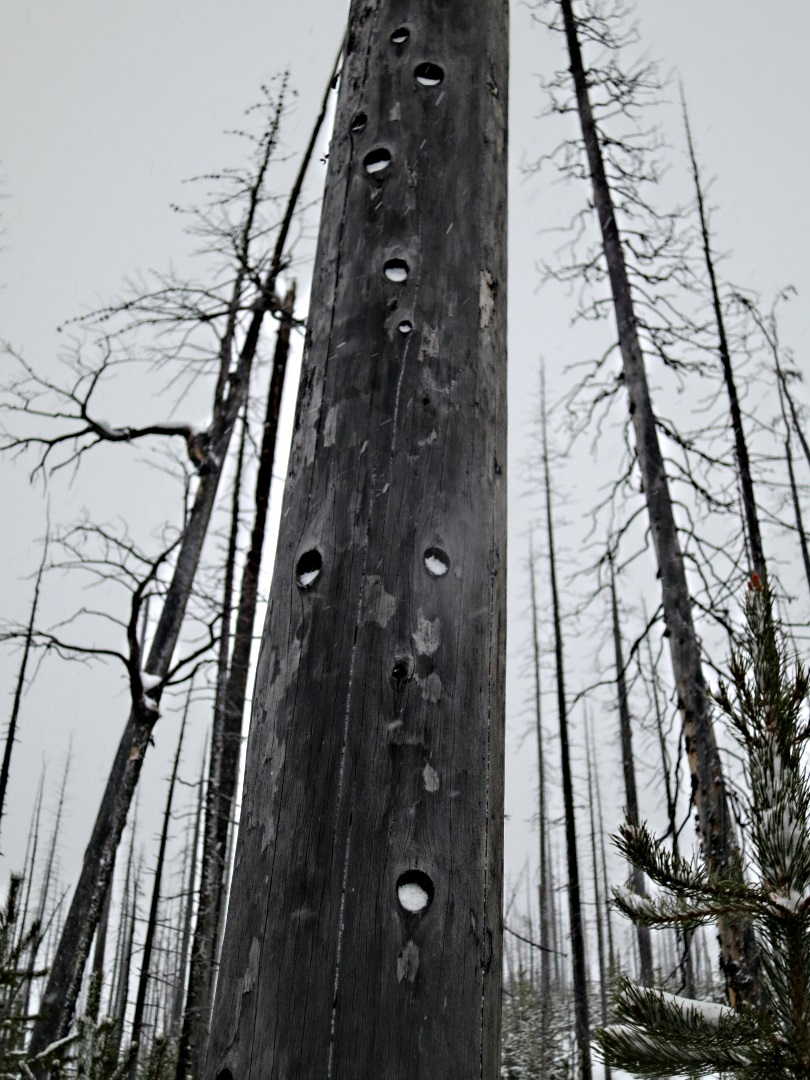
Some trunks thicker than others, pock-marks filled with snow

Reaching upwards

Reaching upwards

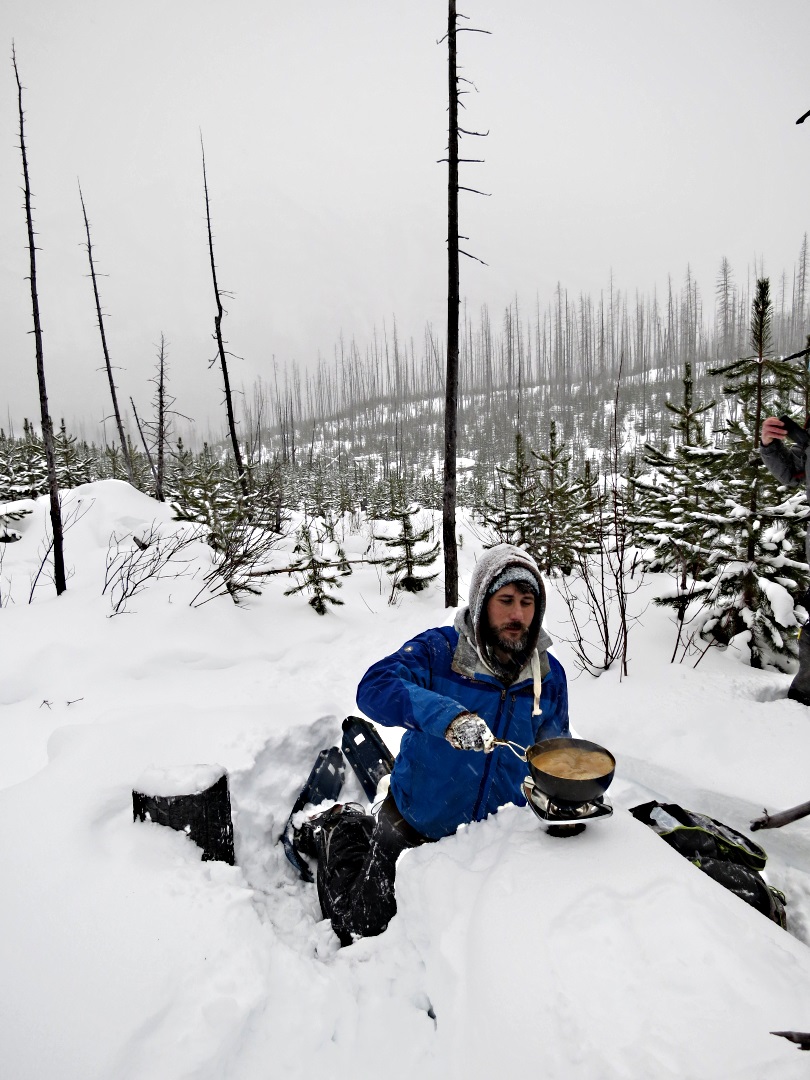
I always like to know where I am, where I’m heading, but here it seemed aimless. Meandering, just playing in deep snow because we had snowshoes.  I asked Giedre, one of the guides, which direction we were going, and she said “just wander around for a while and have fun.  Generally over there” , waving a hand vaguely to the right.  Easing a way through the new growth, careful to avoid tree-wells (hollows in the snow around tree trunks into which it is easy to slide and difficult to climb out of) I picked up a faint smell of something sweet and followed it until I found Dylan, the other guide, sitting in a hole in the snow at the end of a snow-covered fallen tree trunk with a saucepan bubbling away on a camping stove.  It bubbled like lava, smelt like syrup.

Soon we had all clustered around and were being served cups of hot chocolate from flasks.  Then the explanation.  Dylan was making what is variously known as ‘Maple Taffy’, ‘Maple Toffee’ or, in the USA, ‘Sugar on Snow’.  Originally a French Canadian delicacy known as ‘tire d’érable’, maple syrup is boiled until it reaches a sufficiently high temperature that when it is poured onto snow it solidifies and can be wound up on a wooden popsicle stick.  It used to be prepared in ‘sugar huts’ and a quick search on Google shows how many commercial businesses have adopted the name and the image.

Here in the middle of nowhere, in subzero temperatures, after an hour’s trekking uphill, it was somehow magical.   It belonged.  This was the right place, the right context. Dylan had smoothed ‘plates’ in the snow on the trunk and poured the super-hot syrup onto it in individual sized portions while Giedre handed out popsicle sticks onto which the soft toffee was twirled.

Dylan in the snow hole boiling maple syrup

Dylan in the snow hole boiling maple syrup

A closer look at the molten pan

A closer look at the molten pan

We then continued through the burnt-out and newly regenerating forest, each making our own tracks through the deep powder, sinking in but nowhere near as deep as we would without snowshoes. Dylan and Giedre stopped periodically to make sure we were all in the same general vicinity, looking slightly worried when the numbers didn’t tally, looking relieved when a few more heads bobbed up among the new trees.  My guess is that the regenerating woodland will make this part of the trip impossible in a few years time as the trees, now about 5-6 feet tall reach above head height and the branches push together. At the moment it’s great.

A final slide down a steep snow bank into a broad fire-break on our derrières and we were back at the car park.

Next day I bought a pair of snowshoes in the ‘Sale’ in one of the many outdoor pursuit shops in Banff, reduced in price by 60%, and headed off along the Bow Valley looking for deep snow.

New snowshoes, off to look for deep snow

New snowshoes, off to look for deep snow

Check out ‘Discover Banff Tours

Posted in Canada, Hiking, History, Landscape, Mountains, Nature | Tagged , , , , , , , , , , , , , , | Leave a comment

Canadian Rockies: A very different walk

Warning: this is long and may get very boring

The RCMP officer was polite but firm.  I was on the wrong side of the tracks and I couldn’t cross.  The road was closed and so was the trail which at this point came out of the woods and off the riverbank to cross the Canadian Pacific railway at a level crossing before diving back into the woods again..

Where are you headed?” he asked.

“To Vermillion Lakes” I answered, tongue in cheek.

I had really come to check out what was occurring (apologies to ‘Gavin and Tracey’ for stealing their line).  On the way to the ski hill on Boxing Day morning the bus driver said “If you look out of the window to your left you will see the train derailment”.  A bit of a side-swipe that one.  Last time I heard “If you look out of the window to your left “ the driver paused with comedic timing and continued “…. you will miss everything on your right” .  Nice one!  Ha ha!

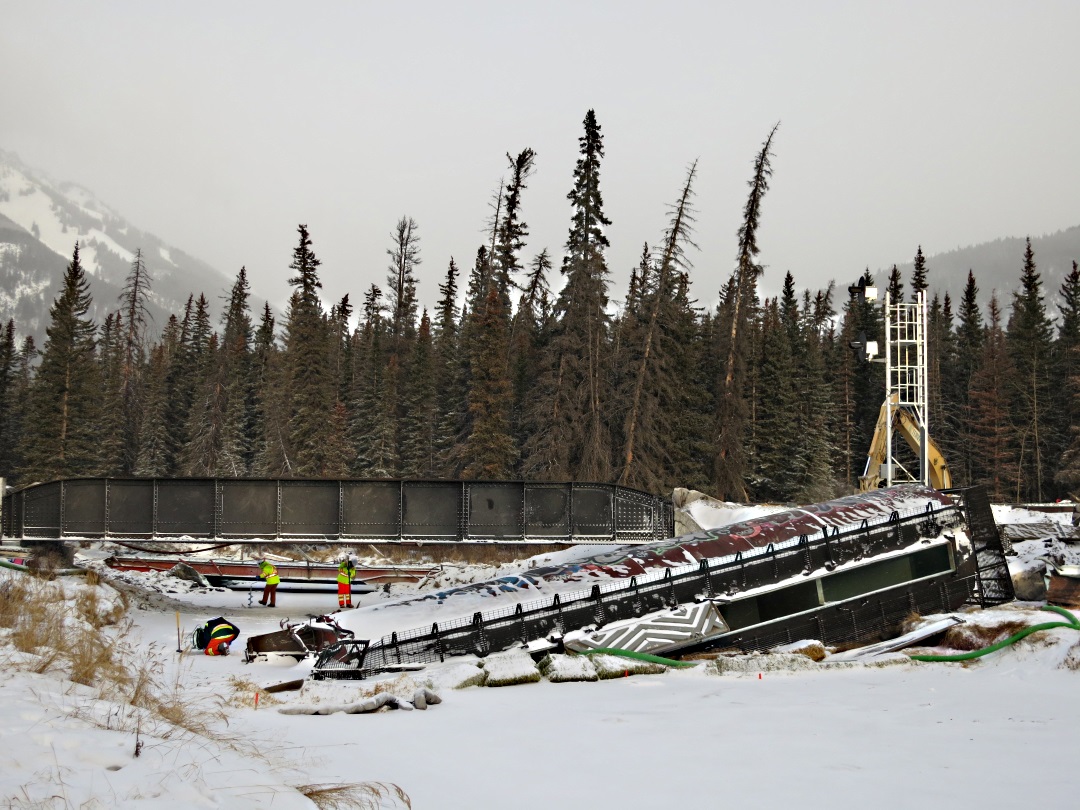
But this time the view to the left was dramatic, train wagons had come off the rail on both sides of the line and were lying at an assortment of crazy angles.  I knew from treks in previous years that some of them would be in the river.  There was no sign of the bridge which carried the Canadian Pacific (CP) railway over the small creek barely 100 metres from the level crossing.

Delivered to the ski hill the conditions were perfect and for whatever reason there were few people there and no sign of the Christmas crazies.  A really great day skiing.  Train wreck forgotten.  Arrived back in Banff close to dark and tired, so no opportunity or inclination to check out the train wreck.

But Saturday I was having a ‘rest day’ and so set out along the Bow River and then onto 40 Mile Creek, the tributary which joins it just upstream of the town and the scene of the derailment. It was dramatic.  The word is much overused, including by me, but this was indeed true to the meaning.

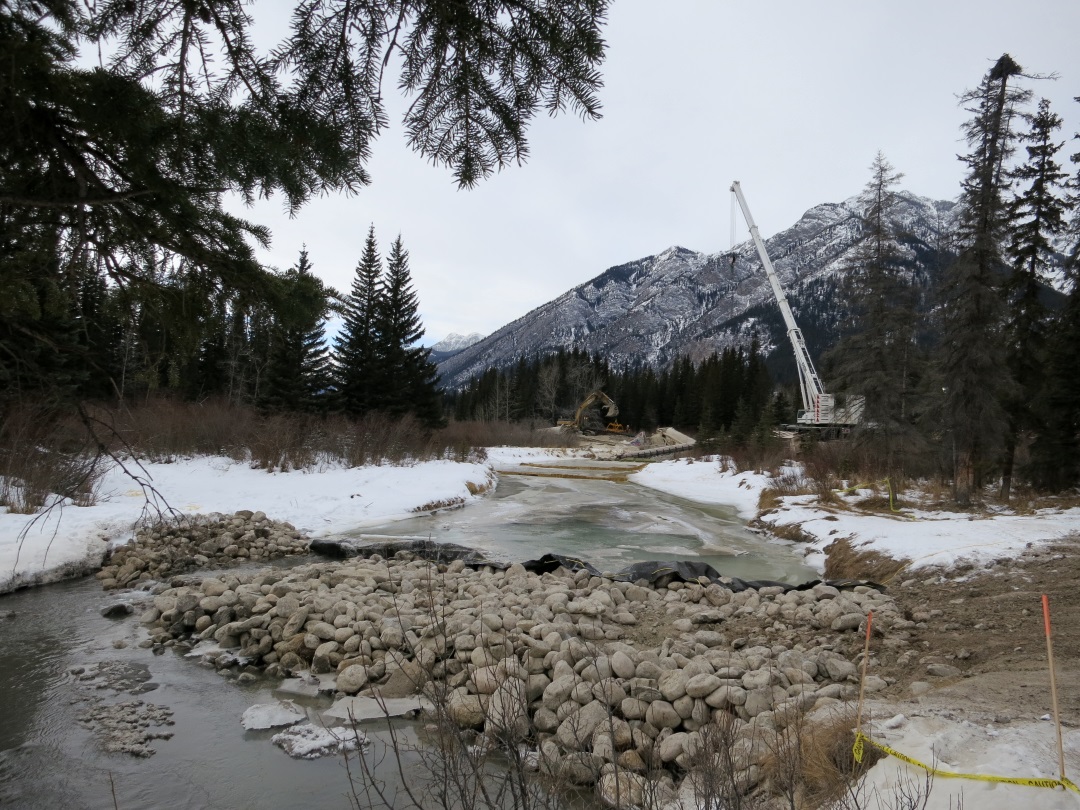
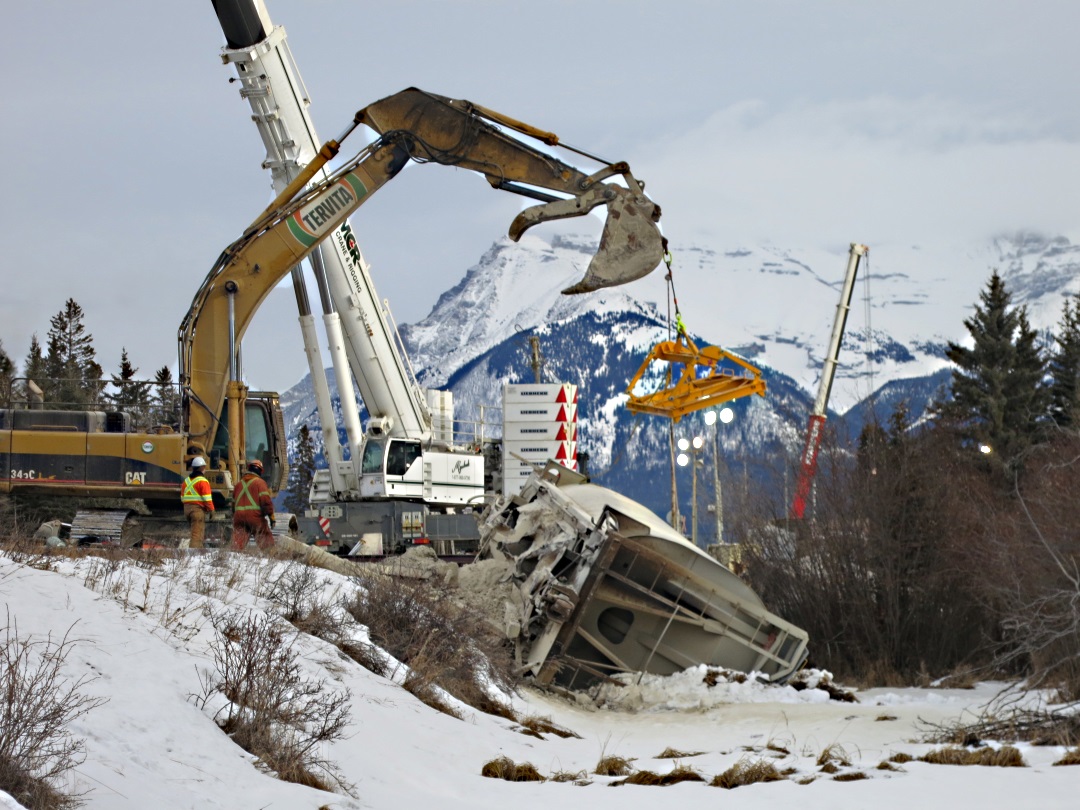
Because of the mild weather (only down to about -10oC) the river was still flowing over much of its width. A dam had been built out of rocks and lined upstream with a membrane.  Further upstream from that were two rows of straw bales damming the flow further.  Immediately above that the accident, a freight wagon lying across the width of the river with material spewed out from it.  Others were lying at all sorts of angles, some split open or snapped in two.  A huge crane and a smaller machine were aligned over the site, men in hi-viz gear swarming over the area.  A temporary footbridge had been hoisted into place to allow men to cross from one side of the fast-flowing water to the other.

I went up to the road to cross the rail line by the level crossing in order to view the incident from the other side.  That was when I was approached by the RCMP.

“I’m sorry but you can’t go any further.  This is a major construction site and the public are not allowed across”.  I asked, with as innocent and naive a look as I could muster, “I just want to join the trail to Vermillion Lakes”.  Much as I like the walk along Vermillion Lakes that wasn’t my goal that morning.  It was indeed a construction site stretching along the railway on both sides of the road with massively heavy vehicles lumbering across.  I was walking through the middle of a major operation.  He wasn’t on a horse or  wearing a flat brimmed hat, red coat, and neatly pressed riding breaches tucked into leather calf-length boots, but I knew when I was onto a loser.  I turned back.  The mountie had got his man.

I walked about 200 metres back to the confluence of 40 Mile Creek with the slower flowing Bow River which was frozen sufficiently solid to have an oval skating circuit close by.  So I took to the ice and walked upstream, carefully staying clear of the still-open water on the creek as it merged, to reach the narrow strip of land between the two rivers and by that route managed to find a way through the trees and wade through the soft snow to get within metres of the site of the derailment.  I could see a number of wagons had left the rails, some ending in the river.  Those which had split or snapped in two, had spilled their contents onto the banks and into the water.  The bridge had collapsed leaving only a stump at one end still bearing its colourful graffiti.

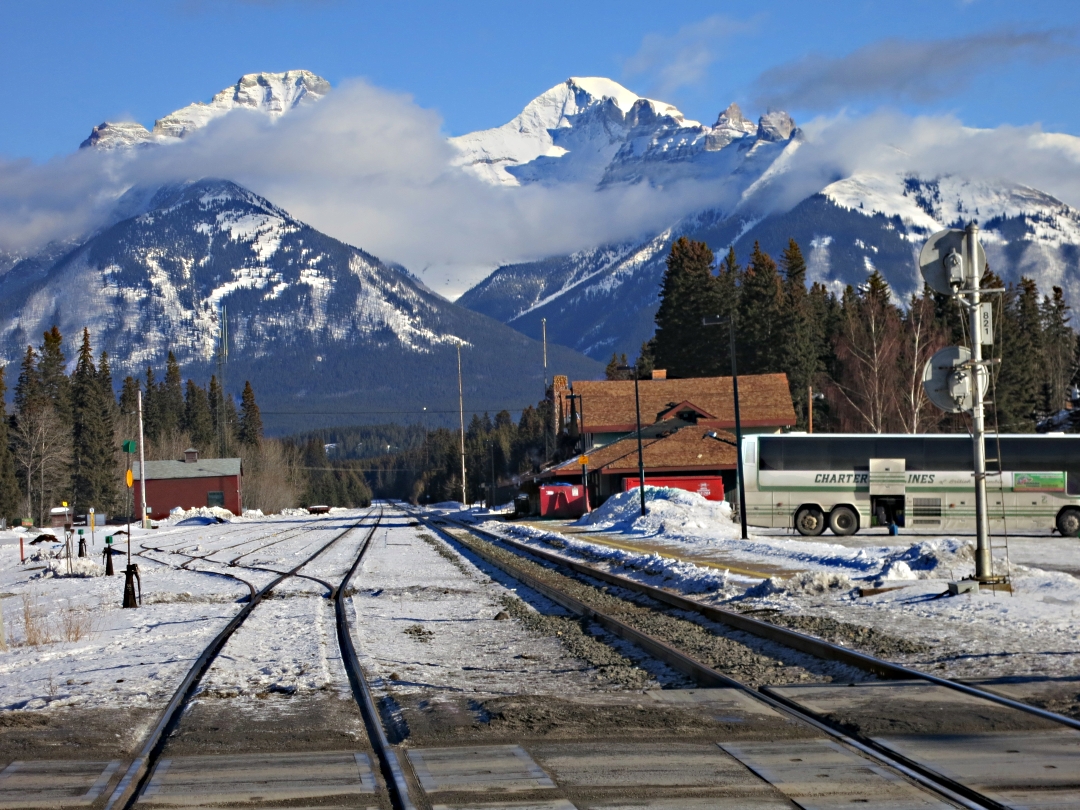
January 2014, looking from the level crossing towards Banff station, at the end of December a marshaling yard for the repair and recovery operation

January 2014, looking from the level crossing towards Banff station, at the end of December a marshaling yard for the repair and recovery operation

January 2014, double-decked wagons crossing the bridge

January 2014, double-decked wagons crossing the bridge

Looking upstream to teh mayhem

Looking upstream to the mayhem

Standing on the stone dam looking upstream to the straw bales and the crash site

Standing on the stone dam looking upstream to the straw bales and the crash site

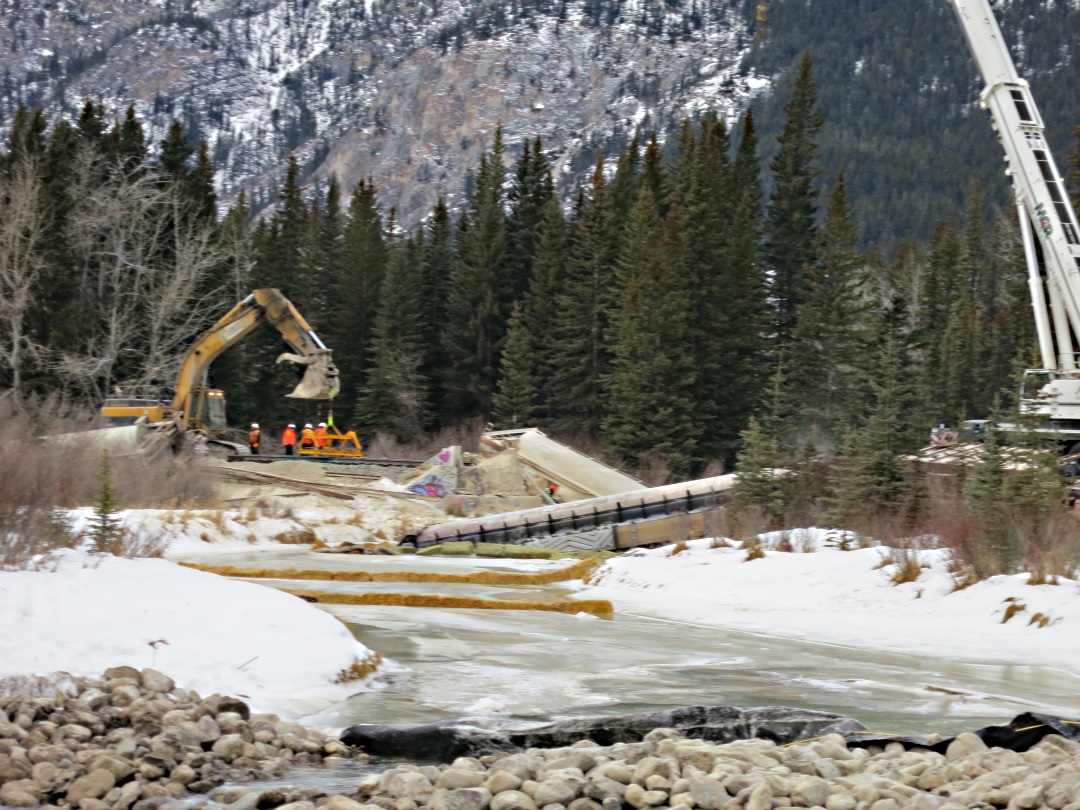
Bridge gone, derailed wagon left across the creek to dam it

Bridge gone, derailed wagon left across the creek to dam it, footbridge in place for the recovery operation, spillage evident on river bank into the water

Derailed and split wagon with large-scale equipment above

Derailed and split wagon with large-scale equipment above

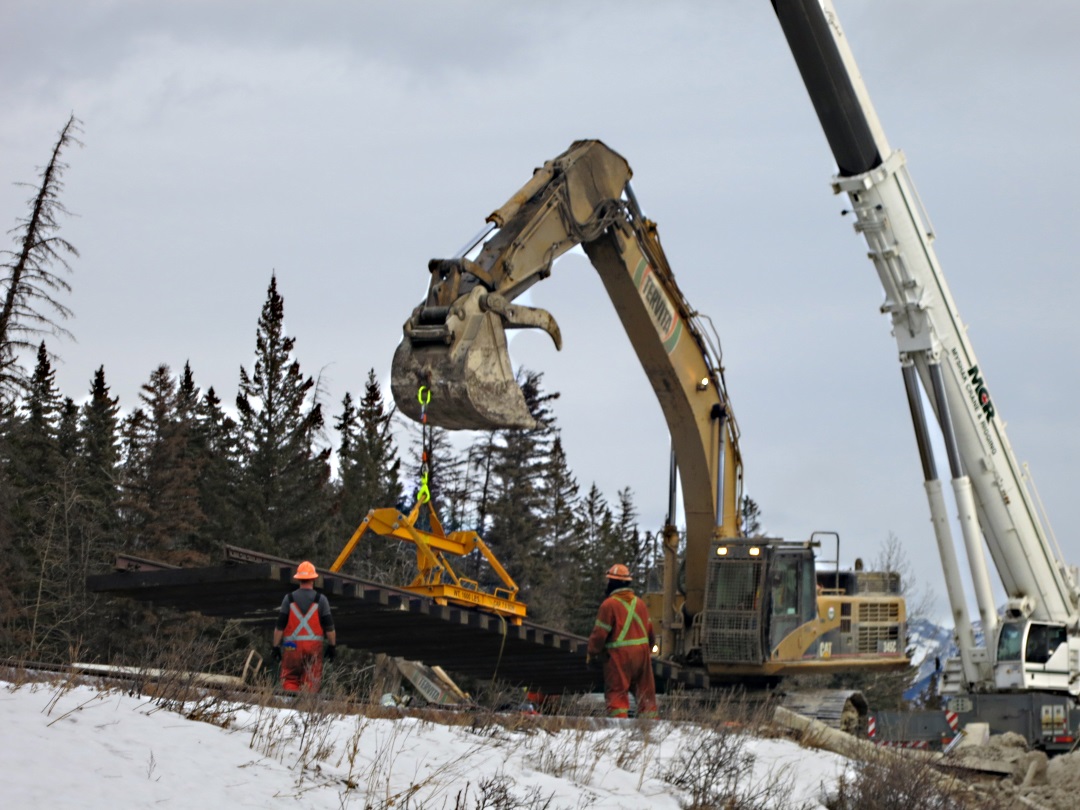
A section of rail track cut by angle grinder and lifted clear

A section of rail track cut by angle grinder and lifted clear

Local newspapers covered the incident but information was vague and contradictory.  As far as I can work out the following is correct.  The derailment occurred at 02.00 on 26 December.  Sixteen wagons were derailed, 6 into the creek. Closure of the line was rumoured to cost C$1million an hour.  The rail line was reopened around 16.30 on Sunday 28 December.  There is no incentive in Western society like money!!  Canadian mentality is simply “If there is a problem fix it.  Fast!”  I admire that.

Initial information that the derailed wagons contained potash and lentils seemed to be wrong, later and more consistent information  was that of the six wagons which ended up in the creek five contained fly ash and the sixth soya beans.

The concern about fly ash is that it is a waste material from coal fired power stations which is pozzolanic, a partial substitute for cement in concrete.  It also contains harmful trace-elements including in particular sulphur.  Thankfully mixing fly ash with concrete is now widely accepted as a positive use of what was once considered a ‘waste’ material which previously was dumped in holes in the ground to gradually leach into the environment.  (I like to claim a minor role in achieving that in the UK)

However, released into a water course in large quantities it can be a serious environmental problem which is why Parks Canada and the local authority environmental agency were on the ball in monitoring what the impacts were.  Hence the stone dam and the straw bales and why one rail wagon has been left across the creek because it acted as a very effective dam, especially as with plummeting temperatures the creek froze over.

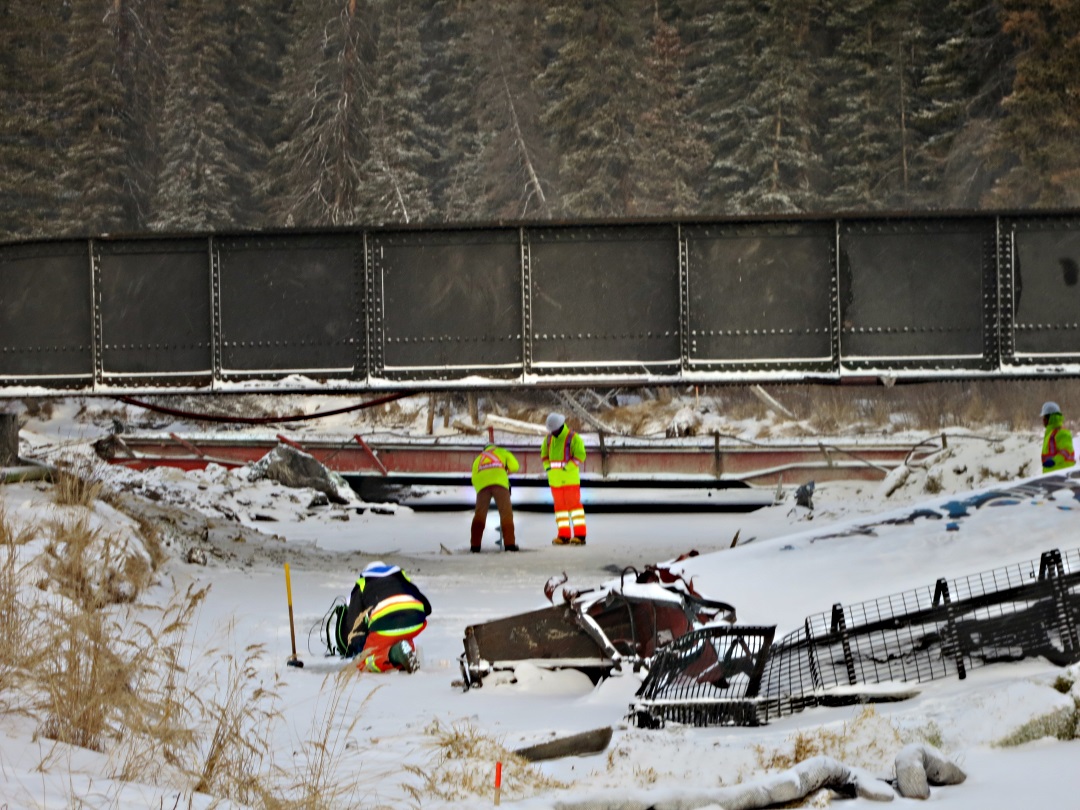
A week after the derailment, temporary bridge in place, river frozen solid enough for work to be carried out from its surface, wagon frozen in place, spillage removed

A week after the derailment, temporary bridge in place, river frozen solid enough for work to be carried out from its surface, wagon frozen in place, spillage removed

Drilling through the ice with hand auger to monitor the water

Drilling through the ice with hand auger to monitor the water

It seems from reports that there has been no serious chemical contamination so far.  Unfortunately however, the fly ash sinks to the bottom and in this context, potentially at least, smothers autumn-spawned fish eggs.

There are increased numbers of bears being killed by trains in the Banff National Park and it has been suggested that one cause of this is spillages of grain from freight wagons.  The soya beans would definitely pose a problem in that regard ………. except the bears are now hibernating and hopefully will not know that the beans had been spilled when they wake up in spring.

A simple, naive question sprang to mind.  Did the bridge collapse and cause the derailment?  Or did the derailment cause the bridge to collapse?

I knew from waiting for trains to pass when I’ve been on the trek to Vermillion Lakes or on the way back to Banff from the ski hill in previous years, that some trains are very long.  You can grow old standing there or fall asleep on the bus. The vast majority are freight, some are ‘double-deckers’.  I started to research.

It seems that the Canadian Transport Safety Board has investigated the causes of ten derailments of long trains since 2000.  Of these nine were Canadian National and only one was Canadian Pacific.  The reason for the large discrepancy, apart from the fact that CN is the larger operator and therefore runs more trains, is that CP has for a long time been at the cutting edge of ‘distributed power’, putting the three locomotives required to move such trains at strategically determined intervals along its length rather than clustered at the front.  This better controls ‘in-train forces’ and compensates for the adverse effects of very cold temperatures on air-brakes.

Another critical factor is the proper marshalling of trains.  A known cause of derailments in long trains is placing heavy wagons behind lighter ones, obviously more of an issue with mixed loads.  Heavier loads have more momentum and can buffer-up into lighter ones which stop more readily, thereby snapping the couplings.  Increasingly, the marshalling of long trains is computer controlled to prevent this.

I have no idea what was the cause of this derailment.  I only experienced the aftermath.  It does seem strange that it was CP, which has a track record (apologies for the pun) of using better technology, which ran this train.

An investigation will produce answers and causes in due course.  If Canada is like the UK and probably the rest of the world, inevitably there will be a battle between assessment of safety and environmental impacts on the one side and powerful economic interests on the other, the outcome of which will play a part in what is made public.

But it made a very interesting variation on a walk.

Posted in Canada, Hiking, Mountains, Nature, Winter | Tagged , , , , , , , , , , , , , , , , | Leave a comment

Canadian Rockies: Climate change

I haven’t been coming to the Canadian Rockies long enough to know what the norm is in terms of weather.  So this is a snapshot looking back 5 years.

In the UK we have ‘weather’, pressure systems blown in in a notoriously unpredictable manner bringing rain and a diminishing amount of sunshine.  In Greece and the Canadian Rockies, my two loves, they have ‘climate’.  Summer in the Greek islands is predictably hot and sunny, verging on very hot.  Love it!  The Canadian Rockies in winter are predictably very cold, verging on very, very cold.    Love it!  I like extremes.

Why doesn’t the UK stop bleating about ‘severe weather events’ with 2 cms of snow and temperatures down to -2oC  (Boxing Day 2014).  It was -29oC on the ski hill on Monday warming to -26oC in the afternoon, -24oC in town!!!!!!!!  No problems anticipated or experienced.

When I came to Banff first in winter 2010-2011 all roads and pavements (sidewalks) in town were covered completely in compacted snow and ice.  How cold it would be through the day was indicated by how far from the door of the hotel it took for ice crystals to form on nasal hairs on the way to the ski-bus in the morning.  If it was -25oC you got to the edge of the car park (20 metres).  If it was only -20oC you got half way across.  That was in the centre of town!  Fabulous on the ski hill.  There were sun dogs, the sun refracting through billions of microscopic ice-crystals on several days.  The guy in the bookshop on Caribou Street remembered temperatures in town dropping to -54oC.

In 2010 the Bow River was frozen over with footpaths across and only a few narrow isolated sections of open water.  The Bow Falls were frozen solid, a solitary narrow rushing torrent of water emerging from the ice briefly on the far bank before plunging back under again as the gradient flattened out.

During this year’s trip so far, until today, temperatures have been typically between -5oC and -10oC, warm enough to go out in the evening with just a shirt underneath a down jacket.  Heavy snowfall a couple of weeks previously has largely disappeared, roads and pavements clear.  Locals comment how mild it is.
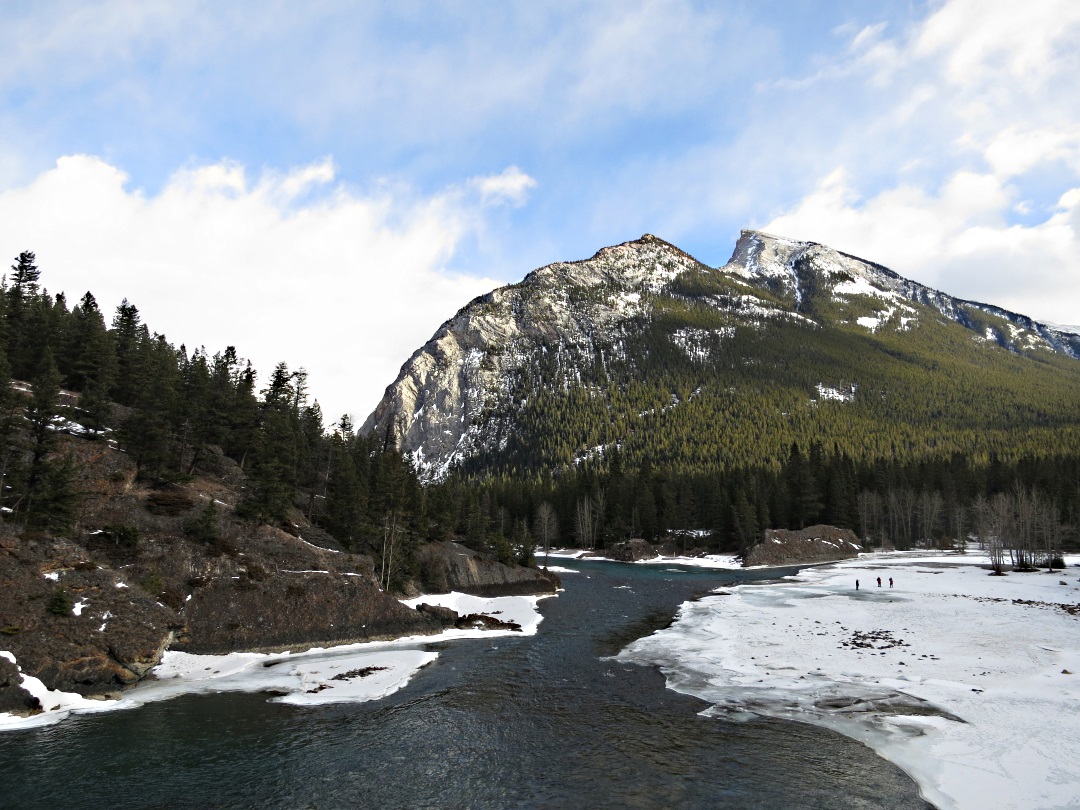
But perhaps the biggest contrast was walking along the river to the Falls, with far more open water than any of the previous 5 years.  Below the Falls the water meanders lazily around the right angle bend between Tunnel Mountain and Mount Rundle, heading northeast towards the Fairholme Range where it bends southwest at the Hoodoos, paralleled by the Trans Canada Highway.  A few years ago I walked the trail to the Hoodoos the river frozen solid, covered in snow, a little disconcerting when I came across a coyote sitting on the ice howling at a rival or a potential mate.  Now it is all open water, no way across. Safe.  Unless the coyotes are on the same side as me and hungry.

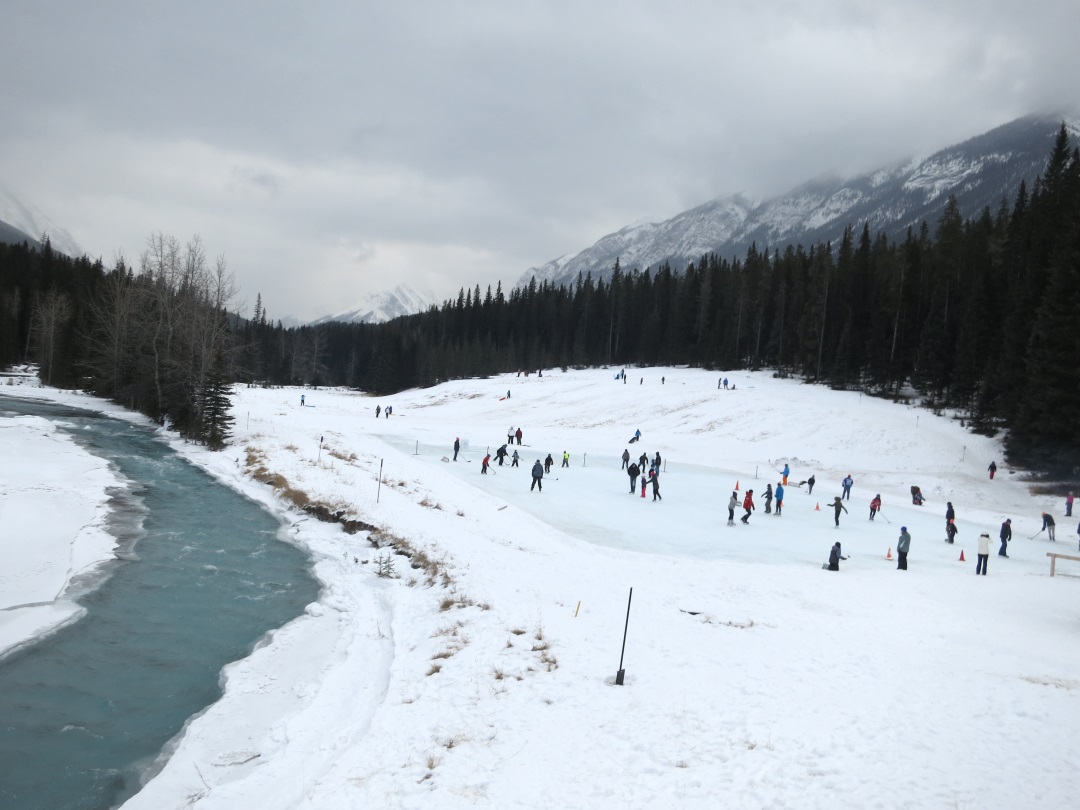
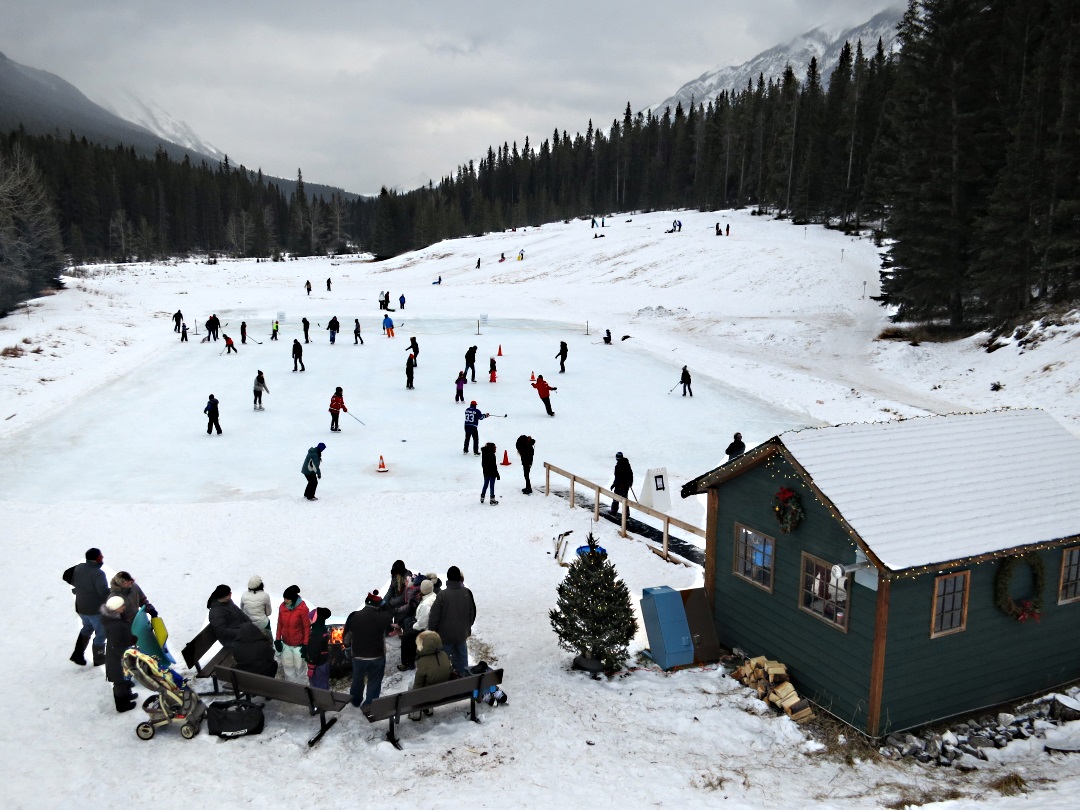
From the bend in the Bow River below the Falls I follow the Spray upstream to a footbridge, glacier-green water flowing broadly all the way.  In 2010 it was frozen and could be crossed at any point.  It is nevertheless still consistently cold enough for the informal ice-rink in a field alongside the river to attract people of all ages to skate, play hockey and stand around a log fire or toboggan down the snowy hillside.  “Isn’t that just typically Canadian” said the guy standing next to me to his mates from Toronto.

Cold weather.  Warm feeling.
Are winters becoming milder in the Rockies?  Is it just a natural cycle?  Is climate change being accelerated by inconsiderate and ill-considered human activity?  The plural of ‘anecdote’ is not ‘data’ but a combination of both seems to indicate that significant changes are taking place in climate generally including the hard winters of North American ‘continental climate’.

Looking downstream from the new footbridge over the Bow River towards Mount Rundle, more open water than usual, ice breaking up

Looking downstream from the new footbridge over the Bow River towards Mount Rundle, more open water than usual, ice breaking up

The top of Bow Falls, usually completely covered in ice by now

The top of Bow Falls, usually completely covered in ice by now

Close look at the vigorous flow

Close look at the vigorous flow

From the crag above Bow Falls looking downstream to the confluence with The Spray Rive, Mount Rundle bahind

From the crag above Bow Falls looking downstream to the confluence with The Spray Rive, Mount Rundle behind

Looking back at Bow Falls after descending the 'closed' trail over the crag

Looking back at Bow Falls after descending the ‘closed’ trail over the crag

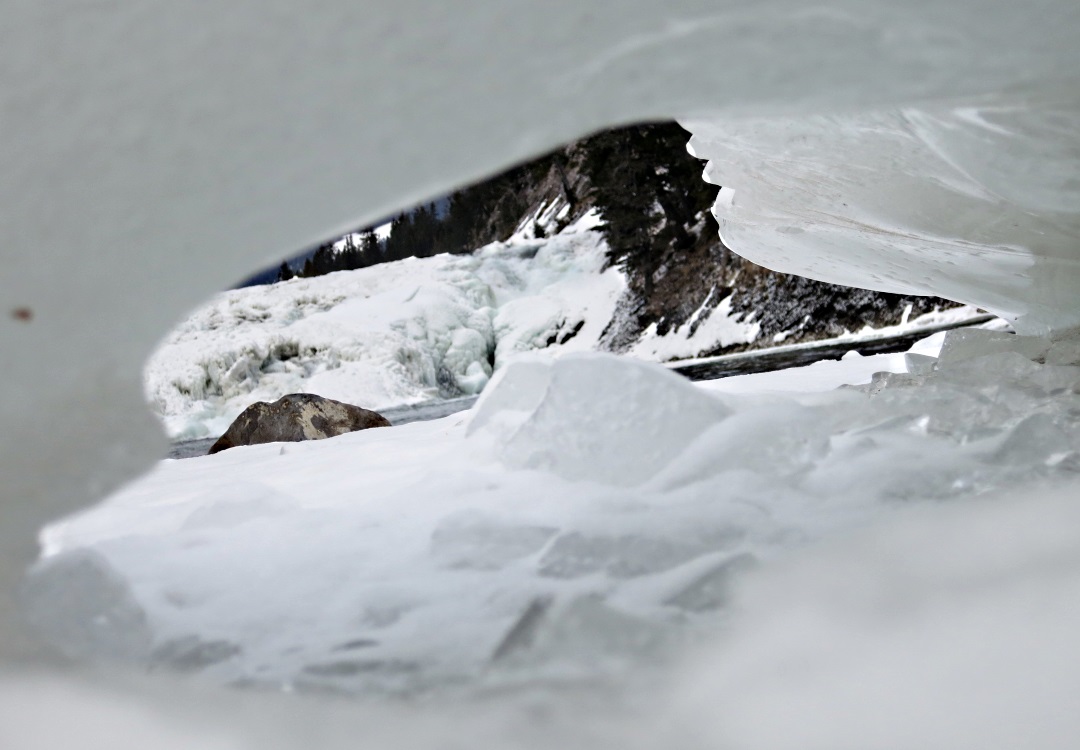
Lying on my stomach on the ice looking towards the Bow Falls through a gap under ice laid down when the river level was higher earlier in the winter .... just as the Earth tilted on its axis

Lying on my stomach on the ice looking towards the Bow Falls through a gap under ice laid down when the river level was higher earlier in the winter …. just as the Earth tilted on its axis

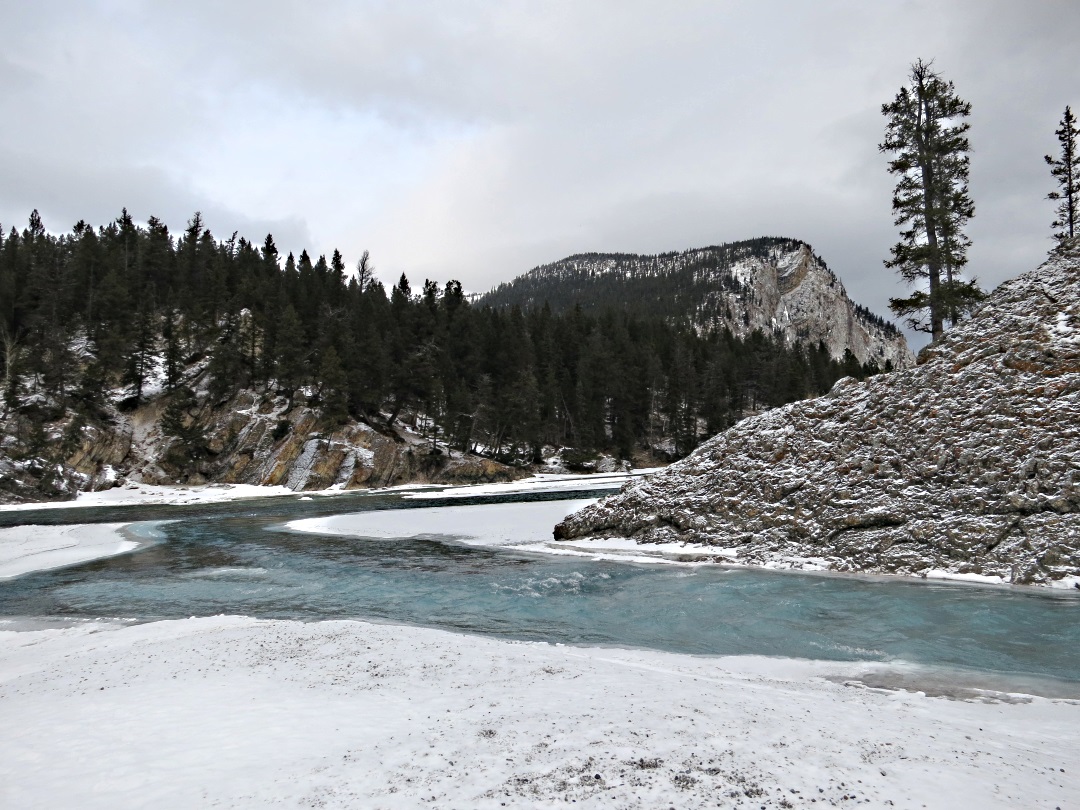
The confluence of the Bow and the Spray

The confluence of the Bow and the Spray

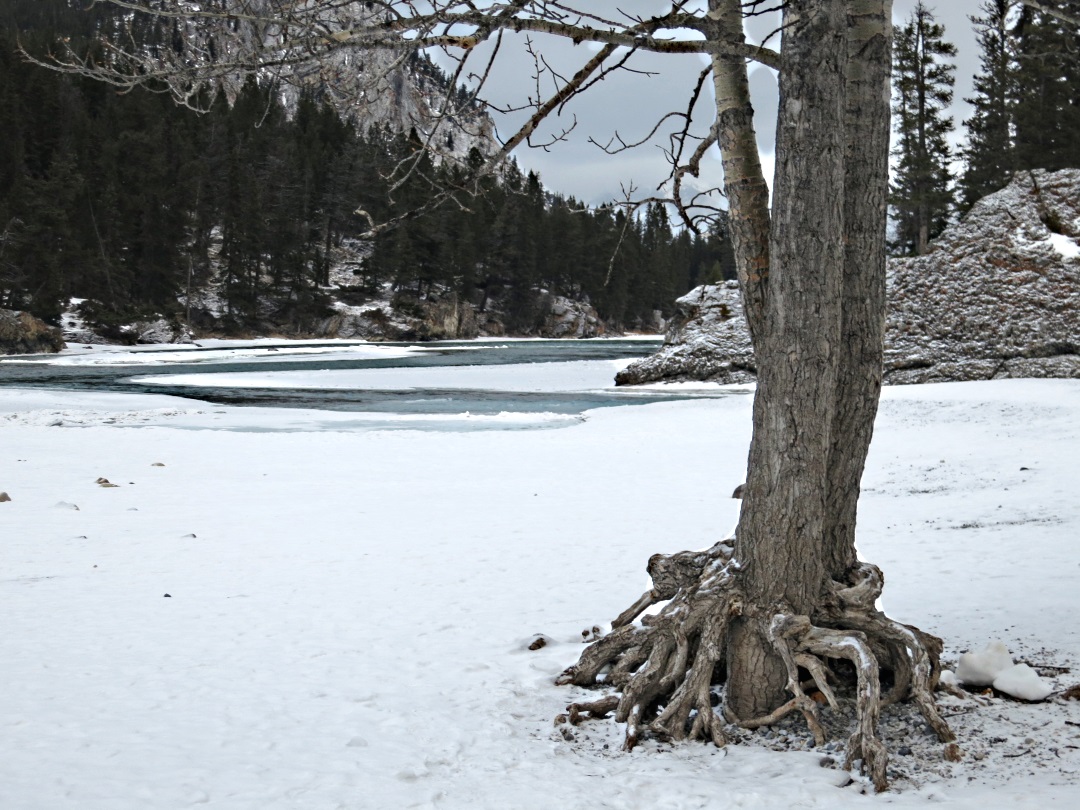
Gnarly roots at the confluence of the Bow and the Spray Rivers

Gnarly roots at the confluence of the Bow and the Spray Rivers

14Canada135w6475

Looking upstream on the Spray River from the footbridge

On thin ice - looking upstream to the footbridge over the Spray River
On thin ice – looking upstream to the footbridge over the Spray River

Looking across the Spray on a slow flowing section Looking across the Spray on a slow flowing section

Rapids on the Spray, usually frozen by now

Rapids on the Spray, usually frozen by now

Rapids on the Spray, usually frozen by now

Thin ice from a water frozen when at a higher level

The ice rink alongside the Spray River

The ice rink alongside the Spray River

Like a painting by LS Lowry or Breugel

Like a painting by LS Lowry or Breugel

x

Posted in Canada, Hiking, Landscape, Mountains, Wildlife, Winter | Tagged , , , , , , , , , , , , | 2 Comments

Canadian Rockies: Christmas on the piste

I’ve been in the Canadian Rockies now for a week, skiing and doing the odd bit of walking.  There couldn’t be a much greater contrast with summer in the Greek islands.  But, after heavy overnight snowfall on the mountain, early on Christmas Eve the cloud moved away and one thing the two places had in common was blue sky.  Idyllic.

Happy Christmas.

Lake ouise, from the the Top of the World looking down towards the base

Lake Louise, from the the Top of the World looking down towards the base

Cruising in to the Ptarmigan lift

Cruising in to the Ptarmigan lift

x

Posted in Canada, Landscape, Mountains | Tagged , , , , , , | 2 Comments

I was attacked by an airport: an unexpectedly wild walk

I did nothing to antagonise it.  Malevolence on its part is the only explanation.  That or ‘smart’ technology out of control.  Which is even more frightening.

I was on my home from Greece in the latter part of October.  I had taken a ferry to Rhodes from Symi, a tiny, in many ways idyllic island because it cannot accommodate an airport which means it only suffers mass tourism for a couple of hours each day when trip boats are in.  Charter flights had finished for the season and I was returning with Aegean Air, the Greek flag carrier, first to Athens and then a connecting flight to Manchester.

I had opted for an onward flight which gave me only 50 minutes to exit the aircraft, negotiate the airport and make the connection. My seat towards the rear of the plane put me close to the rear doors and when steps were wheeled up I thought all was well.  Not so.  The rear exit remained closed and we all had to shuffle along the aisle and leave at the front, with me behind about 200 other passengers.  By the time I was off the plane I had barely 30 minutes

I raced along the narrow passageways towards the main terminal, edging past people wherever I could until I reached a concourse with overhead screens pointing to a range of departure gates.  My flight was from Gate A1, up a long set of stairs to the left.  Now I could speed up.

Or not.  The stairs were clogged from top to bottom with slow-moving passengers dragging over-sized cabin luggage.  Upward progress was clearly painfully slow.

Alongside the stairs was a stationary escalator with nobody on it.  “Must have broken down again” I thought and without a moment’s hesitation sprinted towards it and started to go up two steps at a time.  About a third of the way up the parallel shiny metal strips on the treads and the risers started to do strange things to my eyes, inducing weird, disorienting impressions of movement.  So I stopped looking at them and instead looked at the passengers trudging up the stairs alongside.

Over half way up I realised something was wrong when an elderly woman with a zimmer frame on the stairs started to overtake me.  I speeded up but cold hardly keep pace.

‘Bling!’ The light went on in my brain.  The escalator had started moving.   Downwards.  I was nearly three quarters the way to the top when it reached full speed.  I made the choice to continue upwards and started running.

As I reached the top I realised that getting off would not be straightforward.  Instead of the steps levelling out as happens when you get off an upward moving escalator, the steps were becoming increasingly steep as they moved towards me.  I couldn’t afford to slow my pace to negotiate the rising obstacle or I would have been going backwards.  Nothing else for it, I would have to continue running and jump over the rising step onto the floor beyond.

I leapt, made solid ground but in doing so my sandalled instep was savaged by the teeth on the edge of the rising step.  I landed on a sign painted on the floor at the top of the escalator in two languages saying “automatic operation”.

I limped rapidly forward towards the departure gate, glanced at my sore foot and realised there was a stream of blood flowing from it.  Two parallel gashes cut my foot to the bone.  I stopped, pulled from my pocket a couple of paper napkins which I pick up for just such emergencies, loosened the strap of my sandal, rammed the napkins underneath, cinched the strap tight and carried on running towards goal.

I caught the flight with a few minutes to spare.

Only a couple more days now and I’ll be back in an airport for the flight to Canada.  I’ll be paying more attention on escalators.

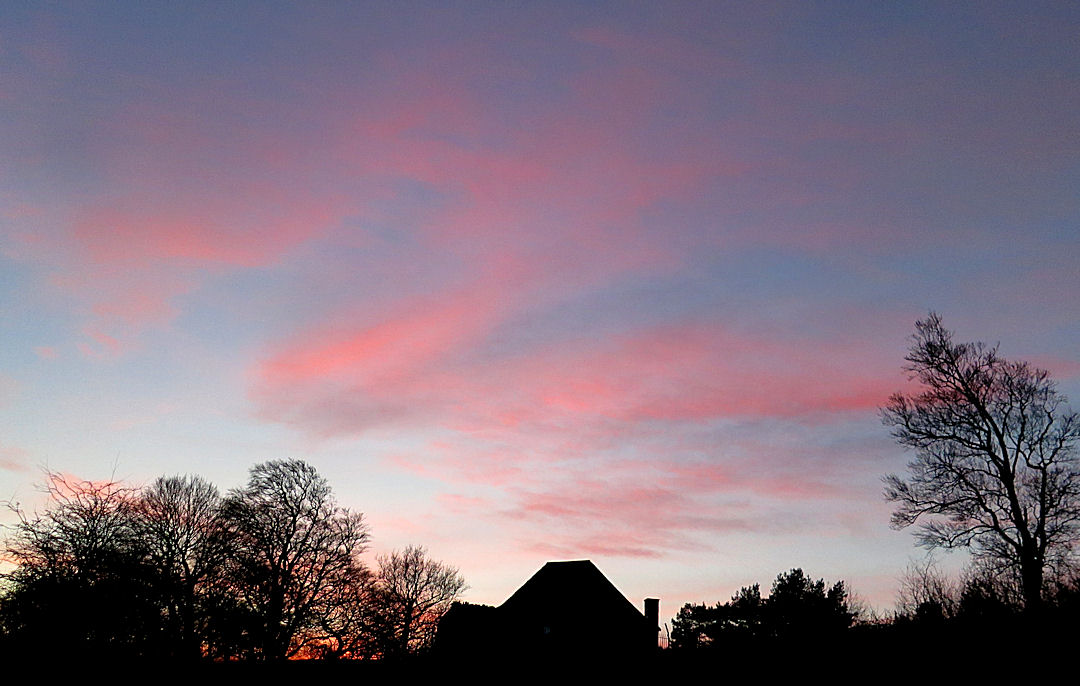
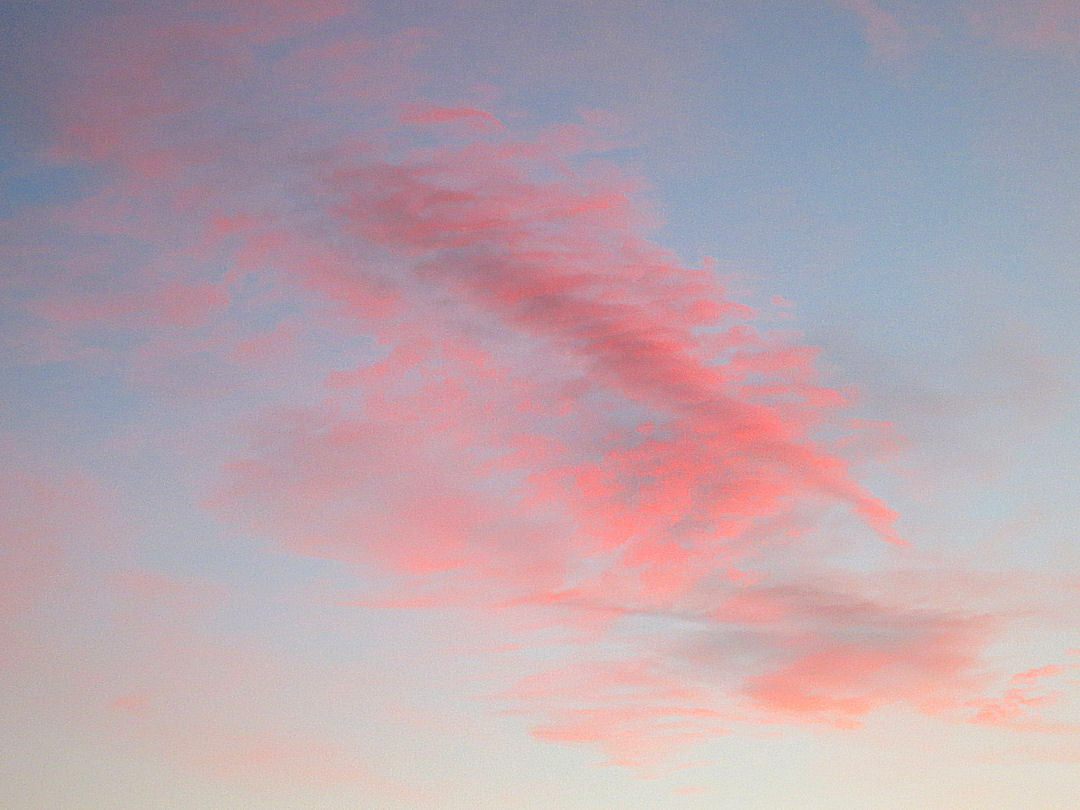
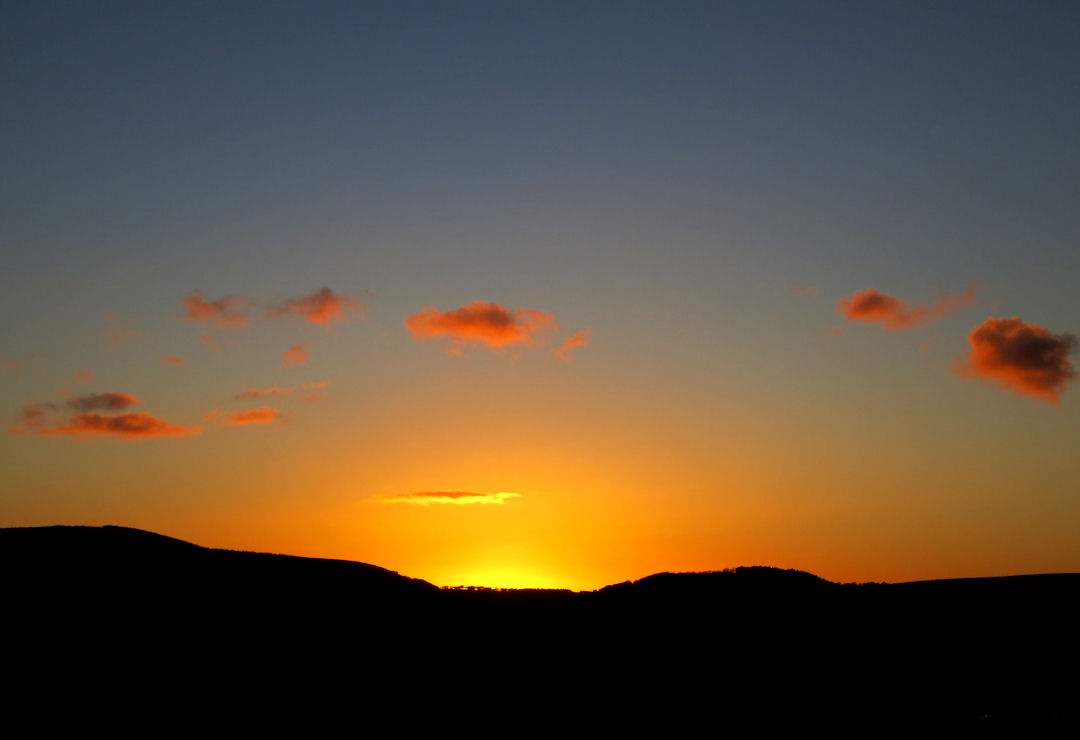
In the meantime, at the end of an afternoon, I managed to take advantage of a sunny day to go back up the ridge at the southern tip of the Brecon Beacons National Park.  Another spectacular sky to the west.  As I started back towards home with gold still tingeing the horizon, the scattered, thin cloud overhead turned red.  Blood red.

Gold on the ridge-top

Gold on the ridge-top

Golden sky sinks behind the ridges to the west

Golden sky sinks behind the ridges to the west

Golden horizon, blood red could overhead

Golden horizon to the south, blood red cloud overhead

Shell Grotto and blood-red sky

Shell Grotto and blood-red sky

A gash in the sky

A gash in the sky

x

Posted in Canada, Greece, Grumpy Old Men, Hiking, Landscape, Mountains, Pontypool, Wales | Tagged , , , , , , , , , , , | 1 Comment

Autumn gold in Old South Wales

You can’t live life looking to the past.  After a few weeks under grey skies reminding myself of Symi summer sun it’s time to focus on the present and look to the future.

The turning point was when yet another grey, wet morning was replaced by clear skies and bright sunshine so at the end of the afternoon I walked up to the ridge behind the house.

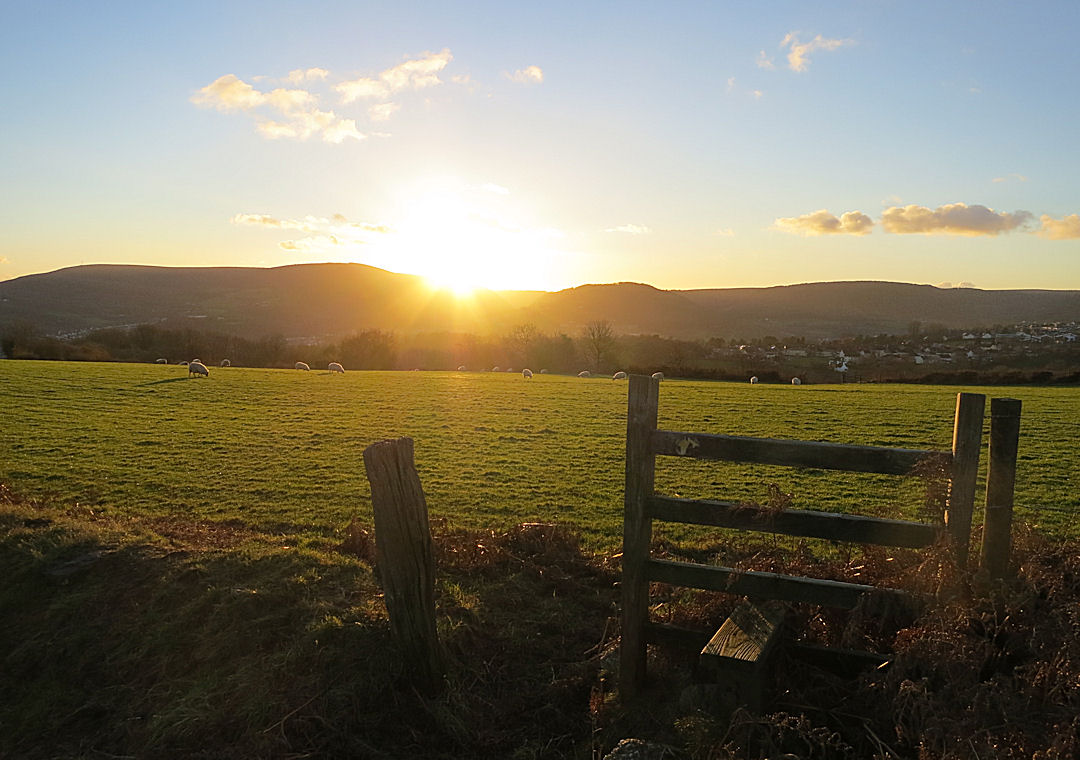
At the southern tip of the Brecon Beacons National Park and around 1000 feet ASL, the Folly Tower above Pontypool is 30 minutes away at a brisk pace and offers great views in all directions.   Visibility was crystal clear as the temperature dropped, humidity condensing out, cold air unable to evaporate the moisture in ground sodden from previous weeks of rain and mist.  With clear skies there would soon be a ground-frost, an air-frost by early morning, but huddled in a polar-fleece I sat and watched as the sun sank slowly behind the mountain ridges ranging away to the west in a clichéd golden glow.

In just over two weeks I will be in the Canadian Rockies in deep snow but for the moment this was great, a mountain top, Old South Wales at its autumnal best.

Autumn gold reflecting in the Abergavenny-Brecon Canal, the south east boundary of the National Park

Autumn gold reflecting in the Abergavenny-Brecon Canal, the south east boundary of the National Park

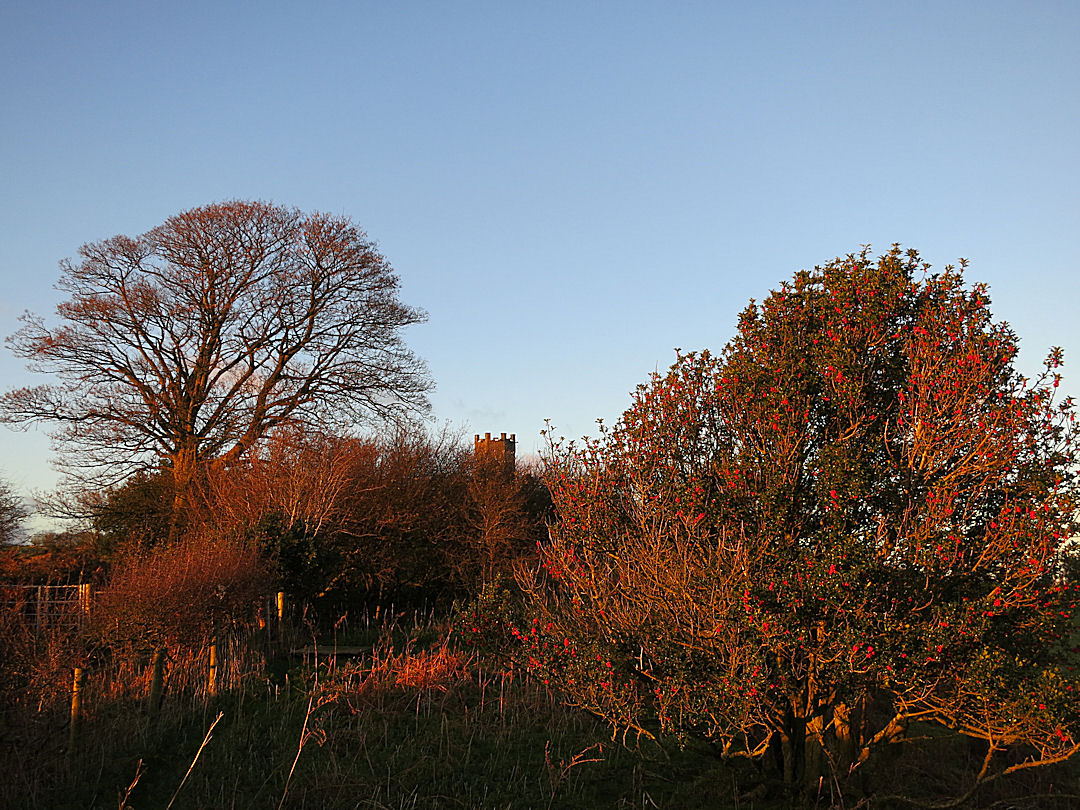
Burnished by setting sun. holly tree on the ridge, the Folly coming into sight

Burnished by setting sun. holly tree on the ridge, the Folly coming into sight

Looking west from the ridge-top path

Looking west from the ridge-top path

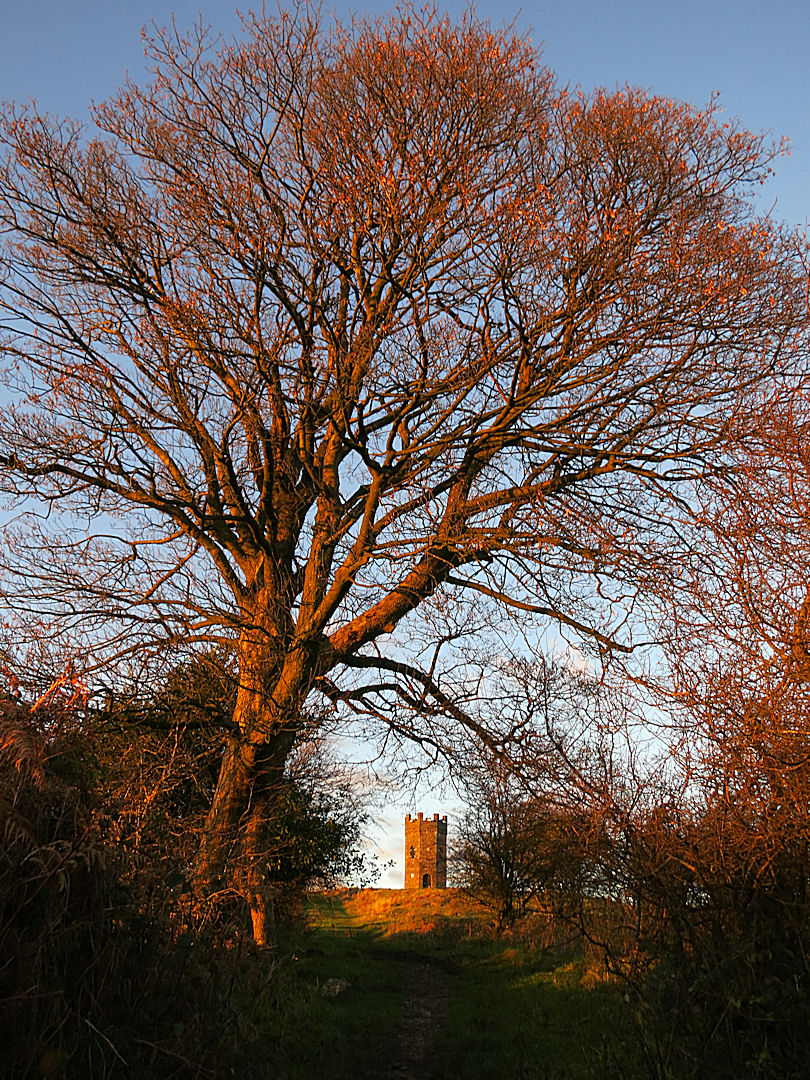
Folly Tower

Folly Tower

Silhouette against the gold

Silhouette against the gold

.... closer view

…. closer view

Going, going .......

Going, going …….

...... gone!

…… gone!

Leaving Scarlet Hood mushrooms in the grass, edible but too attractive to pick

Leaving Scarlet Hood fungi in the grass, edible but too attractive to pick

x

Posted in Autumn, Landscape, Monmouthshire, Mountains, Nature, Wales | Tagged , , , , , , , , , | 2 Comments

Symi: imagining the past

As I recounted in the blog, in July I trekked via many distractions to the ridge-top Lappatoniou Castle  on the western-most peninsula on Symi.  Then in early in October I went back with friends who, after trial and error and the judicious wielding of secateurs, had found an old footpath which they had been told about between there and the monastery of Agios Ioannis Theologos on a path at a lower level on the ridge.  The path to the monastery was very indistinct so I went back again a few days later on my own, partly to reinforce it in the little grey cells but also to explore an old settlement on the ridge-top. I’m increasingly fascinated by reminders that communities once subsisted on small rocky islands like Symi and several times this summer I have set out to try to find out more.  In many cases it is a matter of trying to interpret the fragmentary remains of what in their day were probably significant communities.

The trek to the castle was just as interesting as previously though this time in order to make more rapid progress I ignored the many distractions en route.  The barren rocky mountainside under blue skies seems all the more appealing now I’m home and surrounded by a green but increasingly soggy trudge to the top of the ridge behind the house.

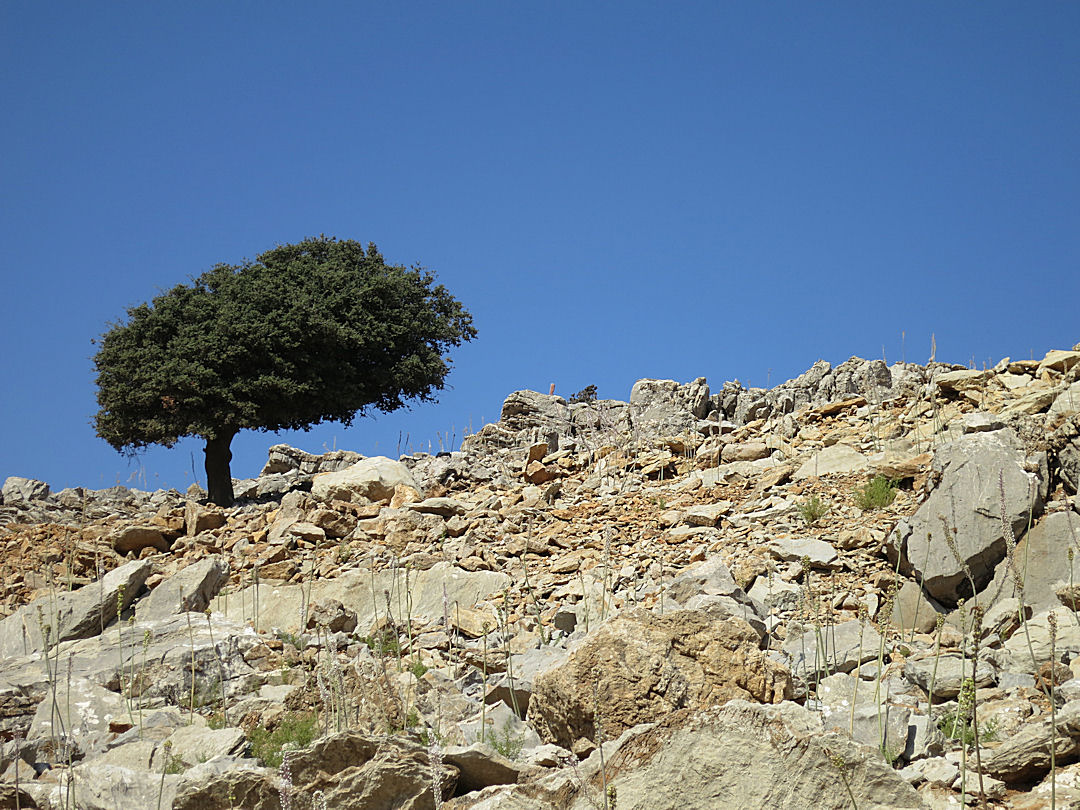
A lone cypress tree skylined on a barren rocky mountainside

A lone cypress tree skylined on a barren rocky mountainside

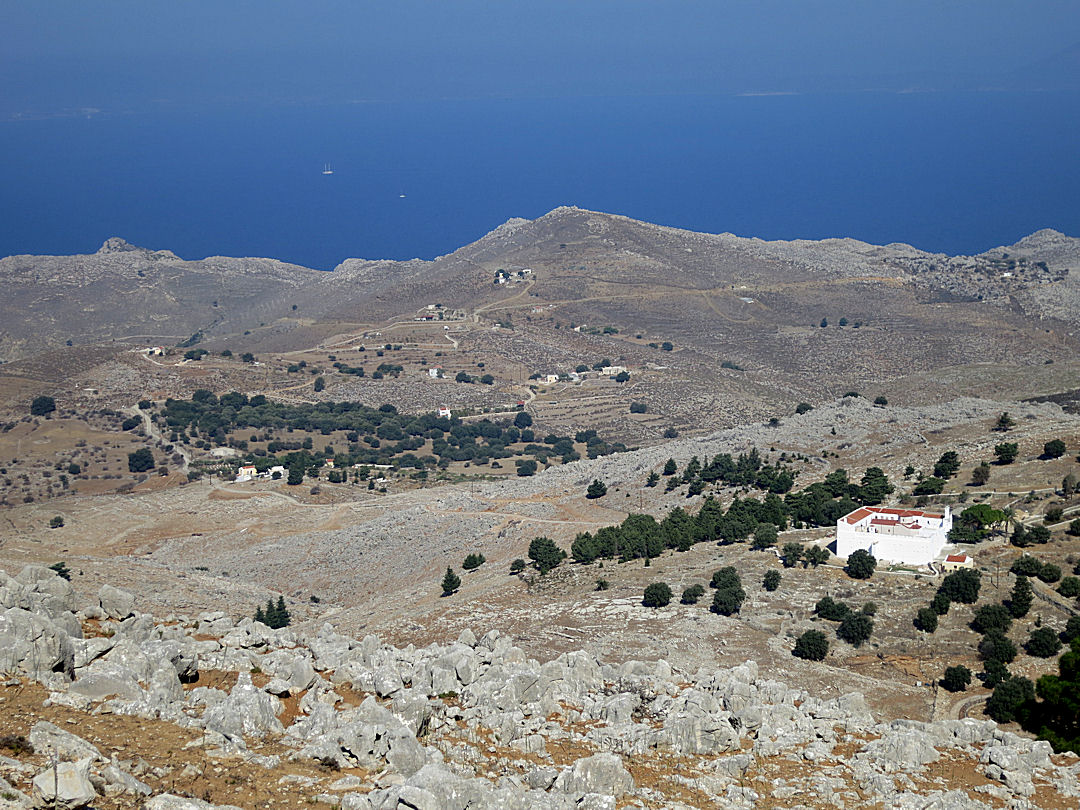
Looking across the mid-level plateau and the fortress-like Roukouniotis monastery

Looking across the mid-level plateau and the fortress-like Roukouniotis monastery

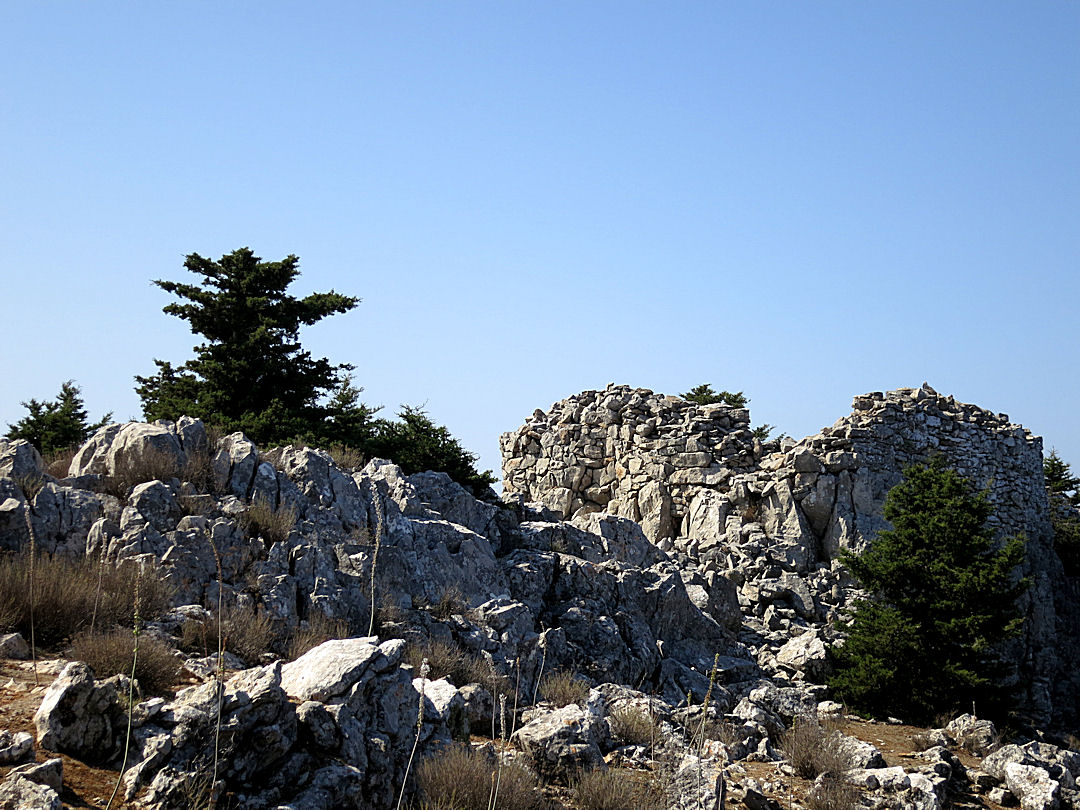
The rocky approach to the ridge-top castle

The rocky approach to the ridge-top castle

the castle on top of vertical crags

the castle on top of vertical crags

I didn’t linger at the castle.  Not shown on the SKAÏ map, nor mentioned in any of the booklets on walks on the island, the path onwards is little trodden now and more difficult to follow. It traces along the crest, sometimes through the top of the tree-line of the cypress woodland which blankets the north side of the ridge, sometimes edging the steep vertical, barren rocky drop to the south.

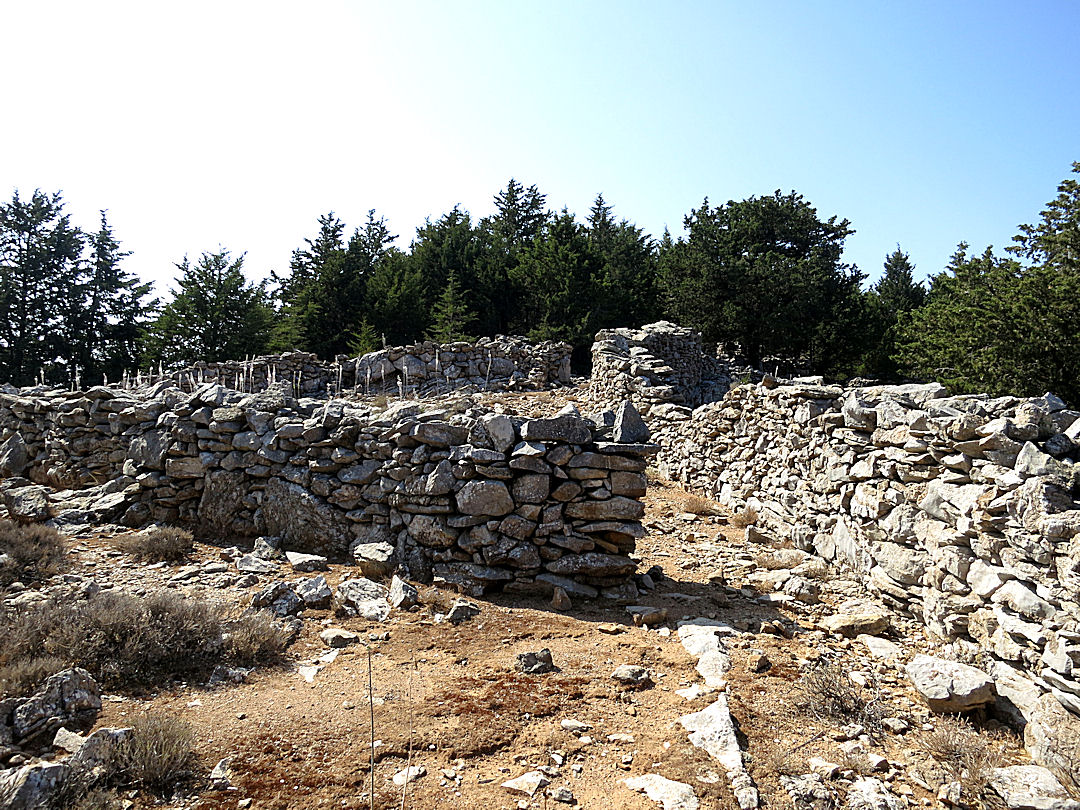
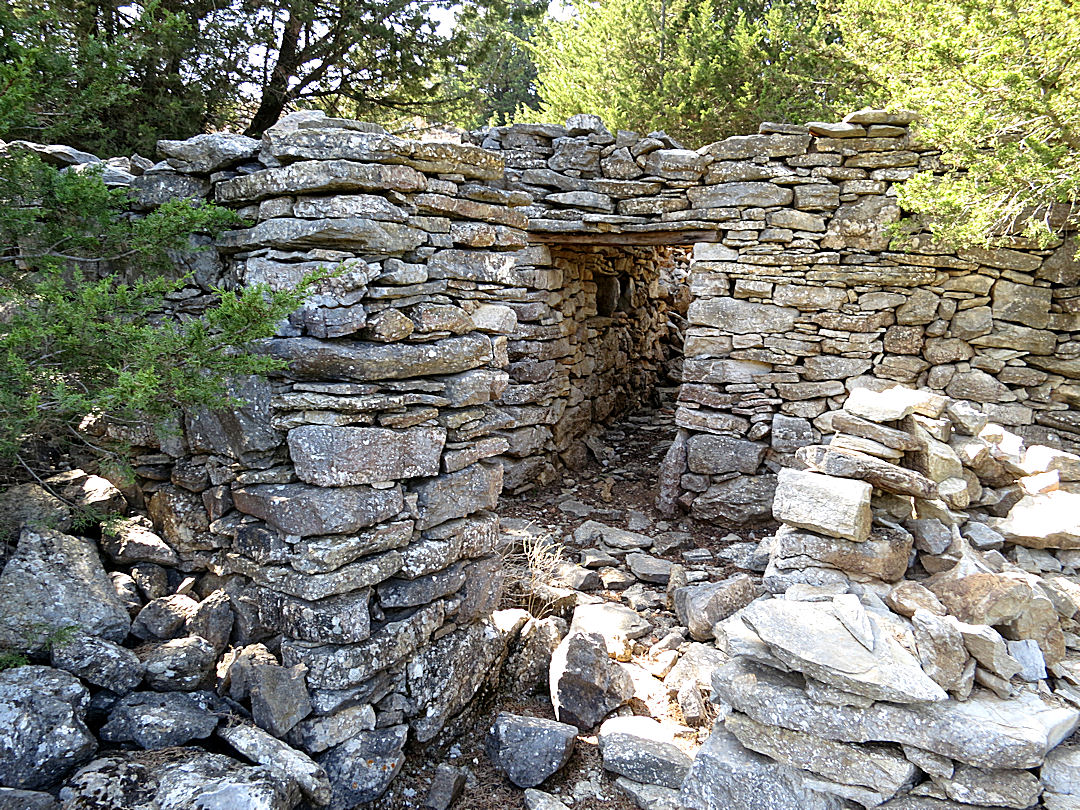
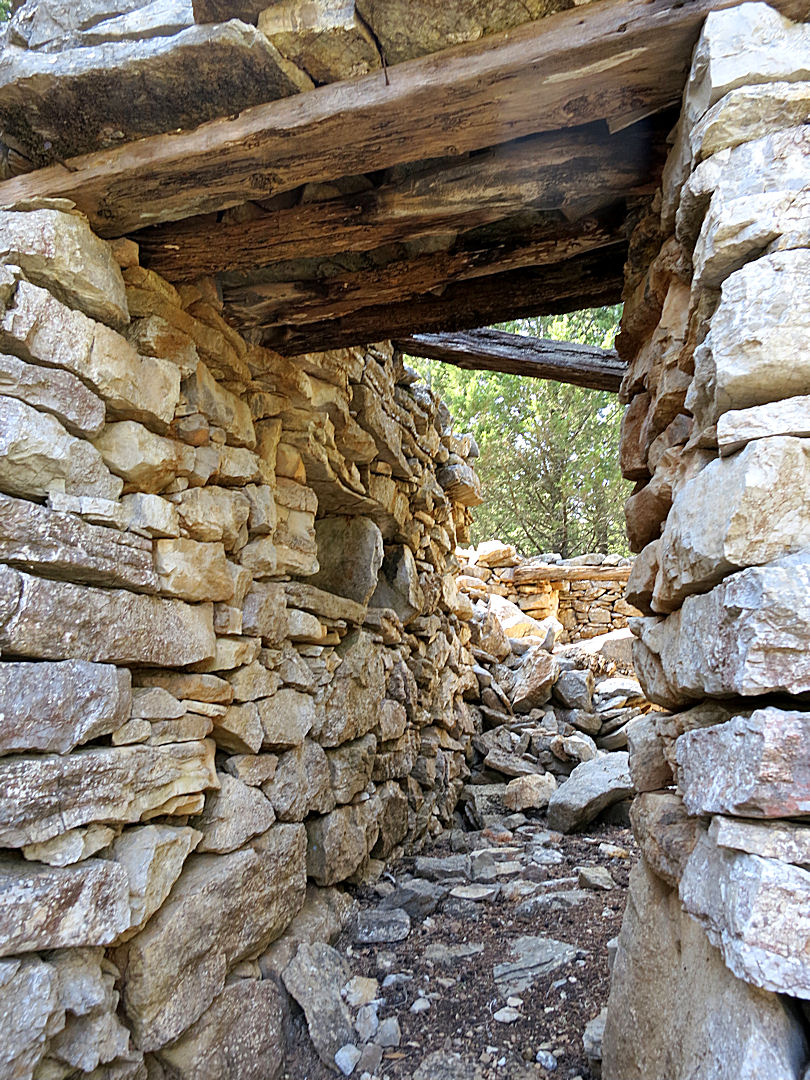
In 15 minutes or so the thin path reaches the stone walls of the enclosure around a long-deserted settlement in small ridge-top col.  Like the settlement I found near to the edge of the sea on the east side of the Kokkinochoma Peninsula there were extensive and still largely intact rough-built stone enclosure walls and just a single house.  However, my guess was that this settlement had been abandoned considerably earlier as there were no signs of doors or shutters and fewer of the roof timbers survived.  The stout wooden lintels bridging the doorway through the nearly metre-thick stone walls were well rotted, encouraging a rapid transit across the threshold, accelerated even more by the swarm of wasps buzzing defensively in the entrance.

The single room of the dwelling was large and would probably have housed a moderate sized group of people.  It showed some sophistication in that it had a number of square storage spaces built into it.

Approaching the entrance into the outer enclosure

Approaching the entrance into the outer enclosure

The entrance to the smaller inner enclosure with the house is marked by large stones, an indicator of prestige

The entrance to the smaller inner enclosure where the house is situated, marked by large stones, an indicator of prestige

The tiny 'front garden' and the door to the house

The tiny ‘front garden’ and the door to the house

Thick stone walls and stout wooden lintels

Thick stone walls and stout wooden lintels

Looking towards the far end of the house

Looking towards the far end of the house

.... and looking back towards the entrance

…. and looking back towards the entrance

Just beyond the enclosure and slightly higher along the ridge was the remains of a threshing circle, large stones marking its edge though without a hard base like that at Gria.  Difficult to spot among the many rocks which cover the small plateau, it was very roughly formed and abandoned long ago.

Looking along the ridge towards with the threshing circle

Looking along the ridge-top towards the threshing circle

.... and just in case it's not clear I've marked it in red

…. and just in case it’s not clear I’ve marked it in red

From the ridge above the house looking towards the island monastery of Agios Emilianos

From the ridge above the house looking towards the island monastery of Agios Emilianos

.... and another view of the threshing circle

…. and another view of the threshing circle

To this point the direction of the path had been consistently south of west.  From the bottom entrance of the enclosure it turns sharply north-eastwards heading directly towards the monastery of Agios Ioannis Theologos, clearly visible, white through the trees.  Within a few metres the path reached another broken threshing circle.

The second threshing circle just below the enclosure

The second threshing circle just below the enclosure

Looking north-east to the monastery of Agios Ioannis Theologos, white among the trees

Looking north-east to the monastery of Agios Ioannis Theologos, white among the trees

The immediate thought was that to need two threshing circles there must have been extensive cereal growing nearby, a supposition supported by the fact that the path to the monastery drops down a whole series of crumbling terraces which would have once been cropped but are now colonised by thick cypress woodland.  Google Earth shows some of the broader terraces lower down the mountainside close to the monastery.

Threshing circles, terraced fields and stone-walled enclosures together indicate that this was a mixed agricultural economy.  Animals would have been penned within the enclosures which are too rocky to have been cropped, possibly fed for some of the year on the straw from the cereals after threshing.

Satellite image from Google Earth with the walls of the settlement enclosure bottom centre, the monastery top right and terraced fields visible to the left of that

Satellite image from Google Earth with the walls of the settlement enclosure bottom centre, the monastery centre top and remains of terraced fields visible to the left of that

Though my main interest on the day had been to visit the old settlement, the trek was not all about crumbling ruins, fascinating as I find them.  Like all walks on Symi there was much spectacular scenery and fascinating wildlife.

Even in October the vividly coloured male Red Veined Skimmers still disport themselves on the top of stalks

Even in October the vividly coloured male Red Veined Skimmers still disport themselves on the top of stalks

More and more flowers open as Autumn gets underway

More and more flowers open as Autumn gets underway

Stunning views on one of the most dramatic kalderimi on the island, and indeed in the whole Aegean,on the way back to Horio

Stunning views on one of the most dramatic kalderimi on the island, and indeed in the whole Aegean,on the way back to Horio

The route plotted on Google Earth

The route plotted on Google Earth

x

Posted in Greece, Hiking, History, Landscape, Mountains, Nature, Wildlife | Tagged , , , , , , , , , , , | Leave a comment