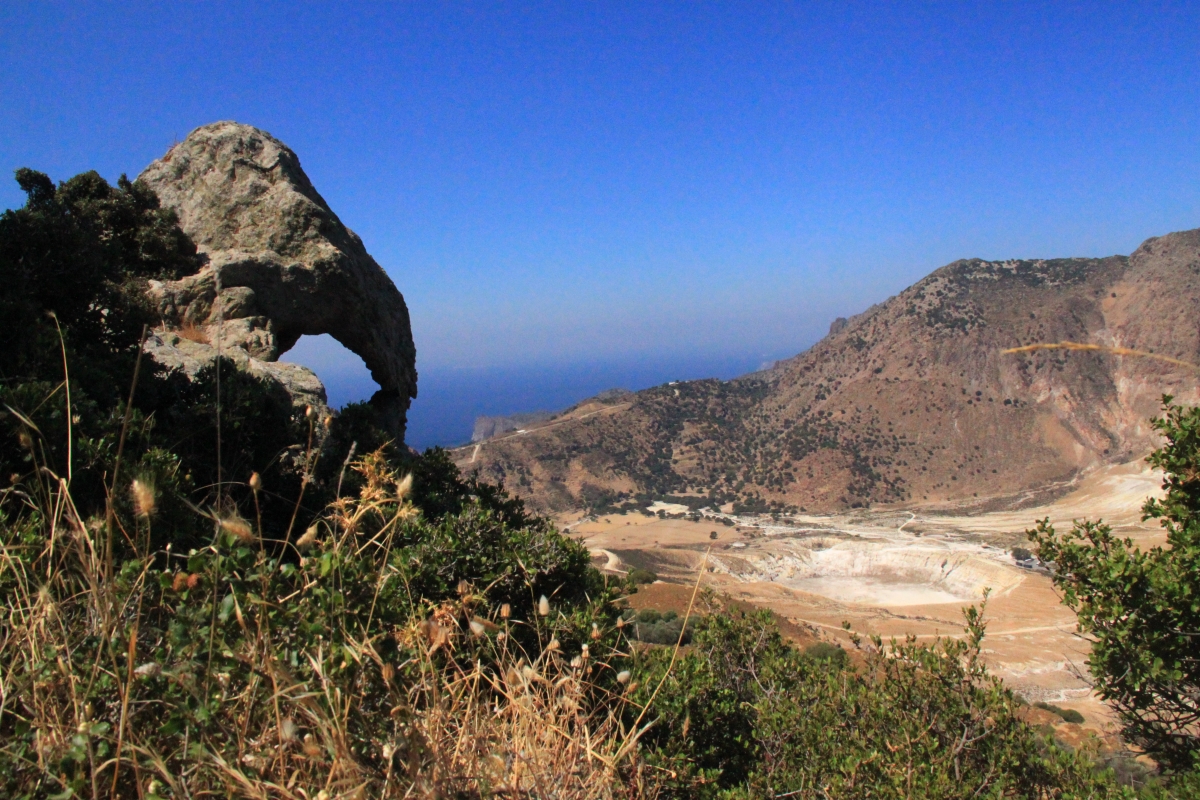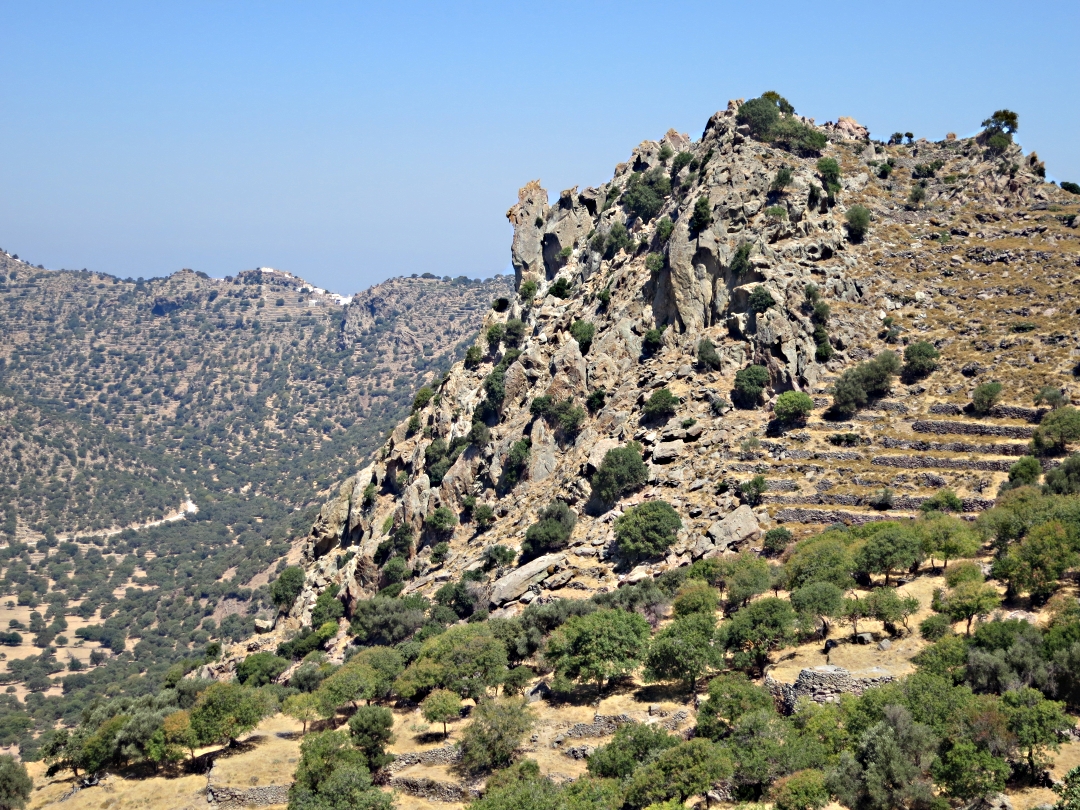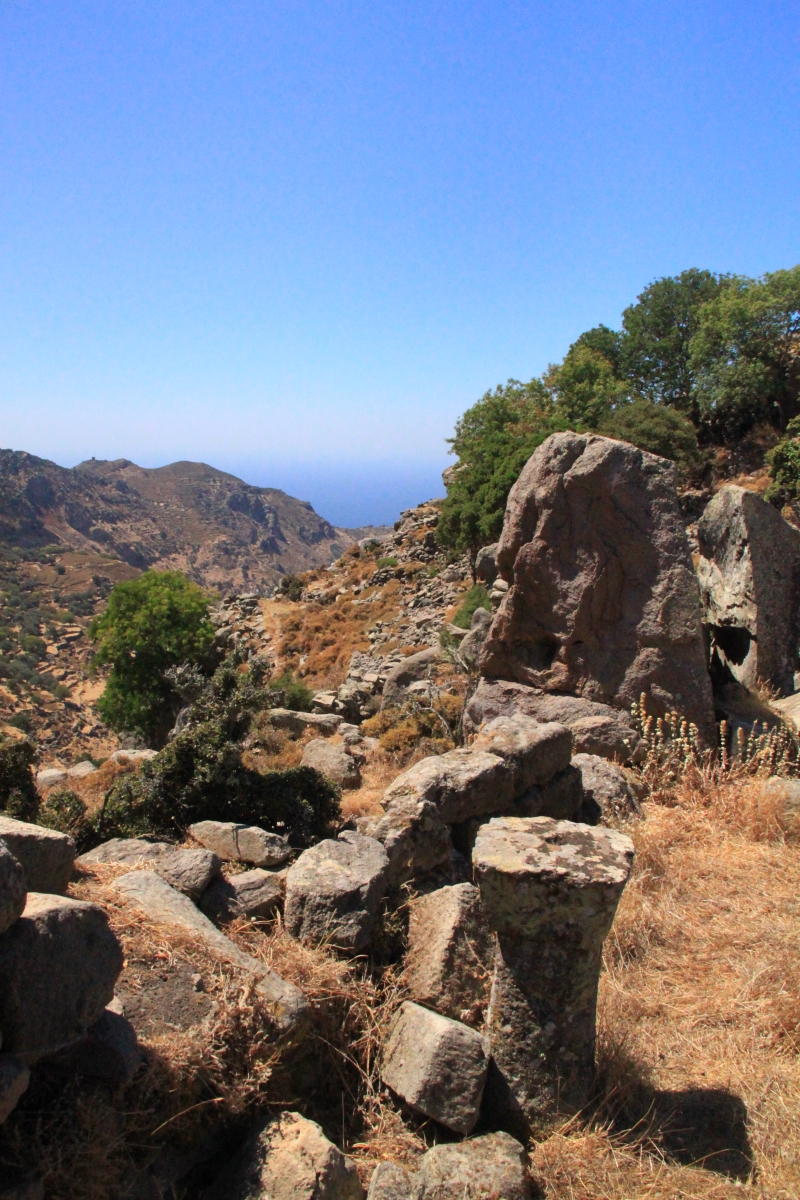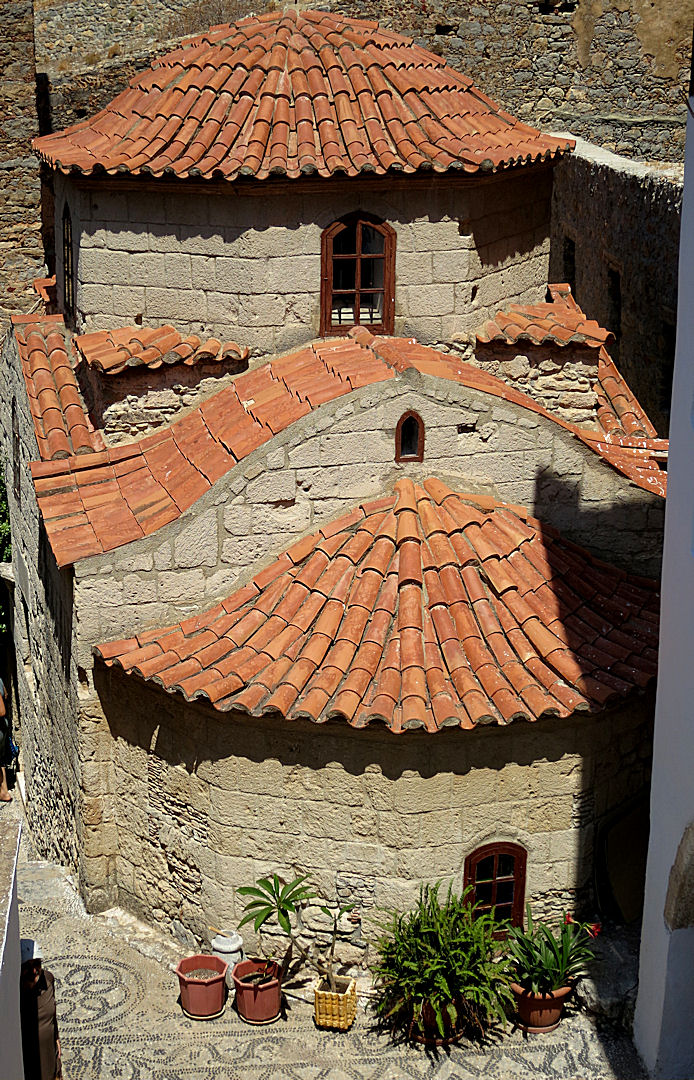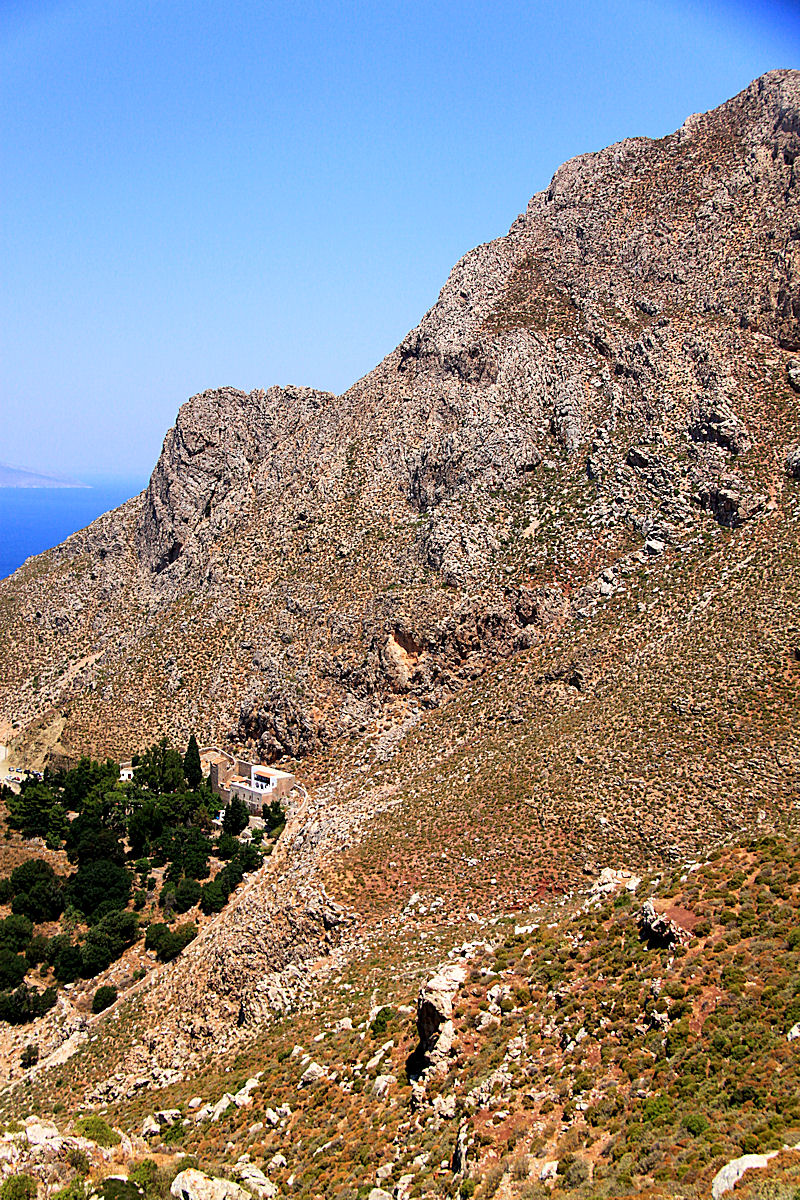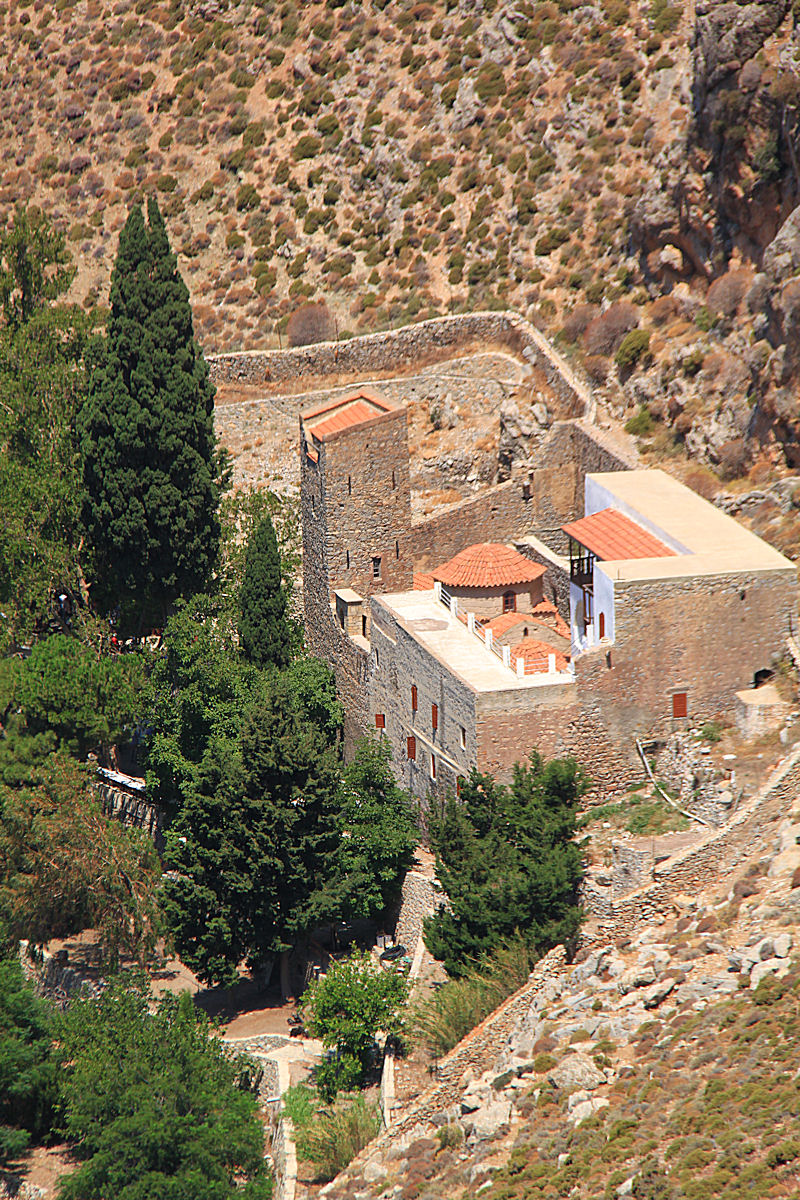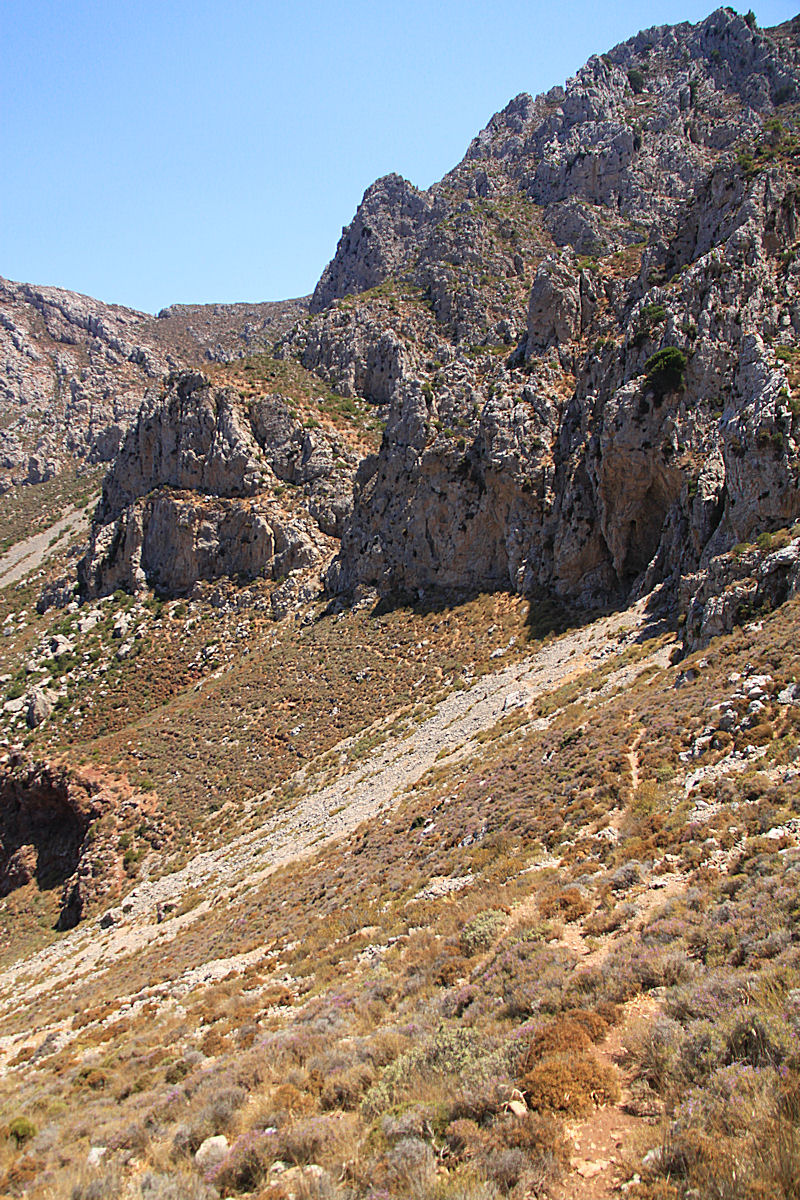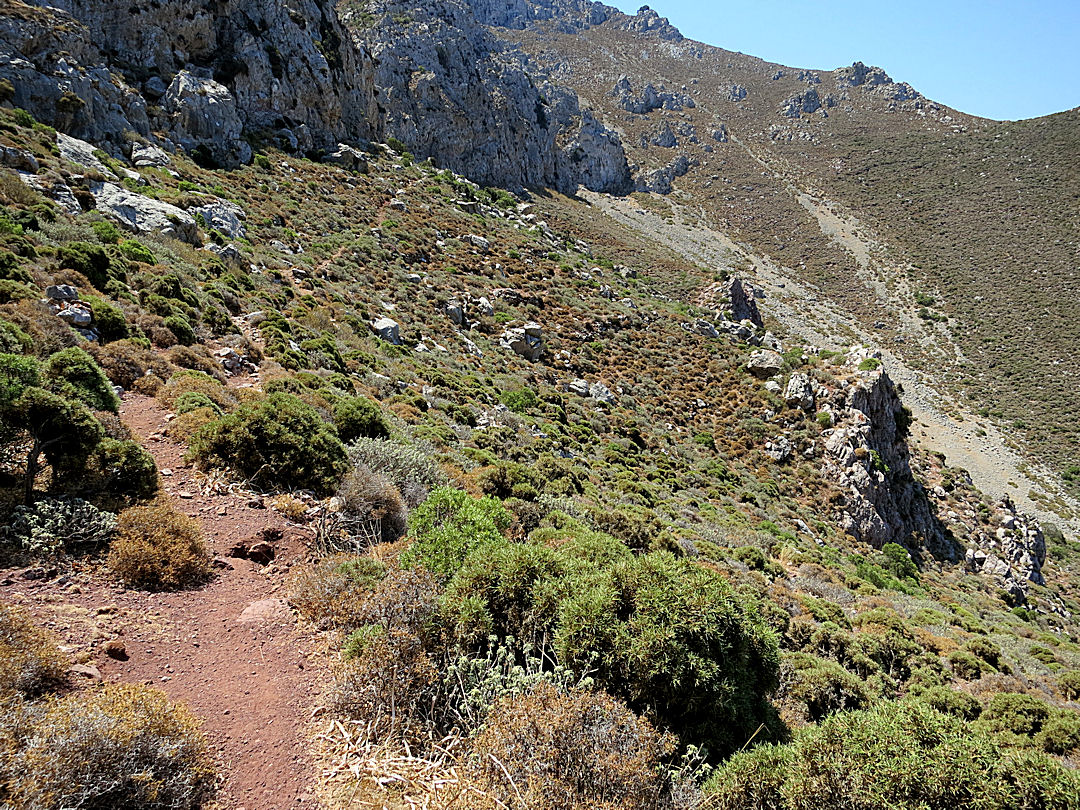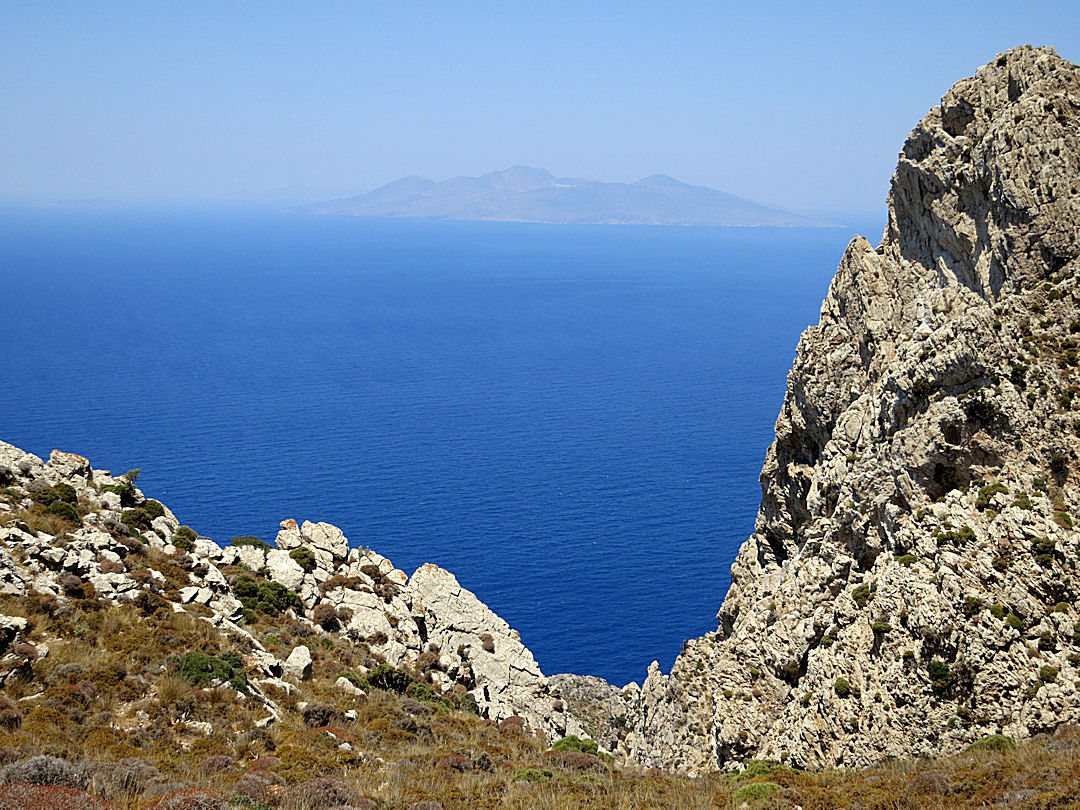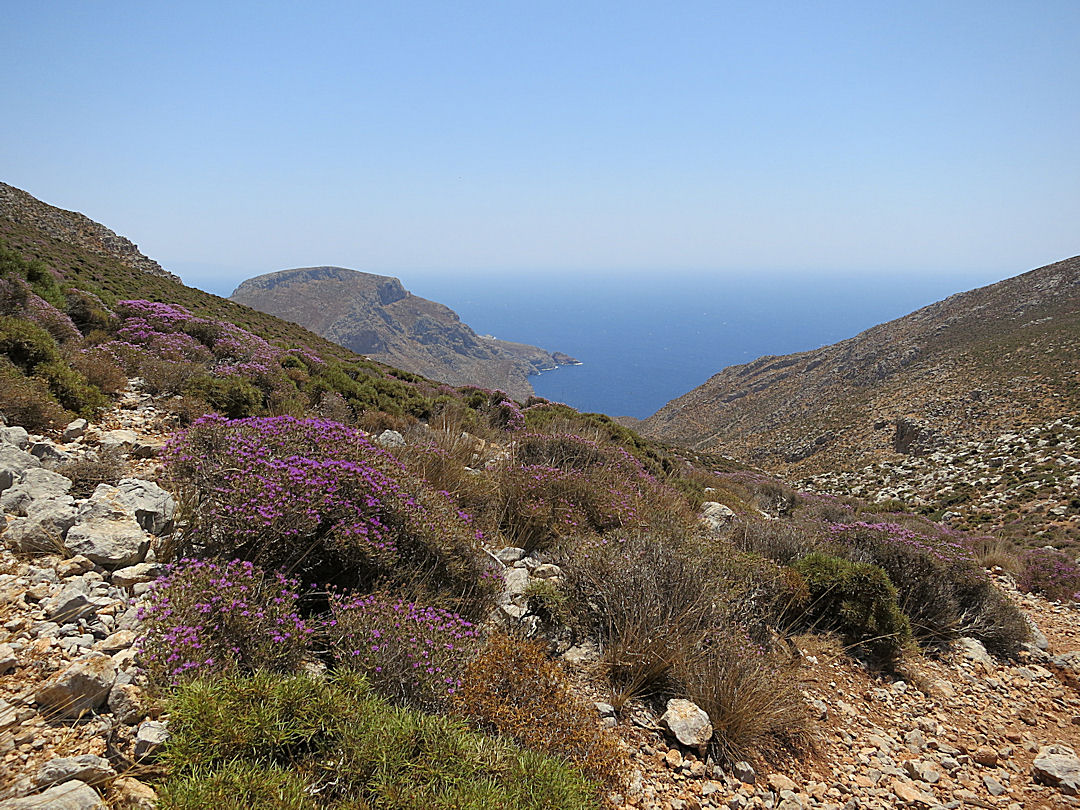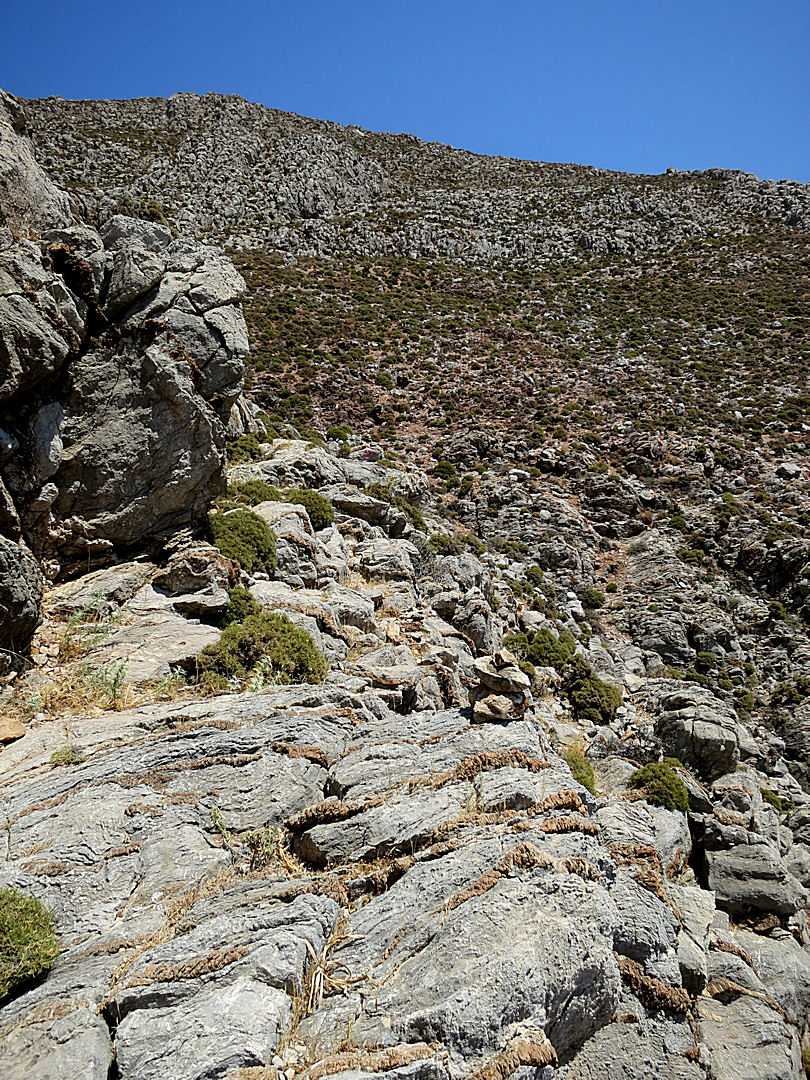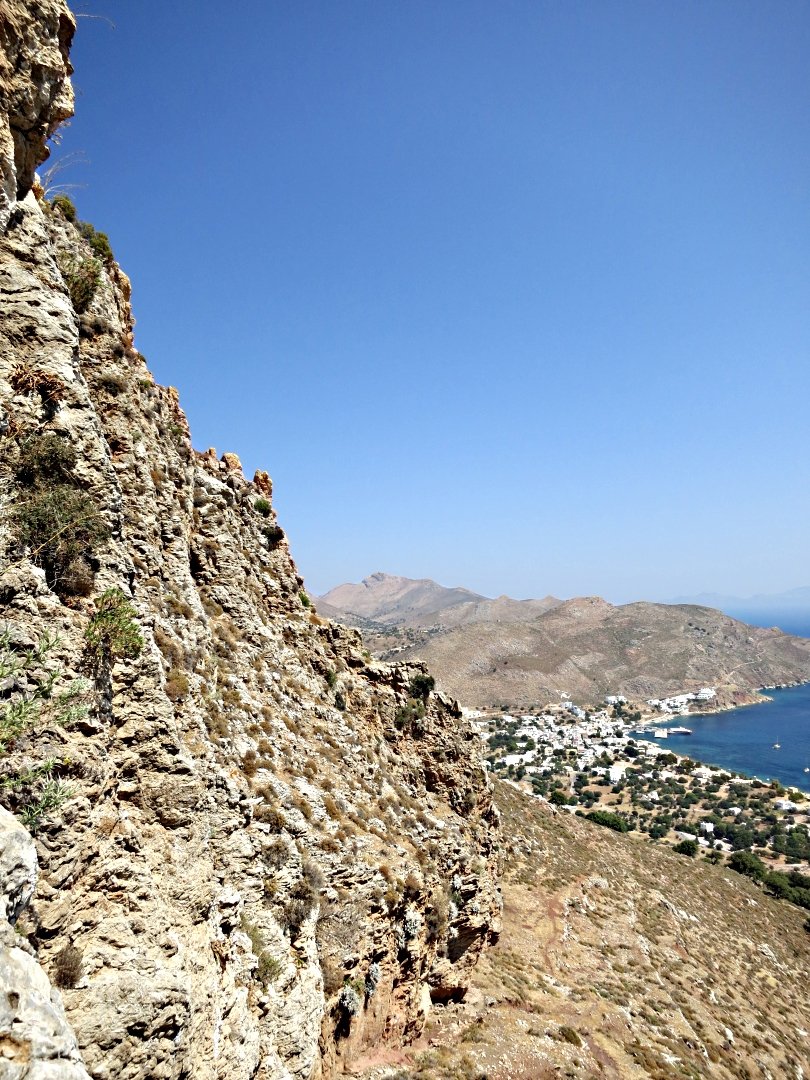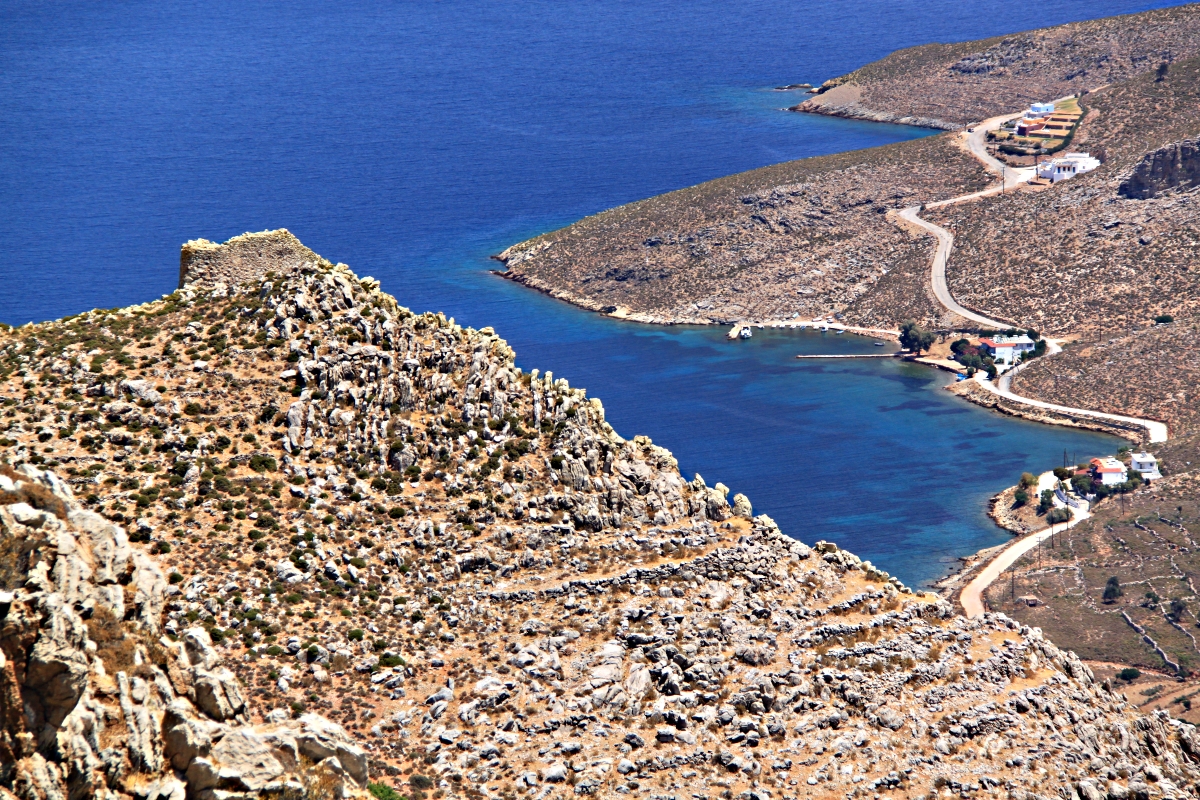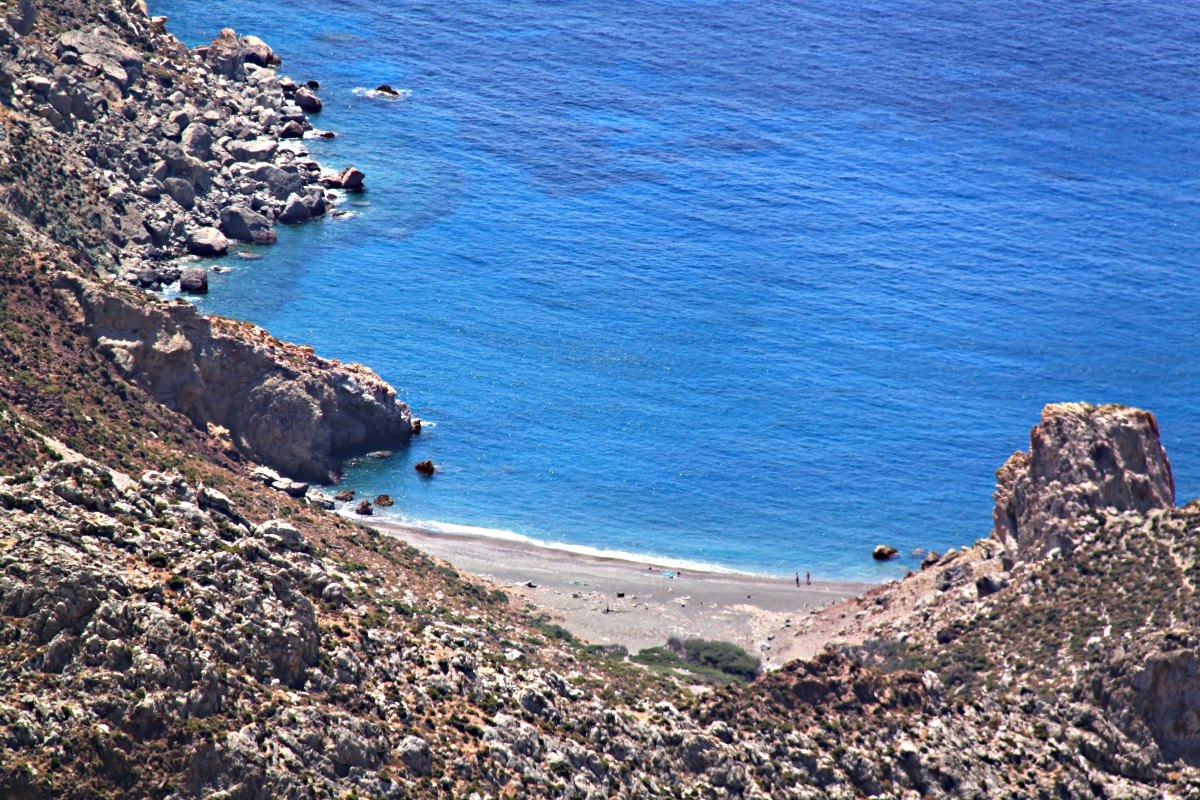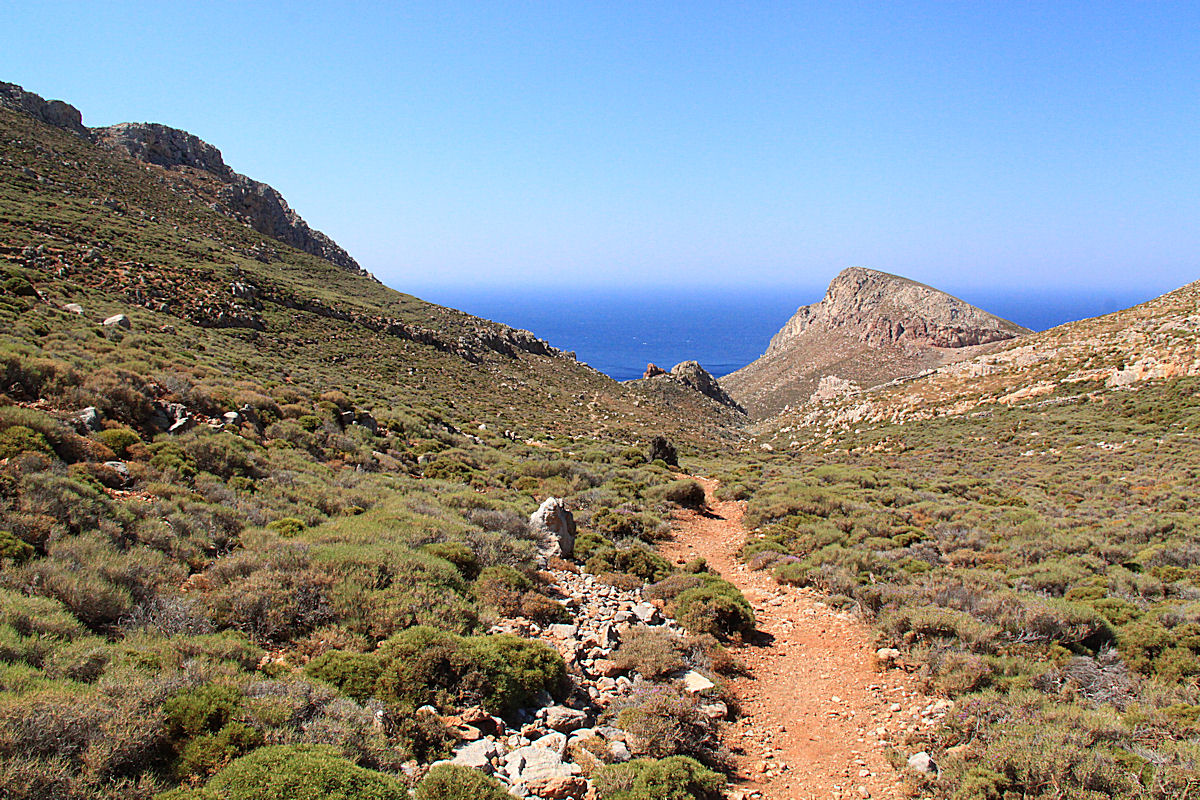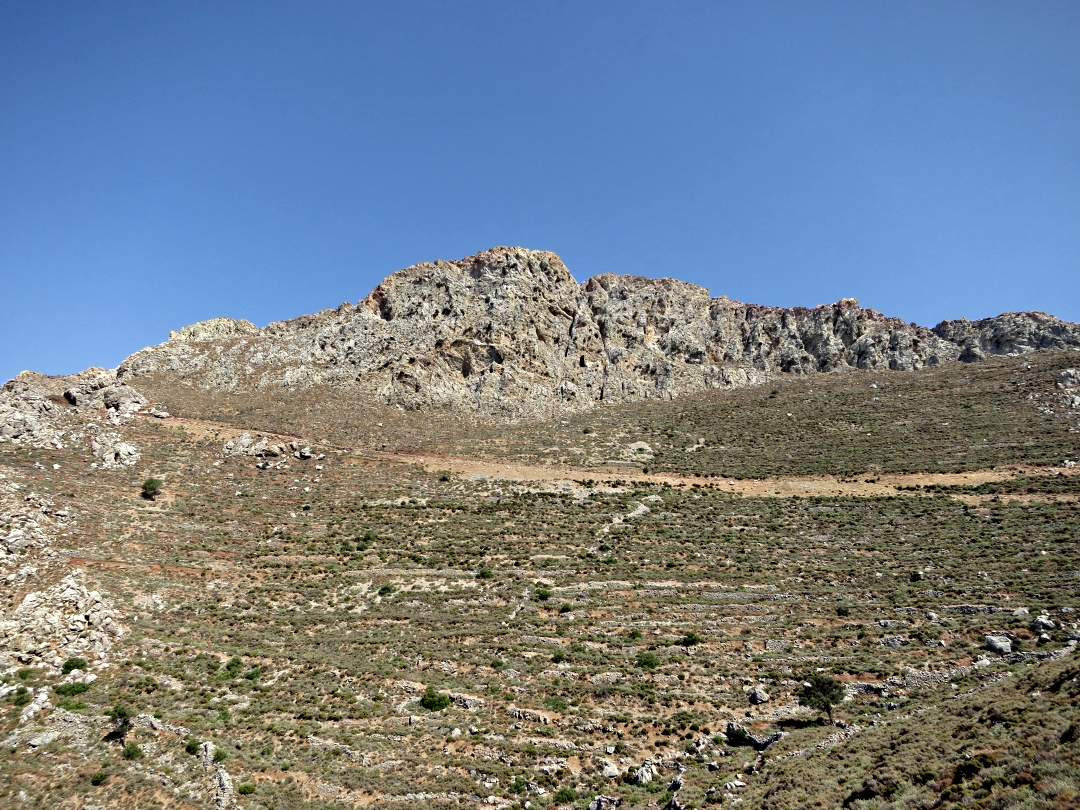
Nisyros: the Lost World, a trip into history

In most places the evidence of the every-day long-ago past has been wiped away or crumbled into the ground.  Large, grand structures like Stonehenge remain but the places where the majority of people lived has long gone evidenced only by post-holes and slight circular mounds visible only from the air at dusk.  One of the fascinations of Nisyros is that hard evidence of what life was like for ordinary people is everywhere, set in stone.  I put together a walk following old routes between long abandoned settlements.  

First, I dropped down an old kalderimi towards the floor of the caldera from the village of Emborios perched on its rim.  The stone-paved donkey path, renovated a few years ago,  is still in good condition with the exception of one point where a dead tree, victim of drought, has collapsed blocking it completely and, with only the limited capacity of secateurs in my rucksack, meant a scramble on loosed ground to the side.

Narrow, terraces supported by high stone walls curve around on either side of the path, interrupted only by towering crags of lava.  Everywhere old stone houses survive beneath the terraces, robust stone arches giving them strength to withstand the tremors which have shaken them for centuries.  Only occasionally has one collapsed, the terraced field which had been the roof slumping inwards.  At the side of the path ancient sterna and basins carved from lava lie seemingly untouched for generations.


Sterna and lava bowl at the side of the kalderimi from Emborios to the caldera floor

Sterna and lava bowl at the side of the kalderimi from Emborios to the caldera floor

Bat colony: taken without flash so as not to disturb them

Bat colony: taken without flash so as not to disturb them

Now a tarmac road zig-zags down into the caldera and runs along its length to the crater-side taverna. The kalderimi reaches the road at its final hairpin bend with a  small cluster of old houses, home now only to a colony of horseshoe bats.Cross the tarmac and the kalderimi resumes, but now much more overgrown requiring diversions into the adjacent terraces which become wider as the steep slopes shallow out.  A pair of ‘semi-detached’ stone buildings on the right have a walled courtyard outside and an entrance into it topped by a huge stone lintel, obviously a more –up-market residence in the past.
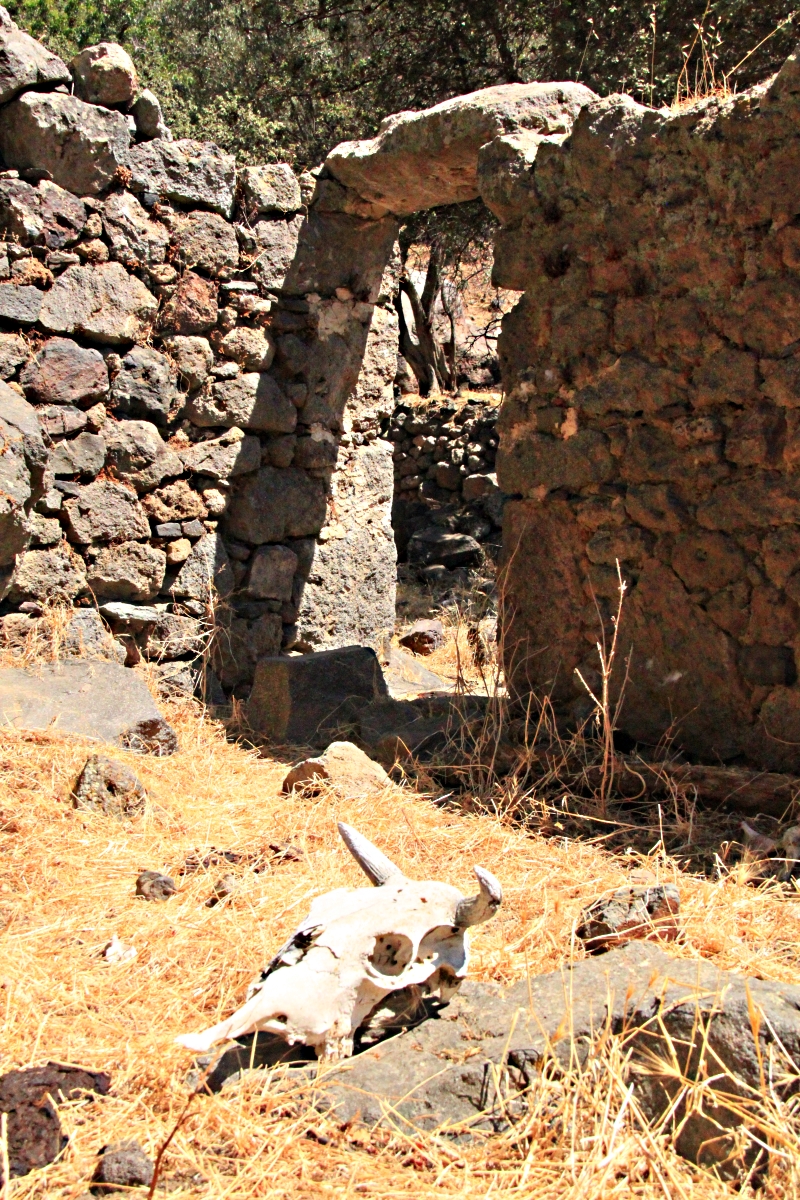
Enclosed courtyard outside more substantial houses

Enclosed courtyard outside more substantial houses

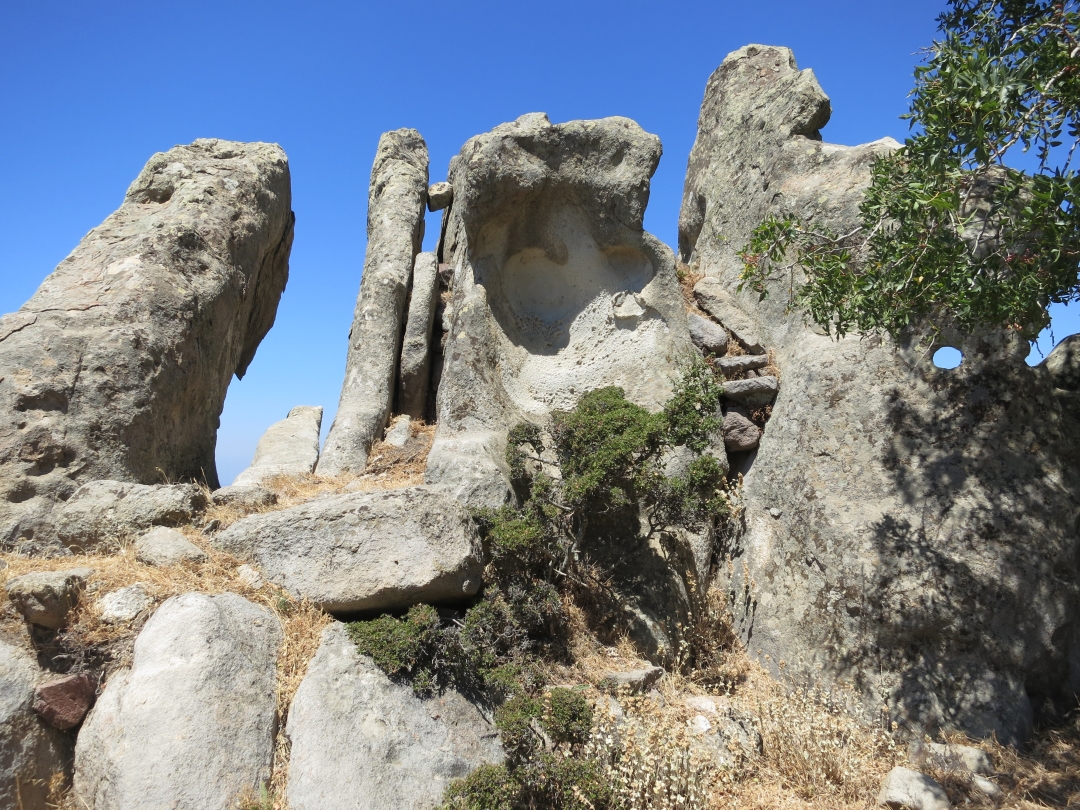
Diving on and off the blocked kalderimi and I soon reached a substantial cluster of 20 or so houses built higgledy-piggledy into the terraces.  This was obviously at one time the main settlement in the caldera, elsewhere the houses are individual or in twos.  The supposition is supported by a large bowl carved out of lava and a fragment of one made from fine white marble which would have been much prized as a  symbol of wealth and prestige.  The supposition is also supported by a large boulder, carved into a prestigious ‘seat of office’ presumably where meetings were held and justice dispensed.
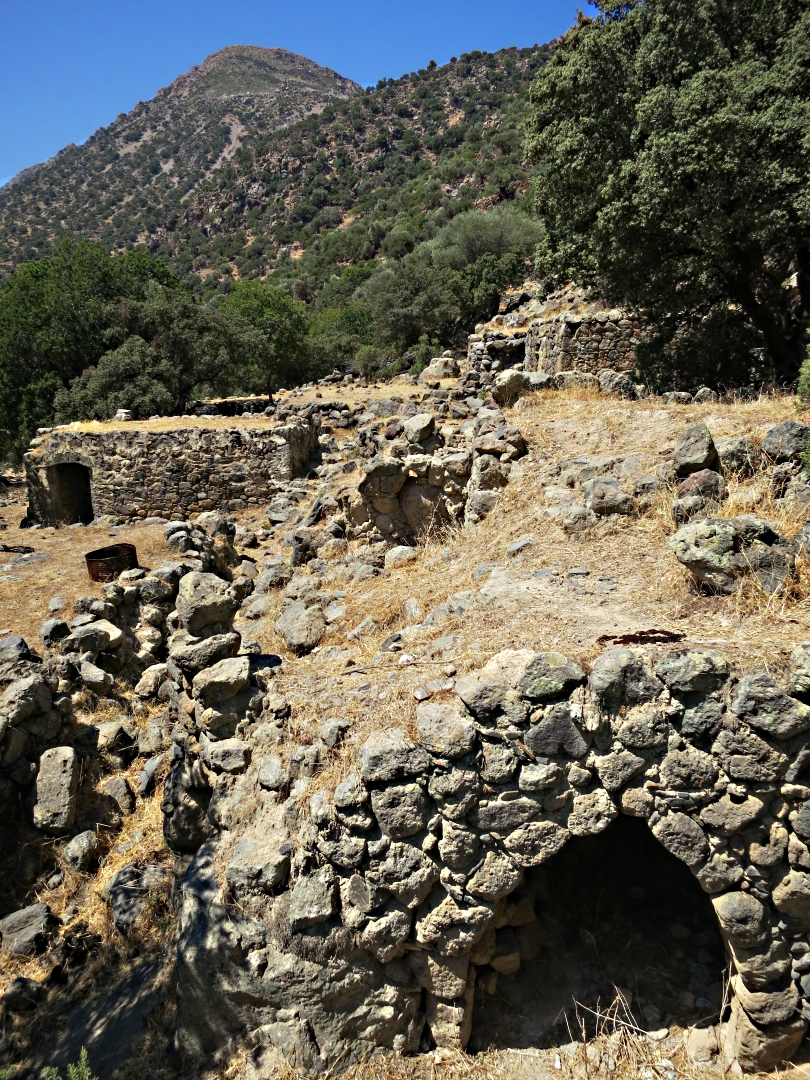
Some of the large group of houses set into the terraces

Some of the large group of houses set into the terraces

The arches inside one of the houses

The arches inside one of the houses

Still in place

Still in place

Holding court: it's easy to be King of the Swingers when there's no-one else around

Holding court: it’s easy to be King of the Swingers when there’s no-one else around

Cows and goats wander around this ancient village but I suspect that no-one comes here much, if at all, even though the tarmac road is only a couple of terraces above and the tops of the coaches taking trippers for their volcano experience can be seen as they thunder by. Certainly the farmer doesn’t come down here.  He rides around the hairpin bend on his scooter, backwards and forwards calling to his animals from the saddle.

Pushing on now onto the wide, open space of the caldera floor and the kalderimi disappears, replaced by countless paths trodden by cows and goats, with very clear evidence of frequent and recent use.  I head for one of the still-active craters but more about that another time.

Theshing circle in the middle of the floor of the caldera with the fortress crags of Parletia behind

Theshing circle in the middle of the floor of the caldera with the fortress crags of Parletia behind

Very close to the active craters this place exudes antiquity, seems to predate hisatory

Very close to the active craters this place exudes antiquity, seems to predate history

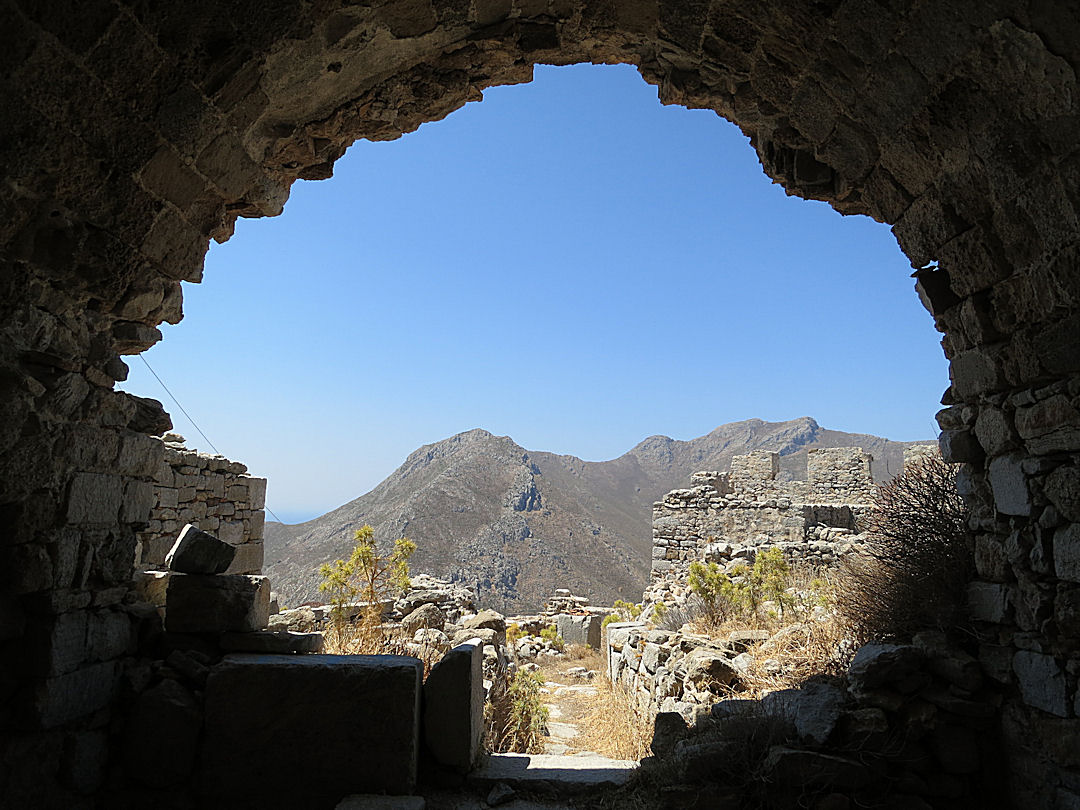
Instead, head on a path into a col on the return leg to Mandraki via Evangelistra.  It’s a steep pull up with a long section of loose scree.  Immediately after topping the scree is another small cluster of dwellings, these all built underground, onto small caves or under overhanging rocks.  The terraces are here are very narrow and the houses smaller, probably abandoned long before those on the caldera floor partly because the soil is poorer partly because they are so remote.

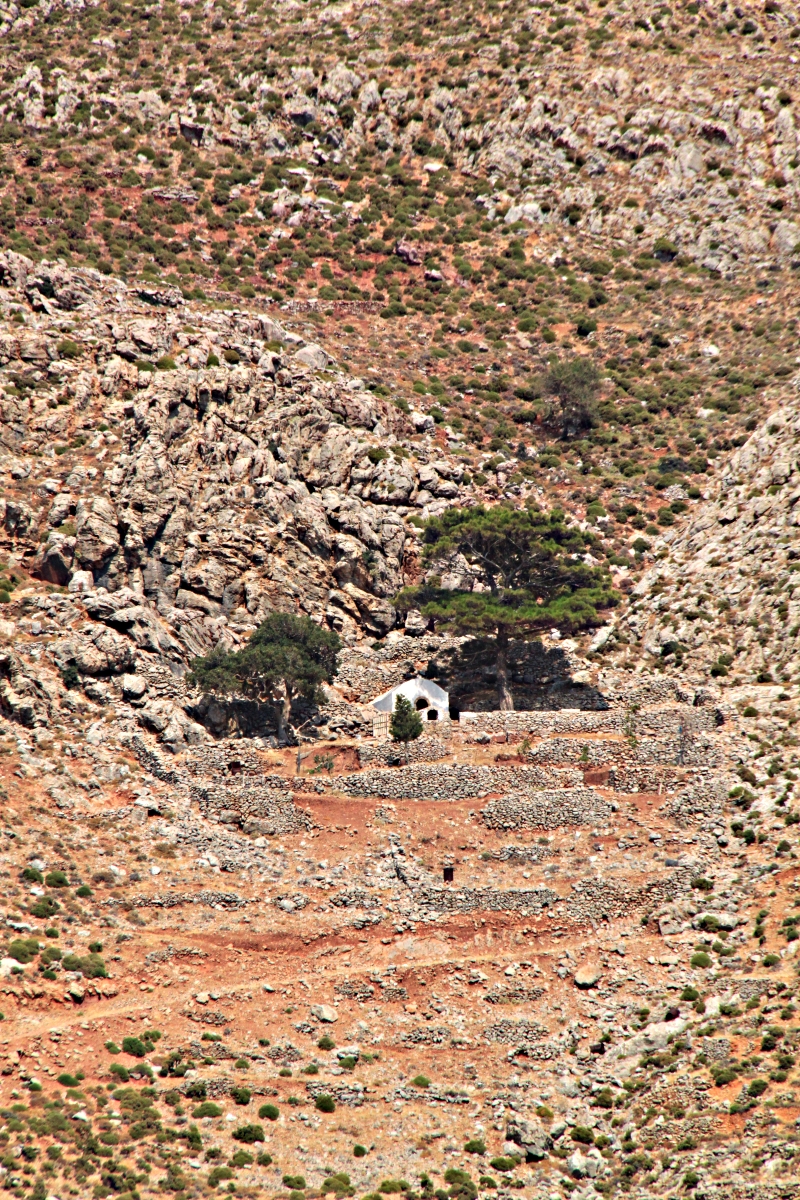
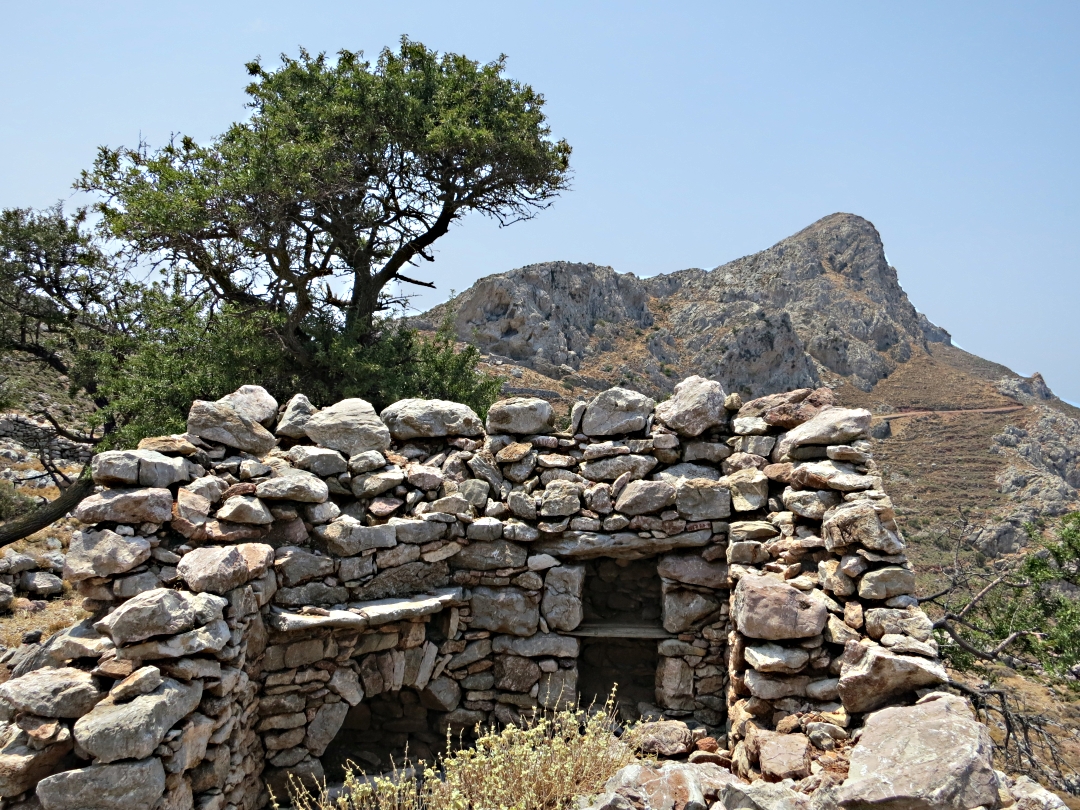
That remoteness would have served them well when attacks by pirates were common in the Aegean.   Clamber onto the earth roofs of a couple of houses alongside the path, hop across boulders choked by prickly oak and nestled into a steeper part of the crags, completely hidden from sight from the path a series of 3 interlinked dwellings set into the rocks. At the back of one is a small chapel, reminder that for centuries Christianity was persecuted in this part of Greece.

Though well over 1000 feet high and still climbing, the path is now walled and rough paved, again obviously a significant settlement in times long past.  Terraces are tiny, every scrap of available soil being collected in small pockets, houses only occupying ground where nothing could grow.

Walk across the roofs of these houses to the boulders beyond
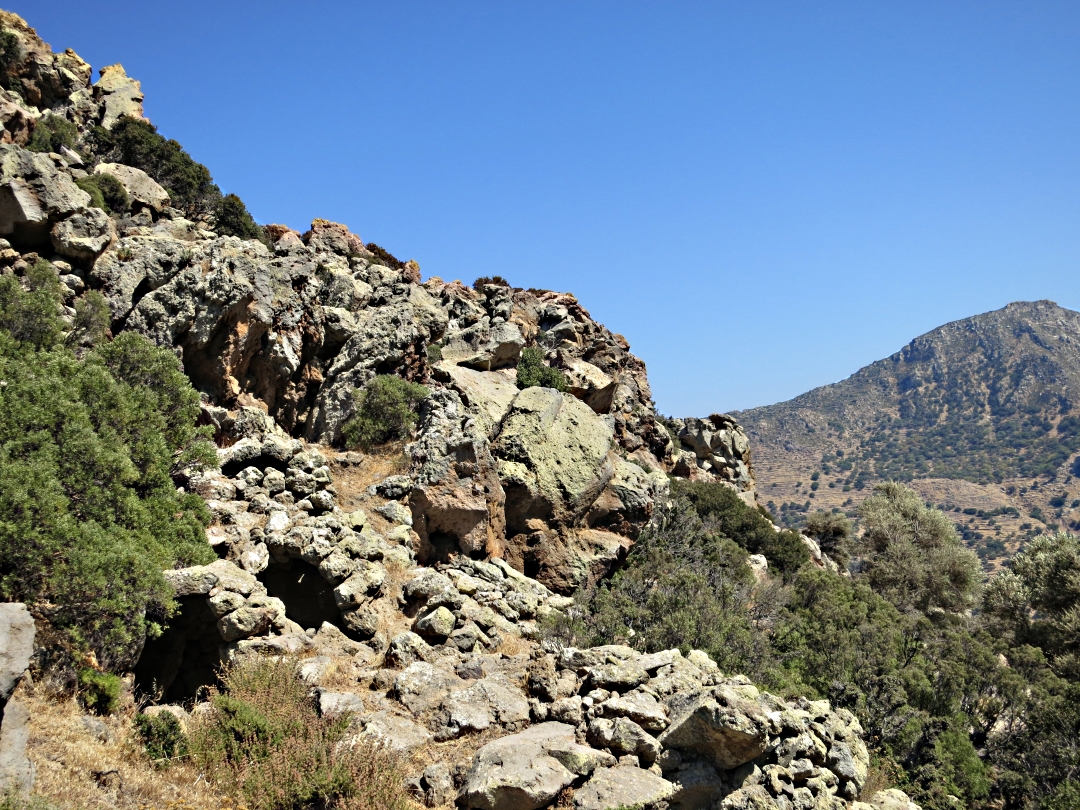
Walk across the roofs of these houses to the boulders beyond

.... and hidden in the jumble are 3 openings into houses

…. and hidden in the jumble are 3 openings into houses

.... zooming in for a clearer view

…. zooming in for a clearer view

The chapel at the back of the furthest

The chapel at the back of the furthest

Walking up the main street at over 1000 feet
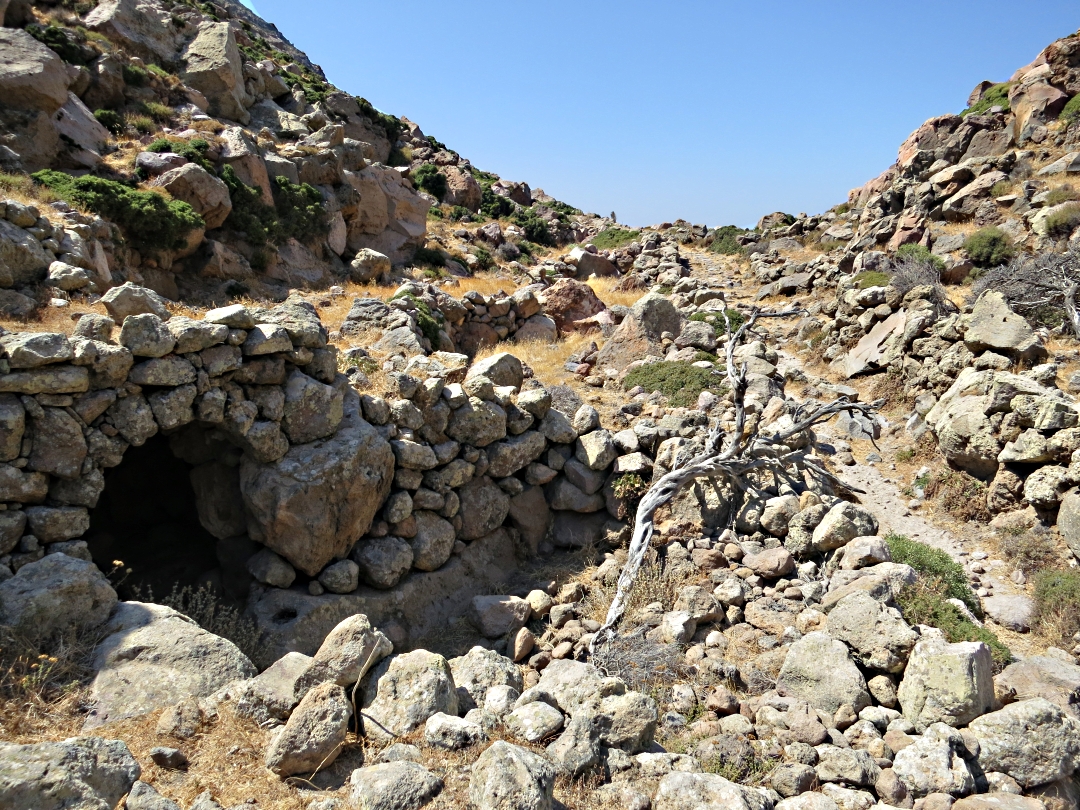
Walking up the main street at over 1000 feet

Built underneath a rock with field overhead

Built underneath a rock with field overhead

..... and taking a look inside

….. and taking a look inside

Fascinating!  I only wish I had the ability to go back in time and see what things were really like when these places were thriving communities.
Posted in Greece, Hiking, History, Landscape, Mountains | Tagged , , , , , , , , , , | 4 Comments

Nisyros: on the lava trail

Nisyros is a volcano, classed as ‘potentially active’, and it is therefore not surprising that its rocks are entirely volcanic in origin.  Perhaps most dramatic are the lavas.

After a couple of days re-acclimatising to the heat I put together a longer walk around the inside rim of the caldera passing some of the most spectacular of the lava pinnacles and crags, a ‘lava trail’.

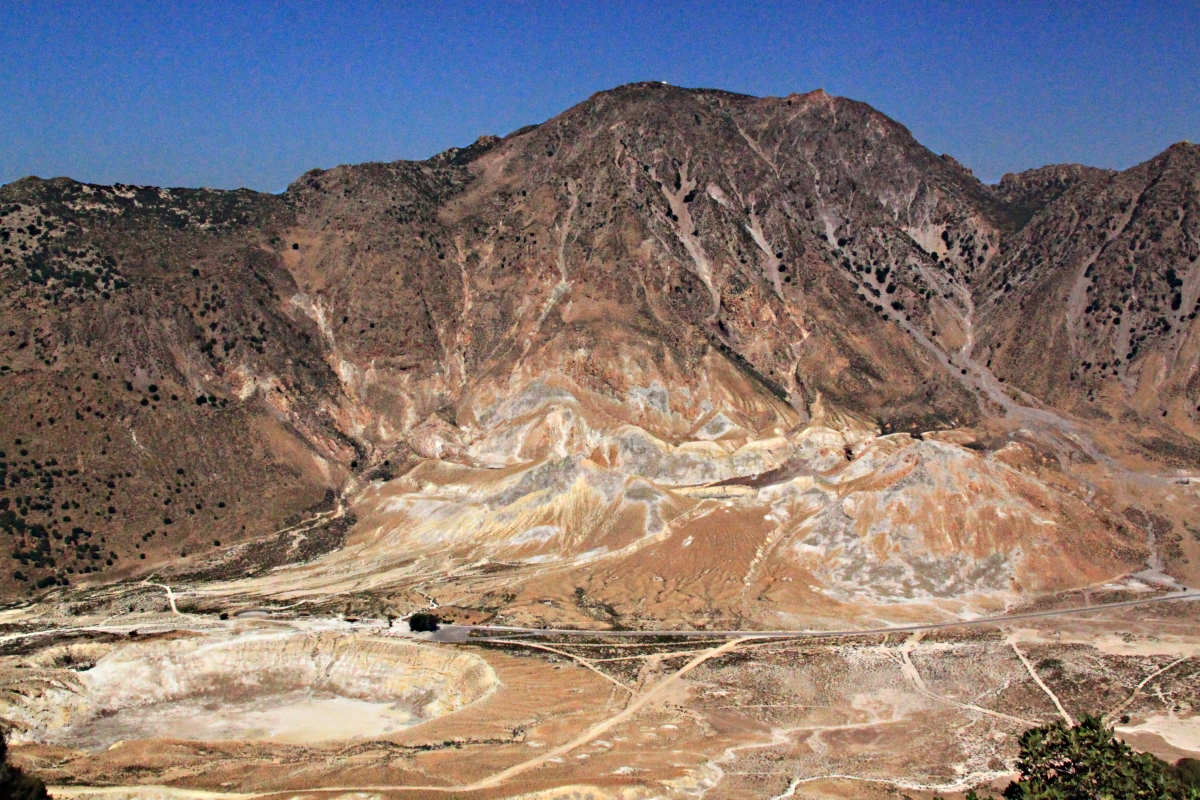
From where the bus stops in the square at the bottom of Nikia, one of the two caldera-rim villages, a concrete path goes downhill passing the Museum of Volcanology.  It very soon turns sharply to follow the edge of the caldera affording dramatic views across the active craters including the largest, Stephanos.

From 300 metres above, the people who venture down the winding path onto the crater floor are smaller than sugar ants, difficult to see unless they are moving.  Immediately opposite, two kilometres away, is the highest part of the caldera rim, the mountain block of Oros Diavatis.  It’s difficult to imagine getting blasé about the scale of the place though I guess you may do if you lived here year round all your life.

Looking across the caldera and its craters from the start of the Lava Trail, 300 metres above

Looking across the caldera and its craters from the start of the Lava Trail, 300 metres above

The concrete ends abruptly, as concrete paths tend to, a stone-paved path diving off steeply down leftwards towards the caldera floor, a narrow dirt path with 2-metre high stone walls above and below continuing straight ahead.  Agricultural terraces rarely more than 5 metres wide step steeply up to the right, down to the left, now straw coloured, grasses and wild cereals parched by nearly 4 months of sun and drought.

Looking back towards Nikia the first of the lava pinnacles stands proudly erect like a beaked creature  haughtily keeping watch.

Lava pinnacle like a beaked creature haughtily keeping watch haughtily

Lava pinnacle like a beaked creature haughtily keeping watch 

The terrace which carries the path is barely two metres at its widest with tough, drought resistant holly oak, leaves about a centimetre long and ferociously prickly, encroaching from both sides.  I was expecting this and had a pair of secateurs in my rucksack for a little judicious clearing.

When the path splits it is clear that the majority of what little traffic there  is goes right, heading up to the monastery of Agios Ioannis Theologos.  The path onwards becomes increasingly blocked by the ferocious oak scrub, reaching a point where I give up on the secateurs, needing loppers and a saw, and climb the stone wall to the terrace above.  Much easier going.  After a few hundred metres I can drop down again onto the path.
Soon I pass under overhanging, contorted lava crags.  Rough steps lead through them to the monastery above with its carved lava bell tower.

View from the top of the lava crags

View from the top of the lava crags

After scrambling around the crags for a while, I drop back down to the path which soon passes at the foot of yet another overhanging lava crag and then the view opens out. On the right is the bulk of the mountain named after the monastery, the shoulder of lava spikes of Parletia on the left, the reason for the gleam in my eye.

A minor problem along here was balancing the urge to look around at the fascinating lava structures, watching where I was placing my feet, and minding I didn’t scrape my head on overhanging holly oak. The col between the main mountain and Parletia is, not surprisingly, made up of softer rock and the path into it becomes loose, in places slipping away steeply requiring care.

Approaching Parletia

Approaching Parletia

Parletia is the highlight of this walk.  It is claimed to be a Medieval fortress but my guess is that it is considerably older than that.  It occupies a very defensible position reinforced by stone walls on the side into the col.  The path leads to this  point and the access into the fortress crag itself involves a rock scramble requiring that every hold on the added fortification be tested first.

Lava pinnacles reinforced by stone walls, the approach to the ancient fortress of Parletia

Lava pinnacles reinforced by stone walls, the approach to the ancient fortress of Parletia

Once up there it is awe-inspiring.  Amazing rock pinnacles and sculptured shapes plunging down near-vertically to the caldera floor about 250 metres below.  Great place for a banana and a nutbar and to just sit, scramble around, and soak in the sense of antiquity.

stone carvings indicate that this was more than just a rough fortress hideout

stone carvings indicate that this was more than just a rough fortress hideout

The pinnacles at the highest point

The pinnacles at the highest point

Looking down between the pinnacles to the caldera floor 300 metres below

Looking down between the pinnacles to the caldera floor 300 metres below

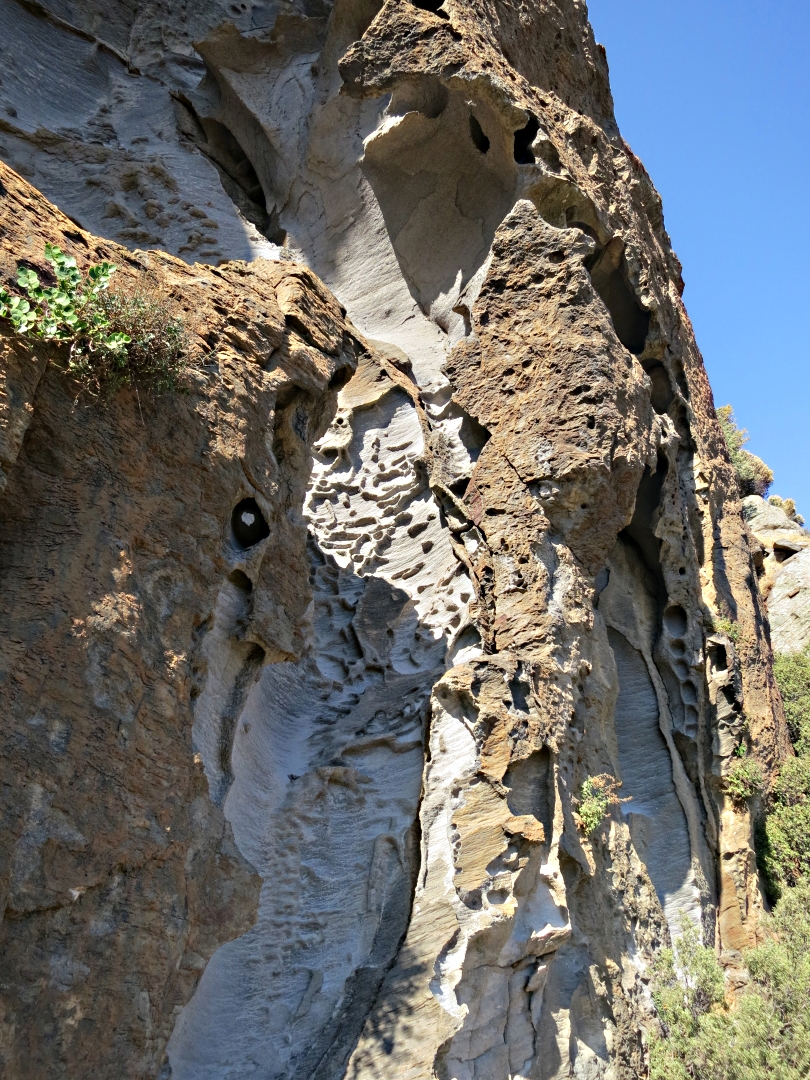
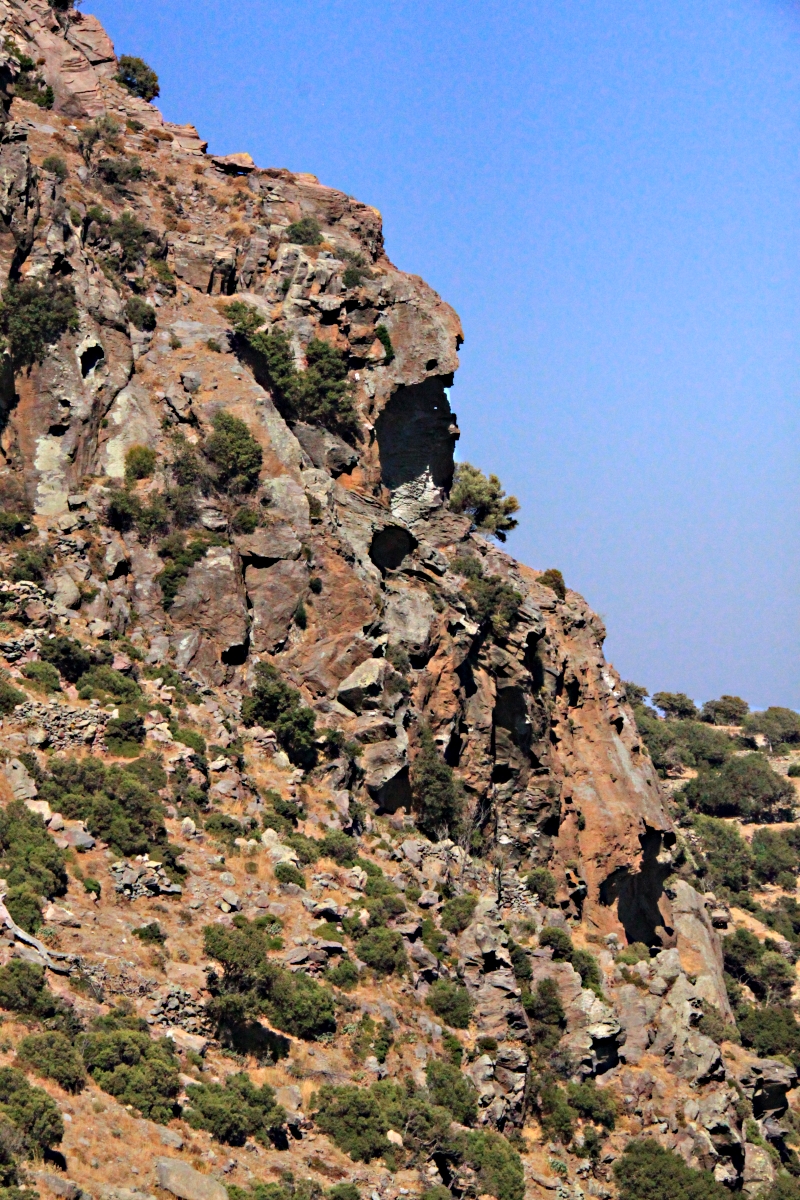
Lava beast about to chomp on the crater-rim village of Emborios

Lava beast about to chomp on the crater-rim village of Emborios

The whole slab

The whole slab

Relaxing on the edge looking down the length of the caldera

Relaxing on the edge looking down the length of the caldera

Reluctantly I had to leave, I still had a long way to go.  One of these days I’ll get myself sorted and spend the night up there, trying to capture the sunset over the crater, watching the Eleanora’s Falcons gathering to feed on the insects in the rising evening air …. and get a sense of those for whom Parletia was once home.

Having down-climbed to the col and regained the path, it is evident that this route is not for the trepid or the navigationally challenged.   After a few tens of metres the path crosses a 20 metre-wide band so loose it would be flattering to call it a scree.  The material is fine dust and small stones at angle of rest with a faint trodden line curving across it and a drop to the left best not looked at.  Keep to the exact line the width of one sandal and try to place each foot on what might be more solid pieces of stone embedded in it and hope they don’t break free.  Caution and confidence are essential.

From there the path continues more solidly until it disappears into a medley of animal tracks and ‘old ways’ under overhanging trees and a bit of casting around is needed to find the through-route.

Breath a sigh of relief once back on another section of narrow dedicated path a metre wide, again with 2 metre stone wells above and below. But the fun is not yet over.  In a couple of places the retaining wall of the terrace on the downside has collapsed and short sections require rock climbing traversing skills on the upper wall.  OK, so I could have dropped down onto the terrace below but the challenge was too good to miss. All the while surrounded by lava landscape.  I was unable to avoid looking back at the Parletia crags silhouetted against the western sun.

Looking back to the silhouetted pinnacles

Looking back to the silhouetted pinnacles

From here a pleasant, easy-going amble around the eastern end of the caldera, visiting a line of red/purple caves in softer lava and then traversing above them to join the tarmac road from Nikia for a couple of kilometres.  The boredom of trudging the road is relieved by cuttings through outcrops of obsidian, a black volcanic rock so hard and sharp that it has a long history of use not only for weapons and tools but for surgical instruments.
At the junction with the road down to the crater an old, stone paved path rises steeply  over the lava outcrop adjacent to Emborios, the other caldera-rim village, and the opportunity for a drink or a meal at the Balcony Taverna looking along the length of the caldera and surrounded by contorted lava crags.

A climb up to the castle and then the path passes at the foot of another dramatic geological  structure, a lava bubble towering 20 metres high, a massive shallow overhang created by gases exploding out of the molten lava which then cooled in amazing patterns.  Looking back as the path rises to reach the upper edge of the caldera other lava bubbles can be seen above it.

The 20 metre high lava bubble

The 20 metre high lava bubble

Detail of part of it

Detail of part of it

Looking back it is clear that the large lava bubble is just one of a series rising up the crag

Looking back it is clear that the large lava bubble is just one of a series rising up the crag

There is much else to see on the remainder of the trek but the main structures are now passed.  Very much to be recommended as a lava trail.

Posted in Greece, Hiking, Landscape, Mountains, Nature | Tagged , , , , , , , , , , , , , , , , , , , , | Leave a comment

Greece: Rhodes, Tilos, Nisyros, high speed island hopping

Wednesday morning and my daughter delivered me to Manchester Airport at 06.15 en route to an hour’s skiing in  the Chill Factory.  How bizarre a beginning to a day is that!!! Given that she was going to minus 2 degrees and I was flying to Rhodes with temperatures forecast in the high 30s and in the smaller Dodecanese islands to which I was heading significantly higher than that.

I’m an old hand at this now and was first on the plane and established in my aisle seat, camera bag stowed in the overhead locker, before anyone else waddled along the airbridge.

Arrival in Rhodes was slightly ahead of schedule and for the first time my Big Bag was first on the carousel and I was strategically positioned to retrieve it and go.   Straight out of the airport to the bus stop and a €2.30 fare to Mandraki harbour rather than €24 by taxi.  On  a roll!!

I had sussed out on the internet that I couldn’t catch a ferry direct to Nisyros, my target destination, on Wednesday.  My options were to overnight on Rhodes, Kos ….. or,  after careful checking of ferry schedules on the internet, Tilos.  No-brainer.  Both Rhodes and Kos have their attractions and interests but have international airports and are therefore basically package-trip destinations, commercialised and loud, places to make the best of but difficult to relax.  A rule of thumb for deciding which Greek islands I might enjoy is to exclude those with airports and instead require a ferry crossing.

There are peaceful corners even in Rhodes Town and I headed straight for one.  Cool reflection on my snap decision during a cool sojourn over a frappé (iced coffee) in a shady garden taverna /cafe/restaurant and then, decision confirmed,  18.00 high speed cat to Tilos.

When we first started coming to Greece the ferries were large lumbering things pensioned off from the English Channel crossings, invariably lateness was counted in hours not minutes,  and even the short crossing to Tilos from Rhodes would take 3 to 4 hours with every organ in your body vibrating with the throb of ancient engines transmitted through wooden slatted seats.  Those ferries have now been pensioned off again, this time to the Philippines, reappearing occasionally and briefly on a news headline when disaster strikes.

Now the ferries plying the Aegean are modern, well equipped and fast.  Few more so than the Dodekanisos Seaways high speed catamarans.  An hour and a half after leaving Rhodes I was one of the first off the ferry with my Big Bag, no accommodation booked, just winging-it, as you do in Greece.  I was streaking along ahead of the throng, heading for a hotel I have stayed in before, not cheap but comfortable and a reasonably close trundle to the harbour for my ferry to Nisyros the following morning, when I was greeted by a shout of “You’re not supposed to be here.  You should be on the next island north”.  People I know who live and have accommodation on the island had picked this up on my blog, recognised my sandaled feet and were barracking me from their perch above the harbour, monitoring comings and goings.  My response was typically self-serving:   “I don’t suppose you have a room for the night?” .

They did.  Perfect!  One short carry up the steps and I had an apartment looking straight down onto the harbour and the bay beyond.   Fabulous view of the moon rising over the ridge on the far side of the bay.  Maybe a 30-second walk to the ferry in the morning.  Life is tough.

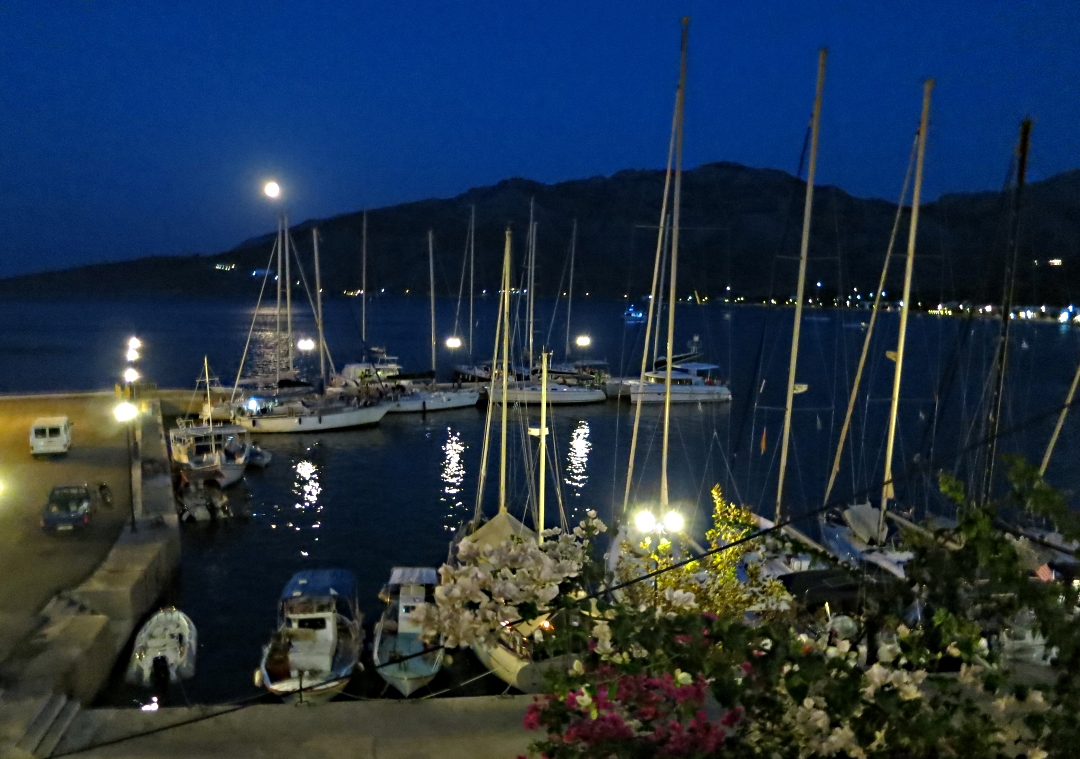
It doesn't get much more tranquil than Tilos harbour at night

It doesn’t get much more tranquil than Tilos harbour at night

.... as the moon rises from behind the ridge and above the mast heads

…. as the moon rises from behind the ridge and above the mast heads

More people greeted me and shook my hand as I walked through the town (village size really!) than when I get home.  These are a very friendly people.  I had to explain time and again that I was only here for one night and leaving next morning.  Genuinely warm welcome even though I had wished folk ‘καλο χειμώνα’, ‘a good winter’ when I left at the end of  July after a 3-week stay.

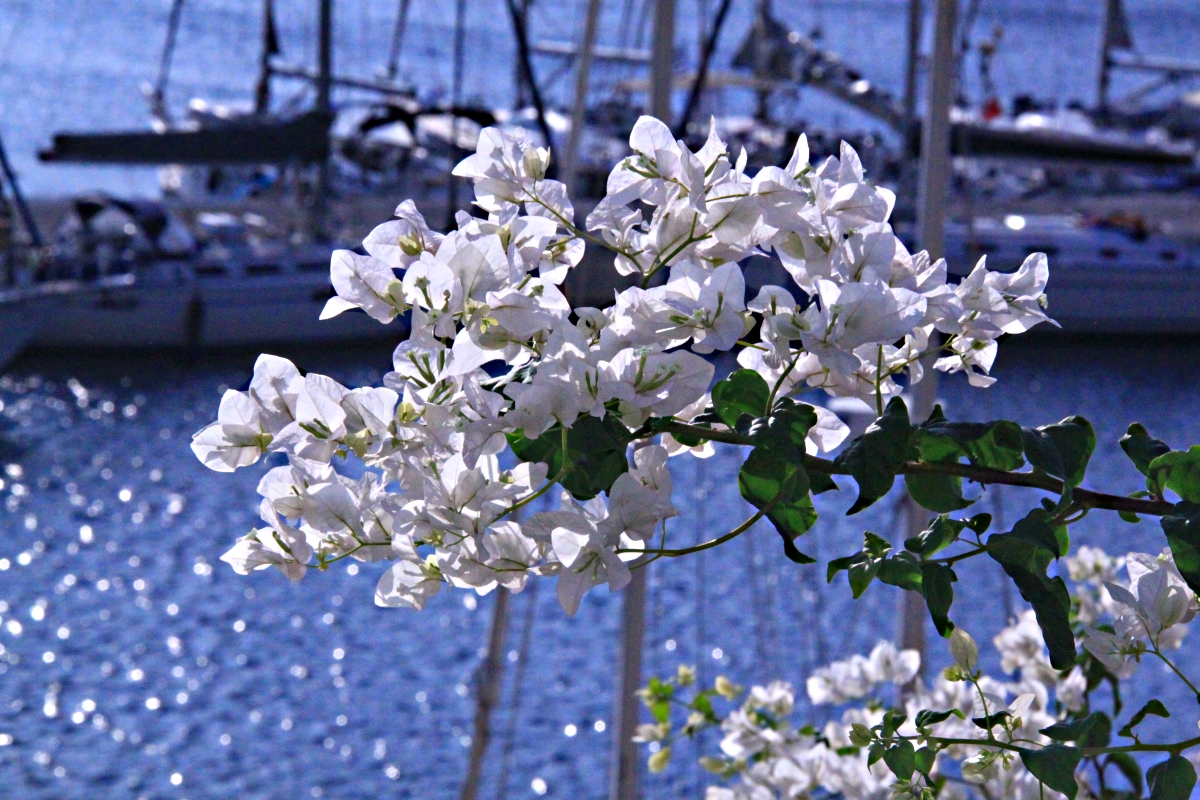
Yet another warm welcome and good meal in Sofia’s Restaurant and then a memorable evening in the main square with live music, a semi-formal family celebration it seems. The music was good , VERY good.  The players sat under a canopy of bougainvillea, a guitar, two bouzoukia and one violin-sized instrument with a crooked neck, rested on the thigh and bowed (Cretan Lyra??).  The instruments themselves were works of art, beautifully designed and crafted in wood, fret boards inlaid with mother-of-pearl.  The music was fast and intricate.  I left some time after 02.00 and continued to listen from the balcony of my apartment.

Musical technique was far in advance of the BBQ technique being carried out against the side wall of a house producing vast clouds of smoke which went straight up until the evening breeze picked up after which it swirled around the players and those nearby.  Who needs dry ice in a nightclub.

What a great start to my third trip to Greece this year.

Very relaxed , slow-paced start to Thursday.

Outside my balcony, white and blue, cool start to a hot day.

Outside my balcony, white and blue, cool start to a hot day.

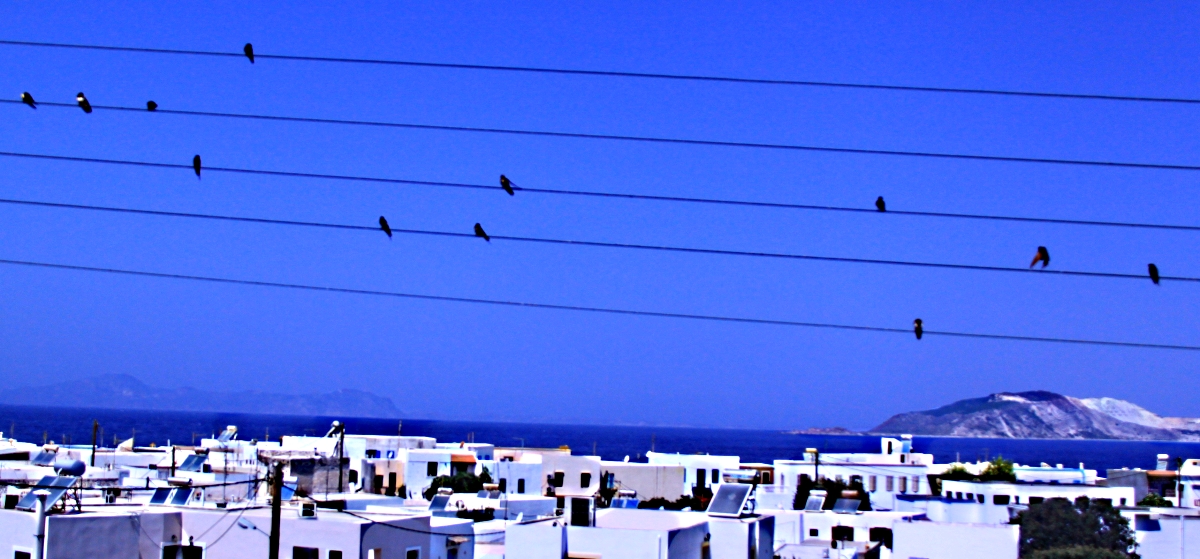
At  11.15 another high speed cat to Nisyros where, 45 minutes later I was picked up and whisked to the hotel.  The balcony doors were open and swallows sat chattering outside on the electricity wires like notes on a line of music.  I don’t believe in omens but it set the right mood.

And another balcony, swallows like notes on a line of music

And another balcony, swallows like notes on a line of music

Unpack, quick change, camera rucksack re-packed in hiking-configuration, cold water and bananas bought and by 13.15 I was off up into the mountains, just in time to escape the mass invasion by Russian day-trippers come over from Kos.

A bonus, I spotted two snakes on my first day though neither wanted to stick around to be photographed

A bonus, I spotted two snakes on my first day though neither wanted to stick around to be photographed

x

Posted in Greece, Hiking, Landscape, Nature, Wildlife | Tagged , , , , , , , , , , , , , , , , , | 1 Comment

Brecon Beacons: waterfalls and pleasures revisited.

For over two weeks now I’ve been non-stop busy in the garden.  The physically most demanding job has been cutting hedges because some of them are 15-20 feet high.  That means erecting, dismantling (English is sometimes very strange, why not ‘mantling’ and ‘de-erecting’?) and moving a scaffolding tower several times, wielding the hedge trimmer with a 42 inch cutting bar from the top of it.  The cutting time is very short compared with the preparations and the tidying up afterwards.   It’s hard work but the resulting neatly shaped trees make it worthwhile

A great pleasure has been harvesting the crops which I sowed in April and which are now ready. Climbing French beans and golden courgettes need to be picked every day, beans blanched and put in the freezer or added to the courgettes and made into fasolakia, one of my favourite Greek dishes.  Potatoes need to be harvested before I go away again, dried, ‘hardened off’ and put in store.  Very satisfying.

The produce from just one brief picking session

The produce from just one brief picking session

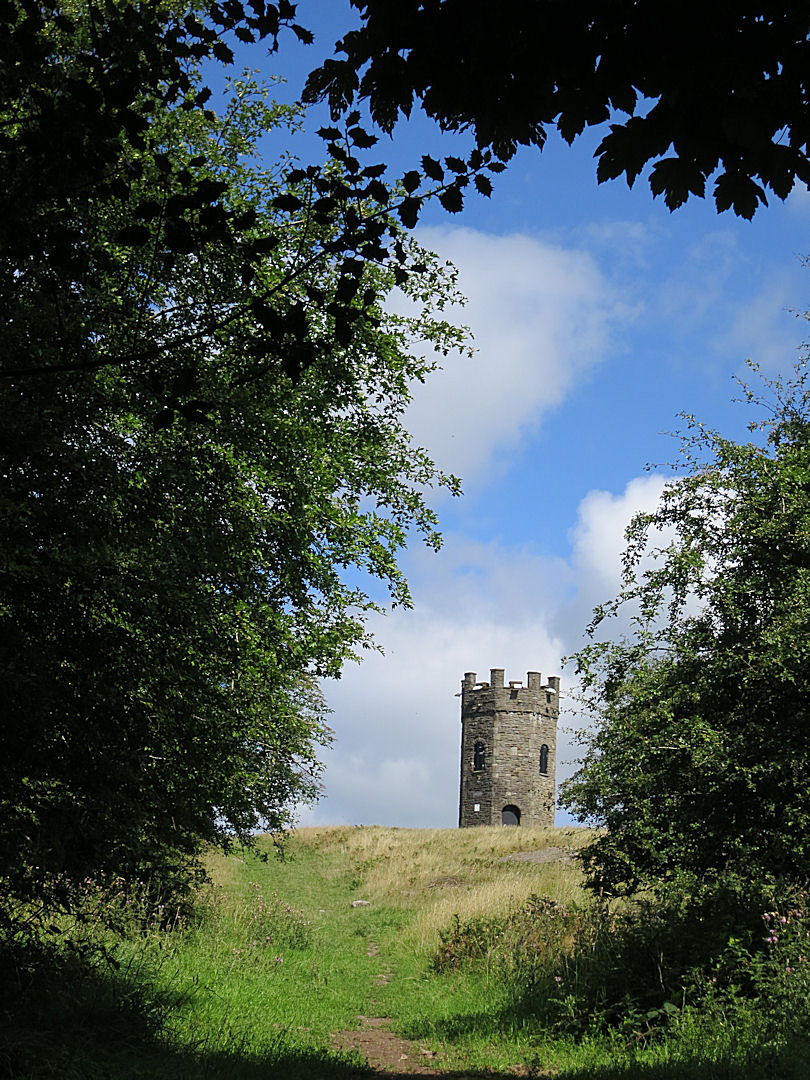
There has still been time to occasionally wander up to the top of the mountain behind the house, passing the Folly Tower on the shoulder of the ridge, the boundary of the Brecon Beacons National Park,  and then on up to the trig point on Garn Wen.

Coming up to the Folly Tower perched on a prominent shoulder of the ridge

Coming up to the Folly Tower perched on a prominent shoulder of the ridge

However, visitors for the weekend prompted another visit to ‘Waterfall Country’ further west in the National Park.  Though it has rained a fair bit since I arrived back the total amount has not been very great and it was therefore a surprise to see that the flows were in no way diminished from the last time I was here in November last year1.

What was a surprise was the large number of people walking in the area, many of them visitors rather than locals.  In November I had the entire place to myself.  Generally I prefer my landscapes devoid of people and I will sometimes wait until I can photograph features with no visual distractions.  This time there was no prospect of that, there was just too much traffic on the paths and clustered around the falls.

Then it struck me how great this was.  People out enjoying the natural landscape rather than stuck in front of some screen or queuing up in an out-of-town shopping centre, an increasingly common leisure activity on summer holiday weekends.  When I was a kid I used to do this sort of stuff all the time, catch a bus into Manchester, a train to Glossop or Hayfield and wander the mountains of the Peak District, swimming in rivers or lakes wherever possible.  When I was in university a group of us went ‘aqua tramping’ down these very same rivers, the Hepste, Mellte and Nedd Fechan, wearing shorts, T-shirt and old trainers.  When we had proper heatwave summers few things were more enjoyable than wading and swimming in the water, sliding down or leaping off the waterfalls into the plunge pools below.  There was one outdoor pursuits group doing just that now, clad in wet-suits against the cold water on a distinctly cool day and wearing helmets against the distinctly hard rocks.

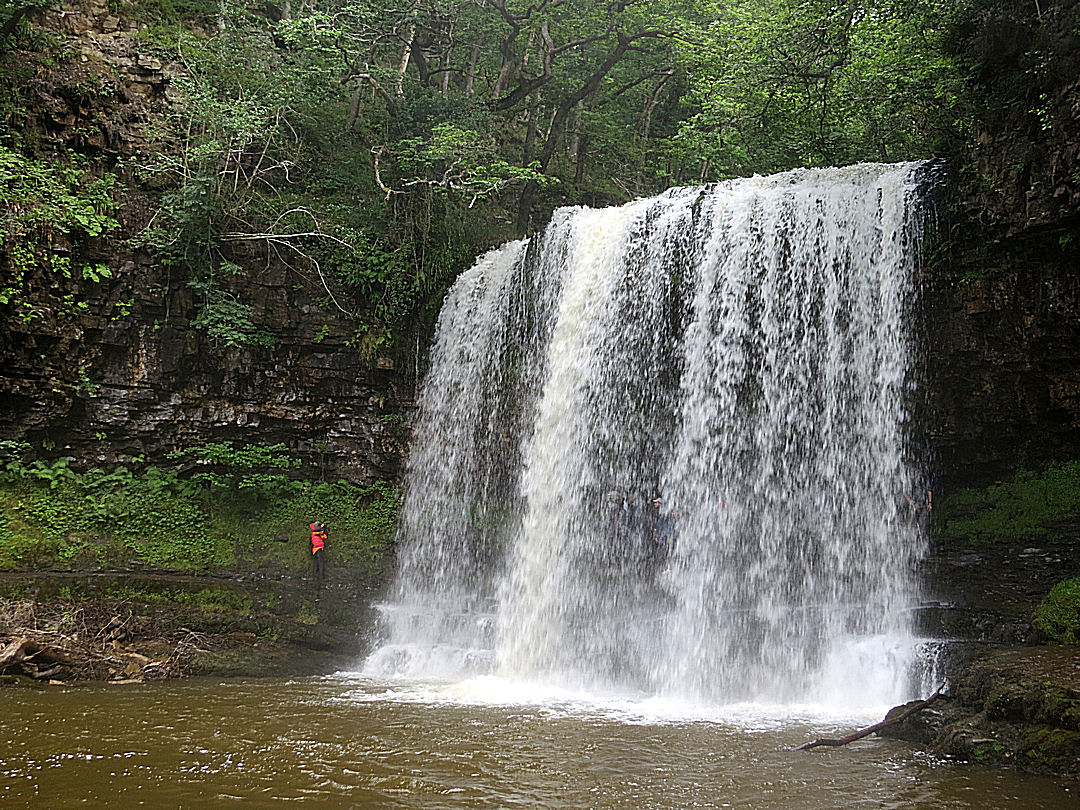
Given the fear of the Damocles Sword of litigation which has crossed the Atlantic and seriously infected the UK it is encouraging that a spirit of adventure still persists.  Truth be told I had to resist a very strong temptation to strip off and jump off the ledges into the plungepools myself …. but fear of arrest for indecent exposure held me back.  We contented ourselves with walking behind the crashing water of Sgwd yr Eira.

Approaching Sgwd yr Eira

Approaching Sgwd yr Eira

Casually emerging from behind the fall

Casually emerging from behind the fall

.... and viewed from the opposite bank

…. and viewed from the opposite bank

The constantly falling water  is hypnotic, creating a dreamscape

The constantly falling water is hypnotic, creating a dreamscape

Looking along the approach path from the ledge behind the curtain

Looking along the approach path from the ledge behind the curtain

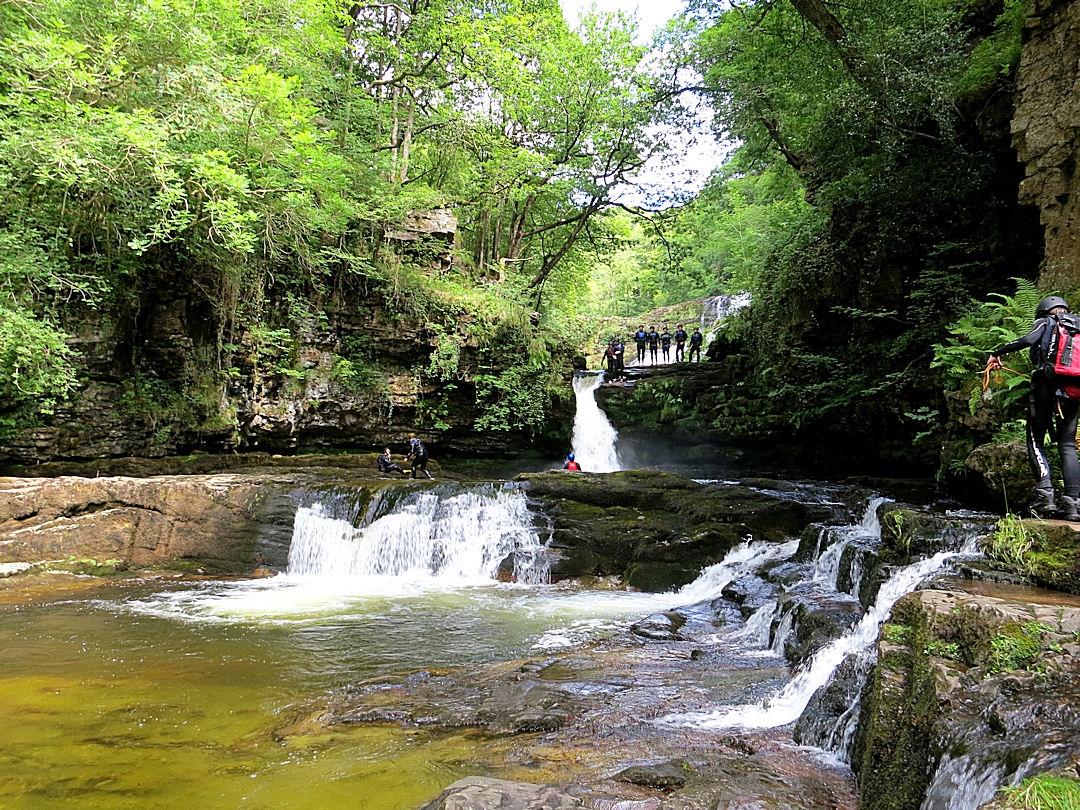
Sgwd Isaf Clun-Gwyn

Sgwd Isaf Clun-Gwyn

Sgwd Pannwr

Sgwd Pannwr

The pools and shallow falls are a great place to play

The pools and shallow falls are a great place to play

"Alright lads, one after the other, shuffle along and jump"

“Alright lads, one after the other, shuffle along and jump”

..... closer look

….. closer look

In just a few days I’ll be back in Greece and the pleasures of wandering the slopes of the volcano that is Nisyros, swimming in the Aegean and basking in the sun.

1  for those walks see:
https://barryh2.wordpress.com/2012/11/08/november-daily-blog-8-waterfalls-and-footpaths/
and
https://barryh2.wordpress.com/2012/11/17/november-daily-blog-17-waterfalls-footpaths-and-shepherds/

Posted in Hiking, Landscape, Mountains, Wales | Tagged , , , , , , , , , , , , , , , , , , , , , , , | Leave a comment

Tilos: images, looking back.

I’m back home now and trying to sort out my garden and come to terms with the vagaries of British weather.  The vegetables would have shrivelled and died if a friend hadn’t watered them for me in the heat and drought the first two weeks I away.  On Sunday and Monday just gone the moisture in the parched soil was replenished by 3½ inches (90mm) of rain in 48 hours.  Now I’m busy harvesting potatoes, French beans, courgettes ….. and trying to find and pick out the countless caterpillars which are voraciously munching their way through the brassicas.  

In just over a week I’ll be heading back to Greece for a few weeks on Nisyros and Symi but before Tilos disappears over the memory’s horizon, a few more, somewhat random images.

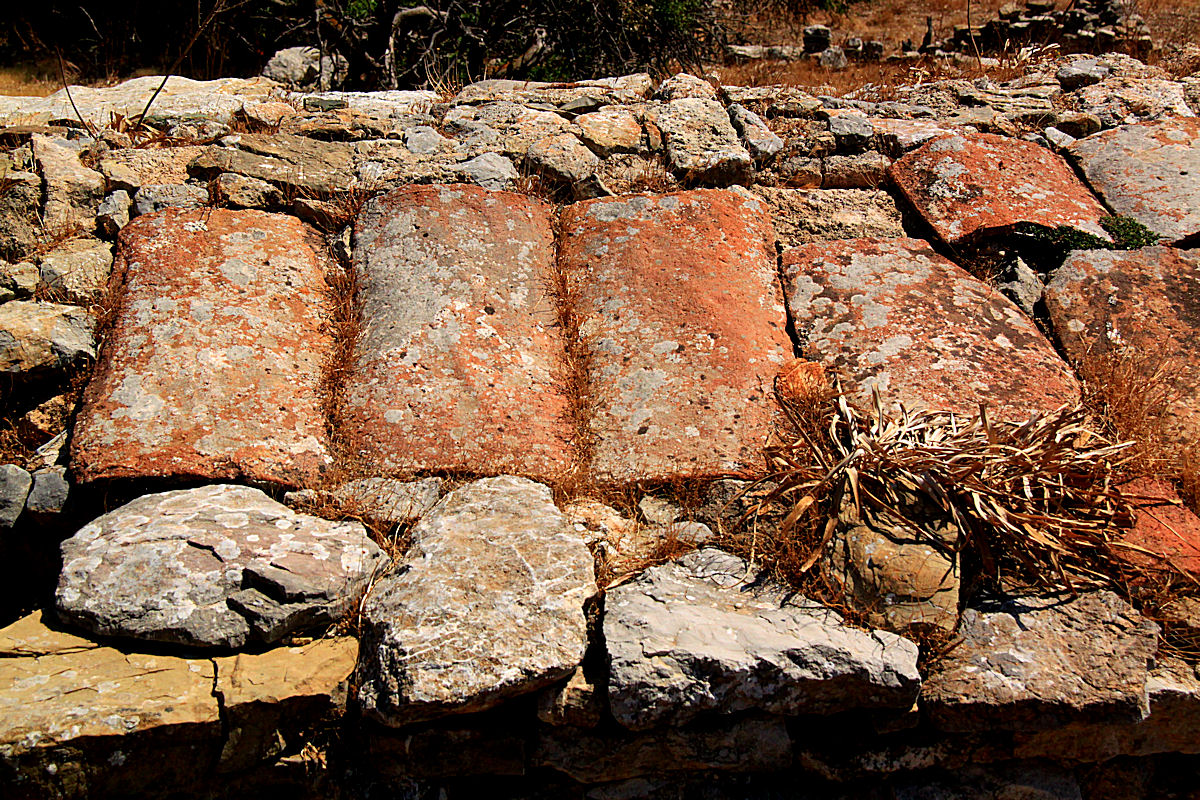
Roof tiles on one of the abandonned houses in Mikro Horio, each tile about 2 feet long

Roof tiles on one of the abandonned houses in Mikro Horio, each tile about 2 feet long

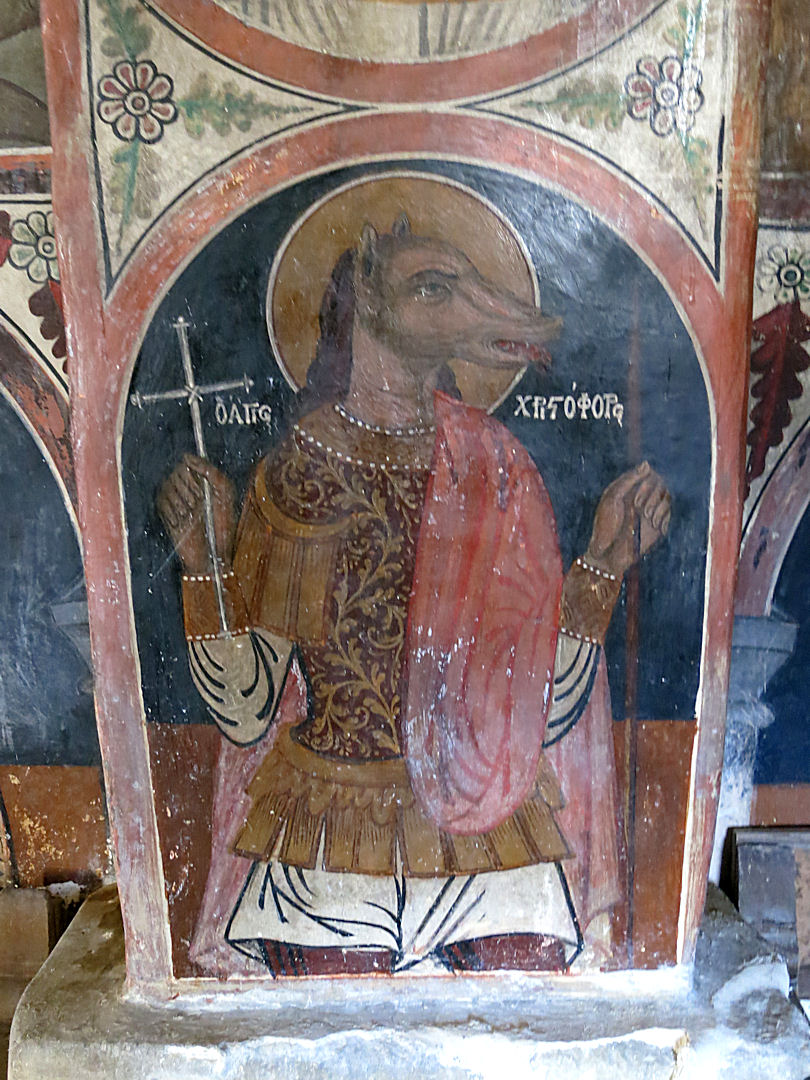
The old churches in Mikro Horio are decorated with old frescos, this one of St Christopher reflects the view that he was from a poeple with the head of a dog.

The old churches in Mikro Horio are decorated with frescos, this one of St Christopher reflects the view that he was from a people with the head of a dog.

The tiny harbour harbour of Agios Antonis, work on hold on boat and buildings against a mountain backdrop

The tiny harbour harbour of Agios Antonis, work on hold on boat and buildings against a mountain backdrop

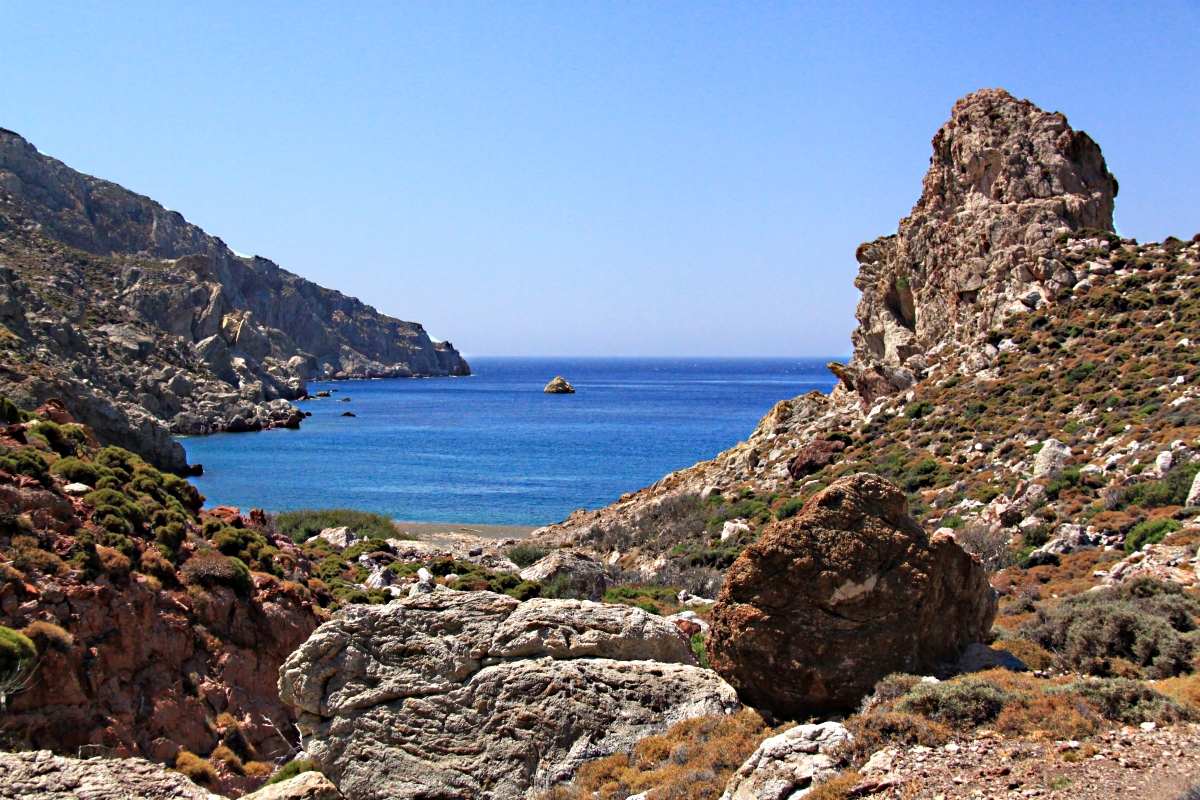
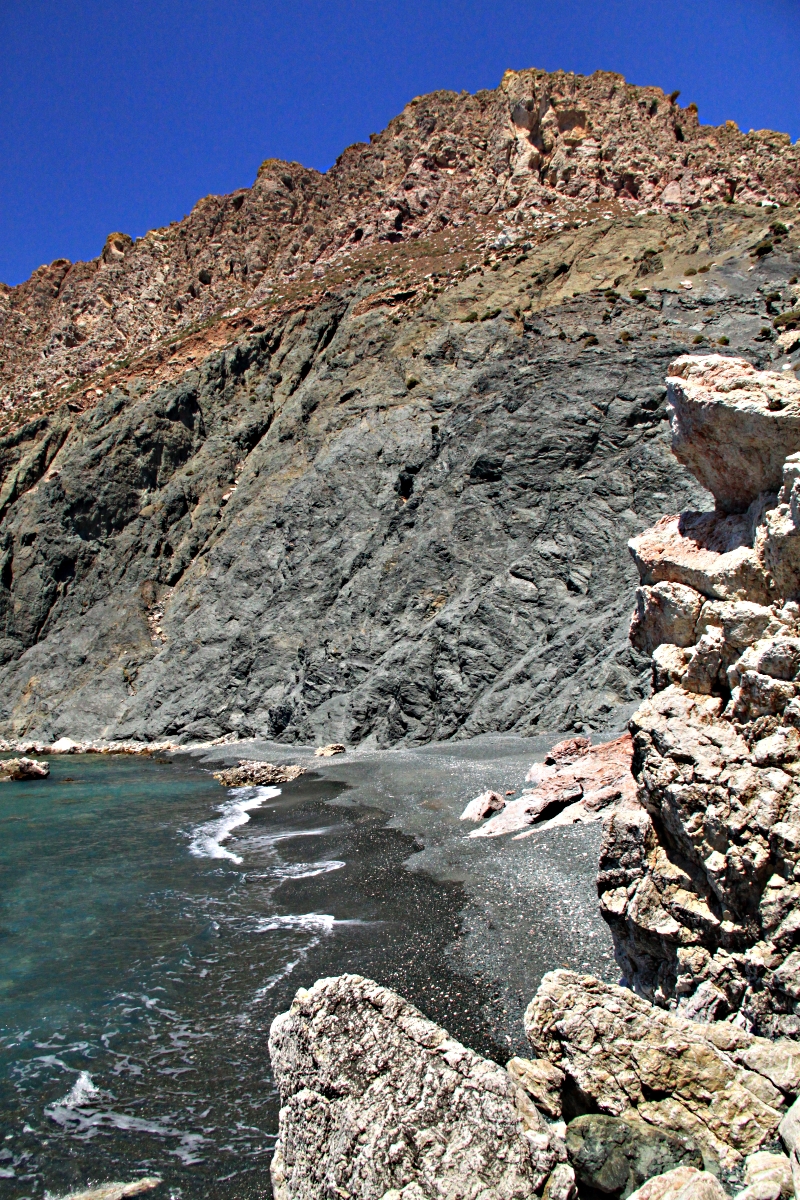
Secluded beaches on the uninhabited west coast are flanked by steep cliffs,providing nesting sites for Eleanora's Falcons

Secluded beaches on the uninhabited west coast are flanked by steep cliffs,providing nesting sites for Eleanora’s Falcons

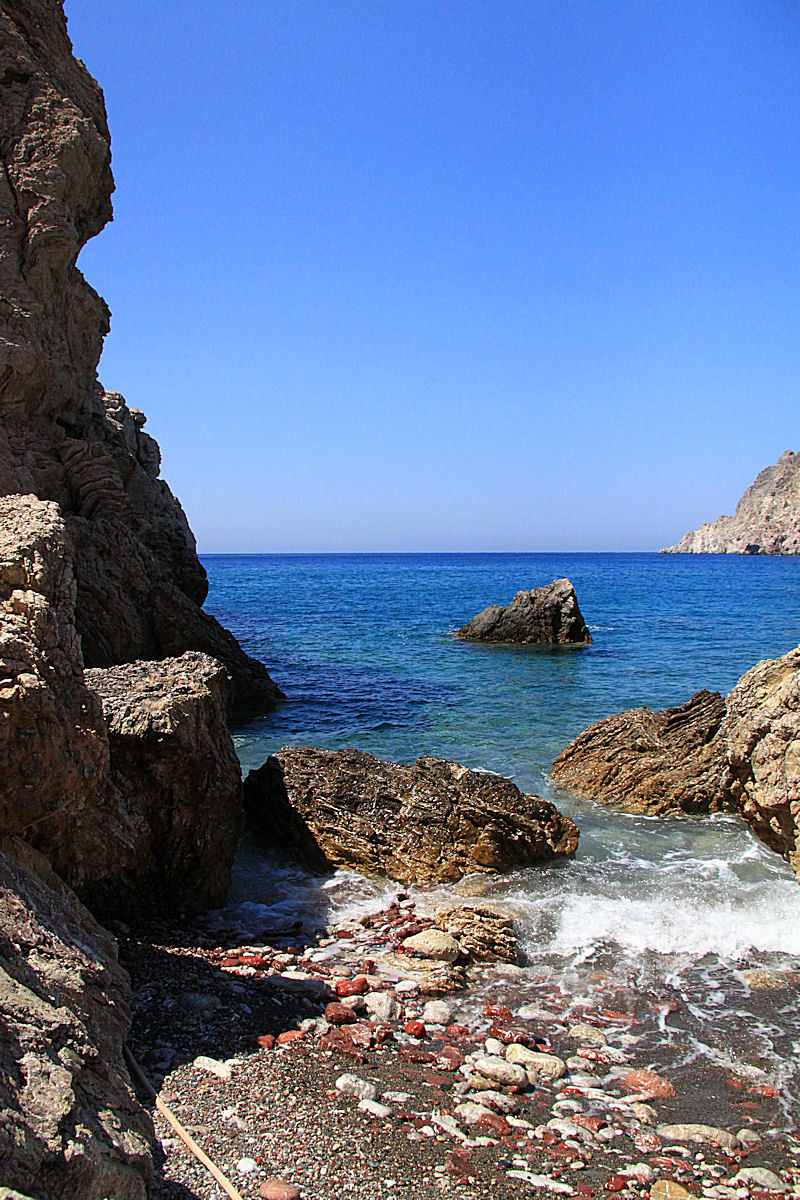
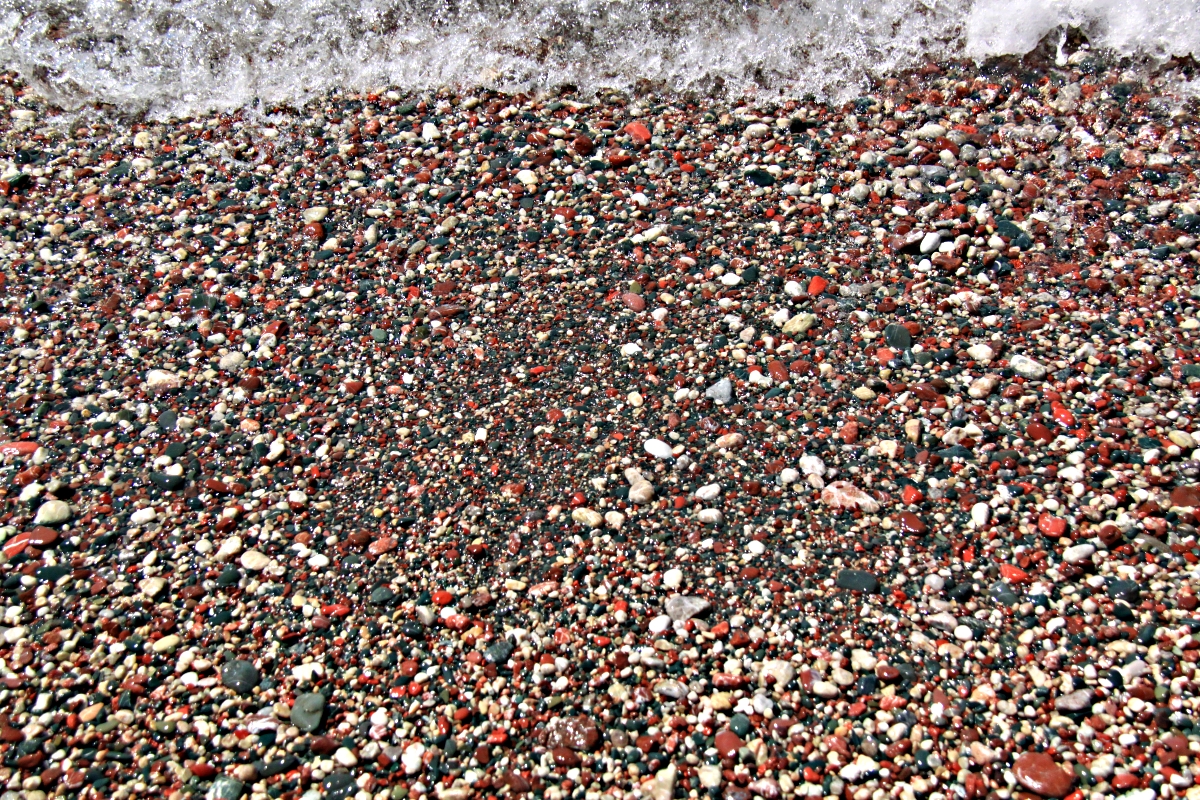
The beach really is that red, the sea that clear and that blue

The beach really is that red, the sea that clear and that blue

Waxing creative while drying off in the sun

Waxing creative while drying off in the sun

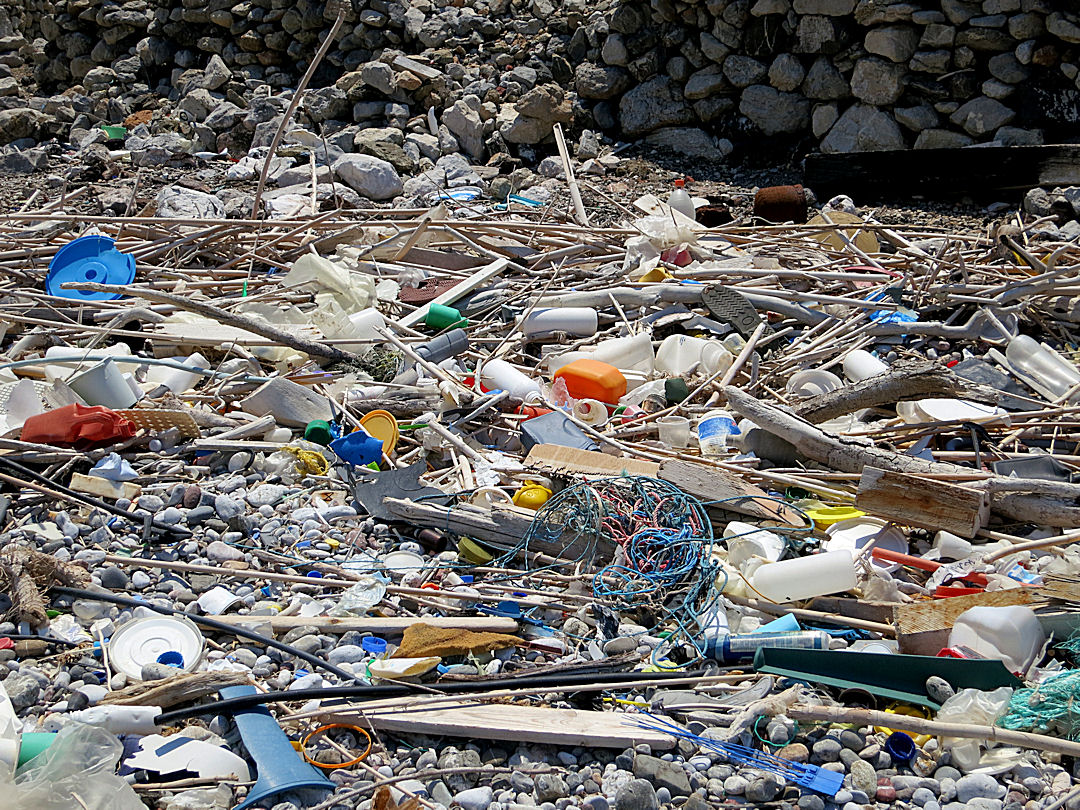
Winter flotsam on secluded beaches is difficult to deal with especially when falling visitor numbers and concentration on umbrella-and-sunbed beaches reduce the incentive.

Winter flotsam on secluded beaches is difficult to deal with especially when falling visitor numbers and concentration on umbrella-and-sunbed beaches reduce the incentive.

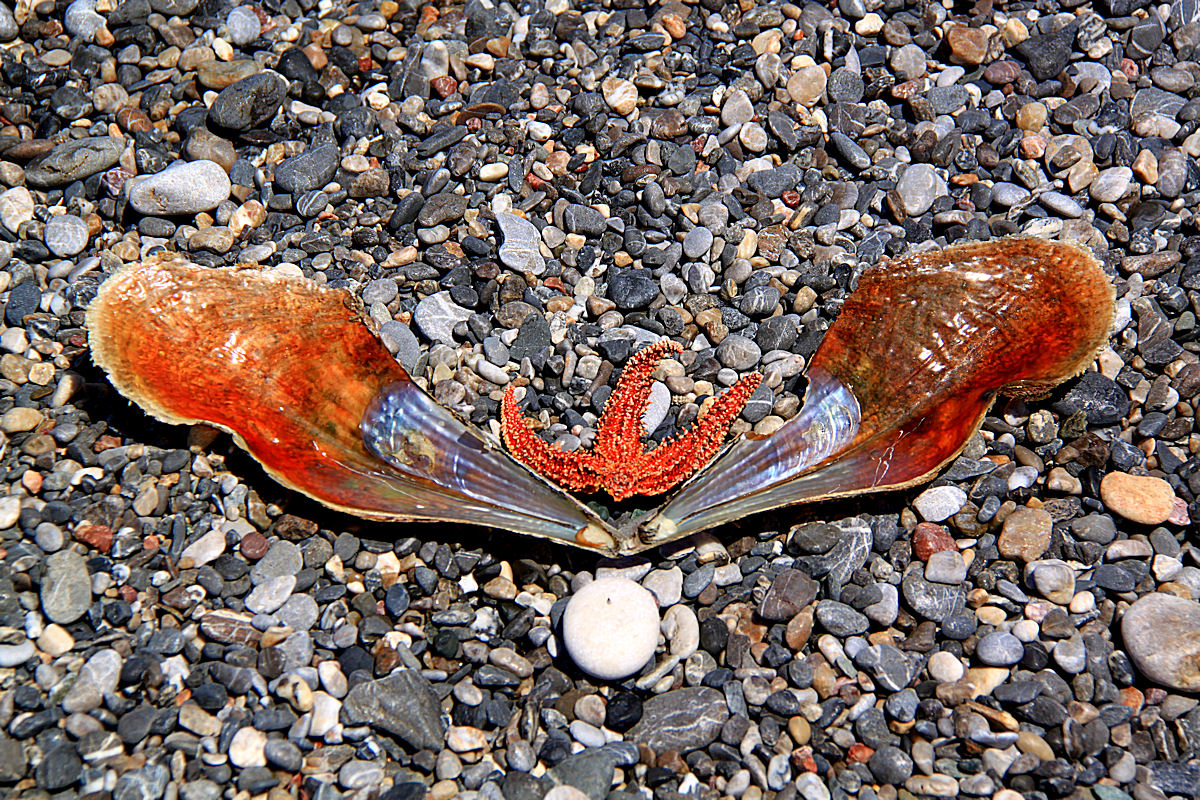
Art is where you find it

Art is where you find it

........... though sometimes given a little arranging

……….. though sometimes given a little arranging

....... or a little help from the birds

……. or a little help from the birds

Not on the beach but close to the top of a mountain

Not on the beach but close to the top of a mountain

View of The highest point on the island from the mountain castle at Megalo Horio

View of the highest point on the island from the mountain-top castle at Megalo Horio

Sweet, cool and very refreshing

Sweet, cool and very refreshing

Not the Turin Shroud ... just the Tilos Towel

Not the Turin Shroud … just the Tilos Towel

x

Posted in Art, Greece, Landscape, Mountains, Nature | Tagged , , , , , , , , , , , , , , , , , , , | Leave a comment

Tilos: a walk beyond the fringe.

Once a week there is the opportunity to do a walk on Tilos which I have intended but not got round to doing for a number of years. It’s a truly ‘wild walk’ from Agios Pandeleimon, the large monastery dedicated to the patron saint at the north end of the island, around the flank of Profitis Ilias, the highest mountain, to Eristos, the longest beach.  With the mountain on one side, the sea on the other and no settlements, there are no escape routes.  You either go on or you turn back.  Though apparently once a well made stone-paved path there is now no trace of it and parts of the route are known to be difficult to find and follow.

At 11.00 every Sunday the bus leaves Livadia for the monastery, stays an hour and then returns.  Since the demise of the island’s taxi service it’s the only way to get there as the start of one of two possible walks.  On my second Sunday on the island I climbed on the bus and, alighting at the monastery 45 minutes later, asked for «ένα απλό», a single (you pay when you get off, not when you get on).  The die was cast.

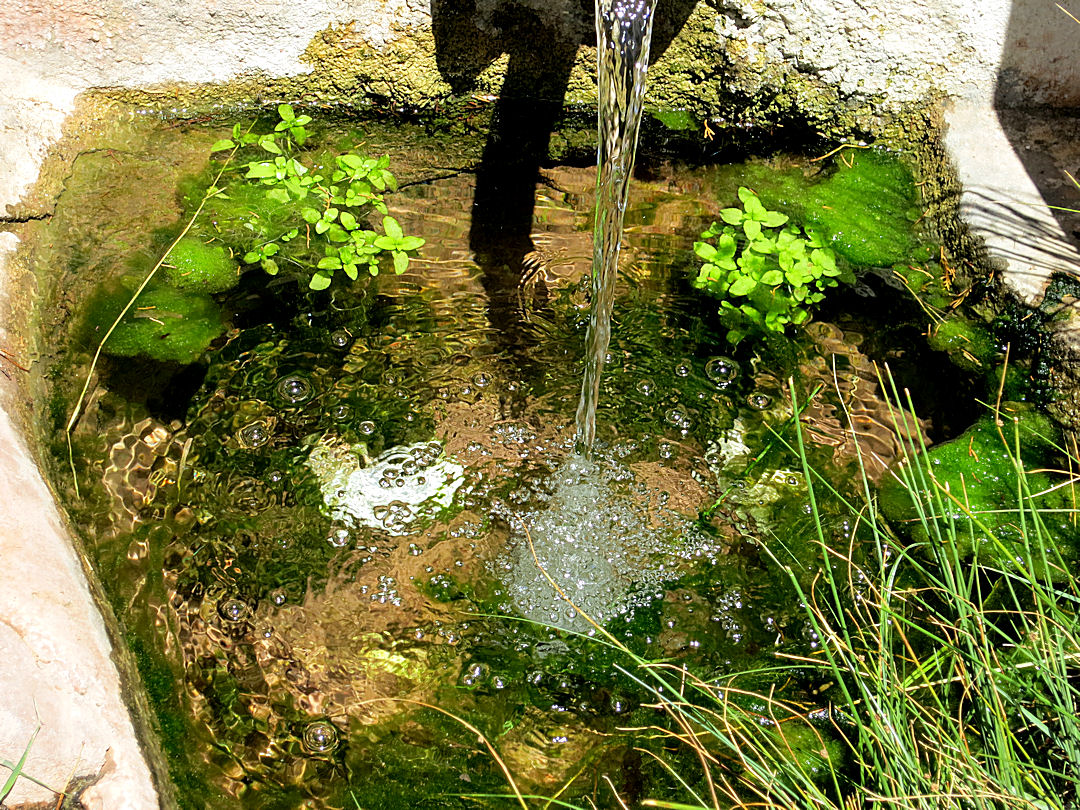
When we first went to the monastery nearly 15 years ago a number of elderly local ladies got off the bus clutching bags full of empty 1½ litre water bottles which they filled from the spring gushing out of the mountain at the side of the monastery entrance, ready to take back on their return. It was a weekly ritual. The water is wonderfully sweet and cool though whether it has the beneficial health effects some attribute to is another matter.  The ladies were certainly considerably older than me and had no problem lugging half a dozen or eight full water bottles around, so …. maybe ?!?!?!?.

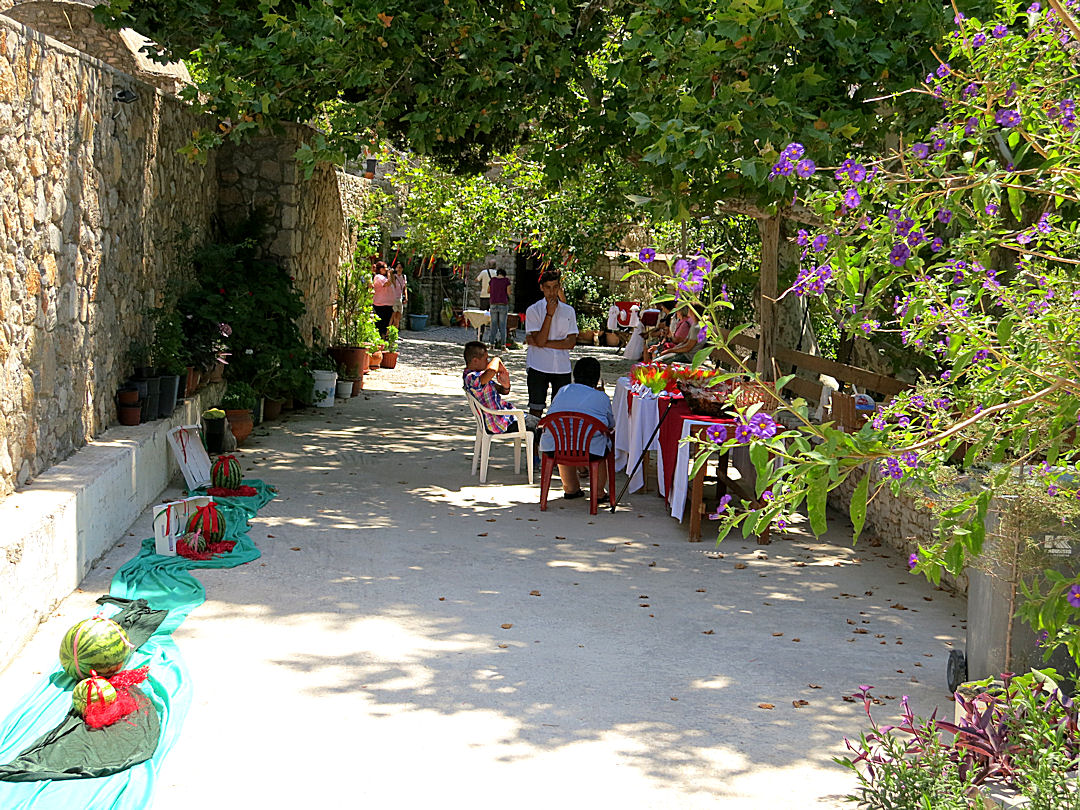
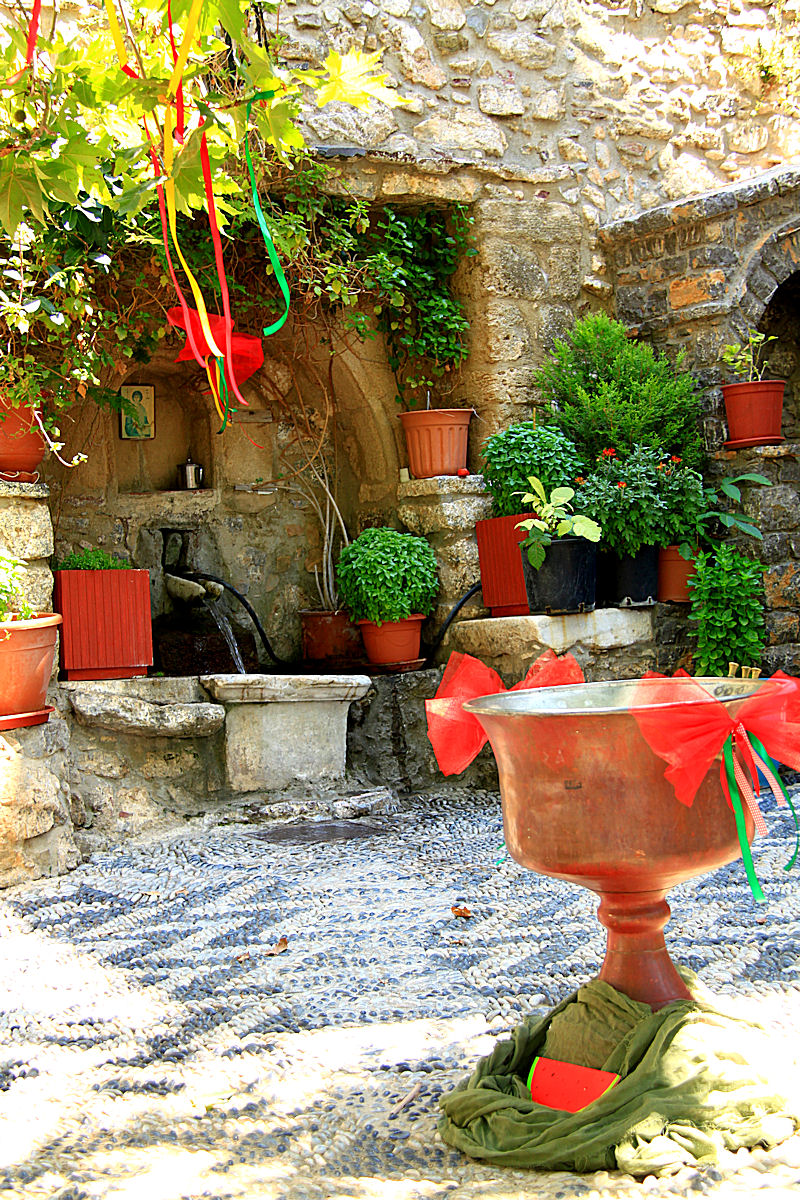
This time the whole monastery was buzzing.  The following weekend was the major festival on the island, the name-day for Agios Pandeleimon.  But this Sunday there were what seemed to be preparations for a baptism.  In the entrance courtyard trees and the spring were decorated with ribbons and there were symbolic displays and laden tables.  The level below was a hive of activity with food preparation and long tables laid out with elaborate place-settings.  Clearly large numbers were expected.  As I was only using the bus one way I could have waited to see what was going on but I regard that as voyeuristic. This was a celebration for local people, not tourists.  I could have engaged people in conversation to find out what was occurring (an expression familiar to followers of ‘Gavin and Stacey’ or residents of Barry, South Wales) but I’m afraid I didn’t.  I was here for a walk and it was already into the hottest part of the day. I needed to be on my way.

The outer courtyard of Agios Pandeleimon Monastery

The outer courtyard of Agios Pandeleimon Monastery

The spring

The spring

I have to be honest here.  I had intended to follow the path from the monastery to Agios Antonis, the small harbour at the north end of the island, a dramatic walk under high, craggy cliffs on a recently improved path.  It would be a pleasant amble on a Sunday afternoon allowing plenty of time for a swim.  But that was what sat uneasily with me, it would be a Sunday afternoon stroll on an almost urbanised path with park–type seats at strategic locations. I fancied a bit more of a challenge.

So on the spur of the moment, standing with a crowd of tourists waiting on a balcony walkway around the monastery, waiting to take the iconic photo of the red pantiled roofscape, I changed my mind.  No dithering.  Decision made. I was going to tackle the path to Eristos.

The iconic red pantile roofscape

The iconic red pantile roofscape

First a few more deep swigs of water from double-cupped hands under the spring gushing out of the rock by the entrance, conserving my bottle of iced water for later.  I quickly found the start of the path, up a short flight of wooden steps to the left of the main gate and then along the high back-wall of the monastery enclosure.

From the monastery the thin but clear path meandered up towards the crags towering above, crossing scree, curving upwards and around a natural bowl to reach a rocky shoulder at about 430 metres.  I stopped on rocks on the shoulder to have my banana and nutbar with views across to neighbouring Nisyros, grey and faint in the haze but with the white of Nikia, one of the crater-rim villages, clearly visible.

Climbing higher and looking back to the monastery

Climbing higher and looking back to the monastery nestled under the crags

Zooming in

Zooming in

The thin path tracing a meandering line under the crags and across scree slopes

The thin path tracing a meandering line under the crags and across scree slopes

A thin but clear path

A thin but clear path

.... squeezing between rocks

…. squeezing between rocks

Looking across to neighbouring Nisyros

Looking through the heat haze across to neighbouring Nisyros

From there the monastery was out of sight and I was on my own, no sign of any settlement or activity.  The sense of isolation was invigorating, focusing the mind. More than usual on the islands I was conscious of the fact that if anything went wrong it could be serious.  The narrow, path winding up, down, and around the mountainside, occasionally marked by small cairns, increasingly rarely by fading red dots, was like a tenuous thread linking me to civilisation.  I was confident that if I lost the path, or if it petered out, I now had enough experience of going off piste to find a way but it would be slow going, not a welcome prospect.

The path dropped down close to sea level and reached a small spring.  Trickling out of the ground into a muddy pool there was no useable water for me but it was an oasis for the goats.  The result was a myriad of paths radiating into that one point.  I cast around to find a marker of some kind but found none.  I followed the clearest of the paths steeply up rocks, polished to indicate the passage of many feet … or hooves.  It was wrong but took me higher up the slope and from a rocky outcrop I could see that it went no further and that the more likely line was lower down.  I backtracked to the pool and took another line which turned out to be correct, marked by a small cairn after a couple of hundred metres.

From the shoulder the path begins to drop back down

From the shoulder the path begins to drop back down

Over the shoulder of another spur and I dropped down again to an isolated, abandoned chapel.  I guessed it was the only feature marked on the map, Panagia, a chapel dedicated to the Virgin Mary, and therefore just over half way along the route.  Another two hours to go if the path remained clear.

Approaching the isolated, abandoned chapel of Panagia

Approaching the isolated, abandoned chapel of Panagia

Climbing up again now towards another col and the path changed nature.  Rather than trodden earth and loose rubble it went over craggy rocks, the meandering line marked by small cairns.  Hopping from rock to rock, walking along narrow ledges, it was matter of identifying the next marker before moving on.  Brain really focusing now but perhaps the most enjoyable and satisfying part of a very enjoyable walk.

Along a narrowing ledge marked by small cairns (centre)

Along a narrowing ledge marked by small cairns (centre)

Up rocks and onto a rough path towards the col

Up rocks and onto a rough path towards the col

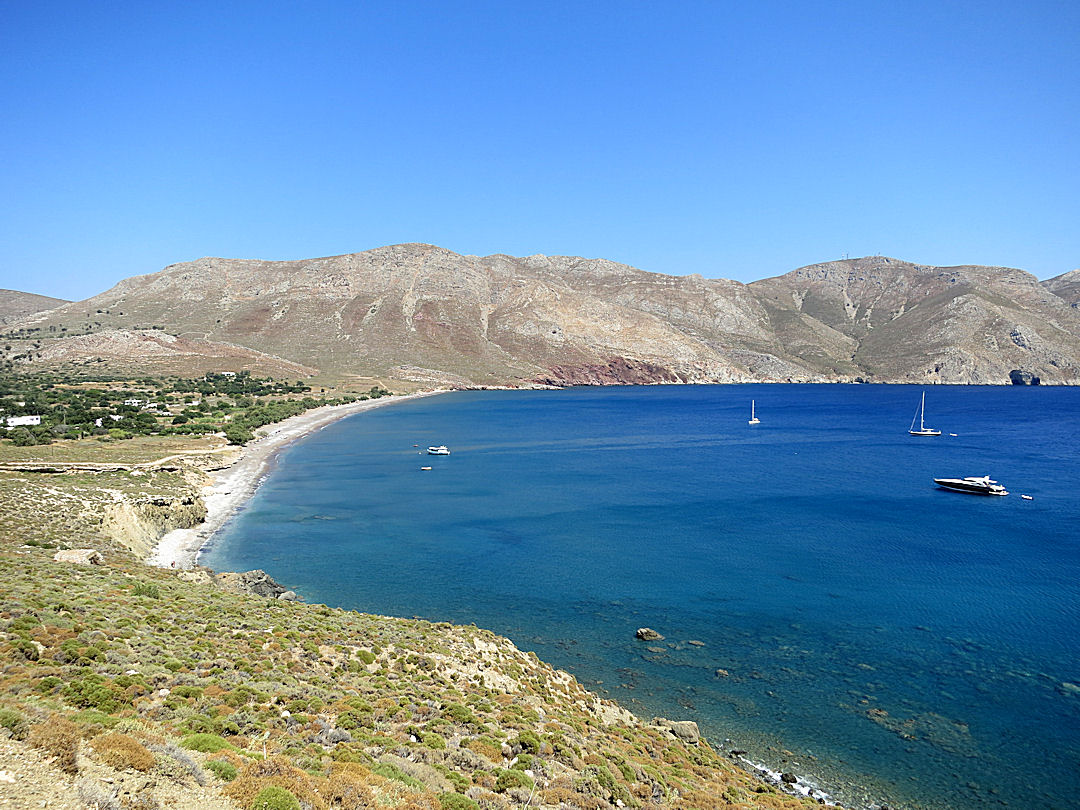
The shoulder of the mountain reached and Eristos Bay came into view. Easy to become blasé at that point, the end clearly in sight, but the meandering path still needed to be traced.

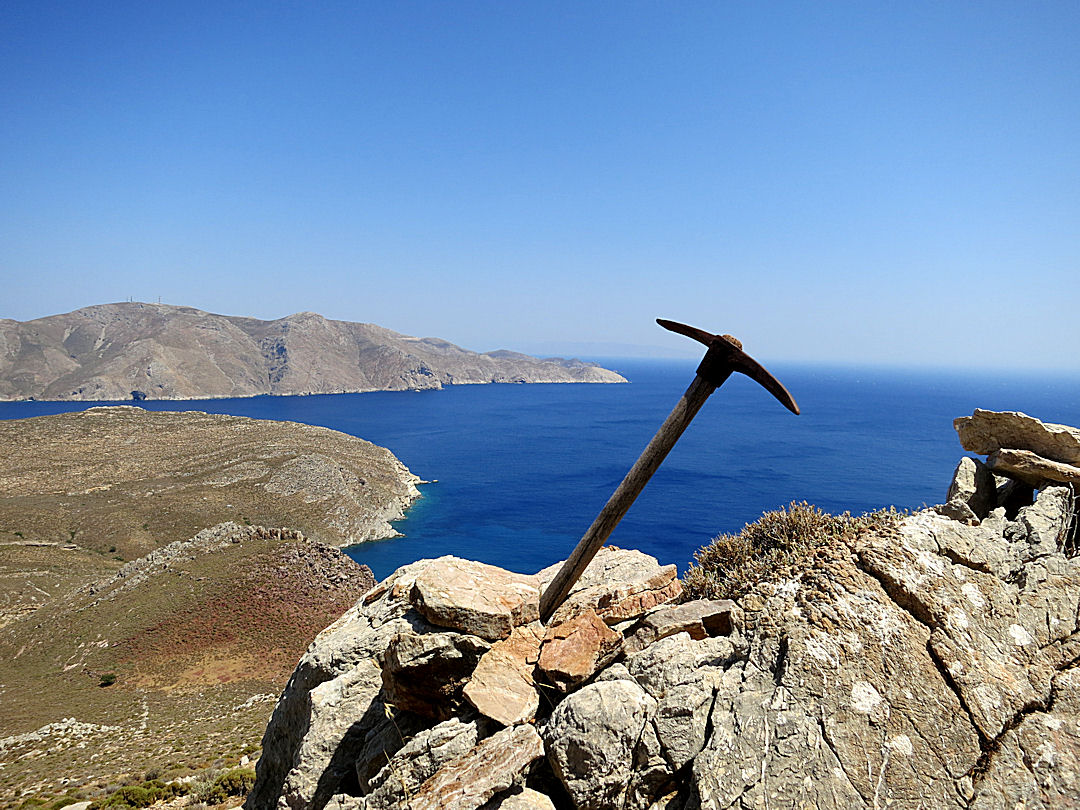
In some mountains this would be worrying, but here it's only a pick left by workmen

In some mountains this would be worrying, but here it’s only a pick left by workmen

Eristos Beach, the end of the path and a refreshing swim in prospect

Eristos Beach, the end of the path and a refreshing swim in prospect

It was still another hour before I reached the track behind the beach and plunged into the crystal clear water for a very welcome and refreshing swim.  Then a swagger past the prostrate, sweltering bodies on the beach to reach the bus turning point and a cold beer to fill the half hour wait.

Marvellous!!  I would do it again tomorrow but will have to wait for another Sunday on Tilos.

If you fancy a walk on Tilos but aren’t sure about wandering into the back of beyond on your own then contact Iain and Lyn, very experienced professional guides who have lived on the island for 17 years and know it very well.   

Contact details: http://tilostrails.com/2.html

Posted in Greece, Hiking, Landscape, Mountains | Tagged , , , , , , , , , , , | Leave a comment

Tilos: sea to sky and back again (3)

Gherondas, the third of the small peaks backing Livadia Bay which I set out to find a way to the top of, proved to be as interesting and distinctive as the other two, Thymadheri and Vounos

Again  the initial approach is along part of the seafront past the sunbeds and the mid-morning prostrate flesh ranging from alabaster white lathered in ‘factor 60’ sunscreen, through pink with a smear of ‘factor 20’, lobster red of the overcooked, to deep Mediterranean brown.  Some lie spread-eagled, toes pointing to the sun, equidistant between the sea and the taverna.  Others set up camp in the shade of umbrellas, tamarisk trees or both, inflatable green crocodiles close to hand.  The stroll along the very pleasant beachside walkway is a battle to avoid being either voyeuristic or appalled … relieved by the occasional sight of friends.

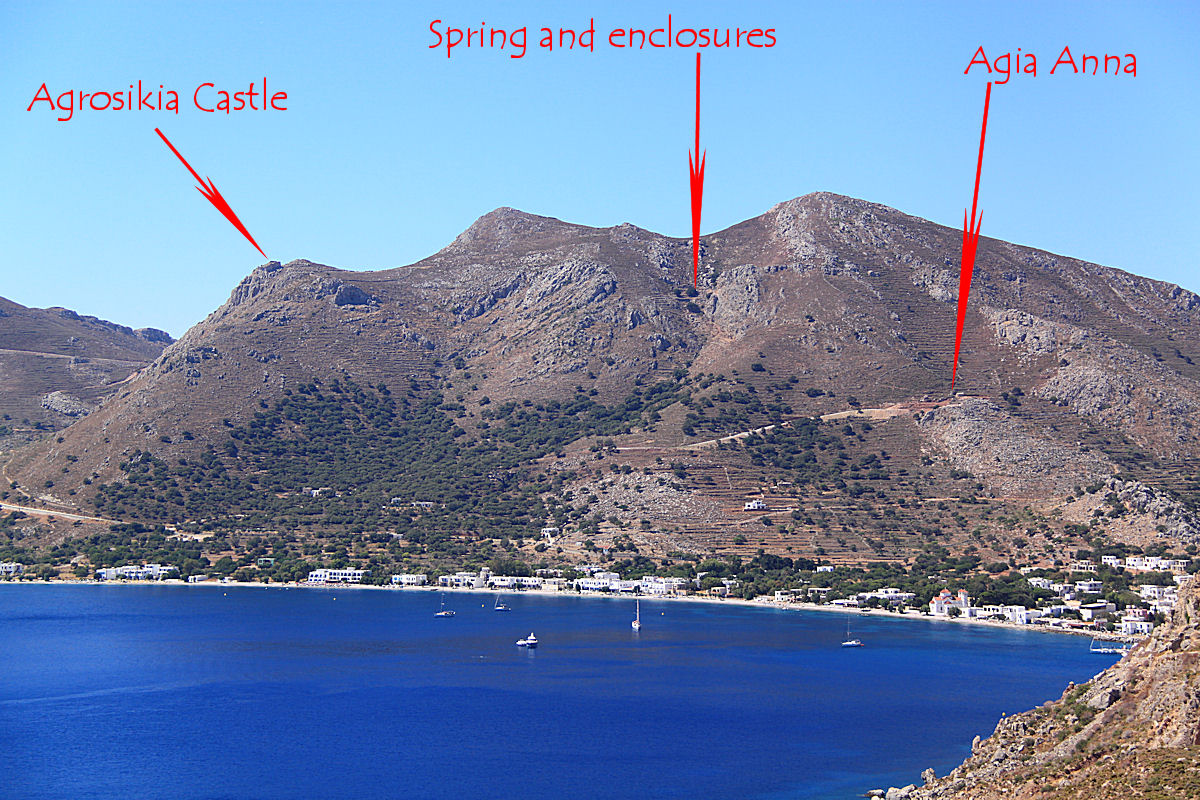
A short distance inland a concrete road doubles back parallel with the seafront, climbing steeply towards the small church of Agia Anna on a rocky knoll overlooking the town.  The concrete road, like so many, seems to serve no real purpose.  It stops short of the church leaving a very steep scramble up a rubble-covered track.  Maybe the road is used once a year on the name day of the saint for a small festival.  Cynics might suggest that the real purpose of the road is more likely to be to facilitate the sale of bits of land for house building, attracting EU funding for political but no practical benefit.

Unfortunately it’s a hot uphill road-slog but necessary

Gherondas seen from the other side of Lividia Bay, Agrosikia Castle on the left, the highest point out of sight beyond false summits

Gherondas seen from the other side of Lividia Bay, Agrosikia Castle on the left, the highest point out of sight beyond false summits

Then onto the good stuff.  From behind the church a thin path zigs back again, picking its way up terraces choked with thorn scrub towards a high vertical crag. From the foot of the crag the path climbs very steeply into a narrow gully with animal enclosures and an old spring.  An enjoyable scramble and a teeter around the narrow top of a wall backed by a wire fence.

Approaching the steep gully at the side of the crag

Approaching the steep gully at the side of the crag

Looking back down past the crag to Livadia

Looking back down past the crag to Livadia

After a welcome rest and swig of iced water in the shade of large boulders with ravens croinking overhead, annoyed at their solitude being disturbed, a short climb up the rocks led to another thin path winding towards the dramatically located medieval castle of Agrosikia.

However, to get to the top of the mountain I left the path and went straight up through the thorn-covered, stone-built terraces.  Less usual were stone boundary walls.  Short sections of goat path helped the upward progress but, as on Vounos, again it was sometimes better to climb the rock rather than push through the thorns. It was relatively slow progress but after a series of false summits the altimeter on my watch confirmed that I was at the highest point, exactly the same height as the previous highest point 10  minutes before.

To the north and nearly 100 metres below was Agrosikia Castle on its craggy eminence and far below that the mediaeval harbour of Agios Stephanos which I visited on the way to Thymadheri on the first sea-to-sky trek.

13Tilos090w0218jpg

Looking north from the high point

Zooming in on Agrosikia Castle and Agios Stephanos harbour

Zooming in on Agrosikia Castle and Agios Stephanos harbour

To the south, seemingly right below my feet, albeit 370 metres below, was Thollos Beach.  I had made good time and was pretty euphoric so decided to head down there for a swim.  But not before visiting Agrosikia Castle.  A drop down more thorn-choked terraces, onto a rough track, a short stroll across the shoulder of the crag and I was there.  To get into the castle means dropping down a shallow gully below it and then scrambling back up diagonally.  Needs a good head for heights but isn’t difficult.  The castle is diminutive by the standards of the many in Wales like Chepstow, Raglan, Pembroke and Caernarvon and the inside is little more than a heap of rubble  but the setting, perched on the edge of vertical cliffs, is well impressive, certainly worth the slight diversion.

Relaxing on the top, Thollos Beach at my feet

Relaxing on the top, Thollos Beach at my feet

Zooming in on the beach

Zooming in on the beach

Ignoring the rough track down from the castle I chose the good and far more interesting cairned footpath passing through another long-abandoned settlement. The path ends at the tarmac road in a col with the path down to Thollos beach immediately opposite, signed by both a green wooden finger-post appropriate for a footpath and a blue and white metal sign which anywhere else would apply metalled road .  There seems no end to the projects of doubtful utility to which EU funding has been put.

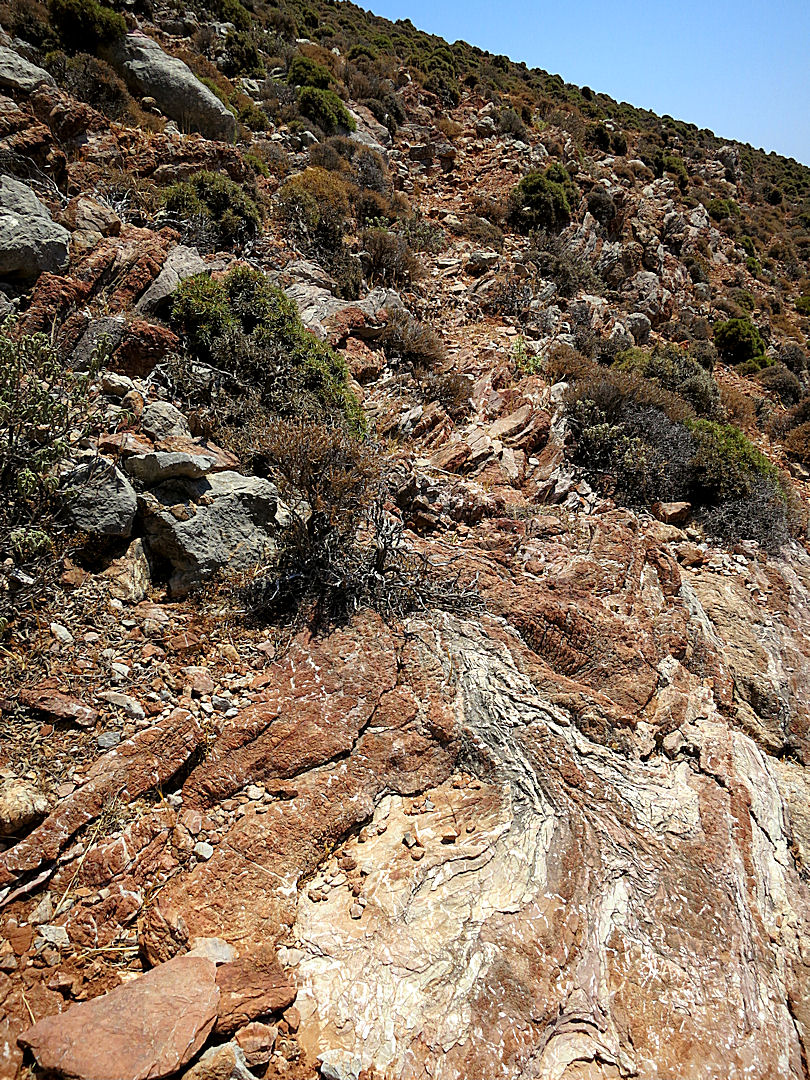
The path down to Thollos is one of my favourites and I would probably follow it even if it didn’t lead to arguably the best beach on the island.  First it drops down at a good gradient with a clear way through the vegetation on deep red gravelly soil and then drops more steeply with grey limestone and amazingly folded, gnarly red rocks and dark green slabs towering overhead in the narrow gorge.

The easy start to the path down to Thollos

The easy start to the path down to Thollos

One of the dramatic red, gnarly rock crags in the gorge

One of the dramatic red, gnarly rock crags in the gorge

The main beach at Thollos is a mix of fine gravel/course sand made up of the red and green rock and small limestone pebbles but climb through the vertical cleft in the red cliff on the right and you come onto ‘Green Thollos’ (my name for it) with uniformly green sand/gravel, and a large overhanging cliff giving shade from the sun until about 15.00.  The main beach attracts few people, maybe 6 or 8 at a time if you are unlucky, because it can only be reached on foot and involves a bit of mild scrambling but Green Thollos is rarely visited.

Rock sentinel on the final approach to Thollos Beach

Rock sentinel on the final approach to Thollos Beach

13Tilos050w0046jpg

The vertical cleft in the red crag leading to Green Thollos

13Tilos051w0048jpg

The colour of the main Thollos beach

13Tilos052w0056jpg

Standing in the cleft looking at Green Thollos

13Tilos054w0060jpg

From round the bay looking back towards both Thollos beaches

After several iterations of the ‘swim/dry-off-in-the sun/get hot/swim’ cycle it was a 30 minute hot pull back up to the col and then another 30 minutes drop down a good path/rough track combination to get back to the beach at Livadia, another swim and an ice-cold beer.  It’s a tough life but somebody has to do it.

Altogether a very satisfying conclusion to my three sea-to-sky walks on Tilos. Maybe not very ambitious but very enjoyable and I encountered no indication that anyone else had been up on the peaks any time recently.  Having sussed them out, maybe next time I’ll do all three in a day making sure that there is plenty of time for swimming of course.

Posted in Greece, Landscape, Mountains, Nature, Wales | Tagged , , , , , , , , , , , , | Leave a comment

Tilos: sea to sky and back again (2)

A couple of days after tackling Thymadheri I headed for Vounos, the highest of the three peaks and a huge rocky mass backing the bay at its easternmost end  (left in the photo below).  This time, rather than incorporating it into a long circular walk and going up the sloping shoulder from the same col as Thymadheri, I chose the direct approach, the diretissimo  as Italian alpinists would call it.

The mountains backing Livadia Bay, Vounos on the left

The mountains backing Livadia Bay, Vounos on the left

Closer view of Vounos

Closer view of Vounos

First, a saunter part-way around the bay, then along a path and track up a deep valley with a monastery at the end, up a rough path to the small church of Agios Pavlos nestled under a rocky crag, a thin, steep path up the side of the crag to a small deserted settlement, and finally strike straight up the slope to the top.  On the final section there were odd bits of path used by goats but wherever possible I climbed the rock to keep out of the thorn scrub.

looking towards Agios Pavlos and the top of the mountain

looking towards Agios Pavlos and the top of the mountain

Zooming in on Agios Pavlos and its shade tree nestled under the crag

Zooming in on Agios Pavlos and its shade tree nestled under the crag

The deserted settlement above Agios Pavlos with another perspective on Thymadheri

The deserted settlement above Agios Pavlos with another perspective on Thymadheri

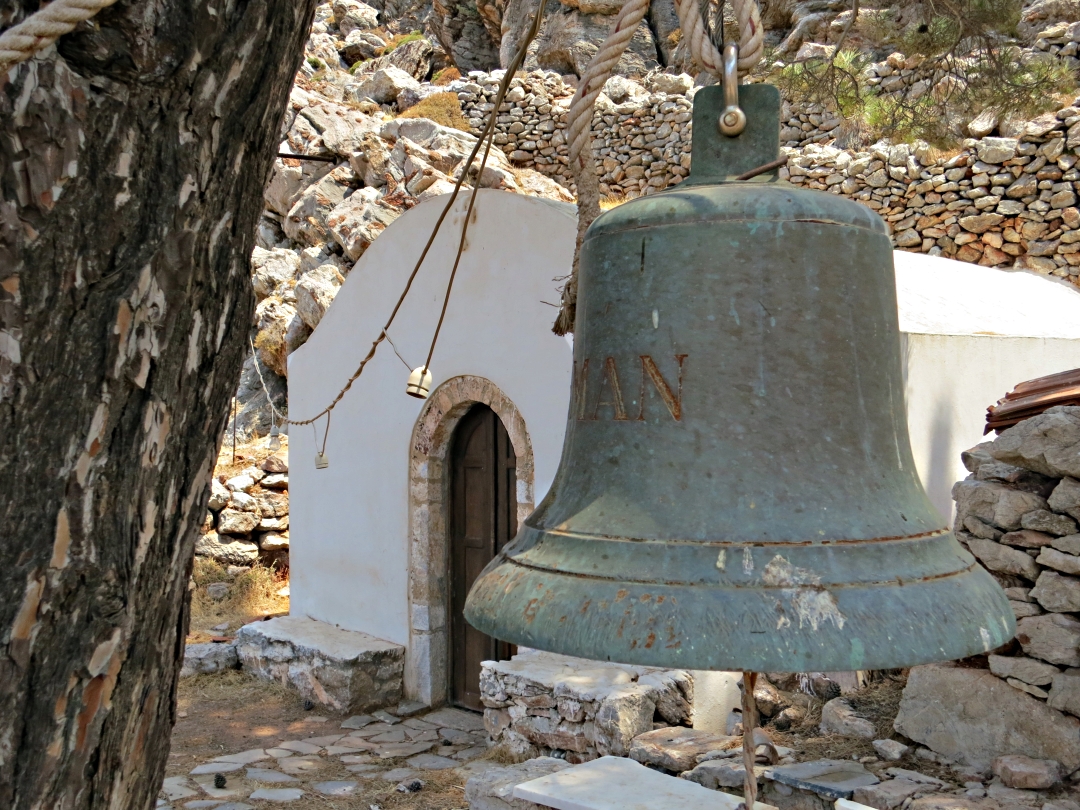
Agios Pavlos and the large bell, engraved 'Turceman',

Agios Pavlos and the large bell, engraved ‘Turceman’,

I look forward to seeing snakes on the islands but this visit didn’t see any.  However, on my clamber over the rocks I came across a snake skin stretched where the snake had sloughed it.  It was about 2 feet long and just over 2 inches in diameter …. so it’s clearly bigger than that now.  It was alongside a snake-sized cleft in the rocks which I was tempted to explore but didn’t in case I came across the sharp end.

Sloughed snake skin

Sloughed snake skin

The top of the crag was made up entirely of large, razor-sharp limestone boulders with thorn scrub between but I found a reasonably comfortable rock to perch, eat my banana and enjoy the views before chasing precariously around like a lunatic trying to photograph dragonflies and butterflies which taunted me by waiting until I crept close and then flitting across to the next piece of scrub.

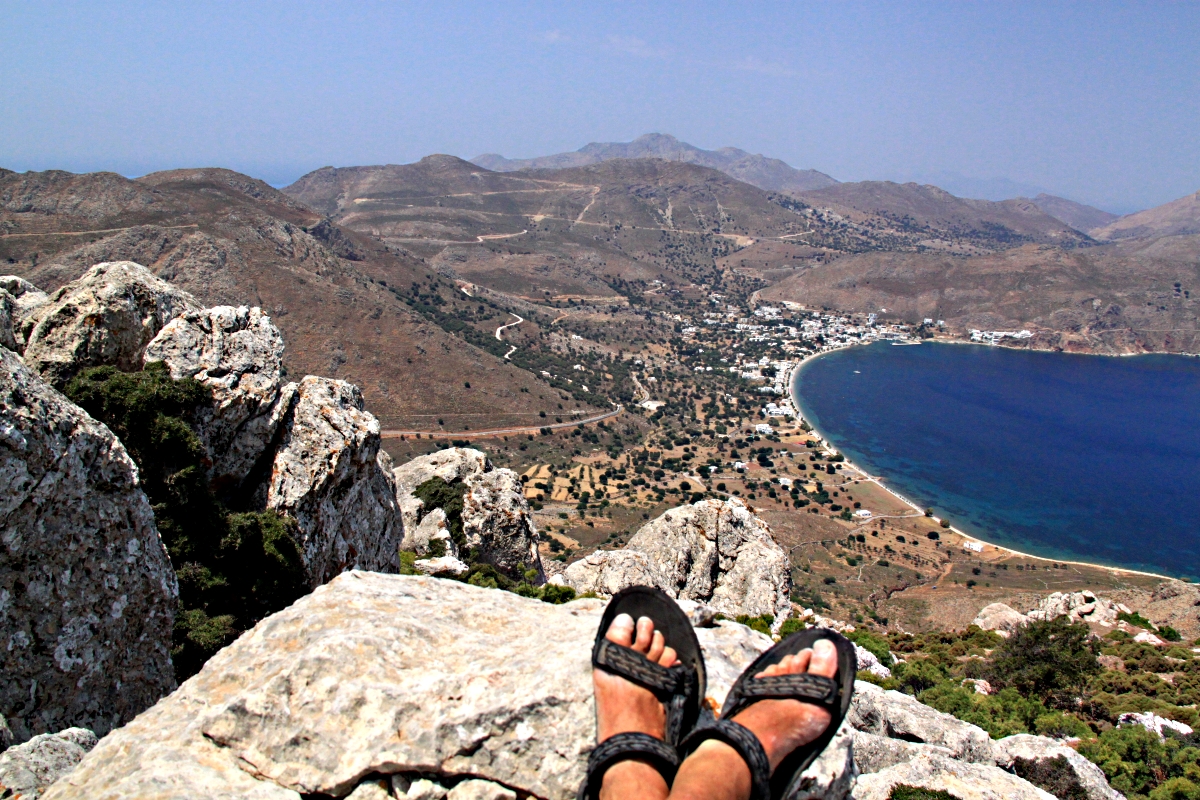
Following complaints that all the photos 'on the edge' are of my right foot, I thought fans might like to see both

Following complaints that all the photos ‘on the edge’ are of my right foot, I thought fans might like to see both

Looking straight along Livadia beachfront

Looking straight along Livadia beachfront

I dropped back into the col but decided to go back to the coast via Agios Pavlos, the way I came up, because it’s a more fun path.  The beach this time, both start and finish, was that at Livadia.  Very good apart from there being people there! It meant I had to wear my swimming trunks.  Outrageous!!!!!

Posted in Greece, Landscape, Mountains, Wildlife | Tagged , , , , | Leave a comment

Tilos: sea to sky and back again

Not as dramatic as Vancouver to Whistler, or as long, but very enjoyable and on Tilos  all done on foot.

Livadia Bay is backed by a curve of mountains, in three main blocks each with its high point (obviously!!)and separated by cols.  The mountains are not very high, from west to east (left to right in the photo below) Gherondas (371 metres), Thymadheri (360 metres) and Vounos (405 metres), each a minor challenge.  None of them has a footpath to the top, they are very much ‘off piste’ but instead of nice powder-snow they are bare rock with flesh-ripping thorns scrub between.

The curve of mountains bordering Livadia Bay to south and east

The curve of mountains bordering Livadia Bay to south and east

Three peaks, three walks from sea to sky and back again.  First, Thymadheri.

I had been up Thymadheri several times in the past as part of a circular walk.  Though the lowest of the three it’s perhaps the most dramatic because it’s a vertical rocky crag which is probably why it has for many years been home to a pair of Bonelli’s Eagles.  I headed there first, principally to renew acquaintance with the eagles, not that they ever seemed pleased to see me but drifted off to neighbouring crags as soon as I appeared with my camera.

Livadia, despite lacking the administrative designation, is the main settlement on Tilos with over 2 kilometres of curving pebble beach around the bay.  A nice easy introduction to the walk is a stroll round it to the furthest easterly point.  The first kilometre is largely sunbed-and-umbrella-beach littered with a mixture of bodies beautiful, ageing rotundity and a wide range in between.  The second section has small groups on towels or plastic chairs mostly in the shade of tamarisk trees, the ‘locals’ beach, again with a mixture of bodies beautiful, ageing rotundity, etc. The final section is narrow and deserted save for the odd guy standing knee-deep in the water fishing.

The restaurant/taverna/hotel and the small mediaeval harbour of Agios Stephanos at the far eastern end of the bay is a remarkably tranquil place to sit with a frappé and watch a miniscule segment of the world drift by … and wonder if you really want to wander any further.

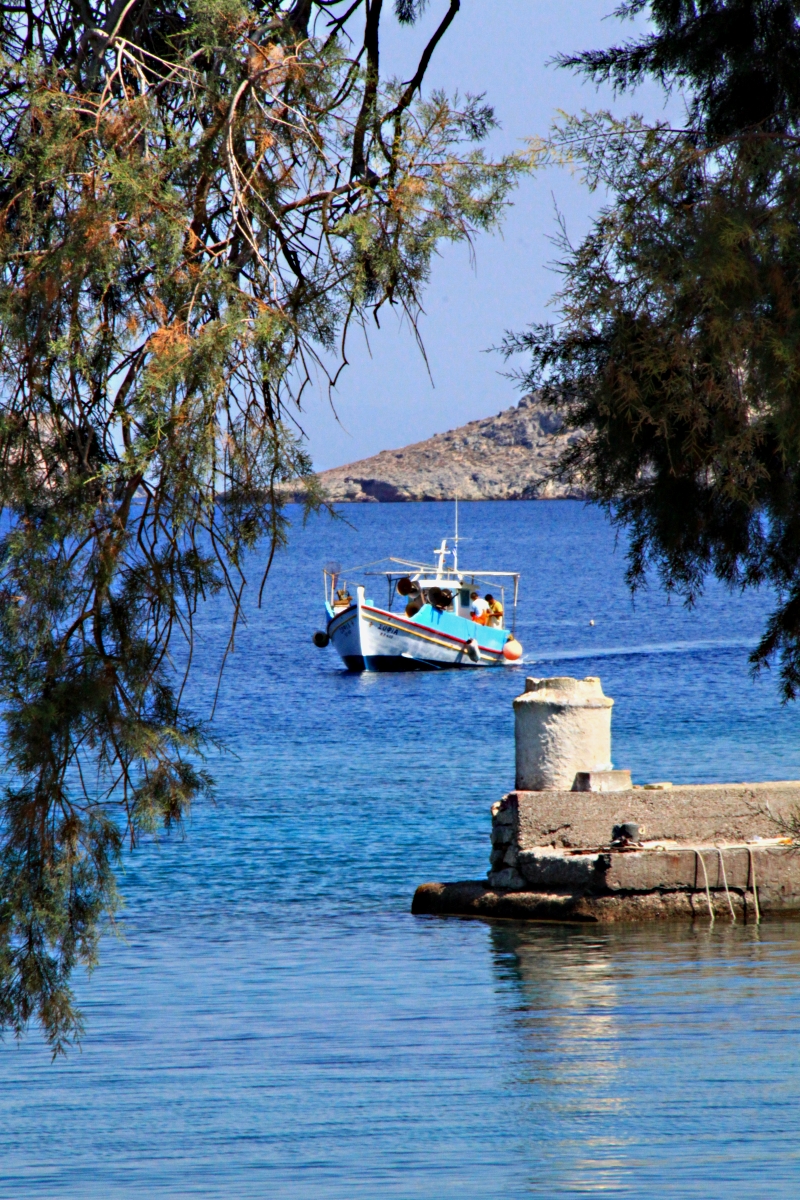
Fishing boat returns to Agios Stephanos after early morning fishing

Fishing boat returns to Agios Stephanos after early morning fishing

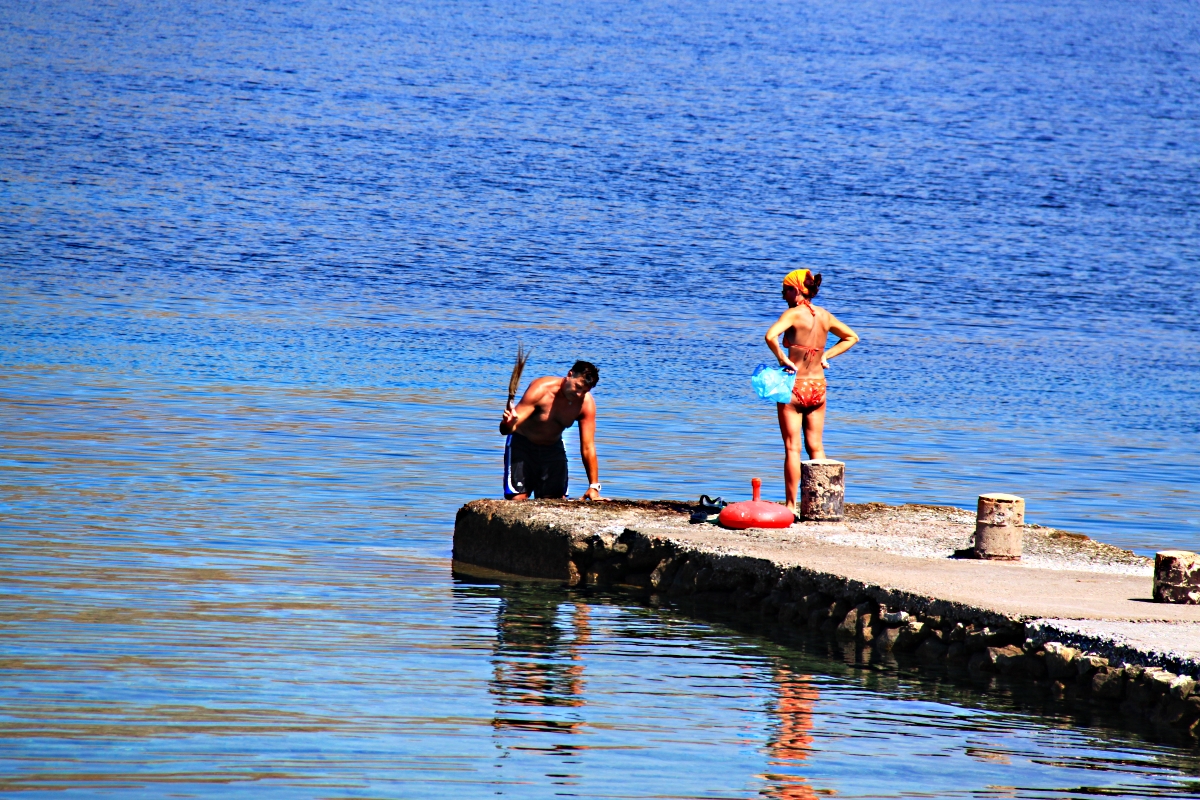
Local guy tenderises the squid he has just caught  while his missus waits with plastic bag to take it home

Local guy tenderises the squid he has just caught while his missus waits with plastic bag to take it home

However, always driven by the urge to move on, the next target is the tiny beach called Δεσπότη το Νερό, which I think translates as ‘Lord of the Water’, at the bottom of a long steep descent from the main coastal path.  The beach is pleasant enough for a swim and a laze but the great joy of it is the freshwater spring (hence the name) which gushes straight out of the mountain, sweet to drink and gorgeous to stick your head under for an amazingly refreshing shower.  Some think it’s masochistic but I love to fill my sun hat, with the water and then put it on my head.  Euphoric!!  Feel the cold, refreshing tingling down your neck and your body.  Again and Again.  Enough of that.  Back to the walk.

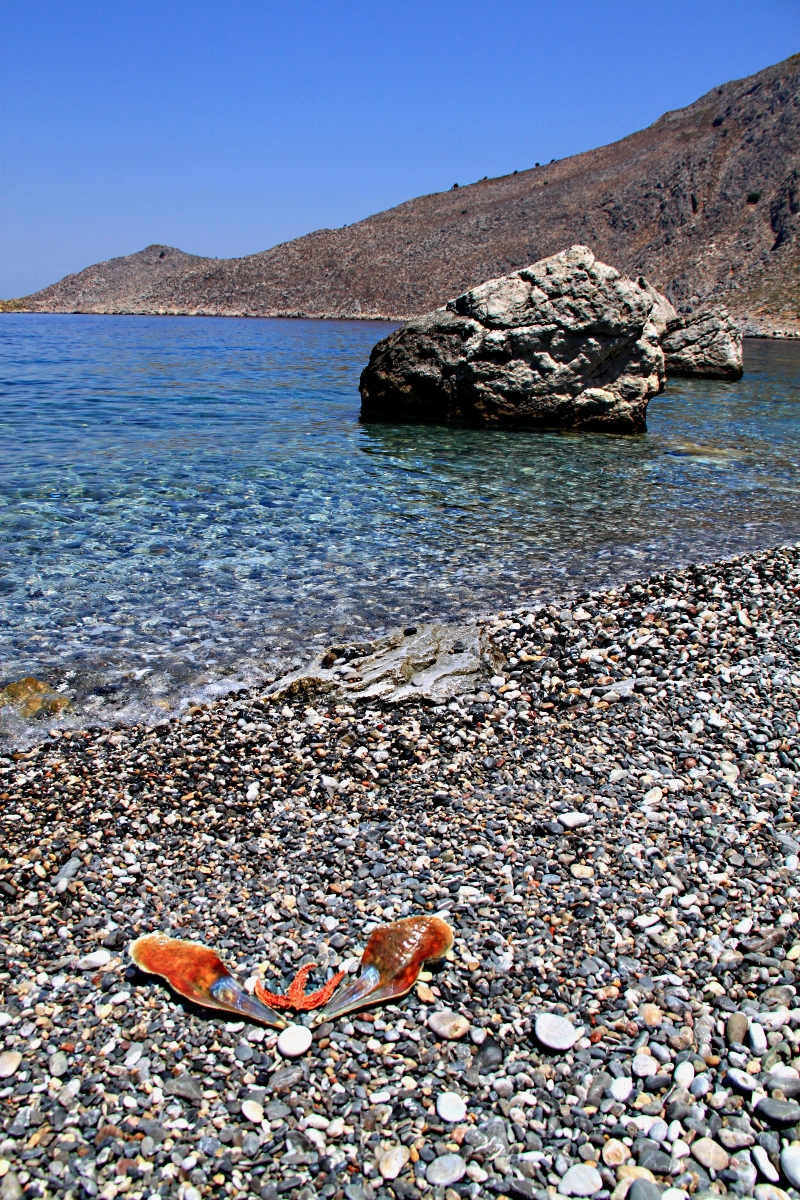
Time for a little creativity on Despoti Nero beach

Time for a swim and a little creativity on Despoti Nero beach

It’s a bit of a pull from there back up to the main path and then backtrack slightly before  upwards again to join a high-level EU funded track, bulldozed for who knows what reason, which passes through a col between Thymadheri and Vounos.

Leaving the rough track behind in the col it’s a steady climb over rocks up the shoulder to the peak.  In the strong wind it was a balancing act between staying away from the vertical drop on the western edge and keeping close to it enjoy the drama of the sheer drop.  Sadly no sign of the eagles.  Friends later told me that they seem to have gone this year.  I could sit on the top of these mountains for hours, reluctant to leave, reluctant to  come down to earth again

View from the top is pretty good

View from the top is pretty good

The crag is vertical overlooking the bay

The crag is vertical overlooking the bay

But finally, a drop down, all the while casting wistful looks over my shoulder at the mountain, and another swim this time from Livadia Beach, at the non-sunbed end of course.

Wistful backward looks to the crag

Wistful backward looks to the crag

x

Posted in Greece, Landscape, Mountains, Nature | Tagged , , , , , , , , , , , , , | Leave a comment

Tilos: wildlife at your feet

WARNING: this is a long blog, take care if you have a short attention span or if you suspect that your demise is imminent !

I have been a long-time proponent of walking in sandals in Greece.  Probably the same considerations apply in other Mediterranean countries but Greece I know best.  One advantage which is relevant here is that you need to pay more attention to foot placement rather than ploughing along in leather boots …………. so you see more stuff scurrying for cover.

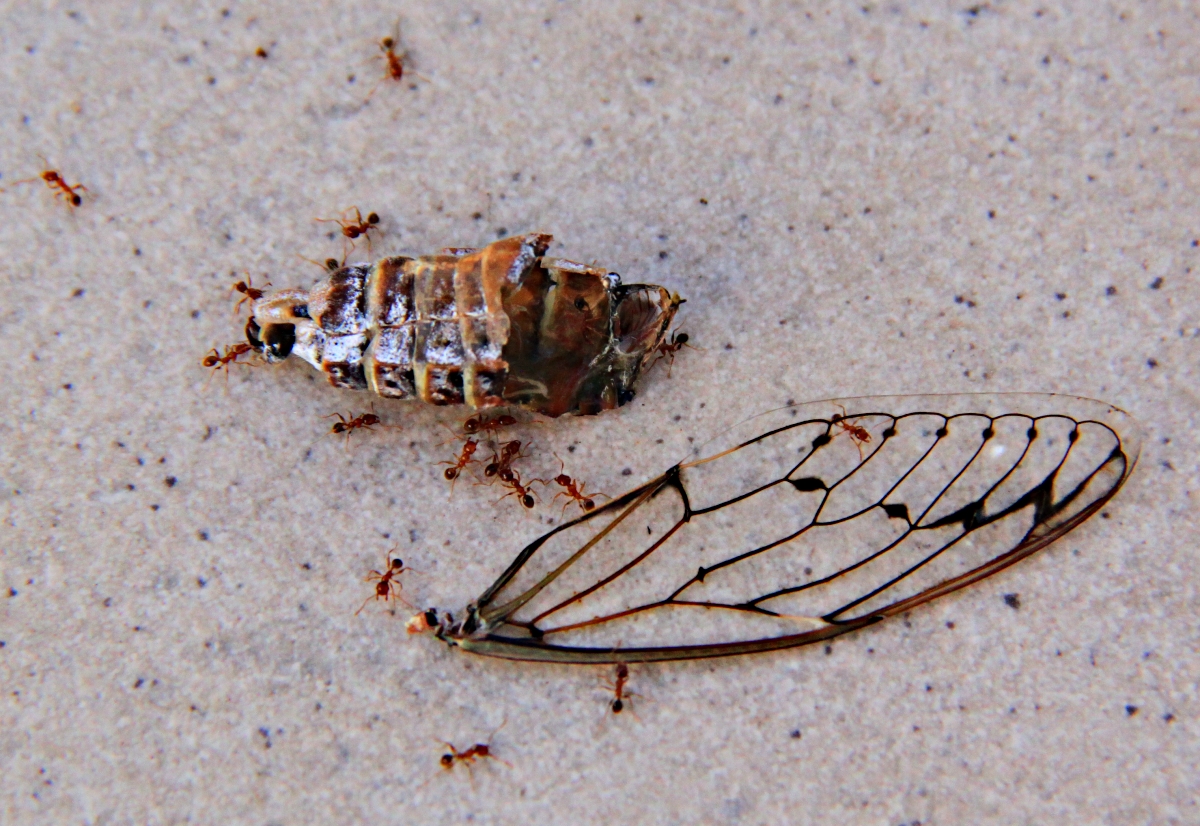
But even before I set foot on a path, ‘nature’ came to my doorstep.  Literally!  I was enjoying a coffee on the small lower terrace of my apartment (I don’t want to sound posh but I have a lower and an upper terrace, the former affording shade and the upper, on the roof of the apartment in front, enjoying unparalleled views of the bay …. I think that is the longest parenthesis I have ever written!) when a house sparrow flew onto the low wall at the edge, dived onto the terrace and started very skilfully and quickly dismembering a large winged beastie.  Wings stripped off in a nanosecond with a deft sideways swipe of the beak then meaty bit deftly picked out with a few quick pecks and the husk discarded.  Newly hatched (or whatever the correct term is) cicadas were being picked up as they dug themselves out of the ground and sparrows were having a feast,  flying in at frequent intervals.  I counted them out and I counted them back in (acknowledgement to Brian Hanrahan’s famous Falklands coverage).

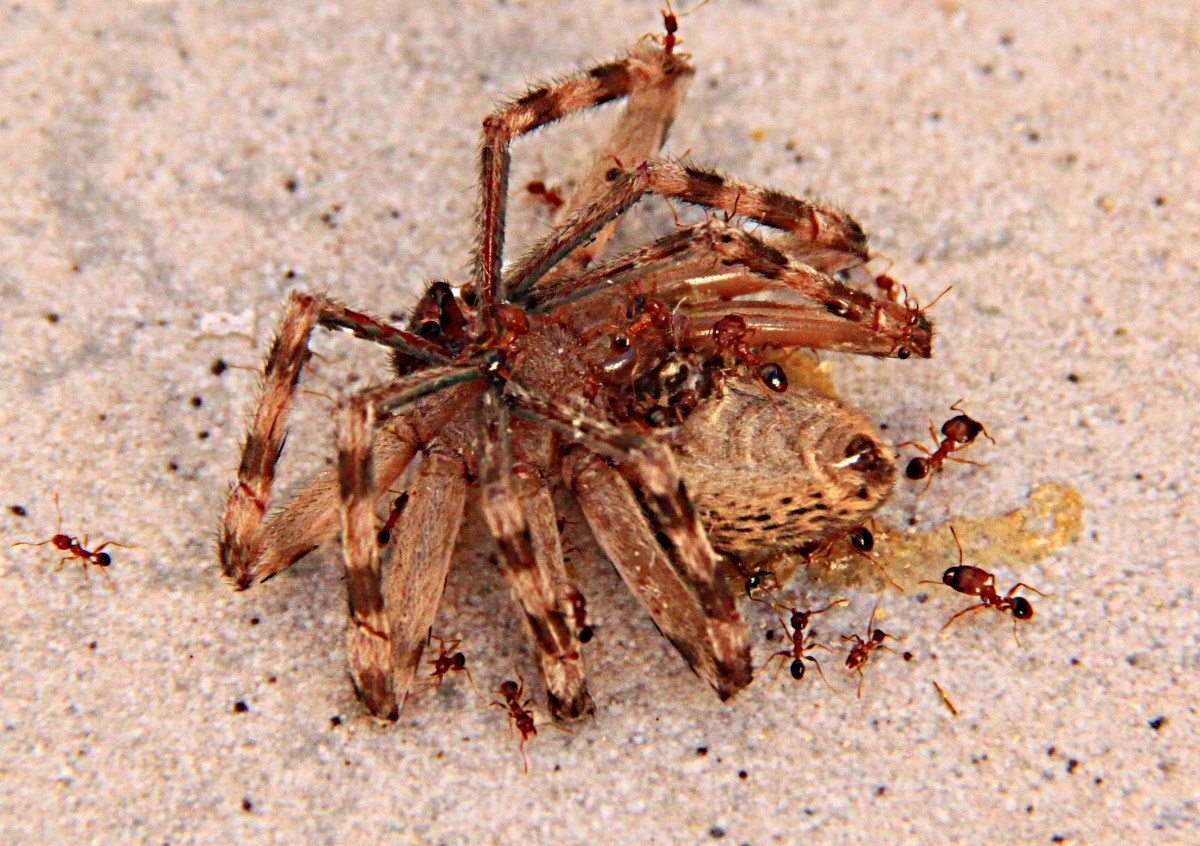
This happened every few minutes and the terrace was becoming littered with corpses … and with sparrow shit.  I thought my terrace may soon rival Chile for production of guano the way it was going.  Except that the corpses were moving.  The husks and the wings were being picked up and moved off by ants even before the sparrow had finished snacking.  The ants seemed to clear anything organic including spiders.

I hesitate to confide this but the ants were also observed clearing away toe nail clippings before they were properly off my toe!!!!!  Purely in the interests of scientific experiment you understand, I made a small collection of nail clippings in one corner of the terrace and by the time I returned from my evening meal they had all gone.  I’m now working on a scientific publication with the working title ‘Predeliction of Tylian ants for cicada hatchling husks and toenail clippings”.   The Royal Society has expressed no interest but I’m hopeful of a positive response from the Royal Slovenian Journal (the RSJ, a heavyweight publication on the fringes of scientific enquiry).  But as it’s work in progress, let’s not go there now.

Wings removed, body being reduced to a husk

Wings removed, body being reduced to a husk

Ants come and carry off the leftovers

Ants come and carry off the leftovers

This spider not to the bird's taste so ants get the lot

This spider not to the bird’s taste so ants get the lot

Instead let’s get down to the real wild life.

Goats have already been covered.  Just to confirm that they are beyond agricultural control on Tilos and therefore truly ‘wild’.  A conservative estimate seems to put numbers at a minimum of 7,000 and possibly as many as 10,000 …….. all on about 61 hectares of island with a resident human population of 200.  As a ratio that handsomely beats new Zealand’s 60 million sheep to 3 million people.

The island has taken a very strong nature conservation position and is a designated Nature Park. Shooting birds, specifically a type of  small rock partridge known as a ‘chukka’, is prohibited, unlike some islands where in September blood-lust and gun culture is very evident.  It is therefore surprising that the numbers of chukkas on Tilos is this year significantly reduced.

They are pretty stupid birds which, if truth be told, deserve to be shot.  They are amazingly well camouflaged in the low growing thorn scrub, totally invisible, yet choose to fly off en flock in a panic if you approach within about 20 feet.  This panic flight is all too obvious simply because they are lumbering birds with a rapid, heavy wing beat but that is compounded by a panicky shriek as they fly …. and they fly straight in front of you going downwards.  Because they always fly off at least 10 or more at a time even the most incompetent or inebriated hunter is guaranteed to hit something.

The chicken and egg thing gets complicated here.  For many years there has been a pair of Bonelli’s Eagles nesting/roosting in one of the crags overlooking Livadia Bay (photos on previous years’ blog) but this year they have gone.  One of their food sources has been chukkas.  Have they eaten the chukkas to the point where there is nolonger a sufficient supply of food?  Or has the reduction in chukka numbers, perhaps from virus infection, forced them to seek happier hunting grounds?

I propound here another theory for the apparent reduction of chukkas, with no scientific support whatever, that it’s all down to natural selection.  Think hedgehogs.  Time was that British roads were littered with squashed hedgehogs which saw approaching cars, froze with fear and got run over. At one time the number of dead hedgehogs seemed to outnumber cats’ eyes and there were even Dead Hedgehog Crisps, (apparently no hedgehogs were harmed in their production, nor indeed were any cats). The ones which survived were the ones which instinctively ran and escaped the two tonnes of rapidly approaching metal mayhem and now this genetically advantaged group make up most of the hedgehog population.  Maybe there are unseen flocks of chukkas which cleverly don’t panic at the sight of predators but stay hidden, camouflaged by inactivity.  I like to think that there are large colonies of them scurrying unseen around the mountains.

Now a few photos. I’m a walker who photographs what I see, not  a photographer who walks to get ‘The Shot’.  So, to get back to sandals, I try to tread lightly and what I photograph is usually at my feet or in close proximity.  The photos below are  just a few of the beasties seen in the last two weeks.  I’m not  a zoologist either so most of what I see is only identified generically, not specifically.

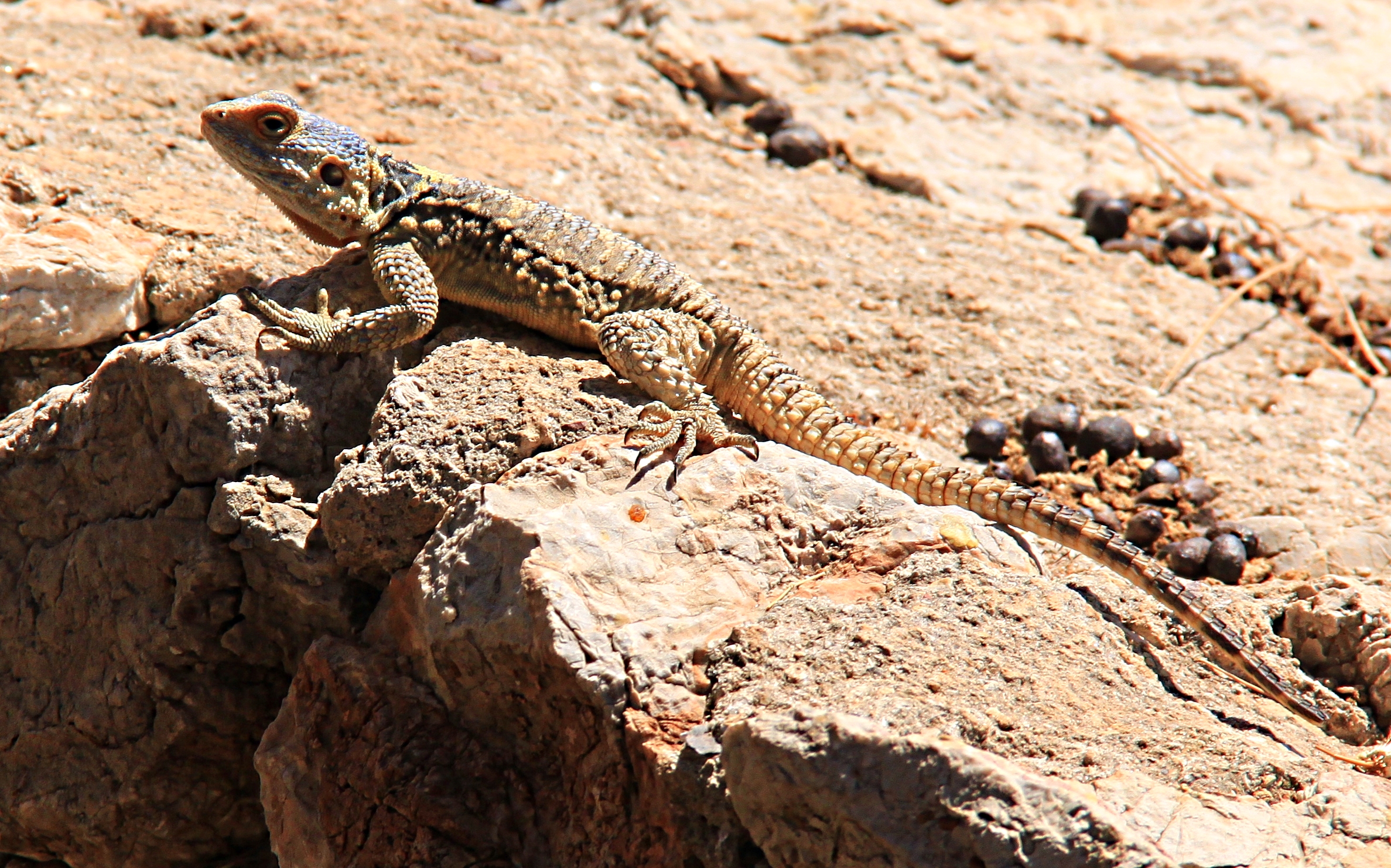
Lizards are a fairly common sight though difficult to photograph because they generally sense the vibration of your approach and dart off into some dark hole.  Occasionally they aren’t quick enough and freeze when they spot that they have been spotted.  Occasionally if you sit still in the shade for long enough they will come out to play.

Canon S100 in hand meant I could photograph this chap before it darted off into thew wall

Canon S100 in hand meant I could photograph this chap before it darted off into thew wall

The resolution was good enough to crop and see more detail

The resolution was good enough to crop and see more detail

13Tilos022w1887jpg

One of the smaller lizards which seem to be in fewer numbers this year

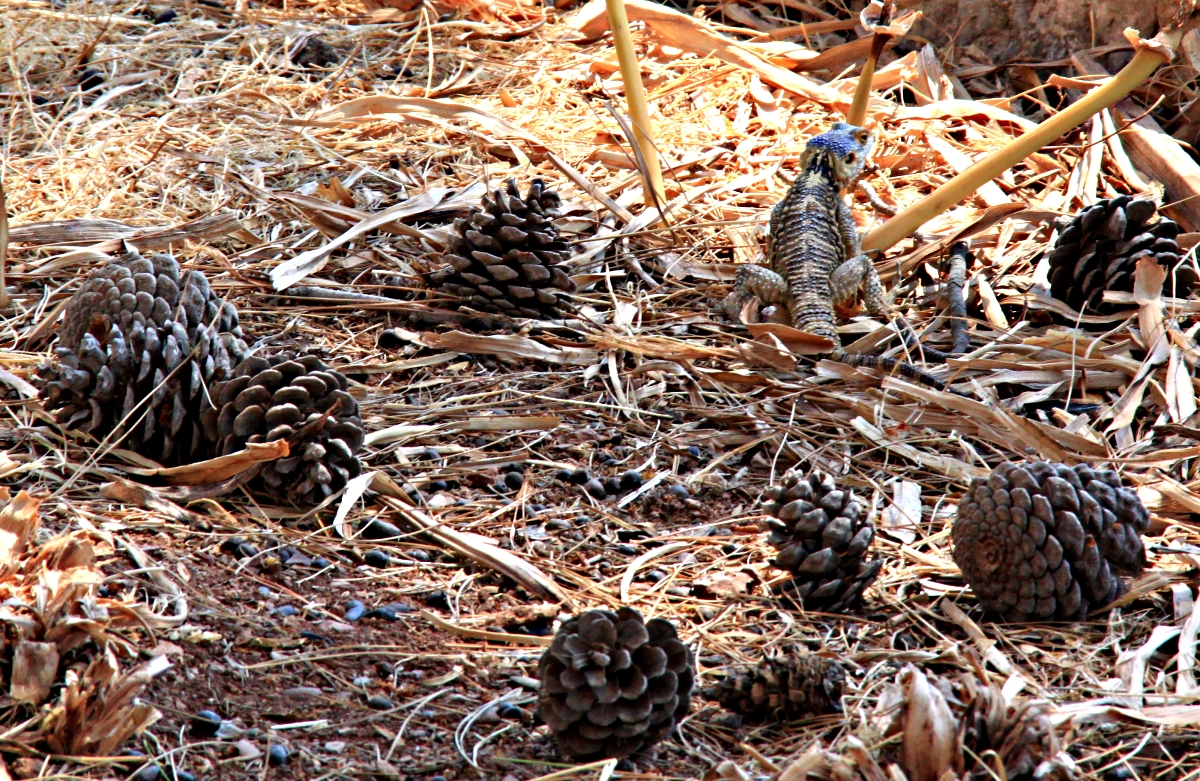
While I was sitting under a shade tree Liz came out among the pine cones

While I was sitting under a shade tree Liz came out among the pine cones

..... became suspicious as I crept closer

….. became suspicious as I crept closer

..... jumped up on top of a low wall

….. jumped up on top of a low wall

..... and crossed to the other side before darting down and out of sight

….. and crossed to the other side before darting down and out of sight

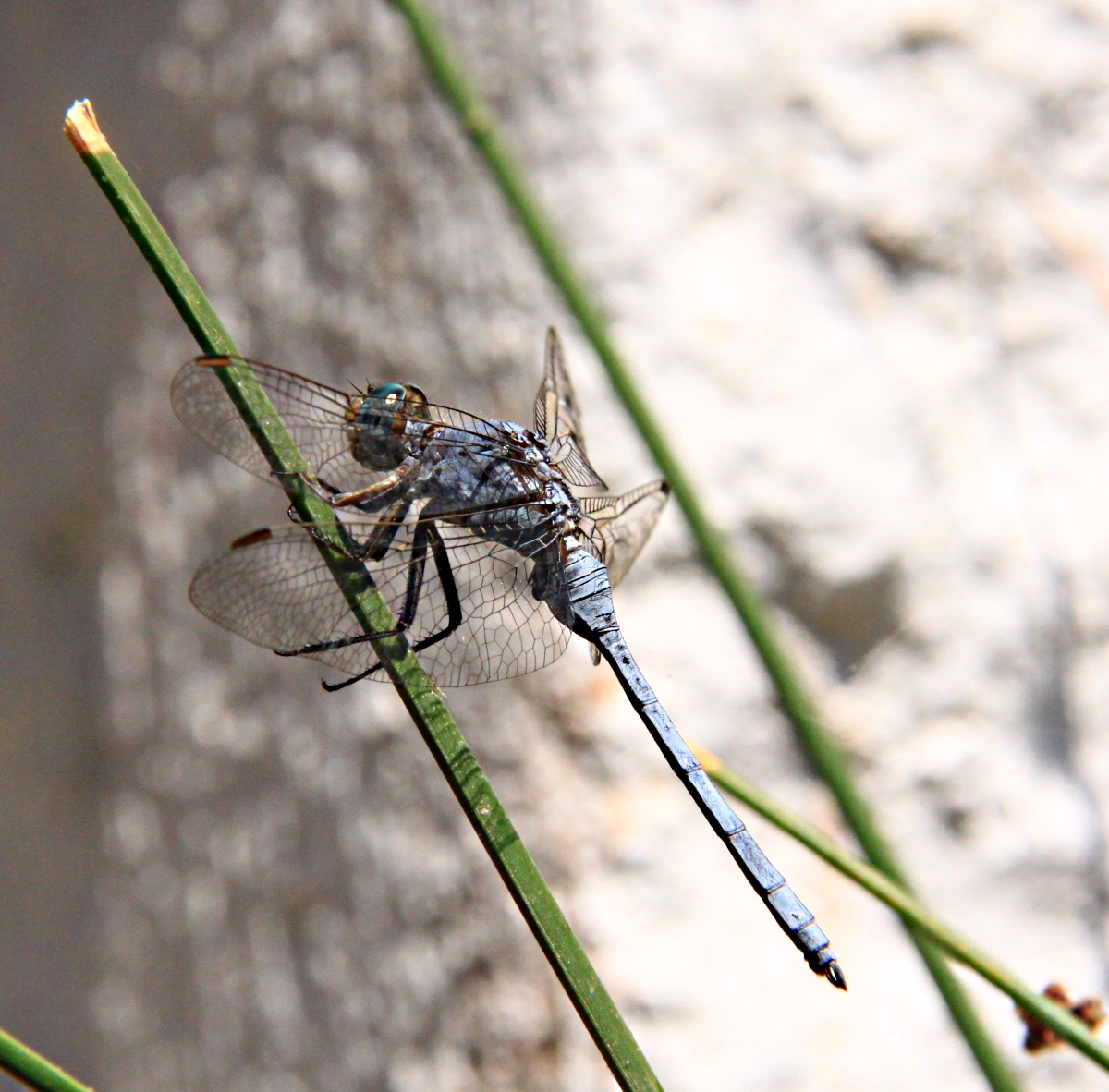
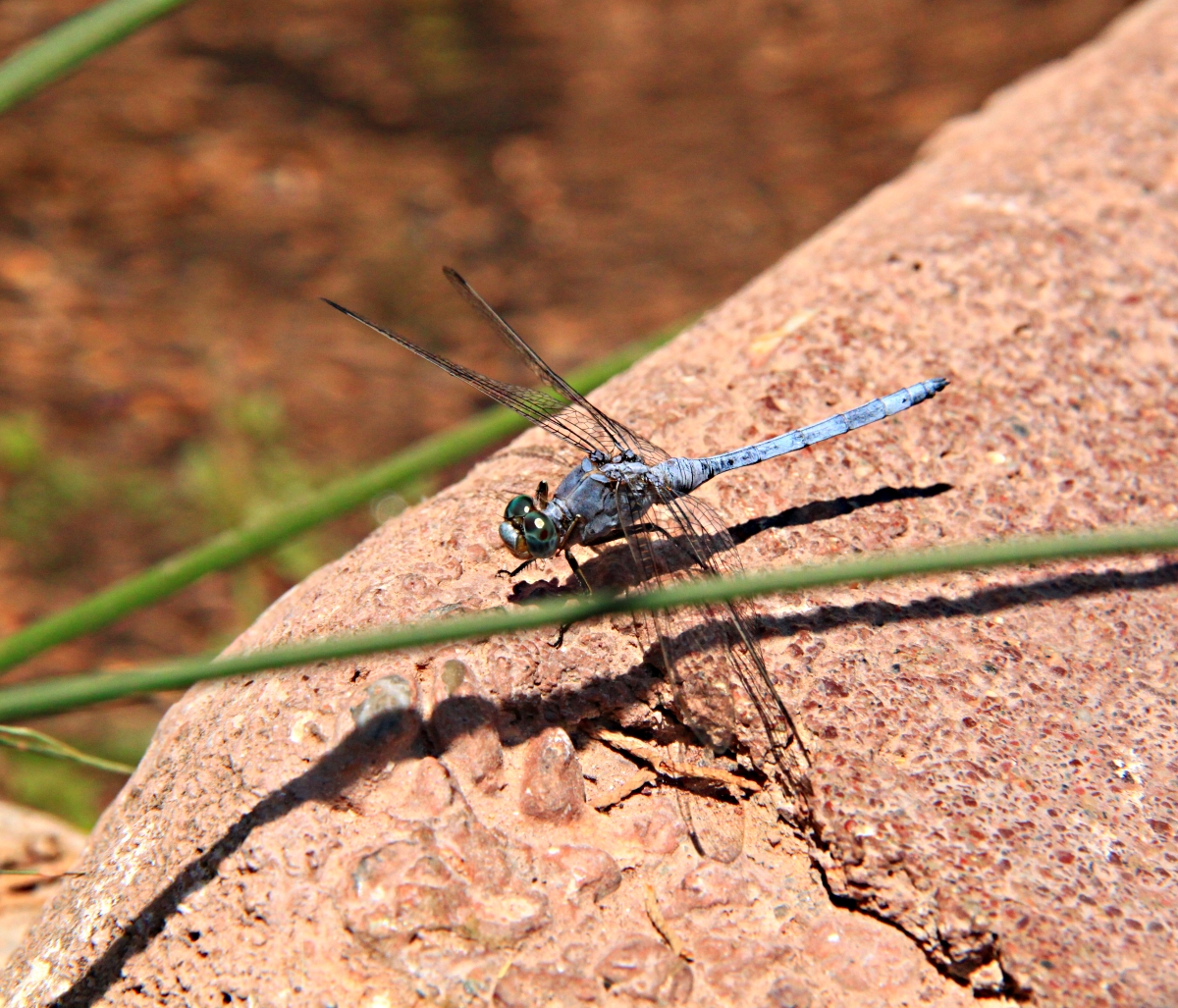
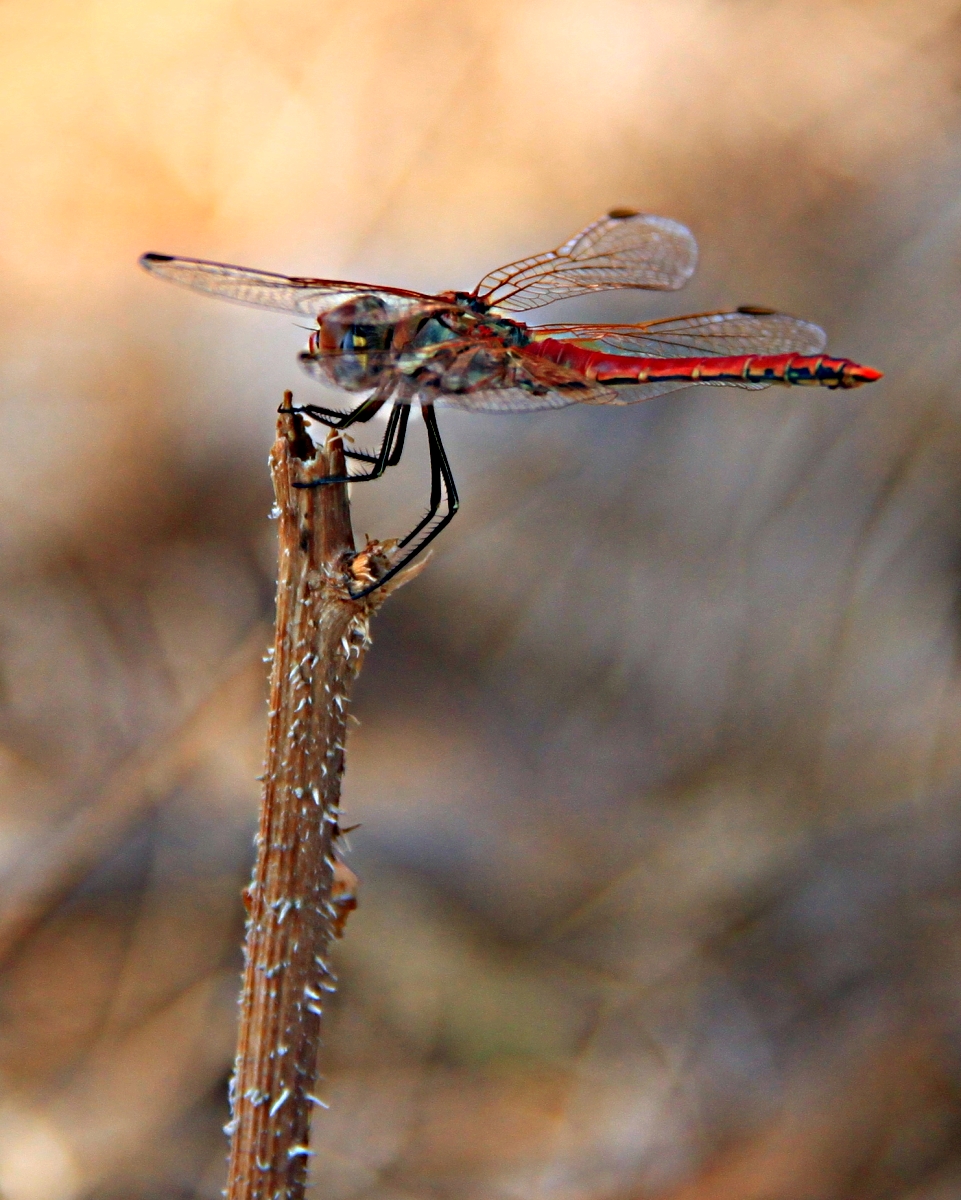
Dragonflies I have a always associated with ponds and wetland but I have seen them here on arid, rocky mountain tops.  For some reason they often seem to perch on the top of dry sticks as if they using them as drinking straws. I have no idea what this behaviour is.

Where I would expect to see it, on reeds by a spring

Where I would expect to see it, on reeds by a spring

.... and then down next to the water

…. and then down next to the water

At the highest point on an arid mountain

At the highest point on an arid mountain

13Tilos071w0130jpg

Nothing but blue sky beyond

What do they do with those sticks?

What do they do with those sticks?

Perched right on the top

Perched right on the top

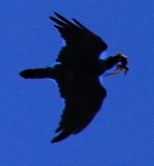
Ravens are easily distinguishable from the far more numerous hooded crows as soon as they open their beaks, the deep ‘croink’ being a dead giveaway even when flying high overhead and only visible in silhouette.  On the ground they are distinguished by being significantly larger and not having a grey back but uniformly rich black.

Maximum 200x zoom with my SLR and cropped around the ravens

Maximum 200x zoom with my SLR and cropped around the ravens

Just enough resolution to zoom in more and see that the lead bird is carrying a lizard

Just enough resolution to zoom in more and see that the lead bird is carrying a lizard

Butterflies flit around and make difficult targets for the camera unless you take time.

Flitting around on top of the mountain

Flitting around on top of the mountain

x

Posted in Greece, Mountains, Nature, Wildlife | Tagged , , , , , , , , , , , | 2 Comments