November Daily Blog 15: grey in the brain, lost in the mists

Wednesday night I fell asleep in front of the TV until 02.30 so on Thursday morning I groped and blinked my way downstairs even more befuddled and foggy-brained than usual.

When we moved to this house from Cardiff we decided that the three things on which we would not compromise were the size of the garden (we wanted a large one), the aspect (we wanted it to face roughly south), and the view (we wanted one).  The house met all three criteria, the ¼ acre garden sloping southeast down to the Monmoushire and Brecon Canal, a 30 mile-long moat between the first ridge of the Welsh mountains and the rolling hills of the Vale of Usk.

Open the curtains first thing in the morning and the view is across to the green 150 metre-high ridge on the other side of the valley, at this time of the year with the sun just appearing over the crest.  But not today. The mist which filled the valley was even thicker than that in my head.  The trees, leafless now except for the Douglas Fir which I planted 30 years ago and which now tops the native ash, alder and sycamore, were just  visible at the end of the garden but the world beyond had disappeared.

It was eerie but more than that it was mildly disturbing.  I don’t suffer from claustrophobia at all, the tighter the cave passage the more I enjoy it, but the mist gave a sense of being hemmed in.  Isolated.  Marooned.

Some time ago I read that to be truly happy one must be content with simply ‘being’.  I’m not.  I have a permanently ‘questing’ mentality, always wanting to explore further, find new things and places.  I suppose it comes from having a basically dissatisfied mind. I remember Captain James T Kirk explaining to the leader of a group of aliens on a Planet of Perfection where every wish could be met, that the mission of the Starship Enterprise was to ‘boldly go’ and that those who manned it were hard-wired to keep exploring. Sitting having breakfast looking across the valley each morning gives a sense of there being something beyond, somewhere else to go, something else to do.  I hadn’t realised that until this morning when suddenly it was gone, the world ended at the trees along the canal bank.  It was unnerving.

I caught a bus to Cwmbran to buy a new pair of walking shoes.  And to escape.

Looking east: the highest point of the ridge opposite is usually visible above the alder

Looking south-east: the sun comes up from behind the ridge above the ash tree in Novemeber
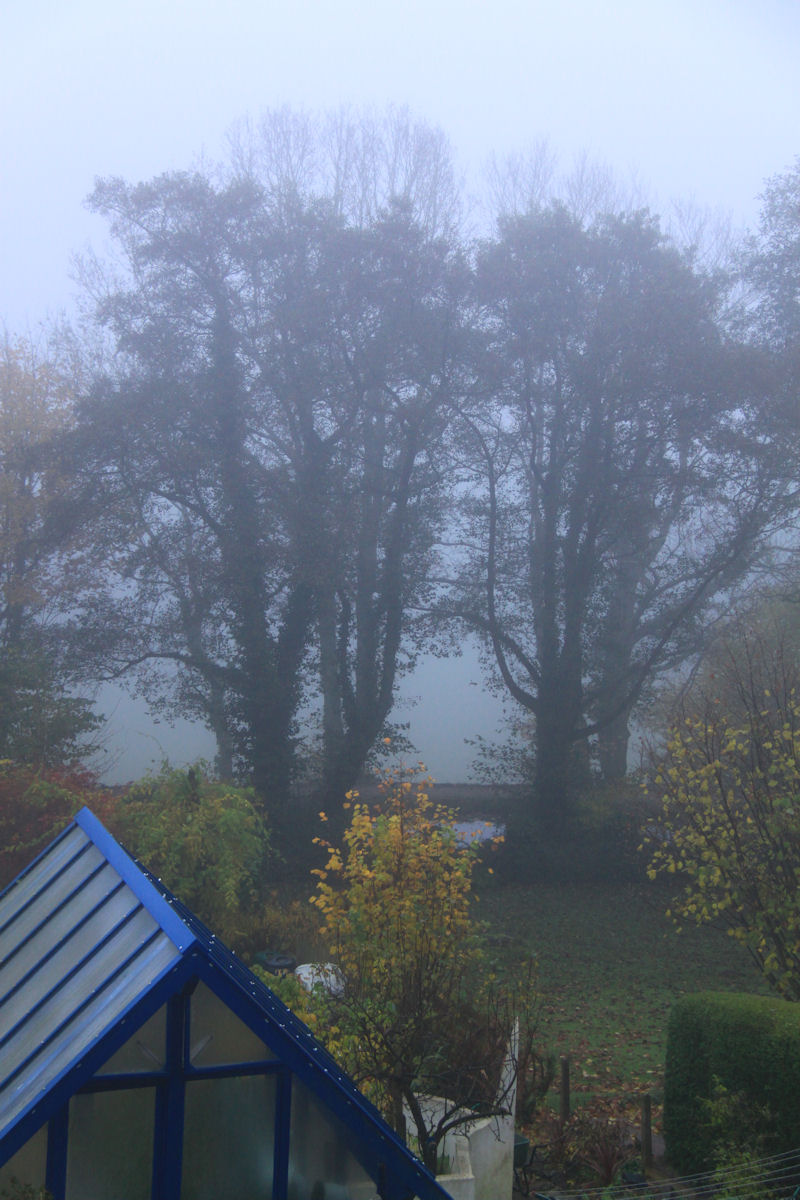
Looking south across the Blue House: nowhere exists beyond the confines of the garden,

Posted in Grey Britain, Pontypool, Reflections, Wales, Winter | Tagged , , | Leave a comment
November Daily Blog 14: What divides the nation

There are many divisions in a nation as cosmopolitan as Britain.  These differences are the consequence of many factors: long-ago invasions (Celts, Anglo-Saxons, Norse, Roman, Norman …); internal conflicts between those wanting to be top-dog; royal dynasties being imported from continental Europe; the immigration legacy of a world-wide Empire; freedom of movement under the banner of the EU.  Some of these divisions run deep and sadly there are those who would exploit these divisions, emphasising the differences between people not the things we have in common.  They create a ghetto mentality with areas of big cities becoming monocultural enclaves based on religion.  They want independence for Scotland and Wales.

Such divisions are complex and multi-faceted. But there is one division which is polar.  People fall into either one group or the other with few areas of grey in between.  It’s what we call our meals.  Basically there is a division between those who have ‘breakfast-dinner-tea’ and those who have ‘breakfast-lunch-dinner’.

As I said in the blog yesterday I am firmly in the ‘breakfast-dinner-tea’ camp and have been known to be outspoken on the subject, though I do translate for others in the interests of effective communication, particularly if I invite someone for a meal.  I make it clear that when I ask them for dinner it will be at about 13.00.

However, it’s not that simple.  When I put my mind to it I was also surprised at the inconsistency of terminology.

Children have school dinners served by a dinner lady at dinner-time but others bring a packed lunch in a lunch box, though probably nolonger including luncheon meat sandwiches.  On 25 December each year we have Christmas dinner. Indeed in the run-up to Christmas we may go out in the middle of the day with colleagues/workmates to a pub or restaurant advertising ‘Traditional Christmas Dinner’ yet at other times of the year we would go for a pub lunch at the same time.  The inconsistencies go on.

Out of curiosity I researched the nomenclature on the internet and was surprised at the amount which has been written on the subject and the depth of feeling.  I was also surprised at the amount of pretentious nonsense which has been written.  There are those who proudly nail their working class colours to the mast with ‘breakfast-dinner-tea’ on various on-line fora, a kind of inverted snobbery.  But more distasteful are articles purporting to be objective analyses and claiming that those who have ‘breakfast-dinner-tea’ are working class and Northerners while those who have ‘breakfast-lunch-dinner’ are middle class and Southerners.  Quite apart from the logical inconsistency in that there are clearly many middle-class people in the North and many working class people in the South the insinuation is that term ‘Northerner’ should be preceded by ‘uncouth’.

There are also those who claim to have found that the terms ‘dinner’ and ‘lunch’ relate to the size of the meal.  A ‘lunch’ is a light snack whereas a ‘dinner’ is more substantial and the main meal of the day.   This is offered as a kind of compromise but fails to recognise that to many the terminology relates to the time of day not the size of the meal.  In common with many others I have a light meal for dinner at about 13.00 and a two course cooked meal for tea sometime between 18.00 and 20.00.

Historically the term ‘dinner’ was applied universally to the meal in the middle of the day but that changed gradually as the theatre-and-opera-going classes started to push the meal towards the evening partly response to late-rising and partly to fit in with the times of performances.  Understandably they kept the same term for the meal at the incrementally changing time and needed a new term to apply to the smaller meal in the middle of the day to see them through to their performance-determined evening meal.   So in that sense ‘lunch-dinner’ appellation has a class origin as the theatre-going classes were, and still are, predominantly middle and upper class and located more in London and the South East than in other parts of Britain.

One on-line survey showed that 38.96% of respondents have lunch and dinner while 37.23% have dinner and tea.  As the sample size is small (circa 250 respondents) the difference between the figures is unlikely to be statistically significant.  So as a nation we are equally divided.

There is no right or wrong appellation for the meals we eat.  Those who eat ‘lunch’ in the middle of day will continue to think disparagingly of working class northerners who eat ‘dinner’ while they in turn will think of those who lunch as snobs.

It gets far more complicated when horizons are broadened and we stop being insular.  Apparently in Argentina and Brazil the main meal is eaten in the middle of the day and is called ‘lunch’.

That’s enough for now.  I’m just going to have my supper.

Posted in Reflections | Tagged , , , , , | Leave a comment

November Daily Blog 13: a day in the City

Though I was born and grew up in a city I’m not and never was a City Person.  But sometimes it’s got to be done.  Occasionally I have to go back for practical reasons and, though I dislike admitting it, to scratch some deeply buried itch.   Tuesday was such a day.  I was taking my damaged knee to a sports physio in Cardiff and in order to make the most of the visit I had arranged to meet up with various friends for lunch, coffee and evening meal.

It began fine.  I left home at 08.00, the dentist having rearranged my appointment time for 08.30 so that I could fit in a check up and hygienist clean-up in time to catch the bus at 10.00 for to make my 11.15 appointment with the physio.  Despite traffic congestion filling the radio waves the bus made good time and I arrived at the physio smack on 11.15 only to find that he had been taken ill and had left before I arrived.

With more time than expected time to kill before meeting up with friends for lunch (you have no idea how difficult it is to type that.  Us working class lads have us dinner in the middle of the day, not middle class ‘lunch’.  But most of the world doesn’t understand so I dumb-down in the interests of international communication) …. I did the bits of shopping I needed, paramount among which was buying an impact-resistant case for my Canon S100 after my unfortunate camera-damaging slip in Greece just before I came home.

Cities are not my choice but I must admit that Cardiff is about as good as they get in the UK. Edinburgh is a close second.  And then York.  But I digress.  After a very long stay in a bar eking out a double caffeine fix I then escaped into Bute Park, a fabulous ‘green lung’ in the centre of Cardiff, for an hour before its dusk closing time.

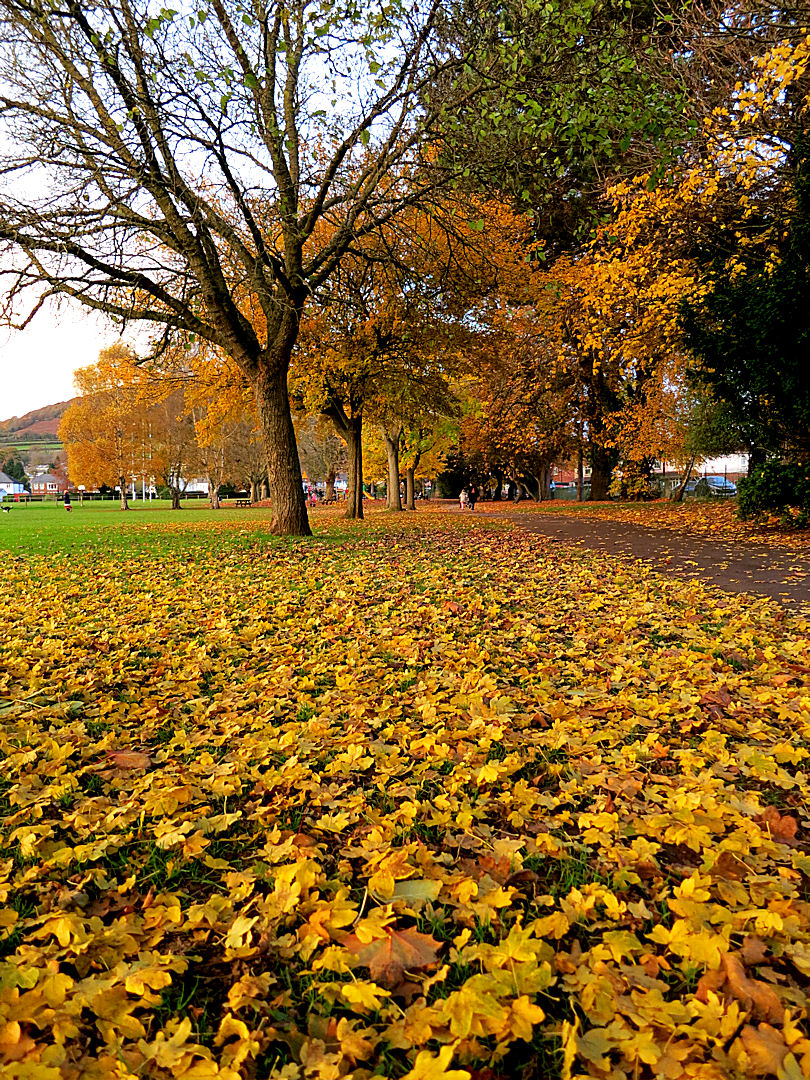
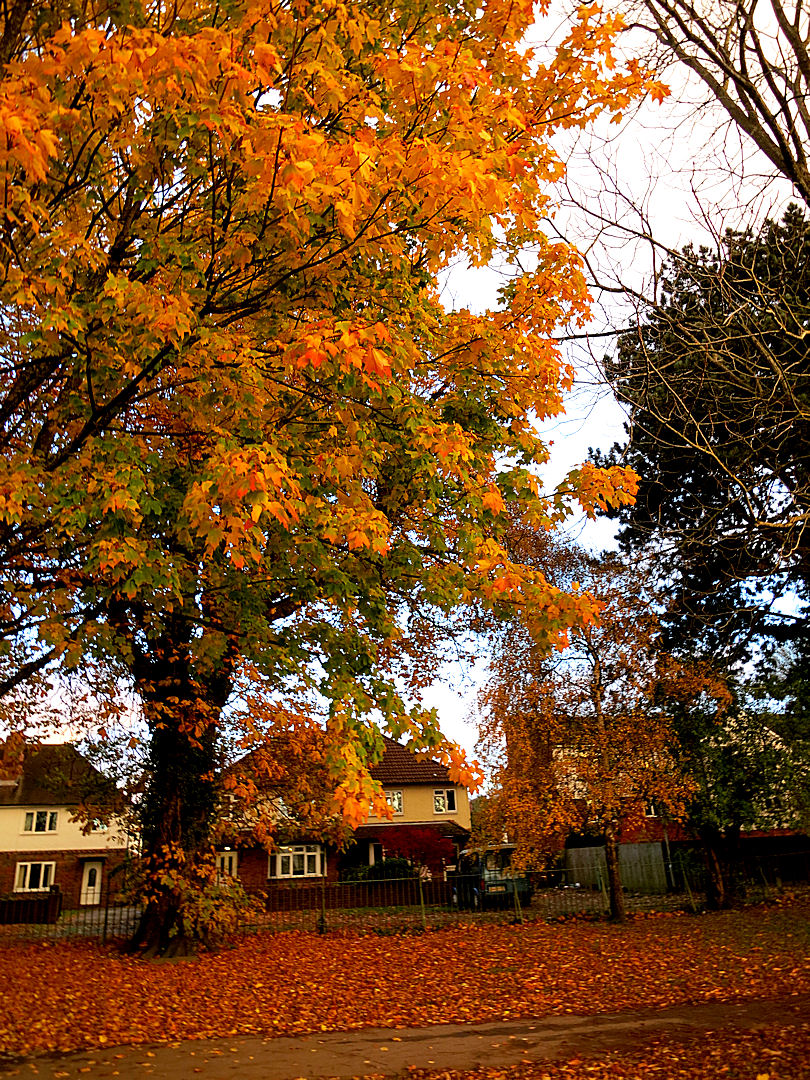
Even the grey sky couldn’t eclipse the splendour of the autumn trees.  Just imagine how they would have shone with a drop of sunshine.

City Hall

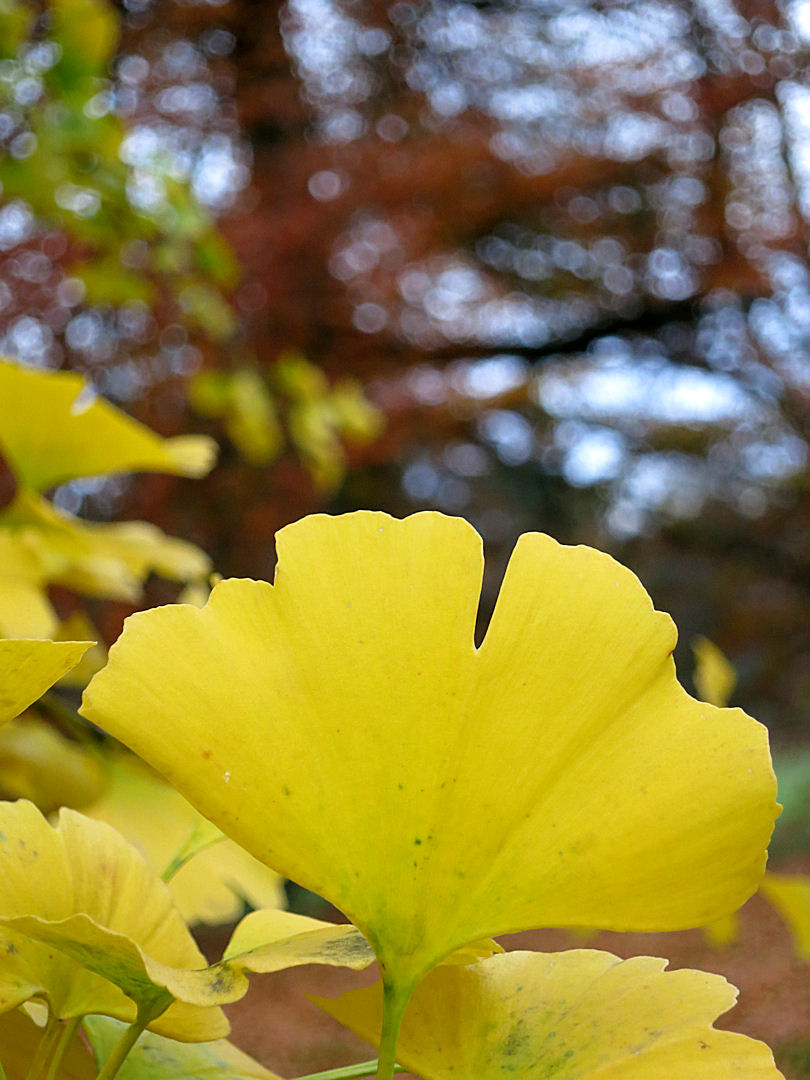
Avenue of Ginkgo Bilboa (Maidenhair) trees

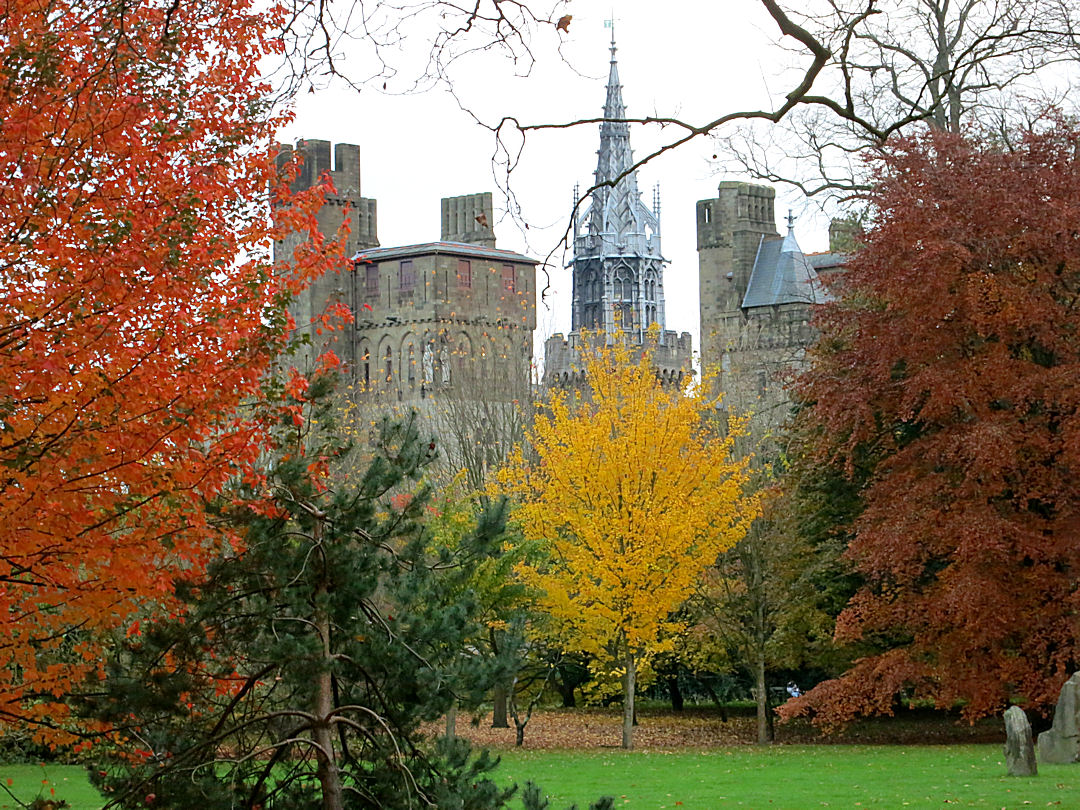
…. and in the other direction, Cardiff Castle

Characteristic leaf

Reflections

….. and more reflections

City Hall clock tower

Across the park

Some trees stand out

Cardiff Castle

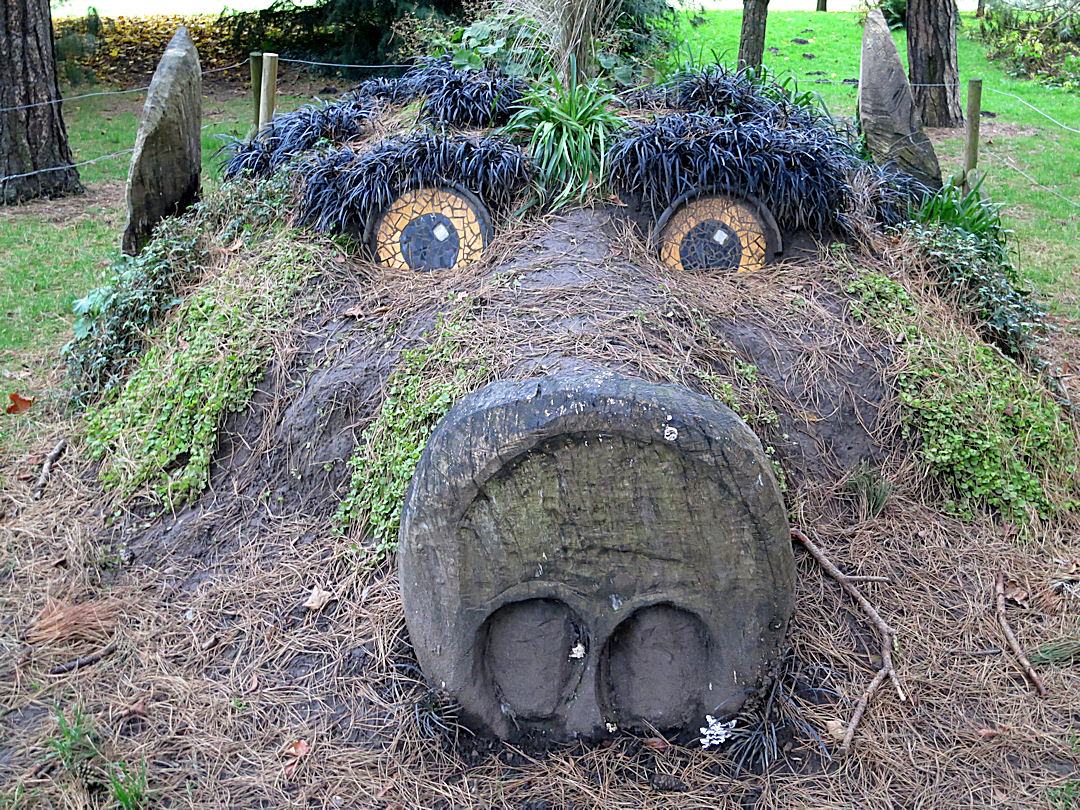
Lurking in the undergrowth


Posted in Autumn, Grey Britain, Reflections, Wales | Tagged , , | 1 Comment

November Daily Blog 12: climate change and Blue House thinking.

There is nolonger any doubt that world climates are changing.  What is disputed is the extent to which the change is simply part of a natural cycle and the extent to which it is man-made.  I have no doubt whatever that climate has changed dramatically over the centuries, changed even more over millennia, influenced by barely understood astronomical phenomena such as sun-spot activity and terrestrial phenomena such as volcanic eruptions and tectonic shifts.

I don’t know how man’s activities relate in scale to those influences but I’m persuaded by the argument that the emission of greenhouse gases can only accelerate not diminish the rate of change and the ‘precautionary principle’ should be applied.  In any case it is time that the profligate consumption of finite resources, particular carbon-based fuels, was brought under effective control.  The refusal for years of some governments to acknowledge that there is a problem which needs to be urgently addressed should be a cause of shame to some of the world’s most advanced economies, particularly the USA.  Thankfully, with more intelligent and courageous leadership, there are signs that they are now playing ‘catch-up’.

The long term effects of climate change are still the subject of much debate and research.  It seems certain that the expectation that the UK would start to experience Mediterranean sunshine and lower levels of rainfall was no more than wishful thinking.  More likely is the scenario that Northern Europe will gradually have higher rainfall, more cloud and stronger winds in addition to higher temperatures and humidity while Southern Europe will experience increased drought.  Another possibility is that the increased meltwater from the Arctic icecap will switch off the Gulf Stream causing cold ocean currents to flow southward down the west coasts of the UK and Europe while the warmer currents start to flow north along the eastern seaboard of North America.  Such a change could happen virtually overnight rather than gradually over years and would be catastrophic. Apart from anything else, industrialised agriculture is unlikely to adapt quickly enough.

Newly emerging scientific evidence points to the changes happening much more rapidly that had previously been accepted.  But therein lies the rub.  Some scientists have been arguing that even before the recent evidence emerged the predictions accepted by Kyoto and since have been systematically scaled down in order to achieve political agreement and have not reflected the evidence or its objective analysis.

Political unwillingness to take effective action stems from fear that the measures necessary will be unpalatable, hitting lifestyles and personal aspirations.  Until large numbers of people are impacted dramatically and directly, weak politicians will not make and implement unpalatable legislation.

It could be that we are moving towards that position now as more and more people are impacted by weather events which are increasingly violent and frequent. It is happening in the UK and Europe with more and worse floods but perhaps the greater will for change will come from the very sad effects of the storms which are battering the eastern seaboard of the USA.

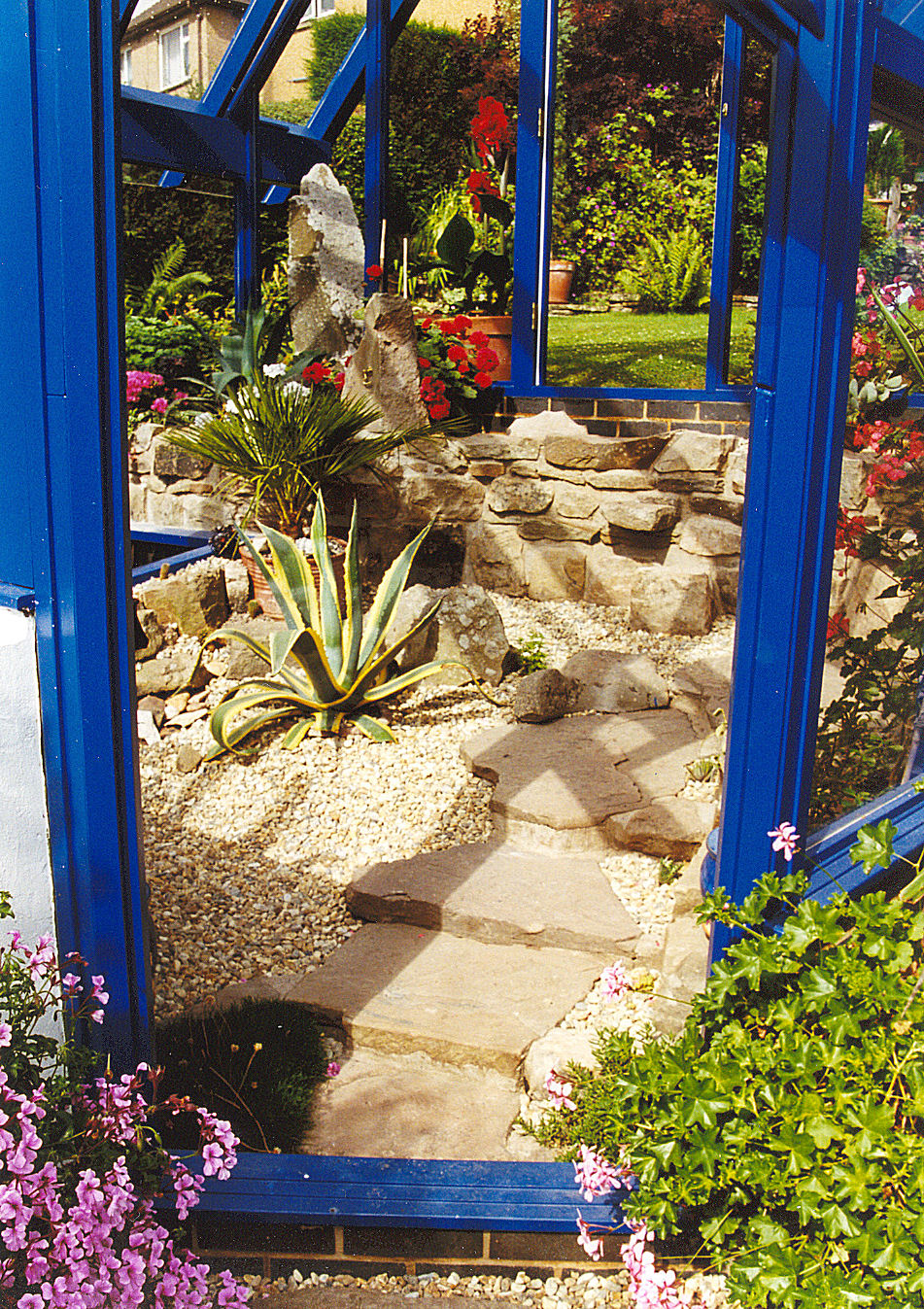
Lightening the tone, I have changed the climate in a small part of my garden.  It’s called the Blue House because, well, it’s blue.  The thinking behind it is to protect Mediterranean plants from weather conditions which would kill them.  Many can withstand freezing temperatures but not cold, wet soil. Initially it was heated in winter but it was decided that that was unsustainable both in terms of my bank balance and environmental impacts.  So now it keeps the rain off and ameliorates temperatures in all but the harshest of winters.

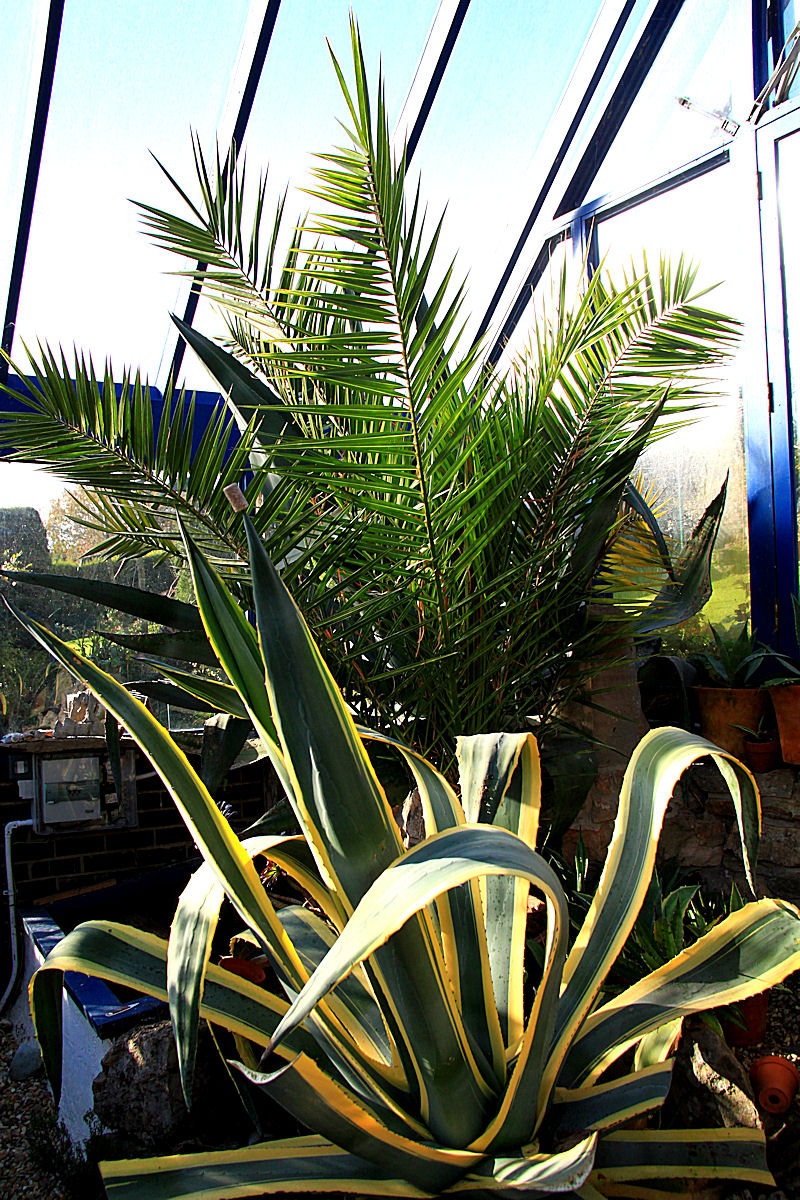
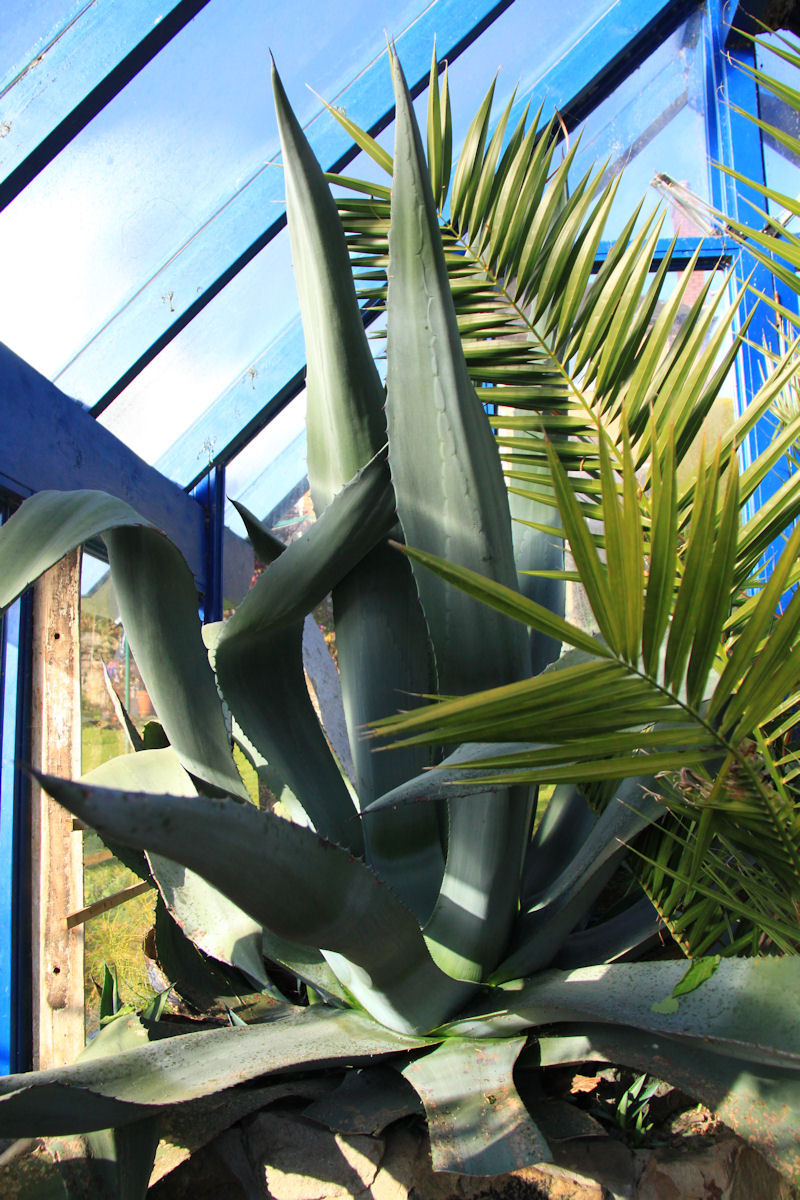
Completed in 2003 it’s coming up to its 10th birthday and in that time it has seen many changes.  The very cold winter of 2010-11 killed a number of the smaller cacti and succulents while I was in Canada.  But now the remaining plants are being denied moisture and nutrients by agaves and a palm tree which, for whatever reason thrived at that time and are having to be cut back just to let me get inside. When the agaves decide to flower that will a moment for action because the flower spikes can be 20 feet high and the Blue House is only 15 feet at its apex.

This climate change thing is very complicated.

The Blue house just after it opened in 2003

Looking across the lower level

A small agave among the pelargoniums

Looking diagonally across from the lower doorway

… and two years later in 2005

… and in 2007

November 2012, the agave has been cut back severely to let me in, the palm tree is nearing the roof and obscuring ….

… that now not-so-small agave which has starved out the pelargoniums

Posted in Autumn, extreme gardening | Tagged , , , , | Leave a comment

November Daily Blog 11: sky, clouds, mountains.

It was the end of the afternoon before I went out for a walk on Sunday.  I had waved the family off, leaving after a late lunch, been sidetracked by having a chat with neighbours taking advantage of sunshine to be out in their gardens, done the washing-up and tidying ….. and I needed to get up the mountain.

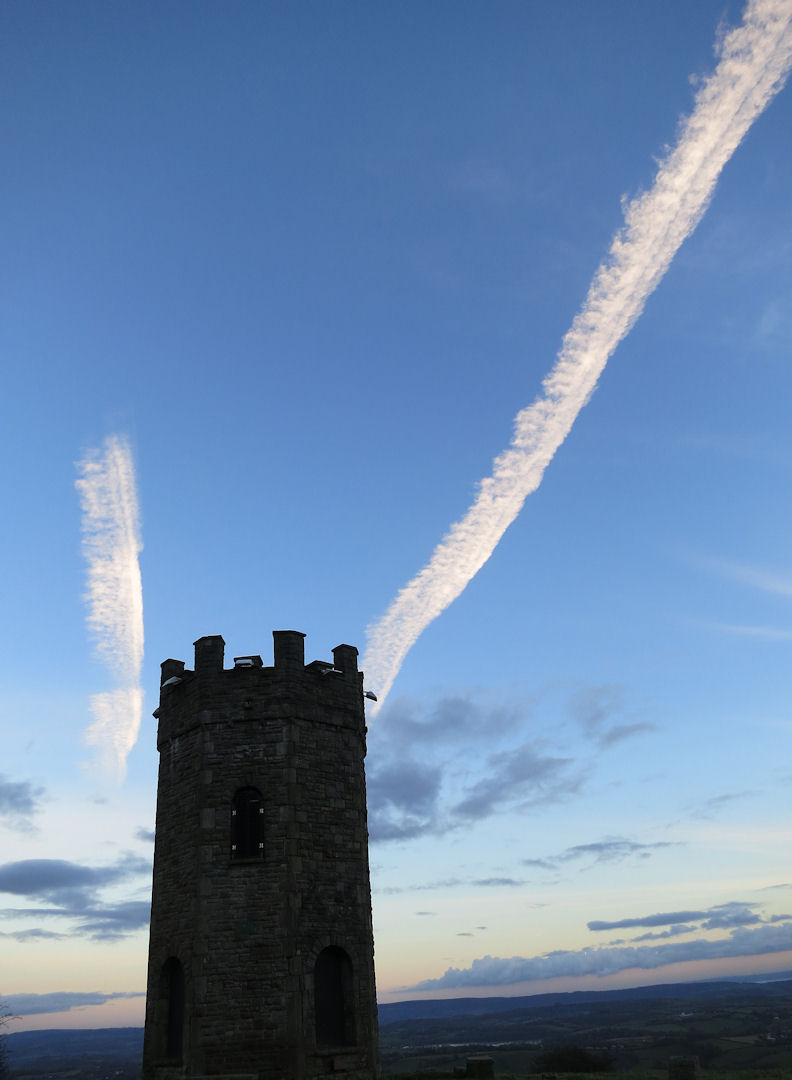
I set out about 15.30 as the sun was disappearing behind the ridge and climbed to the top as quickly as my wonky knee would allow.  I was heading for the Folly Tower, not the highest point on the ridge but at 425 metres, 1,400 feet in old money, easily qualifying for the title ‘mountain’.  That’s according to the 1995 film ‘The Englishman who went up a hill and came down a mountain’ which is based on the premise that a hill only becomes a mountain if it exceeds 1,000 feet.

The storyline starts from the unshakeable conviction that, in Wales at least, the distinction matters.  As the Welsh  Grandfather explains to the English cartographer who is denigrating the village’s local mountain: “Is it a hill, is it a mountain? Perhaps it wouldn’t matter anywhere else, but this is Wales. The Egyptians built pyramids, the Greeks built temples, but we did none of that, because we had mountains. Yes, the Welsh were created by mountains: where the mountain starts, there starts Wales”.

The Folly Tower sits on the eastern-most mountain ridge in Wales, the southernmost edge of the Brecon Beacons National Park, looking east and south towards England, north and west into Wales.  The views extend for miles in all directions.  And it’s only 30 minutes stiff walk from the house, worth racing up there to blow away the cobwebs even at the end of a late autumn afternoon.

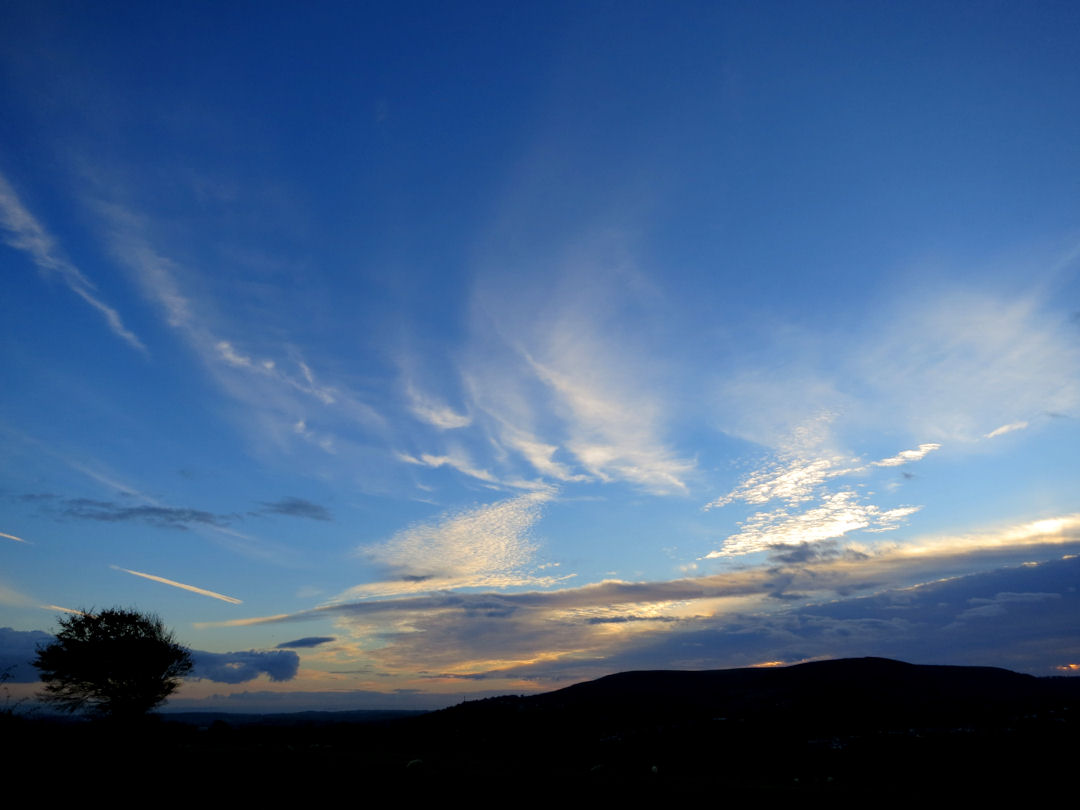
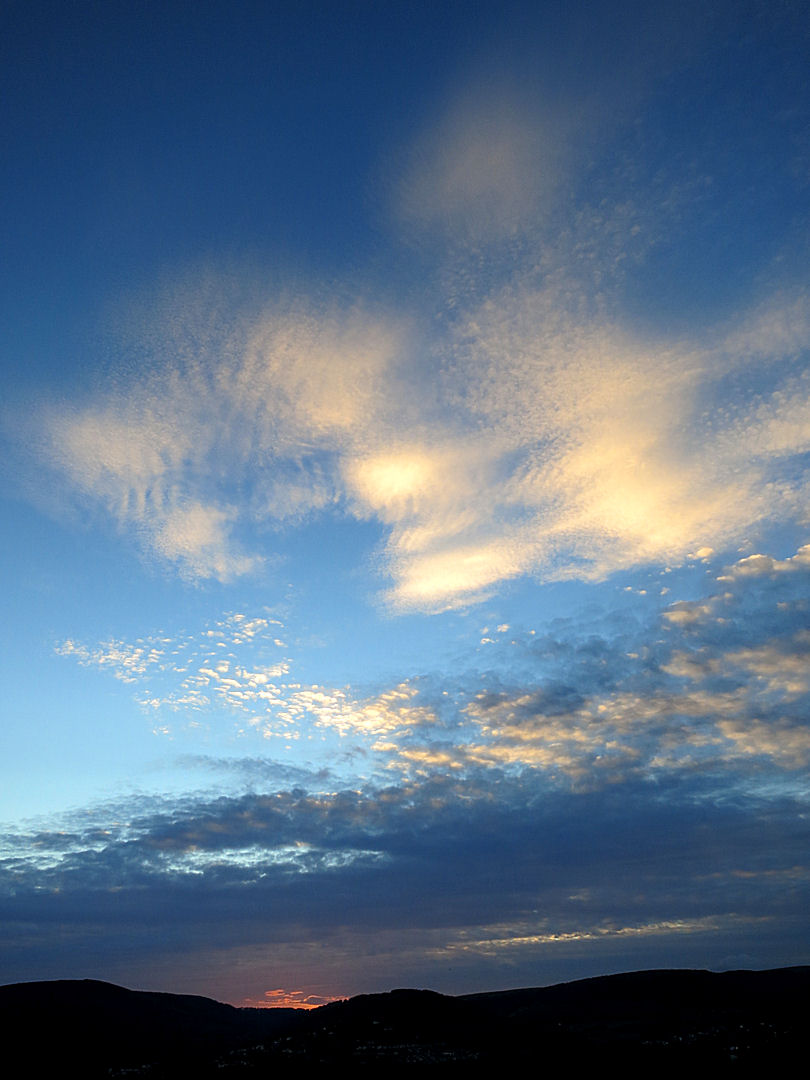
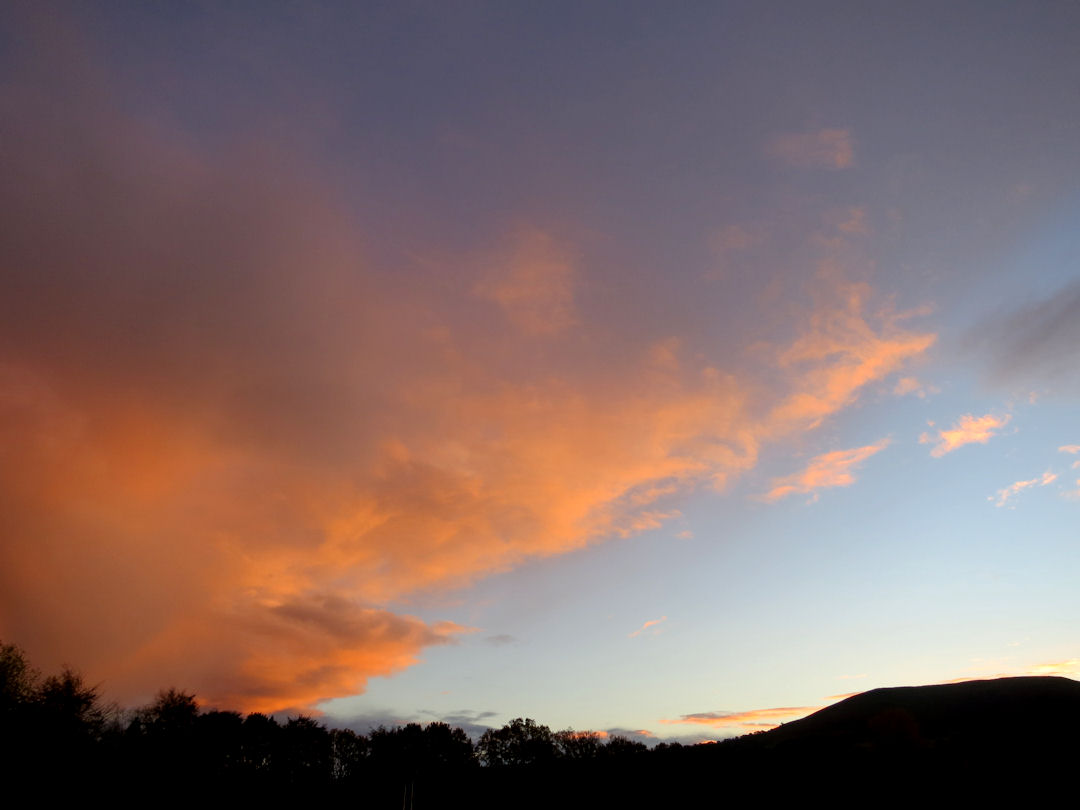
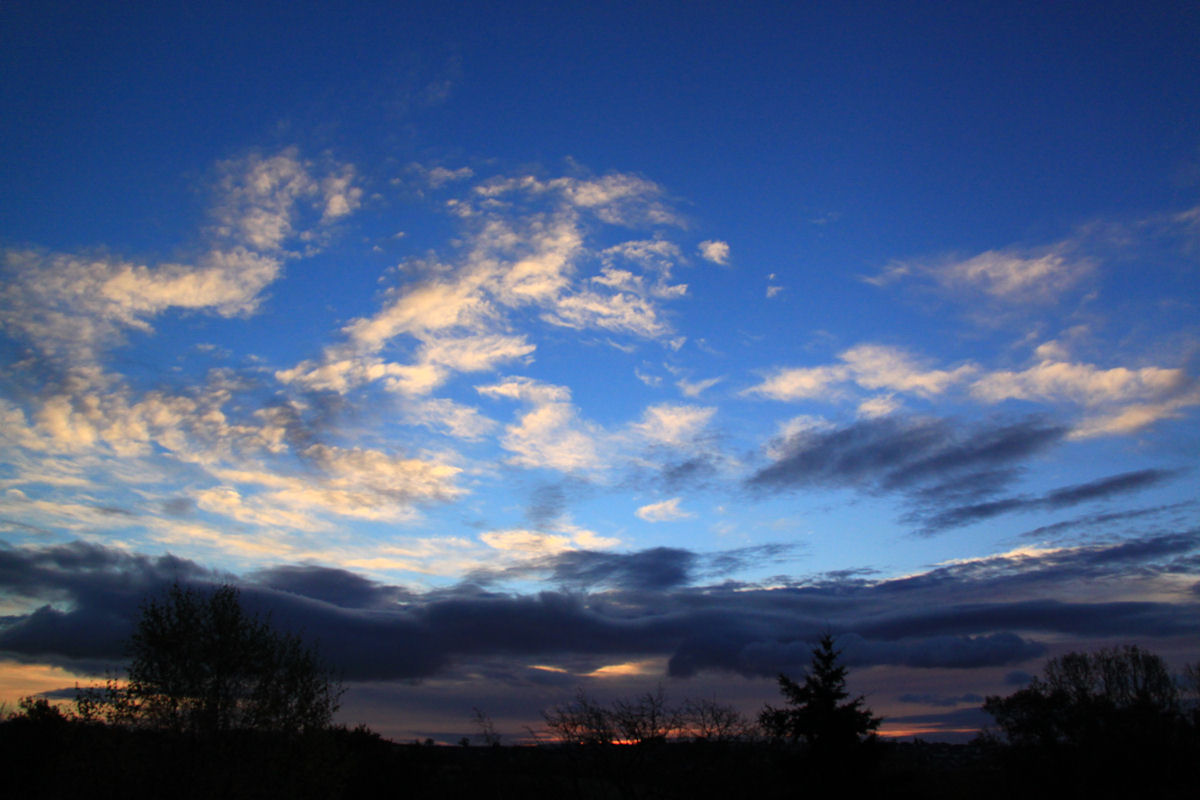
By the time I reached the top the sun had settled behind the bank of cloud approaching from the southwest, as it so often does.  The mountains were now in the shade but the sky was dramatic. I had only taken my small Canon S100 rather than the SLR but I just kept clicking away as the sky changed by the second, clouds moving, sun sinking, colours mixing from pastel to vivid back to pastel.

As so many times before, I had to force myself to leave and by the time I got back to earth the lights were on and it was dark.

What a great place, a great way, to finish a weekend.  I’m glad I don’t live in a city anymore.

The sun gone behind the bank of cloud

Jets stream over the Folly Tower

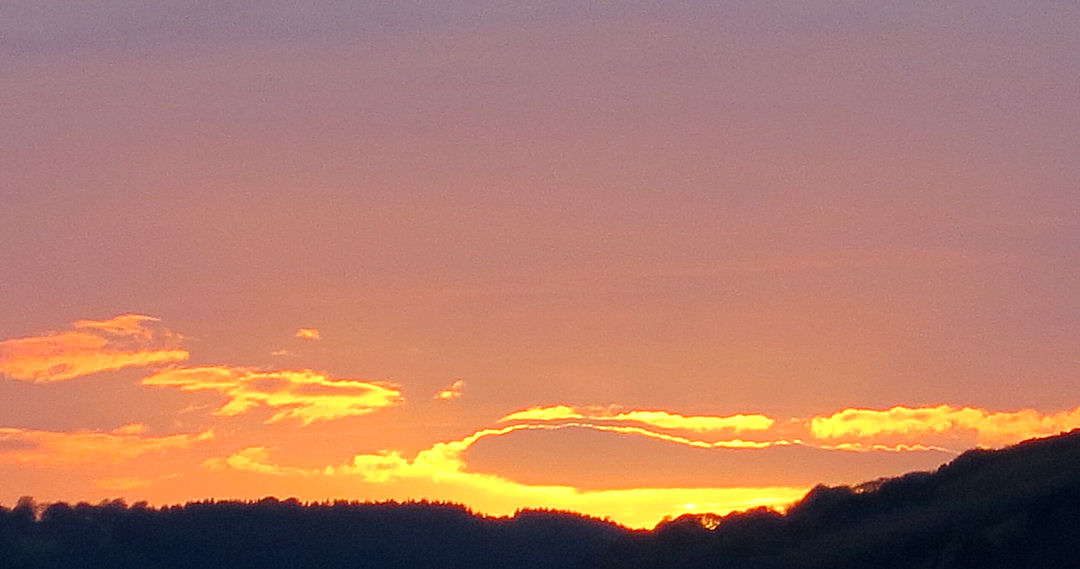
A sliver of red as the sun sets behind the ridge to the west

Zooming on the fiery sliver

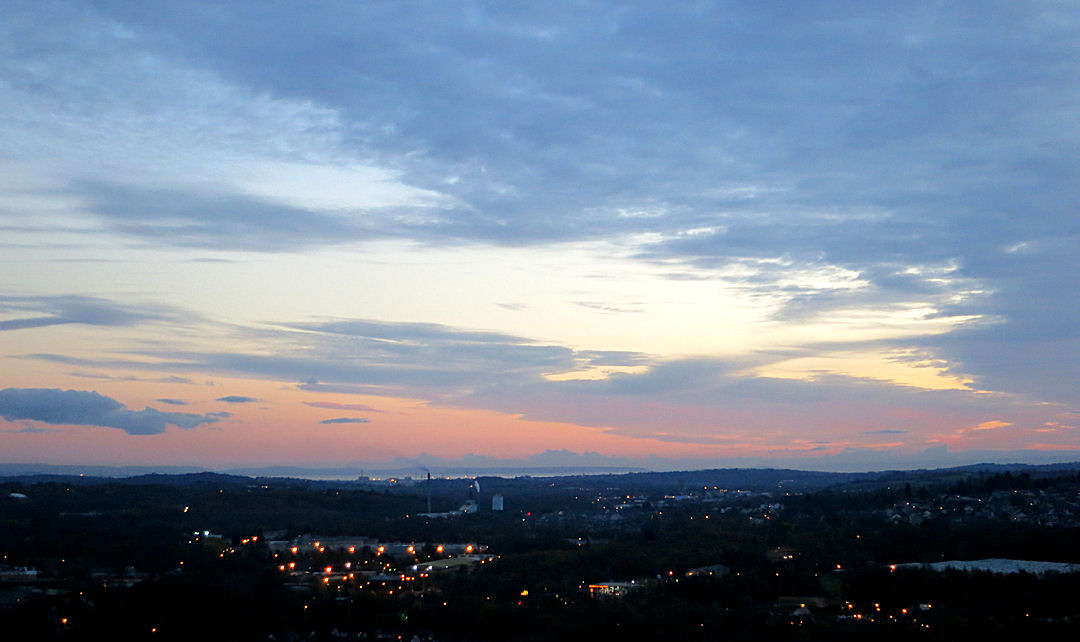
Lights coming on and the sky fading to pastel shades as I finally prepare to leave the mountain

x

Posted in Autumn, Mountains, Pontypool, Wales | Tagged , , , , , , | Leave a comment

November Daily Blog 10: trees, storm clouds, autumn colours.

Saturday was a day with the family.  After grey skies and morning rain the sun came out and so did we, taking the grandchildren to Bailey Park in Abergavenny.  The older two, aged 6 and 4, each had cameras and had great fun recording the day.  They focused on people whereas my inclination is to photograph places.

The late afternoon sun intensified the bright autumn colours of the trees around the edge of the park while the sun, having dipping below the level of the surrounding mountains, set the briefly troublesome rain cloud on fire.

Leaves, on the trees and on the ground, provide a tapestry of autumn colours.  Brown …..

…. yellow….

…. and gold …..

… while passing rain clouds are set on fire ….

…… and the last remnants play between the posts


Posted in Autumn, Monmouthshire, Wales | Tagged , , , , | Leave a comment

November Daily Blog 9: reminiscences of gorges, waterfalls and footpaths.

My visit yesterday to the Brecon Beacons ‘Waterfall Country’ reminded me of the Viros Gorge running from the Taygetos Mountains to Kardamili on the west coast of the Mani Peninsula in the far south of the Peloponnese.  The two weeks I spent there was the longest time I stayed anywhere in over two months of travelling around Greece in the early part of the summer and standing on the ridge-top looking across the gorge yesterday made me reminisce.

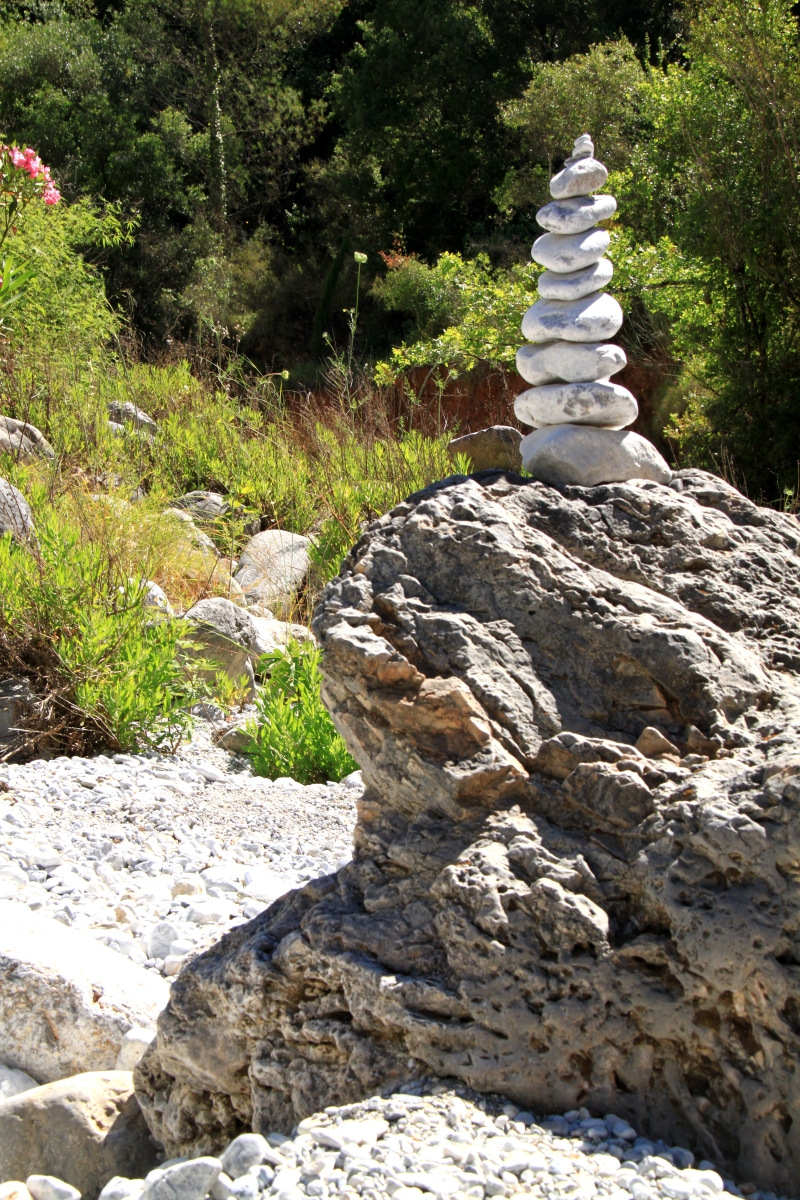
From the top of the ridge looking across the heavily wooded Mellte and Hepste Gorges there is a broad similarity with the Viros and it was that which triggered the nostalgia.  But that is where the similarity ends.  The bed of the Viros Gorge is dry and affords a route into the mountains with paths rising up the steep sides to the old villages on the ridge-tops.

By contrast, the Mellte and Hepste are never dry, though the water levels do vary.  One summer when I was in college a few of us picked up on the idea of ‘aqua-tramping’, apparently introduced from New Zealand.  Starting above the falls, we followed the rivers downstream, wading or swimming, sliding or climbing as necessary.  It was one of those hot summer’s of youth and we exulted in the cool, refreshing water and took unthinking risks as only youth does.  We down-climbed the falls themselves and I even followed the river into a cave, fortunately keeping to the left because, as I found later, going to the right would have plunged me deep underground.  As it was I emerged with nose pressed to the cave roof to breathe the remaining inch of air above the water level to be greeted with relief by the rest of the group.  It was memorable but it would take much higher temperatures to tempt me to repeat the experience.  And I would be more cautious about risk-taking.

By contrast I would go back to the Viros at the drop of a hat, hike the bed of the gorge and follow the ridge-top paths.  The UK has some great mountain landscapes and indeed I live within 100 metres of the Brecon Beacons National Park so dramatic terrain is part of my backyard, but the more I see of grey, wet weather and trek through mud the more I nostalge for sunshine and firm, dry paths.  I have already started thinking ahead to next summer and the plan which is forming is to return to The Mani and then complete the second part of the over-ambitious travel plan I had for last summer.

Friday was very grey and damp and I had to spend time in the kitchen to prepare food for visitors coming for the weekend, so in-between-times I looked back wistfully at the photos I took of the Viros Gorge in June.  Deep sigh!

The beginning of the Viros Gorge at Kardamyli

Marking the point where one of the small paths goes up the side of teh gorge

Dramatic coloured cliffs flank the gorge

The waterfalls in the Viros Gorge are dry most of the year

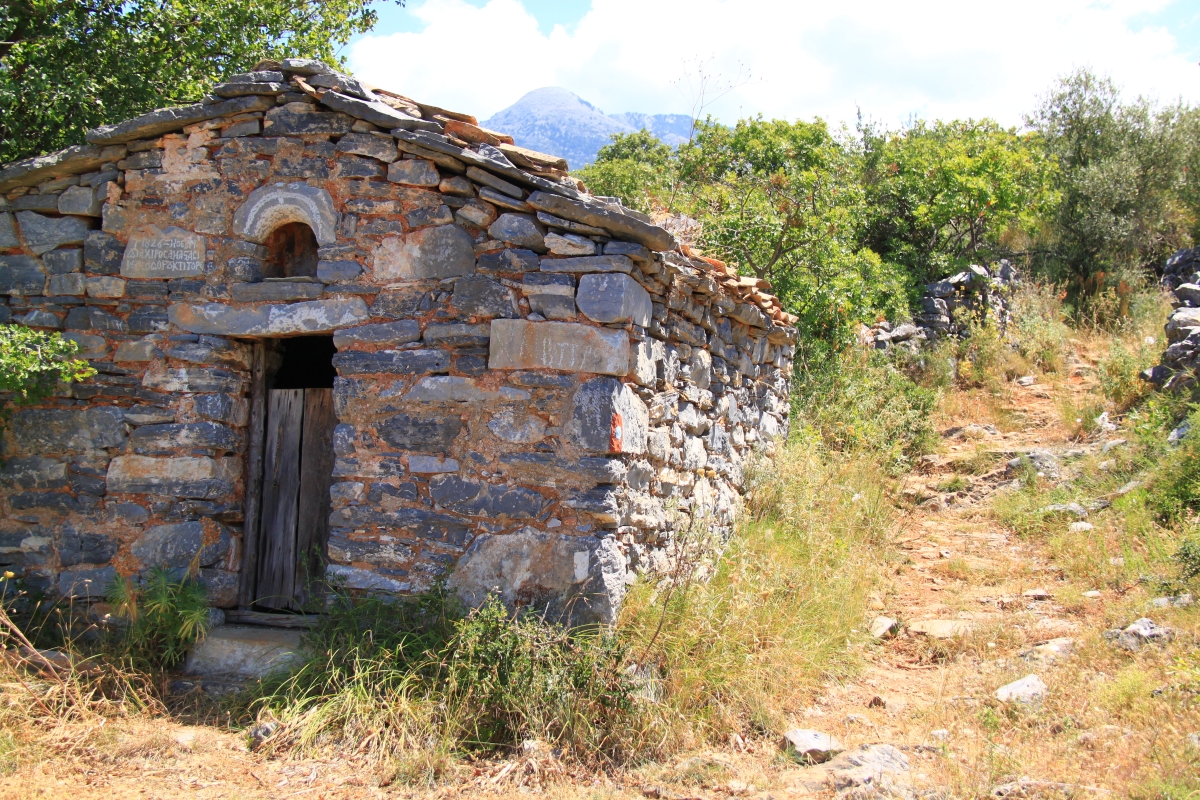
One of many small chapels at the side of the path heading up into the mountains

Some of the paths are well paved

Some of the paths are like a rock garden

Paved kalderimi zig-zagging down to the bed of the gorge over a thousand feet below

Standing on the edge, the bed of the gorge again a thousand feet below

Showing how sharp the limestone rock is.

Posted in Greece, Grey Britain, Reflections, Wales | Tagged , , , , , , , , , | Leave a comment

November Daily Blog 8: waterfalls and footpaths.

The sky was mostly blue when I got up on Thursday.  The sun was showing red through a narrow slit between the hill on the opposite side of the Valley and a band of cloud.  The forecast was for a sunny day.  And my knee was less painful than it has been for a couple of weeks.

Blue sky and a sliver of red

I get very frustrated and restless when I’m stuck around the house so I decided it was time to get out into the mountains.  I hesitated to commit to too strenuous a walk so I came up with the idea of going further west in the Brecon Beacons National Park to ‘Waterfall Country’. It’s a bit of a tourist honey-pot in the summer but I reckoned it would be quieter in November and it has the advantage of a series of easy ‘trails’ prepared and maintained and I thought they would be less of a strain on a wonky knee.  It’s also very spectacular and photogenic.

A great deal of trail-marking has been done since I last visited the area about 15 years ago and I set out along a well surfaced broad track, crossed the river on a footbridge and then climbed the valley side on a well maintained and satisfyingly strenuous path zig-zagging up to the ridge.

The path along the ridge had dramatic views of the gorge, somewhat reminiscent of the wooded Viros Gorge running down to Kardamili in the Mani Peninsula where I spent two weeks in the summer.

Looking up the gorge from the ridge

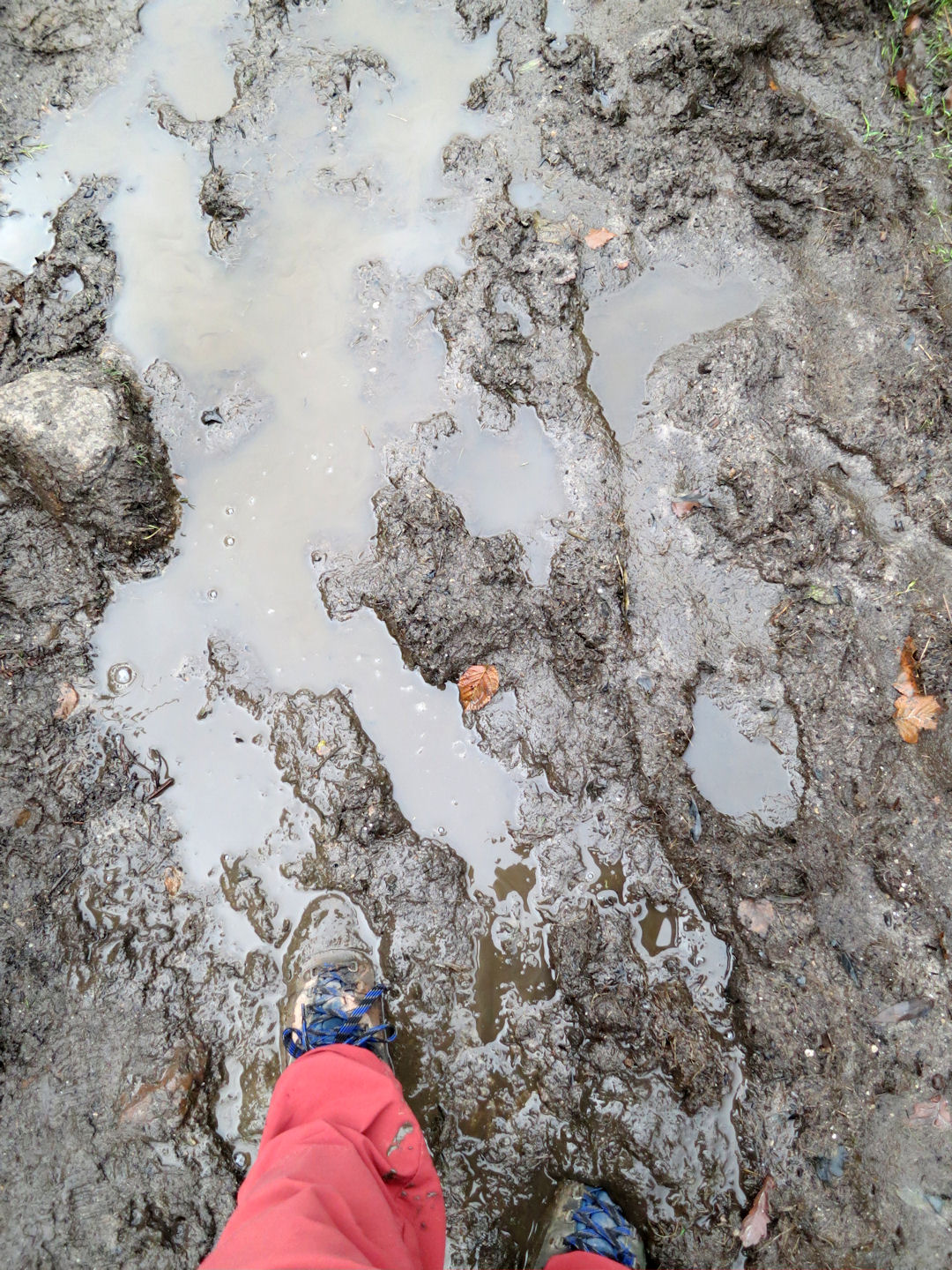
What was very different, however, was the nature of the paths.  Those above the Viros Gorge were baked hard, rocky, a pleasure to walk.  The path along the ridge to Sgwd yr Eira was appalling.  The notice board in the car park at the bottom had warned that the path might be ‘wet’. In fact much of it was wall-to-wall mud, in places nothing but slurry.  Despite the variety of mud colours, peat-black, slate-grey, cow-pat-brown, it was not fun walking.

Much of the path on the ridge is mud and slurry

While I was slithering, cursing, and trying to protect my knee from sideways pressure, I ruminated about why it was so bad.  The conclusion was staring me in the face in the shape of the myriad squelchy boot-prints.  The problem is that the authorities encourage walking in the area with signed trails, maps, visitor centres and the like but the paths cannot take the amount of foot traffic given how wet climate and the ground are.  It is only to be expected that an area of waterfalls has a lot of rainfall and surface water run-off.  In places the path has been gravelled and compacted, in other places duck-boards have been put down but nowhere near enough to protect the ground from the damage it is suffering.

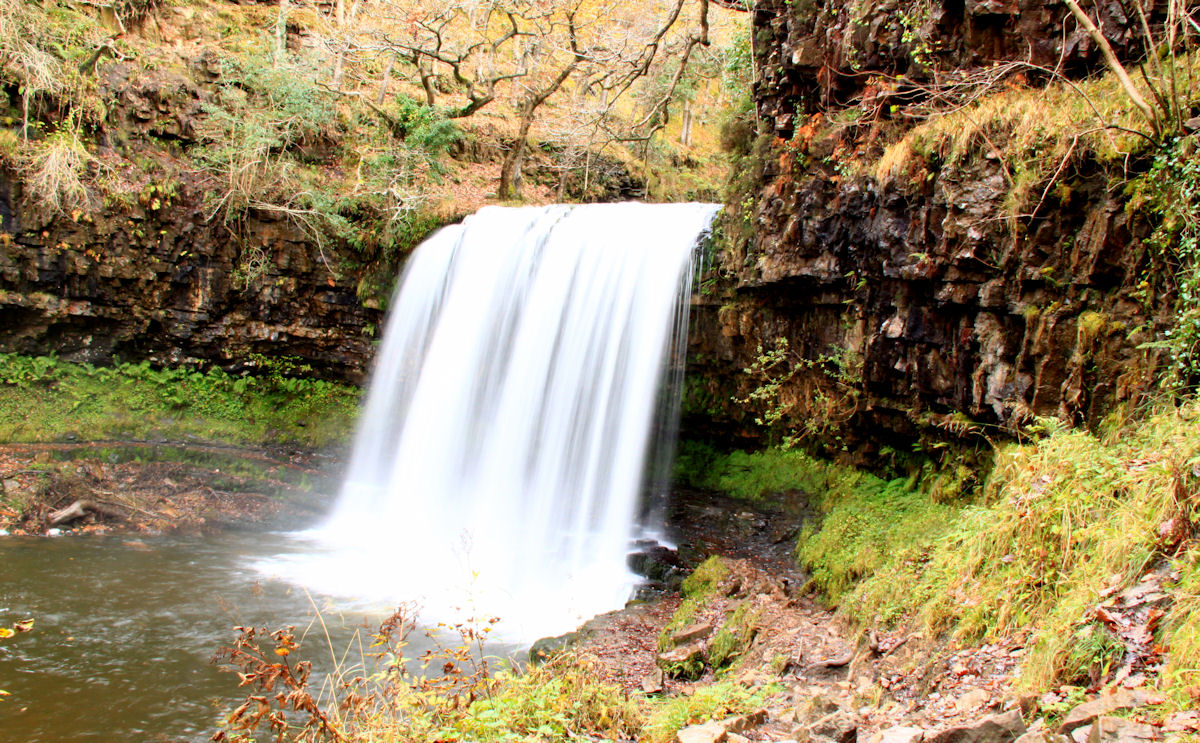
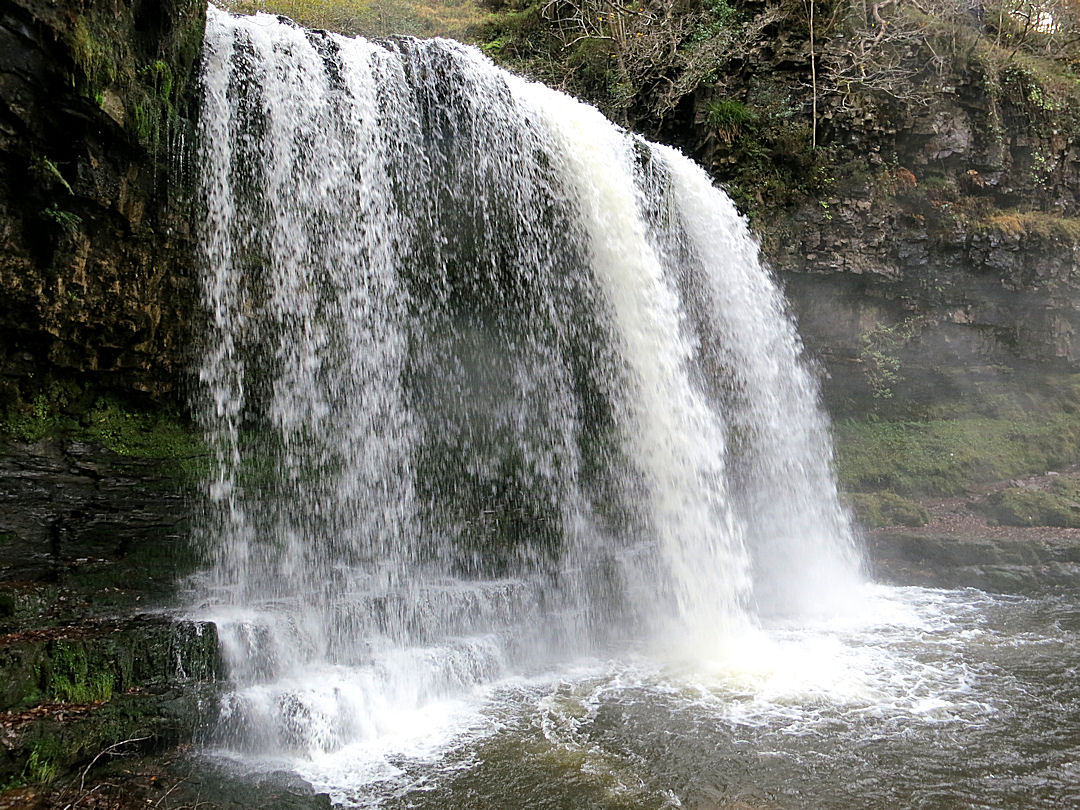
However, nothing could detract from the impressive waterfalls, particularly contrasted by autumn colours.  Slowed up by the mud and multiple protracted photo-stops I only managed to visit 3 falls, each dramatic in a different way.  Then I back-tracked to the car nursing my aching knee, determined to return when I am fully fit and work out a route to take in more of them.  A good day.  An area well worth a visit but something needs doing about the paths.

Approaching Sgwd yr Eira

….. time stood still

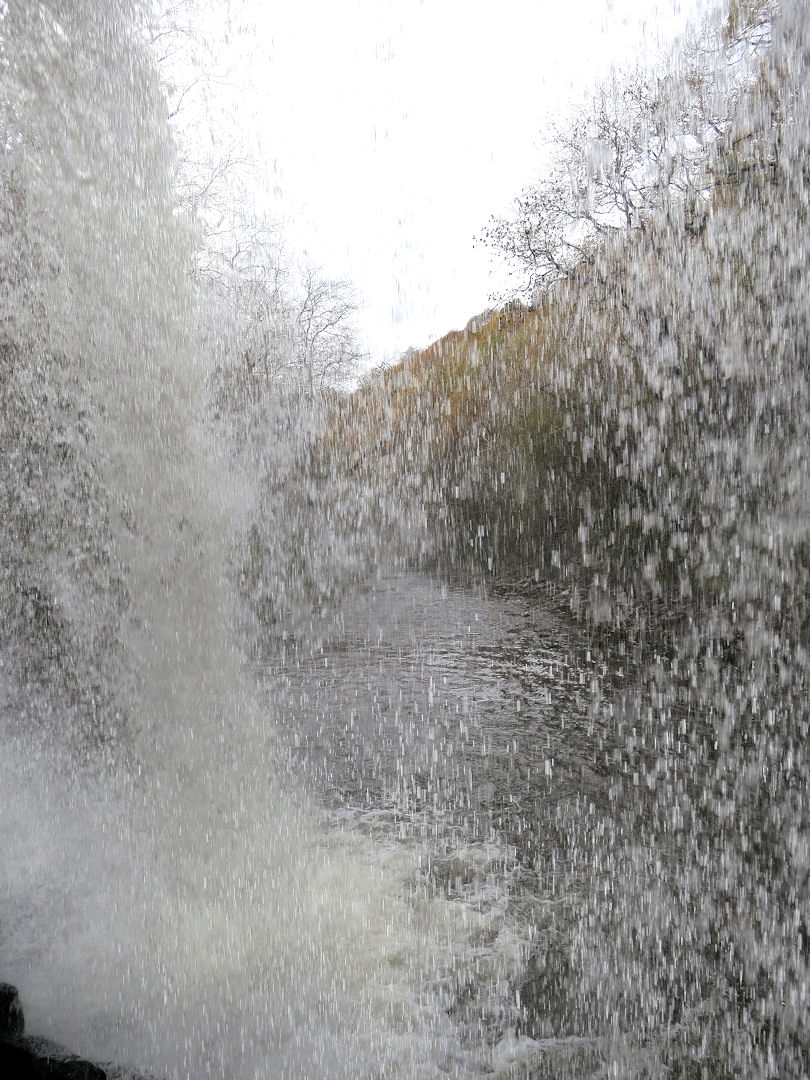
Walking behind the fall and looking out

…. and looking back from the other side

Sgwd y Pannwr

Sgwd isaf Clun-Gwyn

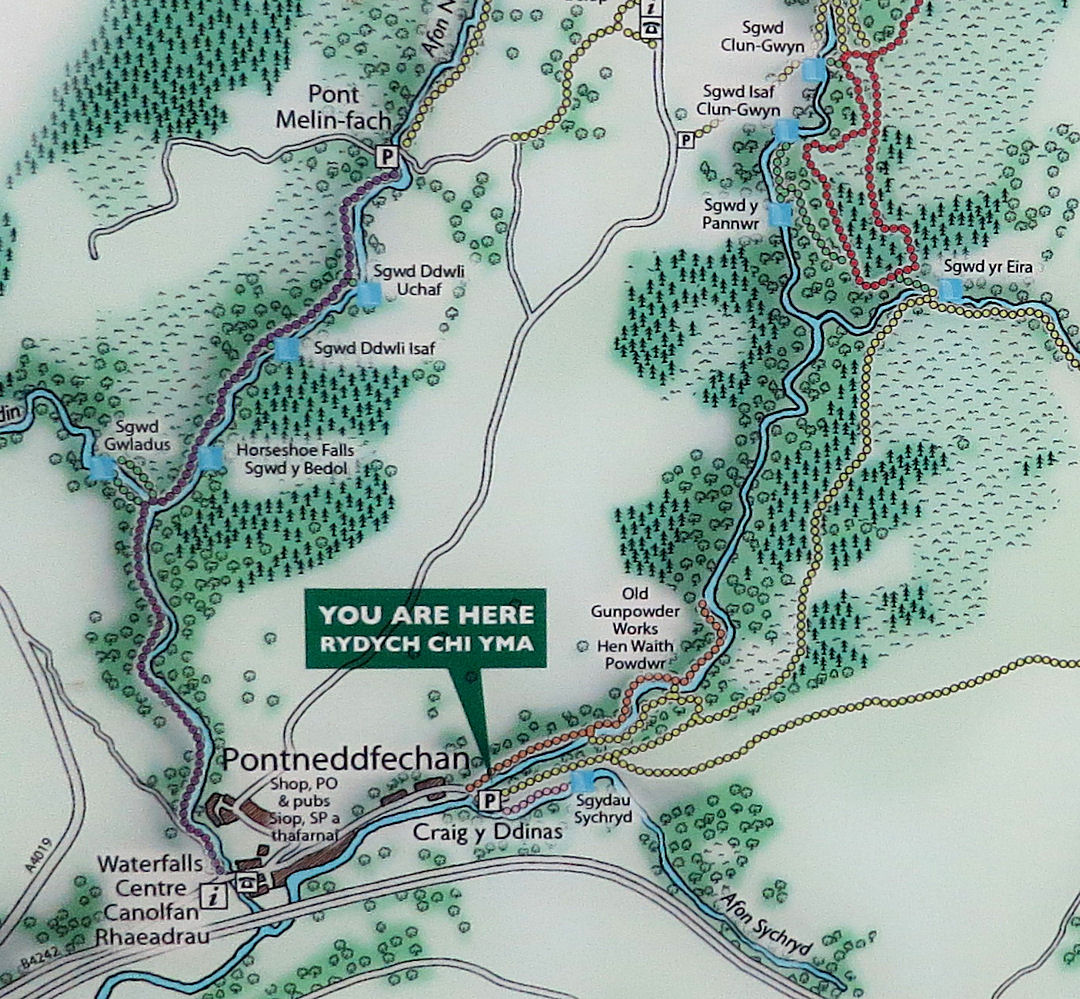
Part of the map on the information board in the car park. I walked up the river on the right of the map.


Posted in Autumn, Wales | Tagged , , , , , , , | 2 Comments

November Daily Blog 7: inactivity and verbal rambling.

I have to ‘fess up.  When I started the November Daily Blog as part of the NaBloPoMo (National Blog Posting Month) challenge I had the intention of using it as an incentive to do something different and interesting every day.  For me that would be something ‘outdoors’, walking, climbing canoeing, caving …..   But it hasn’t worked out.

Almost as soon as I committed to the challenge I damaged the Medial Collateral Ligament in my left knee and the only really ‘different thing’ I have done is visit the sports physio.  The double irony is that not only had I intended to be more active than usual but a few days before it happened I had paid a precautionary visit to the physio.  In the winter of 2010-11 I spent a month skiing in Canada and towards the end of the stay I flipped and damaged the MCL in my right knee.  Because I’m going back to Canada skiing in January-February 2013 I wanted to make sure that there was no residual weakness left from that injury.  I was pronounced fit and given exercises to strengthen the muscles which hold the knee stable against that injury happening again.

In light of the new injury the physio gave instructions that I shouldn’t go walking on ‘terrain’ until it had healed up.  Most of the walking I do is on rough paths and in the mountains which would put lateral strain on the knee so my good intentions were blown out of the water.  It’s more important to get the knee sorted out rather than risk aggravating it or slowing down the already slow recovery process.

Hence in the past week the blog has been more about verbal ramblings rather than rambling around the mountains and the countryside, the primary reason for starting it.

The inactivity has been galling, particularly as the weather has been clement, ideally suited to being in the mountains, the first snow of the winter falling on the higher peaks in the Brecon Beacons, the local National Park.

However, I have, not been completely idle as I have pushed on with Autumn clearing in the garden and preparing for the next stage of re-landscaping.  I enjoy doing the big stuff in the garden but tend to put it off to go walking or climbing when the weather is good.

I hope to maintain the progress on the landscaping work in the garden but as the knee starts to improve I guess I’ll be deferring it and taking to the mountains again.

Posted in extreme gardening, Reflections | Tagged , , | Leave a comment

November Daily Blog 6: the role of the loo in creative writing.

Archimedes is reputed to have had his ‘Eureka!’ moment in the bath, though anecdote has it that he then ran out into the street naked shouting «εύρηκα!»  – I’ve found it!”.  Presumably his slaves filled the bath with hot water, he got in and it overflowed.  The problem on his mathematical mind at the time was how to measure the volume of an irregular object and thereby calculate its density (a gold crown thought of be adulterated with silver).  The solution? –  dunk it in a bath and measure the change in water level.1

I’m not a genius so I don’t get to solve problems in the bath.  Instead I seem to have creative thoughts and solve problems on the loo.  Somewhat of a comedown.

I used to be in town planning, a ‘quasi-judicial’ process.  Certainly after the Freedom of Information Act, I knew that everything I wrote, everything I edited of other colleagues’ work, could end up as evidence in a public inquiry or a court of law.   The guiding principle was that everything – letters, report, plans, documents – should be ‘clear and unambiguous’.  And as far as public documents were concerned they needed to be intelligible to the hypothetical ‘Man on the Clapham Omnibus’, enshrined in English Law.2

Contrary to a commonly held belief this required a great deal of careful and creative writing.  Often I would be stumped for a way to express something and I would find my brain in a rut going over the same inadequate phraseology time after time.  I would end up staring increasingly blankly at the computer screen.

The solution?  I would leave my office, amble slowly along the corridor with furrowed brow, pained expression on my face …. and go to the loo.  Frequently, though not always, I would solve the problem mid-dump.  I would then rush at high speed back to my desk and tap out the new-found words into the computer.  Needless to say this got me a reputation as a frequent visitor to the loo, which apart from the obvious explanation of having a medical problem was behaviour attributed to skivers(shirkers, slackers).  Indeed I had some colleagues who would disappear into the loo for an extended period with a newspaper and drop it in the bin on their return, having read it from front to back.  My trips along the corridor also caused some perplexity because I would walk slowly there and very rapidly back, the opposite of the normal pattern of a ‘man under pressure and with the pressure relieved’.

Whatever, it worked for me then and has continued to work for me since.  Not that my creativity is very great but what there is is reinforced by a visit.  To be fair, I also have flashes of inspiration in the bath and when I’m out walking in the mountains, though none are as productive as the loo.

I have two possible hypotheses to explain this phenomenon.  The first is simply that in the loo I empty my mind as well as …. well, you get the picture.  The mind thus uncluttered can then tap into the subconscious which has doubtless already solved the problem and is just trying to communicate with the dullard at the front.  The second is an explanation I read about to explain why, when we go into another room to get or do something, we find we have forgotten the reason for going.  The hypothesis is that going through doorways closes an area of our brain to what we do in that room and triggers associations with the ‘new’ room.  It is certainly true that going back to where we had been often rekindles the original thought process.  I have no idea which, if either, is correct but both could be subjects for PhD theses.

You might gather that I spent more time than usual in the thinking room yesterday, though not as productively, in the creative sense, as usual.

 1   http://en.wikipedia.org/wiki/Archimedes#Archimedes.27_principle

2   http://en.wikipedia.org/wiki/The_man_on_the_Clapham_omnibus

Sunrise Tuesday morning, from the balcony of the house

The sun pops over the ridge on the other side of the valley


Posted in Autumn, Reflections | Tagged | 1 Comment