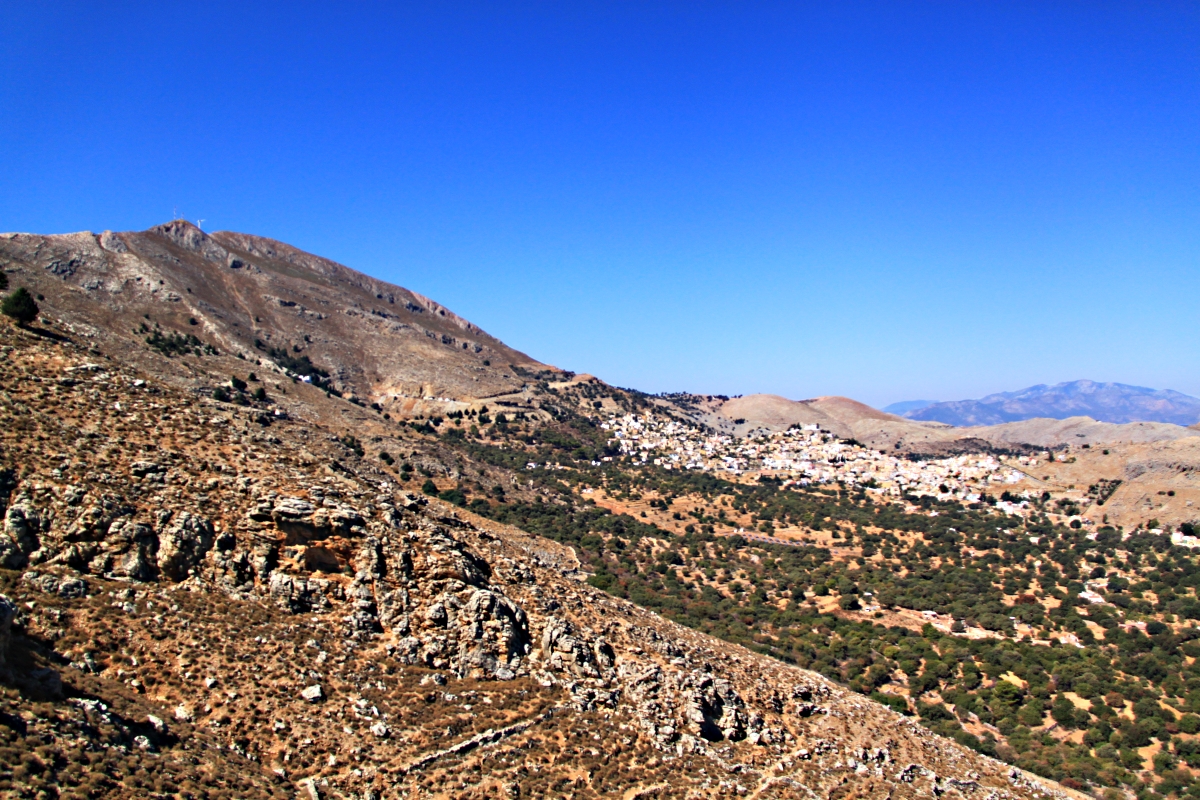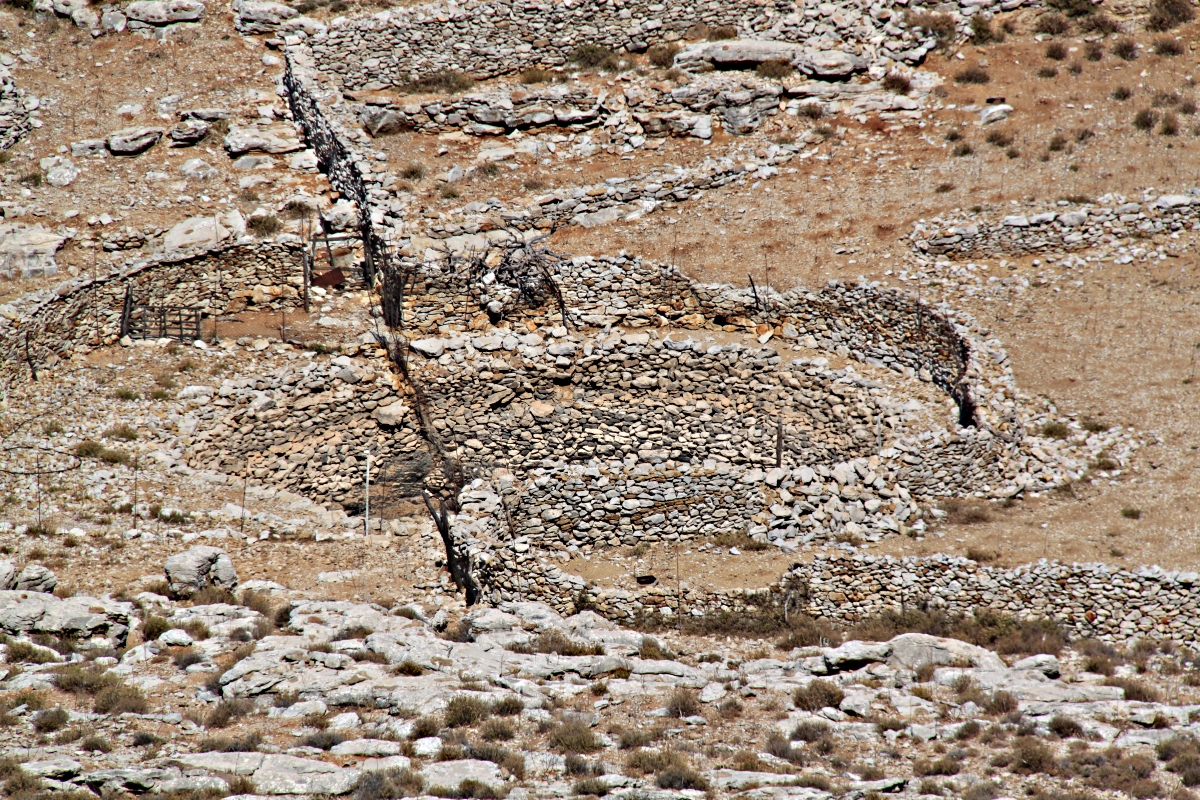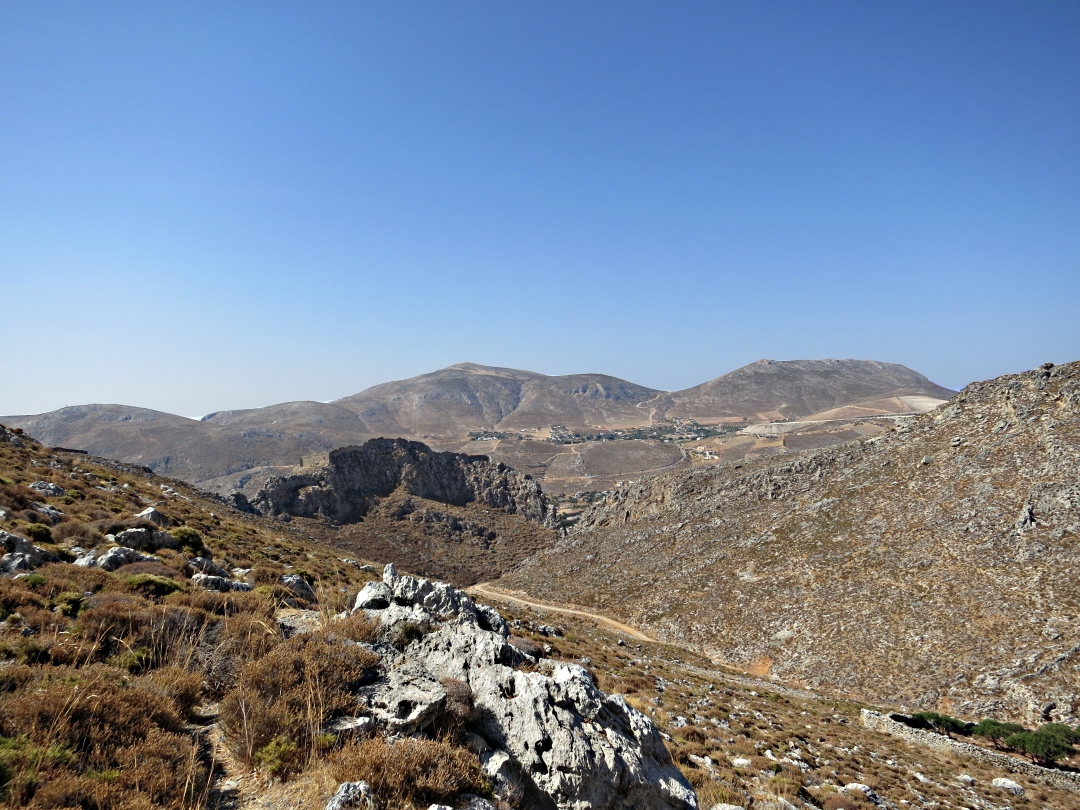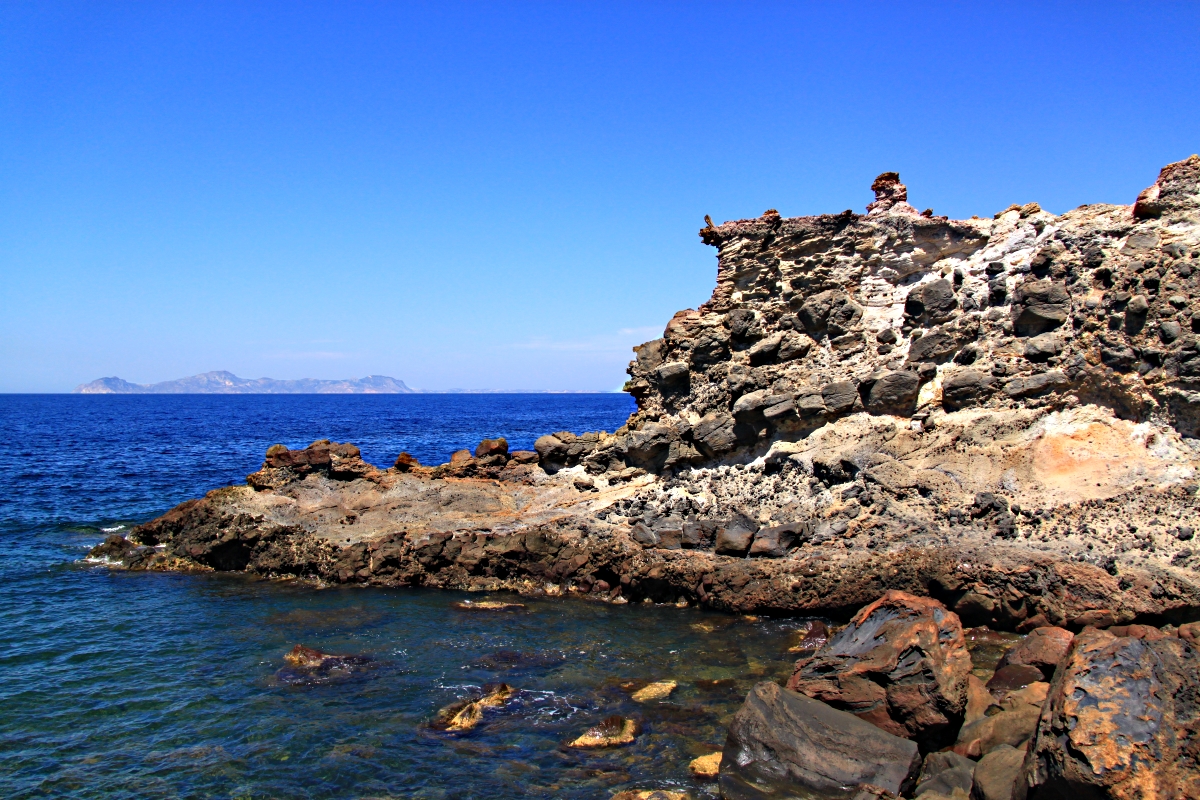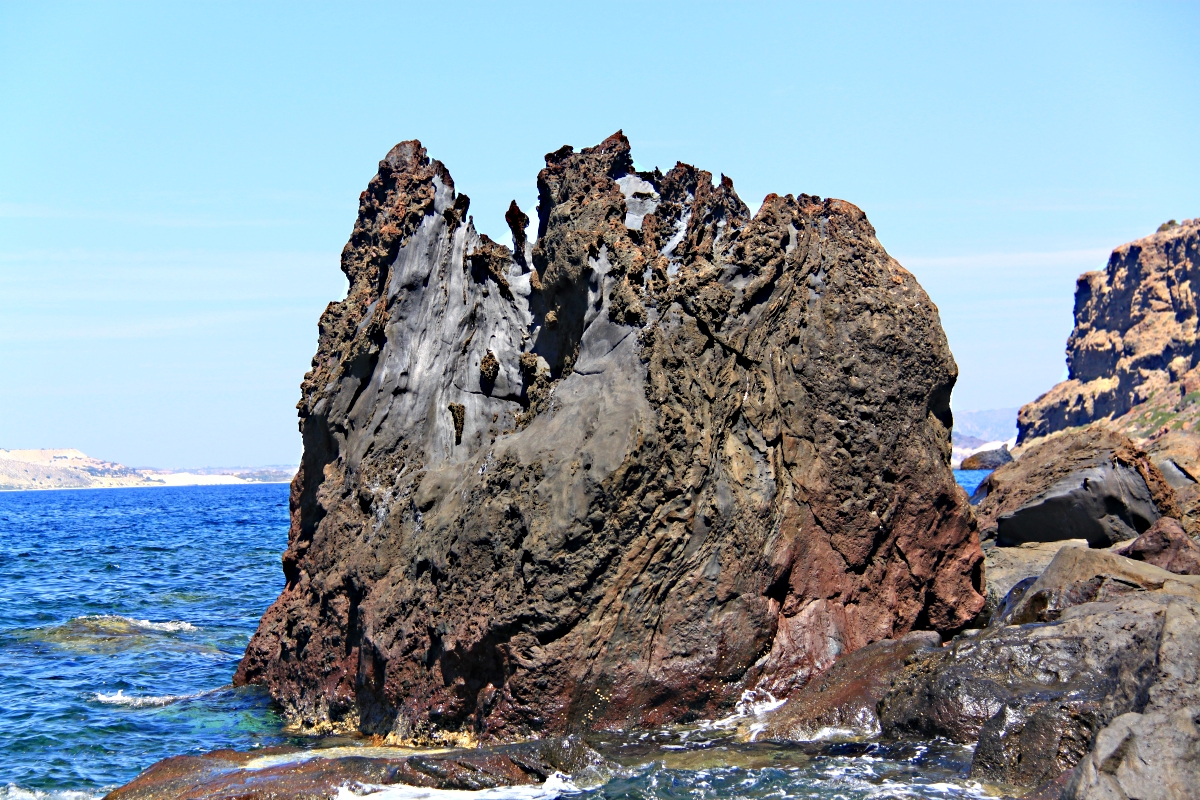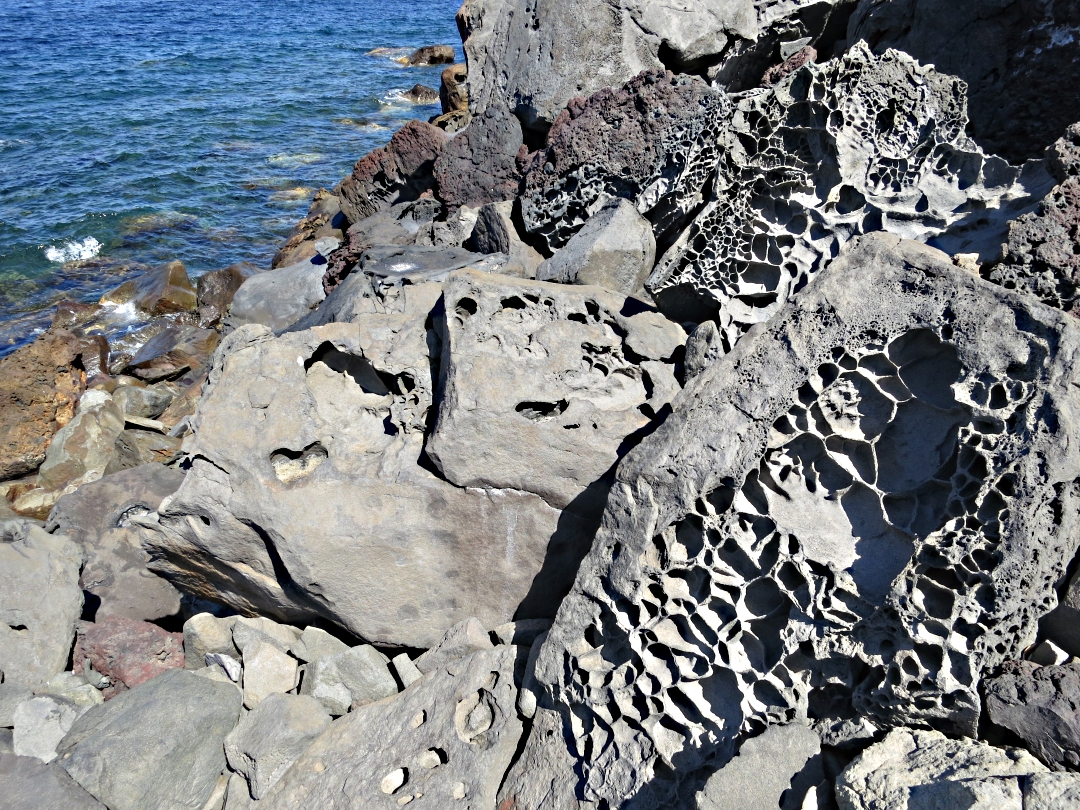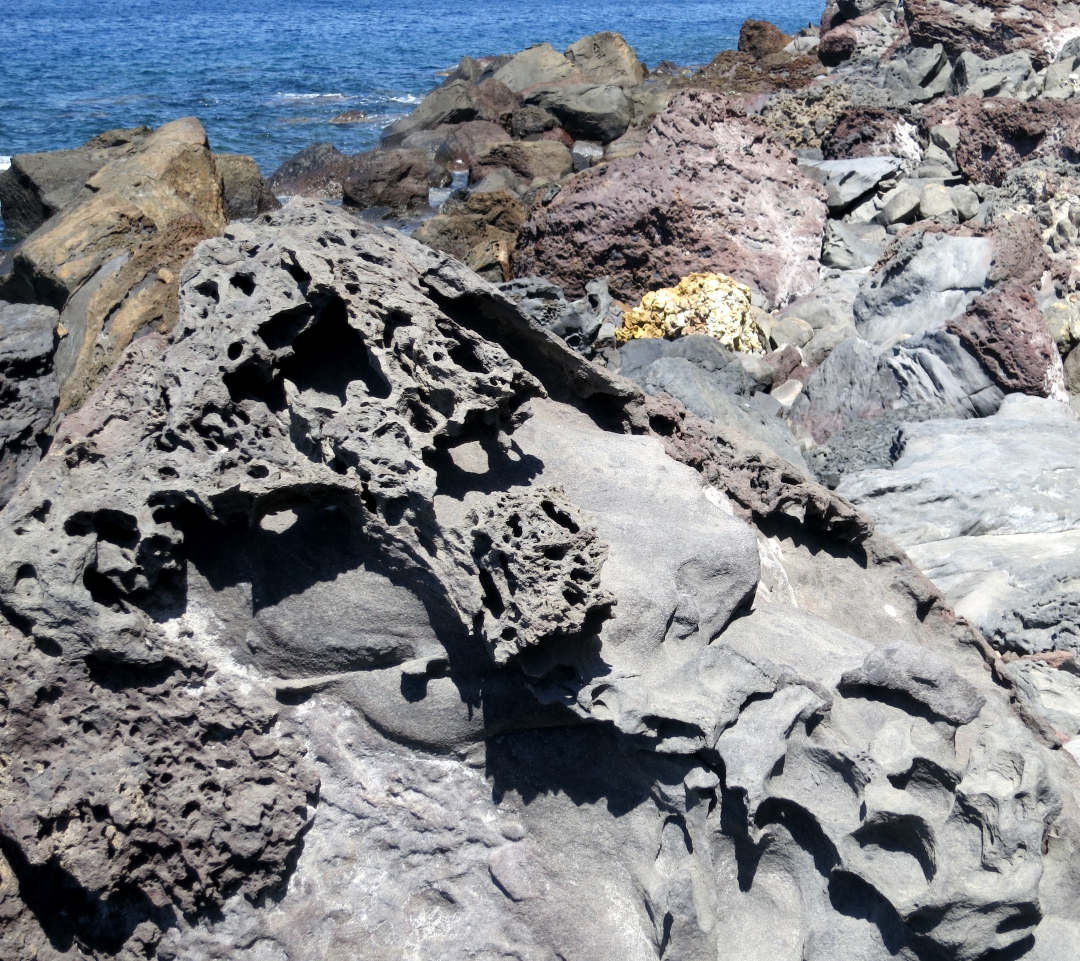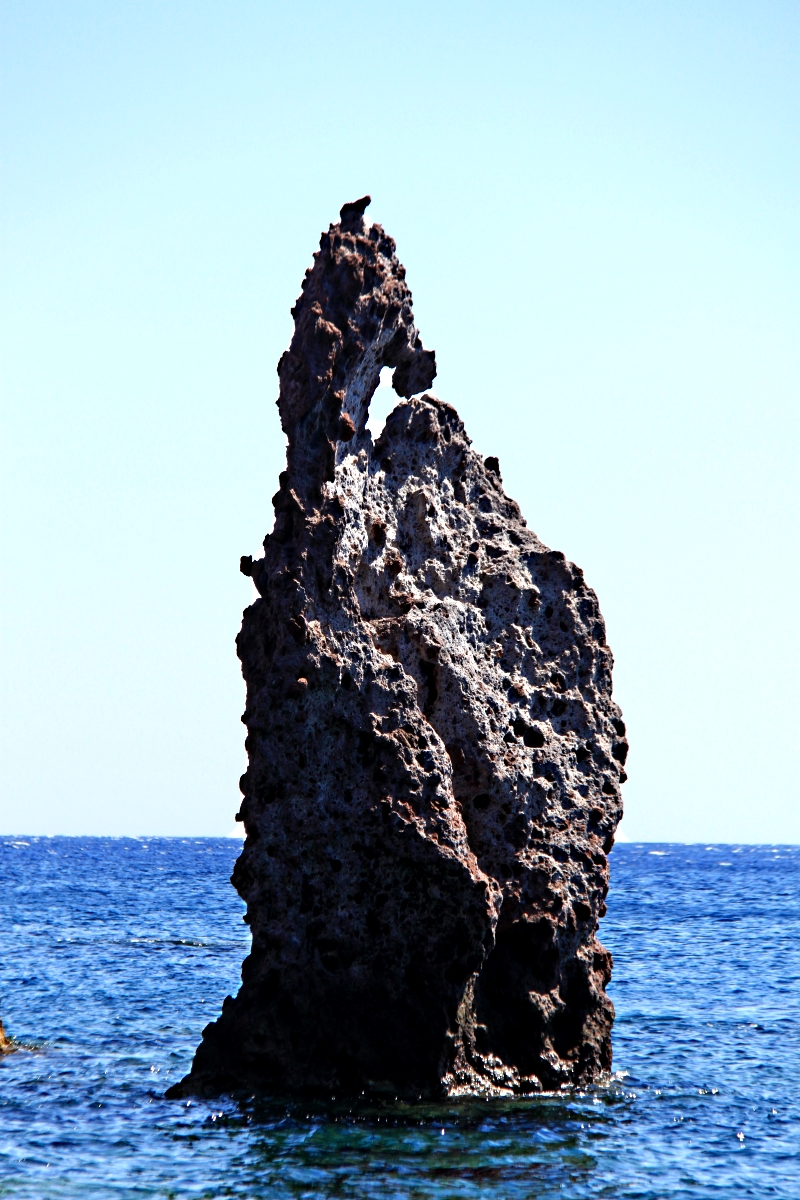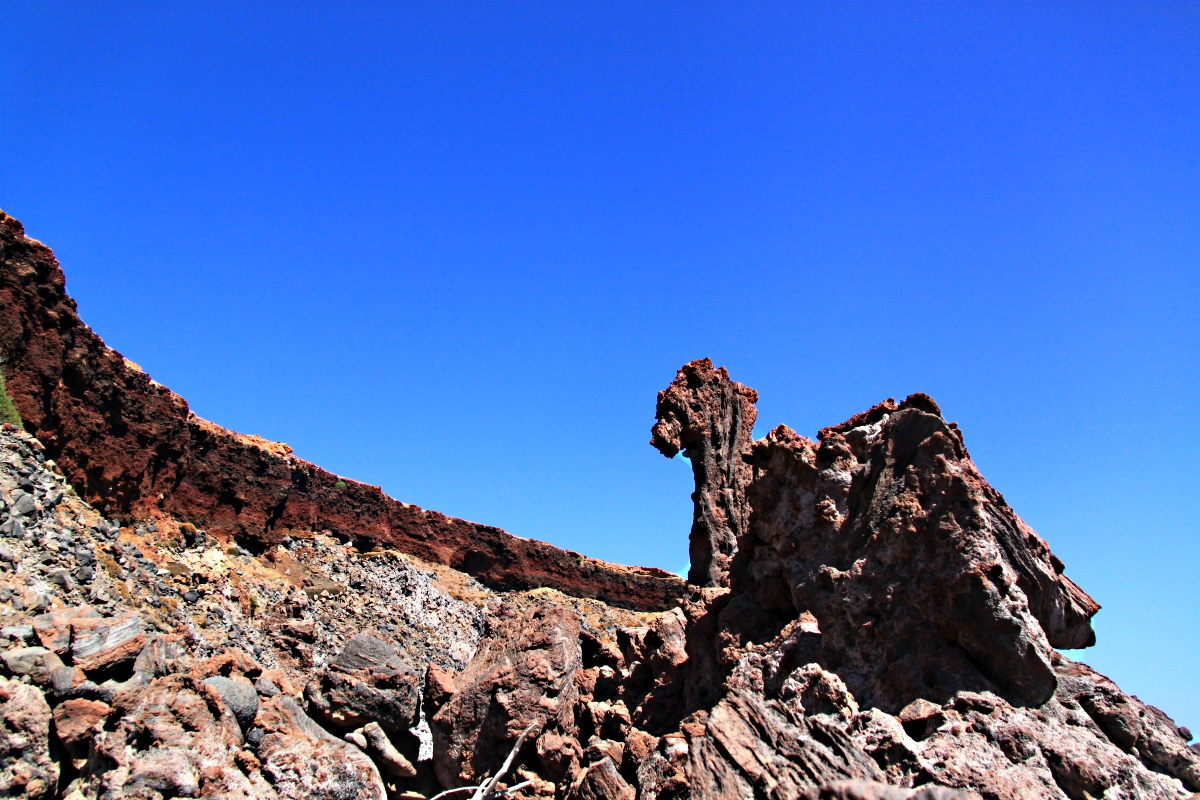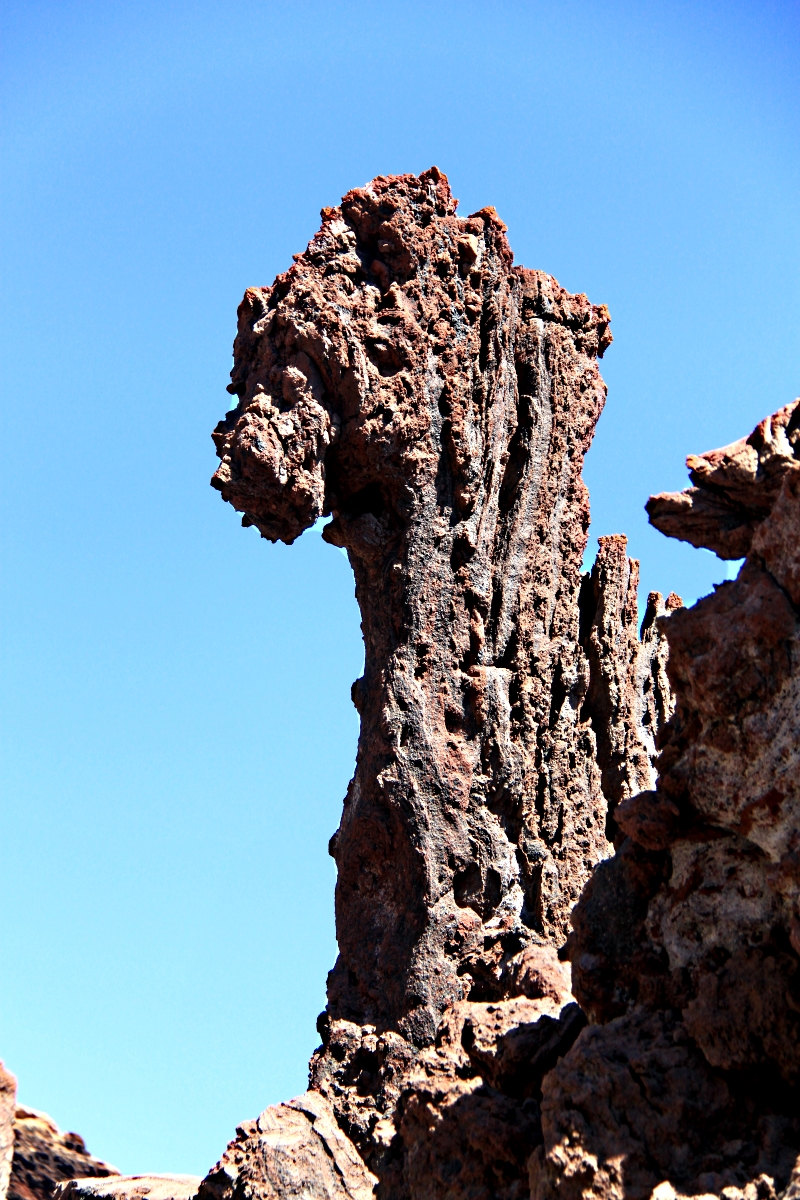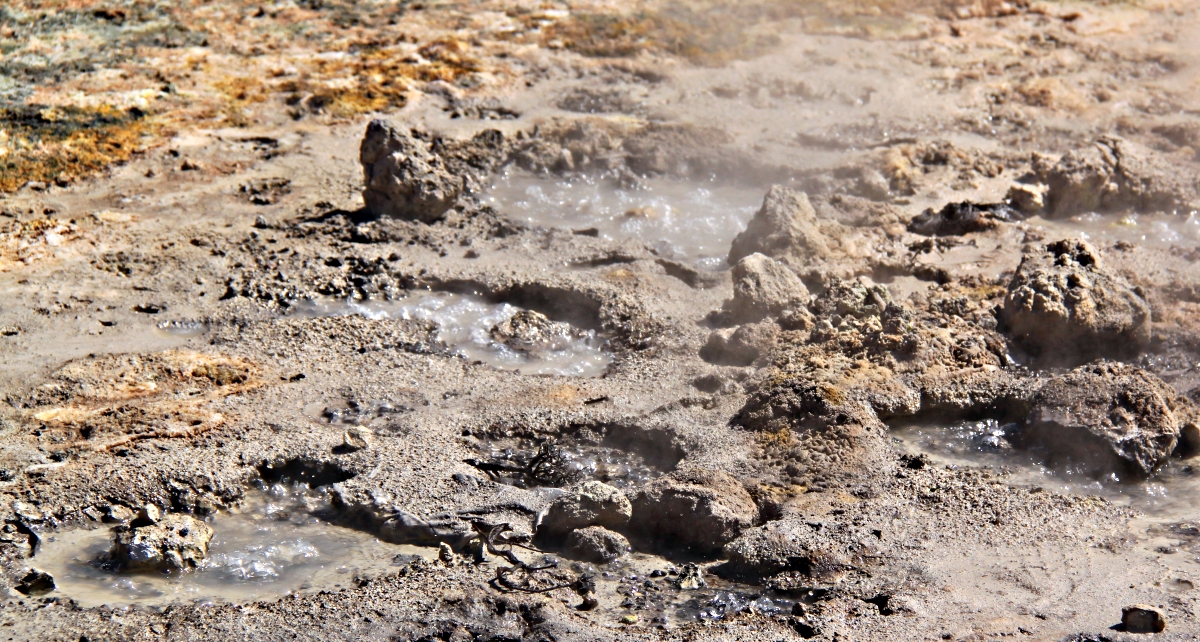
Symi: a gorgeous walk

Normally I’m obsessive about tidying up behind me.  Food shopping gets put in the cupboard or fridge as soon as I walk in through the door.  Clothes get folded or hung as I take them off.  But I hate unpacking when I get home at the end of a trip.  I defer it as long as possible.  I take my clothes out of the bag and wash them but the rest can remain in the bag on the spare bed for a month or more.  It’s a pathetic clinging on to the thought that the trip isn’t yet finally over.

I’m back home now but reliving the last couple of weeks on Symi, remembering good walks, good conversations, as I transfer photos from my netbook to the PC and check them over.  So there are still some blog posts to write.

A long-time favourite walk on Symi is across the spine of the island, down to the tiny iconic cliff-edge monastery of Agios Vasilios (featured on the cover of the SKAÏ map of the island – no.341) and Lapathos Beach below it.  Unlike the ‘off-piste’ routes of recent posts, this is on good, clear footpaths.

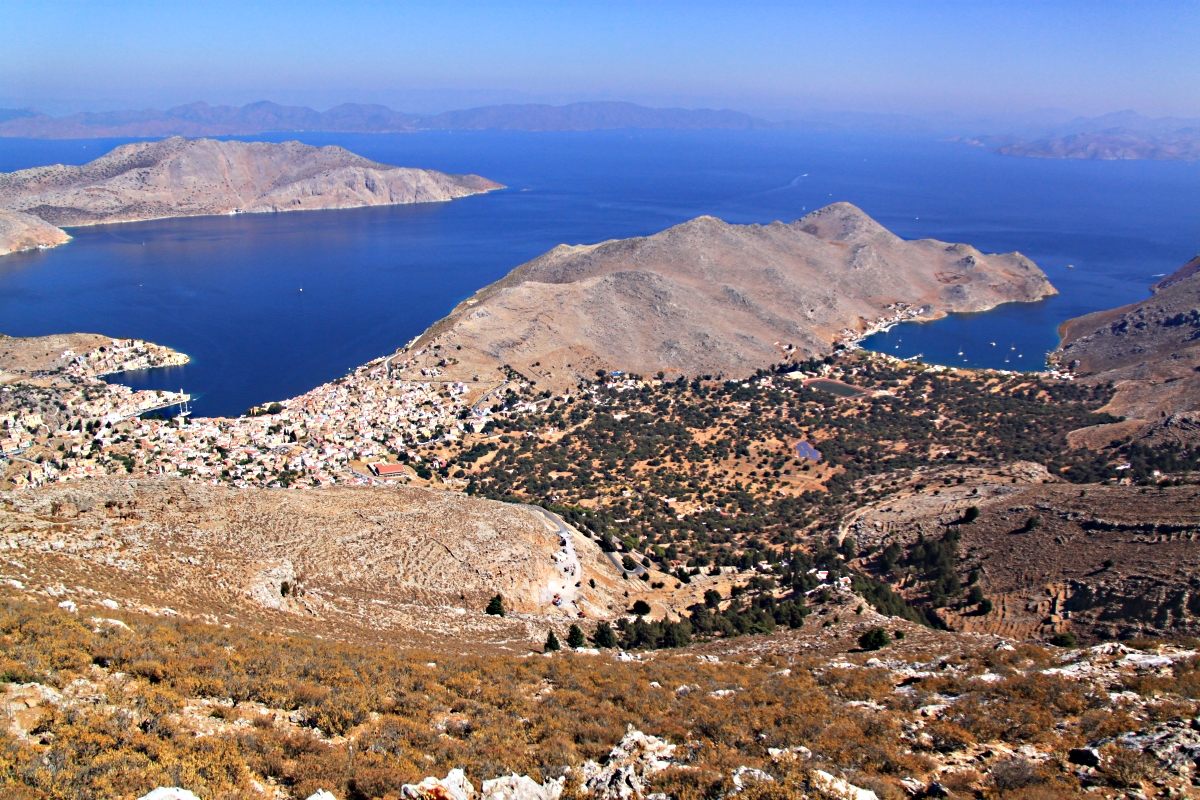
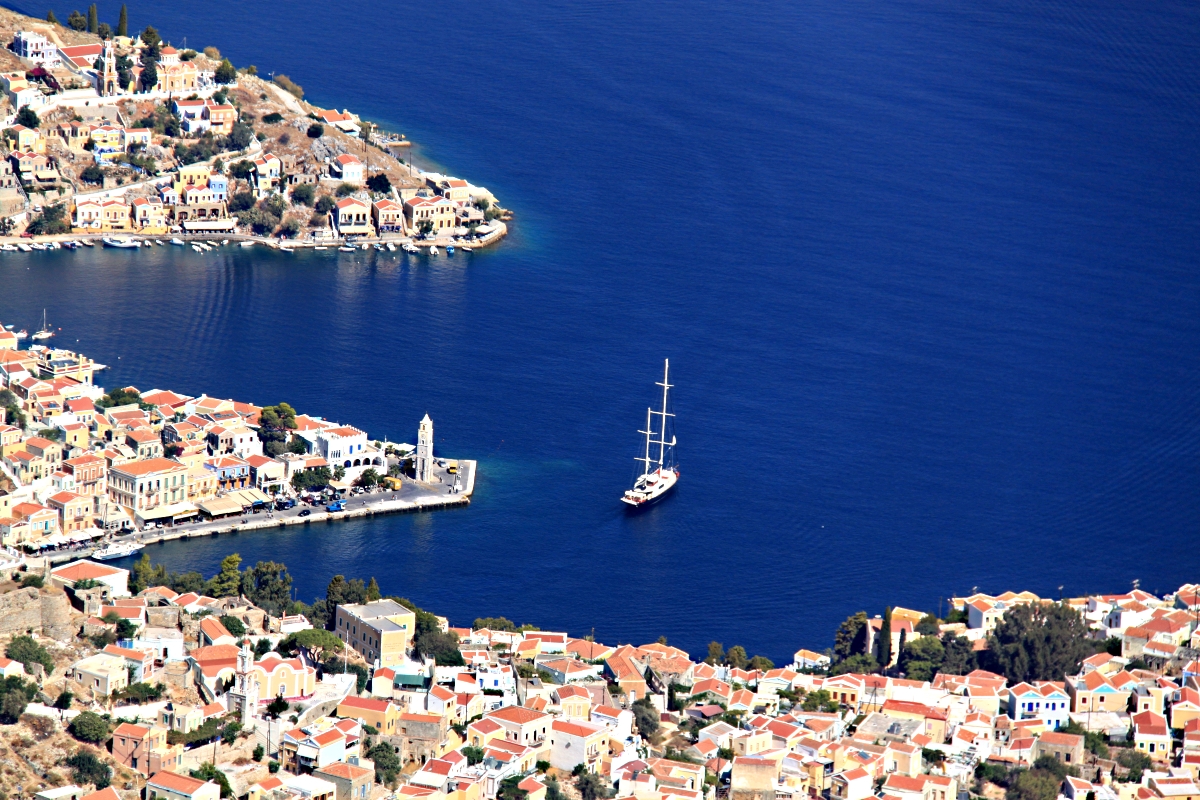
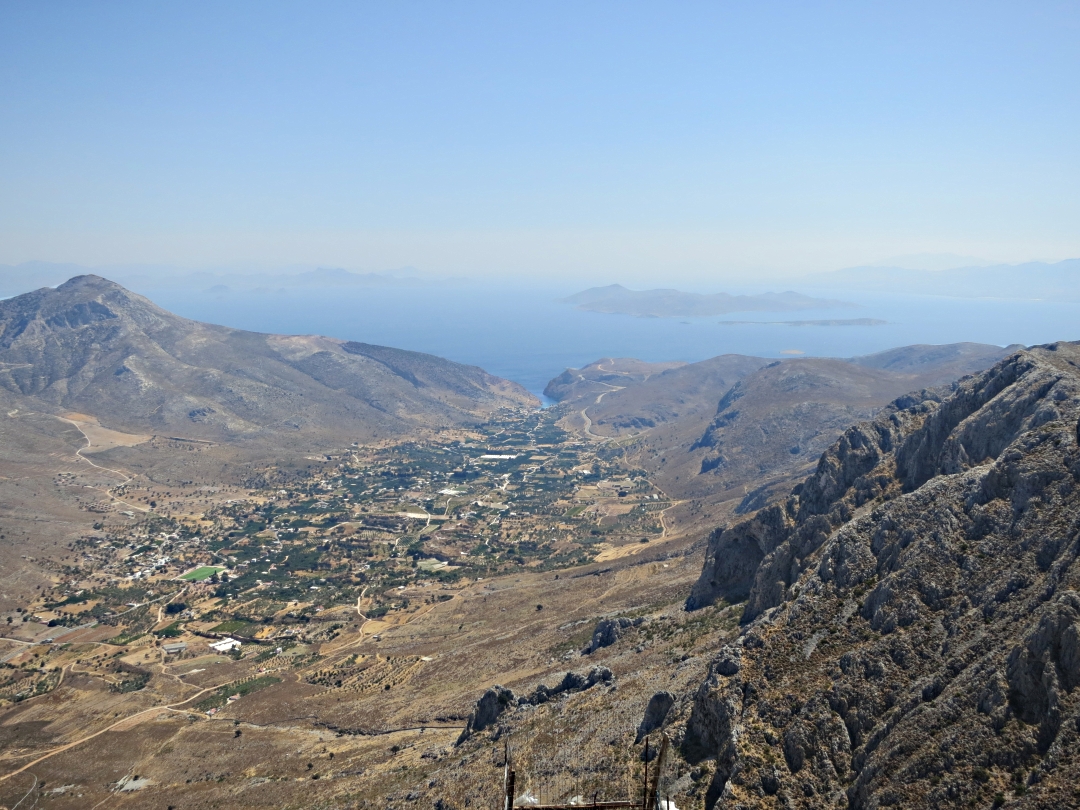
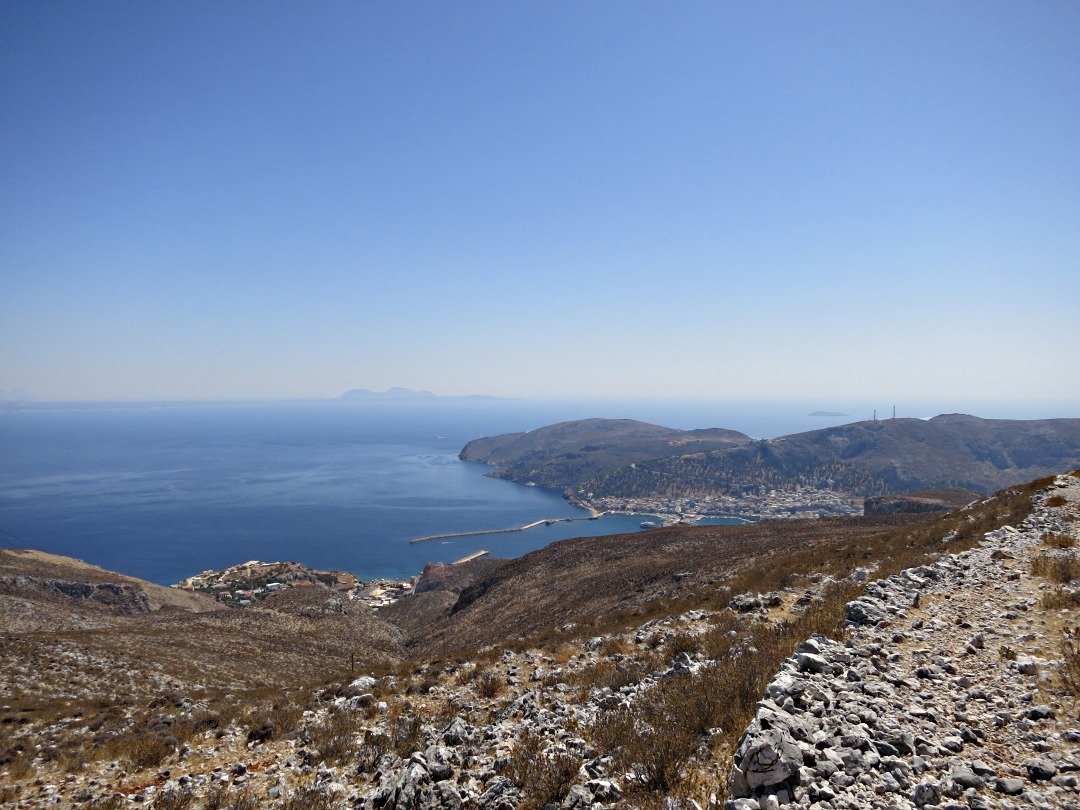
The first part of the walk is through the narrow, winding alleys of Horio, the old village, to come out on the shoulder of the hill at the best viewpoint on the island looking straight down into the harbour, probably the most dramatic in Greece, across to Nimos Island with Turkey beyond, and down the valley to Pedi Bay.

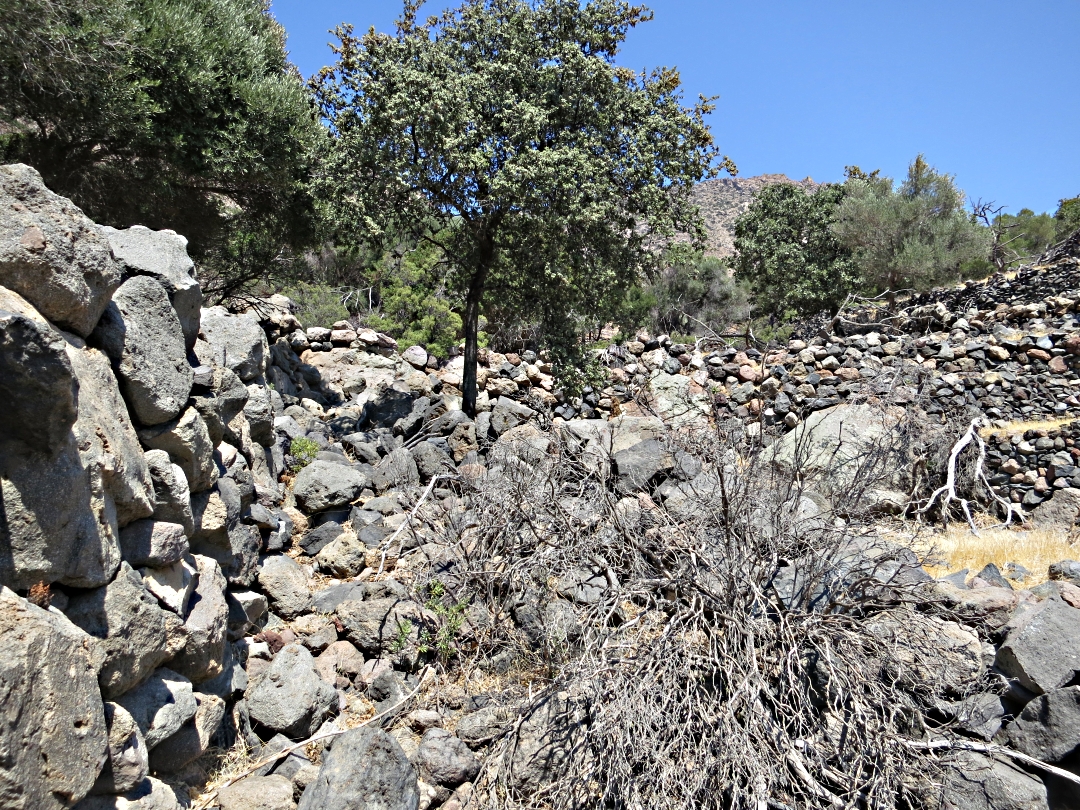
From the viewpoint an old stone-paved kalderimi winds at donkey-friendly gradient, well polished by hooves, passing the chapel of Agia Paraskevi with its large oak shade tree, up to the new tarmac road at the monastery dedicated to the Archangel Michail Perivliotis and the burgeoning hamlet of Ksissos.  There are variations on the same view much of the way.  Those who hire a scooter and park at Ksissos to walk to the beach miss all this.

Until a few years ago there were more churches than houses in Ksissos but recently there has been a spate of house building accompanied by enclosing land.  The enclosures are functional but far from aesthetically pleasing  2-metre high chain-link fencing hung from steel reinforcing rods driven into the ground.  At the end of the concrete road through the settlement the path dives off to the left between two such fences ….. which at least saves the dilemma of choosing the right line over the rocks.

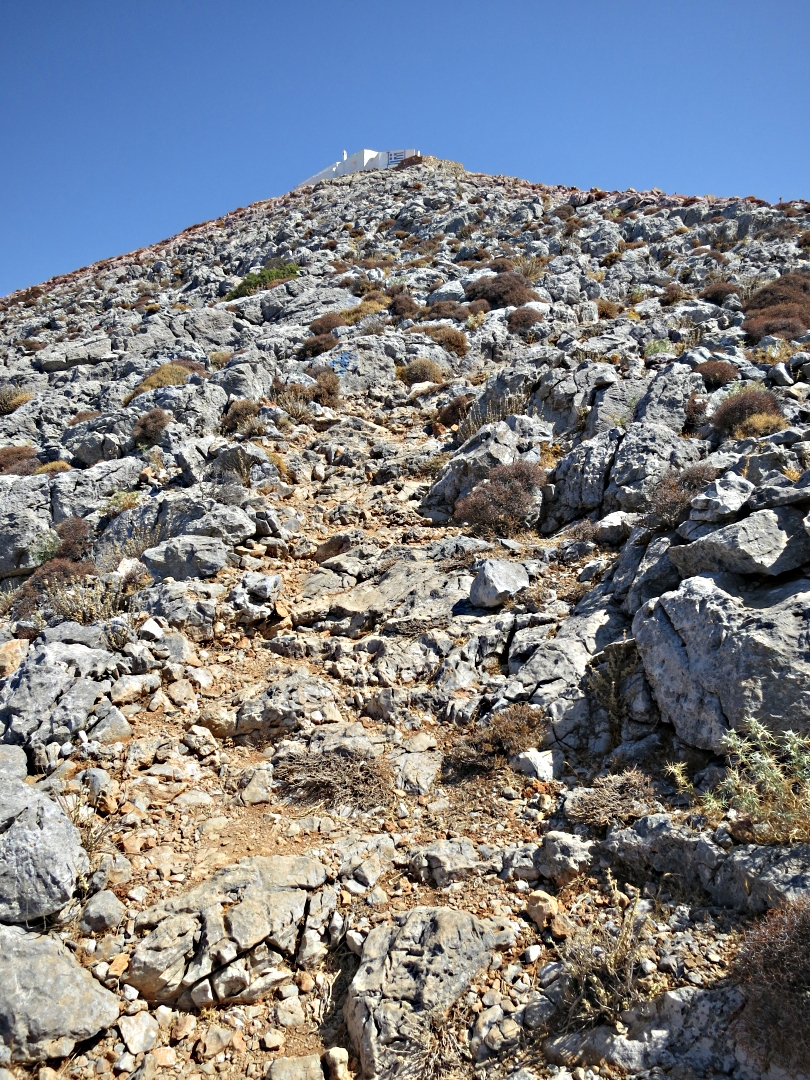
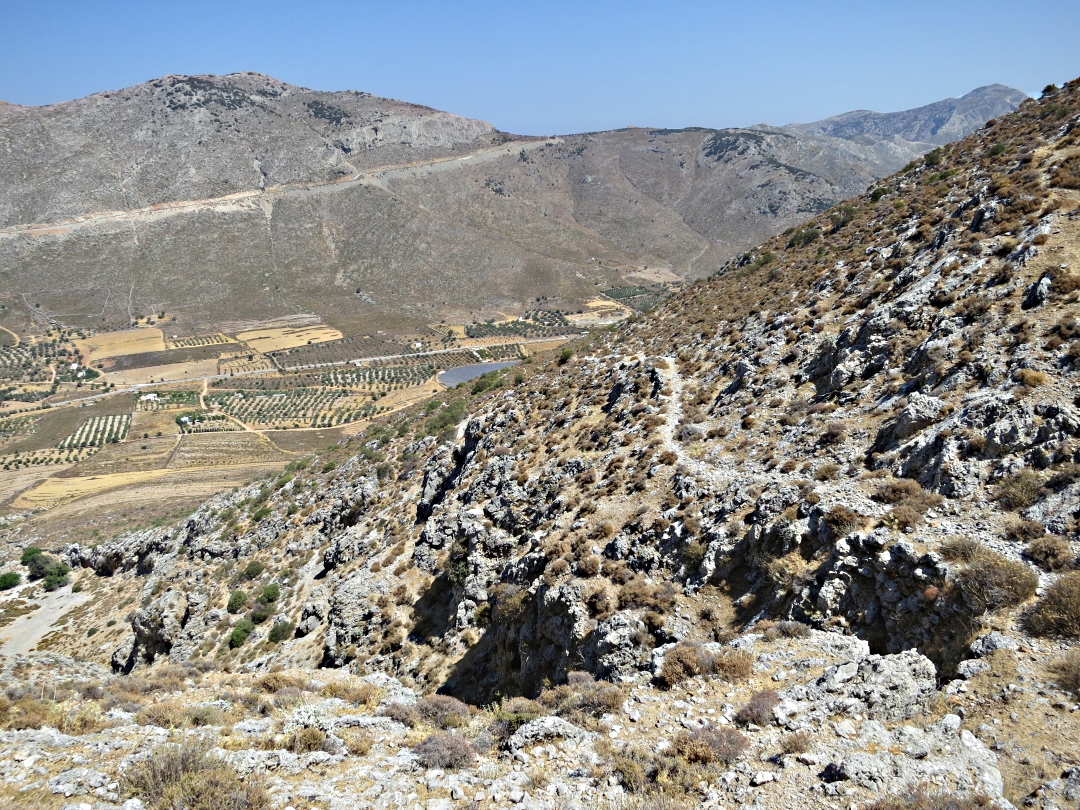
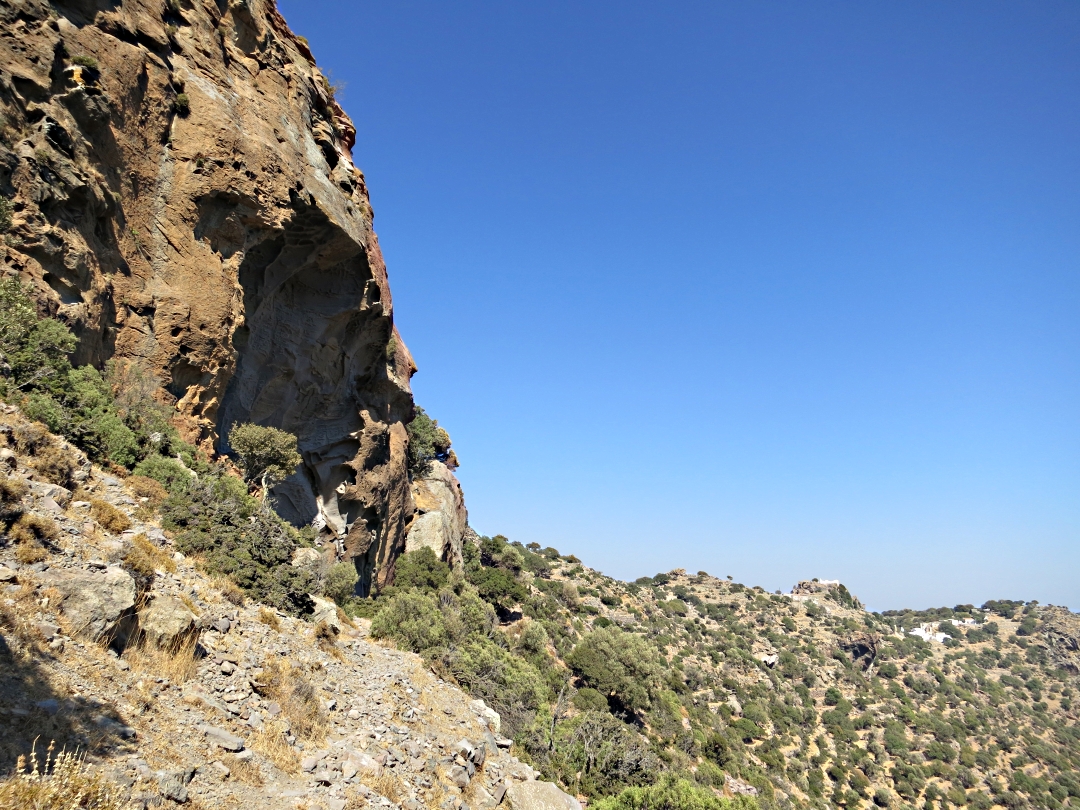
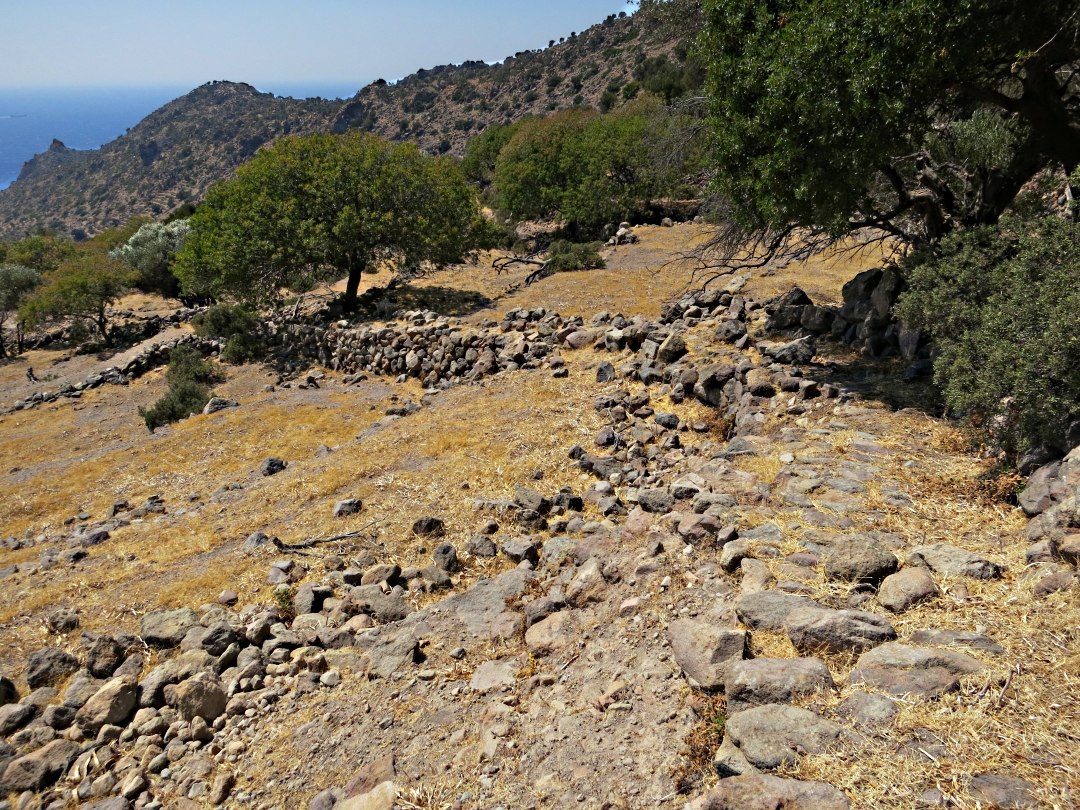
The path, clear and well marked by Red Paint Man and the occasional stone cairn, flanks the increasingly dramatic Vasilios Gorge until it reaches the edge of the limestone cliffs.  The monastery is clearly visible below, sharply outlined against the sea, with stone steps zig-zagging down to it.
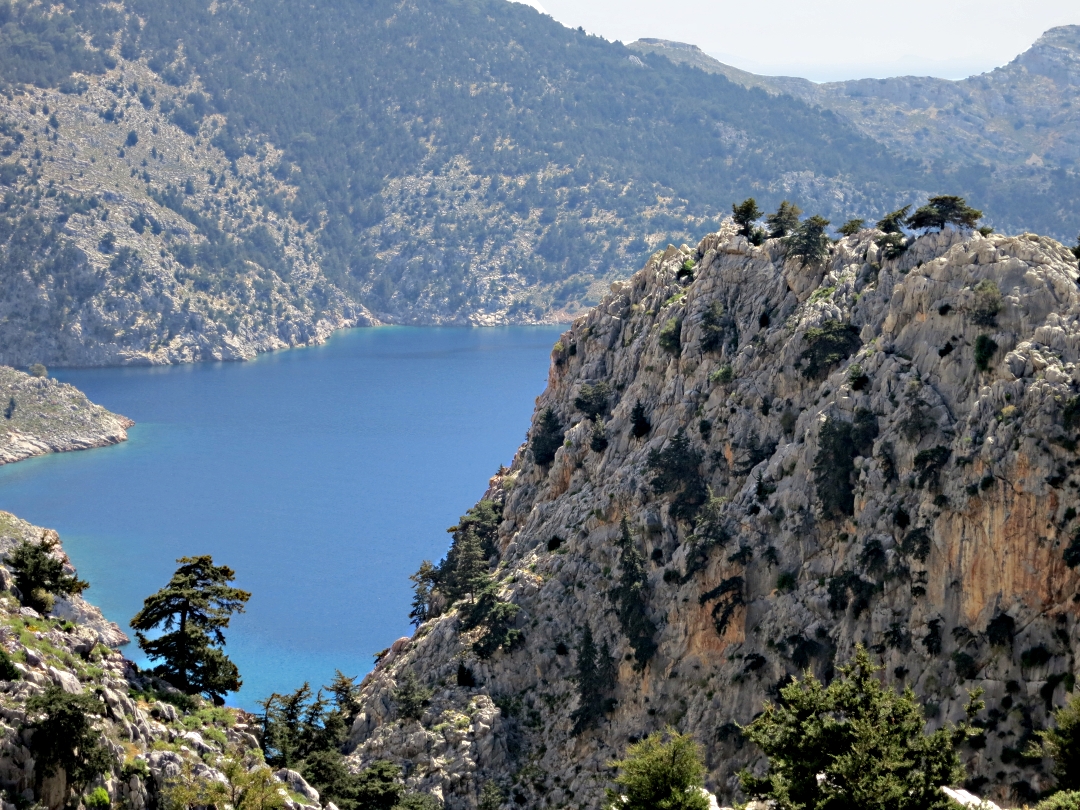
Lapathos Bay comes into view down the Vasilios Grge

Lapathos Bay comes into view down the Vasilios Grge

Looking down to the tiny cliff-edge monastery of Agios Vasilios with Lapathos Beach below

Looking down over the razor-sharp rocks to the tiny cliff-edge monastery of Agios Vasilios with Lapathos Beach below

The way down to Lapathos beach, 200 feet below, is steep.  Initially down rocks in a gully between cliffed walls, and then on loose stony ground, it doesn’t require any specialist climbing skill but it does involve rock scrambling using hands as well as feet and requires a degree of nerve and confidence.

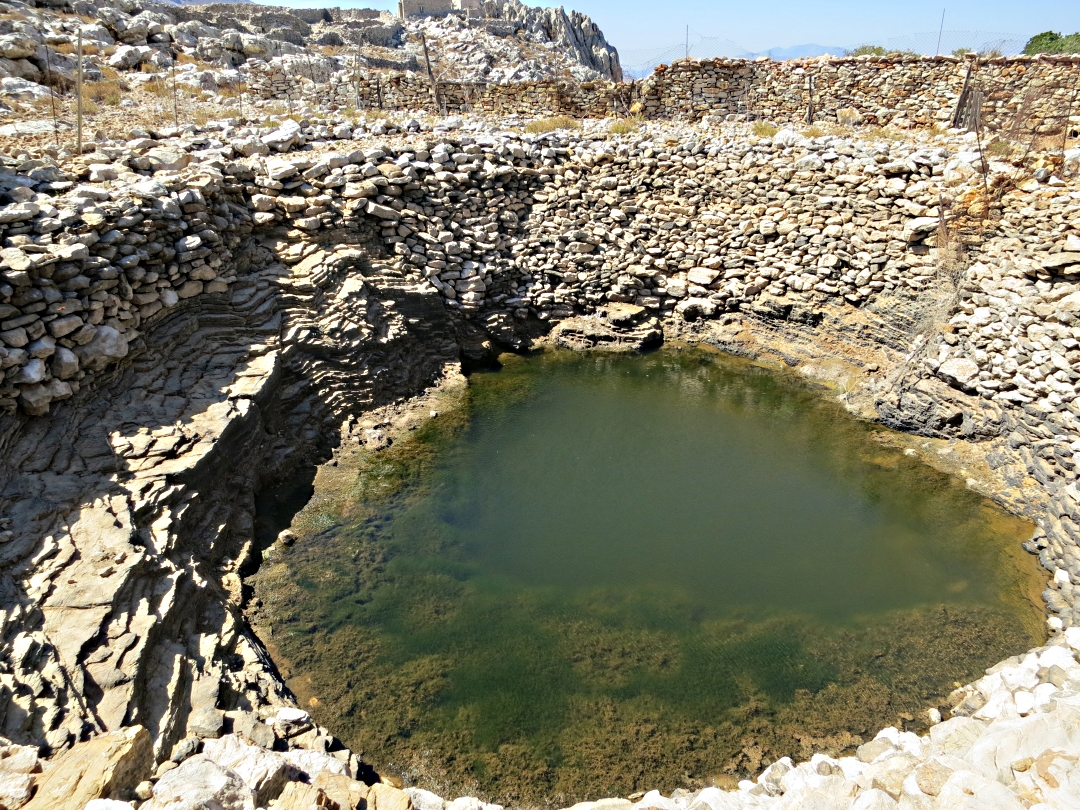
The descent is worthwhile.  Few make it this far even in the height of summer and the beach, backed by cypress trees affording shade, is plenty big enough to ensure privacy …. unless the Round-the-Island trip boat pulls in when circumspection in dress-code is advisable for the hour it stays.  A towering cliff midway along the beach has a fenced pond at its base, though I wouldn’t try drinking the water.
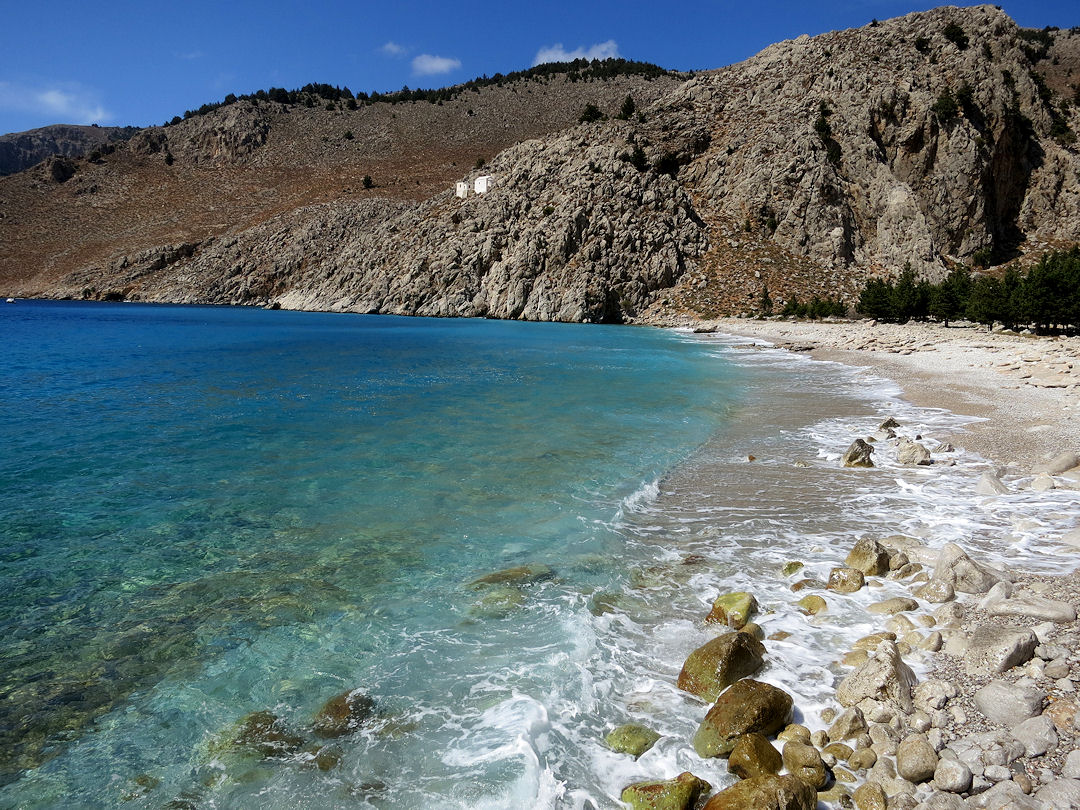
Looking along the beach towards the monastery perched on the cliff

Looking along the beach towards the monastery perched on the cliff

The Vasilios Gorge, emerging onto the beach at the bottom of the descent path, is even more dramatic from the bottom than the top and well worth exploring.  With a bit of mild rock climbing capability it offers a very interesting ‘off-piste’ alternative route back.
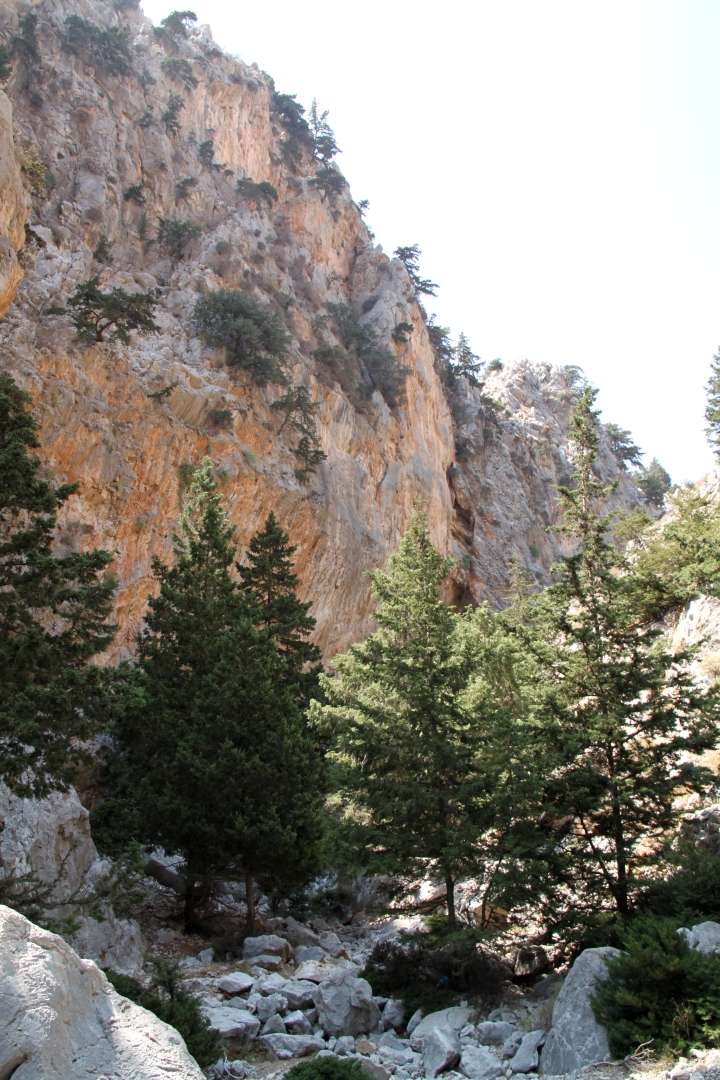
The bottom end of the Vasilios Gorge

The multi-coloured cliffs at the bottom end of the Vasilios Gorge

Rock pinnacles and bonzai pine trees add drama

Rock pinnacles and bonzai pine trees add drama

A little rock climbing on dry waterfalls is necessary to progress up the gorrge

A little rock climbing on dry waterfalls is necessary to progress up the gorrge

In July and August the walk back up to the ridge can be energy sapping in the heat of the afternoon but in September the sun isn’t as high, temperatures are lower and there is often a cooling breeze.  However in the gorge the air is still and the limestone walls reflect and radiate heat stored up all summer.  I learned by hard experience on Tilos a few years ago the effects of dehydration and I pour water down my throat at frequent intervals.  By the time I get back to the shade tree at Agia Paraskevi the ice in my 1½ litre bottle has all melted but the last inch of water is still refreshingly cold.  For the final 20 minutes of the return to Horio my thoughts are split between ogling at the view stretched out ahead, which I’m convinced is one of the best in Greece, watching my footing on the stone-paved path, and anticipating a cold beer.
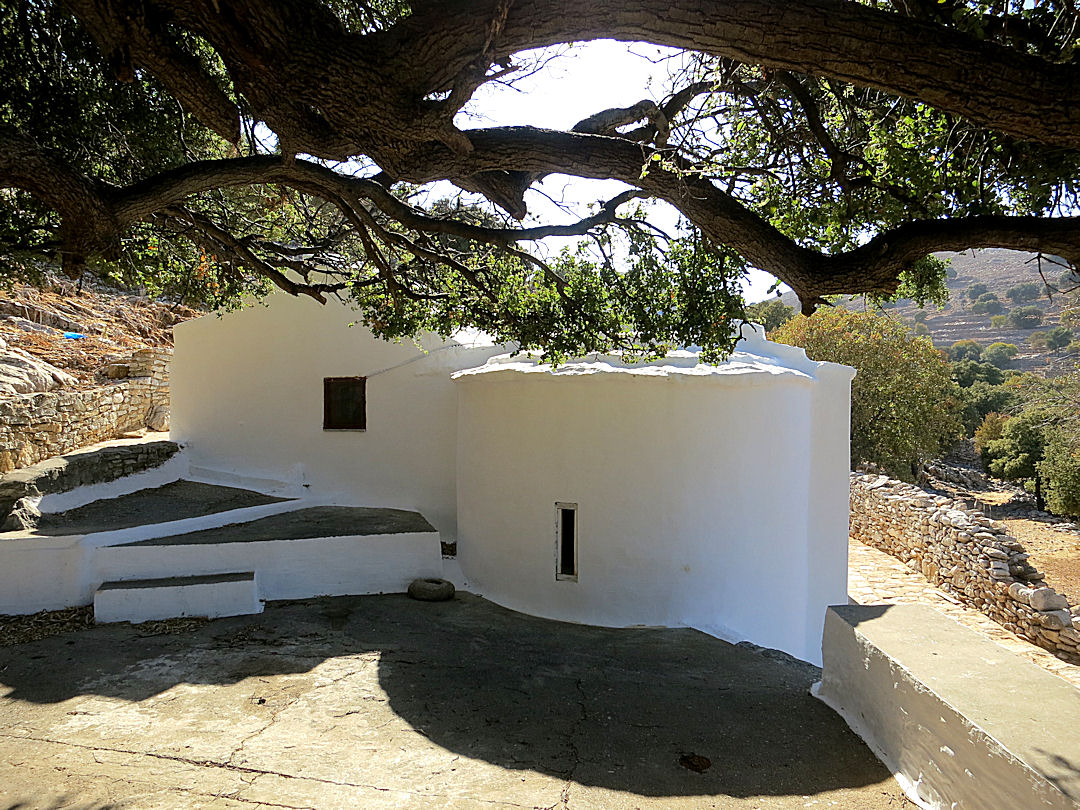
A last stop under the shade tree at Agia Paraskevi

A last stop under the shade tree at Agia Paraskevi

If you want to hike to Vasilios, there are two Walking Guides to help (click links below).  The first takes you up to the Viewpoint above Horio, the second from there to Agios Vasilios and the beach.  There are a few mistakes, such as reference to the trees as juniper when they are in fact cypress, and changes have taken place since publication.  For example the ‘Glaros’ taverna in Horio (photo 2 on Walk 1) is renamed and the oval metal sign has been repainted… but the steps opposite are still there.  Some derelict buildings have been renovated or rebuilt and two shops referred to have closed. Hopefully revisions will be made next summer.

Symi walk 1- Viewpoint

Symi walk 2 Ag Vasilios

x


Posted in Greece, Hiking, Landscape, Mountains | Tagged , , , , , , , , , , , , , | 4 Comments

Symi: below the surface

It has always struck me as odd that Symi, an island made up almost entirely of limestone, has no cave systems, or at least none that I could find out about.

The ‘Round-the-Island’ boat trips advertised from the harbour offers a “Visit to Cave for swimming”.  When I went on the trip some years ago I swam from the boat into the cave but it seemed shallow, no obvious opening further in, at least above water level.  Just a sea cave.

There is a cave, Spilia Skordhalou, part way down the long path from the spine of the island to Nanou Beach but though a fairly large opening that also had no depth and no obvious way on.

Symi has the reputation of being the hottest and driest of the Greek islands and I have heard it said many times that the island has no water.  Indeed until the commissioning of the desalination plant a couple of years ago water was brought to the island several times a week by sea tanker from Rhodes.

But there is water, apart from that collected in sternas from run-off.  I know of at least 5 permanent ponds. Two of them are on beaches and so probably brackish, the others are at a higher level including one at Gria, a deserted village at about 200 metres above sea level (see the end of the last post ).  The water in these ponds is not from run-off because levels remain fairly constant throughout the summer drought. They must therefore be fed by underground aquifers.

It has been suggested, on Tilos not on Symi, that it is difficult to account for the reliability of flow of freshwater springs purely by rainfall on the island.  It is further suggested, quietly, that there may be aquifers under the sea from nearby Turkey which shares a similar geology and has significantly higher rainfall than the dry, hot rocks of the Greek islands offshore.   I haven’t been into the system but Otter Hole, a cave system near Chepstow in the Wye Valley, runs under the tidal river.  The Aegean is wider between Turkey and the islands but not enormously so, indeed it is a swimmable distance, though not for me.  It seems a plausible hypothesis but I know of no direct evidence.

There are also springs on Symi as well as on Tilos.  I know of at least 3 with a constant flow.  The monastery of Zoodohou Pighis, meaning ‘water of life’, at about 260 metres ASL and not much more than 1 km along the mountain flank from the Gria pond, has a spring long ago tapped for monastery use in the courtyard.  Now it is tapped to feed showers for tourists with a black polypropylene pipe on the surface stretching the 2 kms to Horio, heating the water as it flows.  Where did that water go before it was tapped in such large amounts?  What are the hydrological and hydrogeological consequences of such large-scale abstraction?  I have known planning inquiries turn on such issues but that is not my point here.

So there is plenty of evidence of underground water on the island.  Water flowing through limestone usually erodes it physically and chemically resulting in …… cave systems.   There is also plenty of evidence of water eroded limestone on the surface of Symi with whole sections of mountainside covered in rocks sculpted, smoothed or sharpened by water.  Why not underground?

I have walked a lot on Symi, much of it ‘off-piste’, but seen no evidence of cave openings at top or bottom of any systems.  True, the spring at Zoodohou is behind a locked steel door so poking around in a water supply would not be encouraged.  True the resurgences could be below sea level, including perhaps the ‘Round-the-Island’ cave.  Yet I had hoped to find something I could get into.  If the resurgences are below sea level they would be sumped.  I have free-dived sumps in Swildon’s Hole in Somerset but they are a known quantity.  Here they are complete unknowns

As a teenager I used to catch the train into the Derbyshire Peak District.  Most of the time I went to the Dark Peak, millstone grit country, but increasingly I started visiting the White Peak, dry valleys cut into limestone.  There I would find cave openings in the side of the crags and armed with a hand-held, tinny metal torch and a bobble hat (‘toque’ for North American readers) I would crawl in and explore.  I loved it.  The tighter the squeeze the more fun it was.  My mother didn’t think so because inevitably I arrived home caked in mud and eventually I was banned.

Wondering about the absence of evidence of cave systems on Symi isn’t something which keeps me awake at night but it is something which niggled away at me.  It was therefore with some excitement that, following a discussion over a nightcap in Lefteris’s Kafenion, that on my last day on the island, indeed my last day in Greece this year,  a friend who lives on the island and I set out to look for a cave that she remembered visiting 20 years ago.

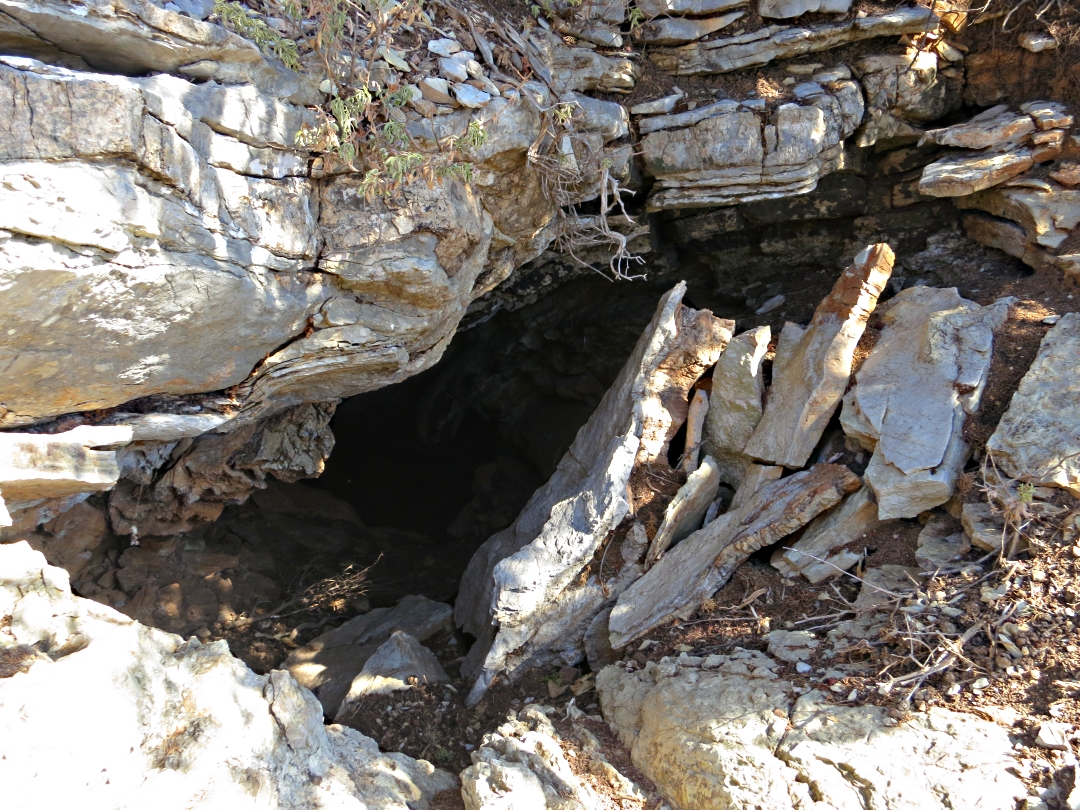
After an hour and a half walking, coming out of the cypress forest into a rocky clearing on the shoulder of the mountain at about 250 metres ASL, overlooking Skoumisa Bay and the island monastery of Agios Emilianos and its causeway …… we found it!  What a memory!!!  What a triumph!!!

The entrance was not enormous, smaller than that on the Nanou path, but significantly bigger than some systems I have been in.  It was like going back to my teenage days in Derbyshire.  With no proper clothing (I was in shorts, T-shirt and sandals) and armed only with torches and sunhats we went inside.

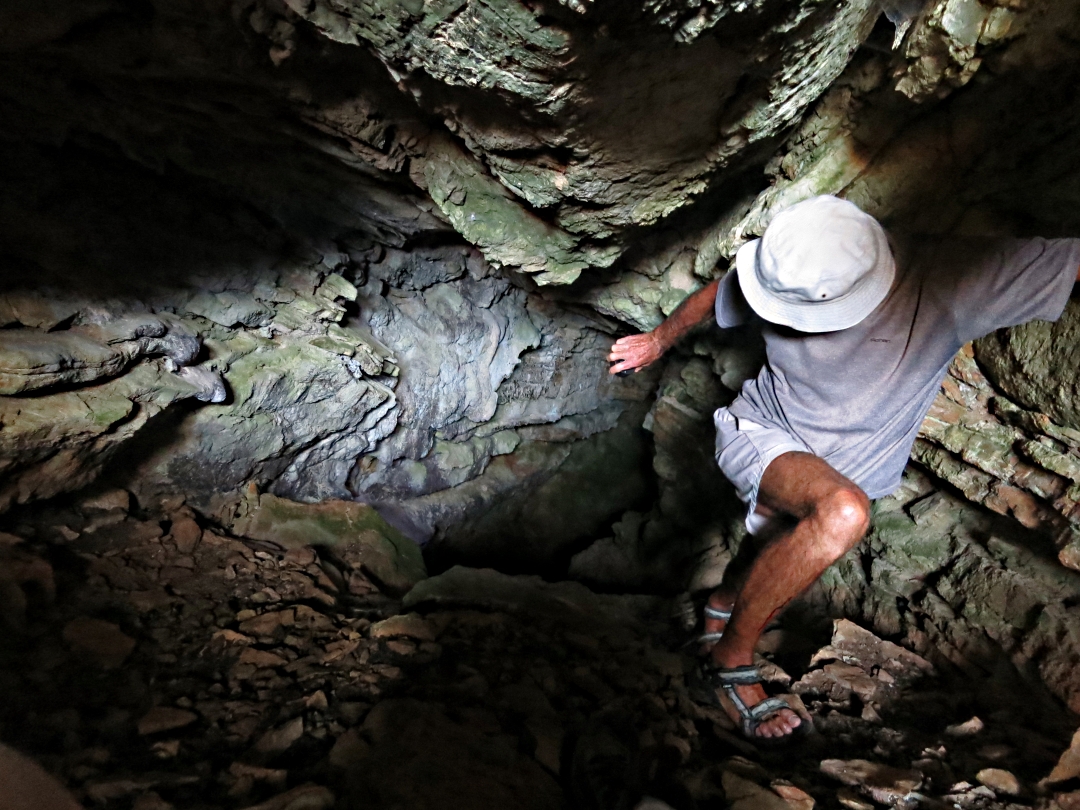
The ground dropped away steeply, sloping at more than 45 degrees from the horizontal following the dip of the strata and was very loose.  Nevertheless with great care not to cause a slide or dislodge large pieces of delicately balanced rock we managed to get far enough inside to establish that this was not a shallow scrape like so many others.  As it descended, the passage turned to the right and the entrance was soon out of sight.  Reaching a point where it dropped sharply and continued to veer rightward it was time to resist the urge to go deeper, quell the euphoria, and carefully climb back upwards.

Looking down from the shoulder of the hill to Skoumisa Bay and the island monastery of Agios Emilianos

Looking down from the shoulder of the hill to Skoumisa Bay and the island monastery of Agios Emilianos

The cave opening

The cave opening

Pink calcite deposits on one side of the passage

Pink calcite deposits on one side of the passage

Creamy calcite overhead

Creamy calcite overhead

Silhouetted against the entrance

Silhouetted against the entrance

Climbing back out ..... carefully

Climbing back out ….. carefully

We were both buzzing as we headed back to Lefteris’s to tell the sceptics.

We would need to return another day with more appropriate gear. But not this year.  As the last day of my summer in Greece it was pretty special.

Posted in Greece, Hiking, Landscape, Mountains, Nature | Tagged , , , , , , , , , , , , | 5 Comments

Symi: going off-piste

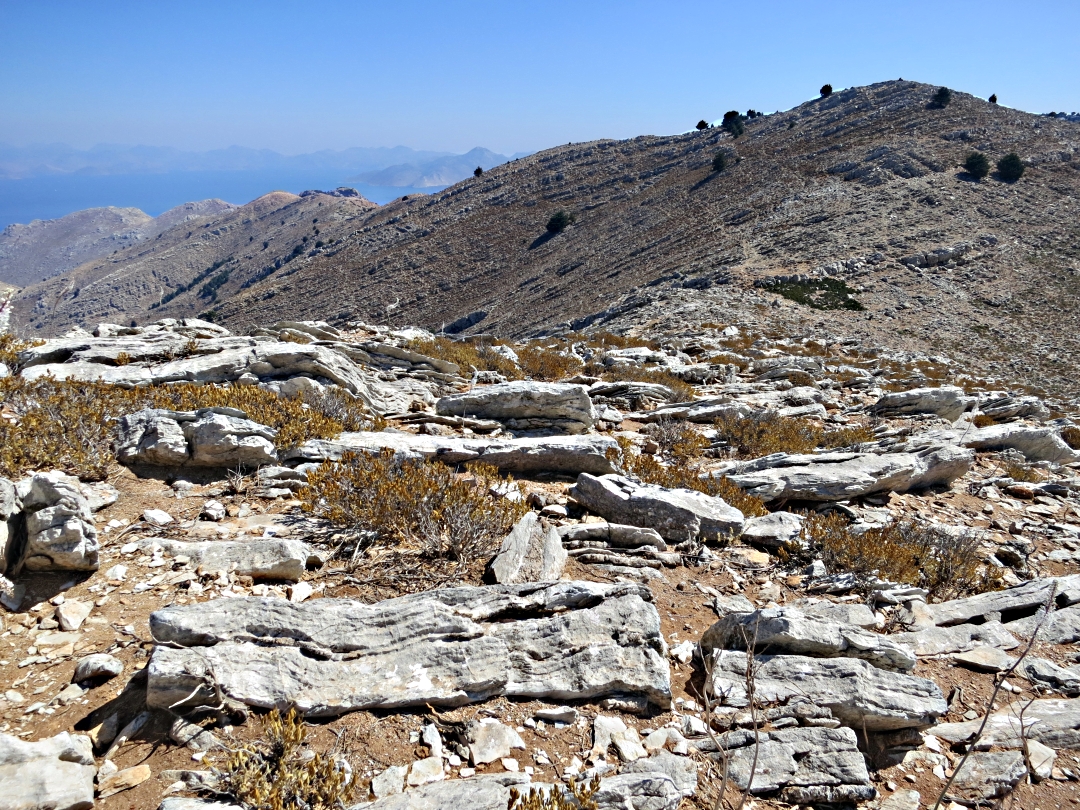
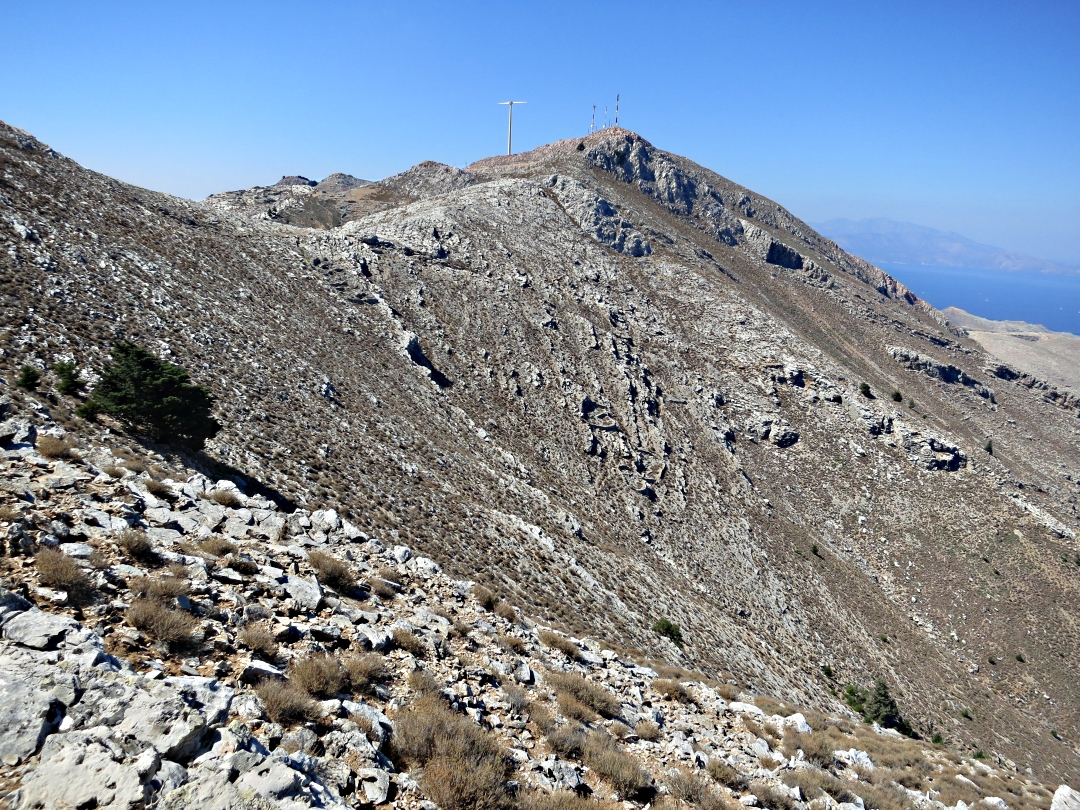
The top of Vigla, the highest mountain on Symi, is always a little disappointing.  There is a whole array of telecommunication masts on the adjoining peak, with a road for their construction and maintenance bulldozed on the south side.  A new wind turbine is within spitting distance of the trig point.  After 4 years it continues to be non-functioning, two blades sticking out horizontally like arms on a skinny, headless scarecrow.  I’m told it’s of German manufacture and there is reluctance to provide a replacement for the faulty component until the bill is paid.  There is solitude but no sense of isolation on top of this mountain.

The satisfaction is in getting there the hard way, straight up the north scarp from Horio, the old village above the harbour.  There is no path beyond the monastery at its foot and even the path to there is in a poor state since a road access was pushed in from the tarmac at a higher level.  My preferred route is to climb a long rib of rock rising steeply from the monastery, more exposed though more reliable and secure, but closer to the top an upward diagonal traverse on very loose material is necessary before getting back onto rock outcrops.  Like the rest of Symi the rock is limestone, in places sharp as razors, elsewhere  smooth and  tilted, near-vertical slabs.  On lose ground thin shards, hard as steel, slide over one another, clinking metallically when they flip over.

It is clear that this is terrain little visited.  Few Greeks walk/hike/trek anyway.   The local sheep farmers and goat-herds tend to call their animals not chase around the mountain after them.  The number of visitors who venture into the mountains is diminishing and almost exclusively tend to follow well trodden paths to well known beach destinations, principally Agios Vasilios, Agios Emilianos, Agios Nikolaos, and Agia Marina.

After 15 September, the start of the hunting season, shooters roam the mountains in pursuit of their quarry, rock partridges. Usually well camouflaged, the only indications where they have been are empty shotgun cartridges scattered around.  I saw none on Vigla’s northern scarp.   That means that even the hunters don’t come here so little prospect of being found in the event of an accident. More than usual care is therefore essential.  Nevertheless I make good time and reach the modest 617 metre summit in less than 2 hours.

Getting towards the top and looking down over the town and Pedi Bay

Getting towards the top and looking down over the town and Pedi Bay

Zooming in on the harbour

Zooming in on the harbour

The trig point on the summit looking beyond Europe to Asia Minot

The trig point on the summit looking beyond Europe to Asia Minor

Ignore the masts and the wind turbine and in late summer sunshine from cloudless sky with a gentle breeze it’s a great place to be with views to the south of mountain-top monasteries such as Agios Stavros Polemou, to the east beyond the edge of Europe to the coast of Asia Minor, to the west the islands of Tilos and Nisyros, …. and the island’s landfill site.

Eventually I reluctantly leave my eyrie and set out to walk northeast to the end of the ridge, again with no footpath.  Having dropped down sharp limestone rocks from the top to long-abandoned agricultural terraces on the narrow ridge, initially the route is across inclined slabs of rock, jumping from edge to edge, heading for a thin path made by goats migrating from one part of the mountain to another.

The goat path is at first very clear, a narrow line of dusty soil meandering through the oregano, sage and thyme, then hoof-polished rock picking the line of least resistance up craggy outcrops.  As goat paths go this is well worn, the equivalent of a major trunk road, probably travelled over centuries.  However when it comes to open, lose ground it disappears as the animals disperse before coming back together and the path resumes.  My guess is that the kids learn the routes from the adults, much like hefted sheep in the Lake District, but I don’t have that advantage and need to cast around to find the route again.  Easy to see and follow when on the line, it is all but invisible from above or below, hidden in the vegetation.

Rock slabs sharply inclined

Rock slabs sharply inclined at the start of the traverse along the ridge

The beginning of the goat path

The beginning of the goat path

Looking back to the summit from one of the intervening rock otcrops

Looking back to the summit from one of the intervening rock outcrops

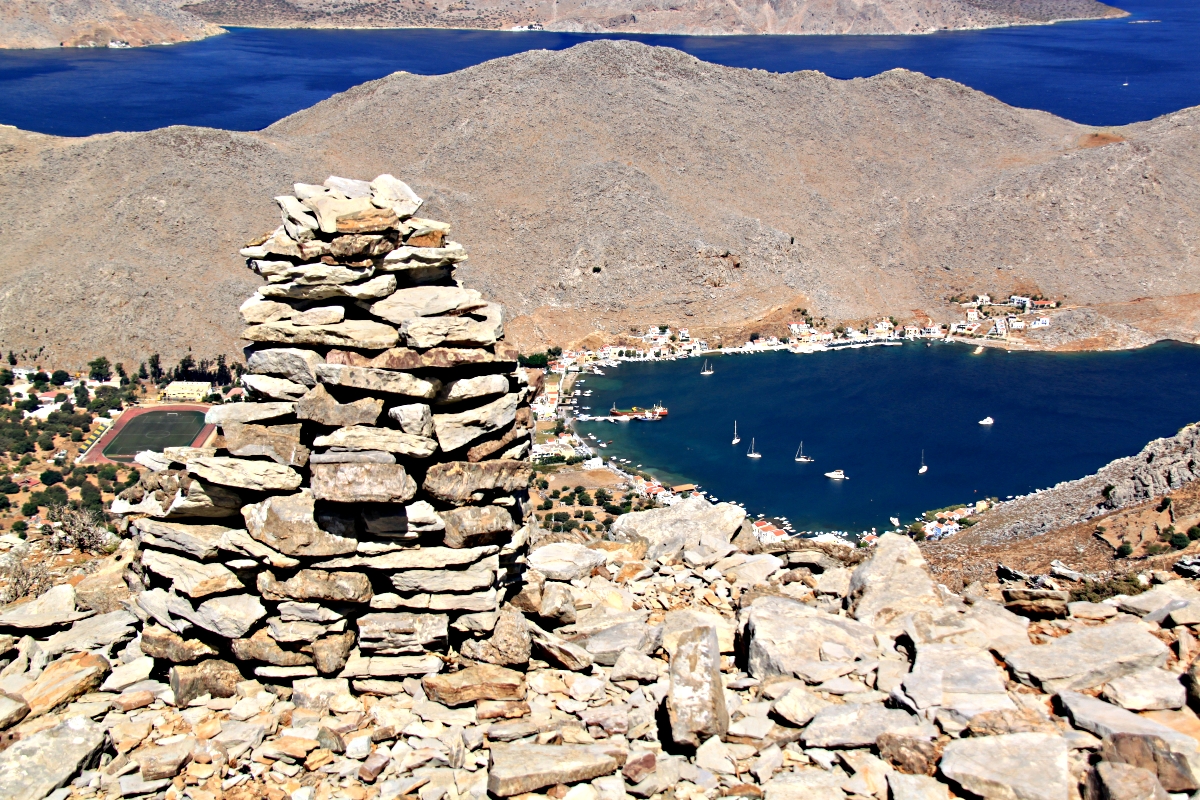
An hour and a half after leaving Vigla I’m standing on a smaller 440 metre peak at the far end of the ridge marked by the remains of stone buildings and a stone cairn 1½ metres high overlooking the abandoned village of Gria and below that Pedi Bay, Symi’s other major anchorage.

First a steep drop down to Gria with its derelict houses, fig trees from which we picked figs 10 years ago but now crumbling to dust, and its stone-lined pond still with water in even after the long summer drought.

The stone cairn with Pedi Bay far below

The stone cairn with Pedi Bay far below

View of Pedi Bay through the squill on the top of the ridge

View of Pedi Bay through the squill on the top of the ridge

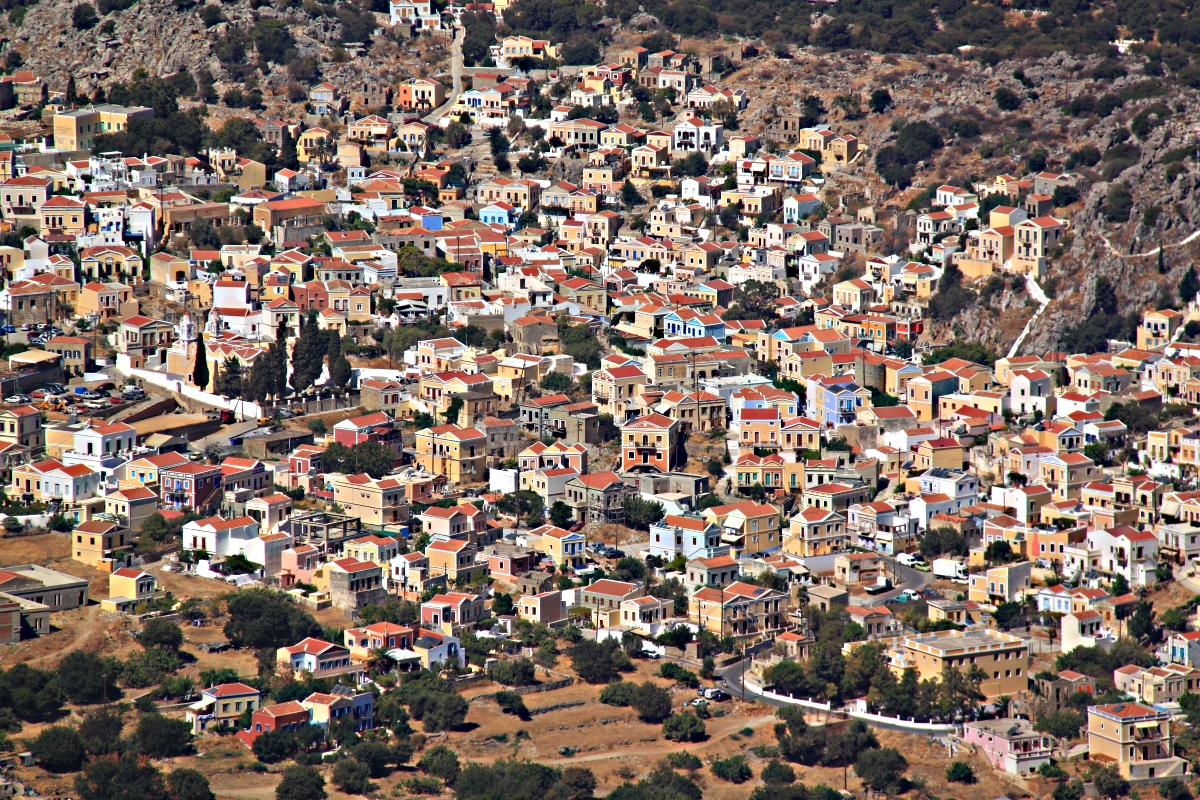
Zooming in on Horio, the old town above the harbour from the ridge top

Zooming in on Horio, the old town above the harbour 

Part way down the end of the ridge looking back to the summit and the rib of rock which I followed to the top

Part way down the end of the ridge looking back to the summit and the rib of rock which I followed to the top

Looking down to the stone-lined pond

Looking down to the stone-lined pond

..... which still has water after the severest of summer droughts

….. which still has water after the severest of summer droughts

Part of the now abandoned village clustered close to a prominent crag

Part of the now abandoned village clustered close to a prominent crag

The final 200 metre drop to sea level is down the rocks of a dry stream gulley, airless and very hot from direct sun and reflected and refracted heat from the storage-heater limestone.  Then a swim in the gorgeous waters of the Aegean to soak tired muscles before the gentle stroll up the valley path back to Horio and a very welcome beer.

x

Posted in Greece, Hiking, Landscape, Mountains | Tagged , , , , , , , , , , , , , , , | Leave a comment

Greece: more high speed island hopping

Now that inter-island travel is both more rapid and more reliable it’s a viable option to  hop from island to island for brief visits and sometimes when moving on it’s possible to make connexions without an overnight stay where there are no direct links

During the month I was on Nisyros I took time out to visit friends on Kalymnos where I spent a very enjoyable Greek Easter in early May.  High speed catamaran to Kos and a frappé later a hydrofoil to Kalymnos.

On Kalymnos I took the opportunity of having got accustomed to the heat of a Greek summer, by the end of August past its most intense anyway, to tackle a long and challenging walk circumscribed by a very limited bus timetable. The 09.20 bus from Emborios at the northern tip of the island got me to Chora with its crusader castle by 10.15, then trek to the top of Profitis Ilias the highest mountain on the island, long drop down to the Vathy Valley on the other side, trek along the valley floor and then one of the best kalderimia in the Aegean, the Italian Path, back over the ridge to Pothia, the main town.  Made satisfyingly good time so able to enjoy a beer and a WiFix on the harbourside before the 17.00 bus to Emborios.  Great evening with friends and then bus and two cats back to Nisyros the next day.

Passing beneath the crag topped by the crusader castle

Passing beneath the crag topped by the crusader castle

... and looking back to it as I climb higher

… and looking back to it as I climb higher

The last section up to the monastery on the summit

The last section up to the monastery on the summit

Looking down the flank of the ,mountain towards the distant fjord-like bay

Looking down the flank of the ,mountain towards the distant fjord-like bay

The path starts to wind its way down, clear in this section but not everywhere

The path starts to wind its way down, clear in this section but not everywhere

The top of the stone-paved Italian Path heading towards Pothia

The top of the stone-paved Italian Path heading towards Pothia

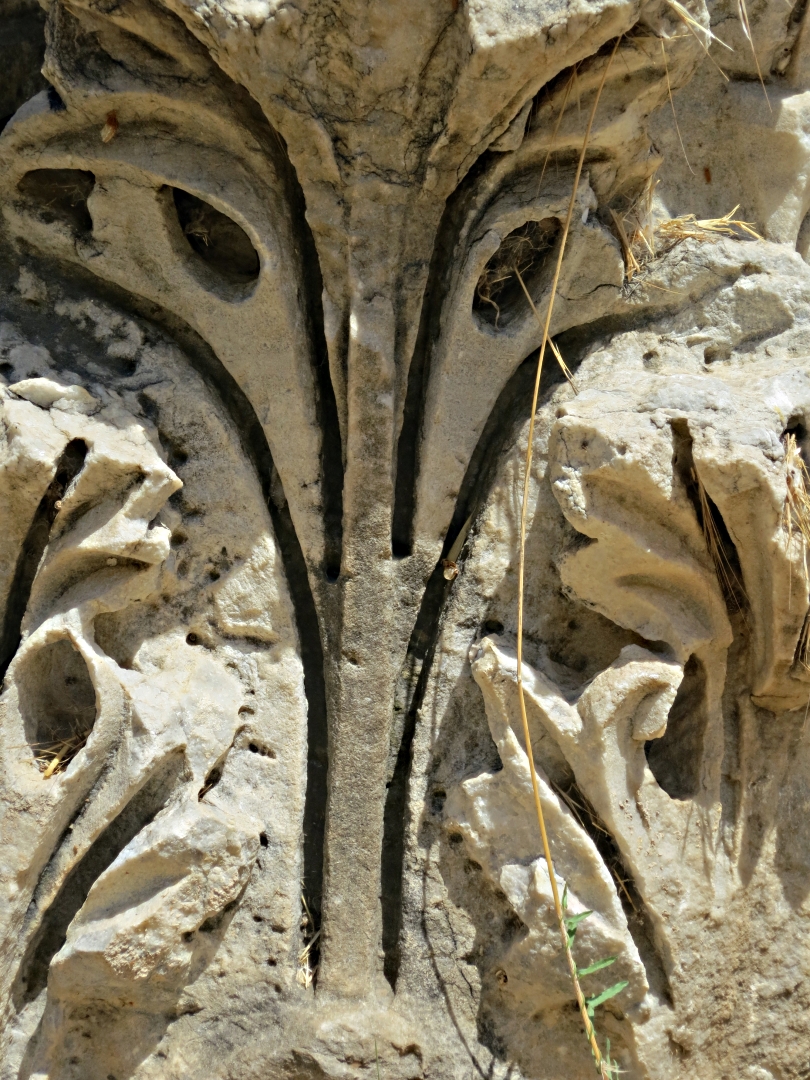
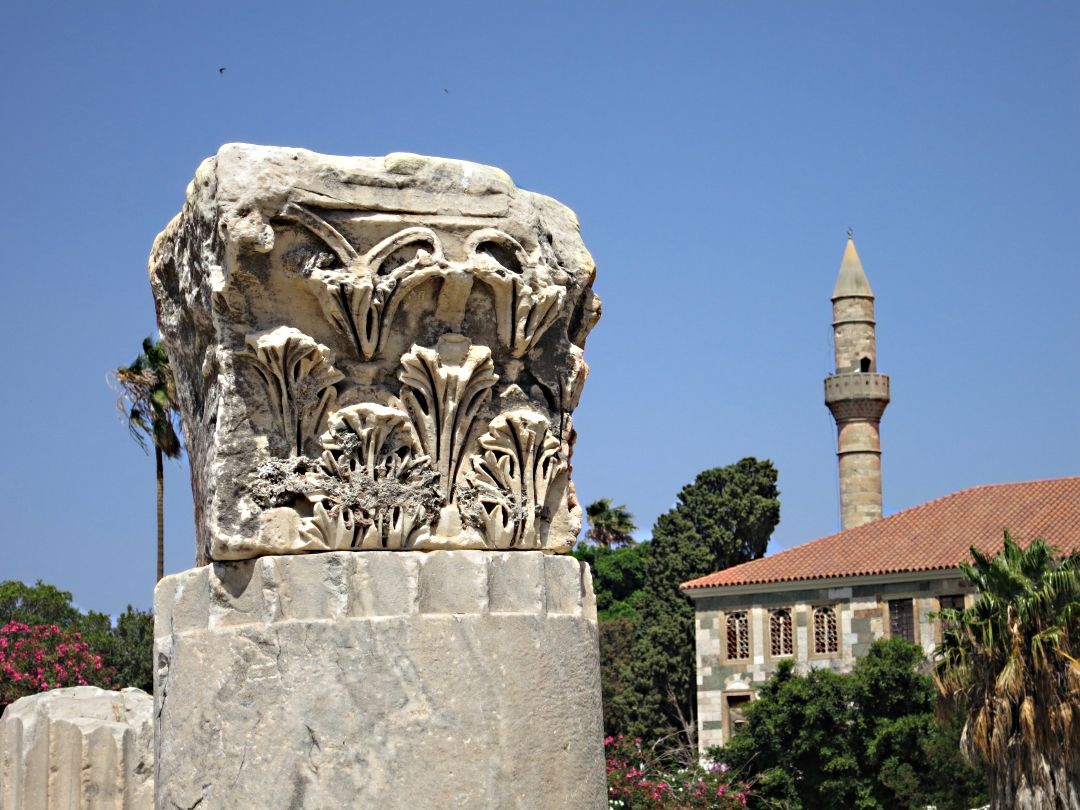
A little longer between cats this time.  Kos town isn’t my kind of place, too busy and noisy, but there are extensive archaeological excavations which offer a very interesting diversion for a couple of hours, and all entirely free.  I wandered around the extensive and constantly changing Old Agora excavation, right in the middle of the town with, among other features, many finely carved marbles.

One of the impressive carved marble figures

One of the impressive carved marble figures

... found in several parts of the site

… found in several parts of the site

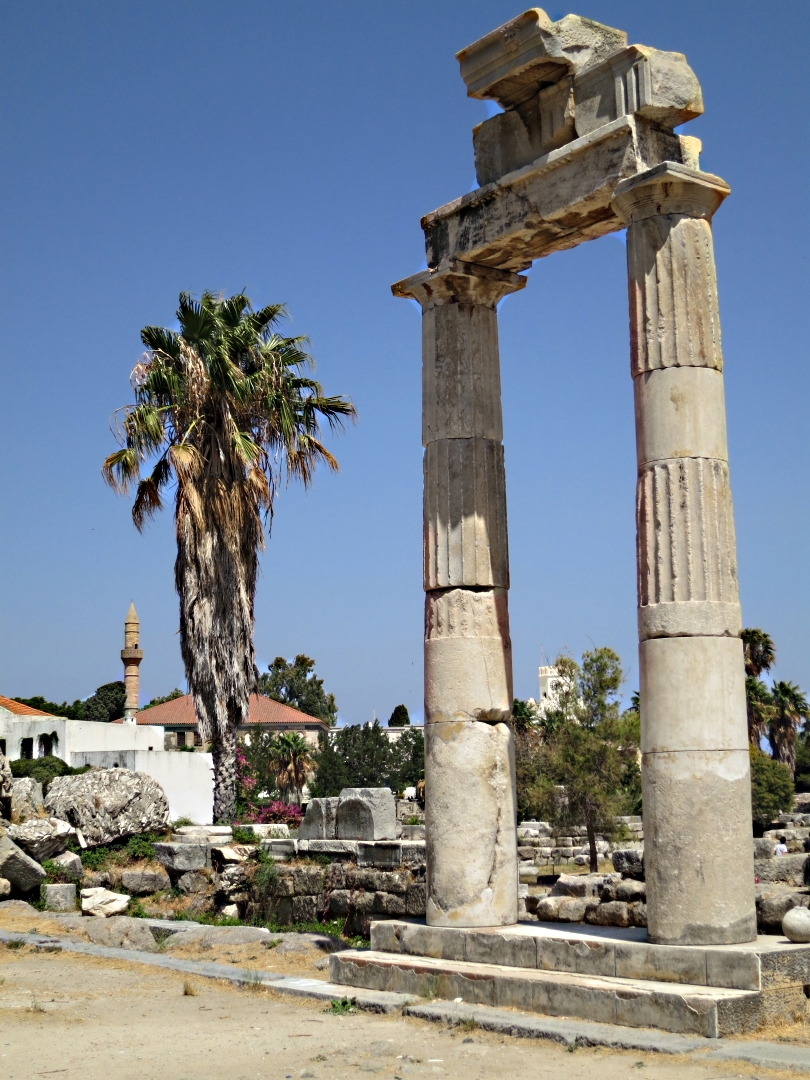
Two remaining columns

Two remaining columns

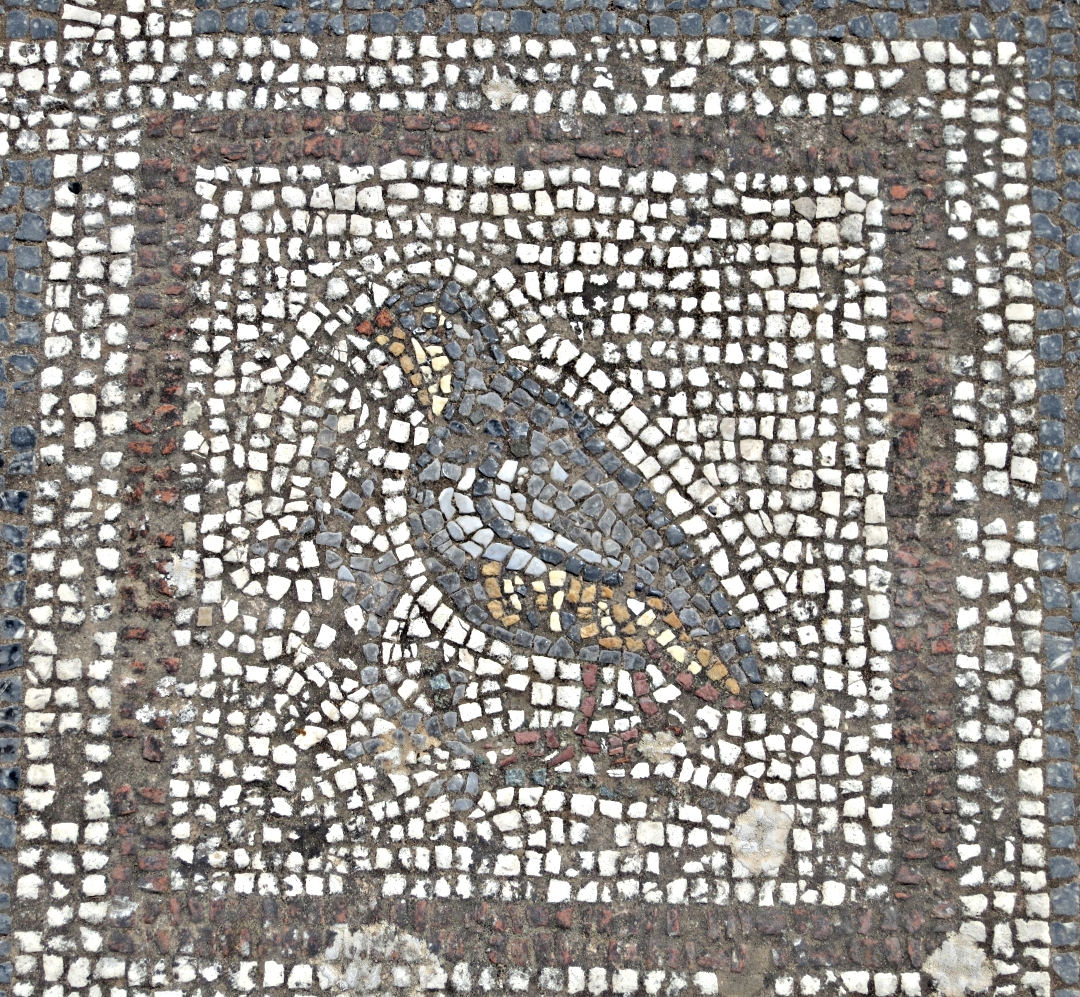
Ancient floor mosaic of the now much persecuted rock partridge

Ancient floor mosaic of the now much persecuted rock partridge

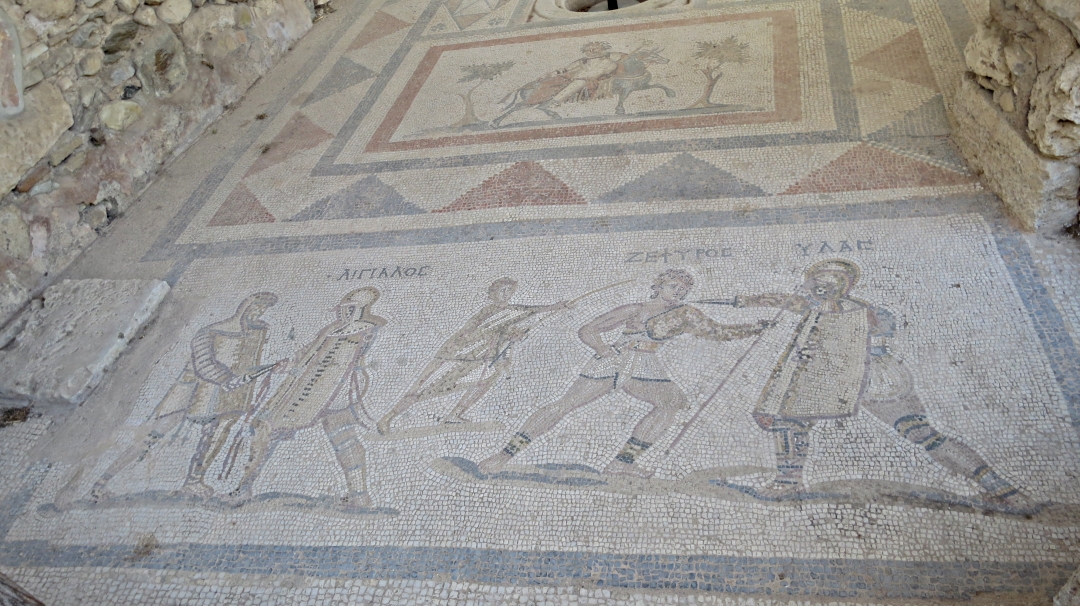
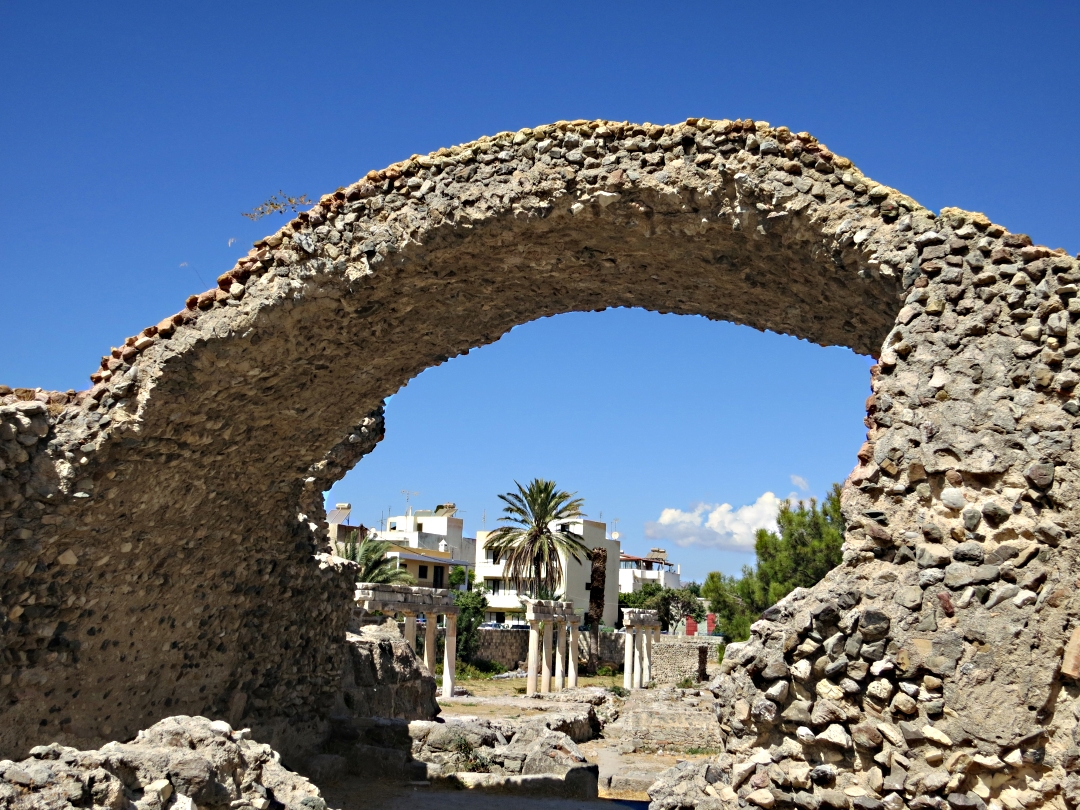
At the end of my stay on Nisyros I moved on to Symi but as there was no direct link at a civilised hour (the 05.30 Big Ship connexion on Friday’s doesn’t appeal)  again it was a matter of high speed cat to Kos and then another high speed cat to Symi.  Once more a couple of hours to explore yet another archaeological site, this time the Western Excavation alongside the inner ring road, less than 15 minutes walk from the harbour and 5 from the bus station  All very civilised and for someone with a very low boredom threshold like me, a real life-saver.

Mini-ret on the way to the Western Excavation

Mini-ret on the way to the Western Excavation

More extensive floor mosaics here

More extensive floor mosaics here

Large arch with some of the remaining columns beyond

Large arch with some of the remaining columns beyond

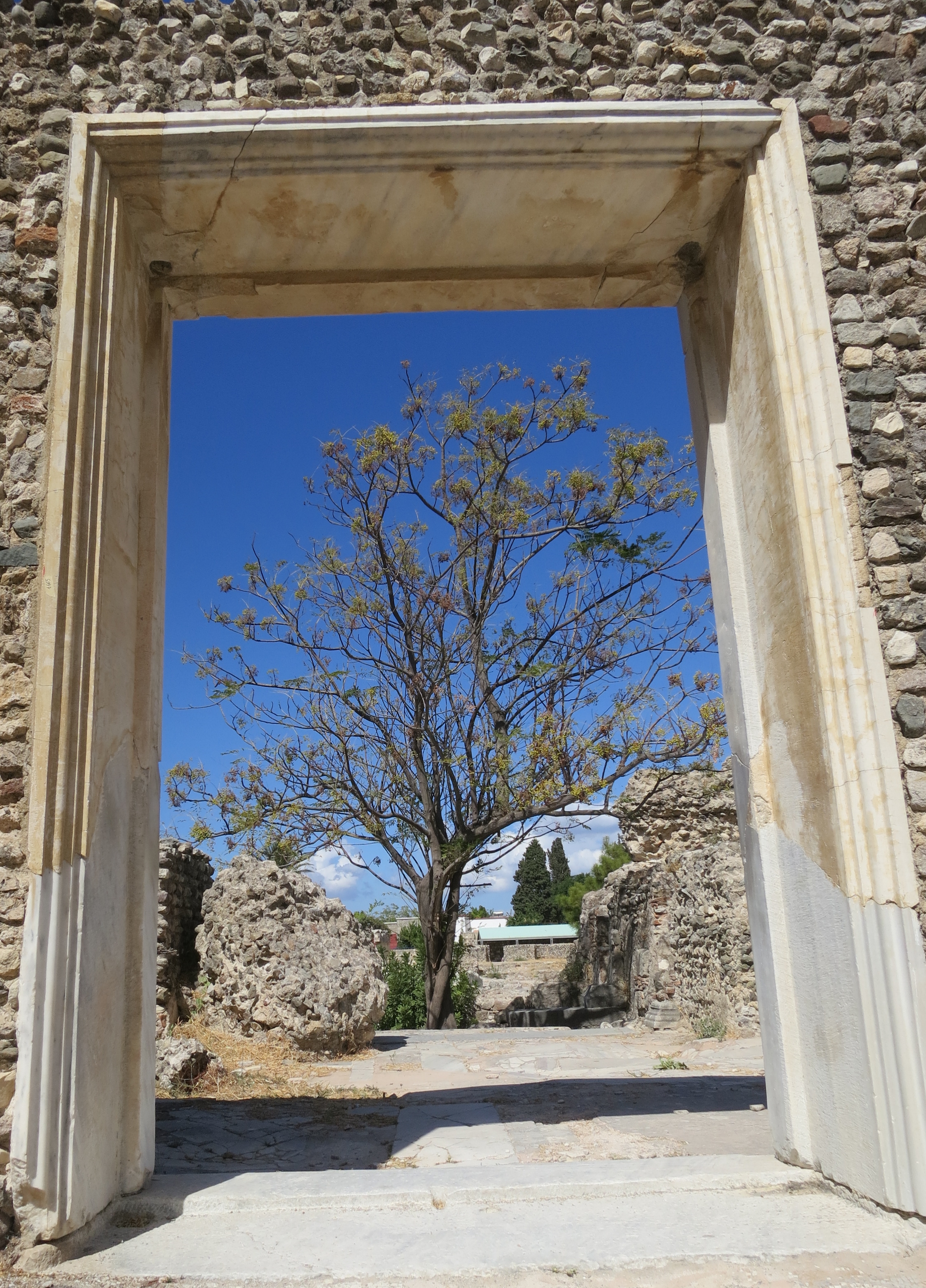
Framed

Framed

Arrival on Symi is always nostalgic.  Not only is it the first Greek island we visited and which hooked us irrevocably on Greece but it’s also where I rented a house for the summer of 2010.  So I know the island fairly well.  An opportunity to revisit favourite walks and exhilarating new ones.


Posted in Art, Greece, Hiking, History, Landscape, Mountains | Tagged , , , , , , , , , , , , , , , | Leave a comment

Nisyros: last glance before moving on

Many people ask which is my favourite island, which one out of the many I like and revisit  I prefer the most.  I’ve come to the conclusion that the answer is Nisyros. 

Nisyros is a volcano, far less well known than Santorini which has a worldwide reputation as ‘The Volcano Island’ in Greece, but with very dramatic and varied landscapes, history and archaeology.

Each time I come here I’m amazed how much of it I haven’t seen and which is so much different from everything else.  Seeing something new and dramatic every visit it’s easy to get almost blasé  about things which are now commonplace but, experienced for the first time, are jaw-dropping.

I’ve moved on now but before the blog moves on as well,  a last few images from Nisyros.

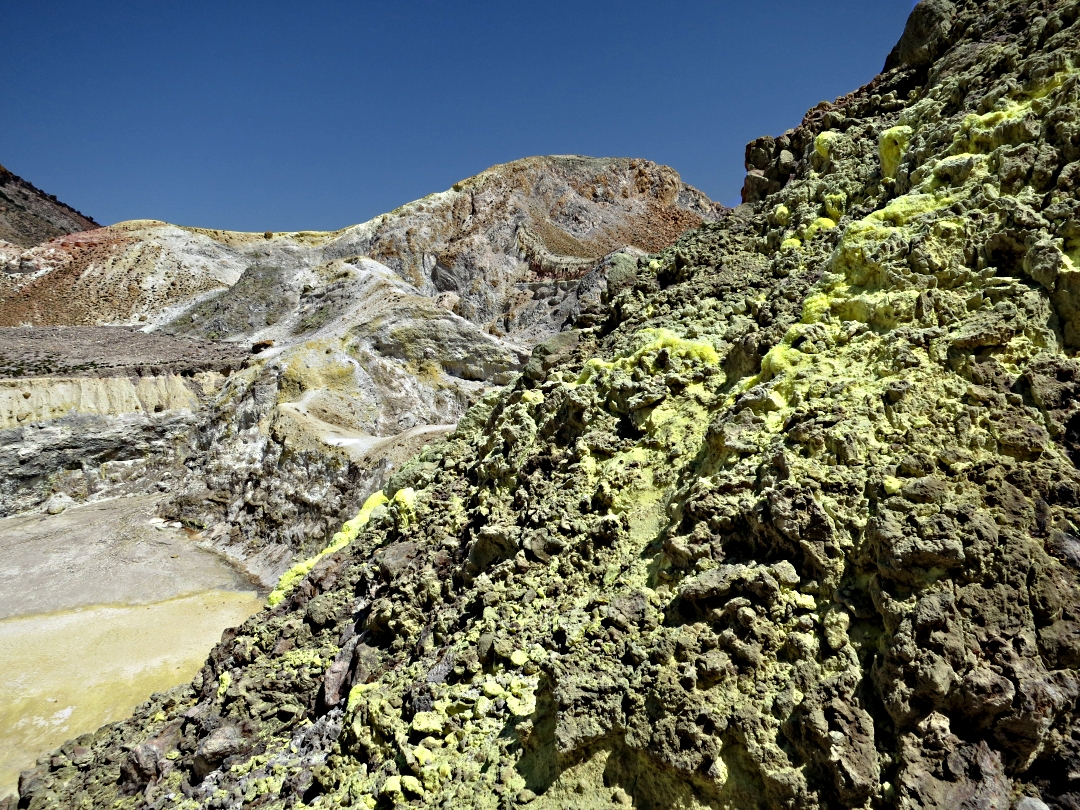
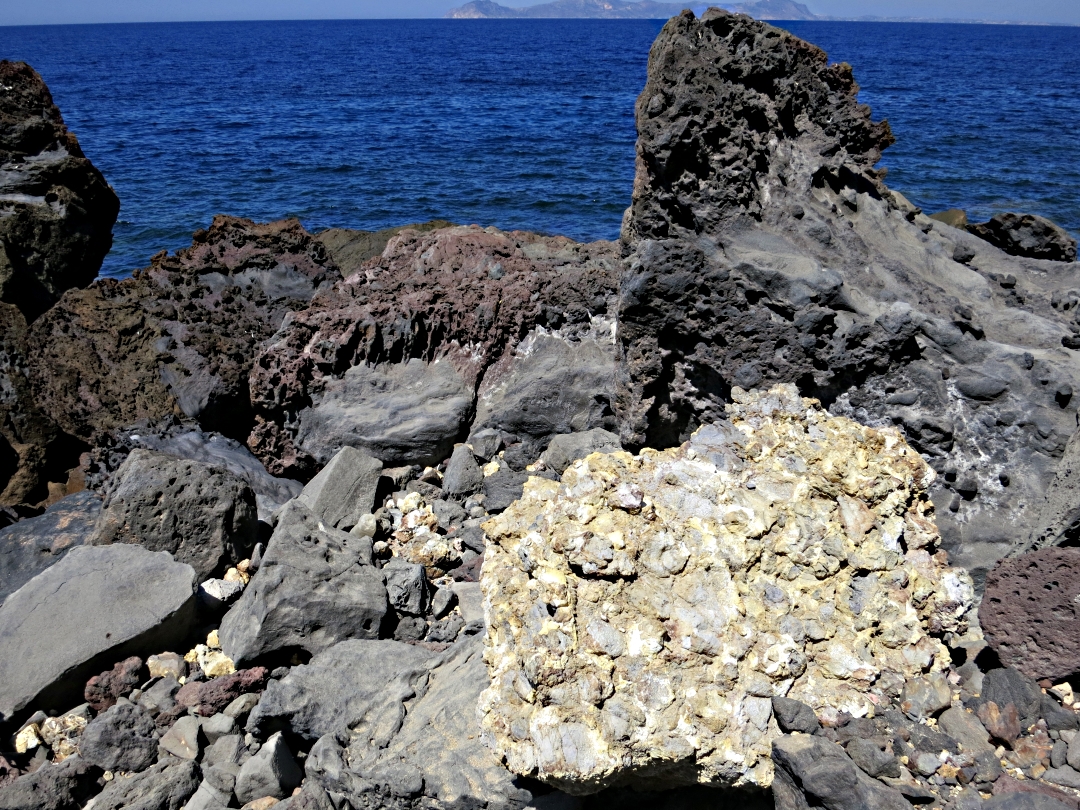
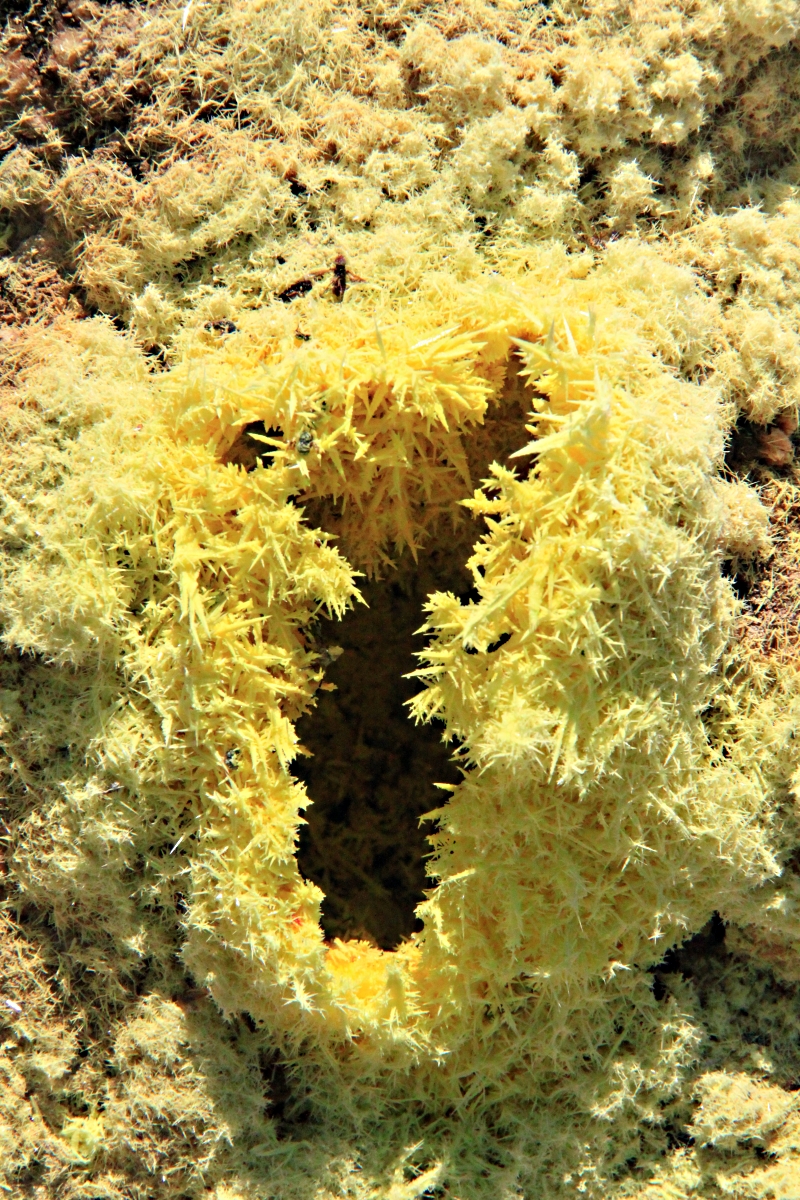
Sulphur encrusted fumarole in one of the caldera 'hot spots'

Sulphur encrusted fumarole in one of the caldera ‘hot spots’

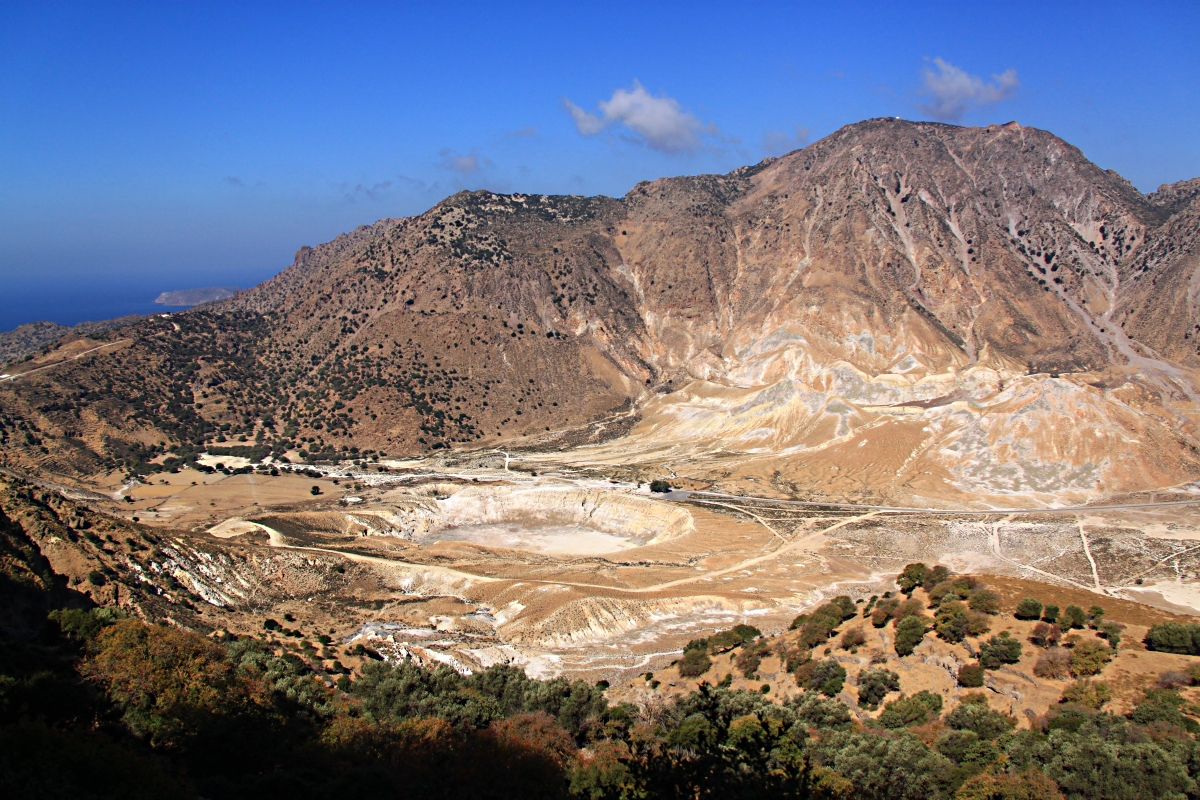
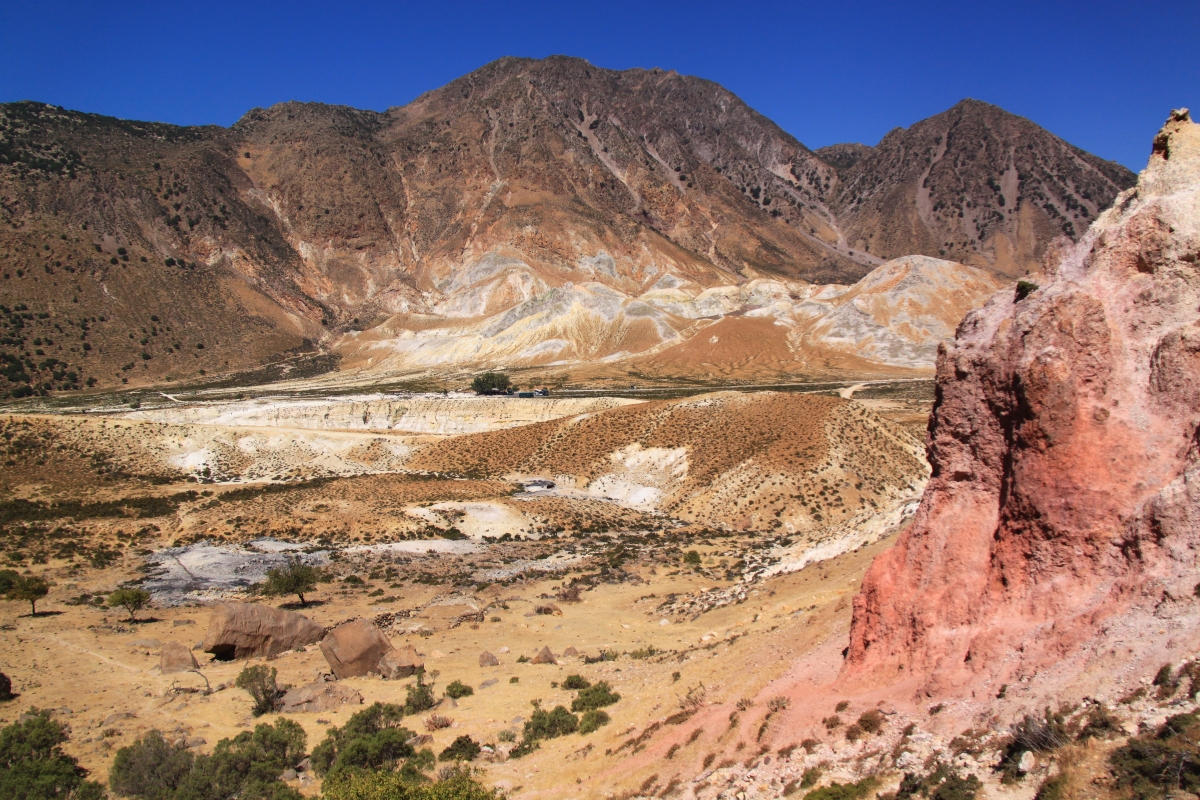
Looking down to the Stephanos crater from high level path

Looking down to the Stephanos crater from high level path

Tree very cleverly trained to follow the line of the crater rim around Nikia

Tree very cleverly trained to follow the line of the crater rim around Nikia

Lava pillars either side of a kalderimi

Lava pillars either side of a kalderimi

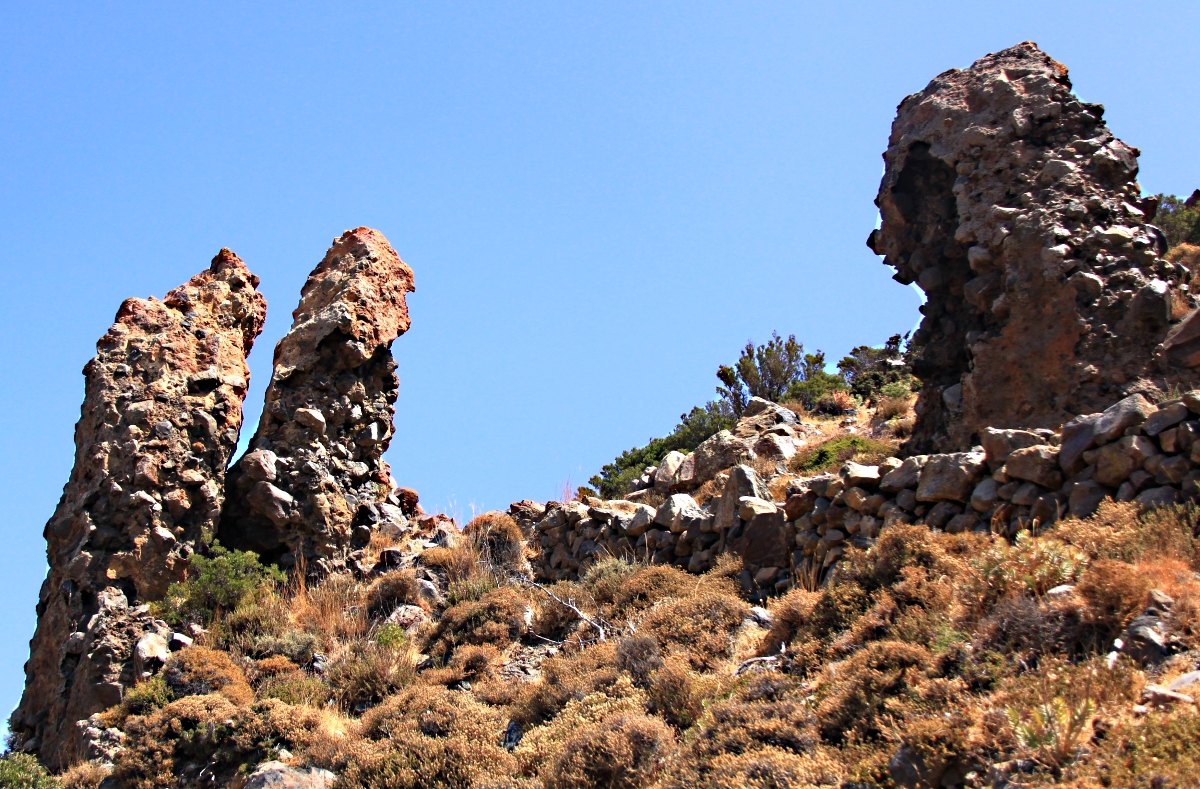
Just another of the lava pinnacles ringing the caldera

Just another of the lava pinnacles ringing the caldera

Intact 17th Century frescoes in the long abandoned Siones monastery

Intact 17th Century frescoes in the long abandoned Siones monastery

One of the rooms inside the Siones monastery

One of the rooms inside the Siones monastery

... opening into the tiny central 'Avli' or inner courtyard

… opening into the tiny central ‘Avli’ or inner courtyard

13Nisyros129w0822

Amazingly picturesque and peaceful main square in Nikia

13Nisyros130w2693

On top of the world: the chapel of Profitis Ilias on the summit of Oros Diavatis

13Nisyros131w0943

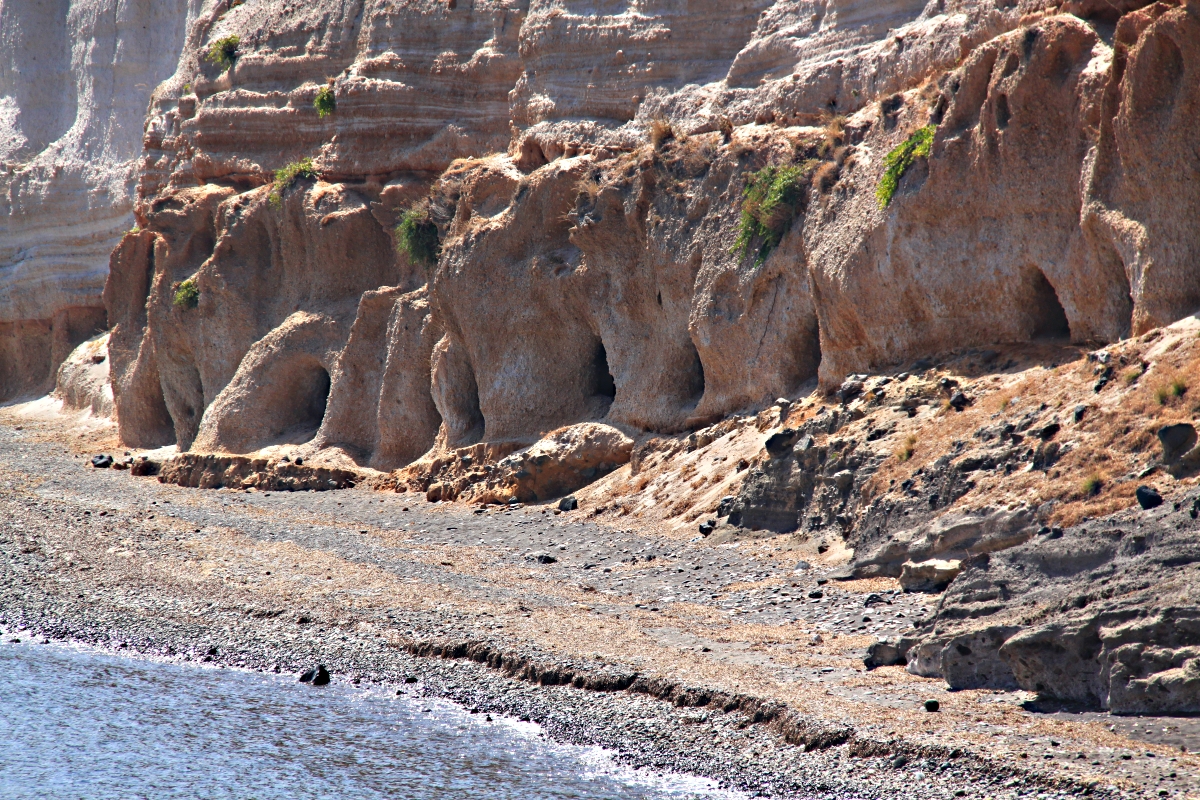
Line of sea-cut caves in pumice cliffs

Sea daffodils in the sand of the east coast, dign of the end of summer

Sea daffodils in the sand of the east coast, sign of the end of summer

.... close up of the delicate flowers

…. close up of the delicate flowers

x

Posted in Greece, Landscape, Mountains, Nature | Tagged , , , , , , , , , , | 1 Comment

Nisyros: probably the most dramatic walk in the Aegean

I kid you not, this walk/trek/hike takes some beating.  But it’s not a Sunday afternoon stroll in the park.  Some short sections are loose scree, route-finding can be difficult, it’s sustained, and it’s wiltingly hot in summer.  However, it’s a very good investment of five or six hours effort.

Get off the island bus from Mandraki in the chaotic car park in Nikia, one of the two villages perched on the rim of the caldera and take a little time-out to recover from the stress by a visit to the Volcanological Museum which amply repays the small entrance fee. Then, heading back towards the taverna, drop down broad concrete steps on the right.  Turn right at the T-junction and try not to fall over backwards gazing up to the lava pinnacles towering on the right or fall over the low wall looking down to the caldera and the Stephanos Crater over 1000 feet below on the left.

From the top of the path  to the crater from Nikia,

From the top of the path to the crater from Nikia,

Lava pinnacles towering above, the morning sun behind

Lava pinnacles towering above, the morning sun behind

Where the concrete steps end, hairpin left onto an old stone-paved kalderimi.  And follow it zigzagging down to the caldera floor.  The views are dramatic.  Pause to gawp at the Parletia lava pinnacles with their ancient fortifications and the smaller lava boulders alongside the path.  Towards the bottom a strong smell of sulphur indicates an active area with small fumaroles hissing out gas.

Looking across to the Parlettia pinnacles and the ancient fortress

Looking across to the Parlettia pinnacles and the ancient fortress

One of the lava boulders alongside the path

One of the lava boulders alongside the path

Rounding a boulder the size of a small house in a dry stream bed at the end of the paved path, head diagonally across the arid caldera floor towards the oasis, in this case a taverna with a coach park for day-trippers with a 1 hour time-slot.  First opportunity for shade, a caffeine-fix and direct contact with volcanic activity.

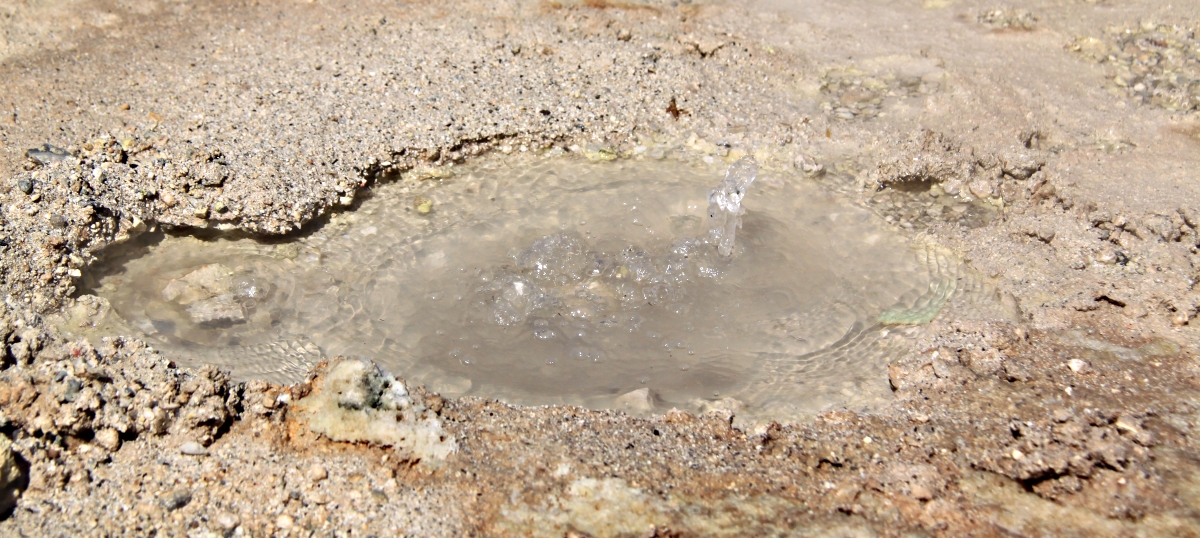
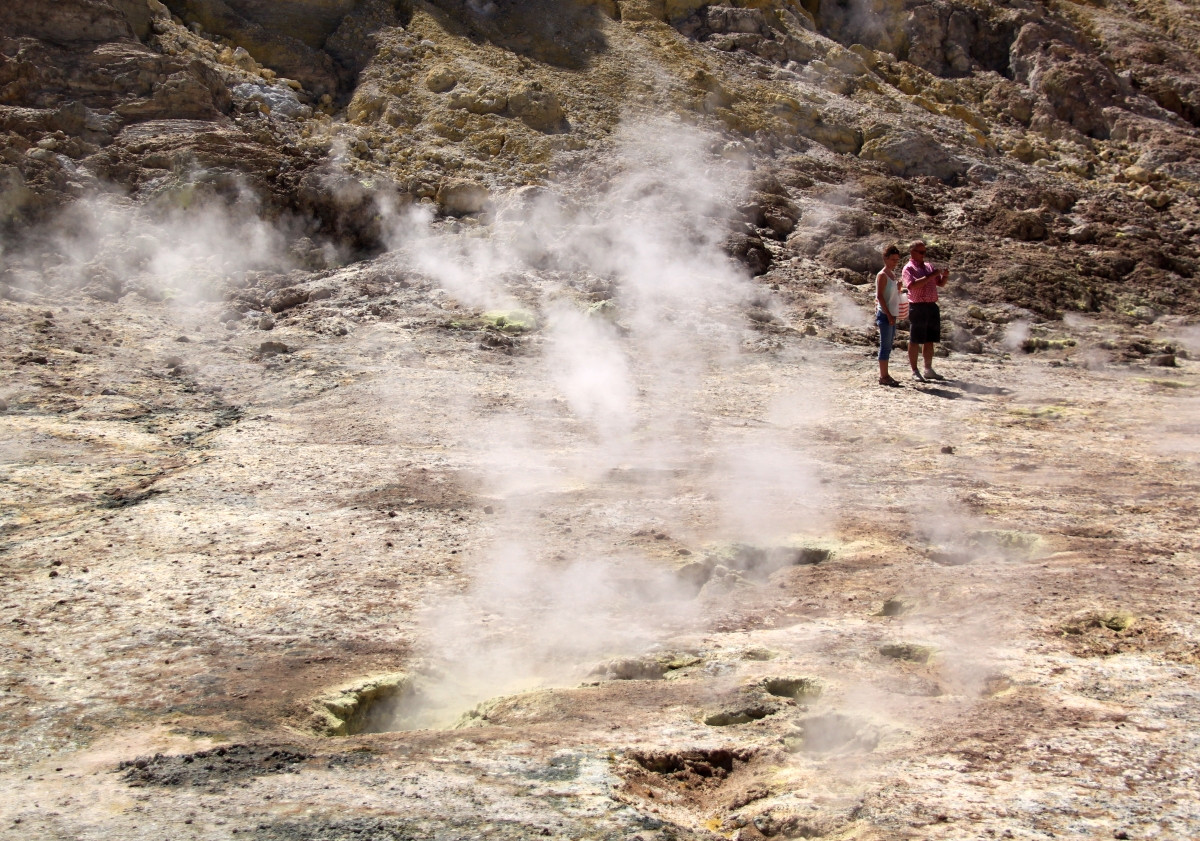
This is no dead volcano, it’s still huffing and puffing and there is plenty of evidence.  Between one batch of coaches leaving and the next arriving there is about an hour of relative quiet to drop down the winding, dazzlingly white path and explore the sulphur encrusted fumaroles breathing hot gases and the boiling mud and water bubbling to the surface on the floor of the large Stephanos crater.

Fumaroles the size of cave system entrances

Fumaroles the size of cave system entrances

Boiling water leaps into the air

Boiling water leaps into the air

Sulphur gas hisses out in clouds

Sulphur gas hisses out in clouds

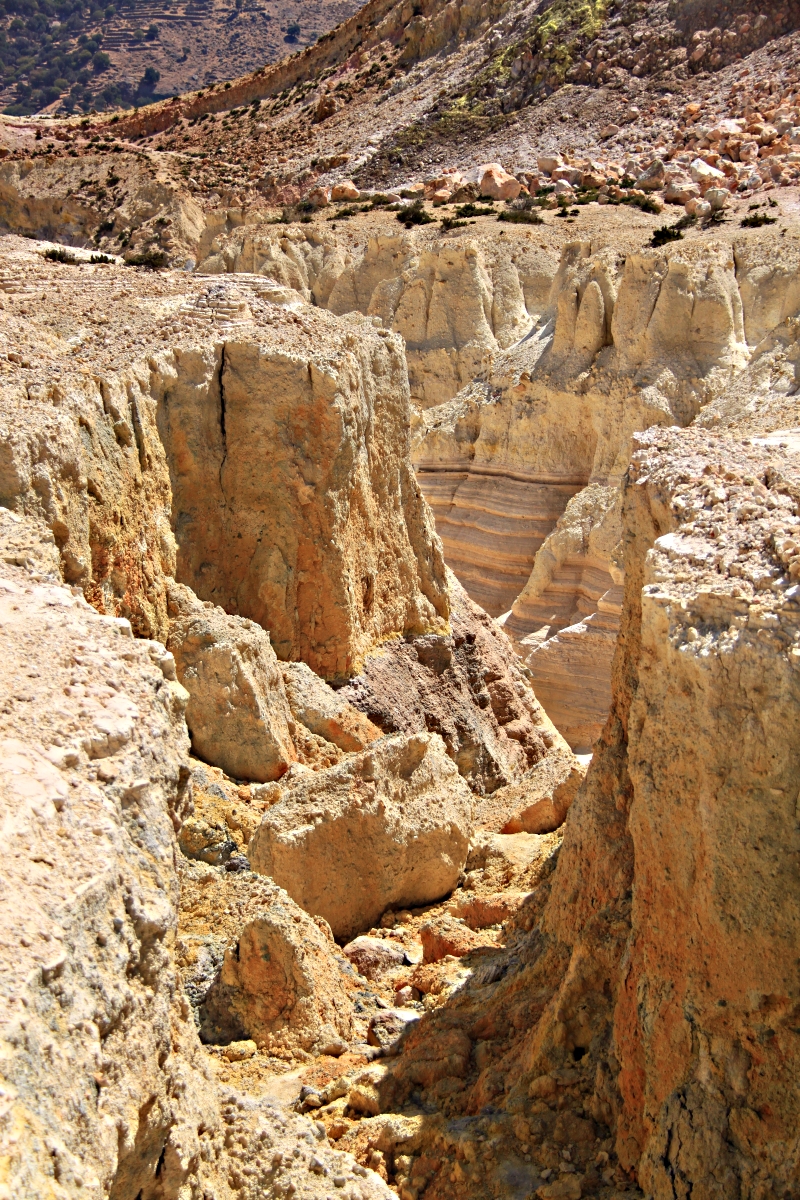
Equally, if not more, rewarding is to follow the path from the back of the taverna up to the smaller but just as active Polyvotis crater with its sulphur hot-spots and a mini Grand Canyon.

The mini Grand Canyon in the Polyvotis crater

The mini Grand Canyon in the Polyvotis crater

Sulphur encrustations around a large cluster of fumaroles

Sulphur encrustations around a large cluster of fumaroles

There are other craters in the caldera but there is still a long walk ahead, so on to something else.  After all, seen one hissing, sulphur-encrusted fumarole, seen them all!!!

Shunning the tarmac and instead finding a way through the scattered trees and around the fenced enclosures to the other end of the caldera reveals a different, abandoned world,.

Indicating continuing seismic activity, is a split in the ground varying from 30 cms deep and wide to over 7 metres deep and 8 or 9 across, zigzagging indiscriminately for a couple of kilometres.  Whole trees fell in when these fissures opened up in 2003, taking everyone by surprise.  It happened before the tourist season began but needless to say it didn’t stop the ‘Volcano Trips’ in the summer.

Trees collapsed into the fissure but stay alive if any roots remain intact

Trees collapsed into the fissure but stay alive if any roots remain intact

In the fissure looking up to Parletia

In the fissure looking up to the Parletia pinnacles

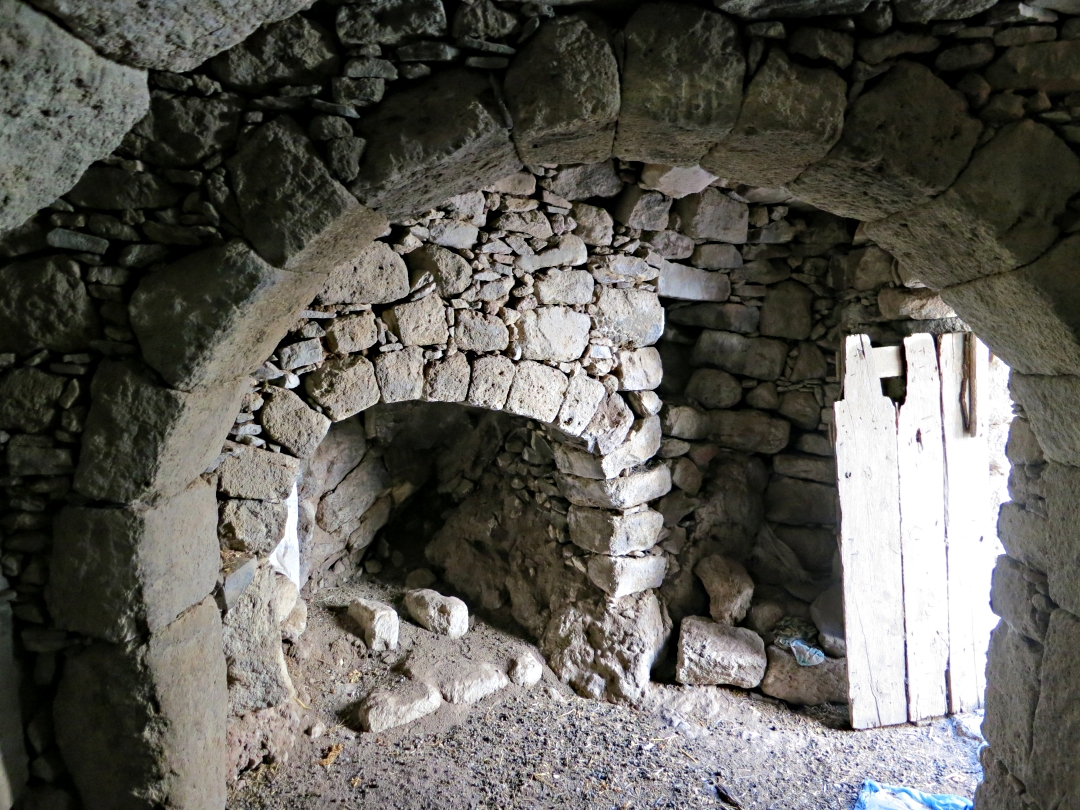
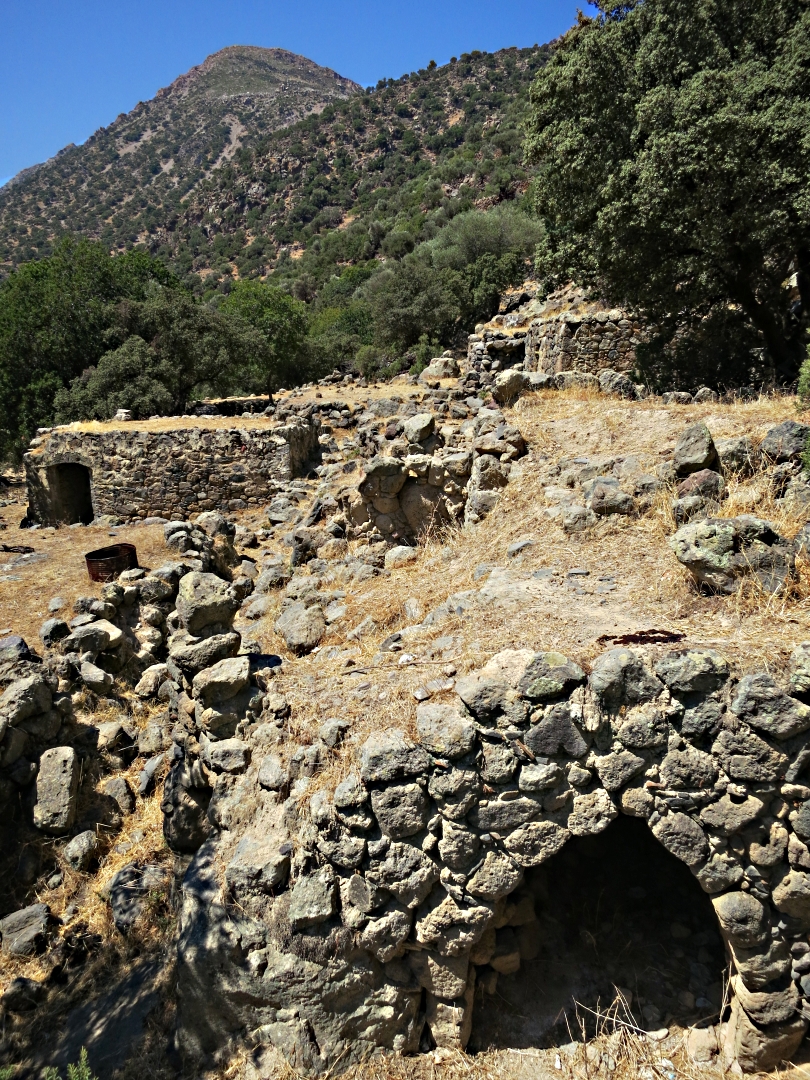
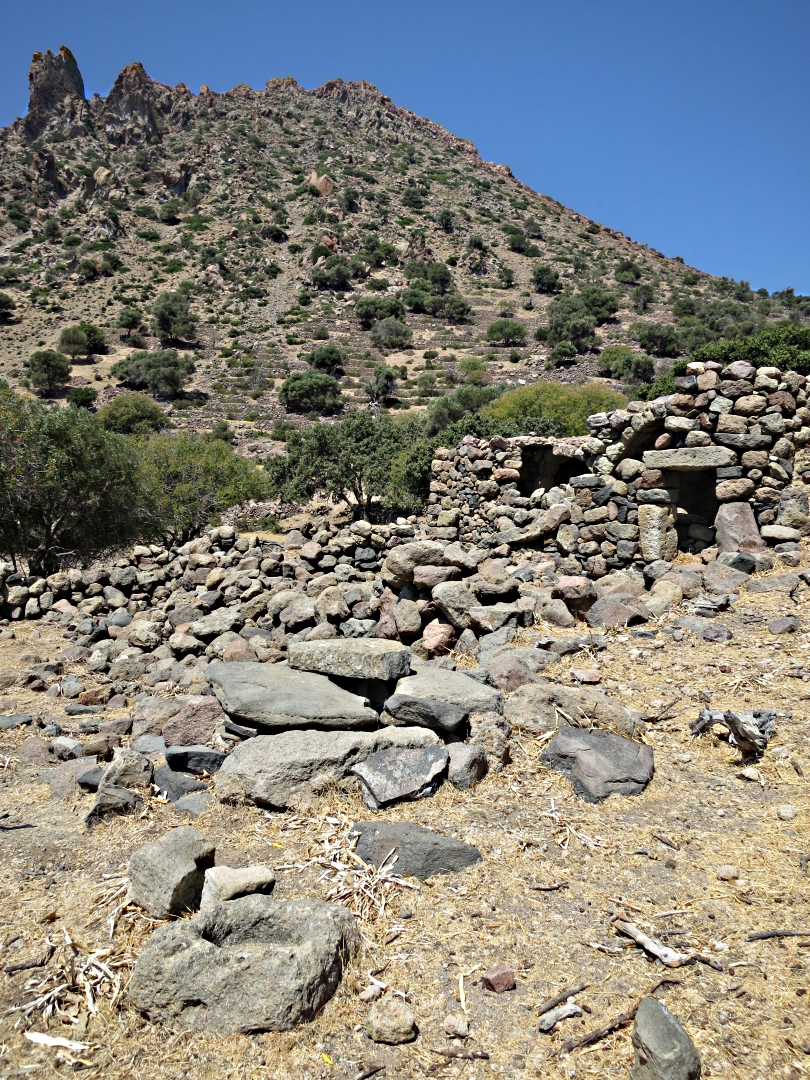
The ground is parched, dead trees lie everywhere.  Everywhere also there are old houses, single roomed, stone-built, barrel-arch constructions, surprisingly many with 6 or even 8 feet headroom, family homes for large families.  Some are free-standing structures in the middle of the caldera floor, others are built under the agricultural terraces along its flanks. After a while they become familiar, part of the background, almost unnoticed, but to see them for the first time is eye-catching  Some were lived in certainly until the 1950’s but now most are abandoned, a few used for agricultural storage.  One cluster of houses towards the eastern end of the caldera features large stone artefacts and a ‘throne’ carved out of a large boulder.  It breathes history just as the craters breathe sulphur gas..

A cluster of ancient houses underneath the agricultural terraces

A cluster of ancient houses underneath the agricultural terraces

Large basin carved from lava and fragment of imported marble container alongside a sterna

Large basin carved from lava and fragment of imported marble container alongside a sterna

From here an old stone-paved path 3-4 metres wide rises up gently through the terraces partly on embankment , partly between stone walls, achieving an easy gradient for people and laden donkeys.  Though now intersected by the tarmac road to the crater-side taverna oasis, it continues upwards, increasingly steeply, to Emborio, the other ancient village perched on the caldera rim.  It’s a taxing pull up in the heat of the day but at the top is the Balcony Taverna, breathtakingly cantilevered out at the eastyern end of the caldera.  Shade.  Another caffeine fix.  Good quality traditional Greek food.  Stunning setting.

The unique Balcony Taverna

The unique Balcony Taverna

Not immediately apparent but there are indications of continuing volcanic activity here too.  Some of the old houses in Emborios have underfloor heating in the form of thermal vents from the volcano.  Proof?  On the approach to the village from the bus turning point is a natural sauna; stick your head inside and even an outside temperature of 400C seems cool when you emerge.

The entrance to the sauna at Emborios

The entrance to the sauna at Emborios

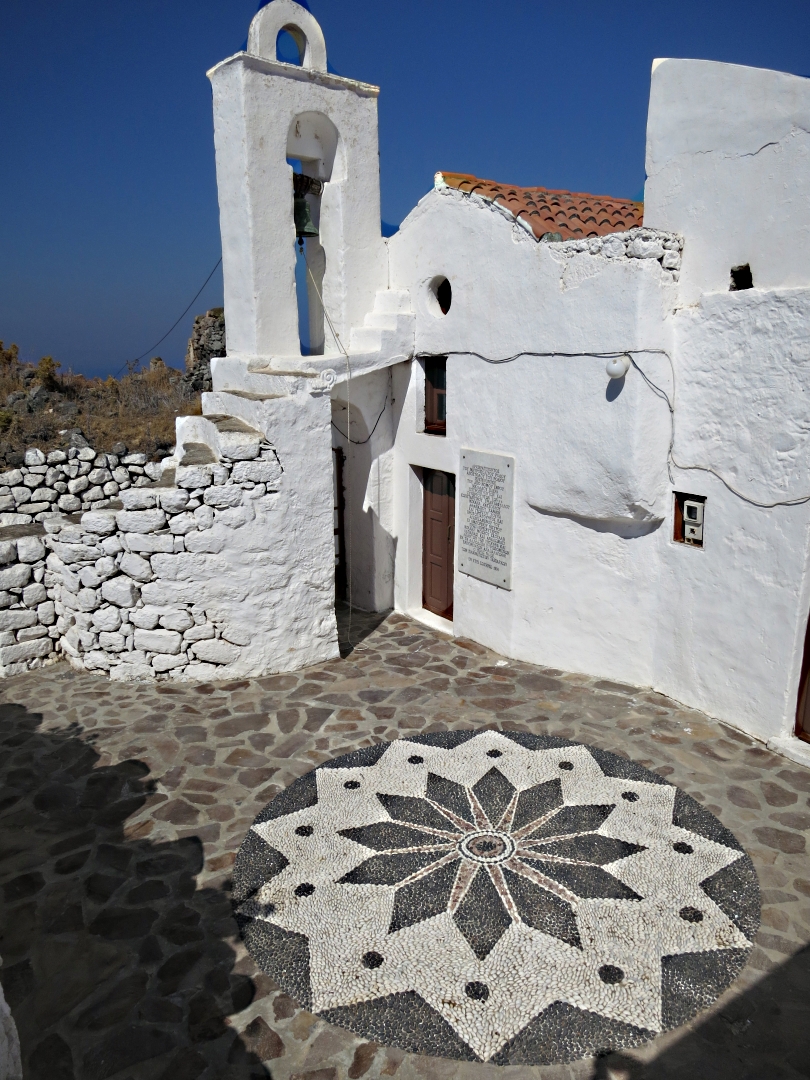
At the top of the village are the remains of a castle, currently being partly renovated,  the white-painted stone entrance perched on the edge of a vertical drop into the caldera with the  active craters 3 kilometres in the distance.  Next to it is a small monastery with a very fine traditional hochlakos courtyard and spiral stone steps up to the bell tower.

The Hochlakos patterned courtyard and the spiral stone steps to the bell tower

The Hochlakos patterned courtyard and the spiral stone steps to the bell tower

The onward path is narrow and winding but very clear, contouring around the inside lip of the caldera.  Shortly after leaving Emborios a 20 metre-high lava bubble towers overhead, the inside covered in patterns like alien hieroglyphics.

20 metre high lava bubble

20 metre high lava bubble

Part of the alien hieroglyphics inside

Part of the alien hieroglyphics inside

Another short rise up over loose ground, passing within inches of a cave entrance and an ancient sterna (water tank sunk in the ground) then it’s over into the smaller and now inactive Kato Lakki caldera and downhill back to Mandraki.

x
Posted in Greece, Hiking, History, Landscape, Mountains, Nature | Tagged , , , , , , , , , , , , , , | 3 Comments

Nisyros: alien images on the Lava Coast

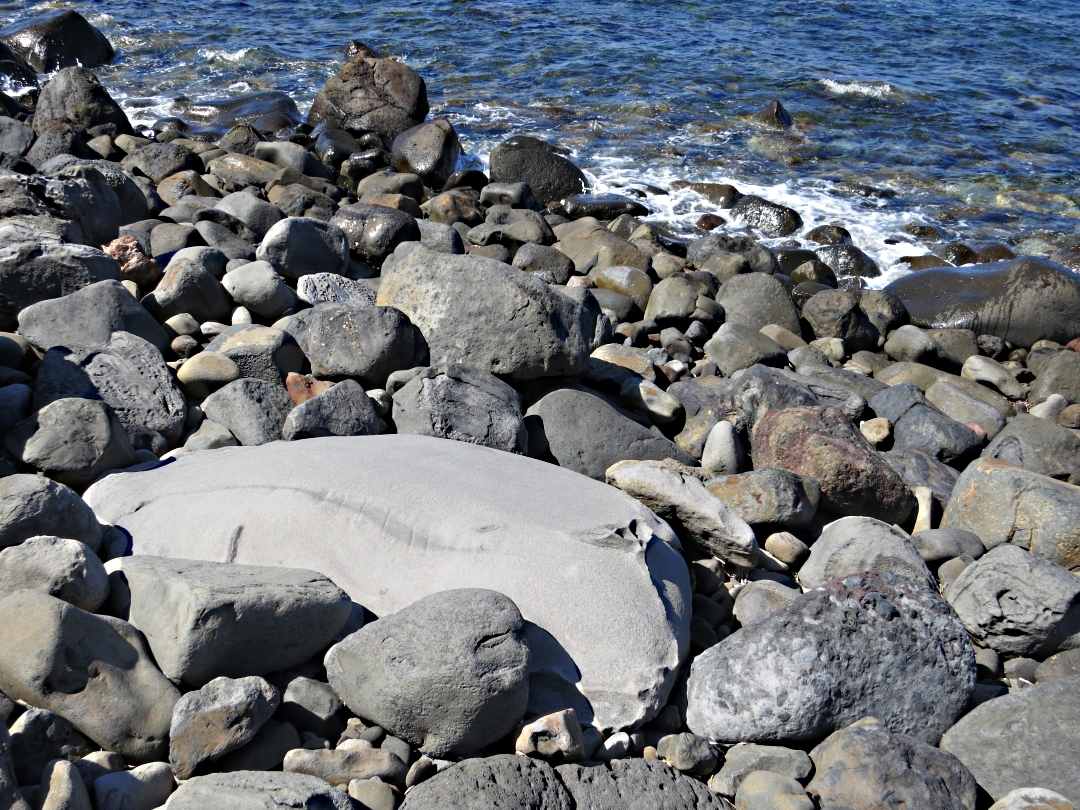
After two weeks of trekking in the mountains around Nisyros every day, much of it in noon heat, I was ready for an easier walk.  I headed south along the west coast of the island, no footpath, just hopping and teetering from boulder to boulder.  I had been that way before a few times but was surprised that little was familiar.  Winter storms had brought down more of the cliffs with lava blocks, some the size of a car, balanced precariously on one another before they settle after a few more winters.  Blocks four or five times my bodyweight could be rocked backwards and forwards by balancing on them …. or slide ominously.

I walked about 4 kilometres to a distinctive headland backed by loose pumice/ash cliffs, and then turned back.  It looked boring from there on.

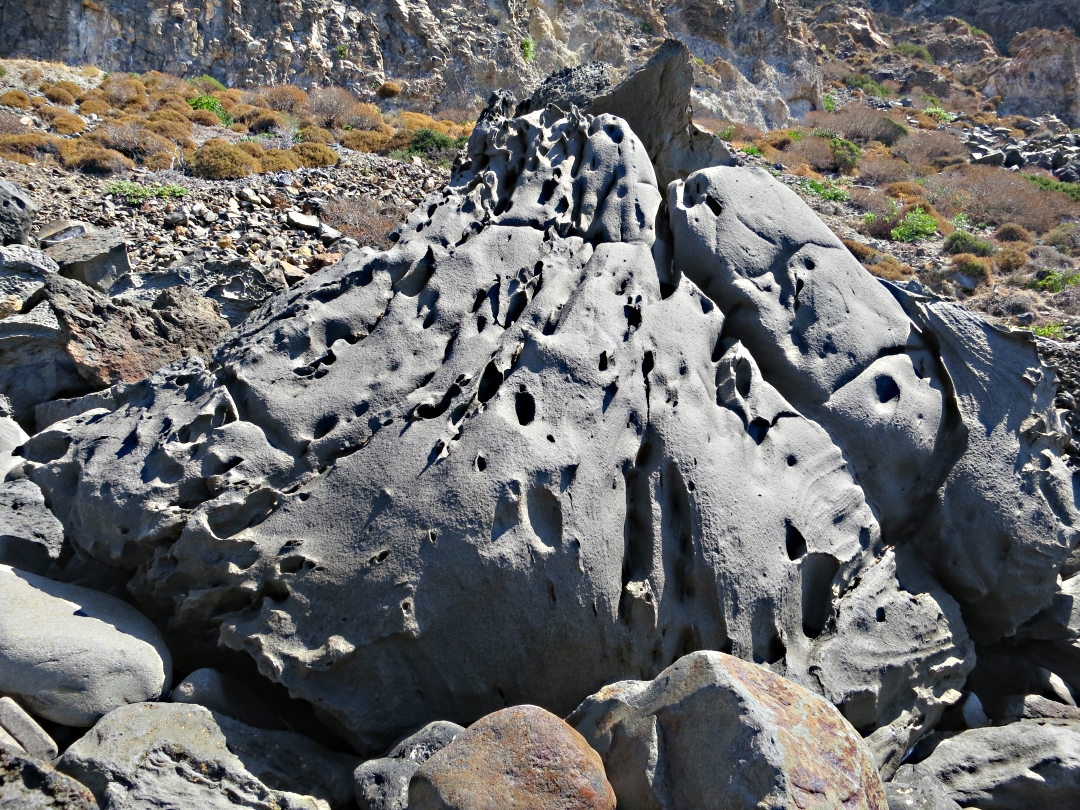
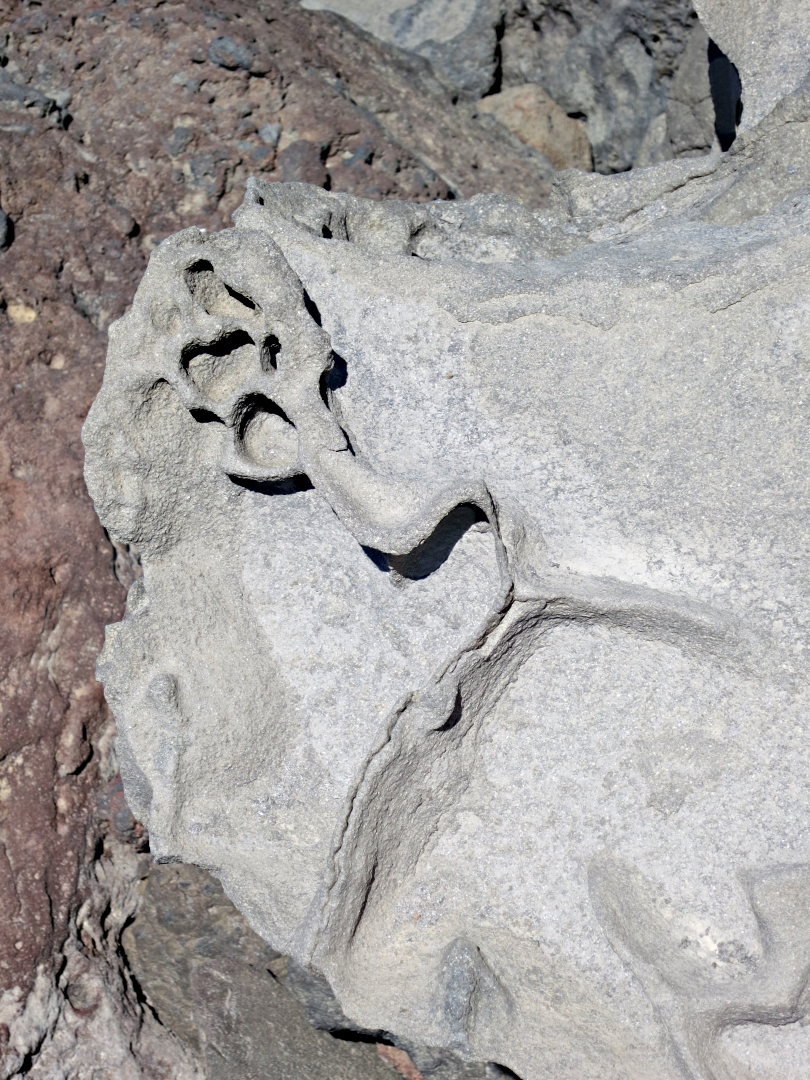
The main problem, apart from the prospect of triggering fresh rockslides, was to keep moving.  The rocks were a mesmerising array of colours, shapes and distortions which had a vrachophile like me (Google it), stopping to look and photograph every few seconds.  Many were fragments of lava bubbles, created when gas erupted from the liquid lava which then cooled rapidly.  Now centuries-old rock. Many pieceslooked like hieroglyphic messages inscribed on tablets more than a metre across.

Enough words

The lump of lava like a weird creature at the beginning of Lava Coast Walk is about 8 metres high, the cliffs significantly higher

The lump of lava like a weird creature at the beginning of Lava Coast Walk is about 8 metres high, the cliffs significantly higher

.... and the distinctive headland at the end of it about 12 metres high

…. and the distinctive headland at the end of it about 12 metres high

.... with the soft pumice/ash cliffs behind also a lot higher

…. with the soft pumice/ash cliffs behind also a lot higher

One of the extrusions in the sea, a mixture of very rough and smooth surface as if squeezed like tootpaste

One of the extrusions in the sea, a mixture of very rough and smooth surface as if squeezed like tootpaste

Multicoloured blocks metres high

Multicoloured blocks metres high

Weird shapes and hieroglyphics

Weird shapes and hieroglyphics

... one shaped like a coffin with inscriptions

… one shaped like a coffin with inscriptions

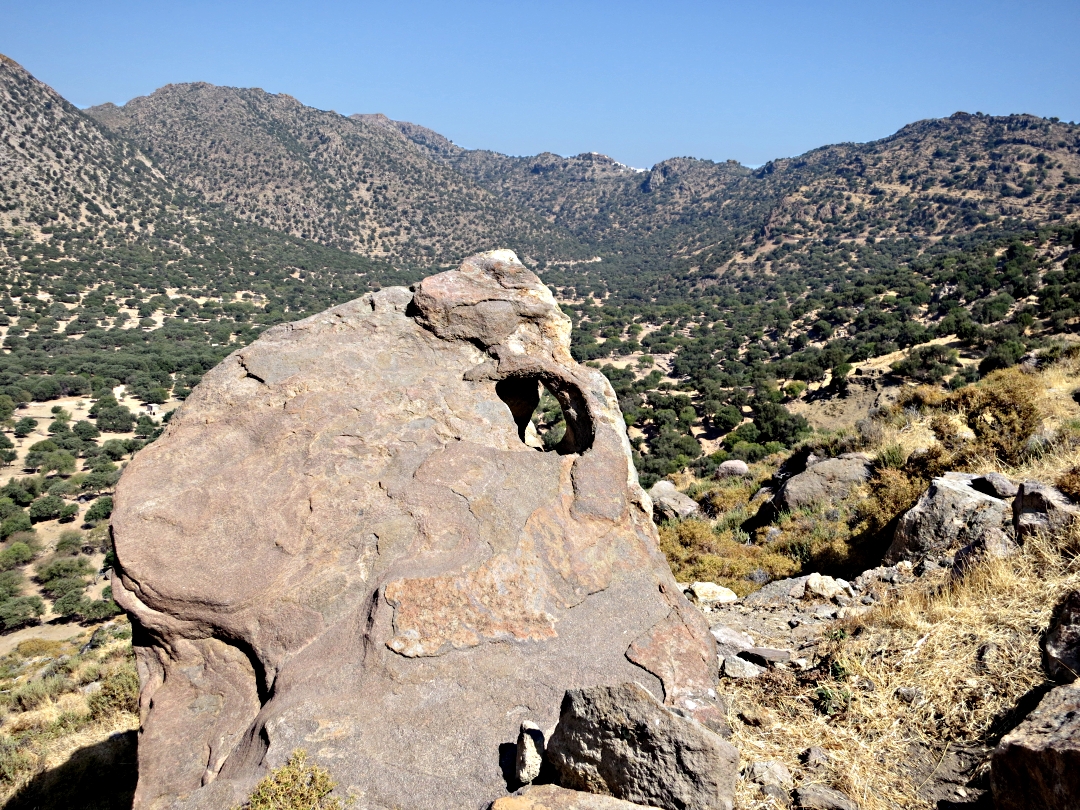
... another like a weird head or helmet

… another like a weird head or helmet

.... or a recumbant figure

…. or a recumbant figure

.... or shooting upwards out of the ground

…. or shooting upwards out of the ground

And then some are matt-smooth like stranded sea creatures

And then some are matt-smooth like stranded sea creatures

..... or delicate plants

….. or delicate plants

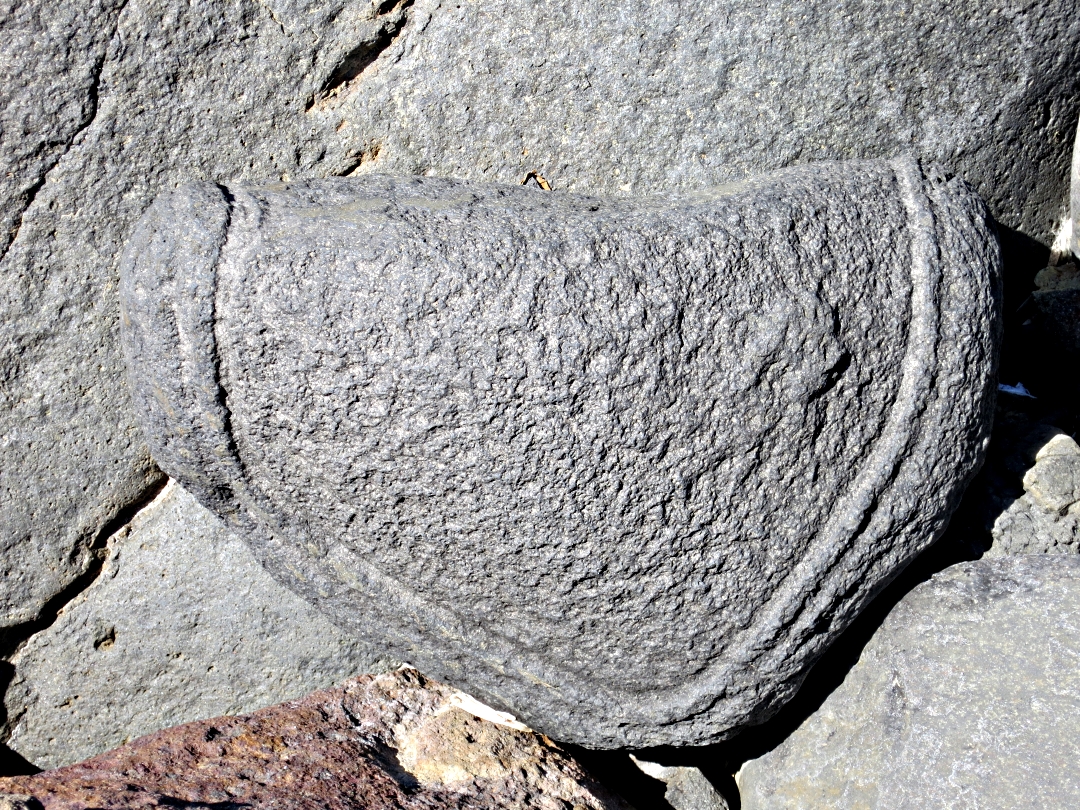
One like a giant fossilised meat pasty

One like a giant fossilised meat pasty

Veined with sulphur like gold, over  a metre in diameter

Veined with sulphur like gold, over a metre in diameter

Or just great lumps of raw ore

Or just great lumps of raw ore

Very definitely of alien origin

Very definitely of alien origin

x

Posted in Greece, Hiking, Landscape | Tagged , , , , , , , , , | Leave a comment

Nisyros: wildlife, meet the residents

In comparison with dry ‘hot rocks’ like Symi, the rich volcanic soils of Nisyros support very varied vegetation which in turn supports many species of fauna.  The vegetation is largely crisped up by this time of year and so there is less to see than in spring and early summer but it’s still worth keeping your eyes open.

However, some just defy photography unless you are prepared to set up hides and wait …. and wait.  Chukkas, or Rock Partridges, sit motionless and completely camouflaged until they suddenly panic and fly off from almost under your feet, winging rapidly downwards and away with much flapping and panic-stricken squawking.   Eleanora’s Falcons, significantly fewer this year, swoop erratically high overhead as they pick off insects on the wing as do the Alpine Swifts.  As on Tilos the Bonelli’s Eagles seem to have left Nisyros, maybe because the number of chukkas have reduced to a level which cannot sustain them, a paucity made more poignant by the arrival of hunters at the start of ‘open season’ this weekend set to go out and shoot what few remain.

Though I can’t bring myself to photograph them, as always very much in evidence are flocks of Hooded Crows, raucous creatures. The occasional pair of their larger cousins the ravens croink overhead.  Within the town, still plentiful are house sparrows.  Sarah of ‘The Sleepy Sparrow’ blog would be in her element: http://thesleepysparrow.blogspot.gr/

However, I have managed a few photos of the wildlife.

Apart from the two snakes I saw on the first day I haven’t seen any more despite careful scrutiny in areas where I have seen and photographed them before.

One of the two snakes spotted on the first day

One of the two snakes spotted on the first day

Lizards too seem fewer in number but that may just be a response to the few numbers of spiders compared with early summer.  The up-side of the reduction in spiders is that there are fewer high-tensile webs stretched taut across the paths to wrap round my head and stick in my beard.

Not sure which way to go

Not sure which way to go

A fluorescent green tale doesn't help with the camouflage

A fluorescent green tail doesn’t help with the camouflage

Climbing up into the Parletia crags

Climbing up into the Parletia crags

.... come any closer and I'm out of here!

…. come any closer and I’m out of here!

Dragonflies are fewer in number than earlier in the summer but still perch on the tops of dry sticks.

I still don't know why they sit on the top of dry sticks

I still don’t know why they sit on the top of dry sticks

Head-on they look ferocious

Head-on they look ferocious

Butterflies flit everywhere, near invisible when they settle:

'Scarce Swallowtails' seem to be becoming scarcer

‘Scarce Swallowtails’ seem to be becoming scarcer

A bit easier to spot

A bit easier to spot

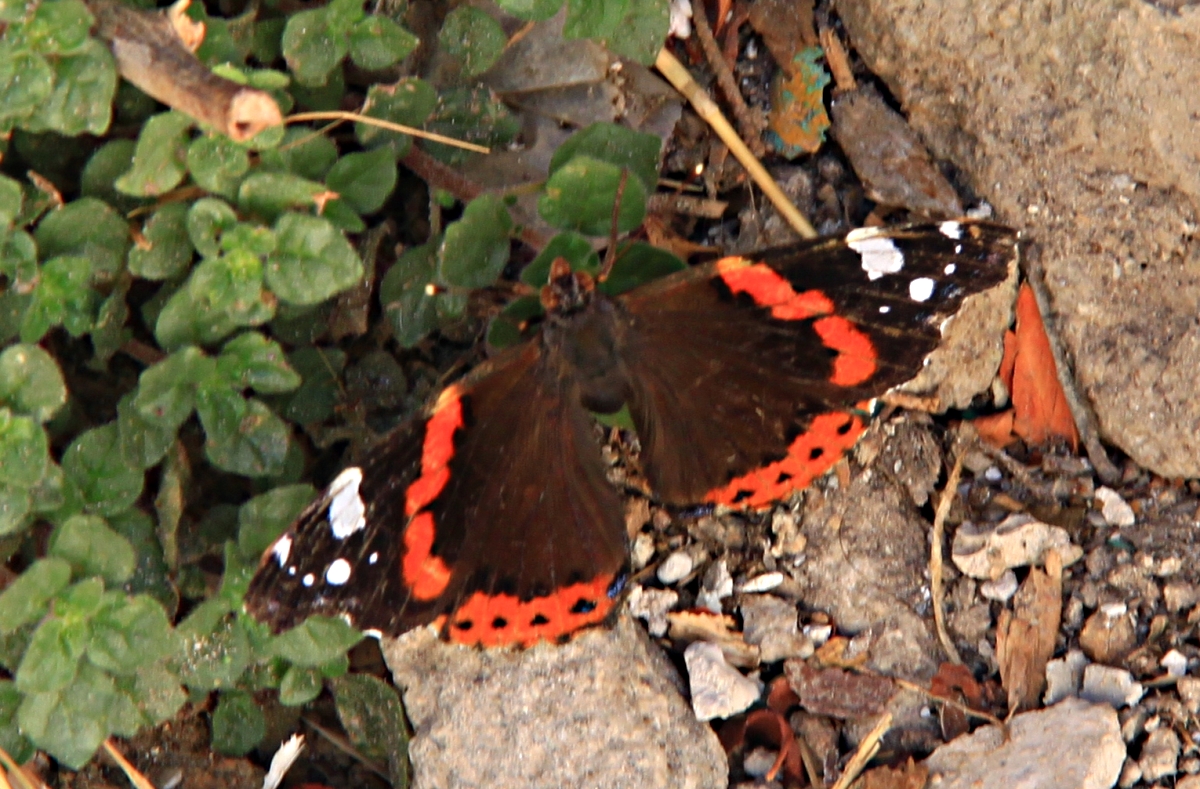
Bright red in flight but changing dramatically the moment it lands

Bright red in flight but changing dramatically the moment it lands

This one explored my ankle while I was considering exploring a cave

This one explored my ankle while I was considering exploring a cave

Many of the old houses built under the agricultural terraces have colonies of bats but difficult to photograph without disturbing.

Bat colony: taken without flash so as not to disturb them

Bat colony: taken without flash so as not to disturb them

….. and then there is the odd surprise.

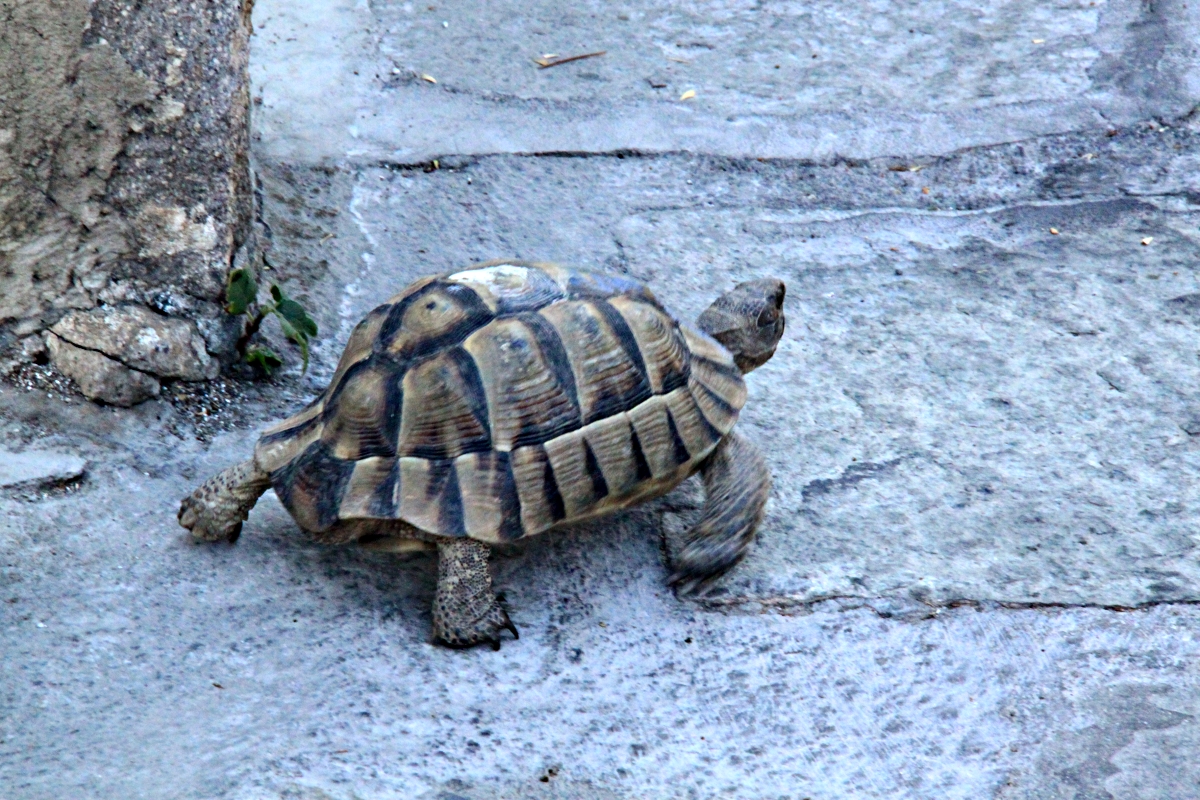
Strolling down the drive ....

Strolling down the drive ….

... leaving four bemused cats in it's wake

… leaving four bemused cats in it’s wake

... then doing its kerb drill

… then doing its kerb drill

... before crossing the road while I stopped the traffic

… before crossing the road while I stopped the traffic

x

Posted in Greece, Wildlife | Tagged , , , , , , , , , , , , , | 3 Comments

Nisyros: Dragon Coast

The paper tablecloth in Irinis restaurant in the old square had a map of the island.  Sipping my wine and waiting the few minutes before my fresh goats cheese, tomato and cucumber starter arrived, I glanced at it idly.  Annotated in Greek it had written across the mysterious, inaccessible southwest corner of the island, «Δρακοσπιλιά», (Drakospilia) , ‘Dragon Caves’.  It was a name I had neither heard nor seen before but which aroused my interest.

When I quizzed Irini she assured me that, yes, there were indeed caves and yes, with a twinkle in her eye, there were also dragons.  Good sense of humour has Irini. Let’s be honest, a map, even if it’s on a tablecloth and not on a battered parchment scroll discovered in some ancient wooden chest, saying in essence, ”here be dragons” just has to be checked out.

So I did.

I had walked into this area before, very definitely off piste.  First a walk up to a col at a little over 1000 feet, partly on enjoyable meandering paths through agricultural terraces and then a trudge along a track bulldozed over the col to the caldera by a thermal energy company with an abortive promise of ‘free energy’, thereby completely destroying what is fondly remembered as one of the best kalderimia in the Aegean.

Then a drop off to the right towards the distant coast on another kalderimi, much of it  on top of a stone walled embankments scything down the steep terraces which contoured the mountain, so as to make the route donkey-friendly.  This one not vandalised by financial greed but sadly severely damaged by neglect as the area depopulated.  Now it is only visited by arrogant rifles and dogs at the beginning of the hunting season (mid September) and  by goat farmers. Enjoyable but not easy walking.  Frequent reminders that it is an environment unforgiving of mistakes.

The kalderimi on top of stone walls, crumbling with disuse

The kalderimi on top of stone walls, crumbling with disuse

... and increasingly blocked by collapses and aggressive vegetatio

… and increasingly blocked by collapses and aggressive vegetatio

Connecting long-ago abandoned settlements

Connecting long-ago abandoned settlements

13Nisyros081w2731

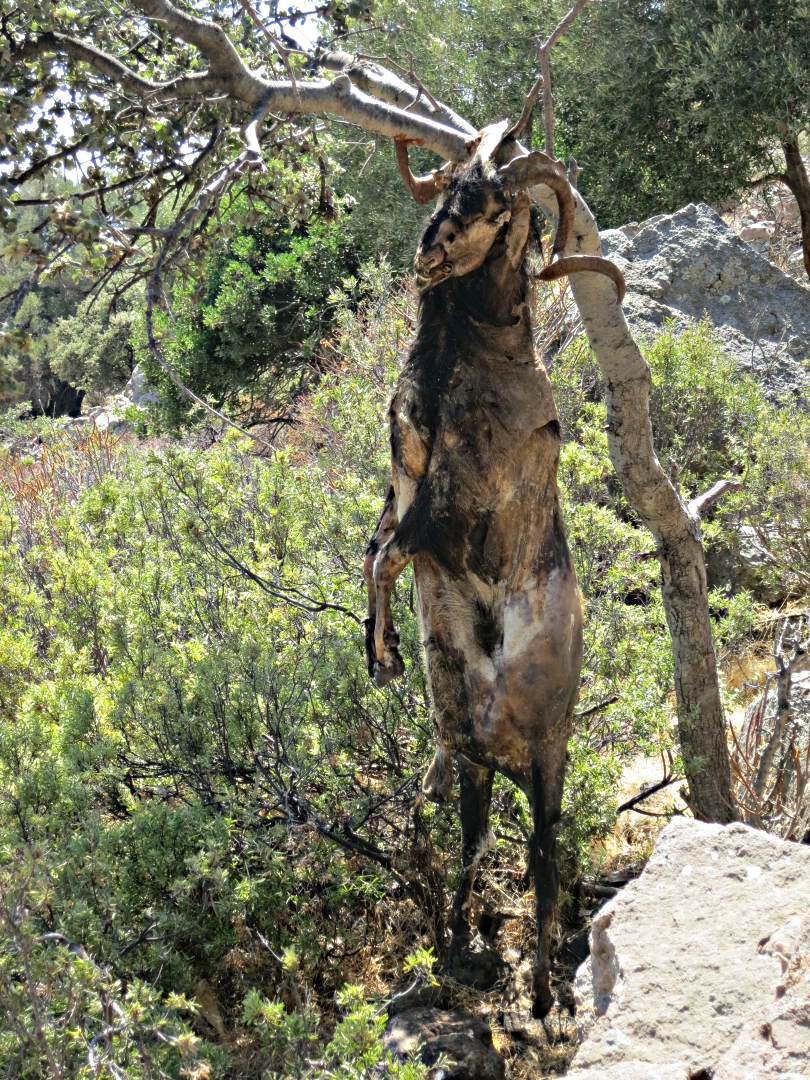
Even old mountain goats get it wrong!!!!!!!!!!

13Nisyros080w2728

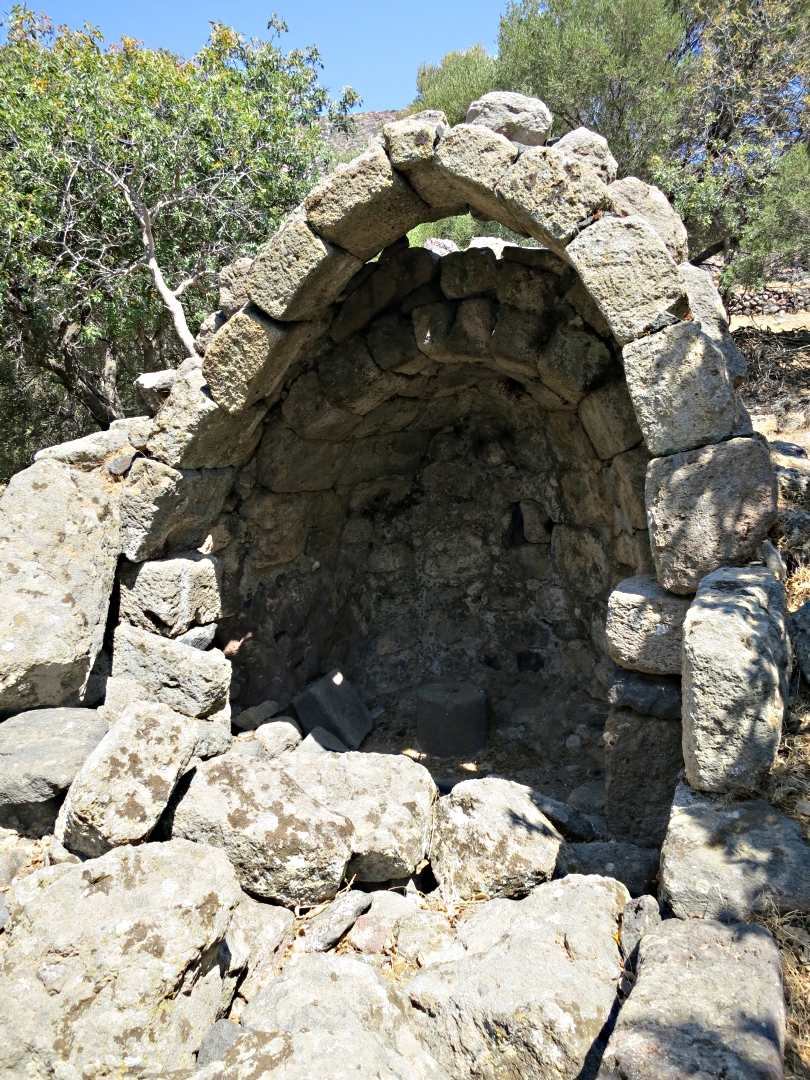
High arches of old churches are less resilient than smooth curves of domestic buildings  

Getting on and off the kalderimi into adjacent terraces to by-pass encroaching and overwhelming vegetation and collapsed walls became an increasing necessity as I approached the coast but no real problems until just a few hundred metres from the sea.  I came up against a goat-proof fence completely blocking onward progress.

Goat fences are made of 2 metre high chain link wire stretched between steel 10cm-diameter reinforcing rods rammed into the ground, unclimbable without certain risk of ripped flesh. Eventually I found a drop into a compound below a 3-metre high stone wall overhung at the top by thorn-brushwood and assorted scrap timber. I managed to down-climb by negotiating the overhang created by a horizontally placed louver door and get onto the stone wall below and find hand and foot holds on that.  Just a few irritating scrapes and grazes and many unkind mutterings about Greek goat farmers in the process.

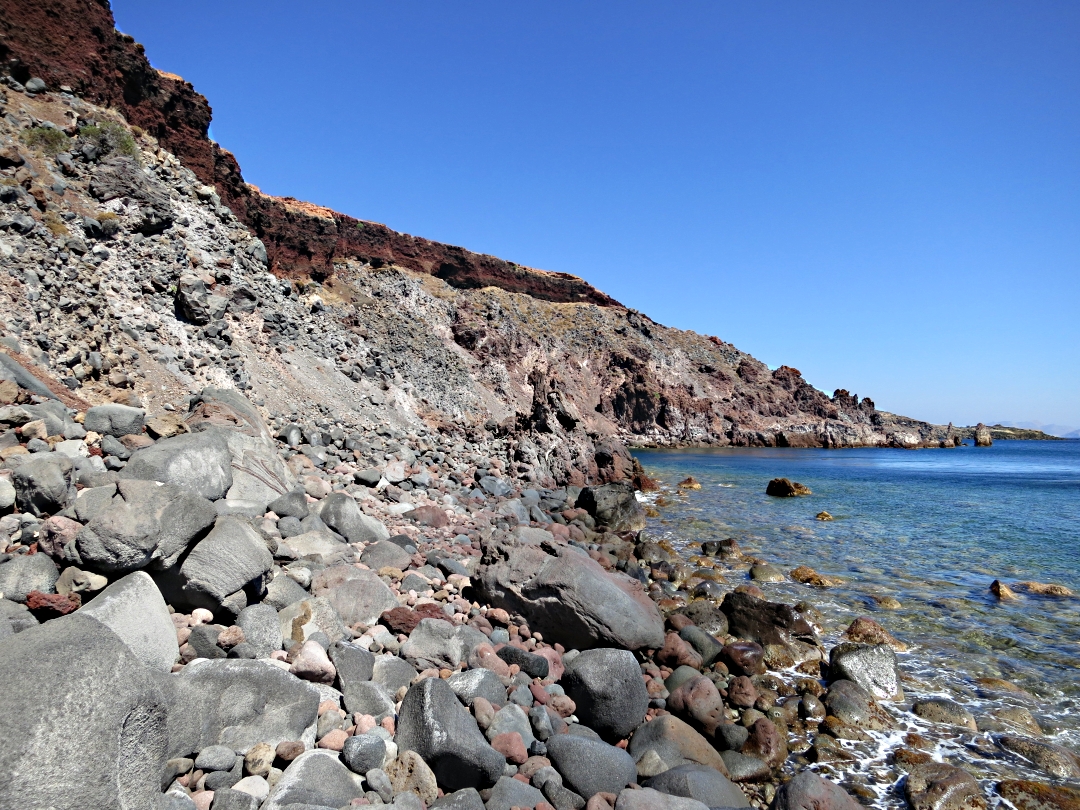
It was worth it.  I already knew from previous visits to this remote area that there are a number of shallow caves a bit further inland, scrapes in soft volcanic deposits, though there are none along the coast at this point.  But the soft cliffs with lava boulders tumbling down to the sea were dramatic, the  lava formations even more so.  And there were dragons!

13Nisyros076w2749

Large boulders tumble out of the ash-conglomerate cliffs

Zooming in on the colour-contrast

Zooming in on the colour-contrast

Lava boulders scattered around, the bulldozed track clear in the background

Lava boulders scattered around, the bulldozed track clear in the background

Lava stacks in the sea

Lava stacks in the sea

A different angle

A different angle

Zooming in on one of the dragons

…. and zooming in on one of the dragons

... and another

… and another

.... a head shot

…. a head shot

A very good walk.  All history.  Very little present.  No future.

Posted in Greece, Hiking, History, Landscape, Mountains | Tagged , , , , , , , | Leave a comment

Nisyros: cue volcano …. ACTION

Let’s face it!  What do we expect from a volcano?  Right! Some action!!  Most would happily forego an eruption and spewing lava but a bit of gurgling and hissing does the trick.

The Greek island of Nisyros is a volcano and action there certainly is.  Hundreds of people arrive every day, thousands every week in the summer months, on day trip ferries from Kos, take a coach to ‘The Volcano’ (really the floor of the caldera, the hole in the middle of the island), park next to the taverna, walk to the edge of the large crater (now protected by a piece of string, the EU funded wooden safety fence lying halfway down the precipitous drop after last winter) and take photos of each other for the folks back home.

Then the brave and the stupid swarm like ants down the narrow, glaring white path to the crater floor, wander around  and photograph each other again amid the gurgling and steaming fumaroles.  Some openings are larger than the entrances to cave systems I have been in.  The many holes belching sulphurous gases are too hot to put your hands near.  Bubbling water leaps into the air.

Few people will have seen the signs in 4 languages on the walls of the taverna telling them that on the crater floor they are walking on a thin crust.  Young children run around in flip flops unsupervised, ignorant of the potential risk.  Adults squat down next to the action and smile for the camera or leap around in pretend slow-motion, imitating astronauts in the moonscape.  Boiling water bubbles to the surface, clear and present danger, but in places it is also just below a soft, spongy layer.  Stand still too long and it starts to well up over your sandals and nip at your toes, a reminder that this is no theme park.

The large Stephanos crater beyond doubt takes the ‘Most Visited’ prize because it is closest to where the coaches stop and so involves least walking.  It’s also closest to the tree-shaded taverna and the loo.   .

But what about other action on offer?  True, the only boiling liquids are in Stephanos but there are more fumaroles hissing and spitting out sulphur gases in other craters and active spots in the caldera than there are in Stephanos. Arguably the most recently active Polyvotis crater (blew in 1873, a mere 140 years ago) is more dramatic and is virtually unvisited despite being the same walking distance in time as the floor of Staphanos.  But that’s fine by me!  I get the place to myself.

Coach trips give an hour to look around, just about enough time stand on the rim of Stephanos then join the crocodile straggling down to the crater floor and up again before whisking you back to Mandraki and retail therapy.  Walking there from either of the caldera-rim villages or over the col from Mandraki allows more time to appreciate just how dramatic this place is.

But enough words.  Rather than me trying to describe it, take a look at some images.

Clusters of pools of boiling water

Clusters of pools of boiling water in the Stephanos crater

a closer look

a closer look

Large fumaroles the size of cave entrances

Large fumaroles the size of cave entrances

Sulphur gas

Sulphur gas and steam

Leaping about on the thin crust of Stephanos

Leaping about on the thin crust of Stephanos

'Grand Canyon' in the Polyvotis crater

‘Grand Canyon’ in the Polyvotis crater

Rock pinnacles on the edge of the crater show how crumbly the rock is

Rock pinnacles on the edge of the crater show how crumbly the rock is

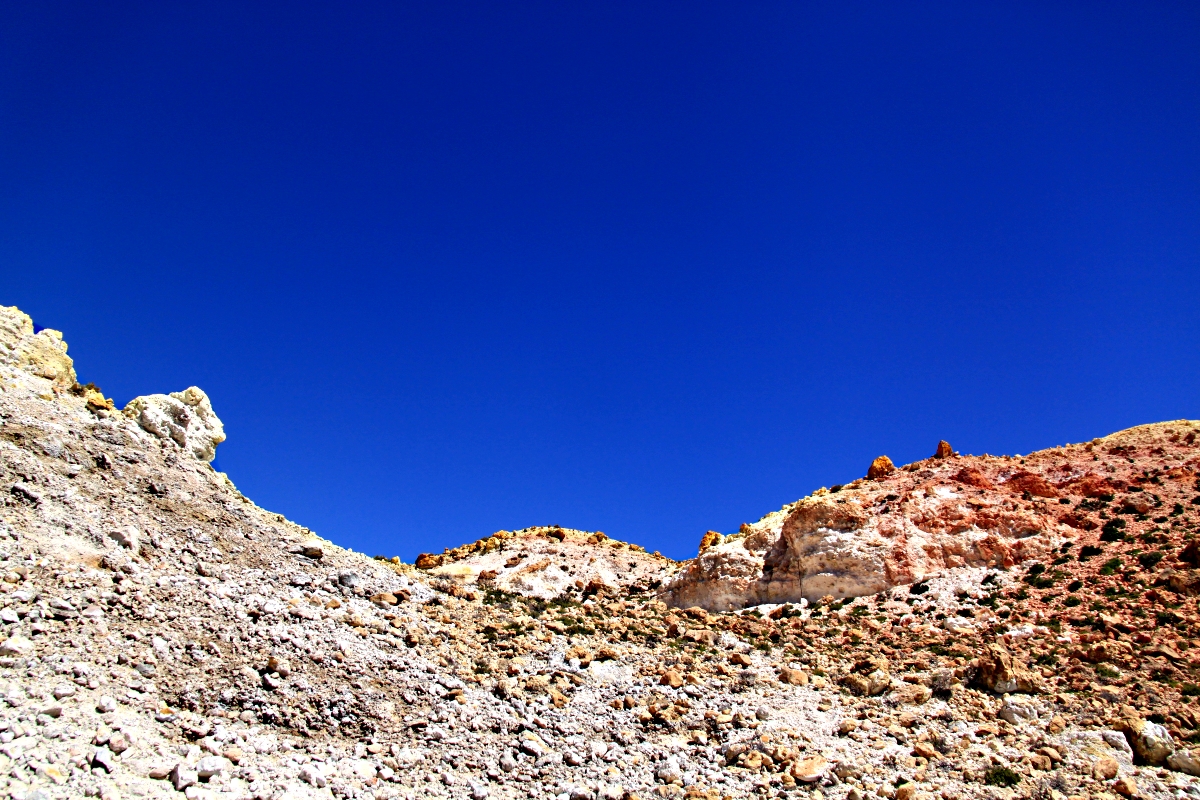
Multi-coloured rim to the crater

Multi-coloured rim to the crater

Looking across the Polyvotis crater to the mouth of  the 'Grand Canyon'

Looking across the Polyvotis crater to the mouth of the ‘Grand Canyon’

Clusters of sulphur-encrusted fumaroles line the rocky sides of Polyvotis

Clusters of sulphur-encrusted fumaroles line the rocky sides of Polyvotis

Lying on my side on the hot rocks looking across a fumarole down the crater floor of Polyvotis

Lying on my side on the hot rocks looking across a fumarole down the crater floor of Polyvotis

Close-up of part of one of the clusters

Close-up of part of one of the clusters

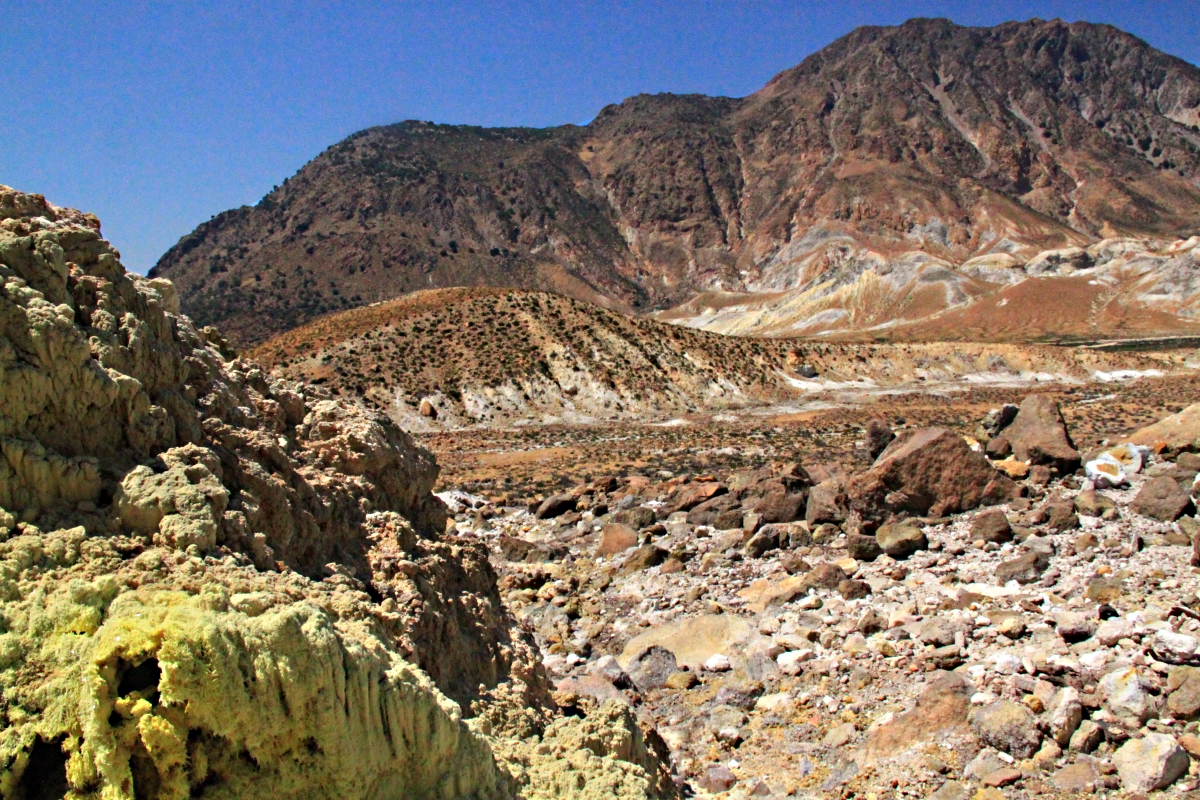
Another active area on the opposite side of the caldera, looking towards Polyvotis and Oros Diavatis, the highest mountain on the island

Another active area on the opposite side of the caldera, looking towards Polyvotis and Oros Diavatis, the highest mountain on the island

Another view towards Polyvotis

Another view towards Polyvotis with yellow-sulhur cliff

Some of the sulphur rocks are pink or red

Some of the sulphur rocks are pink or red

Sulphur encrustation around individual fumaroles id delicate

Sulphur encrustation around individual fumaroles is delicate

... and there are lots of them

… and there are lots of them

.... all shapes and sizes

…. all shapes and sizes

x
Posted in Greece, Landscape, Mountains, Nature | Tagged , , , , , , , | 2 Comments