From Symi to my back garden

I’ve been experimenting with the technology to record some of the treks I’ve been doing on Symi, using a combination of apps to record routes and then create a 3D ‘fly-over’ incorporating photos taken along the way.  It’s not entirely satisfactory yet as the grid is a bit too coarse to always allocate the photos to the point at which they were taken.  But it’s a work in progress.  Below are a few examples, just click on the links.

To the mountain-top monastery of Stavros Polemou

To the mountain-top monastery of Kokkimedes

A ridge-top loop around Nimborios

Let me know what you think of the results


I’ve been back home for a couple of weeks to check that family and friends are behaving themselves  ….. and to try to rescue the vegetable garden, ravaged by drought (!!!! in the UK ????), caterpillars, aphids and a rabbit.  The gardening produced a few colourful and interesting photo opportunities.  Goes to show that if you keep your eyes open there is interest even in your back garden.

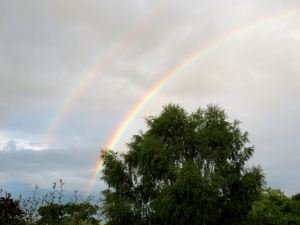
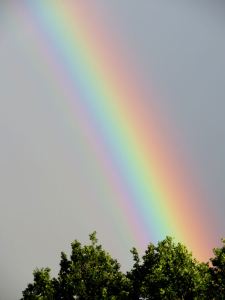
The long summer heatwave and drought in the UK came to an end with a weekend of heavy rain and falling temperatures.  As so often happens, as the rain clouds disappeared south-eastwards, looking across the valley from the balcony I was treated to a colourful rainbow display, a double bow.  This is always especially poignant for me, my late wife’s name, Enfys, being Welsh for rainbow.

18Home01w0011

The extent of the bow

18Home02w0010

The fainter double outside it

18Home04w0014

Zooming in on one end shows the brilliance of the colours

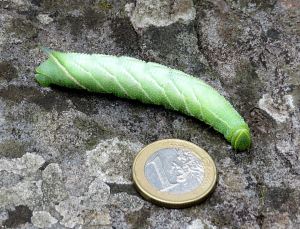
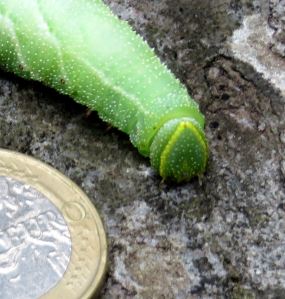
Cutting out this year’s raspberry canes, for the first time ever unproductive because of the drought, and tying in the new growth, I disturbed a dramatic 75mm-long caterpillar of an Eyed Hawk-moth which had been munching through the leaves.  I had been squishing caterpillars of cabbage white butterflies which had reduced my brassicas to lace but this was a rare beauty so I carefully relocated it – after taking the obligatory photos.

18Home05w0018

The only coin I had to hand to show the size was a euro.  Note the blue tail-spur which differentiates it from other hawk-moths

18Home05Bw0018

Zooming in on the head showing the yellow shield-shaped marking

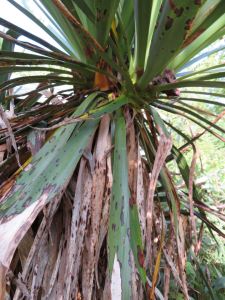
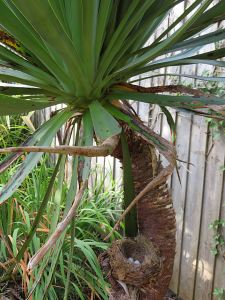
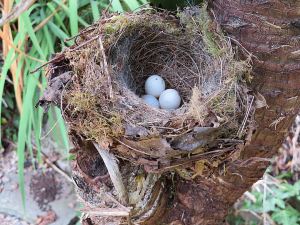
Having tied in the raspberry canes I started to clear the dead leaves from a clump of yucca, a painful job because even when dead they are needle-sharp and unyielding.  Deep inside I uncovered an abandoned goldfinch nest. My guess is that the parents had been intimidated by next-door’s new cat, the nest being a bit too close to ground level.  On a positive note, the cat also seems to have chased off the rabbit.

18Home06w0023

Dense dead leaves covering the trunk and the nest


18Home07w0024

… which emerged in a small fork when they had been cleared


18Home08w0021

Close up of the nest, still with three eggs in it.

  x

Posted in Greece, Grey Britain, Hiking, Landscape, Mountains, Nature, Photography, Pontypool, Uncategorized, Wales, Weather, Wildlife | Tagged , , , , , , , , , , , , , , , , , , , , | 7 Comments

Greece, Symi:  …… and now for something a little different

I don’t often go on the ‘Round-the-island’ boat trip but occasionally I do when I have visitors staying. Like recently.  There are a number of excellent reasons for doing it:

1  It’s a good way to see the island

2  It’s relaxing for tired muscles after trailing around the mountains for a week

3  It’s a very good way to keep cool, not only because of the breeze on the boat but because it stops  at five points for a swim

4  There is a very good barbeque on the beach at the tiny Sesklia Island to the south

The reason I don’t do it more often is that I prefer to be walking through the world rather than watching it pass by me with limited opportunity to side-track to look at things.  I prefer more activity, more interaction with my environment. Sitting on a boat watching the shoreline pass by is a bit like watching TV.

The best compromise is to choose the day when the boat’s first stop is at the island monastery of Agios Emilianos.  Described on the ‘Greek Island Walks’ page of this blog it’s a walk of between 2 and 3 hours across the island to the west coast (see).  Having checked the evening before and arranged with the captain to be picked up at Emilianos, we knew we needed to be there by 11.30 when it left for the second swimming stop.  We allowed 3 hours and took 2½.

With the prospect of an hour to kill on the beach at Sesklia while the barbeque was being prepared, I decided to use it to walk into the interior and visit the castle there.

‘The Interior’ sounds very grand for such a small island but it is surprising how different it is from what you see sailing around the coast.   I last went to Sesklia more than 10 years ago and had no idea how much it had changed.  The short stretch of concrete road from the jetty to St Paul’s church had been extended.  What I remembered as a dirt track running westwards from there is now good quality concrete.

At the point where it turned sharply north to go around the back of the hill up to the large farm buildings on the top, I turned off and walked up through old stone terraces to the castle.  The walk along the road was quick and easy but once onto the terraces it was a matter of following sheep tracks winding through aggressive vegetation, much of it long-dead from drought.

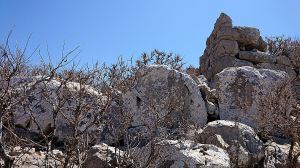
There is more left of the walls of the castle than most of the others on Symi, with one corner nearly 3 metres high.  There seemed to be few large ‘ashlar’ blocks lying around so either they have been cannibalised and used in the construction of the nearby farm buildings or, like in other old castles, large blocks were used for the base of the fortification topped by smaller stones.

Only half a mile from the jetty in the bay, it’s an interesting alternative to sitting under the tamarisks at the top of the beach.  A comfortable stroll back in time to join the queue for the barbeque.

18Symi045wDSC0199

Looking up to the vestiges of the castle walls

18Symi046wDSC0198

Getting closer and the size of dressed stones as an outer defence become clear.

18Symi047wDSC0191

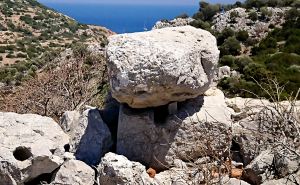
This style of construction, with smaller stones and terracotta levelling out large blocks, is more common elsewhere than on Symi

18Symi048wDSC0190

As in other ancient constructions on Symi, there seems to be one large, carefully cut block with a channel in it


18Symi049wDSC0193

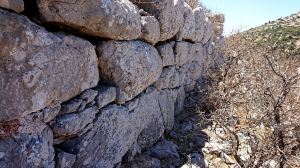
Looking along the wall facing the farm building below.


18Symi050wDSC0188JPG

The central plain on Sesklia island probably has more flat, carefully farmed land than the whole of Symi

x  

Posted in Greece, Hiking, History | Tagged , , , , , , , , , , | 1 Comment

Greece, Symi:  The smell of herbs and The Flood

OK, so I’m posting a lot fewer blogs these days.  Cynics are probably sniggering that old-age is catching up on me and I’m spending the days ‘reminiscing’ in tavernas.  Nowhere near the mark.

True, I have less energy and take longer to recover but in six weeks the least walking I have done in a day is 12 kms and that includes two days hopping between islands and waiting around for ferries.  The least height ascended in a day has been 450 feet on the days waiting for ferries.  A couple of days have been more than 25 kms and 2,500 feet.  This is seven days a week for six weeks. Mostly it has been in temperatures ranging between 30 and 35 degrees Celsius in the shade but towards the end of the period it was pushing 40.

So, not guilty of idling my time away.  Just not getting down to writing much.  I’ll be on Symi for much of the summer though with trips back home to see family and friends and sort my vegetable garden. There will also be another visit to Nisyros and hopefully to see friends on Kalymnos.

This is always, of course, God permitting.  The last decade and a half I have been more and more aware that, in the words of the book of Proverbs, “ A man’s mind plans hi s way but the Lord directs his steps”.  I make plans and then completely unexpectedly, left-field, something happens which takes me in another direction

What finally triggered me to post another blog was walking to the mountain-top monastery of Stavros Polemou on Symi (see Walk 1 and Walk 4) and the next day to Agios Vasilios, a monastery teetering on the top of cliffs above the sea, and to Lapathos, a secluded beach on the west side of the island (Walk 1 and Walk 2).   Great walks and great places.

What struck me both days was the strong, almost overpowering, smell of herbs.  On Symi whole mountainsides are covered in oregano or sage or thyme, often though not always only one of the three depending on geology/soil-type.  Most of the flowering plants in my last couple of blog posts are now dry and shrivelled up, crisped brown leaves.  Thistles are coming into their own but the dominant impact is the herbs.

My favourite herb, oregano has now finishing flowering, the massed heads of white flowers turned to seeds, the swarms of bees having done their job.  The plants are looking drab and tired rather than fresh-green but are beginning to show signs of new growth so will soon be ready to pick and dry again for flavouring my meals.

18Symi041w2246

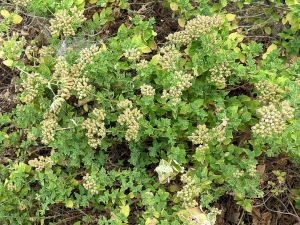
Massed white flowers turned to seed heads

18Symi042w2250

…. with new growth sprouting on some plants

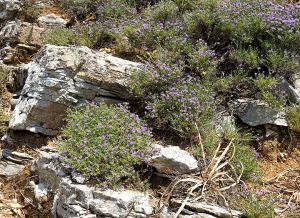
The bees have moved on to the thyme, lower-growing with vivid purple cushions.  Walking along the narrow paths through the plants is a bit nerve racking with bees constantly buzzing around your ankles which brush the flowers at every step.  Mostly they just get on with the job and only regard you as a threat if you get too close to the hives.  One day I did and was stung for my lack of attention.

18Symi043w2247

In places the thyme is dense and close-packed, crowding the path.  Too risky to stop in such places because of the zillions of bees.  Here they are further apart.

In contrast to the dark-green foliage of thyme, in the heat of day the silver/green leaves of sage are curled up tight to reduce the surface area presented to the scorching sun, showing the silvery underside, a typical way plants adapt to extreme heat and aridity.  Not yet in flower, sage is the dominant smell at the moment, perfect for picking and drying.  Because of the heat-stress, the flavour is much more intense than the sage I grow in my garden in the UK.

18Symi044w2272

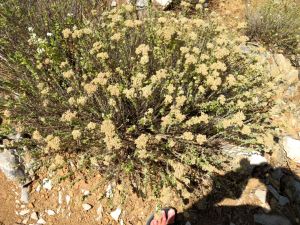
Sage, curling leaves combat the heat and aridity and intensify the flavour.

The ever-present, almost overpowering, smell of herbs on Symi mountainsides has to be experienced to be appreciated.


If you are coming to Symi or Nisyros, don’t forget to check out the walking guides on the ‘Greek Island Walks’ page of this blog. I must admit to not having updated them as intended but even had I done so, the amendments could not have taken account of the dramatic changes which have happened on Symi.  The exceptionally severe storm of November 2017 led to the Greek Government declaring a state of emergency on the island.  The army was sent in to help sort out the devastation and the damage in the harbour area has now been largely cleared.  Most visitors will see no sign of what happened.

In the mountains it’s a different story.  Footpaths and kalderimia have been damaged, especially where they cross gullys.   However, don’t believe what some travel reps are telling clients – all the paths I have checked out have been passable.  More care is needed but none has been blocked.  Perhaps the one which will impact most is the paved kalderimi past Ag Paraskevi  ( Walk 2 and Walk 4 ).  The church courtyard is filled with mud (now dried), rubble and a broken-down digger sent to clear it.  The path for 100 metres after that is badly damaged.  But it’s perfectly passable.  I walk that way three or four times a week.

Don’t forget, especially if you are an ‘independent traveller’ to take a look at my book now in Amazon’s Kindle Store.  ‘Greece unpackaged: Travels in a foreign language’.


Front Coverx

Posted in Greece, Hiking, Landscape, Mountains, Nature, Spring | Tagged , , , , , , , , , , , | Leave a comment

Greece:  Nisyros spring

As intended, after my earlier-than-planned visit to Symi I returned home to resume sorting out my vegetable and fruit garden ready to leave for the summer, a task helped by four days of unusually warm and sunny weather.  Having planted cabbages and sprouts, sown parsnips, pruned apple trees (an autumn task), tied in raspberry canes (another autumn task), and countless other garden-based activities, I headed back to Greece, glad to escape the return to the all-pervading grey and wet which had descended on the UK again.

I arrived on the volcano island that is Nisyros for late spring.

In the distant past it was one of the most fertile and productive agricultural centres in the Mediterranean/Aegean, with massive harvests of grain grown on highly fertile volcanic soil.  Narrow terraced fields climbing up steep mountainsides didn’t lend themselves to industrial scale farming.  Coupled with reduced rainfall consequent on climate change the population moved out leaving much of the land to become feral.

Early spring and fields are blazing white and yellow with crown daisies but now they are golden brown. Eye-catching crimson of poppies have mostly finished flowering.  Purple spathes of Dragon Arum are now confined to a few tiny specimens behind shady walls

By contrast late spring is characterised by a canvas of ripe wild-cereals, golden coloured and sweet smelling of hay, dotted with a huge variety of colours of smaller flowering plants.

Starting to make an appearance are the many thistles, the last of the plants to flower.

Soon all will be withered and dried up.  But at the moment it’s eye-catching.

x

Posted in Greece, Hiking, Landscape, Mountains, Nature, Photography, Spring, Wildlife | Tagged , , , , | 3 Comments

Greece:  Symi spring

Having made the most of the snow in the unusually prolonged winter (the last blog post) my intended trip to Greece and Spring was brought forward by a few weeks. The sudden and unexpected death of a very good friend on Symi meant that I returned to the island weeks earlier than planned in order to attend the funeral. The transition between winter and spring was therefore very rapid.  Snow drifts to spring flowers in a few days.

Sandwiched as it was between UK Easter and Greek Easter meant that in order to get to Symi in time I had no choice but to settle for air fares significantly higher than I usually pay.  The plus side was that I stayed until fares dropped again which gave a week of trekking in mountains unusually green and colourful compared to the parched deserts of high summer.

The colour was both at the micro and macro levels.  Flowers ranged from tiny clusters a few millimeters across to the deep, opulent purple spathes of Dragon Arums two feet long.  If you know where to look there are shy orchids hidden in the other vegetation.

Wildlife was also much in evidence with many lizards and tortoises taking advantage of the cooler temperatures of spring to be out and about during more than the early morning and late evening.

These are just a few images, a montage, of Spring on Symi.  If you only visit the island in the heat of summer, you miss all this.


I had to return home to resume sorting out my vegetable and fruit garden ready to leave for the summer, a task helped by four days of unusually warm and sunny weather.  But I’m heading back to Greece very soon and will be glad to escape the return to the all-pervading grey and wet which has descended on the UK again.

Posted in Greece, Grey Britain, Hiking, Landscape, Mountains, Nature, Photography, Spring, Weather, Wildlife | Tagged , , , , , , , , , | Leave a comment

Wales, Brecon Beacons National Park: spring into winter

I promised more images of winter before spring eventually arrives and I headed for Greece.  My intention had been to post more photos of snow in the Canadian Rockies but once again plans were changed by events.

The real effect of global warming is climate change and climate scientists confirm that what we will increasingly see is more frequent and more extreme ‘extreme weather events’.  In the northern latitudes we are also likely to see more grey skies and greater precipitation.

This is the context in which to view what has been happening in the UK recently. It seems bizarre that tabloid mentality has come to regard 1 March as the start of Spring.  Spring is a meteorological not a calendar concept.  The first month of this mistakenly notional ‘Spring’ saw more winter weather than during winter, certainly in my neck of the UK woods.

Following the heavy snowfall which I wrote about in my last-but-one blog post we had another significant snowfall in the middle of March when Easter bunnies and spring flowers were gracing supermarket shelves.

Once again, after clearing a path up the drive, on a couple of days I took my camera for a walk up the mountain.  This time I walked further up the ridge before dropping down to the Goose and Cuckoo, a log fire and warm welcome.  It seemed right to make the most of the snow before heading for Greece and Spring.


Talking of Greece don’t forget to take a look at my book now in Amazon’s Kindle Store.  ‘Greece unpackaged: Travels in a foreign language’, available for the world to read.  x

Posted in Greece, Grey Britain, Hiking, Landscape, Mountains, Photography, Pontypool, Wales, Winter | Tagged , , , , , , , , | 1 Comment

Greece unpackaged: Travels in a foreign language

My plans for the next post on Barry’s Ramblings have been postponed yet again.

The reason?  I’ve finally got around to sorting out the technology and published my book in Amazon’s Kindle Store.  ‘Greece unpackaged: Travels in a foreign language’ is now available for the world to read.  If it wants to.  Take a look.

Front Cover

More images of winter before  spring eventually arrives and I head for Greece again will follow shortly

Posted in Greece, Health and humour, Reflections | Tagged , , , | 2 Comments

Pontypool, South Wales:  ‘The Beast from the East’ meets Storm Emma

It doesn’t often happen but when it does it’s dramatic.  And fun.

In winter, cold weather comes to the UK from the continental land mass.  It’s a cliché but nonetheless has an element of truth, that the Welsh Mountains are the first high ground west of Siberia.  Dry, cold air builds over Europe and as it crosses the North Sea picks up moisture which falls as snow over Eastern England.  By the time it reaches South East Wales most of the snow has already dropped out and we get a few flakes, rarely amounting to much.  The xenophobia embeded in Brexit this year led to this airmass being dubbed by the mindless media ‘The Beast from the East’.

By contrast, weather coming from the West and South West over the Atlantic is wetter, warmer and often more vigorous.  With the increased influence of climate change and the more frequent and more extreme ‘weather events’ consequent upon it, the Met Office decided to name the increasingly frequently storms in the same way that hurricanes are named in the USA. The reasoning is that giving names somehow makes it more personal, encouraging us to take storms more seriously.  Like hurricanes they are named alphabetically, hence ‘Storm Emma’.

It’s all certainly the stuff of headlines. This was flagged to be the Clash of the Titans, the Beast and Emma.

When occasionally the cold continental airmass pushes west and meets the relatively warm, moist air coming in from the Atlantic the consequence is heavy snowfall where the two collide.

The most notable that I remember in Wales was in 1982 when two days of blizzards brought up to 20 feet of snow and everywhere to a standstill.   Cars were buried in our street.  At the top of the valley, houses were buried and people had to tunnel out of upstairs windows.  Unusually the continental high pressure stood its ground, became a ‘blocking high’.  There was no more snowfall as Atlantic air retreated but temperatures over Wales dropped to minus 20 and below for a week afterwards.

This time, after a brief skirmish The Beast retreated, leaving warm, moist Atlantic air in charge.  Before it did, a couple of feet of snow had fallen, drifting deeper in the strong winds. Panic-stricken shoppers cleared the supermarket shelves of bread. Householders desperately shovelled snow off their drives and onto pavements, blocking footways and even main roads.  Sadly, water mains froze and then burst leaving many homes without water.

It happens so rarely at home that I became excited and went out to play.  Not quite the Rockies but it had to be done.

Having washed but not yet put away winter thermal clothing after the trip to the Canadian Rockies, on three days I togged up and went up the mountain.  Living at the southern tip of the Brecon Beacons National Park means the ridge-top is normally only half an hour away on foot, another hour back home via the supermarket.  This time, in strong wind and drifting snow, it took over four hours each day.  But it was spectacular.

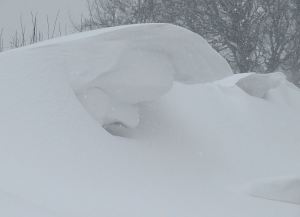
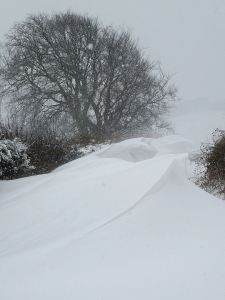
The path along the ridge from The Folly Tower to the Shell Grotto (two eighteenth Century follies) is flanked on both sides by fences and hedges.  It was blocked by drifted snow, in places over 8 feet deep.  At times I had no choice but to leave the path and go into fields on the downwind side.  On two days it snowed heavily the whole time I was out, the drifts continually sculpted into ever larger and stranger shapes.

18Torfaen01w1662

Before I could get anywhere near the mountain, I had to negotiate the drifts outside the house.

18Torfaen02w1735

At the top of the drive, a small cornice had formed.
18Torfaen03w1672

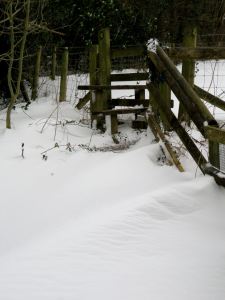
Having negotiated a Range Rover (a toy Land Rover for rich people) stuck in a snow drift and blocking the farm track, I had to negotiate a small drift burying a plank bridge over a ditch and small stream.

18Torfaen04w1676

Part way up the flank of the hill and looking back at the blizzard.

18Torfaen05w1678

A little further on and disoriented sheep follow each other from nowhere to nowhere.
18Torfaen06w1686

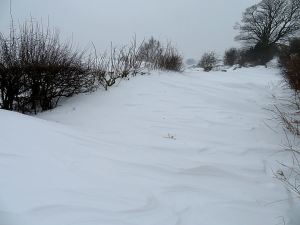
Reaching the ridge top and the path between hedges connecting the two follies is blocked by drifts, swirled and rippled by the wind.  The shallowest part of the drift was half way up my thighs.

18Torfaen07w1683

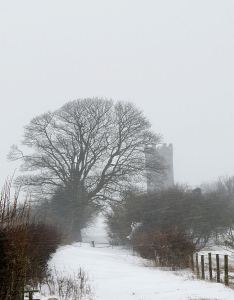
Every step now became a struggle but a short distance and venturing into the deep part of the drifts, the Folly Tower comes into view, the gate to the top field almost out of sight under snow.
18Torfaen12w1701

Struggling up the drift for a better shot
18Torfaen08w1689

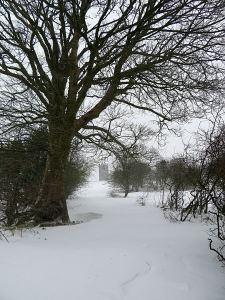
Passing the gate and I sink down into the drift to frame the next shot.

18Torfaen10w1695

Looking North from the Folly Tower and the field is stripped nearly bare by the strong wind, snow collecting in deep drifts behind the stone wall until it is buried.
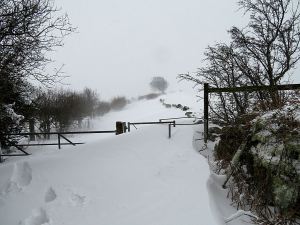
18Torfaen09w1691

Heading back along the ridge path and the problem of negotiating the gate becomes obvious.

18Torfaen11w1698

Then relief, the drifts become shallower at one side of the path.

18Torfaen13w1708

…. but not for long.  These hedges are over 6 feet high and the path between them is blocked completely.

18Torfaen14w1707

I force a way through a drift into a field on the west side of the hedge-lined path, the drifts still being sculpted by the horizontal snow in the blizzard.

18Torfaen15w1712

On the down-wind side, the snow in the field is shallow, the drifts on the left 8 feet high, in places completely burying the hedge.
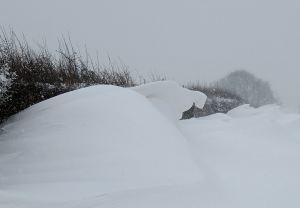
18Torfaen16w1715

… topped by weird sculptured shapes.

18Torfaen17w1718

Back on the path, drifts  form  canopies

18Torfaen18w1724

…. and cave-like structures.

18Torfaen19w1722

Then the path is completely blocked again.  This time there is no choice, it’s the beginning of a ‘sunken-way’, a 5-foot earth bank with 5-foot hedge on top – all buried.

18Torfaen20w1727

I take to the field again by climbing up the snow-filled hedge and dropping down the other side., When I eventually slide down the bank and look back up the path, the footprints are in 4 feet of snow.

Wonderful!  Shame that this time the thaw set in on day four as the Beast from the East retreated back into the continent.
Posted in Hiking, Landscape, Mountains, Pontypool, Wales, Weather, Winter | Tagged , , , , , , , , , | Leave a comment

Banff, Canada:  walking on water

I’m back home now but still reminiscing about the trip to Banff.  It was comparatively mild compared to previous winters when we have been there, afternoon temperatures getting up to a toasty -50C though much colder overnight and most days afternoon temperatures between -150C and -200C.  Makes a mockery of ‘the beast from the east’ headlining in the UK with night time temperatures of -50C.

It snowed regularly, sometimes with falls of 15cms in a fairly short time.  It meant that this year I stuck to skiing midweek leaving the slopes to the hordes from Calgary rushing up at weekends to revel in the ‘pow-days’. On weekends I went trekking, sometimes on snowshoes, sometimes with ice cleats.  I rarely saw anyone else.

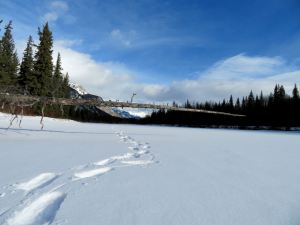
One snowshoe trek was upstream on the Bow River, frozen solid and snow covered.  It snowed much of the time I was out.  Apart from the pleasure of walking on snow in the snow in the vastness of the Canadian Rockies there were micro-moments when the small scale took centre stage.

18Banff46w1642

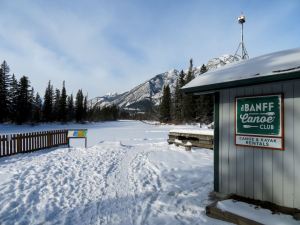
The ironic start  of the trek, the Canoe Club at the confluence of the Bow River and 40 Mile Creek.

18Banff47w1636

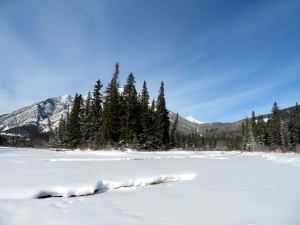
On the river, Bow River to the left, 40 Mile Creek to the right.

18Banff48w1640

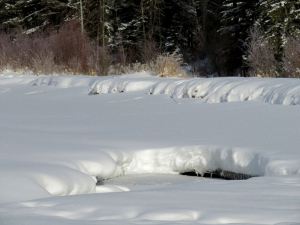
The Creek is faster flowing at this point and so there are vestigial runs of  unfrozen water, thick ice above the water level and covered in snow.

18Banff35w1395

On 40 Mile Creek the edges of the ice collapse as the water level drops.  Tracks show it has been crossed but in my view best avoided.

18Banff49w1643

Walking the dog on the thicker ice of the Bow River.

18Banff39w1415

The thicker ice means that the river can be crossed at any point, here by a single set of prints

18Banff50w1648

….. but there are also well worn trails across, shortcuts from housing on the west bank to downtown on the east.

18Banff38w1403

Deep snow on the river ice makes the going hard work even in snowshoes, mine the only prints

18Banff21w1402

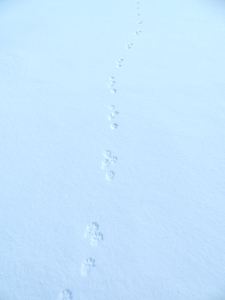
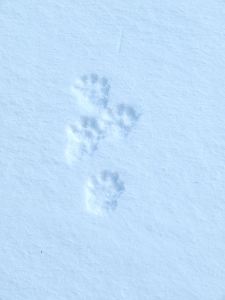
…. until I come across fresh prints crossing the river.  Obviously a big cat as evidenced by the lack of claw marks, running cat-fashion back paws-to front paws, and very fresh with no sign of the fine powdery snow blown by the wind into the depressions.

18Banff20w1401

Thankfully the size of the tracks indicated they were made by a lynx or bobcat and not the much larger and potentially much more dangerous cougar, seen in town only a few days earlier.


18Banff36w1398

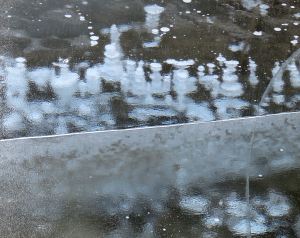
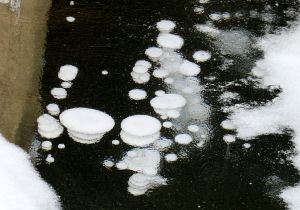
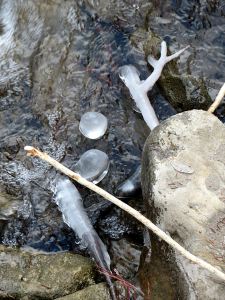
Further on, eddying wind has blown snow off the smooth ice showing bubbles of gas frozen like white mushrooms as they try to unsuccessfully to reach the frozen surface, the effect split by a crack-line.

18Banff37w1407

Looking more closely at the frozen bubbles

18Banff40w1409

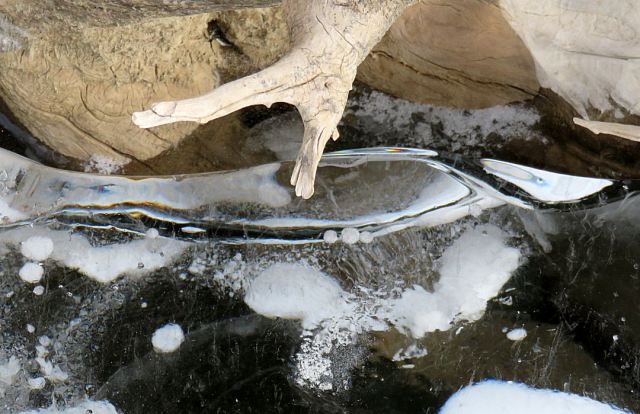
Clear ice shaped into smooth curves as it froze swirling around a tree stump, acting like a prism and refracting the light into rainbow colours.

18Banff41w1420

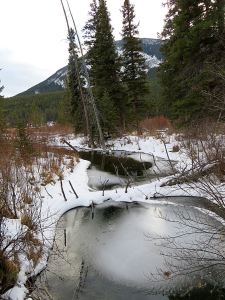
Walking back downriver on the Marsh Loop Trail, a footbridge crosses the always-flowing stream coming down from the hot spring at the Cave and Basin, the reason why Banff grew here.  Slightly ponded on the upstream side …..

18Banff42w1416

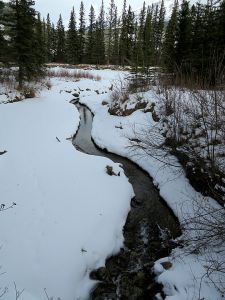
….. on the downstream side of the bridge the open channel is narrower but still flowing.

18Banff43w1418

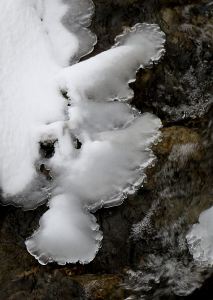
By the time it reaches here, the hot water has cooled.  Now only a few degrees above zero it freezes on twigs and branches.

18Banff45w1604

….. and creates intricate shapes at the water’s edge

18Banff44w1422

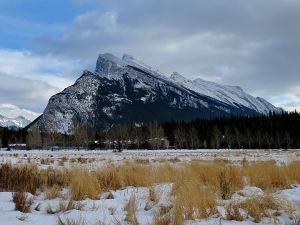
Coming out of the forest and looking across the flat expanse of marshland towards the serrated ridge of Mount Rundle.

A great day.

Posted in Canada, Hiking, Landscape, Mountains, Nature, Photography, Wildlife, Winter | Tagged , , , , , , , , , , , , , | Leave a comment

Banff, Canada: Snow Art

Walking along the pavement (sidewalk) in Bear Street to do a bit of minor shopping, head down to watch out for undulations which would indicate patches of black ice under the trodden snow, I didn’t notice the barriers across the road.  But I couldn’t miss the six 3-metre cube wooden crates sitting in the middle a few yards further on. It was if they had been beamed down from space.  I overheard one grumpy Brit from the Sarfeast complaining “They’ve just dumped them in the middle of the street”.

An A-board next to the crates announced that they may have something to do with Banff SnowDays, an annual celebration of winter in January.

SnowDays usually features come-and-try-it ice skating on the playing field alongside the high school, flooded to create an outdoor rink in the winter, music provided in case you fancy yourselves as Torvill and Dean.  For a few years there has been ice-climbing on an artificial ice-wall in Banff Avenue.  One year, ice-sculptures were dotted around the town.

This year was obviously different.

Over the next few days the sides of the crates were dismantled to expose huge cubes of compacted snow, barriers were set up and artists from North America and Europe moved in armed with power saws, handsaws, rasps, files, scrapers and polishers.

The lumpen cubes of snow were transformed into giant works of art.   When finished the barriers were opened to allow people to get close to them. Fire-tables were lit, sparkling and crackling, giving off an unbeatable smell of wood-smoke.  After dark, coloured floodlights picked out the features.    Great experience.

I heard nobody else complaining.  Everyone loved it.  All ages waited their turn for a photo opportunity in front of the skier, or the buffalos, or the explorer in a rowing boat, or the winter-visitor-with-binoculars.  Most popular seemed to be the wolf’s head with the magic wonderland in the back of it.

I don’t offer comment on the sculptures, I don’t know enough about art.  But, in my philistinic opinion, as a municipal/community/international artistic event it was right up there with the best.

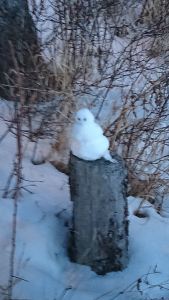
Maybe inspired by the idea.  Maybe anticipating it.  A nine inch high child’s creation on a  tree stump alongside the frozen, snow-covered river.

18Banff34wDSC0362

Across the planet and the seasons see: Nisyros: Beach Art


Posted in Art, Canada, Photography, Winter | Tagged , , , , | 2 Comments