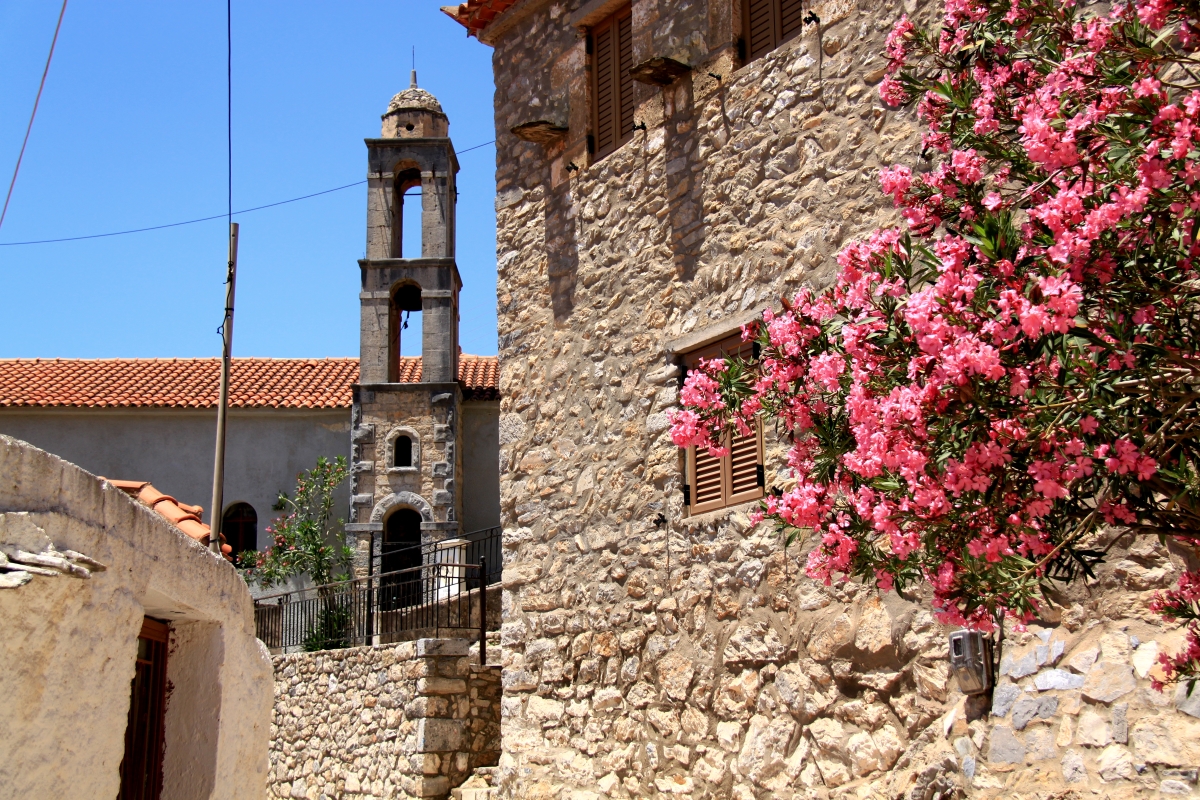
Kardamili: olives, maps, flat earth?! Where will it end?!?!

Every time I try to have an easy day to recover from a series of long, strength sapping walks in the Greek sun …. I get it wrong.

Wednesday was to be a gentle amble along the coast road northwards from Kardamili before striking off onto a footpath gently meandering over the headland.  Problem was that the path goes off the edge of the map.  And therein lies the worrying problem.

But before we get there, a small ramble about olives.  Whatever else you may have heard, the best olives in the world are Kalamata olives.  The rest are just fit for turning into olive oil (which I use in copious amounts I might add).  I had a Greek salad on Tuesday evening, liberally furnished with olives.  They were delicious.  Kardamili is in the Kalamata region and though I have only touched on it a previous blog post, the olive groves are completely different from those around Parga, Paxos and Corfu where ‘olive forests’ is a more accurate description.

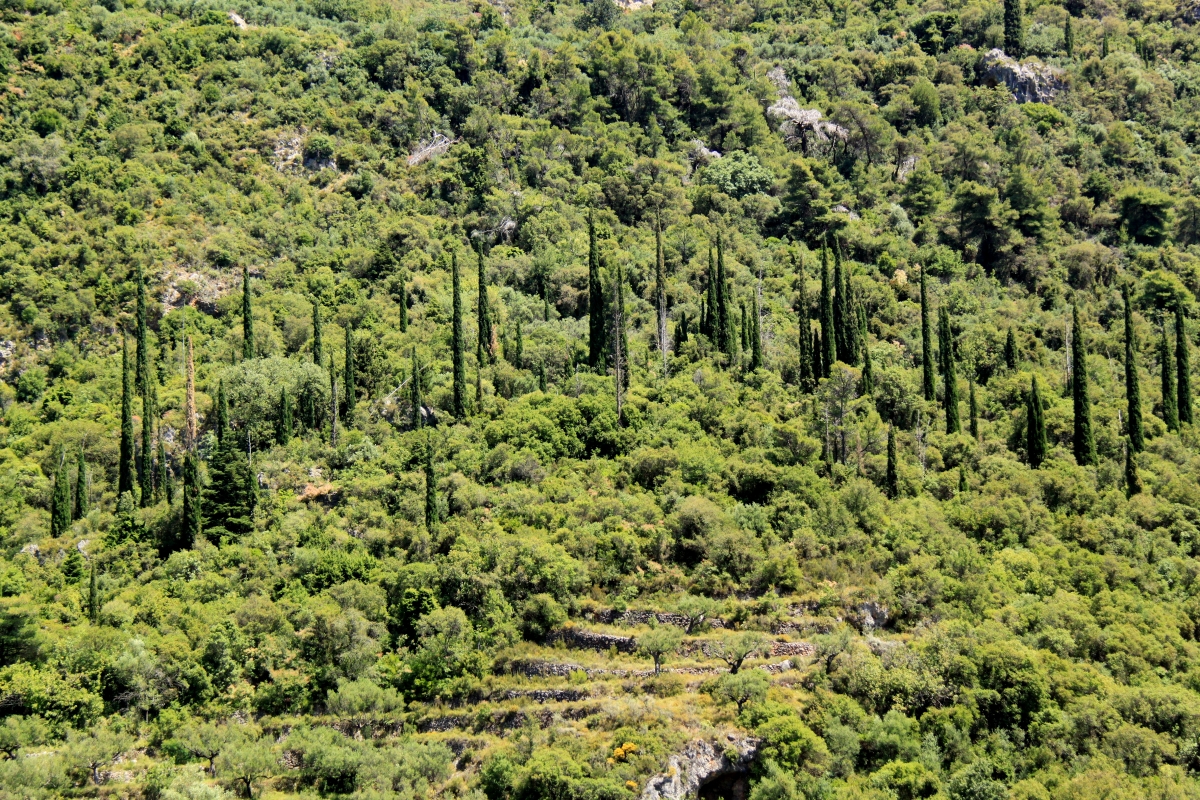
Basically, around Kardamili the olive groves are like well tended apple orchards in the UK: trees evenly spaced in rows following the contours; terraced where necessary; pruned regularly; usually about 15 feet high rarely more than 20.  The landscape impression is therefore completely different, a lot more open and light.  The ground between the trees seems to be generally cropped for hay.  Petrol strimmers are heard everywhere in the mountains in the mornings at the moment as the hay is cut back and left to dry.

Olive grove high up on the hill (note the footpath marking)
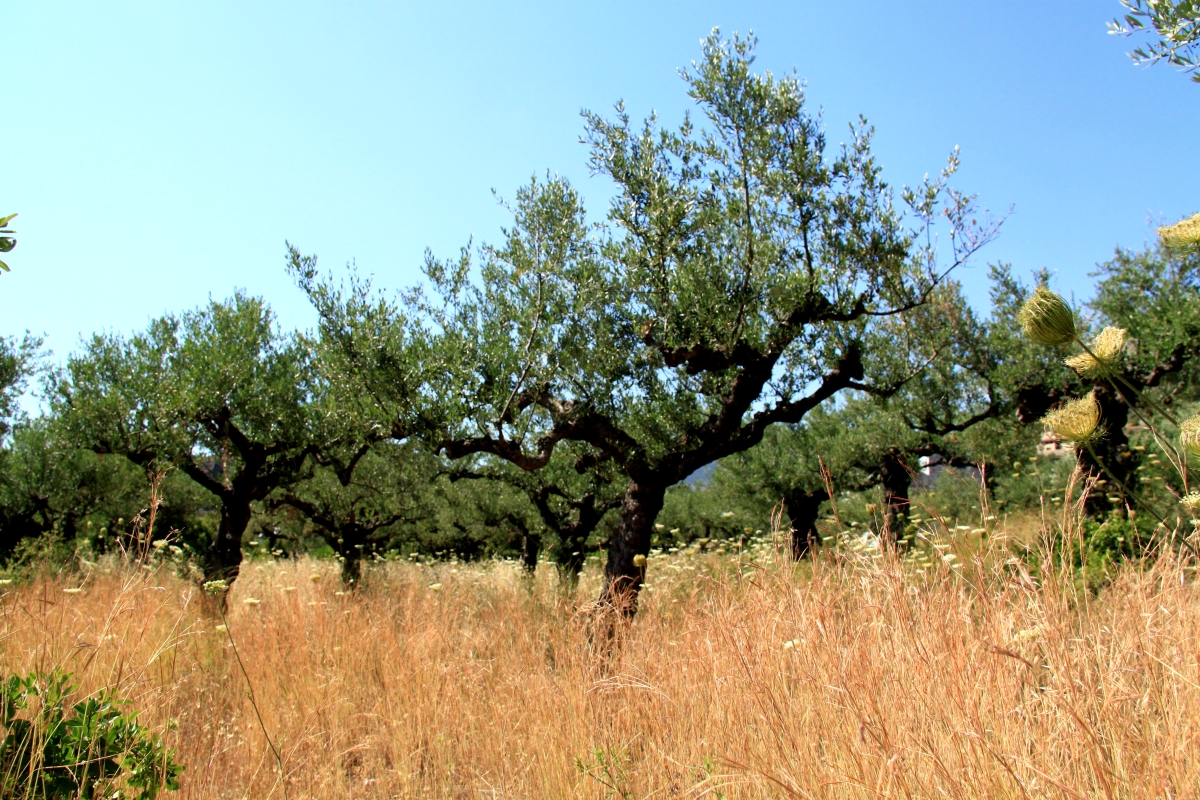
…. down next to the sea.
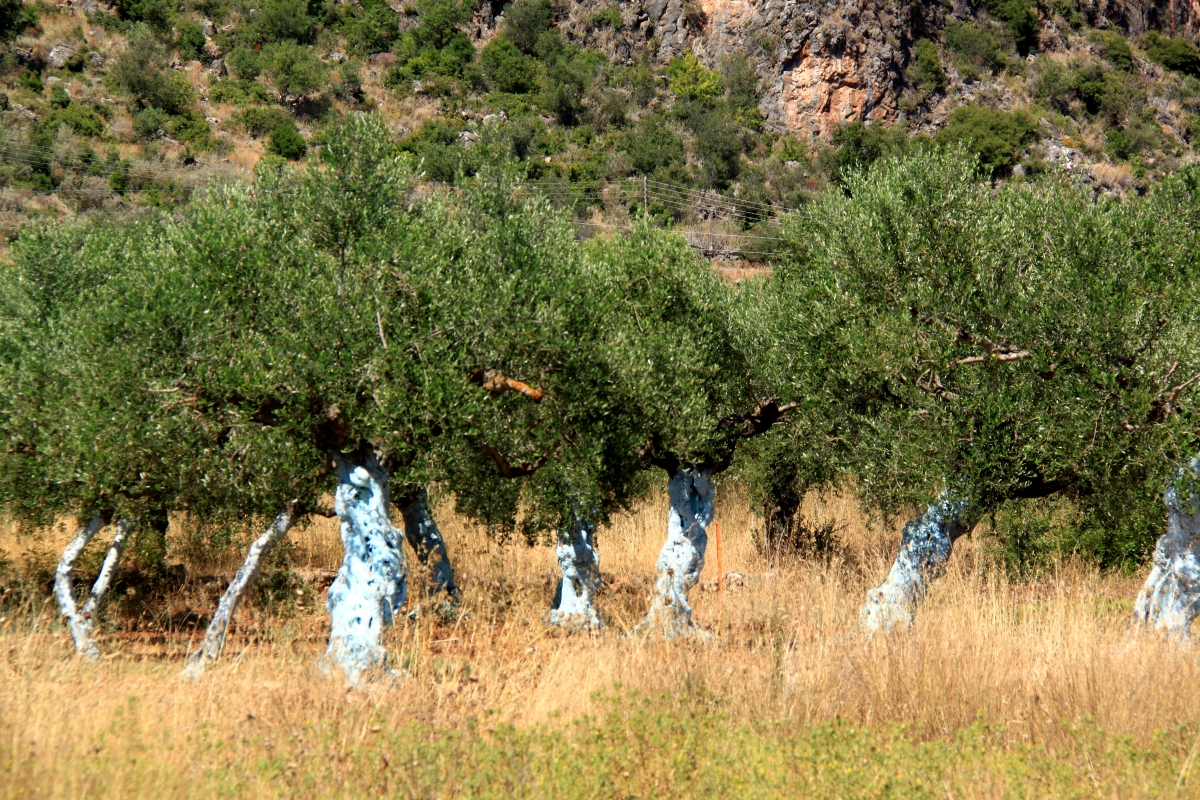
Sometimes the trunks are painted to protect against insects

The walk on Wednesday began as a pleasant amble along the beach road.  Not an early start but by 10.30 people were laying themselves out on sunbeds for the day.  Except for those ordering breakfast in the beach-side tavernas and trying to decide whether to have beer or wine!?!?!?  Then onto a very good paved kalderimi.

Not all the coast is white-pebble beach. Some is jagged rock.

A bit more rambling here.  A rough dirt track has been bulldozed to give access to a few properties built at higher levels and to facilitate access to olive groves, cutting across the line of the kalderimi as it zigzaggs at donkey-friendly gradient upwards.  But, and that is a big BUT, every time the dirt track crossed the path, the access to the path was preserved and signed.  That is a very sharp contrast with other places, particularly Symi in the Dodecanese where a policy of have-bulldozer-will-destroy has prevailed.  Significant kalderemia have been annihilated and access to many paths is now by scrambling up loose earth banks. It was a pleasure to walk the path today, though a modest amount of judicious pruning of aggressive foliage would have helped.  But that’s nit-picking.

One of the attractions of the walk was that it was to Malta.  I kid you not.  The main concern was that Malta, and the end of the path to it, were off the edge of the map.  In fact worse than that, there was a gap between the map to the north of the one I was using and the Kardamili map.  Malta and the end of the path weren’t on any map at all!!!

Given that Kardamili is tucked into the Taigetos Mountains, not the highest mountains in Europe but at 2000 metres plus not insignificant, it seems somehow inappropriate to bring up the subject, but I was put in mind of the Flat Earth Society.  Could they have a point? Given that a pair of human eyes can only see in three dimensions up to about 200 feet and after that the brain interprets from relative positions, what direct evidence do any of us have there that the earth is a geoid?  More to the point, what would happen when I reached the edge of the map?  Was that it?  A drop into The Void?

You doubt the existence of the Flat Earth Society?  They even have a web site and  T-shirts!

http://theflatearthsociety.org/cms/

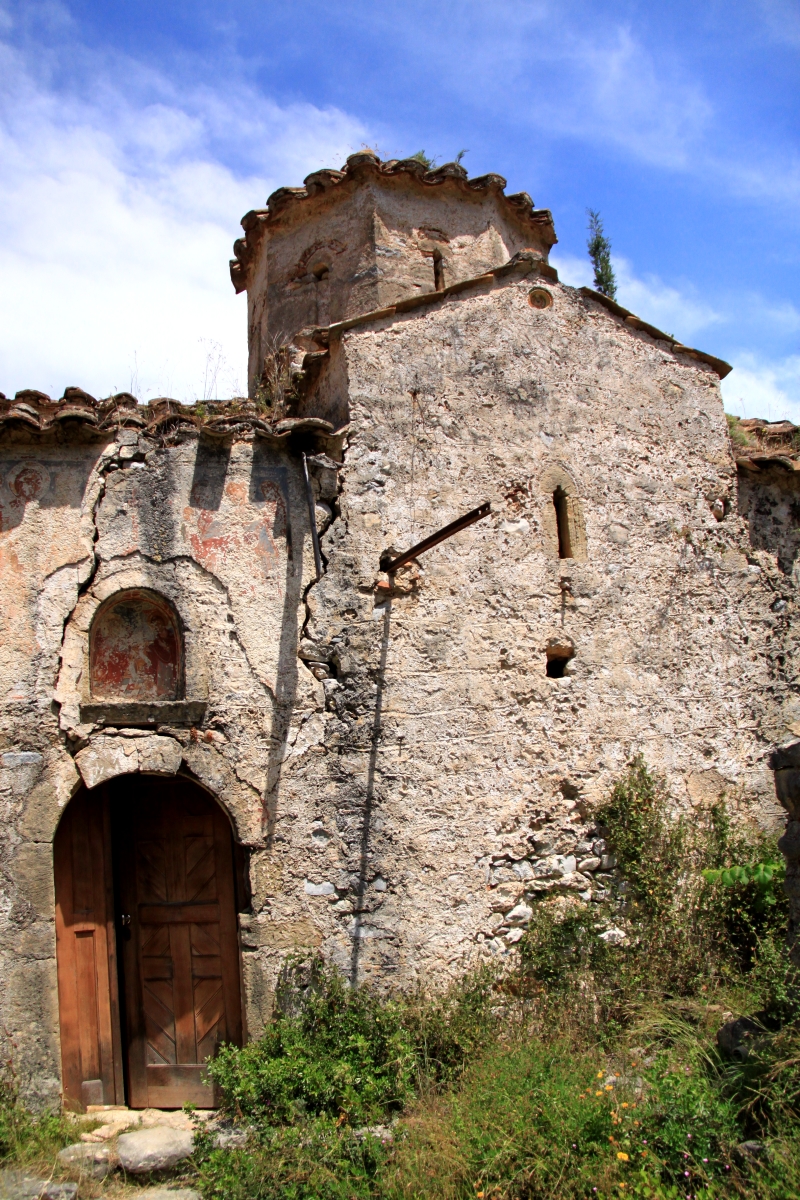
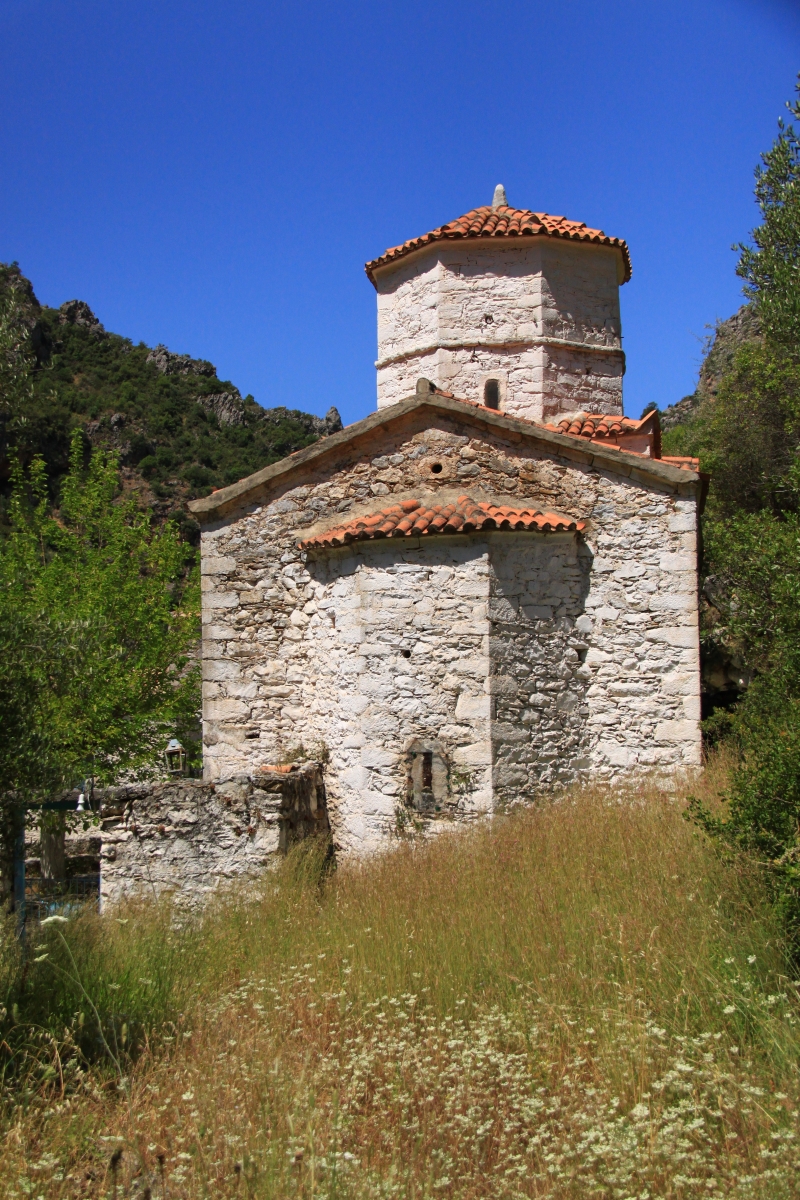
Everything went fine.  I reached the high point on the kalderimi (only about 200 metres) at a derelict church on the headland from where there were great views down the west coast of the Mani and the line of the Taigetos to the south.

Looking down the Mani west coast

Focusing on the Kardamili section of the coast

From the crest of the hill I dropped down on the kalderimi to join a track heading up higher again to an obvious col.  I approached the col cautiously because it was off the edge of the map!! At 360 metres ASL it was marked by a large standing stone.  It was like looking off the edge of the page.  What I took to be Malta was in view over the other side.  It looked nothing like I expected.  Not even an island!!  And no evident crosses.

I decided not to go further than the col.  Uncertainty about what might happen if I did had been reinforce by the sight of a dog, looked like a Welsh collie, trotting away from me and over the rim.  Dogs in the Greek mountains always bark at you and try to rip you to pieces.  They really are very aggressive.  But the sight of one trotting way from me over the rim, wagging its tail, into The Unknown, was very unnerving. Especially so when I reached the standing stone at the top and there was no sign of the dog!!!!!  Was it trying to entice me over the edge of the flat earth?  I’ve seen too many of those old black-and-white films on TV ‘Journey to the Unknown’ to be sure about this.

See http://en.wikipedia.org/wiki/Journey_to_the_Unknown

I took a couple of photos of Malta and headed back to the security and safety of the map.

Looking from the col towards Malta

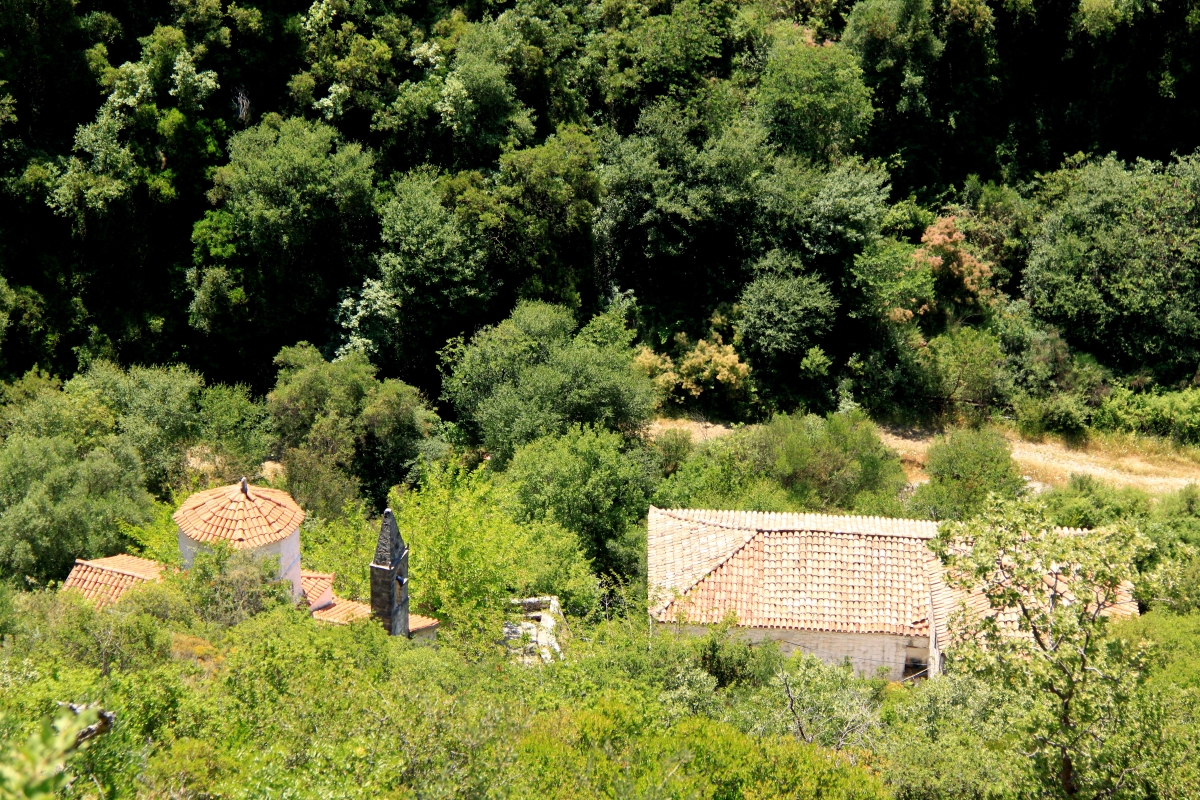
The towers above Malta
Posted in Greece | Tagged , , , , , , , , | Leave a comment

Kardamili: more time perception …. and a problem with drugs

Inspired by Monday’s 25 km walk into the mountains and not unduly tired after it, I set out with an even more ambitious plan on Tuesday.  Hack back up to Saidona, the village at 600 metres and then take to the tarmac to get to a footpath higher up into the mountains.

In line with yesterday’s rambling about time perception, there was so much new and interesting stuff that the day seemed to go on for ever.  I was convinced I had covered a lot more ground than on Monday but my pedometer put me straight.  I had in fact only walked 1 km further, 26 kms not 25.  My watch also confirmed that I arrived back only an hour later, the additional time taken up with mooching about and taking even more photos.  The reason it seemed a longer day was clearly that there was even more new and interesting stuff to look at.

Not all of the photos were successful.  Sadly, the eagle I watched had seen me before I saw him and had thermalled up to a height at which I couldn’t hold him in focus long enough to get more than a blurred shot when cropped.  But I enjoyed watching him circle lazily getting higher and higher.  Always nostalgic.

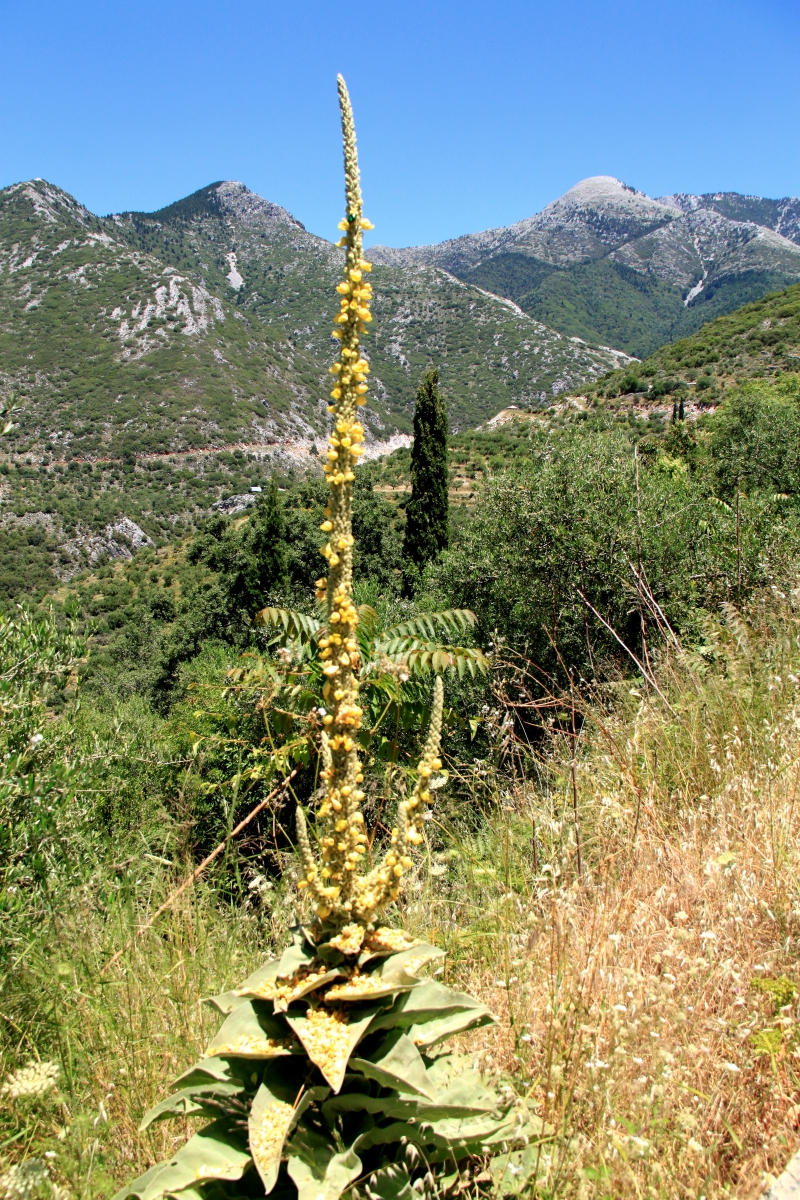
Plants are easier to focus on then eagles

Also sadly, I have now been here long enough to start getting RPS – Repetitive Photo Syndrome.  I see something amazing and photograph it from multiple angles.  I see it again a couple of days later and do the same thing, confident that I can improve on the shot.  When I get back to the hotel and download to the computer there is rarely a discernible difference in quality,  I had simply repeated the same framing and composition of earlier shots with the light quality the same.

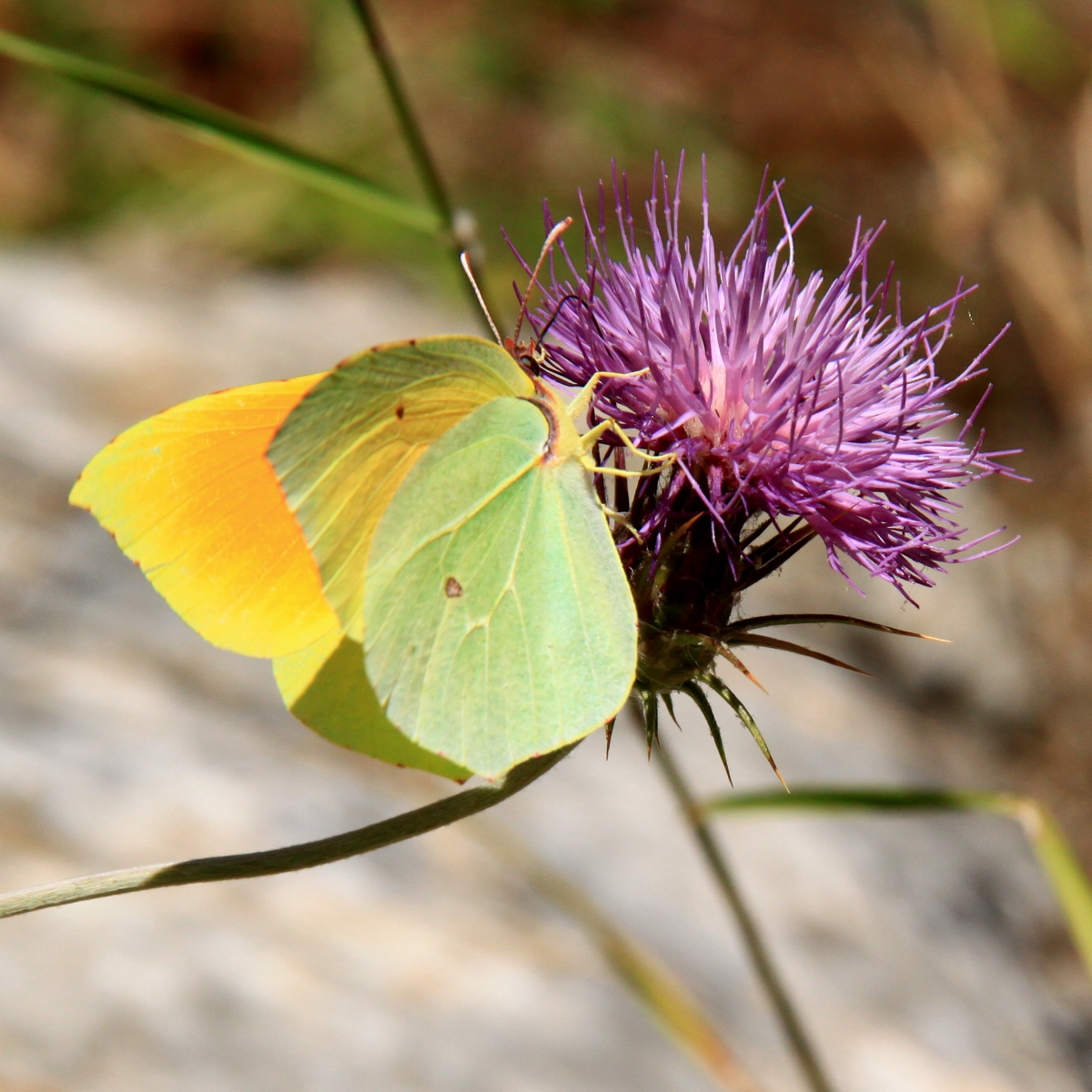
One of those sulphur yellow butterflies again

I generally have the knack of seeing the right place to take the photo and the right amount of zoom to compose the shot so have done the business within a couple of minutes.  I climb crags, teeter on the edge of tiny footholds, wade through aggressive vegetation, all in search of The Perfect Photo.  But usually find what I already have in the can (to use an old film-making metaphor, or so I’m told … in films) is as a good as I am capable of.

But today, apart from the RPS, there was a lot which was new.  The scale of the landscape is just so large that it can’t be captured with a camera but it is fantastic to walk through it.  A few times I stumbled because I was looking around rather than at my feet.  No injuries, thankfully.

I reached Saidona in less than 2 hours, with which I was well pleased.  Then followed the road to reach a footpath up to the monastery of Viadenitsa.  It’s not fun trundling along tarmac but it was the only way ….. and it was well worth it.

The monastery was in a great location, very photogenic, but not shown on the map is a Mani tower immediately behind the church and from there a footpath carrying on up the mountain.  I followed the footpath up to an altitude of 800 metres before I reckoned that I really should head back in view of the passing time and the fact that I was getting further from Kardamili not closer to it.

Mooched around the tower for a good while.  It has been partly restored with a roof and newly made floors on two levels.  Someone had been living there at some point but not for a while.  The new door was open but lockable.  The only inhabitants now were more horseshoe bats. A place like that breathes history.  And is covered in droppings.

The Mani Tower with the church of Viadenitsa below

From inside the upper storey of the tower

From another angle

The church was also open with a very old wooden door behind a metal counterpart. Inside was very simple and plain compared with many churches of similar size.  That’s maybe why it was open.

The door of the church

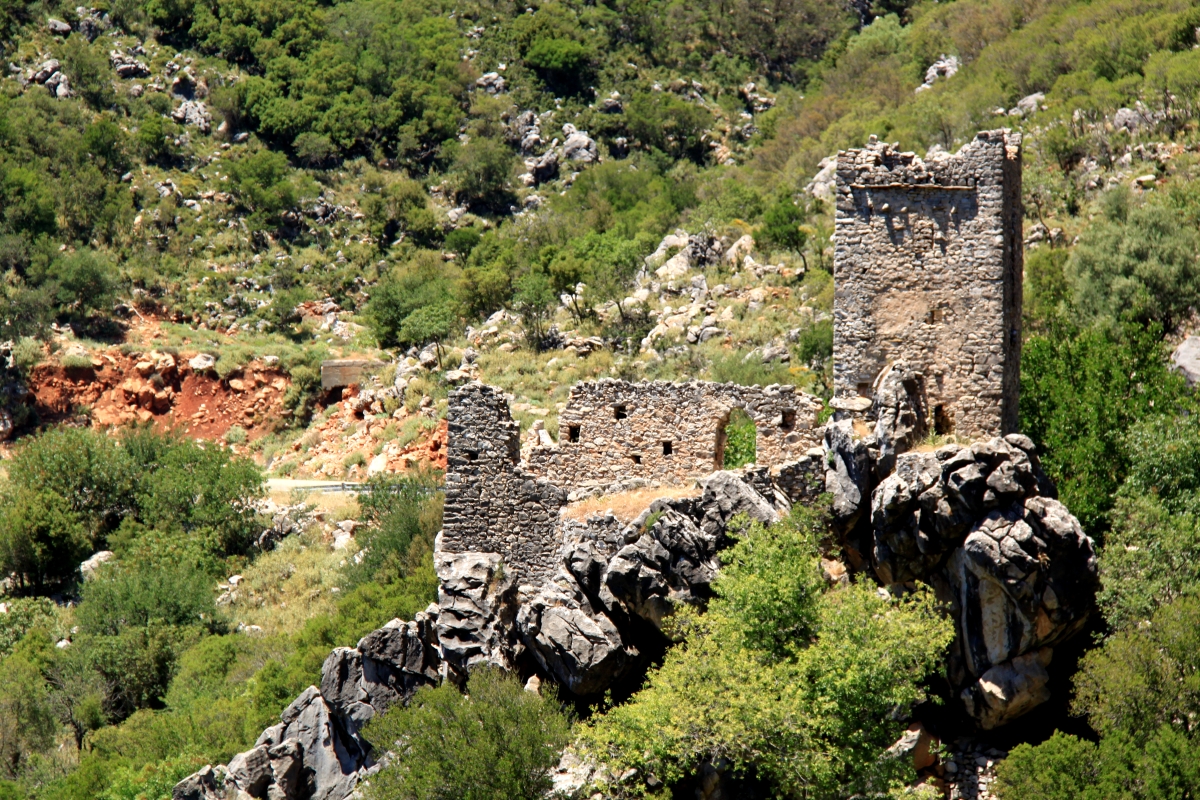
Carried on very mindful of the time and the distance to cover but progress again thwarted by the ruined tower of Kitriniaris at the side of the road which I had just had to go and explore.  I was confirmed in my view that only by walking can you really experience a place when a hire car pulled up as I was scrambling over the rocks on the way down from the tower.  The young couple in the car took a look and moved off again within 20 seconds.  They clearly didn’t stop to take a look at Viadenitsa either as within a minute the car had appeared on the road towards Saidona.  I bet I got more out of my day than they did.  Chock full of new stuff.

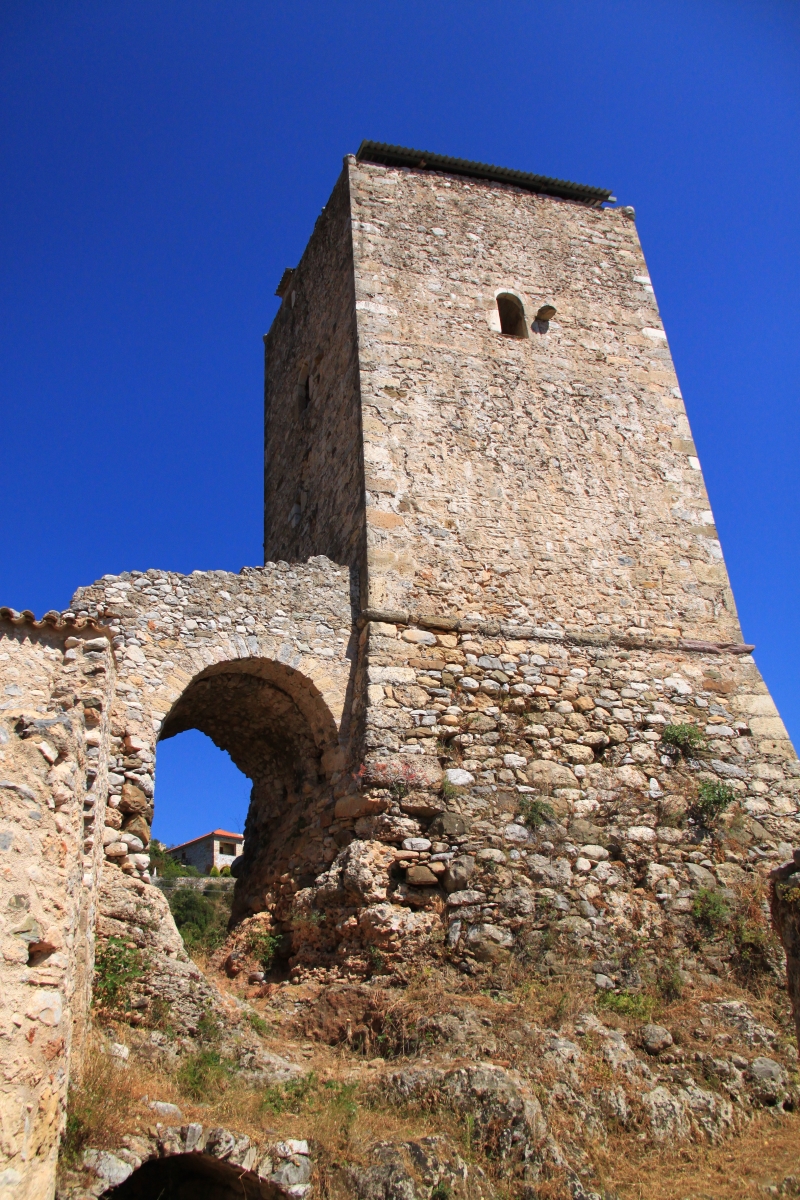
The Kitriniaris  Tower

Getting up close

… and inside. The roof and floors may have gone but note the number of built-in cupboards.

PICSThat problem with drugs?  It’s all down to grapefruit juice.  Two things you should know about grapefruit juice.  First it’s my favourite juice of all time.  I could make myself ill on it just because if I don’t discipline myself I can drink a 1 litre carton in  a minute and move on to the next one, converting my personal sewage disposal system into an explosive device.  Dramatically.  Second, it inhibits the body’s ability to absorb drugs into the bloodstream.

I discovered this when I was skiing in Canada in temperatures between minus 15 and minus 30.  I suffer from Reynaud’s Phenomenon which means that because of poor circulation my fingers become very painful in the cold.  ‘White Finger Syndrome’ it’s often called.  A friend recommended Nifedapine as a help so I read up about side-effects on the internet.  One thing which it stressed , and both my doctor and pharmacist subsequently confirmed, was not to take it after drinking grapefruit juice.  I read up about that and it seems that grapefruit juice seriously inhibits the body’s ability to process drugs of all kinds.  The drug is then released into the body in one big slug which creates an overdose.

What does all this have to do with rambling around the Mani peninsula in the Peloponnese?  When I used to play squash 6/7 times a week I took Siberian Ginseng to speed up the recovery time between games.  Since then I have taken it when I am exercising hard and frequently.  Like now in Greece.  Unfortunately I saw a new delivery of grapefruit juice in the supermarket and, without thinking of the consequences,  loaded up with it in the fridge.  But I don’t fancy a big hit of side effects from Ginseng which can include palpitations so I’ve stopped taking it which means my recovery time after 3 days hard walking is going to be longer.  Similarly, my drug of choice is caffeine and I get a fix of double espressos two or three  times a day.  Not at the moment!  I highly recommend all three, grapefruit juice, Ginseng and espresso ……………. but not in combination.

Let’s see what that does for time perception.

Posted in Greece | Tagged , , , , , | Leave a comment

Kardamili: doors, bats, belfries, fish, funky art, olive groves, gorge-hopping …. all grist to a rich memory

I keep going on about the great footpaths around Kardamili …. because it’s true!  There are colour-coded walks shown on the hiking map and marked on the ground but the great thing is that you can pick’n’mix as you fancy.

Monday and I did just that.  And, even though this was my 8th full day of walking around Kardamili, most of it was new to me.  I put together bits of walks: first one marked by a red ’x’; then a blue dot on a square red background; then a white ‘+’ on a green square; then red and yellow vertical stripes; then a single yellow stripe shortcut to finish on black and yellow vertical stripes.  Now just how mixed and interesting is that!!  Added up to a great day.

Before we get there, a bit of ramble.  I have banged on before about the philosophy of time and how I was very influenced in my thinking on the subject by ‘The Magic Mountain’ by Thomas Mann.  Simply, if your time is full of interesting and novel stuff then it seems to go quickly as you pass through it but when you look back on it it seems to be longer than it actually was.  Conversely if nothing new is happening and you’re bored, time drags but when looked back on seems to have flashed by.  I borrowed the book from the sixth form library in school when I was 16 and the truth of it has been confirmed over the years ever since.  It seems self-evident.

Having decided I need to bring my knowledge of and thinking about the subject up-to-date, The Magic Mountain having been published in 1924, I’m now reading a book on my Kindle called ‘Time Warped: unlocking the mysteries of time perception’ by Claudia Hammond.  I haven’t yet finished the book but have reached a point where she says: “I believe monotony and variety are crucial to explaining many of the mysteries of time” then goes on to acknowledge the contribution of The Magic Mountain which “pre-dated and seems to have anticipated much of the research on the perception of time”.  Anticipated it by a century given that he started it in 1912.

Hammond goes on to identify what she terms the ‘Holiday Paradox as the key factor, really a re-stating of the Mann thesis but adding a sharper distinction between prospective and retrospective views of time.

It’s a good book which, so far at least, confirms and reinforces what I already thought.  But then isn’t that how we all define a ‘good’ book, one which reinforces our views and prejudices.

Back to the walk.  I don’t find it paradoxical at all that the amount of new stuff I see every day makes the time go quickly and stores up memories.  I reinforce the memories with the camera, and to some extent the blog.  And I try to share them by the same means.

Today’s walk was just such a case in point.  I walked up to Saidona, another village at about 600 metres ASL, through new landscapes, dropping down into and then climbing out of another gorge, then following the rim of the Viros Gorge again. Bringing together in a single walk 6 footpaths totalling about 25 kms. New stuff all the time. General landscapes.  A ‘new’ gorge.  Views.  Details.  Buildings and structures.  Flora and fauna.  It’s all new to me and therefore novel and interesting.

Locals must regard a bloke photographing their village church or taverna, or olive groves and fields, or insects crawling on plants as a bit weird.  But then they might be fascinated by the local stuff in South Wales which I try to see with ‘fresh’ eyes but really ignore as ordinary.  I remember someone coming to stay and being excited by seeing buzzards flying overhead.  We see them every day flying over the house, perching on lamp posts on the dual carriageway, being mobbed by crows, and so they arouse no interest.

The area around Kardamili is all new to me and so is filled with the novel and the interesting.   Long may I remember it.

Stone bridge over the Noupadi Gorge

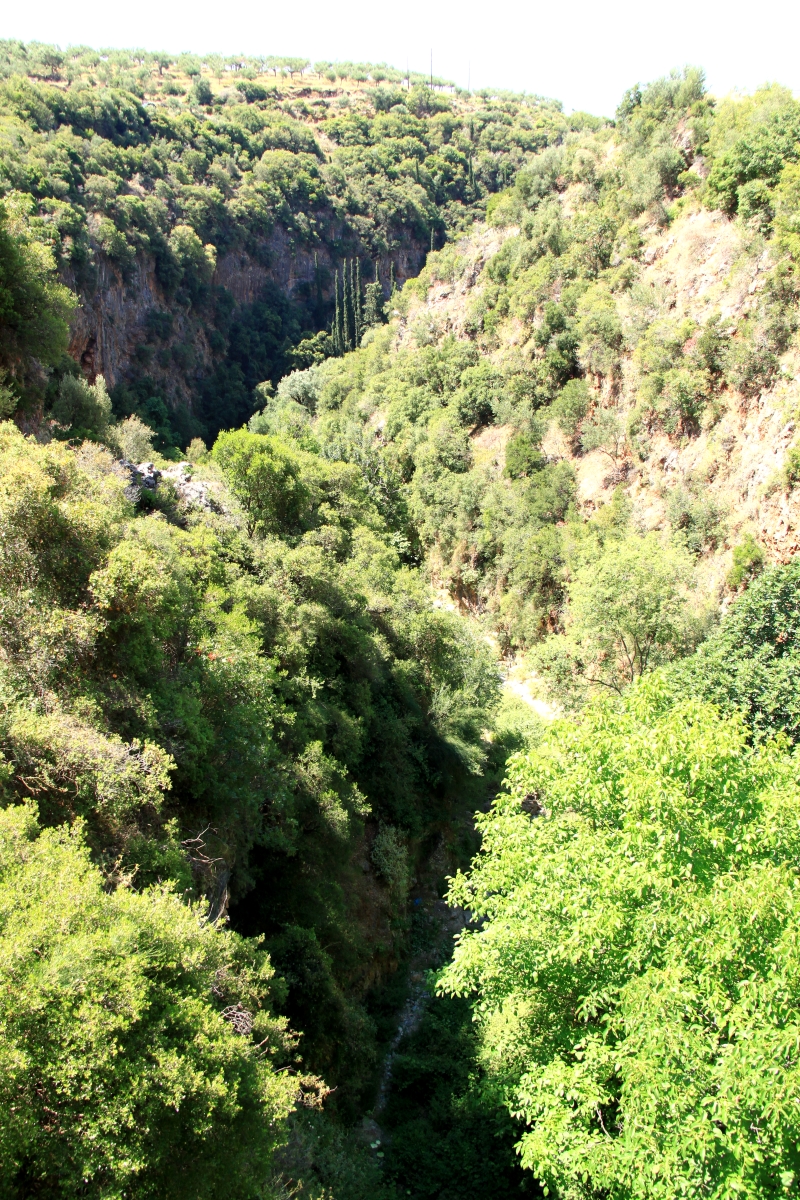
The dry bed of the heavily vegetated gorge can just be made out a long way below the bridge

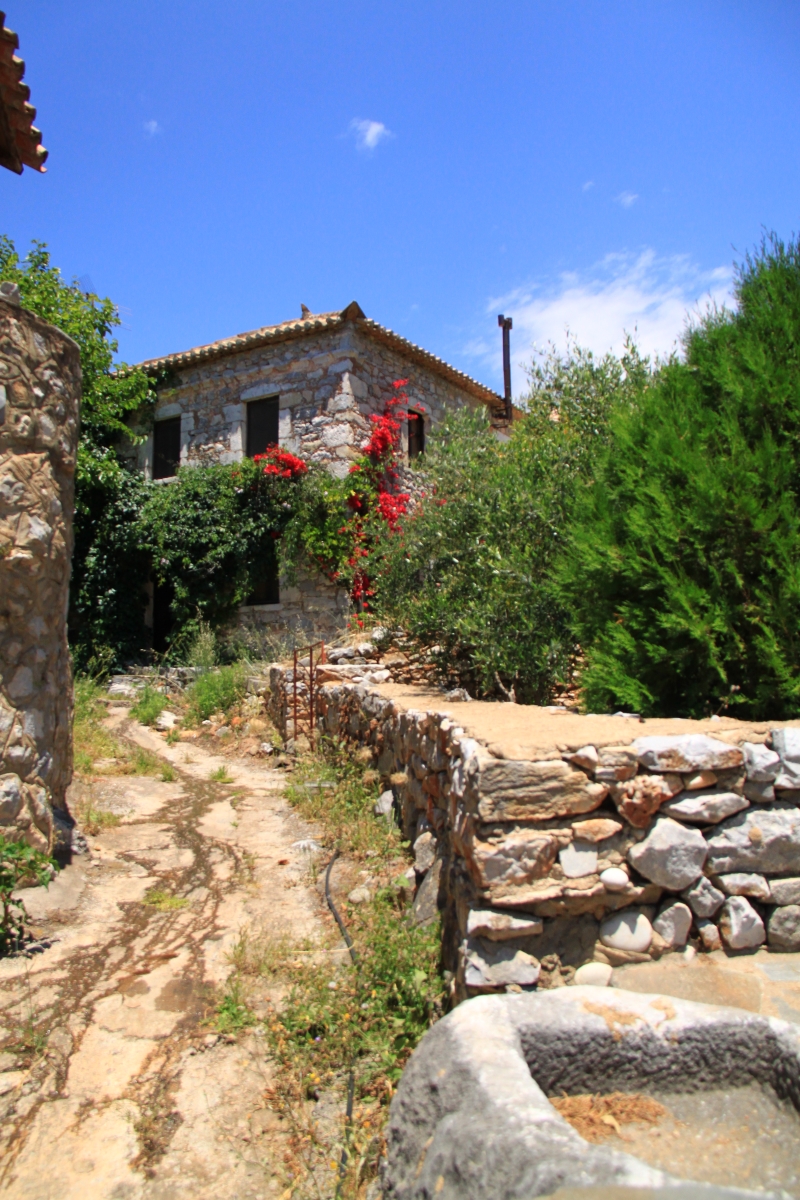
This door at the side of the bridge just appealed to me. What is the story?

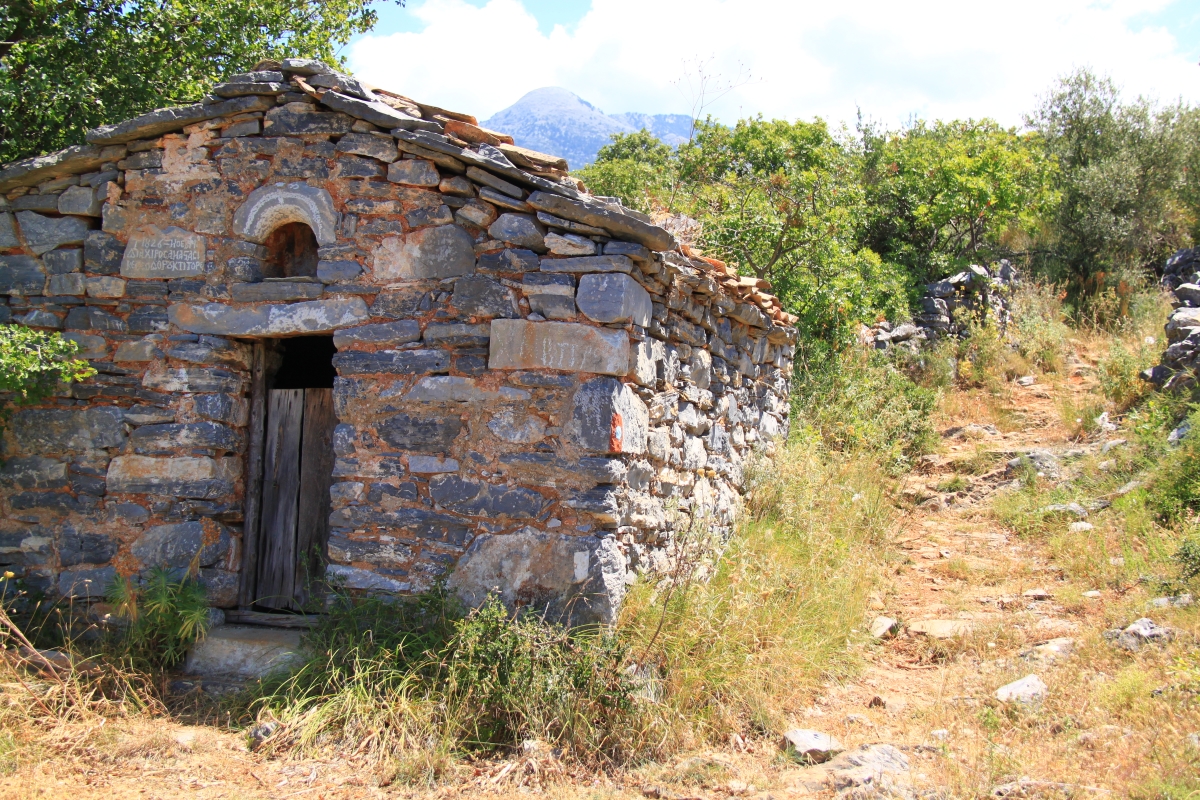
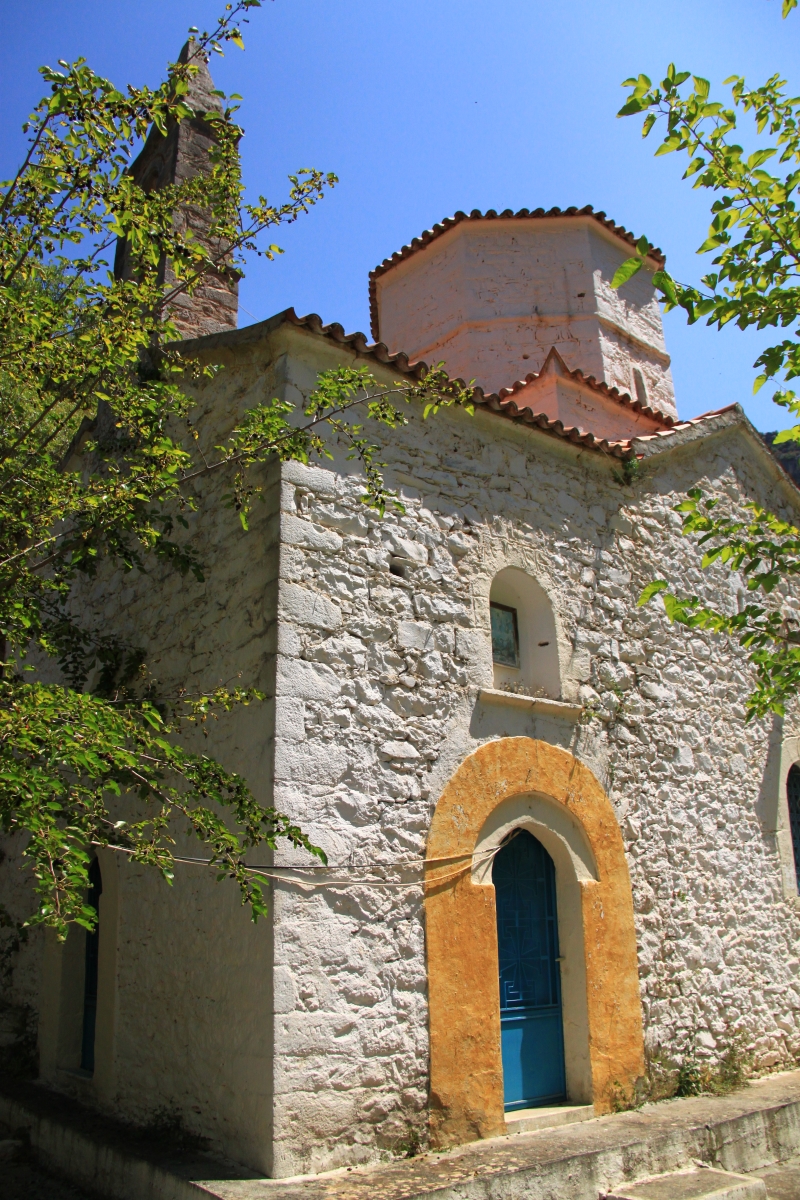
One of the many small, generally very simple, ‘family’ churches at the side of the path. This one built in 1826.

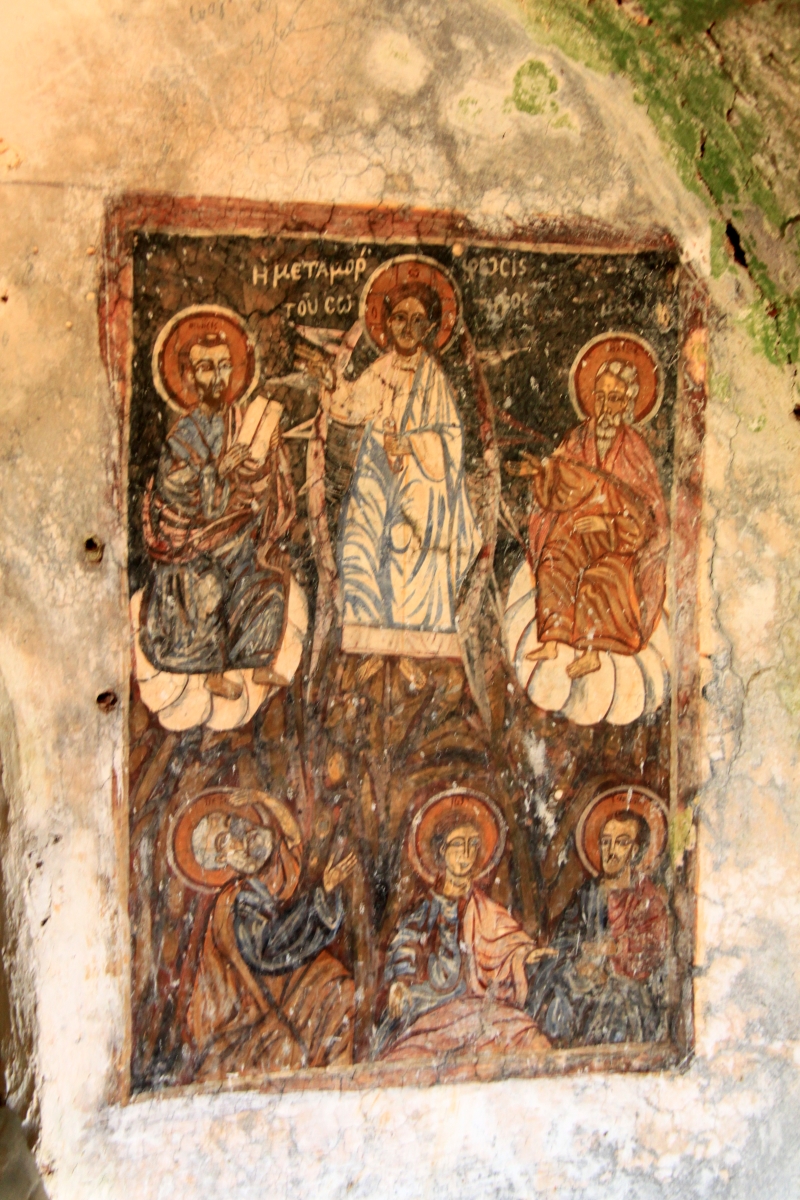
Inside many of them are a couple of small frescoes

Inside some of them are horseshoe bats

Don’t know whether there are any bats in the belfry

Laid back, very simple tavernas with shade tree in the mountain villages. This one in Saidona.

…. and just over the fence is a drop to a 10 metre long water tank with at least 100 golden carp. Unexpected!!!!

Funky art on the cut ends on the trunk of a palm tree

Well-tended olive groves round here in contrast with Parga/Paxos/Corfu. The crop of hay underneath has been cut ready to lay nets

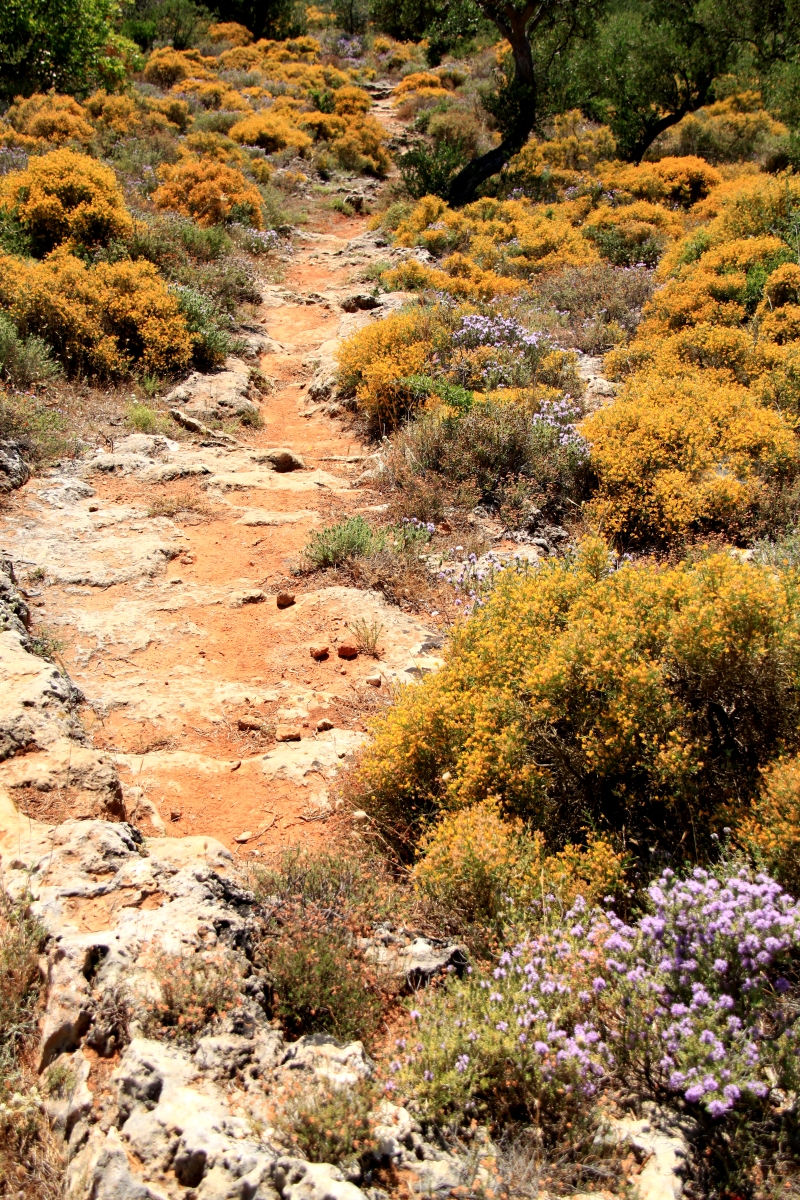
Some of the paths are like gardens. The scent from the broom is intoxicating.

x

Posted in Art, Greece | Tagged , , , , , , | 1 Comment

Kardamili: another day in and around the Viros Gorge

After a difficult day on Friday when the walking was an effort, come Sunday and I’ve got the bounce back in my legs.  So, very interestingly and satisfyingly for me and very boring for blog readers, I went for a long hard walk.

I walked up the Viros Gorge to the Agios Sotiros monastery, an hour at a good pace on the dried up river bed of the gorge, and then a very stiff climb up 1000 feet to the village of Pedino and another climb up to the highest village in the immediate hinterland of Kardamili, Tseria, at an altitude of about 600 metres.  I completed that stage of the walk in under 2 hours from Kardamili which seemed a gratifyingly distant when looking back down the mountain from the diminutive village square in front of the church.

From Tseria it was down to the bed of the gorge again and then up the other side to the tiny settlement of Kolibetseika, the place with the taverna looking straight down into the gorge.  The path down into the gorge was truly amazing, mostly a stone-laid kalderimi zig-zagging down and all the time looking at the boulder-strewn river bed way down below and the mountain peaks towering way up above.

One of the differences between walking in the mountains around Kardamili and other places I have been is that because effort is made to keep up and waymark the paths and there is a good ‘hiking map’ a lot more people obviously feel confident to venture out.  Very few Brits but in the last couple of days I have met Belgians, Dutch, and a large number of Norwegians. There seem a lot of Norwegians in Kardamili at the moment.  All want to stop and pass the time of day before moving on.

There is always a shared affinity in the mountains, people always greet each other.  But it seems that there is something about the sunshine which brings out the sunny side of people even more.  All the walkers I have met have been North Europeans and all have the same message: “the weather back home is lousy.  Isn’t it marvellous here”.  And that’s the point.  It is!

After the long stiff climb up to Tseria and then to a frappé in Kolibetseika it was a long drop down back to Agia Sofia and then to Kardamili.  Frankly it was so enjoyable in the sunshine on good paths that I didn’t want it to end.  But it had to of course.  At the beach for another swim.

The church in Tseria

Kardamili way down in the distance

One of the many small ‘family’ churches in the mountains

Not all are ornately frescoed inside, some are very simple and plain.

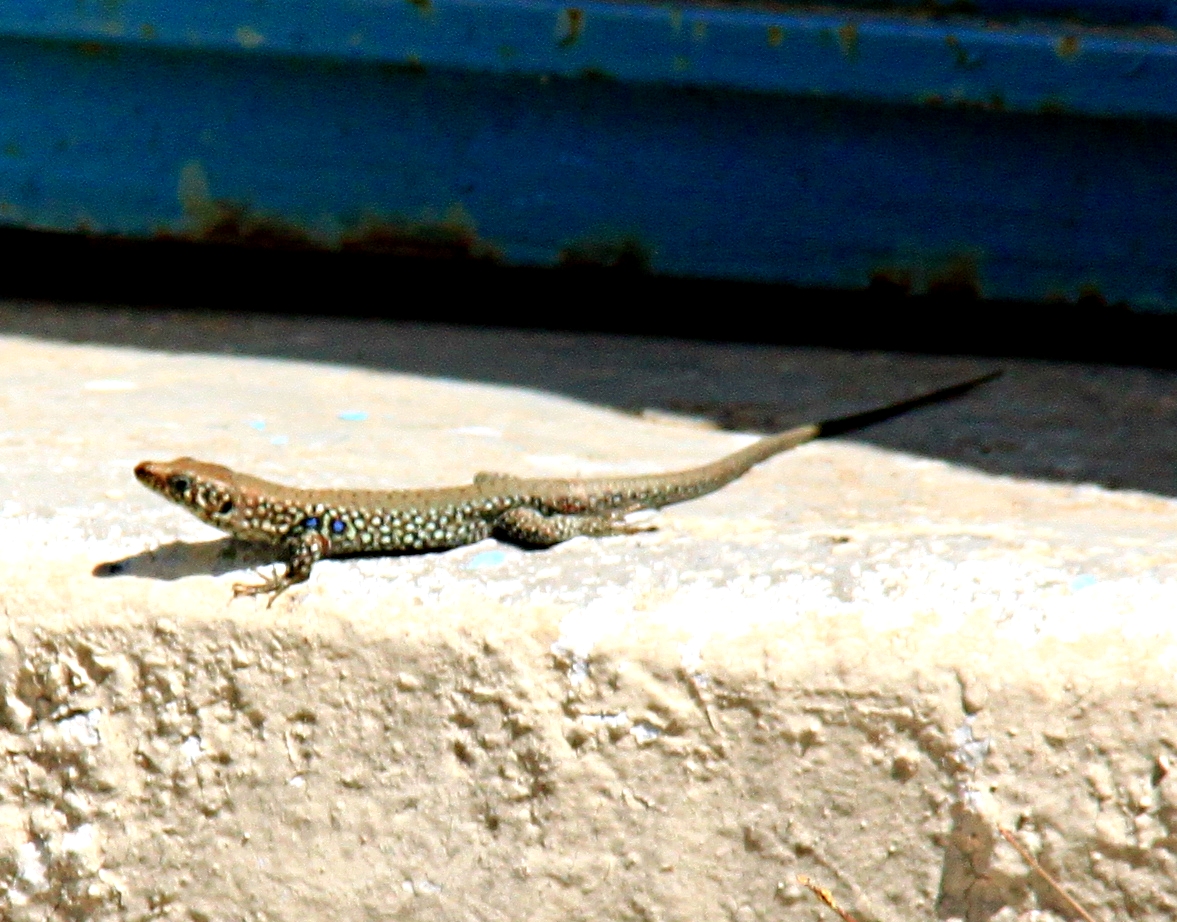
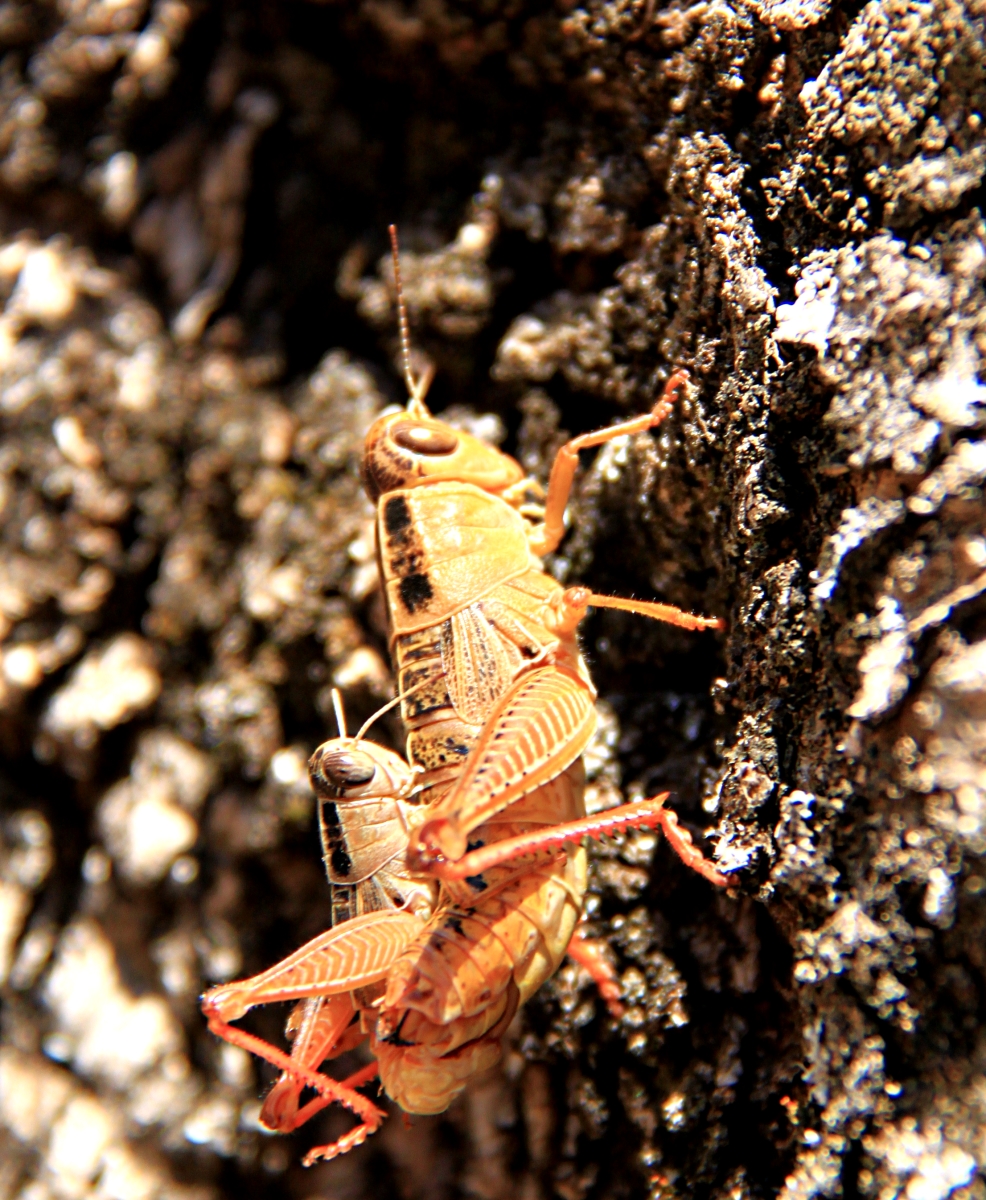
There are small beasties everywhere, this on the doorstep of a church

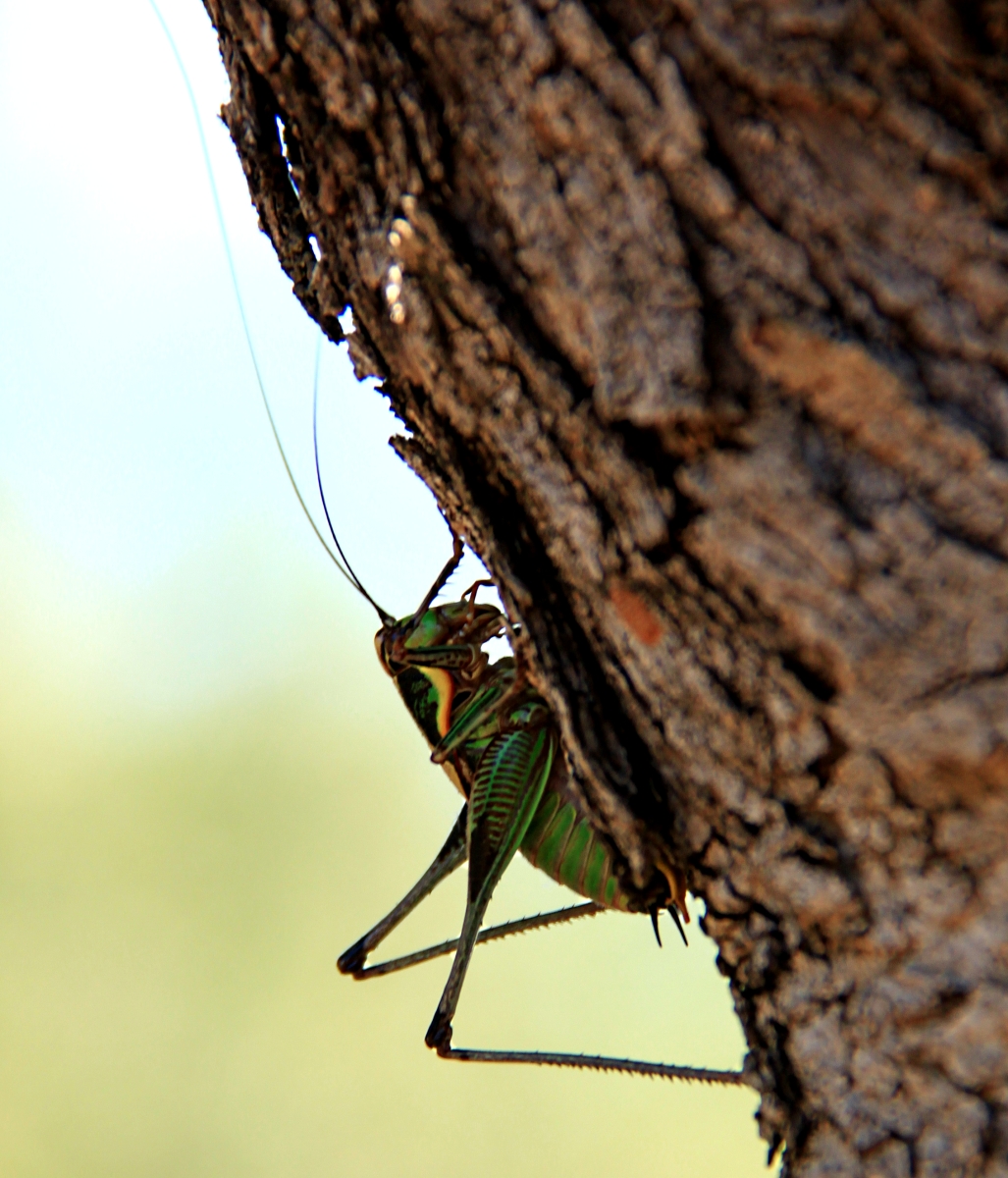
There is a huge variety of crickety things, different colours, sizes, shapes

The view from the taverna terrace: Tseria is on the shoulder of the mountain on the left; in the far distance is Profitis Ilias, highest mountain in the Taigetos

Posted in Greece | Tagged , , , , , | Leave a comment

Kardamili: musings on the way ahead

Friday evening and the clientele at the Maistros coffee bar next to my apartment, where I regularly get my caffeine fix, erupted into spontaneous cheering and applause.  Greece had equalised against Poland in the 2012 European Cup.  At last something the locals all agreed on! This was A Good Thing. (reference to the book “1066 and All That” for those not familiar with it.  The one truly great book about history.)

Earlier in the day and again on Saturday passionate argument had been the order of the day in the Maistros as in other coffee bars.  Greece goes to the polls in a week’s time and few elections will have been more important.  At stake is the stability of the economy, the well-being of families and individuals, and, some argue, the social stability of the country.  Wider implications could affect the whole of Europe.

The way ahead is certainly not clear.  From what I can gather it boils down to a simple dilemma:  People want the Euro as currency because of the economic well-being it has brought, but don’t want the austerity measures tied to it. There is no simple solution.  I don’t know how I would vote.

Locals on Saturday evening were told how to vote.  The Government organised what I can only describe as a political rally in its support in the main square in Kardamili.  I couldn’t miss it, my apartment being in the main square,  the restaurant where eat being in the main square.  And the whole show having a massive sound system designed to reach a significant proportion of the planet.

It consisted initially of loud music, mostly with a militaristic and patriotic tone, very reminiscent of what we used to have portrayed on TV and in  films as characteristic of  the Soviet bloc.  Then at a prearranged time an impassioned hour long speech from a Hyde Park Corner orator who, as far as I could gather, was saying “Don’t vote for PASOK (the previous socialist government) or the left, they got us into this mess.  Vote for Us”.  There was a small audience which applauded at various points, obviously pleased with what they had heard.  Most ignored it or seemed unimpressed.

I regret that my Greek wasn’t up to it.  I know the difference between ‘keftedes’ (meat balls) and ‘soutsoukakia’ (meatballs in a piquant tomato sauce)  and can ask my way and understand the reply, but rapid flowing political diatribe is beyond me.

I know it sounds unlikely, but there is strong scientific evidence in support of it, the result of the Greek election on Sunday 17 June will undoubtedly be influenced by the results of the Euro 2012 matches between Greece and the Czech Republic on Tuesday 12th  and especially Russia on Saturday 16th June.  The feel-good factor of sports results is very real and cannot be ignored as an influence on election results.  Let’s hope that the Greek Government doesn’t follow the example of the Hussein regime which imprisoned, tortured and executed unsuccessful Iraqi soccer teams.

Back to the mundane.  Today’s walk brought some of the issues to mind.

I followed a path, new to me, from one chunk of mountain down into a valley and then up and across to another.  Very good path, very clear, very interesting, alongside craggy cliffs.  Just the sort of path I enjoy.  Then rounded a bend and the narrow path was all but gone, taken out by an uprooted olive tree.  The way ahead was blocked.  On one side an overhanging cliff, on the other a steep drop in thick vegetation.  There was a way past, somewhat awkwardly squeezing past the uprooted tree, so on I went.  The Greeks have a reputation for determination, finding  a way around obstacles.  Look at the Athens Olympics, delivered on time despite all the doom-mongers and gainsayers.  Let’s hope they have the touch this time to find a way past the impasse.

Narrow path: blocked

The view down to Kardamili from the blocked path

It’s pushing the allegory a bit too far but another thing struck me about the path.  I dropped down towards another valley on a very good paved old kalderimi and was presented straight ahead by a gate made from 6 inch square reinforcing mesh for concrete.  Gates in Greece are generally cobbled together affairs.  On Symi they make them out of old pallets tied with bits of string or old rope.  On Kalymnos they are made out of wire fencing stretched across a thick wooden frame with hinges make from bits of car tyre so you have to struggle to open them and they then whack you up the backside as you go through. On Amorgos, great paths but the gates are 6 inch square reinforcing mesh loosely hinged and tied with wire so they flop everywhere as you try to go through.  The one I encountered today was just like the Amorgos variety.  My heart sank, they are the ones I dislike most.  If you’re not careful they rip your arm.

But then I had a dim recollection from the pantomime as a kid:  “it’s behind you!!”  Oh yes it was!.  The kalderimi had turned sharply back in the opposite direction as my eye had had been caught and my attention fixated by the nostril-flaring recollection of Amorgos gates.  This gate was into a smallholding, private property, keep out.  The path was completely un-encumbered.  Then it struck me.  There are no gates on the paths around Kardamili.  The only exception is when the path goes through a monastery and the only one I’ve encountered like that so far is Agios Sotiros in the Viros Gorge …. and that was no problem whatever.

So there’s a rule of thumb and a moral.  If there is a gate on a path around Kardamili, it isn’t a path. Think laterally. And don’t get fixated by a problem ahead, it may turn out not to be a problem at all.  Think laterally.

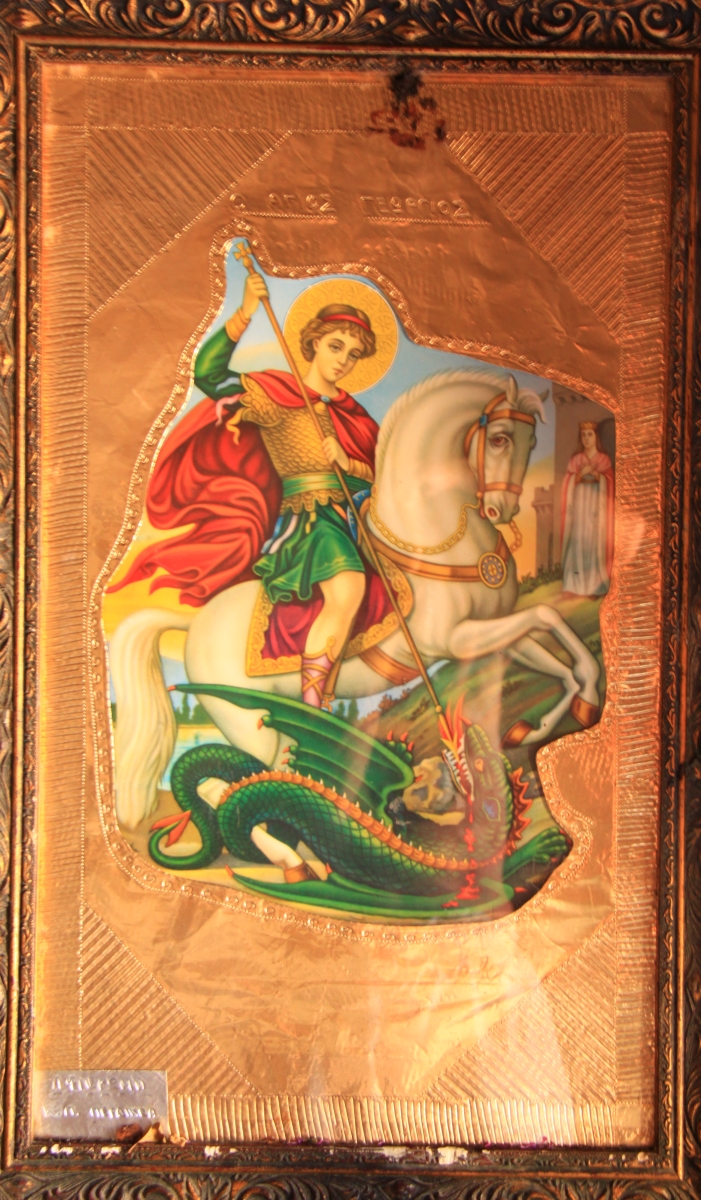
Another Greece-in-Europe connexion on the walk.  I was heading for a village called Proastia shown on the map to have 3 Byzantine churches.  Fascinating place.  Just before the village was the small church of Agios Giorgos with door unlocked.  Inside were the remains of frescoes  and a picture of himself slaying his dragon. Why is St George always associated with England?  There are far more churches dedicated to him here in Greece and every single one has multiples of the same picture.

Young St George slaying his dragon

One of the surviving frescoes in the church of Agios Georgos

…. and the only one I’ve seen in black and white rather than rich colours. Perhaps they don’t do flesh tones.

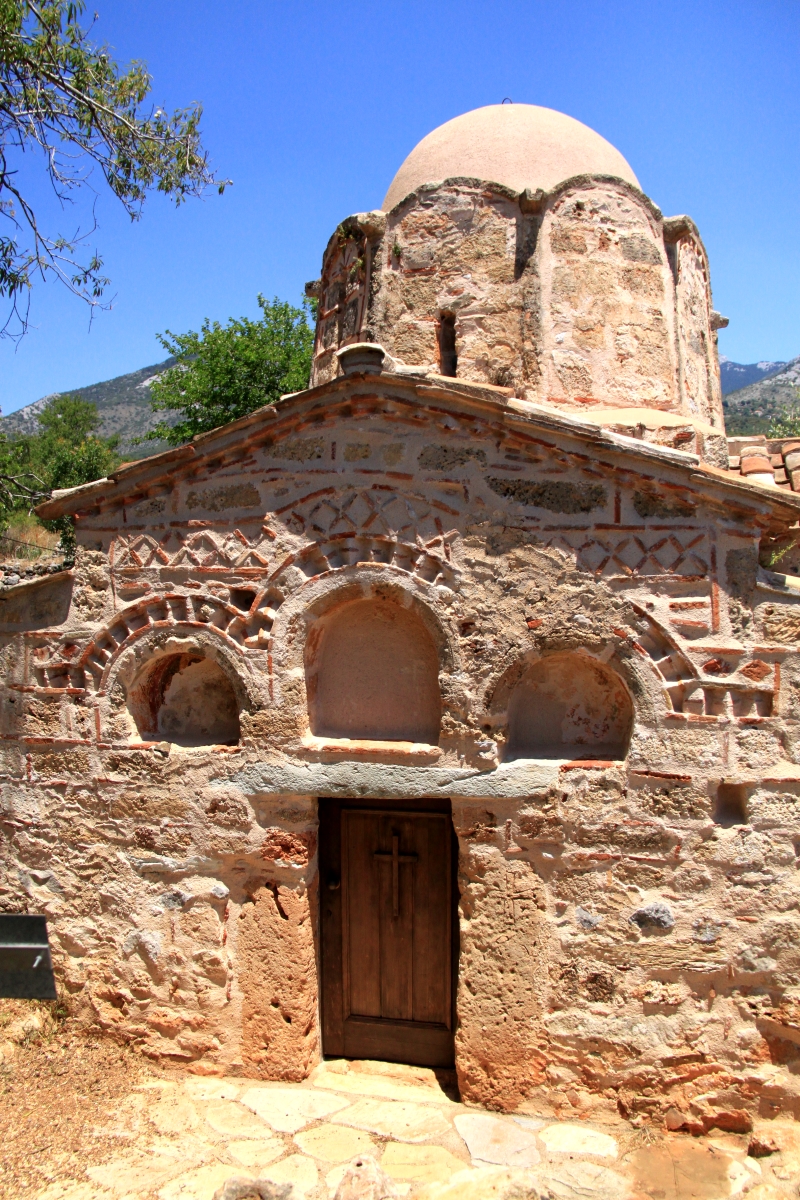
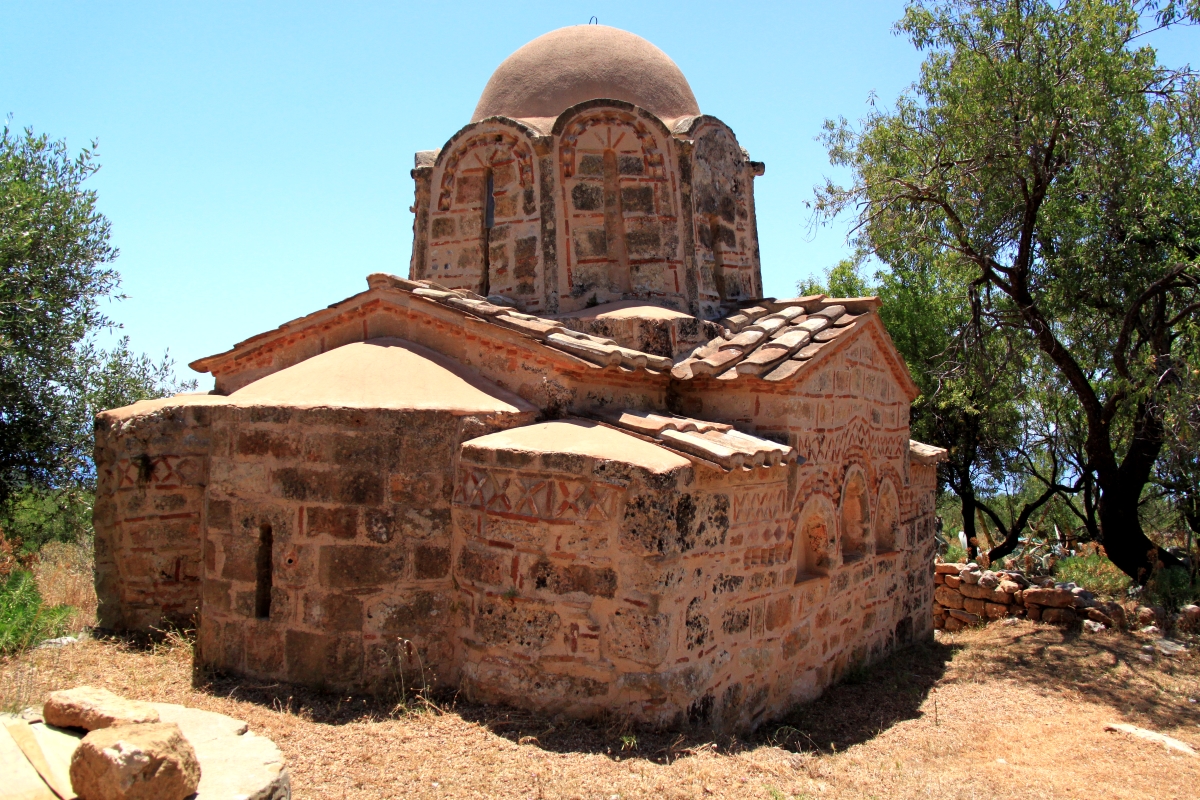
On to Proastia with its narrow, winding alleys and indeed not 3 but 4 Byzantine churches.  Two of them had been restored with signs outside acknowledging the 75% funding grant from the EU.  No access to the inside because they were locked but certainly very interesting architecture on the outside.  They had been restored back to what they would have looked like originally. Another looked to have a pretty modern add-on and was the main functioning church of the village so in no danger.  The fourth was very definitely in need of TLC.  Without massive investment from the EU and the match funding of 25% from Greece it won’t get it.

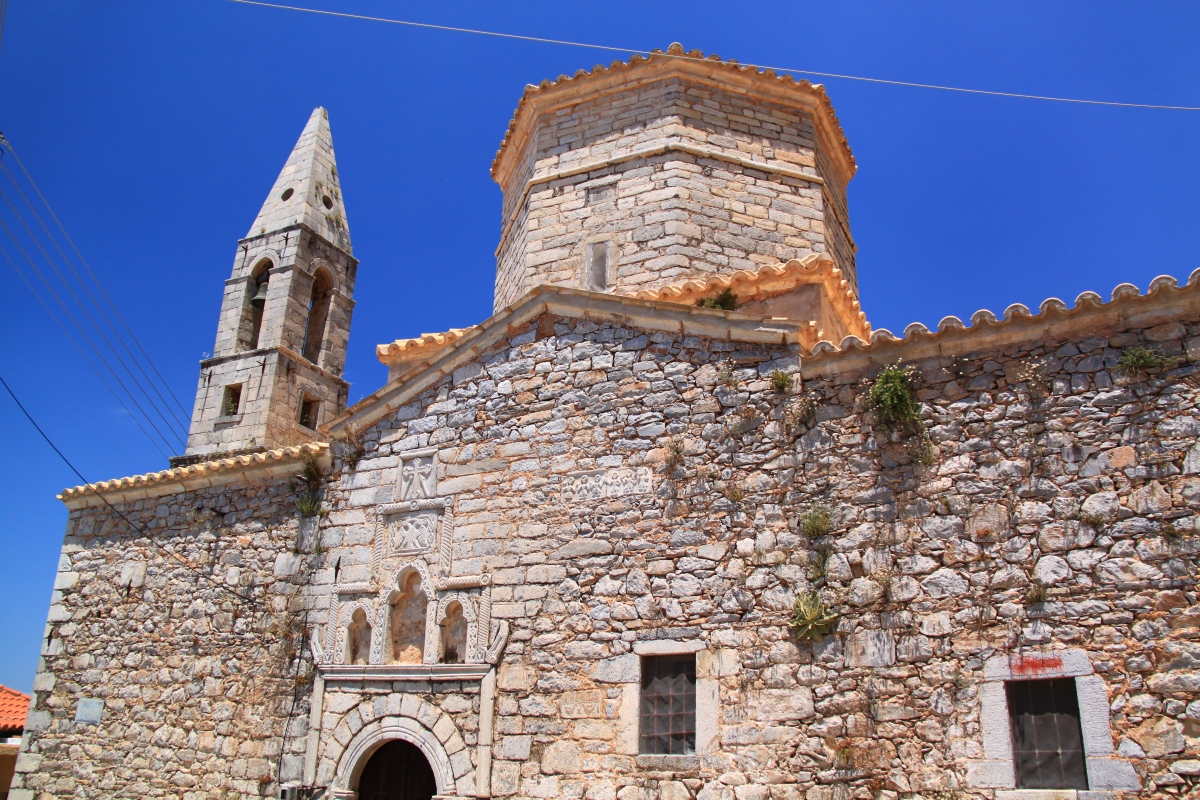
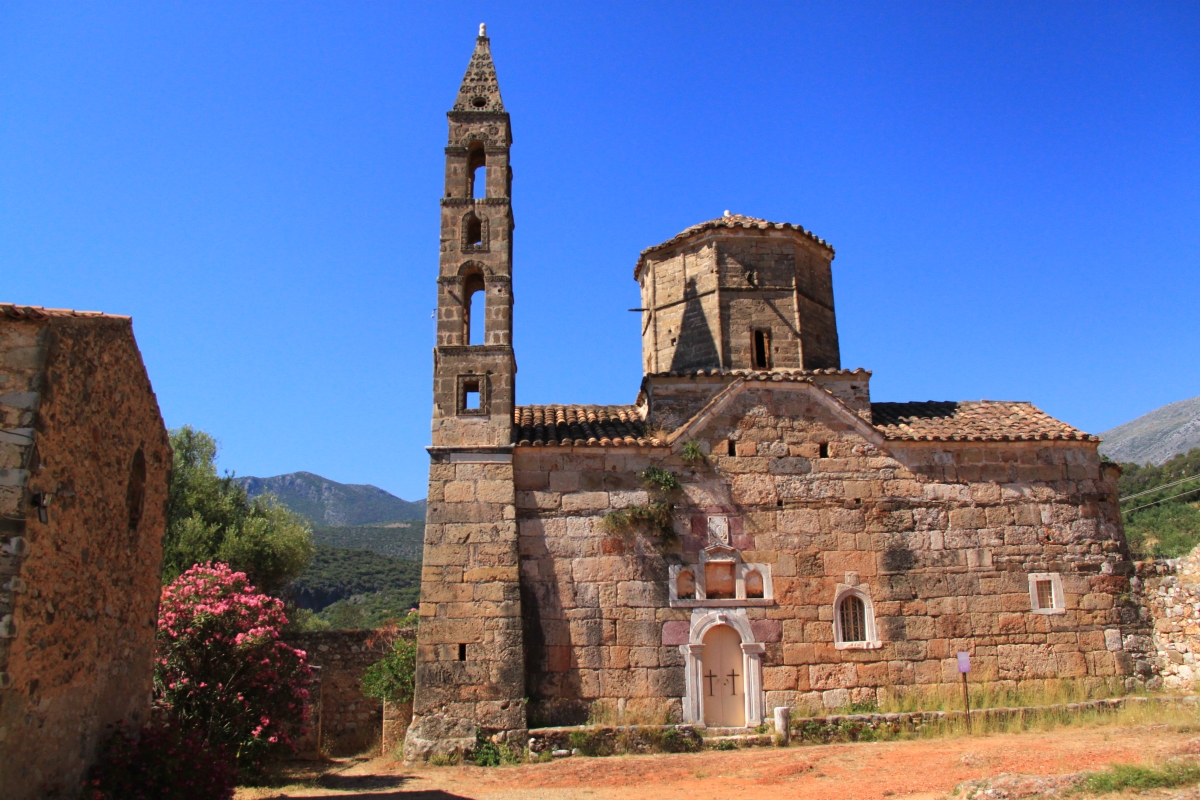
Agios Nikolaos in the centre of Proastia. The central dome is said to date back to the 12th Century

The tiny restored church of Agioi Theodoroi (Saints of the Gifts of God)

… and from another angle. Note the brickwork.

Alongside, in urgent need of a roof job

I said it last year and I repeat now.  Greece is an exception in modern Europe.  It has a lifestyle, a history and an archaeology which the rest envy.  So an exception should be made in terms of funding.  It should be supported and the heritage it represents for the rest of Europe guaranteed before it crumbles into the ground.  I put my money where my mouth is and spend my hard–earned over here in the summer.

In Proastia today I had a frappé in a tiny back-alley taverna.  It consisted of a very acceptable frappé (iced coffee to non-French speakers), a glass of iced water (as all coffee should be accompanied by) and a slab of very nice  cake.  The bill?  €1.20 !!!!!!! Less than £1.  Do I care of any of that gets declared for tax purposes?  Not one jot!  There is only one income stream here, tourism, and that peaks July/August with low income June and September.  That’s it for the whole year.

From Proastia I headed down to the coast for a swim.  Another world.

The beach

I don’t know what the way ahead is for Greece.  But I sure hope they get it right on 17 June and the rest of Europe bites the bullet.

Watching the world go by, suspicious but unmoved

Still watching you!

Mum taking nipper for a walk up an olive tree


Posted in Art, Greece, Reflections | Tagged , , , , , , , | Leave a comment

Kardamili: another perspective

I knew that my legs were tired after the last three days walking.  It’s surprising how much it takes out of you walking the bed of a gorge.  The altitude rise is not very dramatic but you can’t get into any kind of walking rhythm as every footfall is different.  Each step has to be watched and stride is stretched or contracted to cope with the distribution of boulders.  Coming down is easier, if you concentrate, because you can hop from boulder to boulder more easily taking advantage of gravity …. assuming that you get your balance right!!  That plus the fact that I’ve not yet acclimatised to walking in the heat of the day took more out of me than I thought.  By the end of a month walking in the heat I have usually acclimatised but the first 3 weeks over here this year it has been pleasantly warm but not hot.  Now I’m finally beginning to acclimatise to a Greek Summer.

So I set myself a modest target for Friday culminating with an early finish on the beach for a long swim.

First was long pull up to Agia Sofia  (in case you haven’t twigged yet Agios = Saint,  Agia = Saintesse, Agio is the neuter form and as far as I know is only used to used to refer to the Holy Spirit  ‘Agio Pnevma’, yes, same origin as the  word as ‘pneumatic’.  Greek lesson over!  Almost.)

The tiny church at the bottom of the village was just as photogenic as yesterday and I couldn’t resist taking another photo with the sun at a different angle.  One major bonus today was that the lady who lights the candles etc was arriving to do the business just as I was struggling up the final section of path.  I intimated my wish to look around inside by the use of the ubiquitous ‘parakolo’ (please, may I) and she urged me inside but very quickly said ‘no photos’ …. so, apologies, no photos of the frescoes lining the inside of the church.  They were more intact than in Lakaki but still showed signs of damage.

Yes, I know the church is leaning to the right, but at least I’ve hidden the electricity pole behind the olive tree

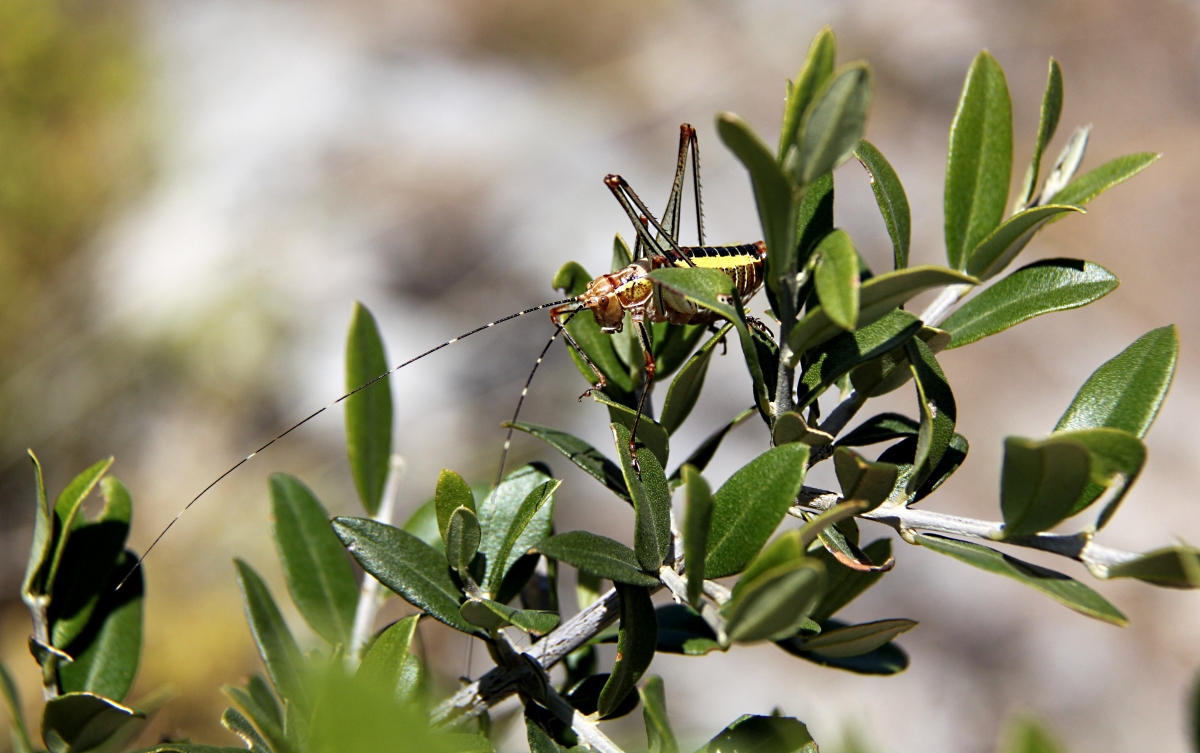
… and just look at the antennae on this little guy

From there I dropped down into a small valley and then climbed up to the village of Petrovouni, which as far as I know means Rock Mountain though I couldn’t understand why.  The old church was enclosed by walls, fences and locked gates so I couldn’t even see the outside properly nevermind the inside.  No matter.  The paranoia may be justified in view of the damage at Lakaki.

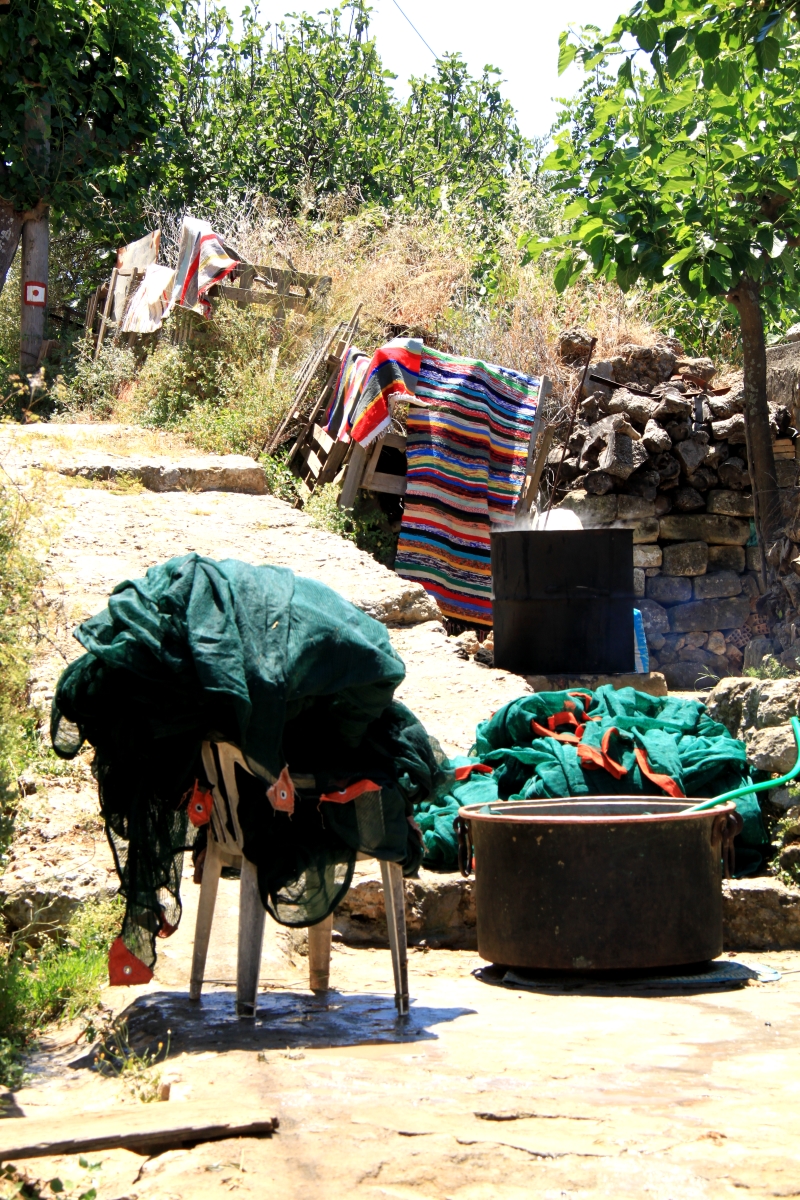
From there I got really boring and dropped down a very good kalderimi (paved donkey path) and encountered wash-day blocking the path.  It reminded me, very nostalgically,  in some way of my uncle’s farm in Carmarthenshire which had no running water inside the house, no bathroom and only an outside loo at the end of the orchard.  There was a large 45 gallon drum with handles boiling water over a wood fire burning slowly underneath it .  The water was then transferred it seems to a smaller drum where the nets for catching the olives were being washed ready for the Autumn’s crop.  The household rugs had already been washed and were draped alongside the path to dry in the sun.  There was a route through washday-on-the-path.  Fascinating!

Wash day on the kalderimi. Note the footpath sign on the tree trunk top left.

I dropped back down to Kardamili and from there to a frappé and then a  sunbed on the beach.  Sequence of swim, dry out in the sun, get hot, swim, dry out in the sun ………….. you know the decadent pattern.  What a contrast of lifestyles with the guy washing his olive nets up the mountain!!!!

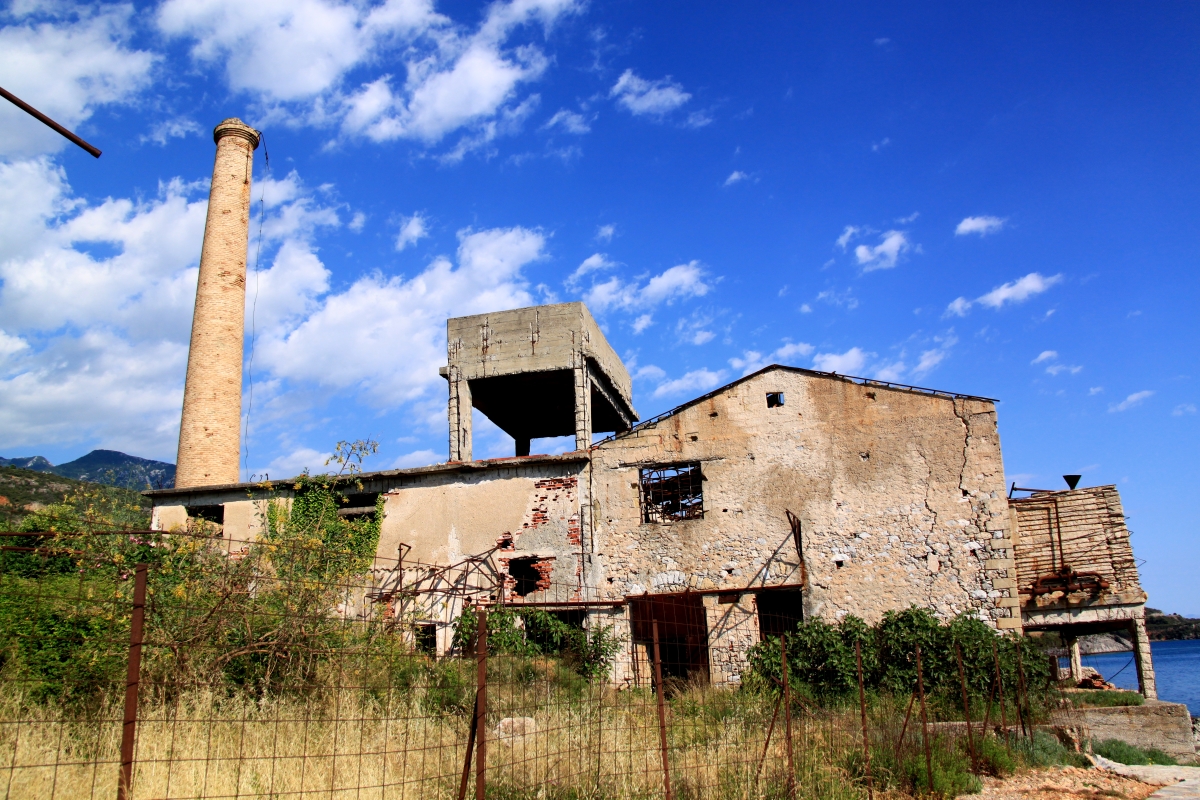
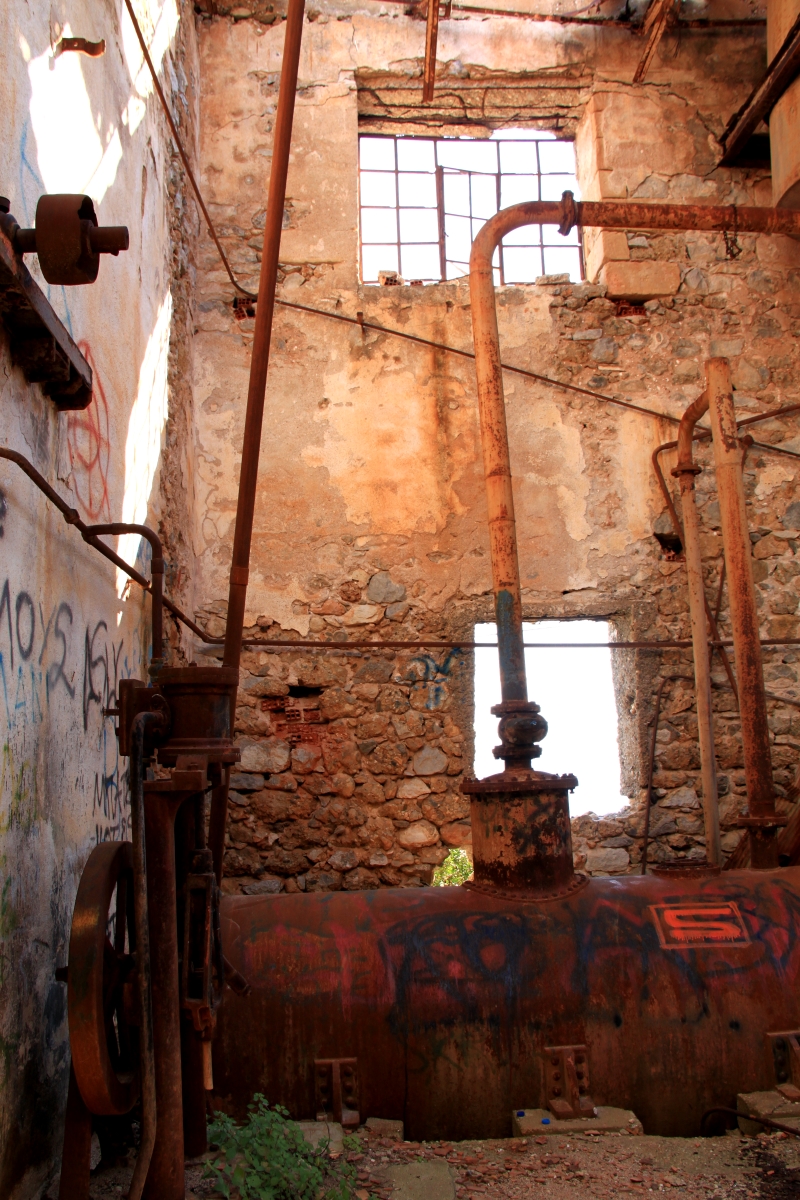
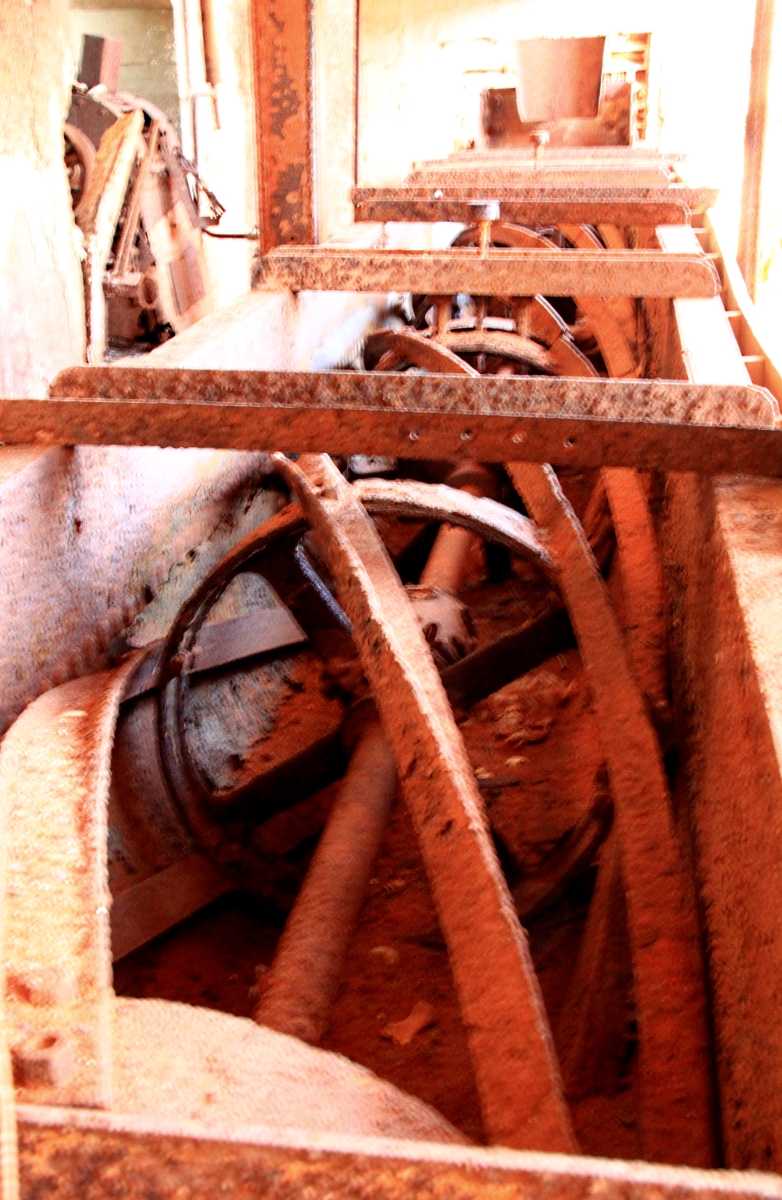
Having got bored with that I took the camera for a walk to the old olive oil factory on the edge of the sea.  Once again, fascinating!  No olive oil processed here for many years.  A ghost of a place.  I climbed up into the building and wandered around inside the skeleton.  This used to be a thriving business, providing employment for local people.  The only income for Kardamili now seems to be processing tourists.

The olive oil processing plant, Kardamili

Part of the main ‘hall’

They look like boats but …..

Inside is a large screw mechanism

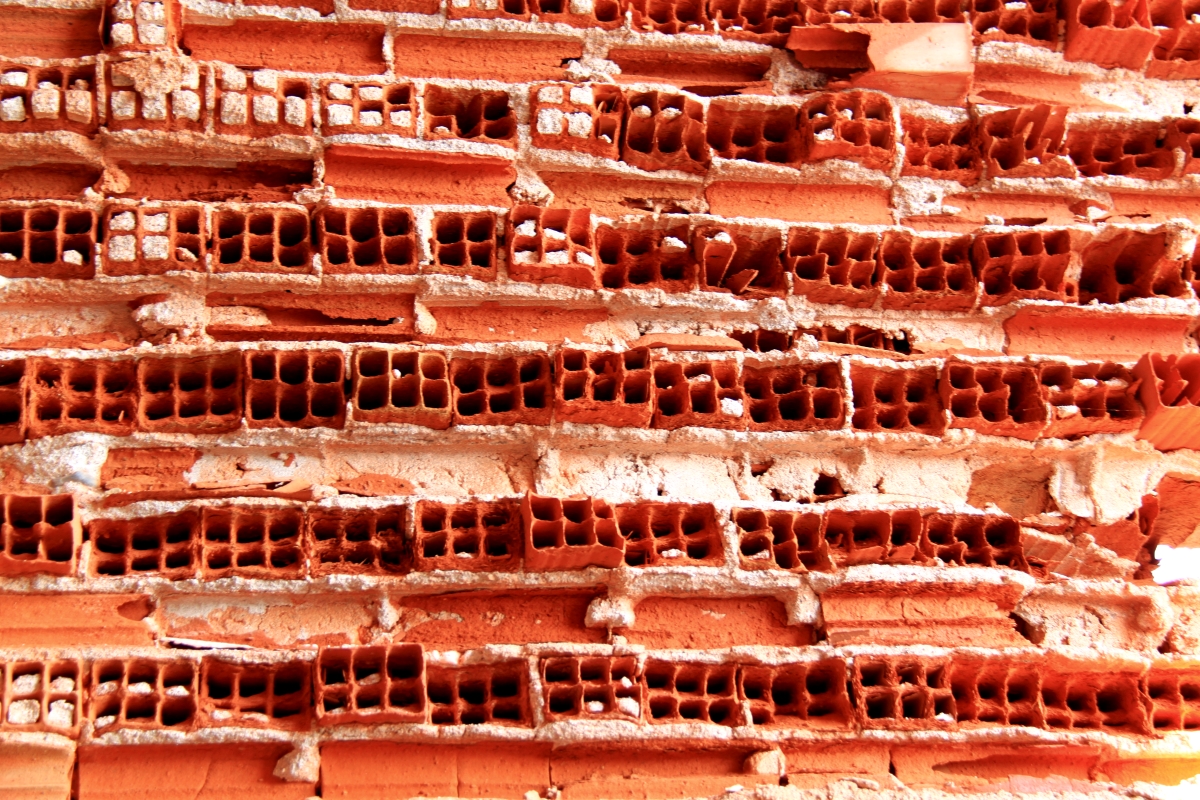
Crumbling brickwork

Very apposite graffito

A very different day with very different perspectives on life past and present.

As a complete change of subject.  I had my usual twice-weekly e-mail from Aldi supermarket today telling me of Sunday’s special offers.  They include: ice cream maker; ice cream wafer curls and fan curls; freezer bag; ice lolly moulds (or is that molds); ice cream tray and ice cream scoop; swimwear; beach dress; beach bags.  Checked the weather forecast for South East Wales, my home patch, and see that they will be on sale just in time for the end of the cloudless blue skies forecast for Saturday with temperatures up to a sweltering 16oC and a return to wet weather from Sunday onwards.  Two thoughts occurred to me.  First, Aldi have got a different and more reliable weather forecast (unlikely!!).  Second, the order placed in China 6 months ago has now been delivered to the UK and the stuff just has to go on sale (more probable).  The problems of the global economy!

Posted in Art, Greece, Reflections | Tagged , , , , , | Leave a comment

Kardamili: The Viros Gorge, knowing the limits

Two tasks for Thursday.  First was to find the monastery of Likaki, shown on the map to be,like Agios Sotiris, close to the bed of the Viros Gorge.  Second was to walk up the gorge beyond where I had been previously with the possibility of then finding a path leading up to the taverna on the rim of the gorge which I visited yesterday.

I had tried to find the Likaki monastery a couple to times previously but failed to find the path.  Photos of the church I had seen on the internet were taken a few years ago and reports said it was seriously dilapidated.  A couple of times I had tried to follow paths which were completely obliterated by vegetation and I thought that this might be the same again.  Not only are footpaths marked on the map but they are colour coded on the map and on the ground, making route-finding much easier ….. if you are following a set path. Where paths diverge, there are also signs pointing to the places they lead, even on the bed of the gorge.  It’s crazy but the only sign I have found pointing to Lakaki is a hand-made wooden finger post high up the flank of the mountain on the very well signed path up to Agia Sofia.  Given that Lakaki is in the gorge that seemed a little odd.  It also seemed a little odd that the path which it pointed to isn’t shown on the map and yet is much clearer and better defined in reality than some which are on the map.

Enough of this rambling.  The conclusion is that while the map and signing on the ground are far better around Kardamili than anywhere else I have been to in Greece, except possibly Amorgos, the map cannot be entirely trusted, a key factor in judging how far to commit oneself, as will be amplified later.

I followed the unmarked and unmapped path down to the bed of the gorge to a point I had passed a number of times.  I was determined not to leave until I had tracked down the monastery even if it meant hacking a way through impenetrable jungle. (yes! I know if jungle is impenetrable you can’t hack through it.  I’m just using  a cliché).  Perseverance paid off.  Once found, at a slightly higher level and behind scrubby vegetation, the path to the monastery is very clear and not at all overgrown. The only limits pushed so far were those of credibility.  I wouldn’t accept that there was no way to Lakaki.

The monastery itself does raise serious issues of limits.  It is badly decaying and damaged with great cracks not only over the door but showing in the roof/ceiling.  The door is pretty new and has a brand new lock, but it was open.  Timbers have been inserted inside to try to stabilize the roof but they have obviously got wet and rotted where they nib into the walls.  It’s a great shame because the inside is completely covered in frescoes, probably 18th Century, including the roof, the arches and the dome.  Some are extraordinarily well preserved, others less so.

First sight of Lakaki church

Round the other side the severe cracks become evident

The iconastis, grey and ageing carved wood and frescoes: the stonework behind panels which have been removed on either side

Some of the frescoes are still very vivid

Some hidden on the back side of pillars

As yet the dome remains intact but the roof is in danger

But what can be done about it?  It’s easy to say that some government body, the equivalent of CADW or English Heritage, should repair and restore it.  But what about funding?  At a time when Greece is on the economic rocks there are understandably higher priorities.  I know of instances of people whose pensions or salary has been cut by 50% recently. Would they support repairs to a tiny church in the Viros Gorge?  It wouldn’t be simple even if a funding  source could be found.  There is no road access anywhere near to get materials in. It’s an hour from Kardamili on foot.  I have seen no evidence of donkeys used for transporting building materials as on some of the islands (Symi, Hydra, Amorgos ….).  No other way in other than lowering from a helicopter …. in a steep sided gorge.  It is more remote than many areas in Britain.  What techniques would be needed to repair it?  Substantial underpinning?  Infilling?  Steel reinforcement? Much as I would like to see it restored my guess is that in 21st century Greece it is beyond the limits of possibility.

I commented last year about Angela Merkel’s suggestion that Greece should sell off some of its islands and archaeological/historical treasures to meet its debt commitments.  An extraordinarily insensitive suggestion in face of the pillaging which apparently went on in WW2.  But it looks as if someone has been removing frescoes from Lakaki.  Some of the smaller panels have gone entirely as if they were removed whole, leaving the bare stonework behind.  That may be why churches round here are all locked and may explain why the  substantial new door to Lakaki was open.

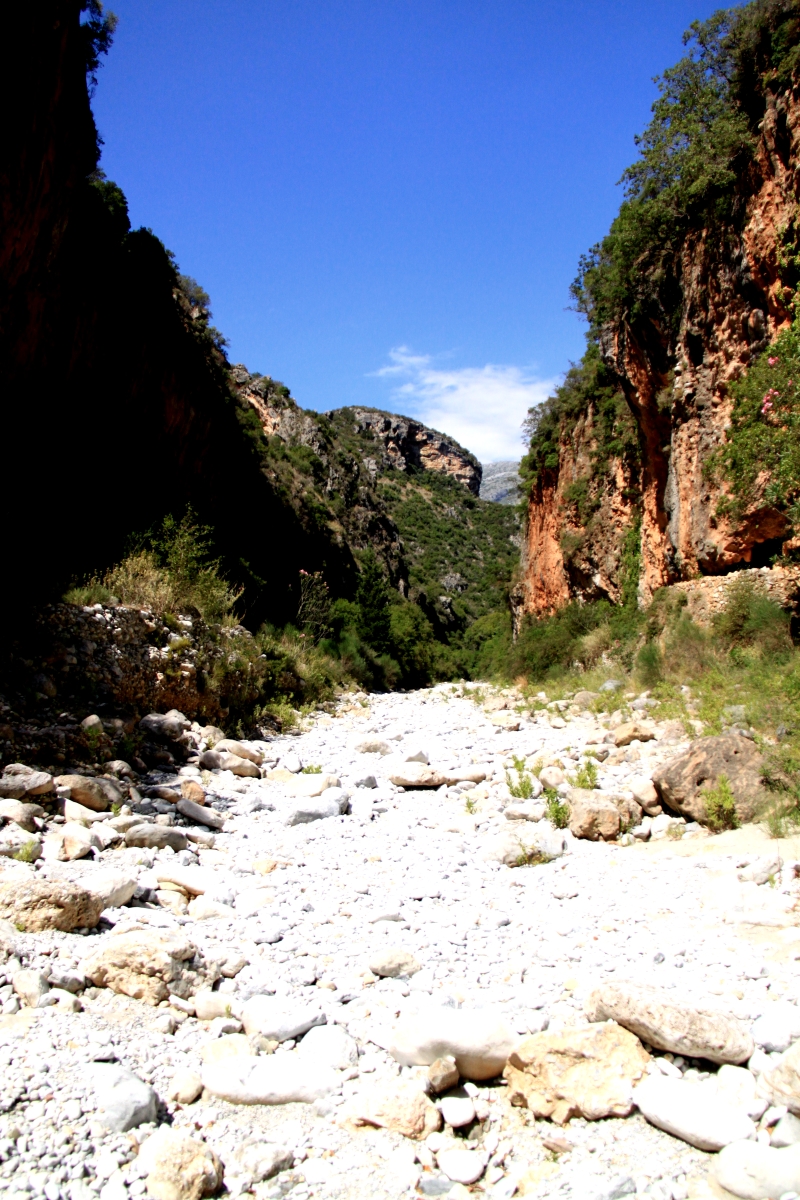
I continued on up the gorge from there, and this is where finding limits personally comes in.  As is often the case it was very hot in the gorge.  The canyoned sections which are in shade all day set up a microclimate, the air is cooler so the pressure is higher and a gentle breeze blows from there to the sections of the gorge in the sun.  Very pleasant.  But much of the gorge has no breeze at all and the heat is  amplified by reflection from the walls and the white river bed.  I passed the limit of where I had been before with paths coming in on both sides and found a small mound of stones built across the river bed and a large red X painted on a rock just above it.  It clearly said “don’t go any further” .

Of course I did.  The going got more difficult as I got further up the gorge.  Every step had to be watched, the stability of rocks calculated before trusting them.  Small waterfalls were encountered which had to be surmounted (no water at this time of year, just the rocks).  It was the classic river profile, I was going into the ‘youth’ stage or ‘upper level’  upstream where the bed gets steeper with larger boulders.  A long way to go yet because it begins at Profitis Ilias which is a day’s walk away.

When I reached a 20 foot high waterfall at about 15.00, 250 metres above the village, I decided that this was far enough.  I could climb up the waterfall but if the path I wanted to find wasn’t there or was blocked I would have to retrace my steps and down-climbing is always more difficult.   So I had a banana, swig of water and retraced my steps.  A bit disappointing but then walking on my own with a map which is pretty good but not 100% reliable it was the sensible thing to do particularly as I knew I was tiring.  I’m still not heat-fit yet.

I’ve said before I don’t tell people where I’m going, partly because I may change my mind and go off exploring.  It’s important to take responsibility for your own actions in life and with solo walking in the mountains it’s essential.  I always push the limits but know when enough is enough.

Climbable …. but I called a halt to upward progress here

The importance of this approach is demonstrated by the fact that there are posters all round the area, in town and on finger posts up in the mountains, because an English guy went missing in March while taking part in the Taygetus Challenge, a 36 km mountain marathon.  That’s an organised event with a set course.  Search parties have so far failed to locate him.

I eased my tired muscles back down to Kardamili, sorry I hadn’t progressed further up the gorge but at least satisfied that I had made the right decision on the day.

Posted in Art, Greece | Tagged , , , , , , , | Leave a comment

Kardamili: A walk on the South Side

It seems a little pointless now to say: “Wednesday dawned cloudless and warm” , but it did.  After the uncertainties of the weather in Meteora, Metsovo, Ioannina, Parga and Paxos, the appearance of heavy cloud over the high Taigetus Mountains on Tuesday evening left me a little apprehensive.  But by Wednesday morning it had entirely disappeared.  The summer does now seem to have settled in.

I had worked out a route on the very good ‘hiking map’ of the area produced by Anavasi which would take me up onto and along the southern rim of the Viros Gorge and then dropping down onto the bed of the river for the walk back to Kardamili.

This blog is mostly images from that walk but a couple of asides first.

The drop down to the bed of the gorge was on a footpath from the highest settlement shown on the south side.  There is a hotel and taverna at that point with stunning views straight down into the gorge where I had a frappé and a chat with the owner.  She said that the footpath I intended to follow was very dangerous, which sparked my interest, and was a jungle, which put me off a bit.  Nevertheless I gave it a go. Given that the drop at this point is nearly straight down to the bed of the river it is not surprising that the path was steep.  That I can cope with.  What I couldn’t be doing with was that the path just disappeared into dense vegetation, a lot of it pretty aggressive.  Given that the path would inevitably twist and turn every which way it would be impossible to find.   So I turned round, went back up to the hotel and adopted Plan B.

Which turned out to be very enjoyable, incorporating a quick walk up a rock pinnacle to a tiny church on the top with precipitous drop down vertically 1000 feet on three sides. to the bed of the gorge.  It looked as if I could have thrown a cricket ball and it would have landed at the bottom without a bounce.  Best thing to do with a cricket ball really.  Even if I was daft enough to ever carry one.

Another good if tiring walk.  Covered 21 kms, highest point 475 metres.  Visually stunning, hence the number of photos.

DON’T FORGET, YOU CAN CLICK ON ANY OF THE PHOTOS TO ENLARGE THEM.

THEN CLICK ‘BACK’ TO RETURN TO THE TEXT

Agios Spiridos church in Old Kardamili

Agios Spiridos seen through olive grove

One of the Mani towers, this one in Old Kardamili the former home of the Moutzinos family of warlords

Looking back to Kardamila as the path climbs higher into the crags

Church of Agia Sofia with the peak of Profitis Ilias behind

Zooming in on Profitis Ilias

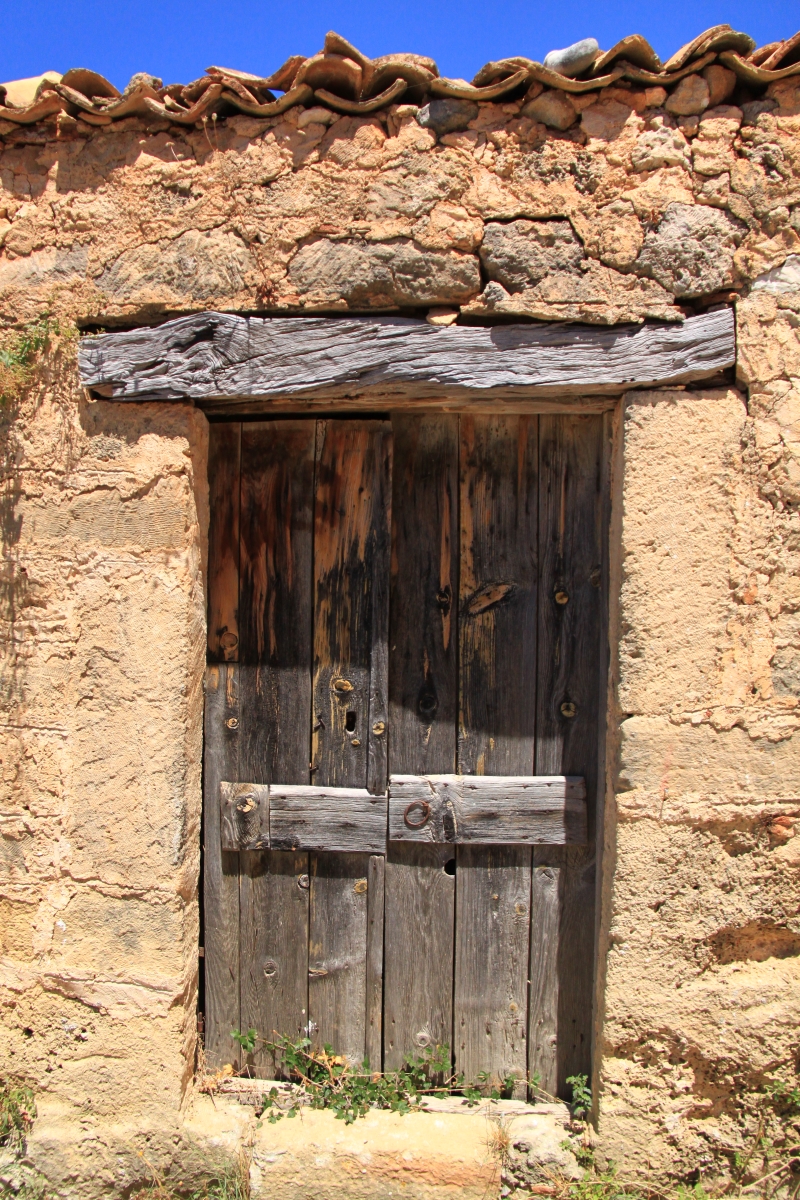
Old door in the village of Agia Sofia

Old limekiln in the village of Agia Sofia

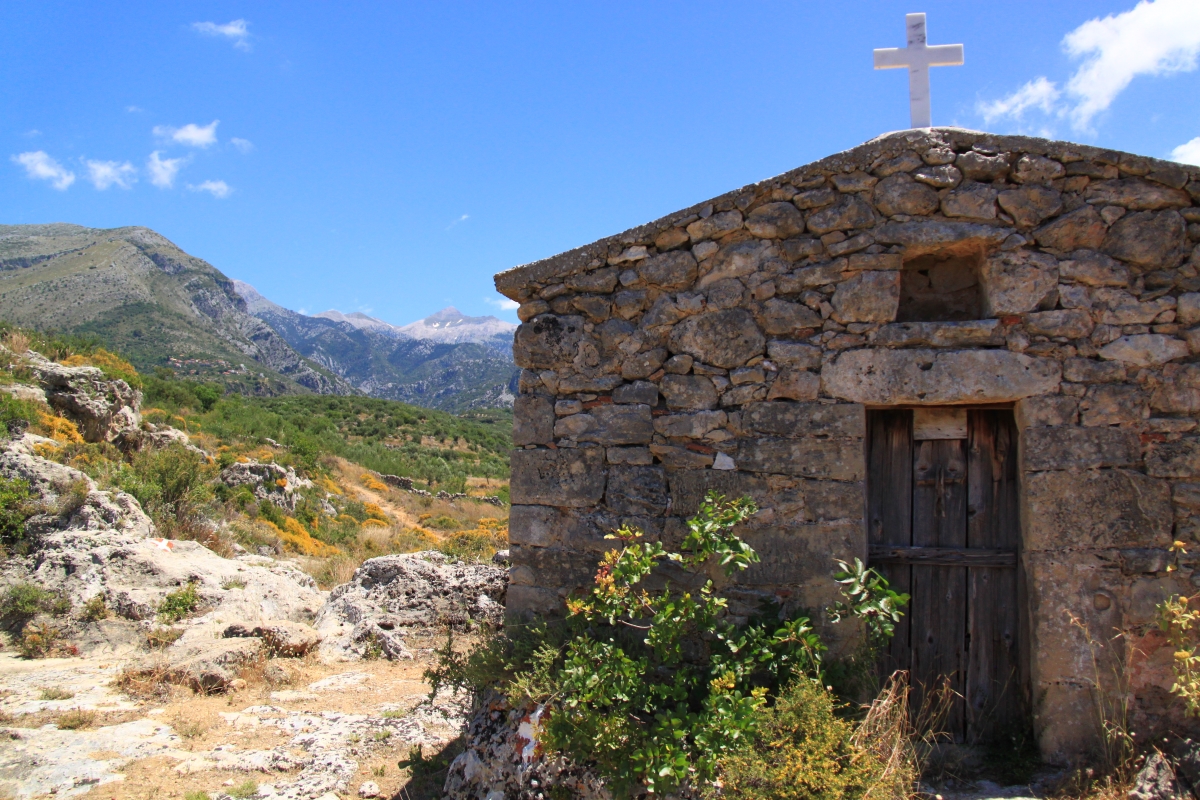
Small church higher in the mountains

At the lower edge of Chora, a bit wonky but standing the test of tiem

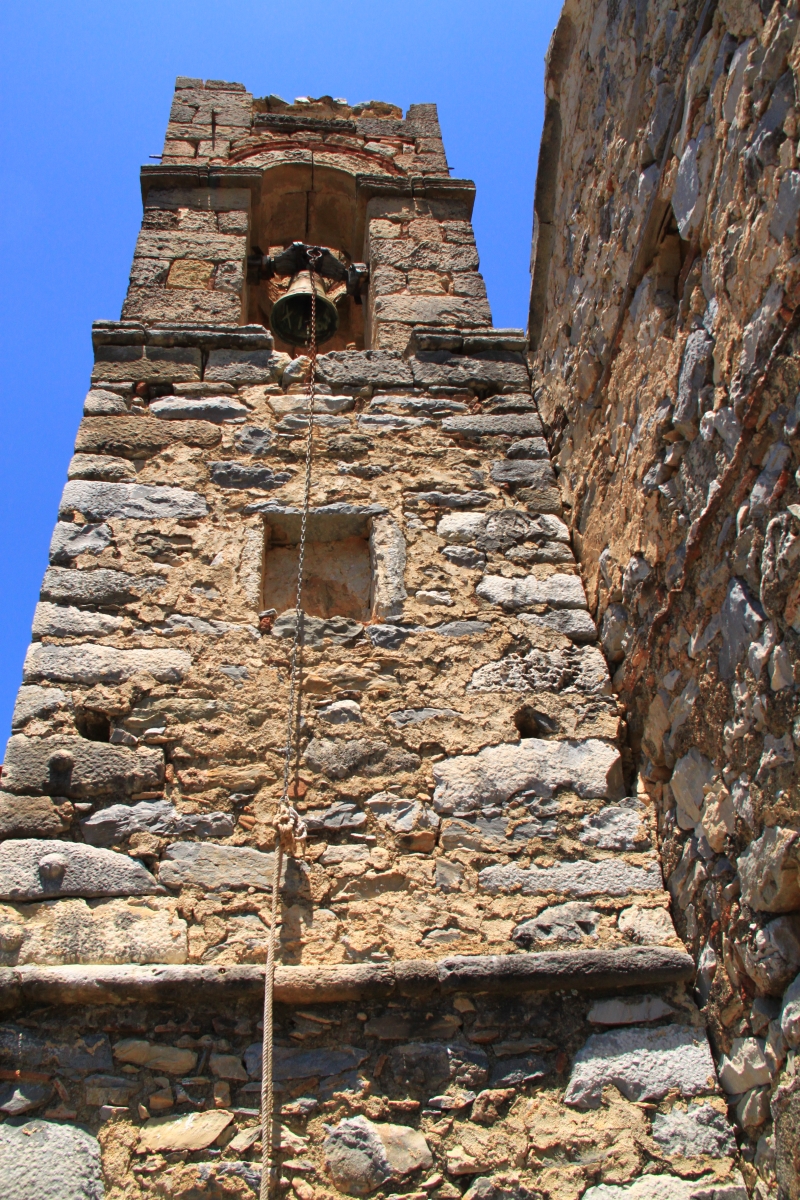
Very old church tower in Chora which seems to have had the top blown off

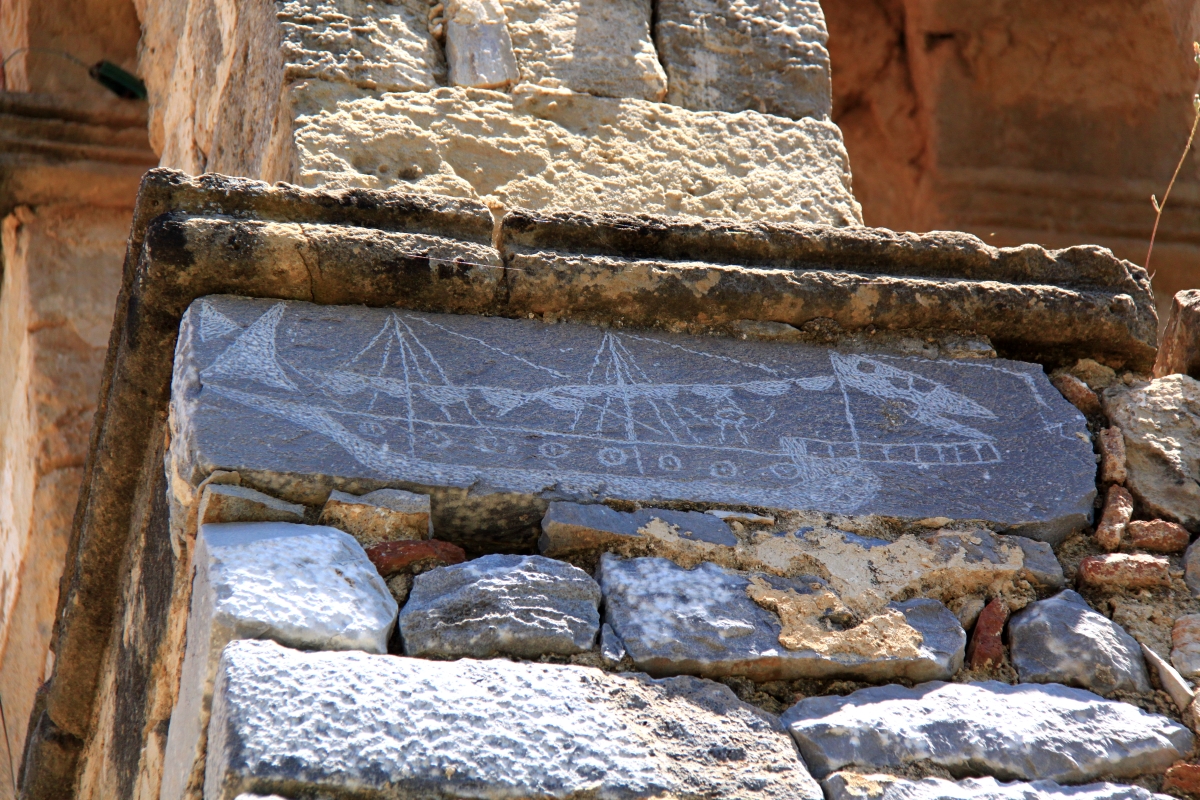
There are many stone/marble tablets set in the wall of the tower, this one of a trireme

From the top of the rock pinnacle looking down on the bed of the gorge and Agios Sotiros monastery

Zooming in on Agios Sotiros monastery

Photographer on the edge looking upstream

Looking back up to the pinnacle from which the last 3 photos were taken (right of centre)

Zooming in on the pinnacle

Does anyone know what these are? High under an overhanging cliff and seemingly attached to broken stalactites. Bees? Bats? Birds?

As the walls of the gorge close in, the canyon sections are in deep shade for much of the day

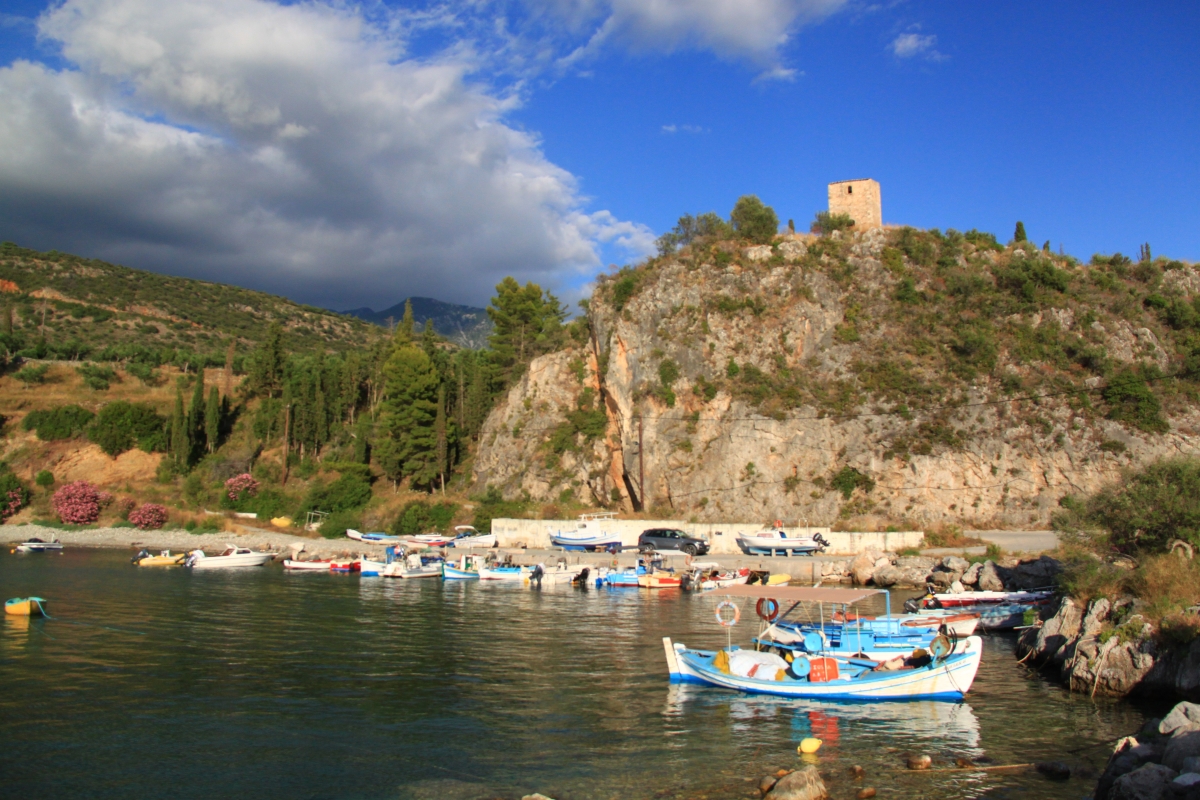
A reminder that Kardamili has a harbour, albeit a small one

End of the day, time for reflection

Posted in Greece | Tagged , , , , | Leave a comment

Kardamili: up the Viros Gorge

Made my own breakfast Tuesday morning for the first time since I arrived in Greece early in May.  When I stayed on Symi and Tilos for extended periods in 2010 I was self catering and got into the habit of buying and preparing my own food but staying in hotels for a few days at a time isn’t conducive to that.  It was good to sit on the balcony on Tuesday looking out over the sea and tuck into a plateful of Greek yogurt, nuts, honey and assorted fresh fruit.  I may even buy bread and marmalade as one of the supermarkets does nice wholemeal.  Coffee is a different matter.  There is only a briki for making Greek coffee or boiling water for instant, neither of which I find palatable.   No worries, there is a very fine and inexpensive coffee shop with comfy armchairs opposite the apartment, probably a full 20 seconds away.

But enough of the housekeeping, I’m here for the mountains, the walking and the history which the area exudes in bucket loads.

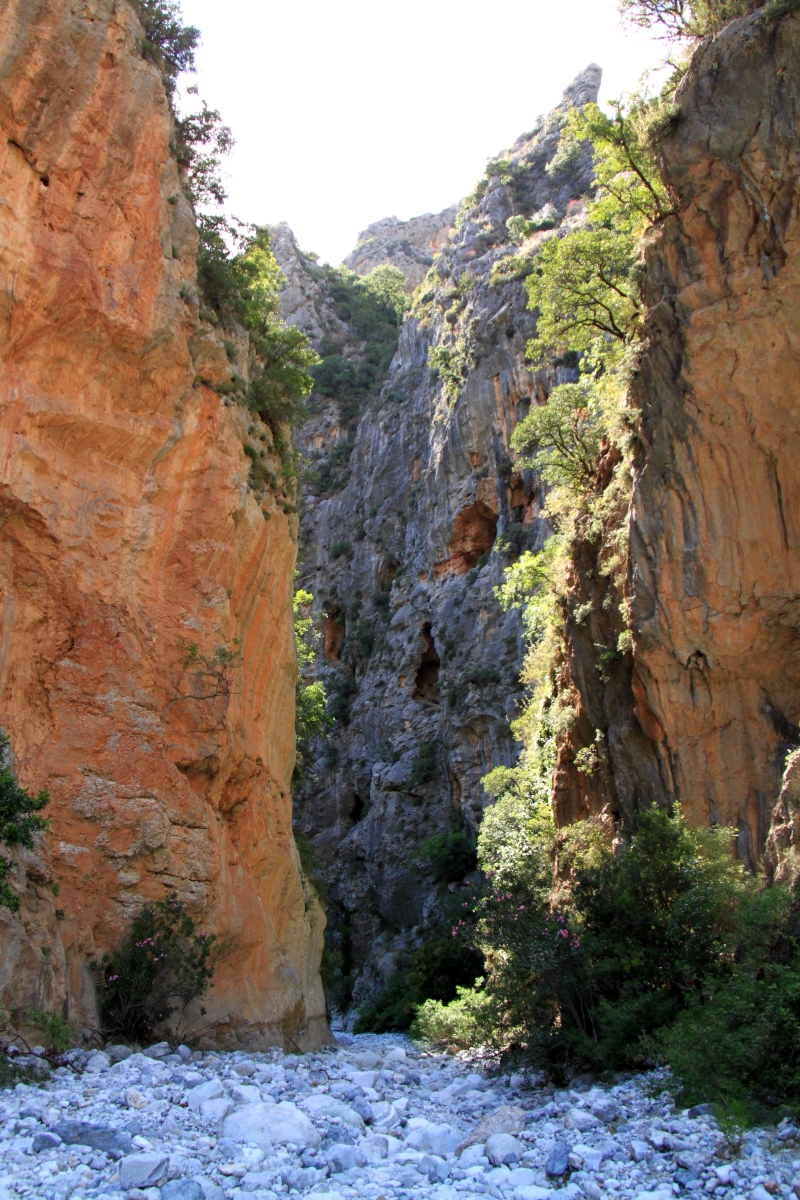
Having done the modern equivalent of girding my loins I set out at 10.30 to walk up the Viros Gorge.  I wasn’t hurrying, partly because I kept stopping to gawp at how spectacular it is, partly because I kept stopping to photograph bits of it, partly because you can’t walk and look around without falling on your face.  Or your Londonderry Air as I did later in the day.

The floor of the gorge is brilliant white in the bright sunlight, creating a technical problem of contrast for photographs which I haven’t worked out to overcome yet.

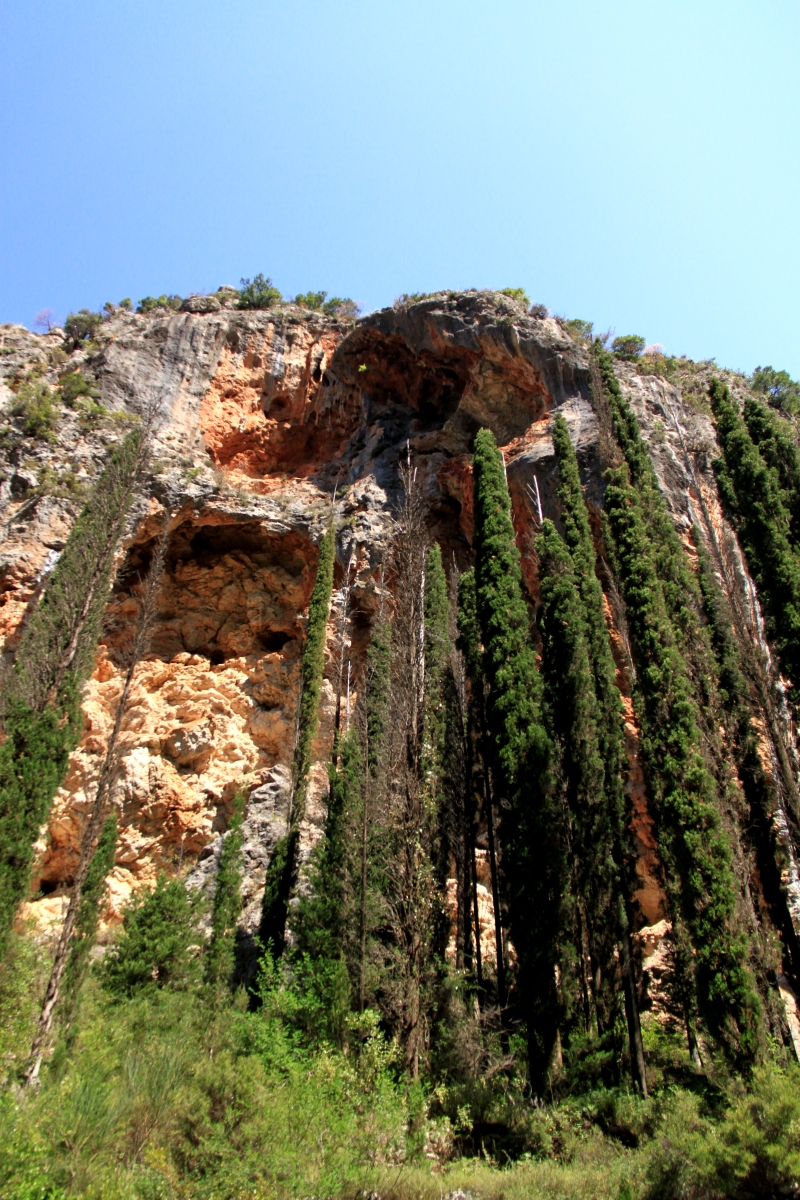
One of the elements in the landscape round here is the ‘pencil’ cypresses familiar from photos of posh villas on hillsides in Tuscanny but very much part of the natural scene in the gorge.  They towered above the floor of the gorge with the cliffs towering above them in turn.

‘Pencil’ cypresses reach up to the cliff-tops hundreds of feet above

Often just growing head and shoulders above the other trees

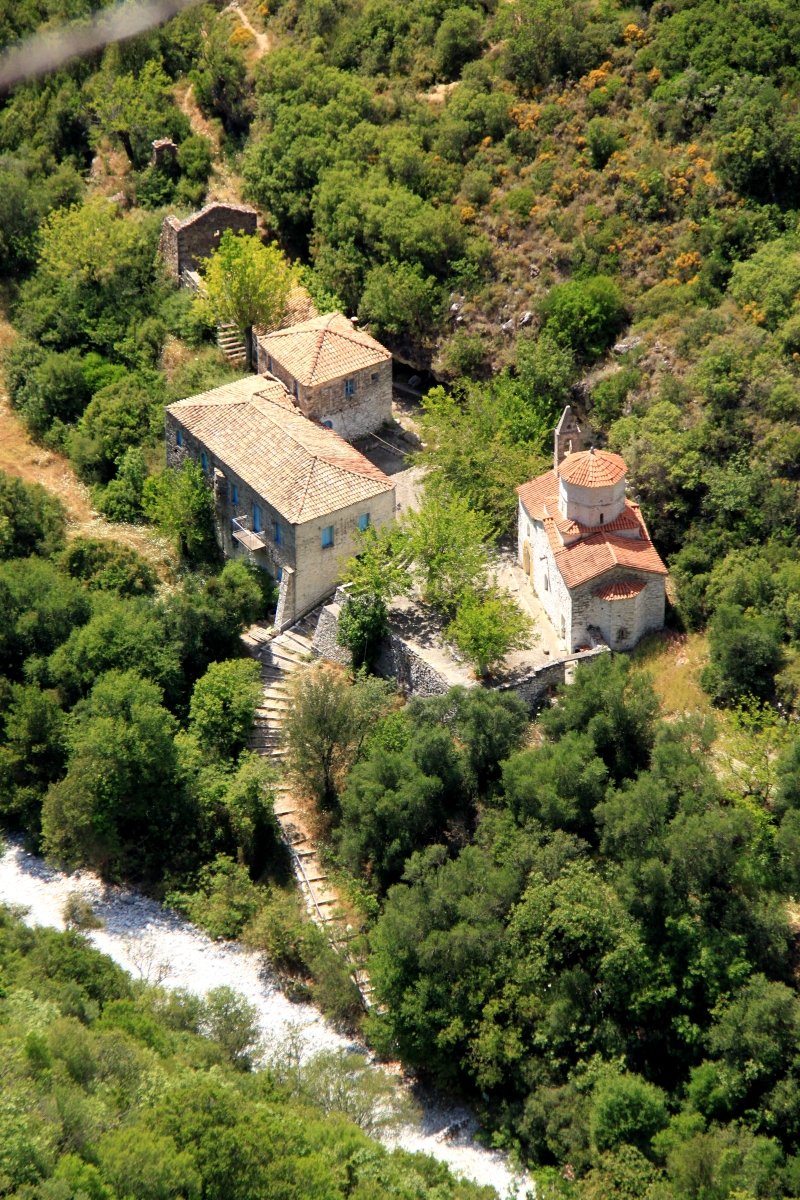
After about an hour the cliffed walls opened out a little and I reached the tiny monastery of Agios Sotiros set just above the floor of the gorge.  Perfect place for banana and nutbar, very pleasantly augmented by copious amounts of mulberries picked from the massive trees in the courtyard which were absolutely laden with luscious, ripe fruit.  My fingers turned purple, almost black as I picked them.  Large numbers were lying around where they had started to drop and I inadvertently sat in some leaving massive stains on my shorts which I only discovered when I stripped off for my swim later in the day.  Couldn’t have been a better spot to have my snack.  And the stains came out easily with a wash.

Agios Sotiros with one of the heavily laden mulberry trees alongside

Another view of Agios Sotiros

The monastery complex seen from way up on the path to the gorge rim

From the monastery a path rises very steeply 1000 feet to the village of Pedino on the rim of the gorge.  A long pull up in the heat but interspersed by pauses to take photos of the views and the wildlife.

Nature has a way of warning us what’s not good for us: I wouldn’t touch this little fella

One of the very many sulphur yellow butterflies. This time I managed to catch some of the colour, only visible on the upper surface of the wing

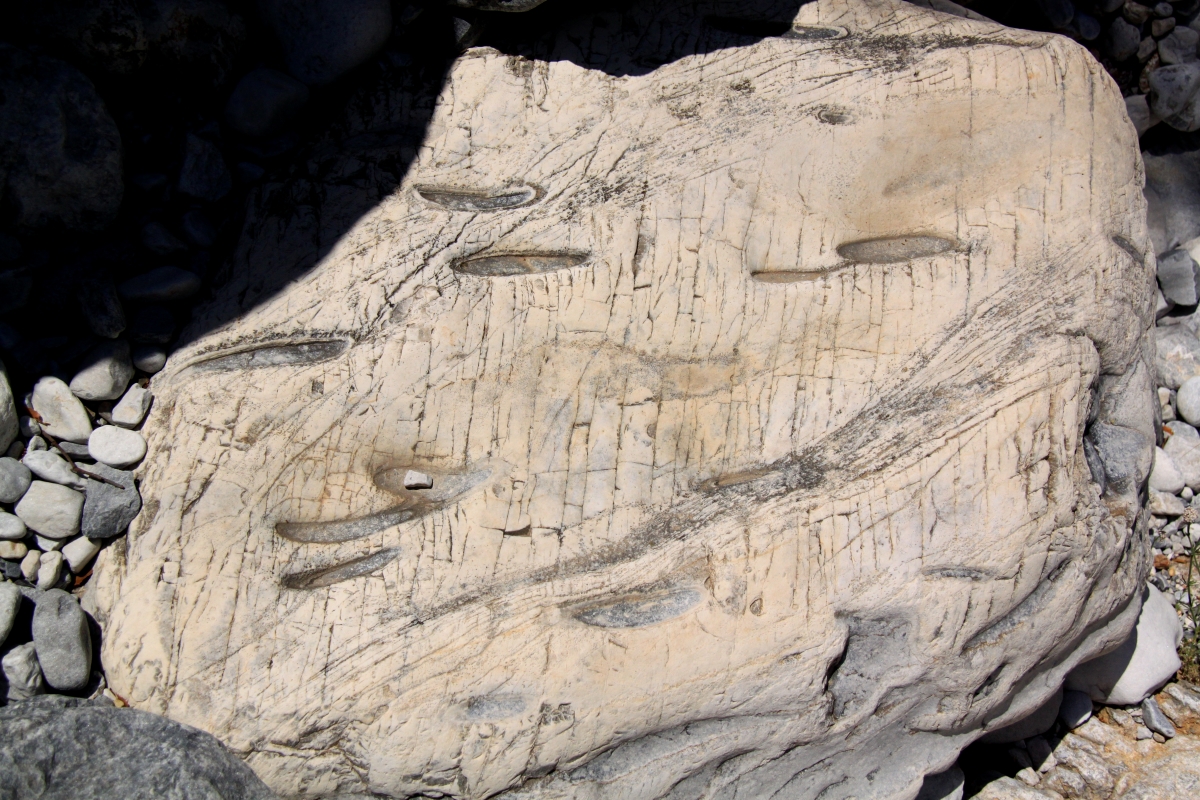
Just another rock?

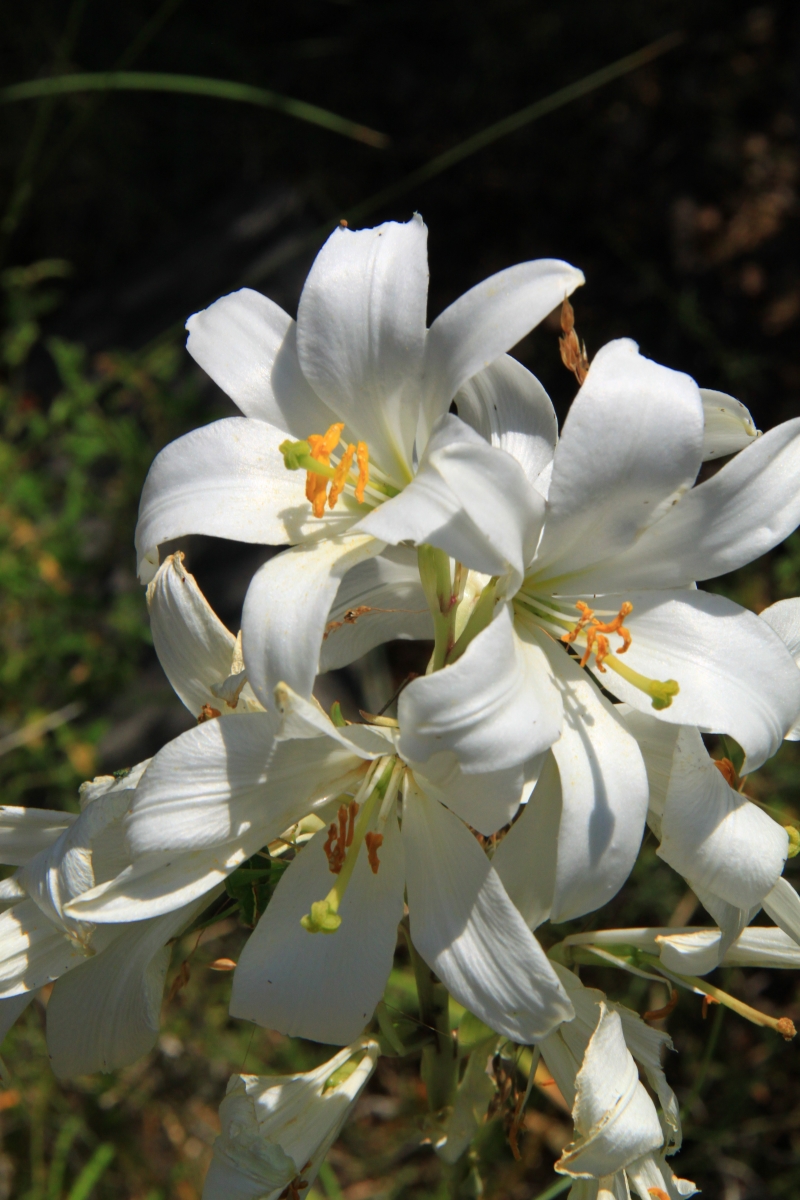
Wild lily at the side of the path

A bit of a bleat here.  Because the Canon s95 was pinched in Patras I don’t have a camera in my hand for the quick-draw shot.  I learned years ago when I tripped on Tilos that the SLR can take the brunt of a tumble so, on broken ground, and this was very broken ground, it stays in the rucksack out of harm’s way. It kept the camera safe when I did take a tumble later in the day but I missed the opportunity to photograph a fast moving snake on the way up the side of the gorge (I was on the way up, not the snake which just disappeared under a bush).

Coming into the gorge-rim village

The temperatures are starting to rise now and most of the pull up to the rim of the gorge was very hot work but very well worth it.  The views from the village were dramatic but too expansive and hazy to make decent photos.  I may need to go back later in the day to catch the evening light though that creates the problem of getting back before dark.  It took over 2 hours to drop back down to Kardamili but that was again because I kept stopping to take in the view.  It really is very impressive.  Covered about 18 kms in all, rising up to 460 metres above sea level.  Not bad for a first day in real heat.

Arrived back at the village by 16.00, hot tired and ready for a swim.  Perfect end to a very good walk.

Posted in Greece | Tagged , , , , , | 1 Comment

Patras to …. Kardamili: full circle

I followed the Biblical principle and shook the dust off my sandals as I left Patras at 08.30 Monday morning on the KTEL bus for Kalamata.  I had decided long before I had my camera pinched that this was not a town for me.

Three hours of fairly monotonous, but very non-UK, landscape until the Taigetos Mountains appeared about an hour before the end of the journey.  Arrived Kalamata KTEL bus station on time but only to find that it was not where the description on the internet led me to believe.  Instead of a short walk to the hotel I had sussed out, it was about  1km away ‘kato, kato! (down, down!).   …..  so I was told by a local guy.   The internet placed the hotel very close to the railway station on ‘Sidirimiko Stathmos (Railway Station) Street’.   Shame that the railway isn’t operating and is unlikely to do so in my lifetime. The bus station wasn’t shown on the map.  The hotel itself was about 1km from the sea.  I was not a little dischuffed. Time for rapid rethink.

I instantly resorted to my favoured work principle:: ‘All problems have solutionsYou just have to think laterally and find them.”  .  My solution?  I had only intended staying overnight in Kalamata en route to Kardamili in the North of the Mani.  I knocked that plan on the head, enquired in the KTEL office, and found that the next bus to Kardamili left in 30 minutes.  No brainer!!  Time for a spinach pie and frappé in the very good, if a touch expensive, bus station café and I was on my way again for the 1 hour journey to Kardamili.

Rarely has a flash decision turned out so right!!!!!  Kardamili is just my kind of place (though I don’t fit in with the upper middle class English contingent around (see http://www.zorbas.de/maniguide/kardamili.html#dont under the heading ‘a certain type of English tourist).  It’s village-sized, not a large town.  Very good walking in the mountains on the doorstep.  By the sea.  Perfect blue-sky weather.

I would have frittered away a day of my life in Kalamata.  Not that I’m dissing the place but I would have been looking for things to kill the time as I had been in Patras.  As it is I’m where I planned to be from the outset.  Which brings me to the ‘full circle’ bit.

I was given the idea of coming to the Mani, the central and most southerly of the 3 Peloponnese peninsulas, by a book given to me for Christmas and titled ‘The Mani’ written by Patrick Leigh Fermor, a WW2 hero (he captured a German General on Crete and exported him to Britain) and author.  See http://en.wikipedia.org/wiki/Patrick_Leigh_Fermor

I didn’t get on with the book because, though my grasp of English is pretty good, there are on average 10 words per page which I have never seen before.  But I persevered and the story of the area which unfolds is fascinating.  It struck me as my kind of place.  So I built the whole trip around that one goal of coming here.  Kardamili is the beginning of the Mani.  I’ve come full circle from the original inspiration.  In the fullness of time I plan to head further south into the Deep Mani.

I arrived in Kardamili on the bus at just gone 14.00.  Fed up with lugging Big Bag around Big Towns looking for hotels or bus terminuses, I saw a ‘domatia’ (rooms to let) sign at the edge of the main square about 20 yards from where I got off the bus and enquired within.  It’s good here.  Very good!  Reasonably priced though not cheap. Not a hotel but an apartment so I can do my own food as I choose.  Sea view.  Sun on the balcony afternoon, evening and sunset. In-room WiFi.  Couldn’t be more central.  Draught beer 20 metres away in the main square €2.60 … that’s draught beer.  Remember the 330 cl bottle in Petras @ €5?!

There is the beginnings of a gorge within 200 metres of the other side of the main square …. I love gorge walks …. and next to it are 2 very well stocked supermarkets.  After a preliminary amble up the gorge at the end of the afternoon I stocked-up in the supermarkets for breakfasts and banana/nutbar midday meals. There is a walking and climbing shop within 50 metres which stocks good quality gear and 1:25,000 scale walking maps of the area.  There are way-marked walks up into the mountains.  I repeat:  it’s good here.

I deliberately ate tonight in Lela’s Taverna.   Good food and service but pricey.  However, I had to eat there first night because the eponymous Lela used to be housekeeper for Patrick Lee Fermor when he lived here.  The location of the taverna is unbeatable, on small terraces above rocks looking down onto the sea with views of the setting sun and, in the opposite direction, the rising moon.  Magical.  Shame I was on my own.  The staff were all young, energetic and multilingual Greeks.  There was a tiny, wizened old lady sitting at the side as I left.  I said ‘Kali Nichta’ and raised my hand in local greeting to Lela. Full circle.

Just a few photos to give an impression of Kardamili.

The track leading into the Viros Gorge with the church of Agios Spyridon up on the right.   Profitis Ilias, the highest Mountain in the Taigetos range in the background …. still with snow on it.

Agios Spyridon, the family church of the Moutzinos clan which ruled Kardamili

in Old Kardamili, the Tower home of the Moutzinos. One of the famous Mani towers.

Inside the Old Village

The beginning of the Vykos Gorge

x

Posted in Greece | Tagged , , , , | 1 Comment