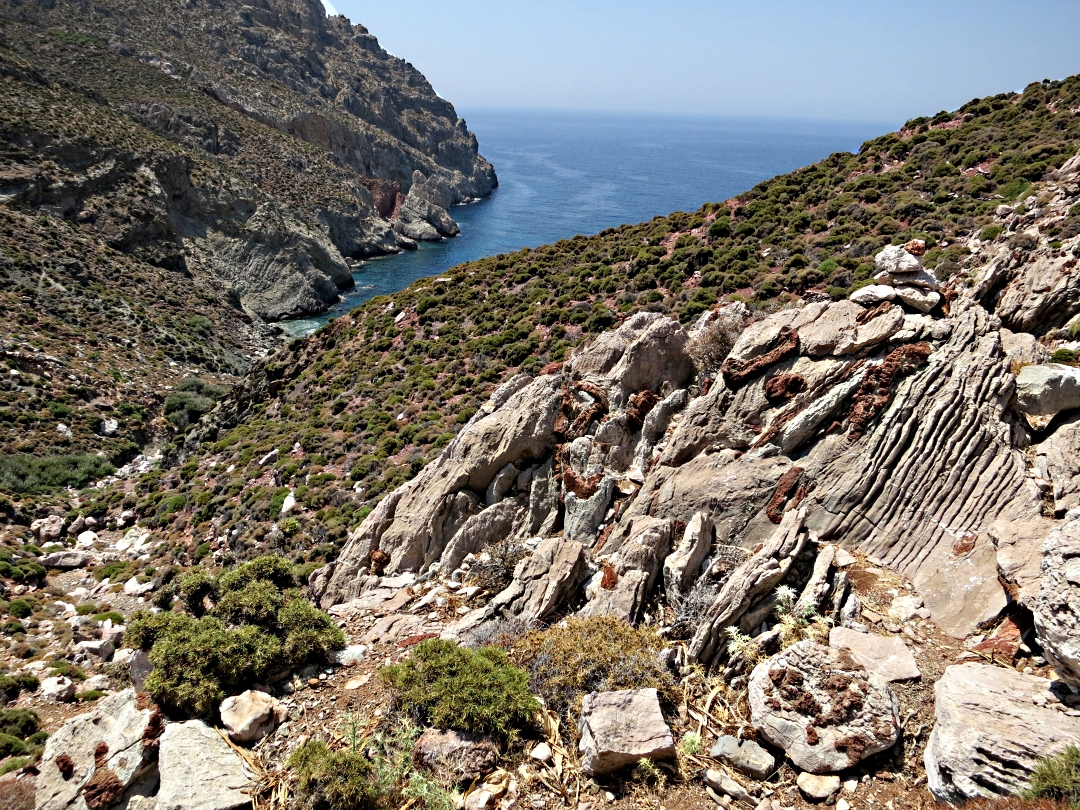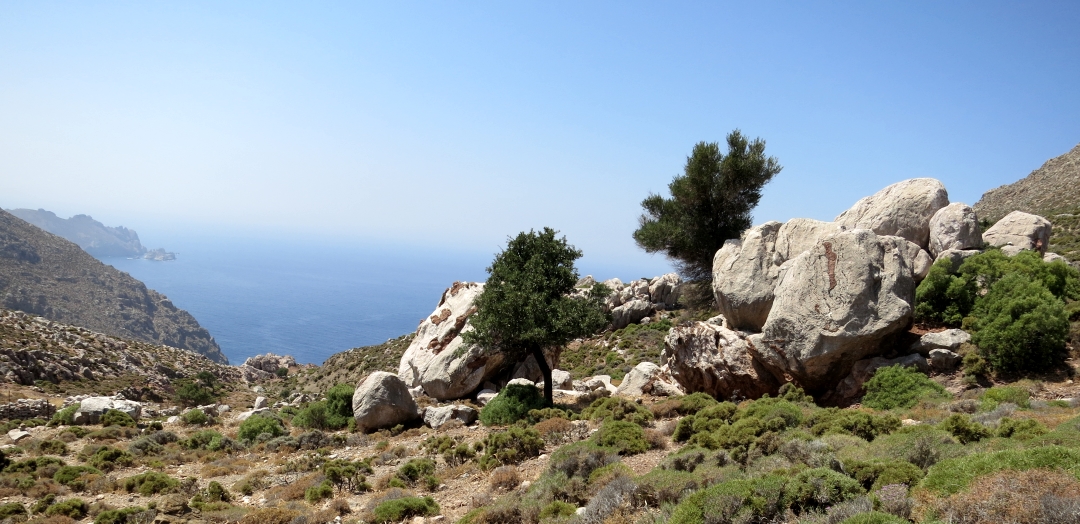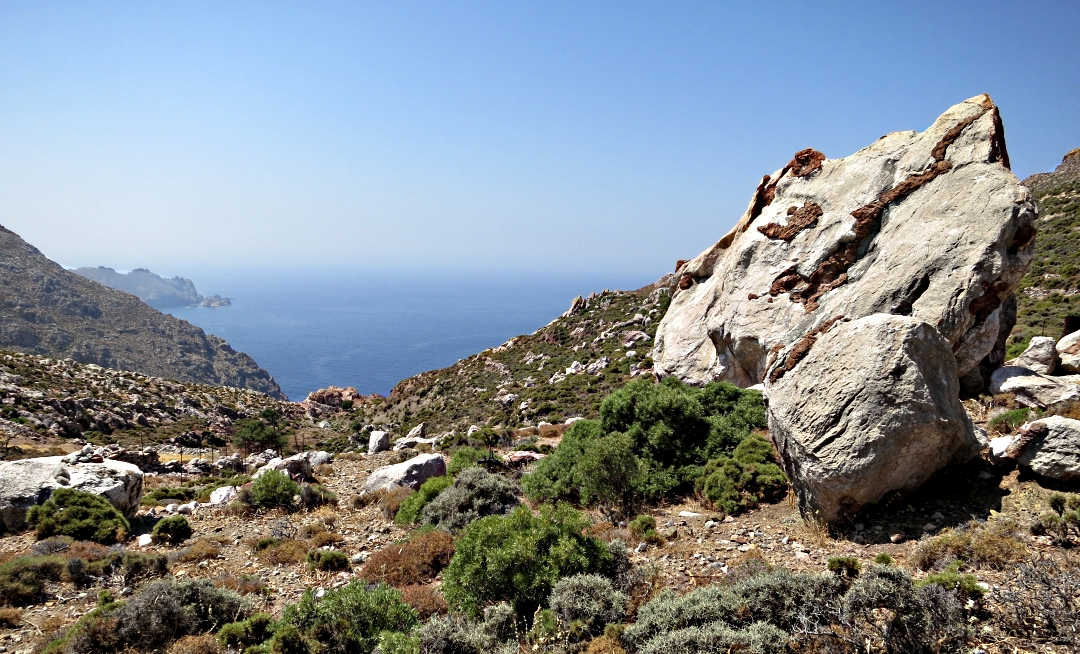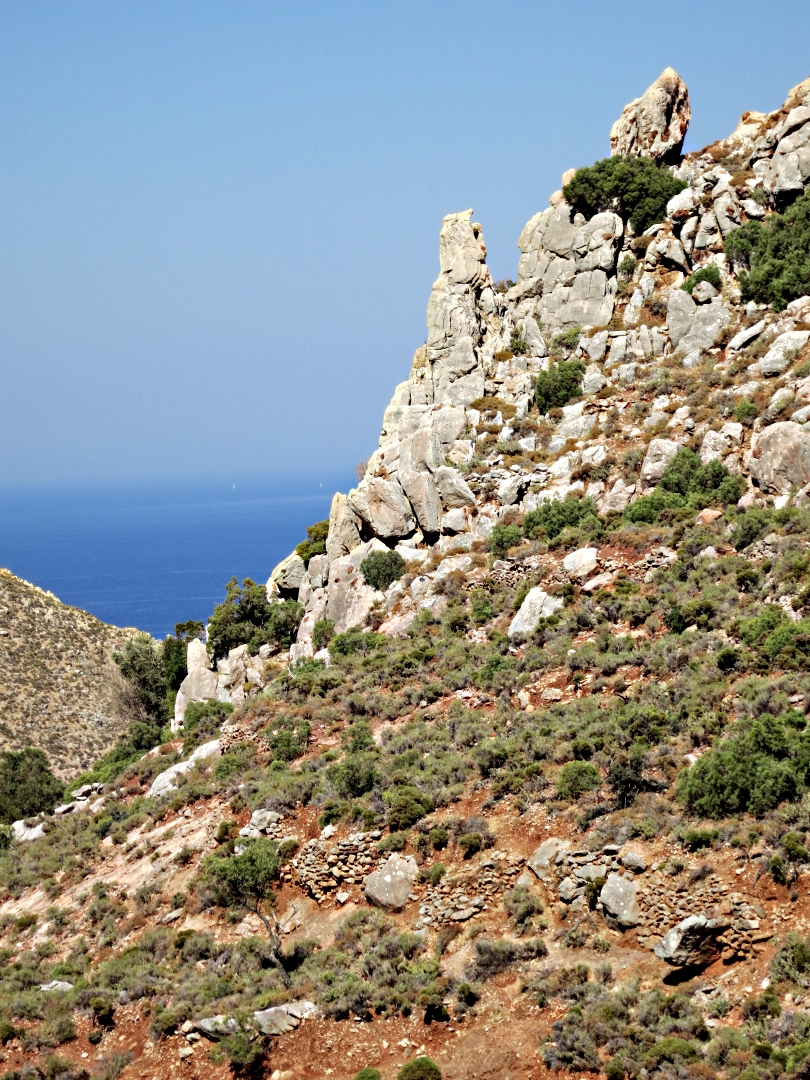
Tilos: a coast walk and making like a commando

It’s not that I’m contrary or perverse but a notice saying that the coastal path is closed due to a landslide is nothing but an invitation to go and look.

The path leads to Red Beach and the further, less red, beach of Lethra both of which had become increasingly popular after the island council improved the path along the cliffs about a decade ago.  One of their major attractions had been diminished by this improvement but only in the sense that they could no longer be regarded as secluded and so had unfortunately become ‘textile’.

The path begins just after passing the massive ‘Ilidi Rock’ luxury apartment complex, climbing the cliffs at one end of the bay and known disparagingly, at least by those who can’t afford to stay there, as ‘Alacatraz’.

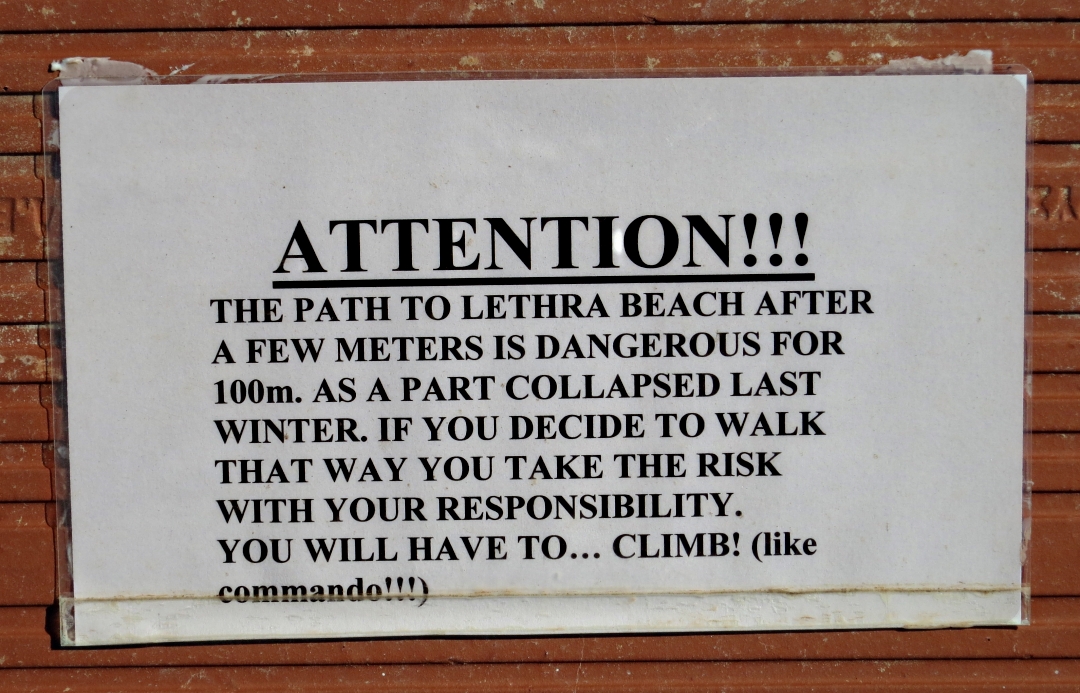
At that point a string had been draped loosely across the path and an A4 notice stuck to a terracotta building block in the middle with the clear and eminently sensible announcement that if you walk this way it’s your own responsibility and rather beautifully and enticingly advises that “YOU WILL HAVE TO … CLIMB! (like commando!!!).  Apart from the killing I reckoned I could do the commando bit.  Indeed I was very much looking forward to it, almost dribbling with excitement at the prospect. .
This is your final warning!

This is your final warning!

There has indeed been a landslide, quite a massive one in the context of the path which has dropped a good few feet, with loose rubble at each end of the slip.  It presented no problem to us aspirational commandos, the only bit requiring just the tiniest amount of climbing skill, rather than simply care and attention, being at the far side where there is a one-move climb from the top of the rubble back onto the original path.
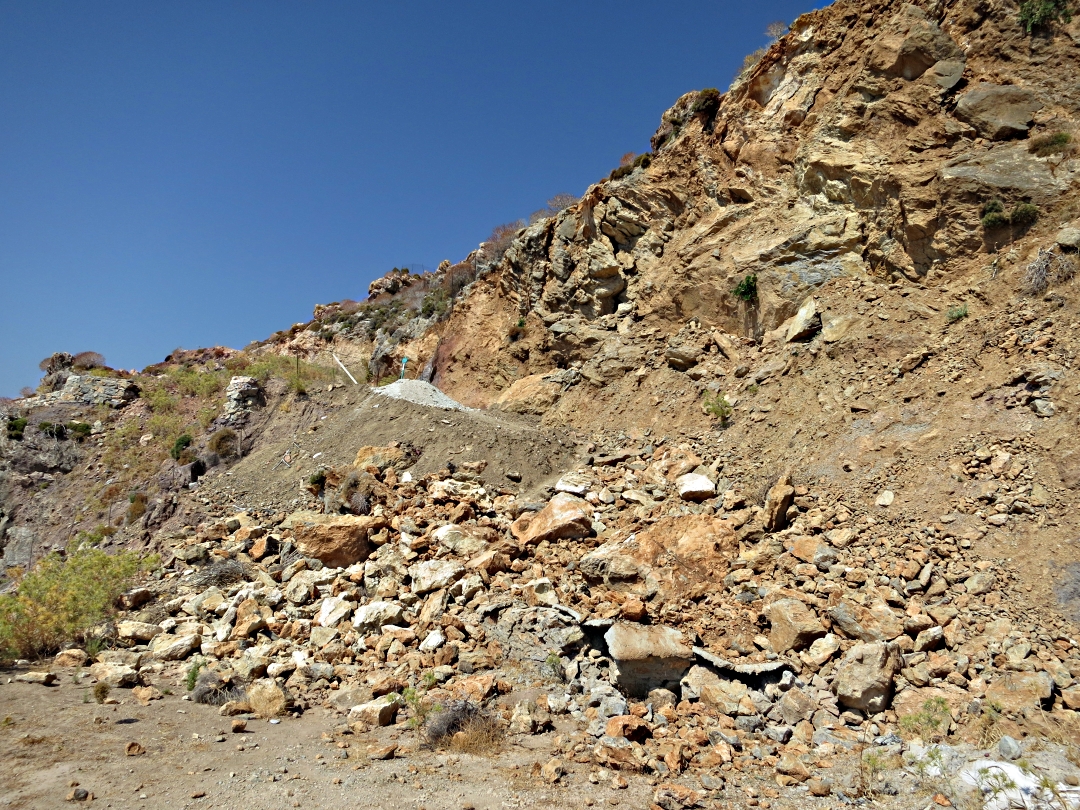
The one end of the collapsed path

The one end of the collapsed path

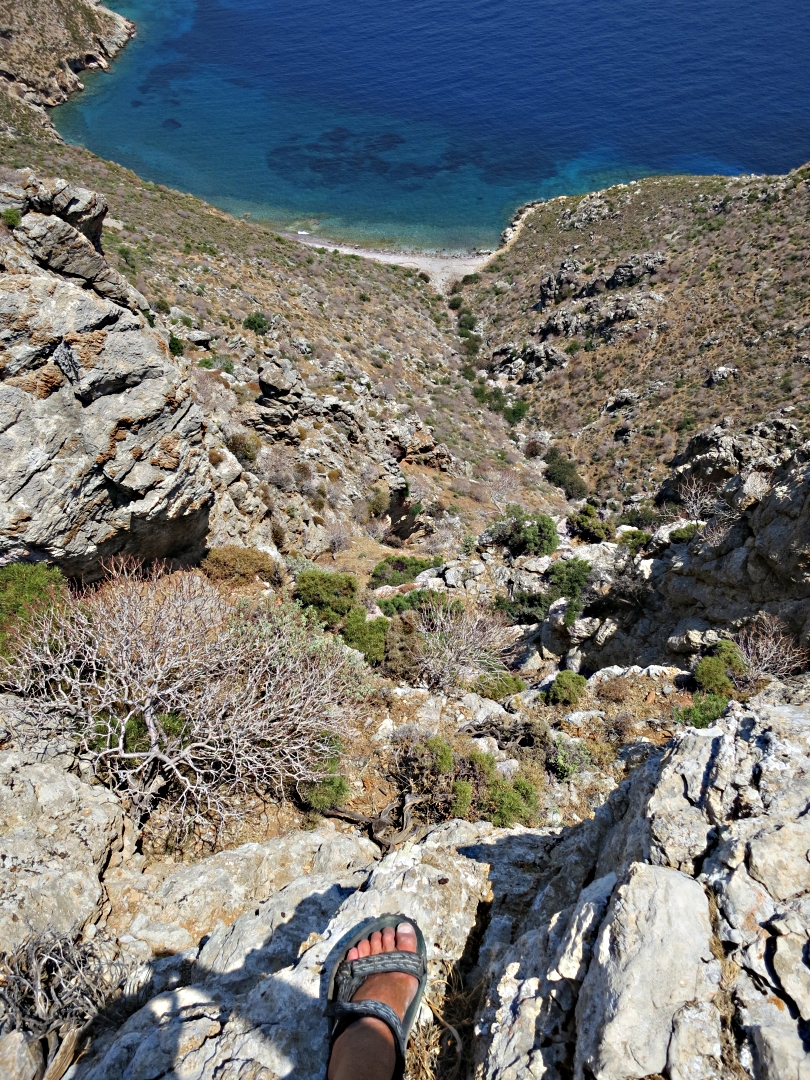
There are bands of weak rock in the cliffs along this stretch of coast and I had been wondering for some years how long it would be before slippages which nibbled away at the width of the path every winter would render it impassable.  This landslide was something entirely different.  Shortly after regaining the path I came across one of the points where erosion of a band of weak, shaley purple rock has narrowed the path to little more than a 18 inches.(45cms) fromm its more usual 1½ – 2 metres.

13Tilos037w1972jpg

On the edge of the path eroding year-by-year into the sea far below
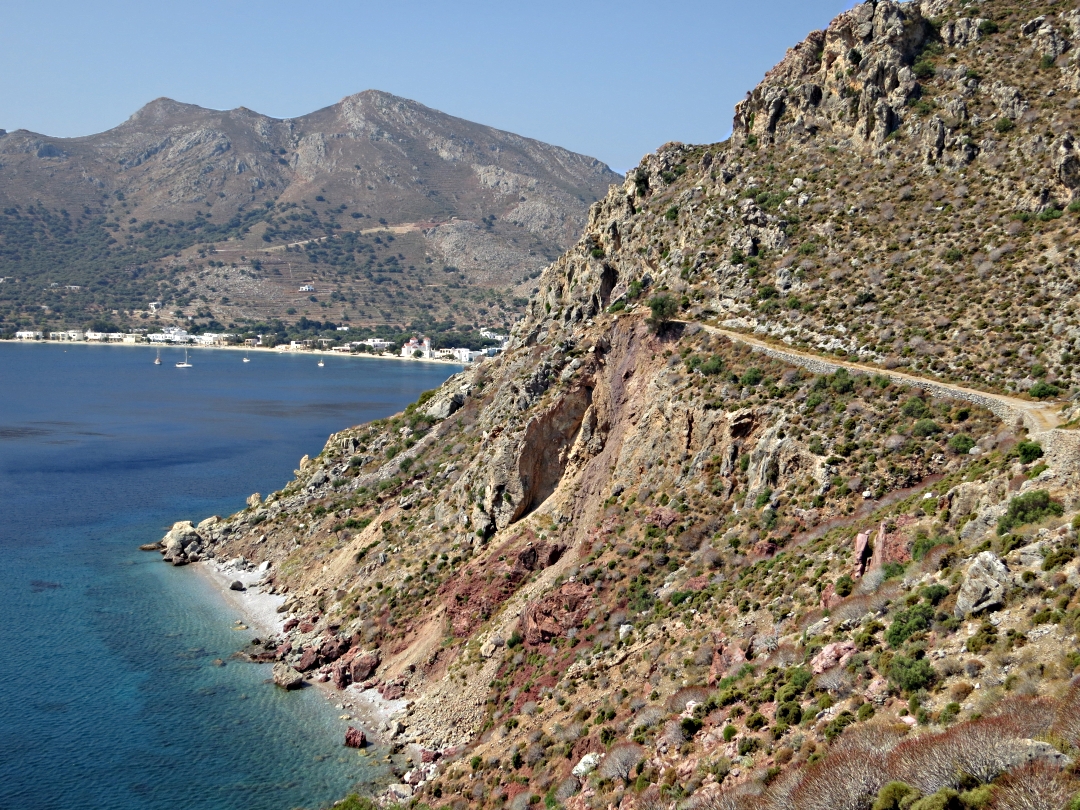
Looking back at the weak, shaley band and the tiny beaches far below

Looking back at the weak, shaley band and the tiny beaches far below

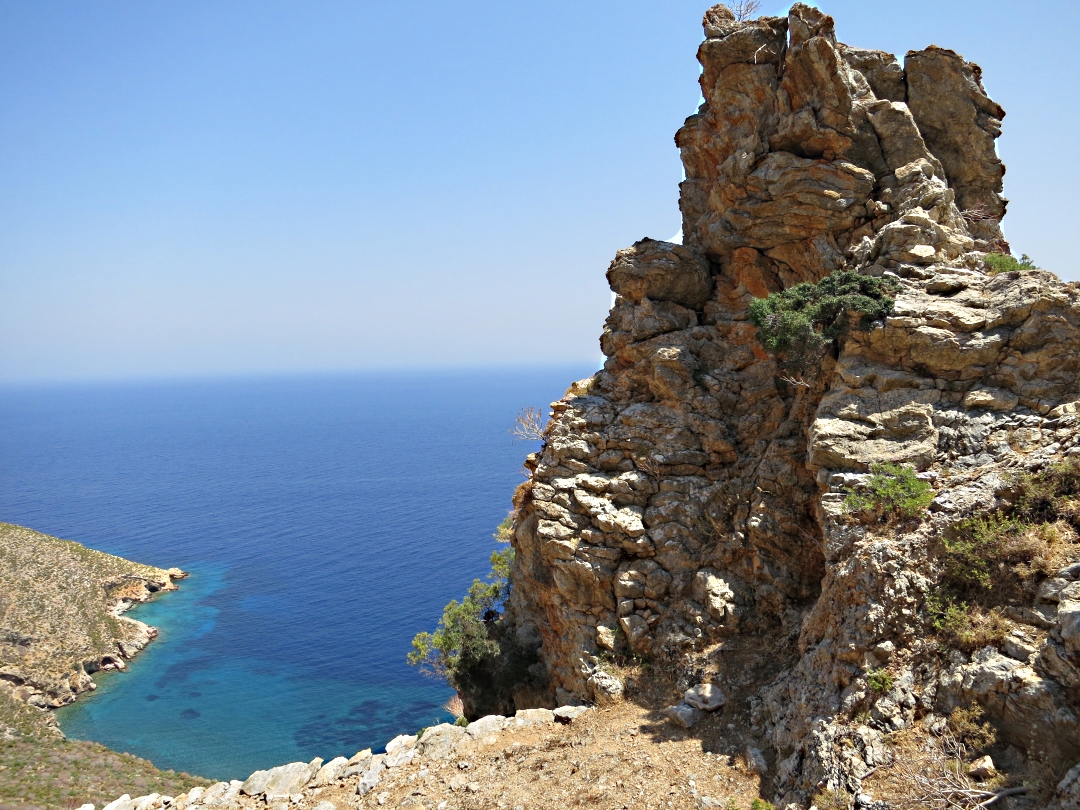
The rest of the walk was uneventful.  It’s not the most dramatic coast path I know but it’s certainly up there with some of the best, including the Pembrokeshire Coast Path in Wales.  A broad path which until the landslide and the nibbled-away width would almost certainly qualify as an “accessibility path” attracting EU funding, provided you had assistance or the strength and tenacity of Tanni Grey-Thomson (now Baroness TG-T in recognition of her achievements).  It rises to some 100 metres above the sea with dramatic views along its whole length.

Just one of the views along the coast path

Just one of the views along the coast path

Red Beach, reachable only by narrow, winding, rocky, cairned side-path, was completely deserted and the much larger Lethra had only one other person at the far end.   He was significantly overweight, hobbling on a walking stick with a damaged leg, had set out to walk the coast path, failed at the one-step climb and had walked right round via the main road and down the top of the gorge to get there.  He complained that his body was giving out. Respect for determination.

After lazing around, swimming, playing with stones and generally dealing with the tedium of beaches, I headed inland up the bed of the gorge to the deserted village of Micro Horio which I banged on about the other day.  I love gorges and though this isn’t one of the biggest by any means it’s good fun.
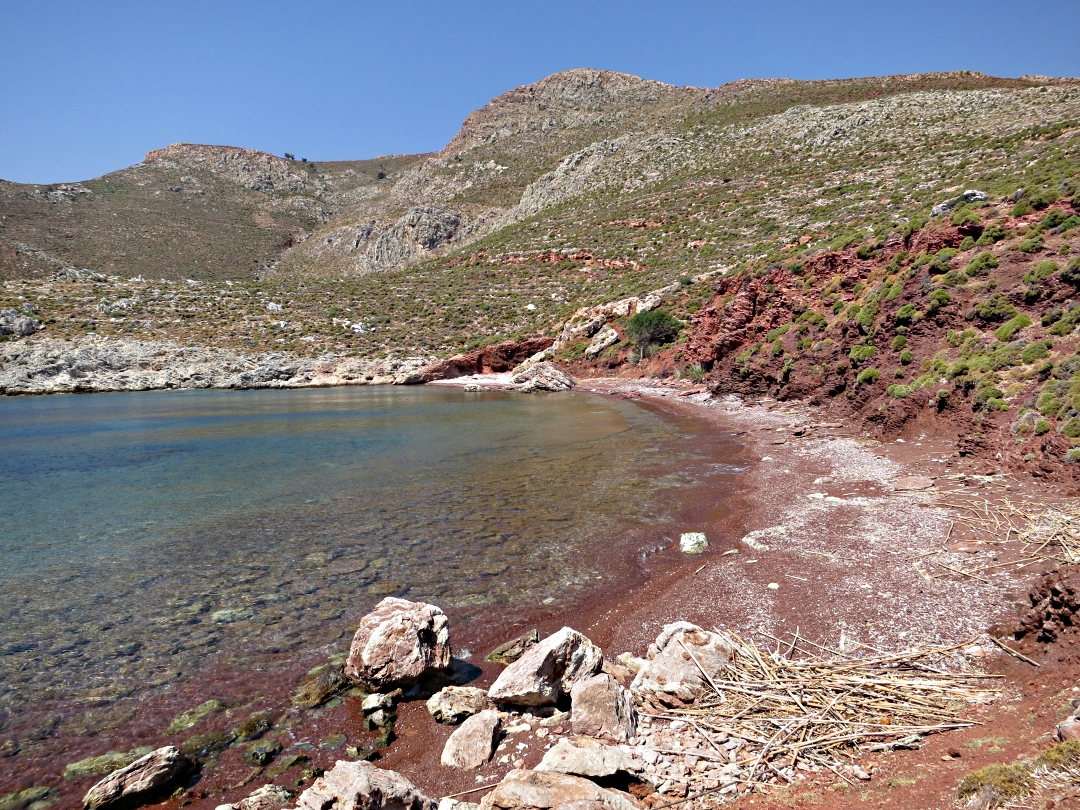
Looking along the length of Red Beach
Looking along the length of Red Beach

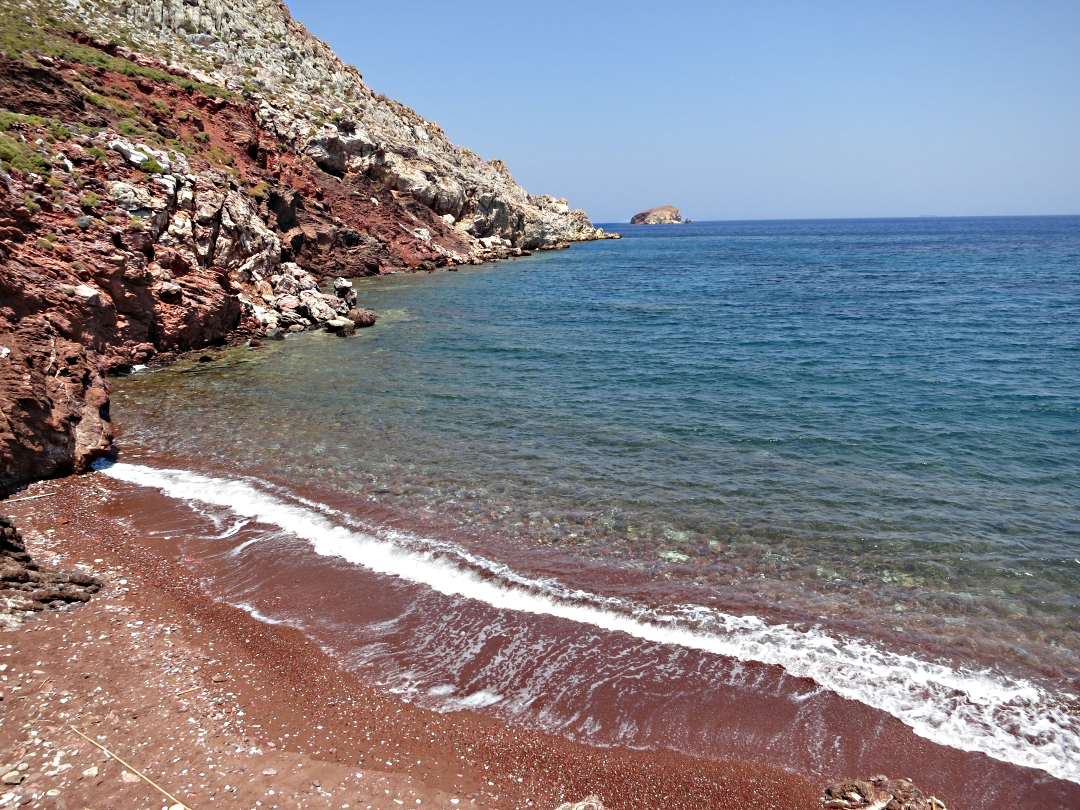
The even redder beach on the other side of the narrow peninsula
The even redder beach on the other side of the narrow peninsula

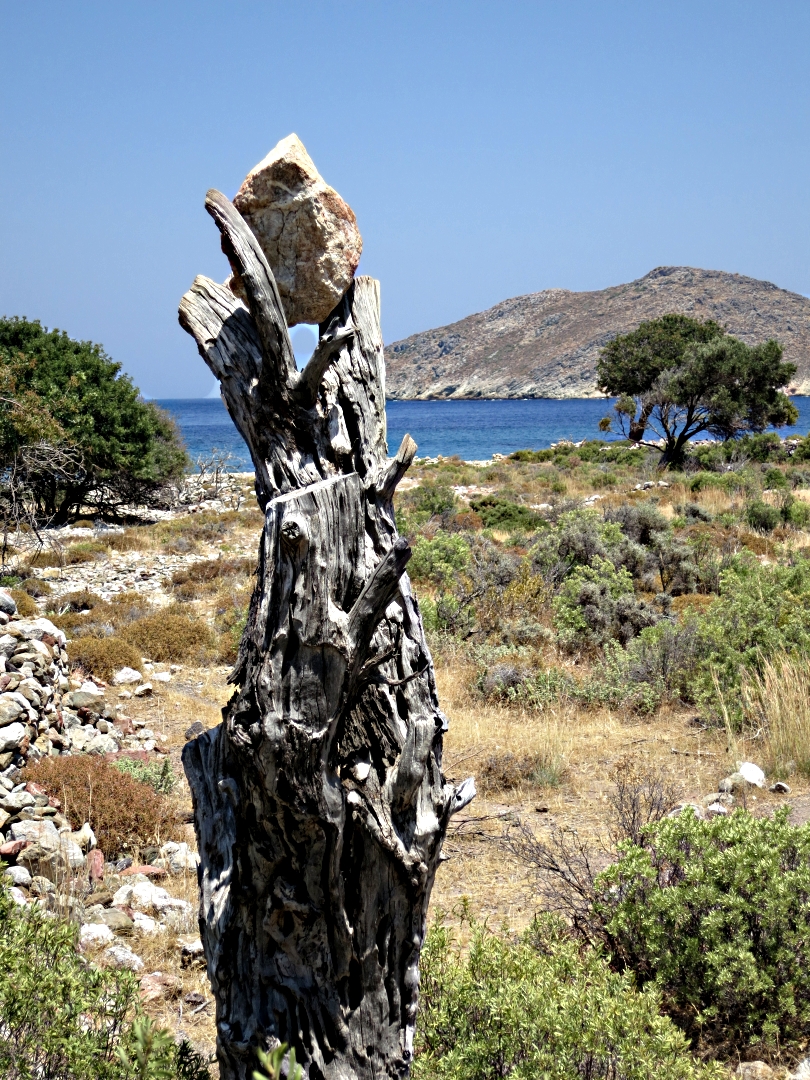
Some creative person wedged this big stone in a dead olive tree at the side of the final section of path to Lethra Beach.

Some creative person wedged this big stone in a dead olive tree at the side of the final section of path to Lethra Beach.

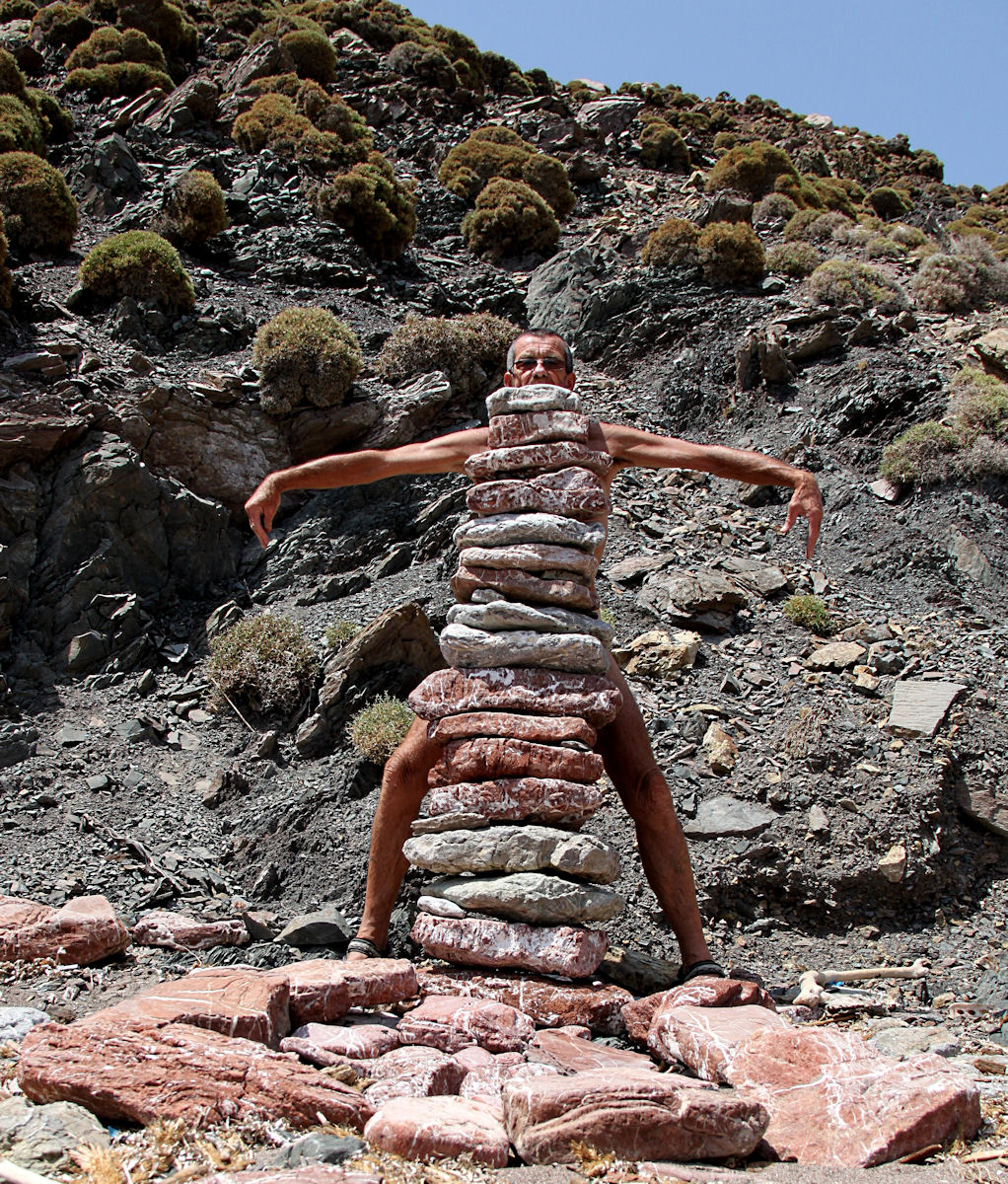
.... and I just played with stones

…. and I just played with stones

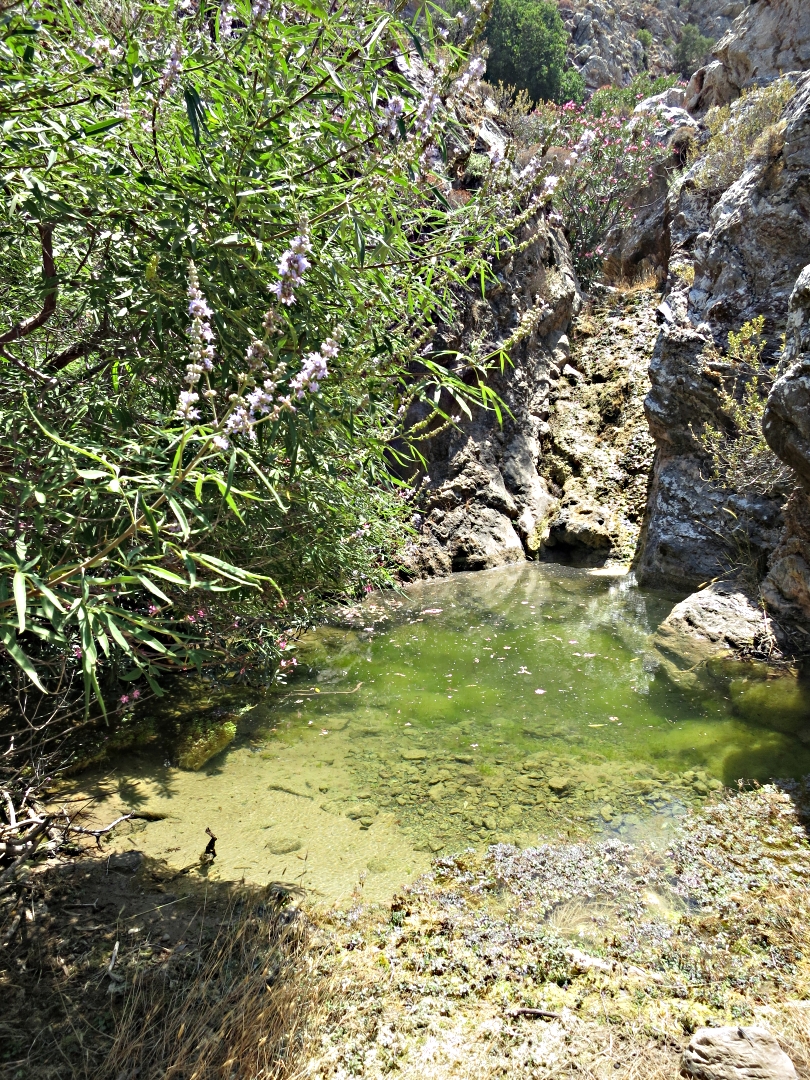
I have been down the gorge a number of times before but this was the first time walking up it and, not surprisingly, it gave a quite different impression.  The difference was heightened by the fact that for the first time I saw the upper sections with pools of standing water, a consequence of a long, unusually wet winter here.  Springs which have normally dried up by mid-July are still running though the spring at the top of the gorge hasn’t dried up at all in the 13 years I have known it.
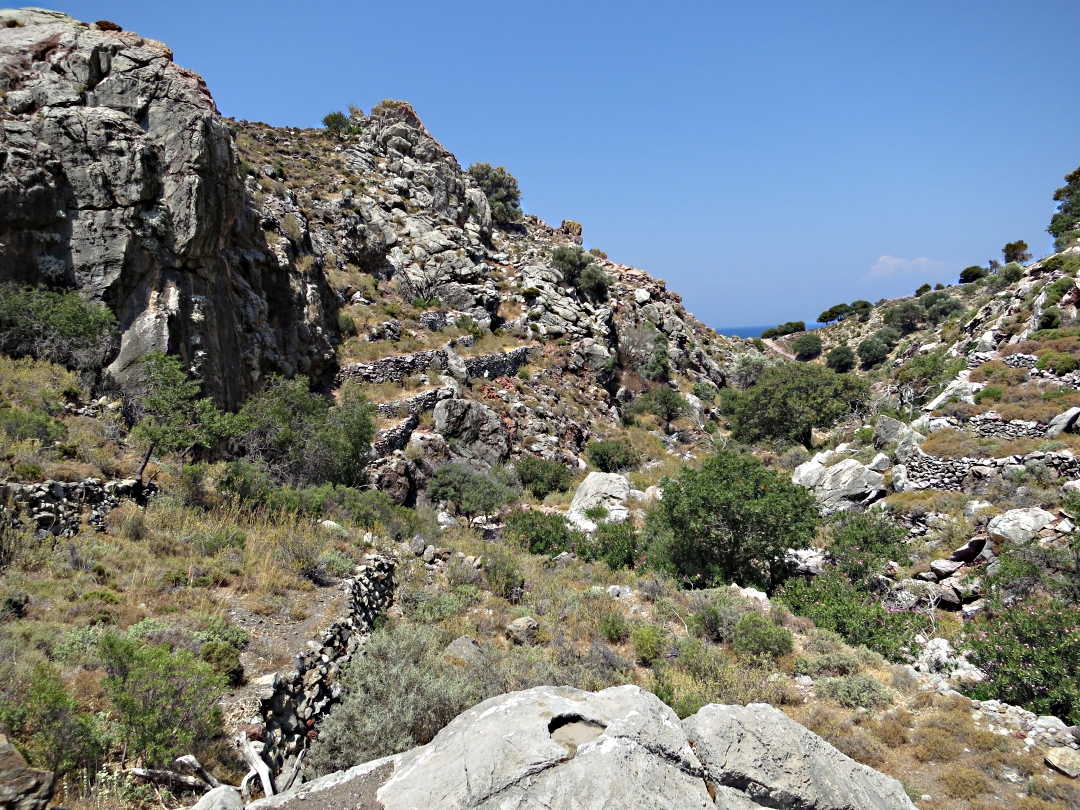
Looking back down the gorge from a mid point on the top of a large rock
Looking back down the gorge from a mid point on the top of a large rock

One of the standing pools of water

One of the standing pools of water

Photographer in the water

Photographer in the water

Another good day.

Posted in Greece, Landscape, Mountains, Nature | Tagged , , , , , , , , | Leave a comment

Tilos: what is getting the goat of the island’s landscape?

My attention was suddenly diverted from picking my way through the excessively prickly vegetation on a narrow mountain-side agricultural terrace to get into position for a photo of yet another abandoned olive press. A noise like a turkey having its neck pulled while learning how to make its annoyingly stupid “gobble-gobble” noise came from a lower terrace.  That was quickly followed by a sound like pushing your tongue rapidly and forcibly through closed lips.

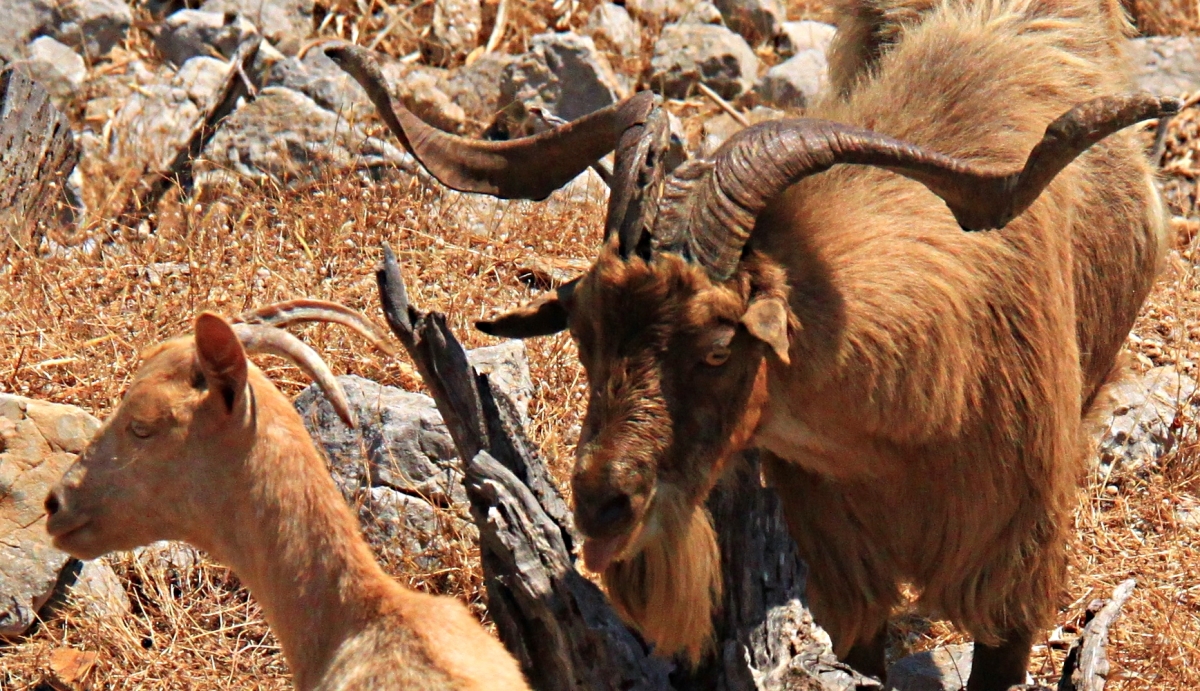
A couple of young adult male goats were standing erect, alert, poised at the edge of  the terrace alongside a dead olive tree.   Picking my way closer it soon became clear that they stood aloof as Big Billy was softening up a young honey-blonde who had obviously just come to the point of finding out what being a young female goat is all about.  The more slightly built young males clearly didn’t have either the bulk or the horns to take on Big Billy but, driven by uncontrollable biological urges, hung around, presumably hoping he wouldn’t be up to the task and go home.

The sound like pushing your tongue rapidly through closed lips was precisely that.  The huge male flicked his tongue all over the young female who clearly relished the attention and enjoyed the experience.

I left, as discretely as being surrounded by flesh ripping vegetation would allow, before matters became any more personal.

A few days later, having spotted that it bore ripe fruit, I stopped underneath a fig tree in yet another of the abandoned settlements on Tilos.  I love ripe figs straight from the tree, it’s a real bonus when trekking in the mountains.  I sat down to munch on my now augmented banana and nutbar when I heard those strange sounds again.   The only difference was that this time the young female was not so compliant and instead was making straight for where I was sitting, ignoring Amorous Billy’s advances.

It was clear.  The young female wanted some of the food and Amorous Billy wanted some of the young female. Not wanting to get into the middle of a lovers’ tiff I picked some of the dried up, over-ripe figs from the tree and threw them some distance away, followed by the skin from my rapidly dispatched banana.

Amorous Billy walked off huffily, not impressed by the fact that the female was more interested in the banana skin than in him.  Who can blame him?!

Fact of the matter is, you can’t go anywhere on Tilos without encountering goats.  Admittedly not always amorously inclined but they are in numbers larger than is good for the fragile environment of the island.  Nature conservation interests as well as opinions expressed by locals and knowledgeable visitors consider that there are just too many.

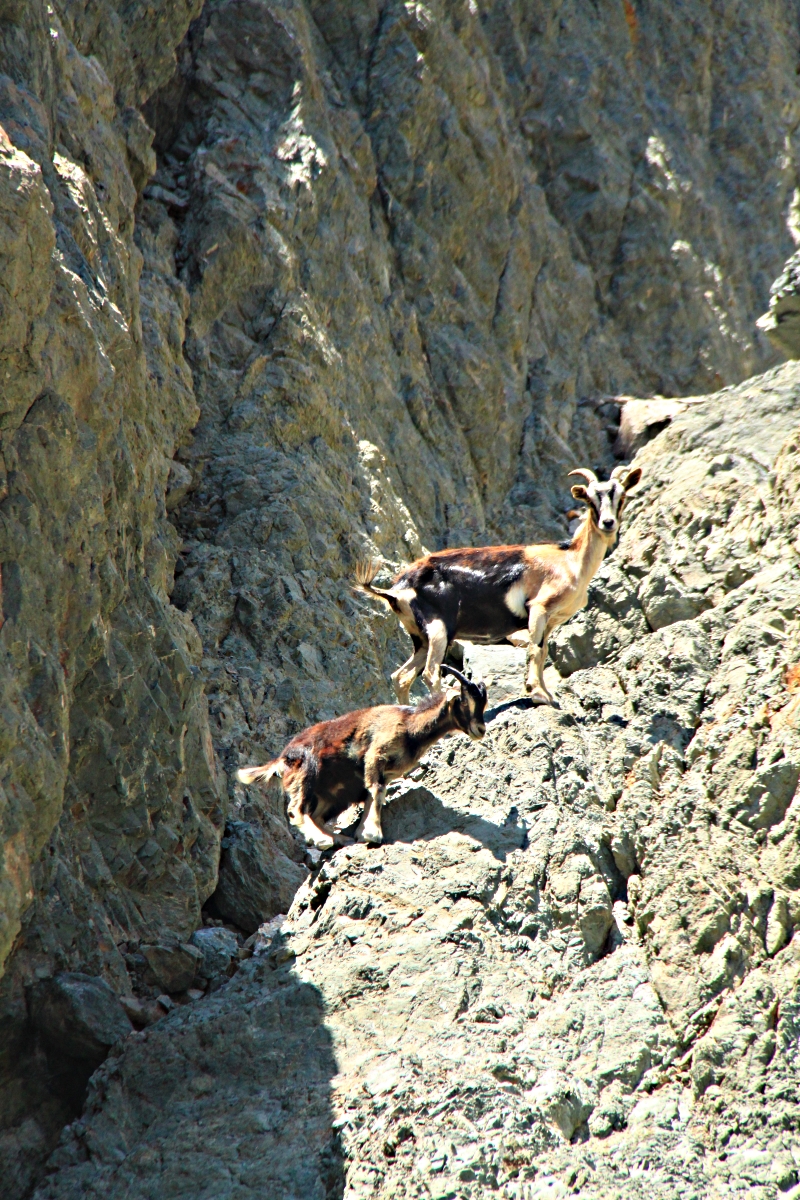
They pop up everywhere: looking down from lofty crags; leaping out of bits of shade beneath rocks or trees; wandering along otherwise secluded beaches; licking seepages of water from rocks faces; jumping out of a luxury pad in the many derelict buildings.  It’s impossible to find a bit of natural shade on the island which isn’t carpeted in droppings and dark-brown goat urine stains.  In enclosed spaces the smell is overpowering.

Desperate for food in summer months, numbers are so great that they resort to digging up arum and squill bulbs, which they obviously find inedible, in order to get at the succulent roots beneath.  Areas of mountainside are churned up and sections of footpaths destroyed.

It has to be said that they look the part, leaping around the crags balletically, showing just how cumbersome we lumbering, arthritic humans are at the task.  They come in all shapes, sizes and colourings: black, white, streaked, brown, honey blonde and dramatically piebald.  They are certainly photogenic.

Some now have ear-tags in compliance with EU regulations but many …. most …. are simply wild in the senses of rampant, out of  control and ‘not subject to agricultural practices’.

Because they are wild there is, as far as I can find, no reliable estimate of the total numbers  but one thing is beyond doubt, the number of goats far exceeds the 200 or so people who live here all year.  This set me thinking – something needs to.

In Wales the number of sheep at over 8 million also outnumber the 3 million residents.  There is no real significance in that apart from providing a butt for jokes (pun acknowledged but not intended).  What is of significance is that the mountain landscape of Wales is a direct result of overgrazing by sheep.  The bare, grassy mountains were not always so.  Until the industrial revolution the mountains of South Wales were largely covered in beech/oak/cherry woodland.  When that was felled to make charcoal to fuel the blast furnaces it never recovered and the introduction of large flocks of sheep on vast areas of upland common allowed virtually nothing else to grow except grass.  The numbers of sheep allowed are specified for each common but in reality significantly exceed that.

Arguably there us a tie up between the excessive numbers of goats on Tilos and the landscape too.  I have commented before that on nearby Symi, a walk in the mountains leaves an overwhelming impression of herbs, especially oregano, sage and thyme which fill the air with their characteristic smells.  On Tilos the overwhelming impression is of aggressive thorny bushes which impale passing flesh.  My guess is that these have flourished because the goats have eaten everything else so they have little competition.

Hey, you!  I'm Big Billy, aren't I impressive

Hey, you! I’m Big Billy, aren’t I impressive

First of all a good tongue-flicking to get her in the mood

First of all a good tongue-flicking to get her in the mood

Young male hovering around, waiting his day.

Young male hovering around, waiting his day.

Mother takes one of the kids for an amble up the crag

Mother takes one of the kids for an amble up the crag

young kid licks the rock to get water which oozes out

young kid licks the rock to get water which oozes out

Large piebald male in pursuit of some action

Large piebald male in pursuit of some action

Next post on the blog will be more walking, less rambling.  Maybe.

Posted in Greece, Landscape, Mountains, Nature | Tagged , , , , , , , , , , , , , , | Leave a comment

Tilos: sharply to the top

I’ve mixed the words and the pictures in this post so it’s more trouble to avoid the words.  I’m malevolent like that!

Friday night and I went for a meal with friends who live on the island.  Clichés abound to describe the evening ranging from the prosaic English ‘convivial’, to the probably more accurate undertones of the Irish/Scottish ‘a good craic’.

The high spot was perhaps when our hostess told the story of a chicken-keeping friend in Scotland who, expecting guests for the evening, went shopping leaving the instruction for  her husband to “pull the neck of a chicken and pluck it” by the time she arrived back.  On opening the fridge door on her return, the naked bird jumped out and waltzed across the kitchen floor. I must admit that rather than being economical with the actualité, at this point1 I maybe straying slightly beyond it as I don’t know what dance-step the chicken did. But I guess that though it was somewhat perplexed it was  glad to be out.  If you have never tried to pull the neck of a chicken you won’t know how believable this tale is.

Sometime well after midnight when thoughts were turning to wandering back to our various temporary refuges someone asked where I planned to walk on Saturday.  In a  fit of bravura and optimism I said that I intended to climb 494 metre Oros (Mount) Koutsoumbas, the high point at the south end of the island.

Needless to say, an early start it wasn’t!  When I struggled free of Morpheus’ grip I scaled back my intentions.  Doing just part of the walk to suss out the path seemed sensible.  That was the rationalisation anyway. I deferred the start even more by calling in Roulla’s in the main square for a fresh orange juice and then barely 30 minutes later called in the ’Faros’ restaurant/taverna at the far end of the bay, the last vestige of civilisation en route, for a frappé.    But both visits did the trick.  By the time I reached the Faros the fresh orange juice worked its wonders and I shed about a pound in weight in a couple of minutes and then the caffeine worked its magic and I was …. waltzing along.

Looking across the bay from teh Upper Terrace of my apartment.  The 'Faros' is the furthest building at sea level

Looking across the bay from the Upper Terrace of my apartment. the ‘Faros’ is the furthest building at sea level

Newly invigorated, I reinstated the original plan even though by now it was 11.30 and temperatures were soaring beyond 35 degrees to who knew what.  At least it would be windy on the way up as it was blowing a hooley2 all the way along the spectacular coast path from the tiny chapel of Agios Ioannis.

Looking from the pinnacle to the very goodcoast path

Looking from the pinnacle to the very goodcoast path

The coast path hits a pinnacle of rock and has to hairpin

The coast path hits a pinnacle of rock and has to hairpin

On the edge.  In places the drop from the path is dramatic

On the edge. In places the drop from the path is dramatic

Some of the views to the sea are stunning

Some of the views to the sea are stunning

I reached the abandoned village of Ghera, the start of the climb, in good time.

Looking across the top of the abandonned village of Ghera

Looking across the top of the abandonned village of Ghera

Then over-confidence took control.  I have climbed the mountain 5 or 6 times and on most of those occasions have had trouble finding the path.  Being older, wiser and assuming that I now knew what I was doing, I plunged on through the dense and aggressive vegetation to cross over the narrow gorge  …. at the wrong point. I got it wrong again.  I blame it on goats excavating the path to dig for roots in the parched summer months and malevolently knocking over the carefully positioned way-marking cairns to further confound the issue.

I know the mountain well enough to find my way to the top despite not being able to see the summit until the last few hundred metres but it was hard work, especially so in the middle of the day.  Even the goats were holed up in the shade somewhere, presumably worn out after digging up the path.  Very little of my way to the top was on the ‘proper’ path.  Most of it was up razor-sharp limestone, picking a way between universally aggressively sharp vegetation.  The rock was preferred at all stages, however sharp and steeply angled.  I pride myself on being a rock climber with no aspirations to vegetation climbing.

The top of the mountain is both a minor triumph and disappointment.

Triumph because, with the additional 160 metres of ascent along the coast path to get to the mountain and a total of about 10 kilometres each way (measured on the pedometer not the map) it’s good to get there.  Particularly as the entire walk was done in the heat of the midday sun when only mad dogs and Englishmen should be out.  As a Welshman I suppose that aligns me with mad dogs.

Disappointment because the top is almost entirely taken up with the remains of a telecommunication station.  A large unsightly concrete building at one time housed all the electronic kit and provided accommodation for the guys who must have trudged up there for  week-long shifts.  Now the building is open but inaccessible because of the retching stench of decades of accumulated goat shit.  They could quarry the stuff like they do with guano in Chile.  Best be careful though, Chile went to war with its neighbours in the second half of the 19th Century partly/largely over guano, arguably the first and only Bird Shit Wars.

To the side of the concrete block is the remains of a telecomm mast which adds some drama to the summit and the prospect of a climb up a steel ladder to reach a platform another 50 or so feet higher.  I excuse my failure to make the climb on a) the fact that it will hardly add anything to the potential photography and b) the wind is always howling and the whole structure, abandoned decades ago, seems to hum and shake. The real reason is that by the time I get to the summit I’m knackered and just want to sit in the shade, slurp an overheated banana and drink iced water which I have carefully nurtured for this very pleasure.

The derelict telecom mast on the summit, not without its drama

The derelict telecom mast on the summit, not without its drama

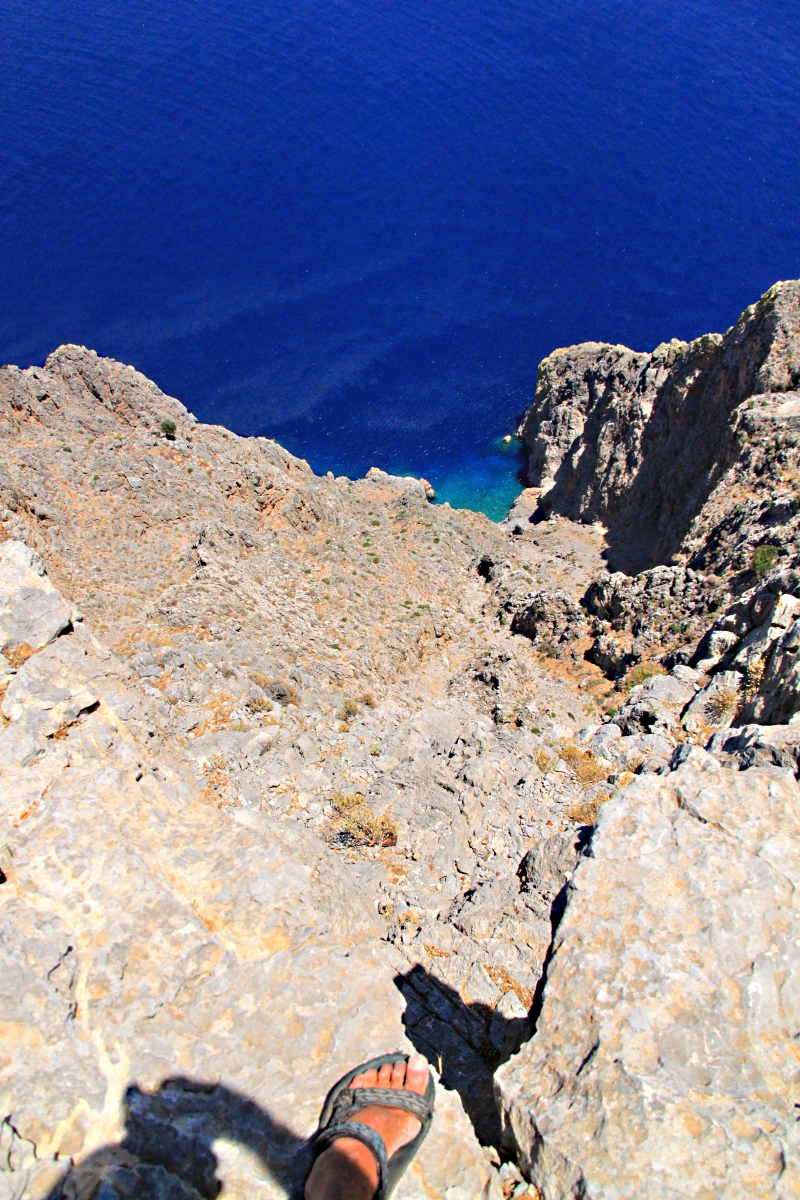
The views to the south are as dramatic as they come.  Just short of 500 metres straight down to a clichéd-blue sea.  In a strong, swirling wind I daren’t get too close for my ‘on the edge’ photos’.

Looking from the top to the start of the coast path, Agios Ioannis

Looking from the top to the start of the coast path, Agios Ioannis

No messing .... 494 metres straight down

No messing …. 494 metres straight down

The way back down is on the path, well marked by small cairns which I assiduously add to, but the in final few hundred feet there are many options and no clear marking.  It’s easy to pick the right option going down but turning round to try to locate the right route into the thin path going uphill is impossible.  I’m going to have to try it again before I go home.  It’s a matter of pride!

But isn’t that what it’s all about?  Satisfaction in achievement!

The welcome sight of Agios Ioannis, straightforward from here

The welcome sight of Agios Ioannis, straightforward from here

1  Alan Clark, a minister in Margaret Thatcher’s Government, rather than admit that he had lied to Parliament, said during the Matrix Churchill (Arms to Iraq) Trial (1991/92 ?) that he had been “economical with the actualité” , embellishing the phrase “economical with the truth” introduced by civil servant Sir Robert Armstrong in the ‘Spycatcher’ Trial in Australia in 1986.  Can you trust any of these guys??

2  This was intended as a reference back to the craic the night before BUT it’s amusing to Google the phrase, as explanations suggested for its etymology include: a wild Irish party; a strong down-river wind in Calcutta; and an obscure reference to Julio Inglesi and a lady of the night.

Posted in Greece, Mountains | Tagged , , , , , , , , , , , , , | 2 Comments

Tilos: traumatic changes and empty shells

If you get bored with the words and just want to look at the pictures, scroll down and click on the ones you want to see larger.  But there are a few more words at the end.

Norman Tebbit, one of the senior ministers in Margaret Thatcher’s much hated or much nostalged right wing government (depending on your political perspective)is famous for his advice to the unemployed, the economically-challenged in society, to ‘get on your bikes’.  History will remember him for this one phrase, liberally translated as:  GO SOMEWHERE ELSE.  BUGGER OFF! (reason for this diatribe another time)

There were not many bikes around in the mid-1950’s on Tilos but a whole community decided that there was no point in struggling on where they were and they left their settlement, the ‘capital’ of the island, en masse.  The main problem was lack of water.  For an agricultural society water is essential but therein lies the rub.  The society thrives , grows and makes more demands on water for crops and personal use …. just as the climate is changing and rainfall is getting less.

To put it in context, imagine the population of London deciding they had to leave because the problems of rising sea-levels breaching the Thames Barrier were just too much to cope with any longer … and Boris could do nothing except wax jocular.

Back to Tilos.  It’s a bit of a bummer really.  Communities located high up the mountainsides out of sight of the sea not because that was where the best agricultural land was so much as to avoid pillaging pirates who plagued the Aegean for centuries. As water levels dropped the terraced fields were nolonger viable agriculturally and famously (at least locally so) in the  mid 1950’s (1956 if I remember correctly) the remaining residents of Micro Horio on Tilos decided to leave.  They had had enough and left, reportedly taking their roofs with them.

That bit I think is a bit fanciful, the evidence on the ground doesn’t bear it out.  Most roofs were obviously made of soil on a lattice of timbers and brushwood – nothing to take with when you leave really.  My guess is that most of the roofs collapsed.  But leave, virtually overnight, they did and the very extensive remains are there to see as are the dried up, desiccated, ant-eaten trees and the nolonger-cropped terraced fields.

Another piece of folklore is also of doubtful provenance, that they all  moved down to the coast and Livadia.  The probability is that most of them moved to either North America or Australia along with millions of other Greeks escaping the dire economic austerity visited on them by the Second World War.

I walked to Micro Horio on Tuesday.  Not my first visit by any means.  It’s a kind of pilgrimage, a sort of respect for those who accepted and dealt with the trauma of a rogue elephant at the door.  It must have taken a lot of courage in the face of desperation.  Truth be told I find it fascinating walking the narrow alleys between the roofless small, thick-stone-walled houses.

There are no ghosts walking the streets but it takes little imagination to think of this place, built of stone on rock, teaming with life, large families spilling out of the tiny houses (by modern standards) for outdoor living.  Here and there communal olive presses, doubtless used for generations, still stand solid, too massive to move and of no use elsewhere even if they could be and so simply abandoned.

The main church is still maintained and two others are kept as historic monuments (more about which another time).  But the village is most famous now for its night club.  It’s not my scene (I’m old enough to not have a scene … or a bag) but apparently it kicks off about midnight every night and goes on until the small hours with free buses back to Livadia every hour or so, until about 05.30 at weekends in the summer. The thinking , brilliant in its simplicity, is that those who want to rave can do so in Micro Horio because there is no-one there to complain about the noise!!!!!!!!!!!!!

I have been to Micro Horio a number of times, outside rave-hours, and taken many photos but I still took more this visit.  This  is partly to record the changes with the passage of time (an excuse) but also because I suffer from RPS, Repetitive Photo Syndrome, and always think I can do better.

This time I climbed the mountain behind to get a different perspective.  Steep ascent, no footpath but very enjoyable despite the aggressive vegetation (more about which another time)..

A really good day.  Micro Horio is a must on Tilos though the walk up the mountain behind is a bit serious …. not a Sunday stroll.

Approaching Micro Horio on the footpath from Livadia

Approaching Micro Horio on the footpath from Livadia

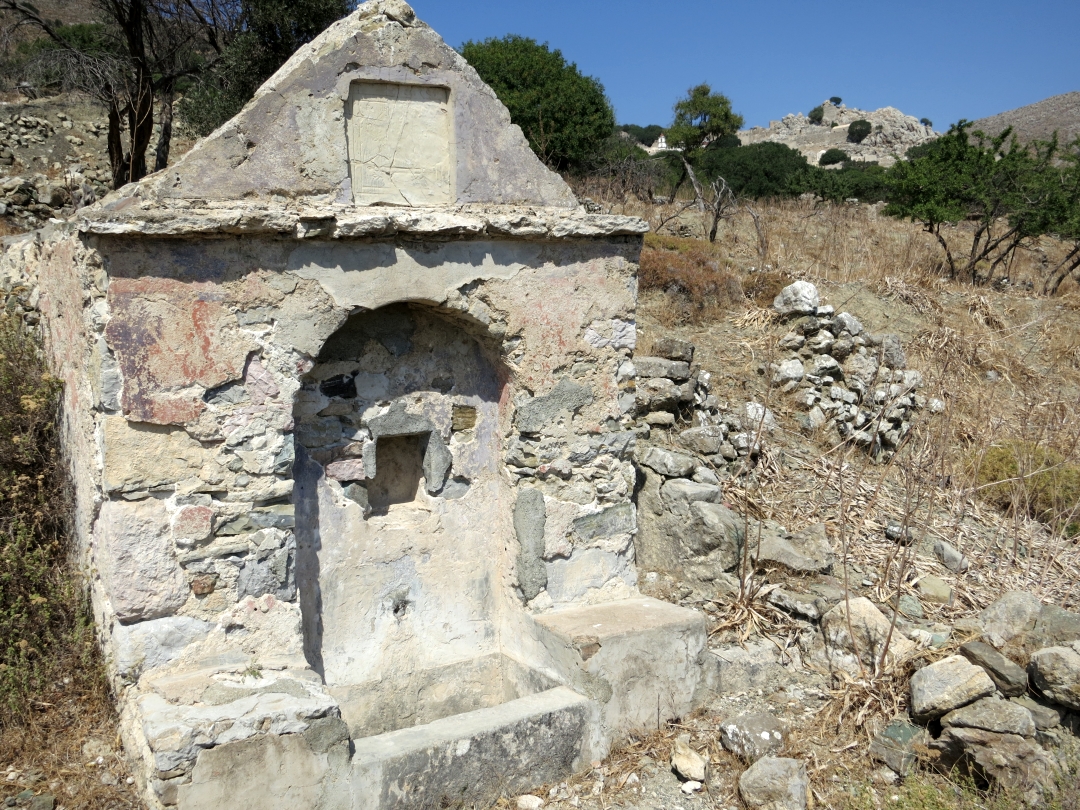
At one time obviously an important spring - hence the architecture - but long since dried up

At one time obviously an important spring – hence the architecture – but long since dried up

One of the many trees reduce to an ant-eaten stump by decades of drought ... with the village behind

One of the many trees reduce to an ant-eaten stump by decades of drought … with the village behind

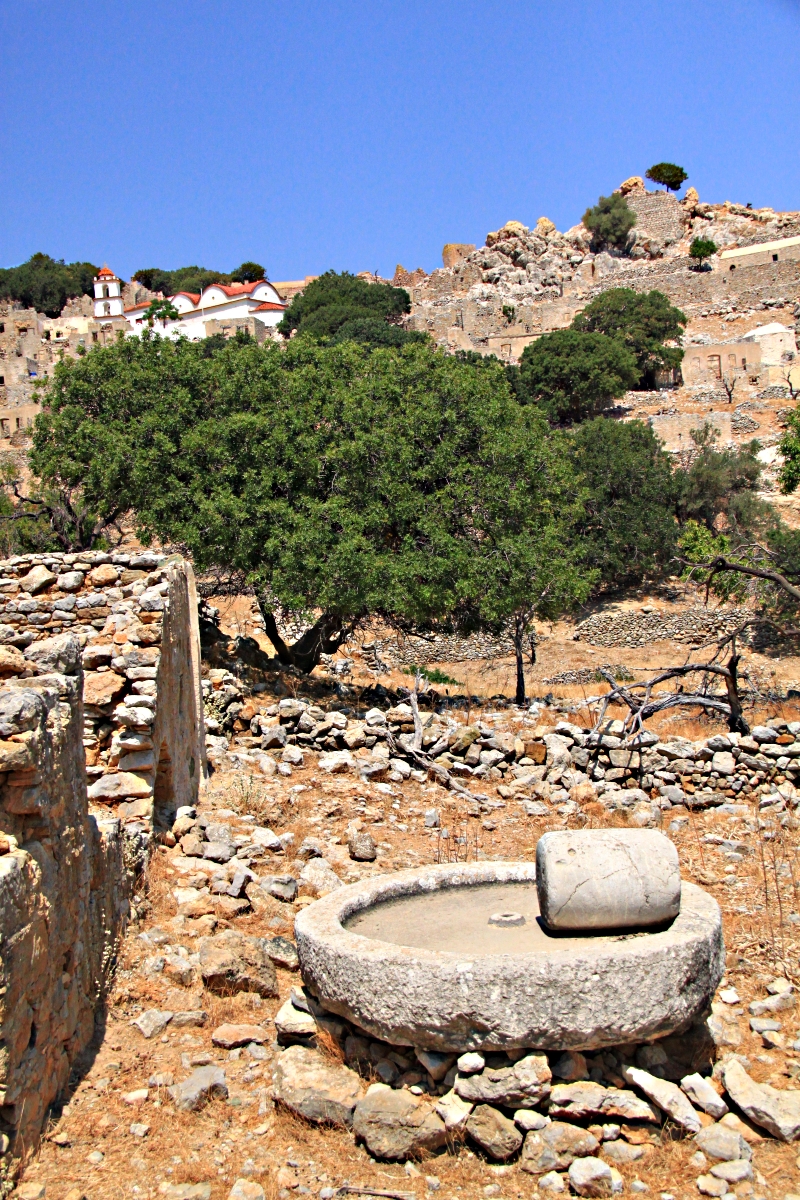
Olive press complete with grinding stone just left behind

Olive press complete with grinding stone just left behind

... and another.

… and another.

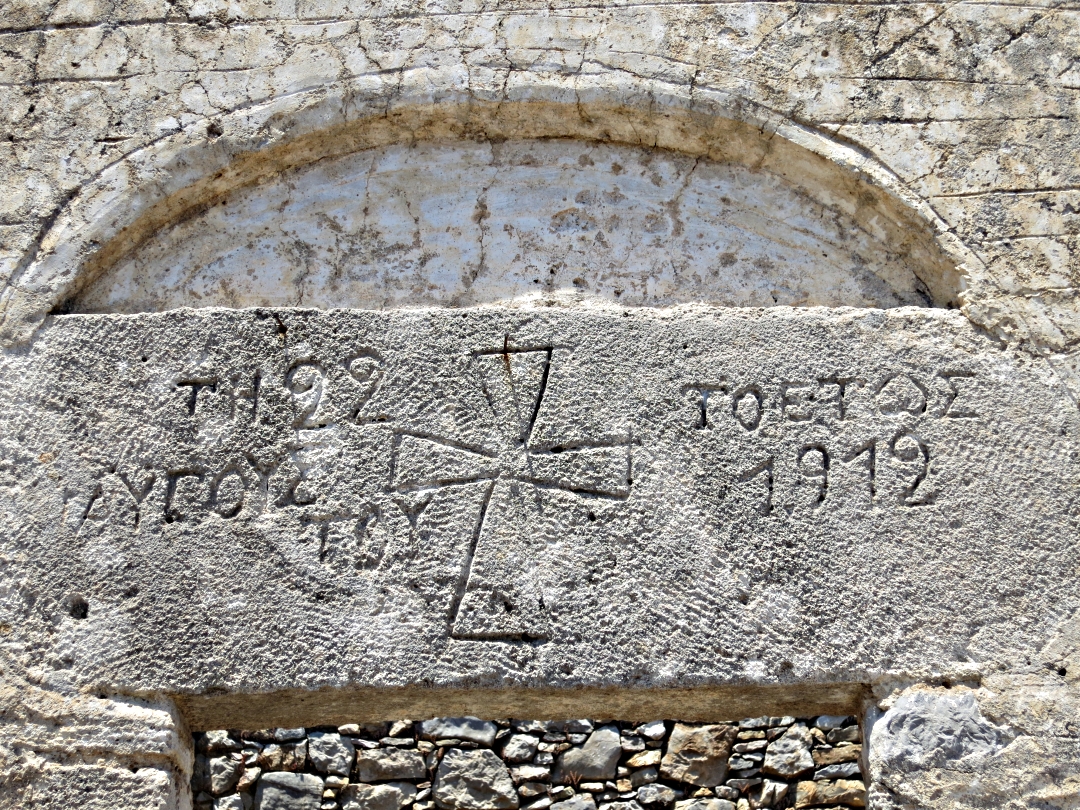
Some of the houses are modern by European standards this one built in dedicated on 22 August 1912, years after the slum house I was brought up in which was twice the size and had an outside loo

Some of the houses are modern by European standards this one  dedicated on 22 August 1912, years after the slum house I was brought up in which was twice the size and had its own outside loo.

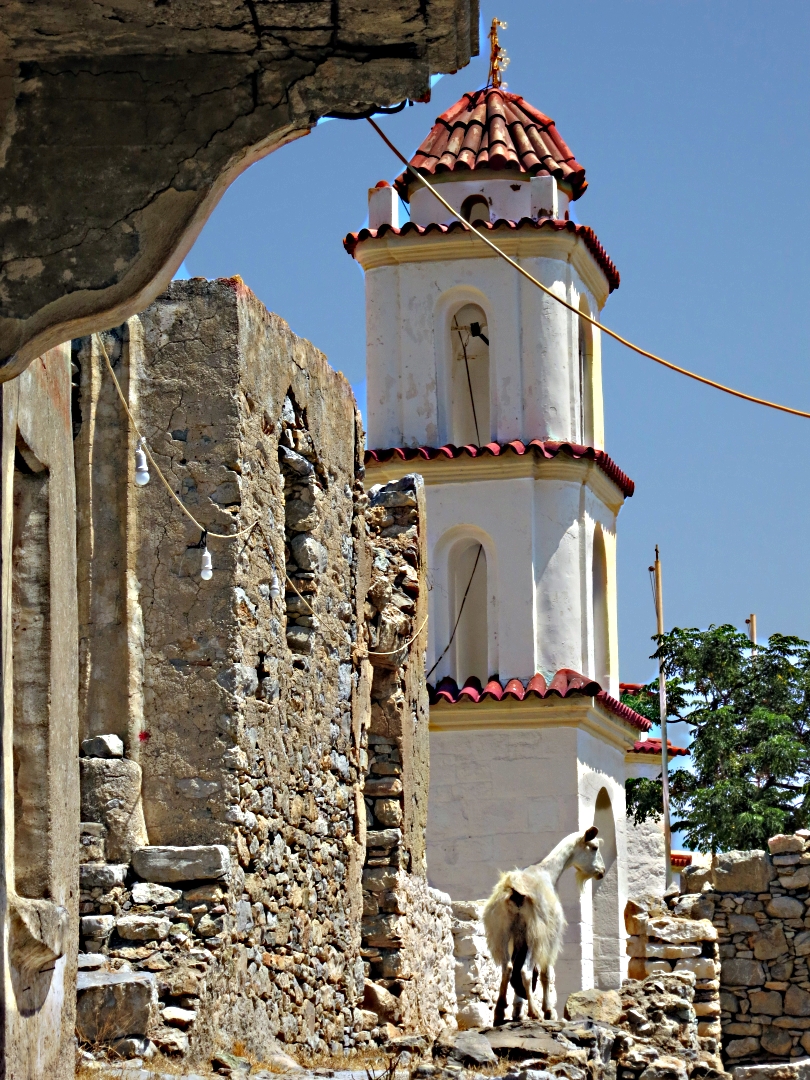
You are more likely to see goats than people wandering the alleys of Micro Horio

You are more likely to see goats than people wandering the alleys of Micro Horio

Looking across a series of roofless houses, stone walls survive but wooden roofs decay

Looking across a series of roofless houses, stone walls survive but wooden roofs decay

A somewhat grander house than many with windows, a front 'yard, and a 'fourno' (oven)

A somewhat grander house than many with windows, a front ‘yard, and a ‘fourno’ (oven)

The remains of the castle built by the Venetians on a rocky crag close to the top of the village

The remains of the castle built by the Venetians on a rocky crag close to the top of the village

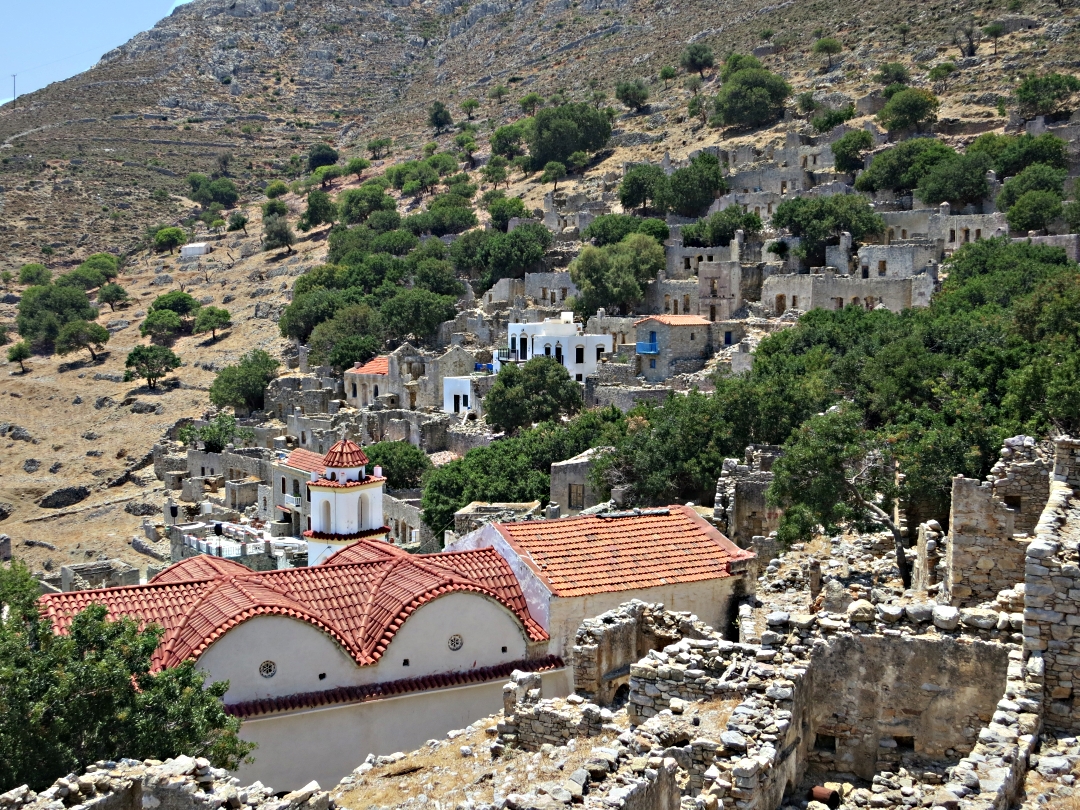
Looking from the castle across the main church to the night club area

Looking from the castle across the main church to the night club area

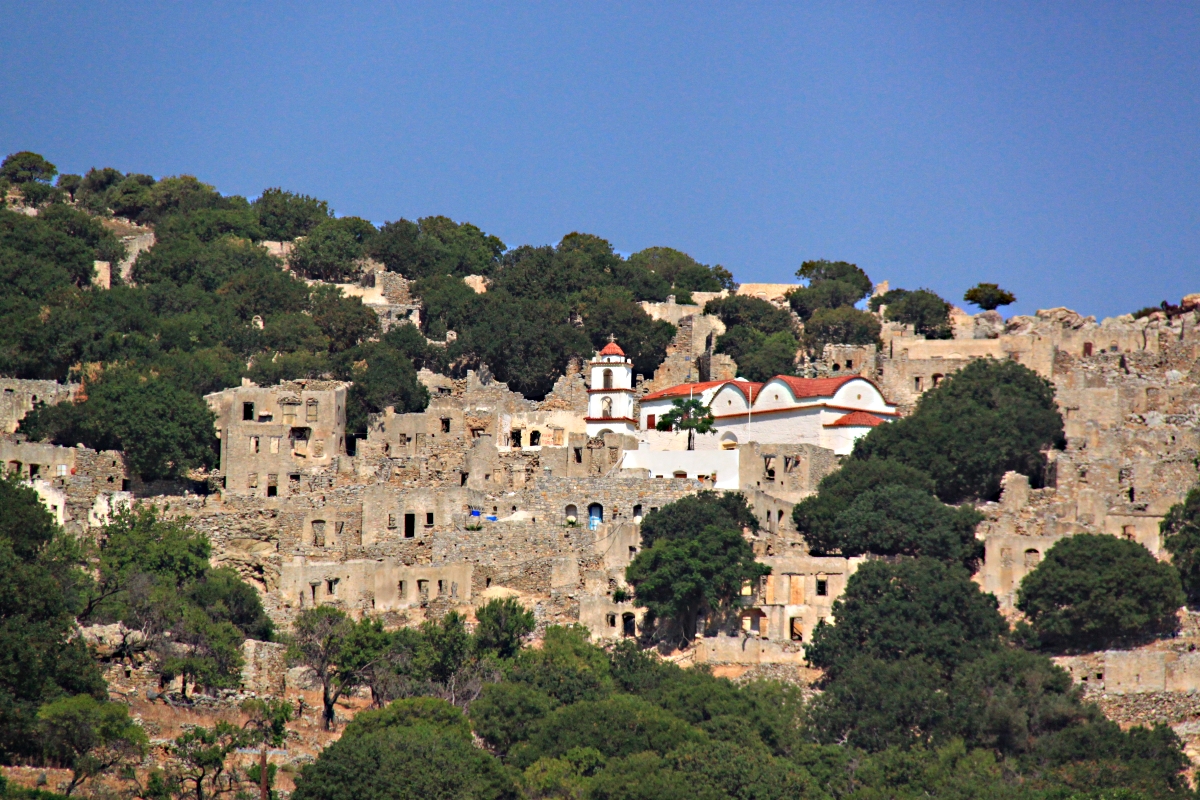
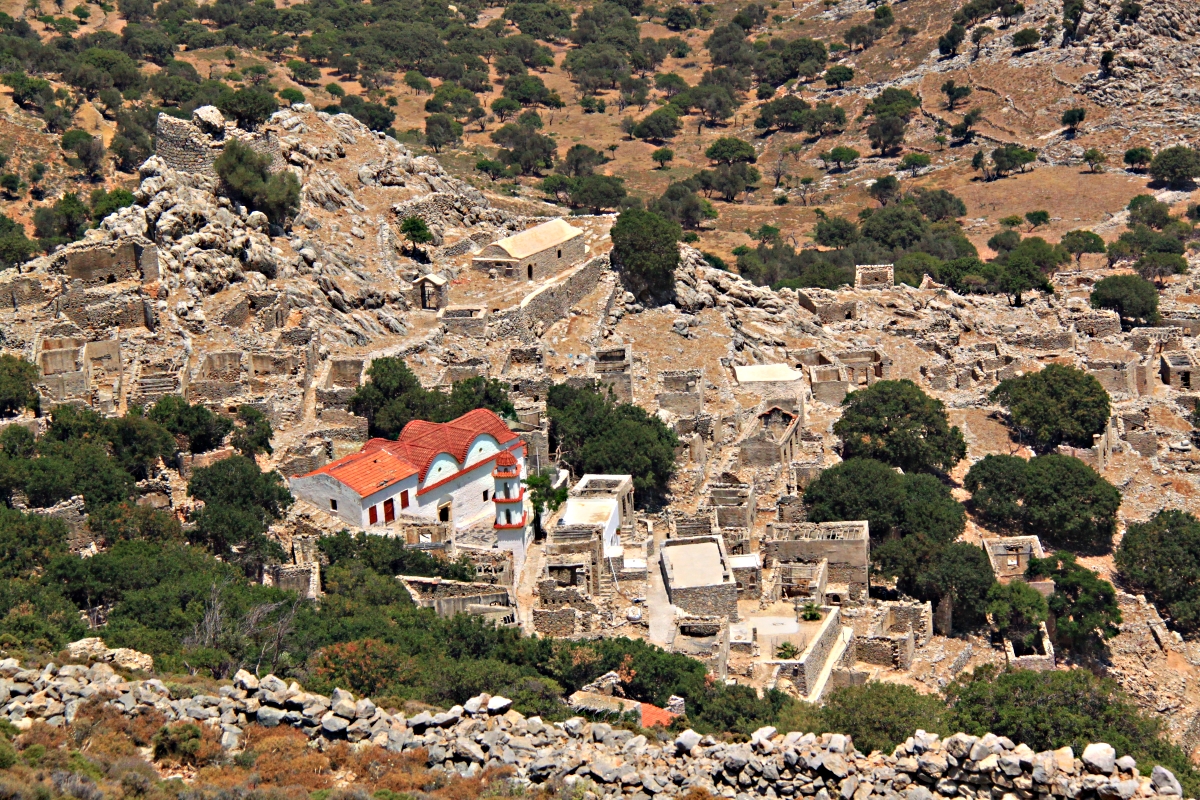
Zooming in on the village from the mountain behind

Zooming in on the village from the mountain behind

Apologies to those who only read the blog to check that I’m still alive and not dropped off some cliff somewhere.  I’m out doing stuff and photographing it rather than writing about it.  Hence the long gaps between posts compared to previous years.

Posted in Greece | Tagged , , , , , , , , , , , , , , , | Leave a comment

Tilos: rocky ramble and vrachophilia

No matter how rational we like to think we are we mostly make decisions based on subconscious, emotional inputs and then justify them with logic.  We reinforce the positives and diminish the negatives in so doing.

Thus it was on Monday, my first full day on Tilos.  It was significantly hotter than the heatwave conditions when I left home and I knew that I ought to be sensible and opt for a fairly short walk until I’m acclimatised to Aegean midsummer heat with the sun still high in the sky after the solstice.  Out of the various options with which I was familiar there was one which stood out in my mind, a walk across the island to Stavros beach.  I didn’t have to think about it much, the decision was made.

It fitted the main criteria in that it was relatively short and there was the prospect of a refreshing swim.  I pushed to the back of my mind the knowledge that there was no natural shade on the beach and the prospect of very little en-route.

It was a great walk and as I looked back on it I tried to work out why it was I knew without doubt that that was what I wanted to do.  First and foremost it got me into the mountains and away from the crowds, not that there is much resembling a  crowd on Tilos, especially this year when numbers seem to be down again thanks to the recession and media scaremongering about the Greek economy.  It also had an inbuilt swim on a pretty inaccessible and therefore secluded and deserted beach.

But high up there in the list of subconscious inputs to the decision was the fact that it is very rocky, a clincher for a self-confessed vrachophile (my invented word from the Greek βράχος – ‘vrachos’, rock and φίλος – ‘philo’ friend).

It didn’t disappoint.  The climb up to the ridge is partly through a steep-sided gorge and the drop down to the beach from the giant boulders at the top is rock all the way, in places involving scrambling.

The fact that there was no shade on the beach turned out not to be a problem.  From the large amount of winter flotsam and jetsam previous visitors had built a shelter with wooden beams and bamboo.   Perfect.  The late afternoon pull back up to the ridge in full sun had the prospect of finding a corner of shade in the boulders on the top.

When I was here for a month in 2010 I did the walk to Stavros fairly regularly in preference to walking the 10 minutes down to the ‘town beach’.  I dare say it will feature a number of times again this year.

First glimpse of the bay at Agios Stavros

First glimpse of the bay at Agios Stavros

On the edge of one of the steeper drops

On the edge of one of the steeper drops

Stavros beach with its very welcome shady shelter

Stavros beach with its very welcome shady shelter

The cluster of boulders on the ridge

The cluster of boulders on the ridge

Just one of them

Just one of them

Limestone pinnacles tower above the gorge

Limestone pinnacles tower above the gorge

The gorge narrows and the path passes close to one of them

The gorge narrows and the path passes close to one of them

x

Posted in Greece, Mountains | Tagged , , , , , , , , , , , , , | Leave a comment

Greece: art and about in Rhodes

My ferry from Rhodes to Tilos was at 18.00 so I had plenty of time for a leisurely wander around Rhodes Old Town with the camera, even after a sluggish start.  We have been wandering around the walled town at least once a year since we first came in Y2K and in 2010 I came several times on shopping trips from the smaller islands where I was staying for the summer or to meet people off flights so it is familiar and much photographed.  But it is so complex and ancient that there is always something new to take the interest.  The rest of this blog post is just images from the day.

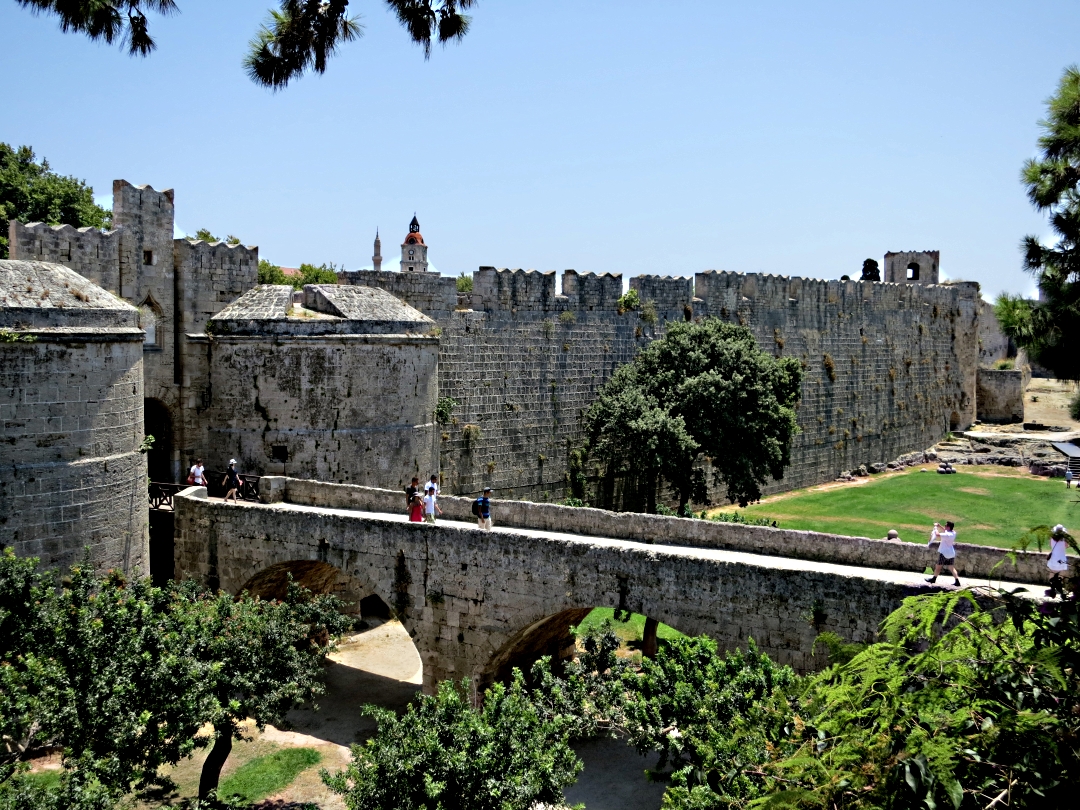
One of the main entrances to the walled city with typical Crusader crenellations

One of the main entrances to the walled city with typical Crusader crenellations

13Rhodes20w1766jpg

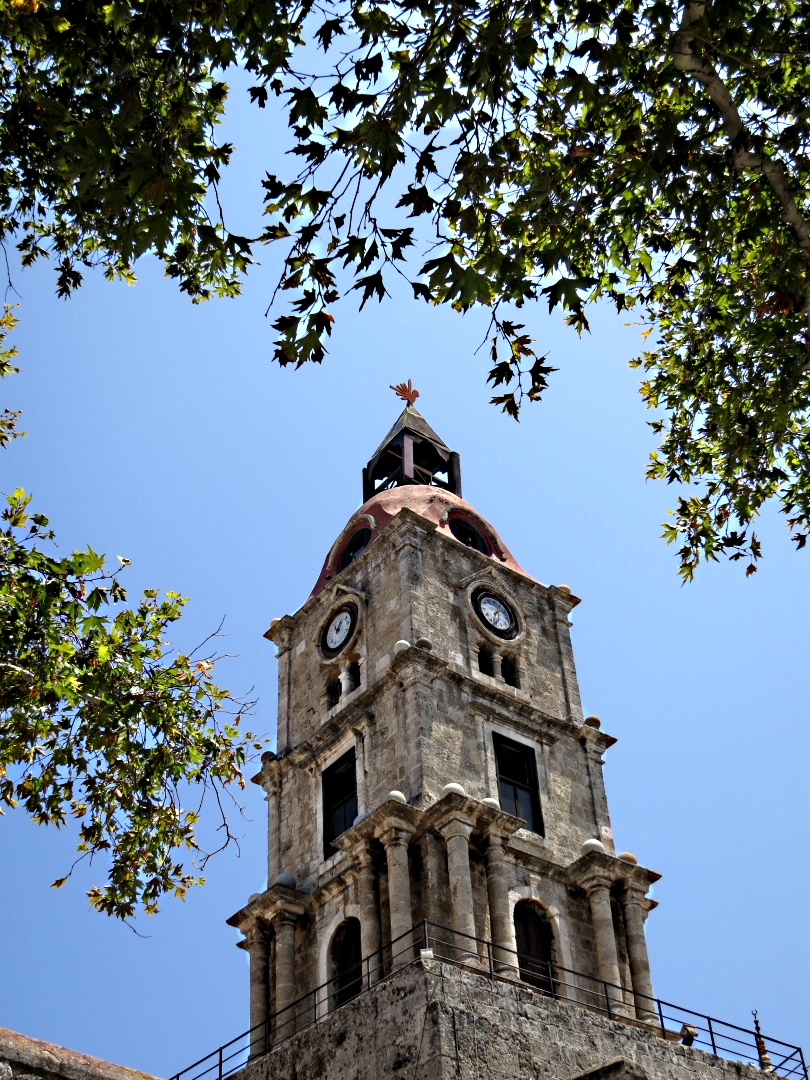
The ‘Roloi’ or clock tower at the top of the town

13Rhodes21w1773jpg

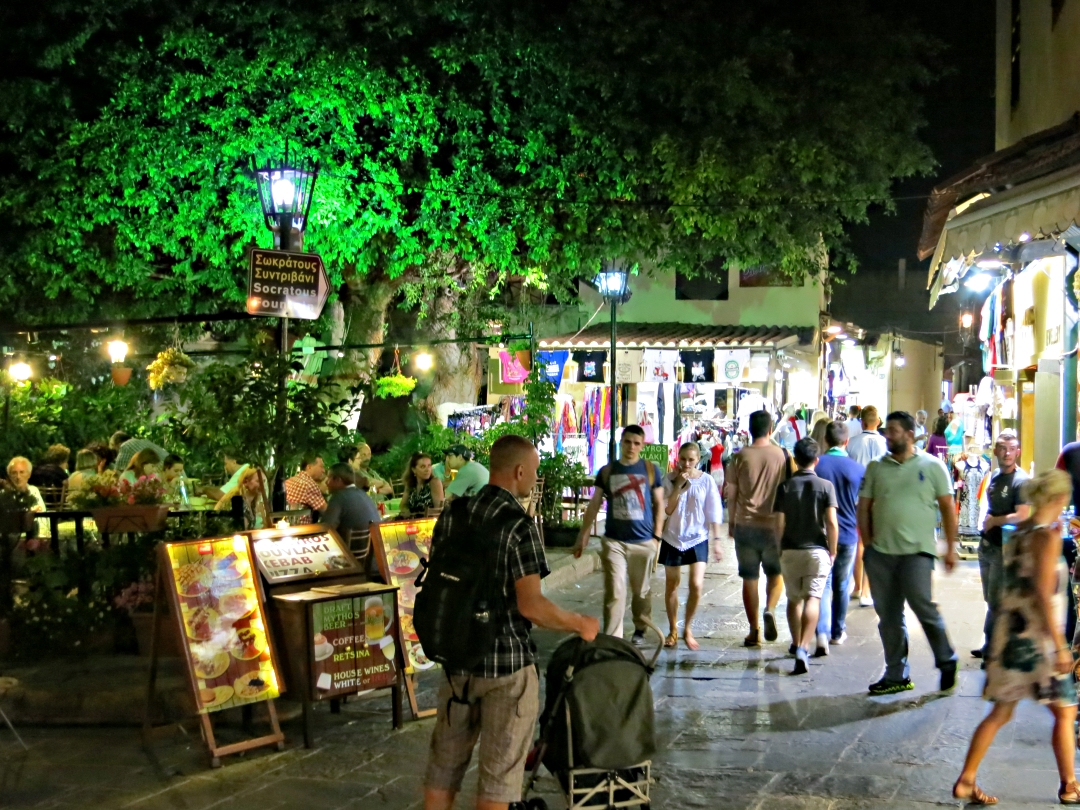
One of the buildings on Socrates Street with the Islamic crescent on top

13Rhodes22w1774jpg

The sign says that this building in Socrates Street dates back to the 14th Century, now a ‘traditional’ kafenion but closed on Sunday

13Rhodes23w1770jpg

The rough cobbled path up to the Roloi

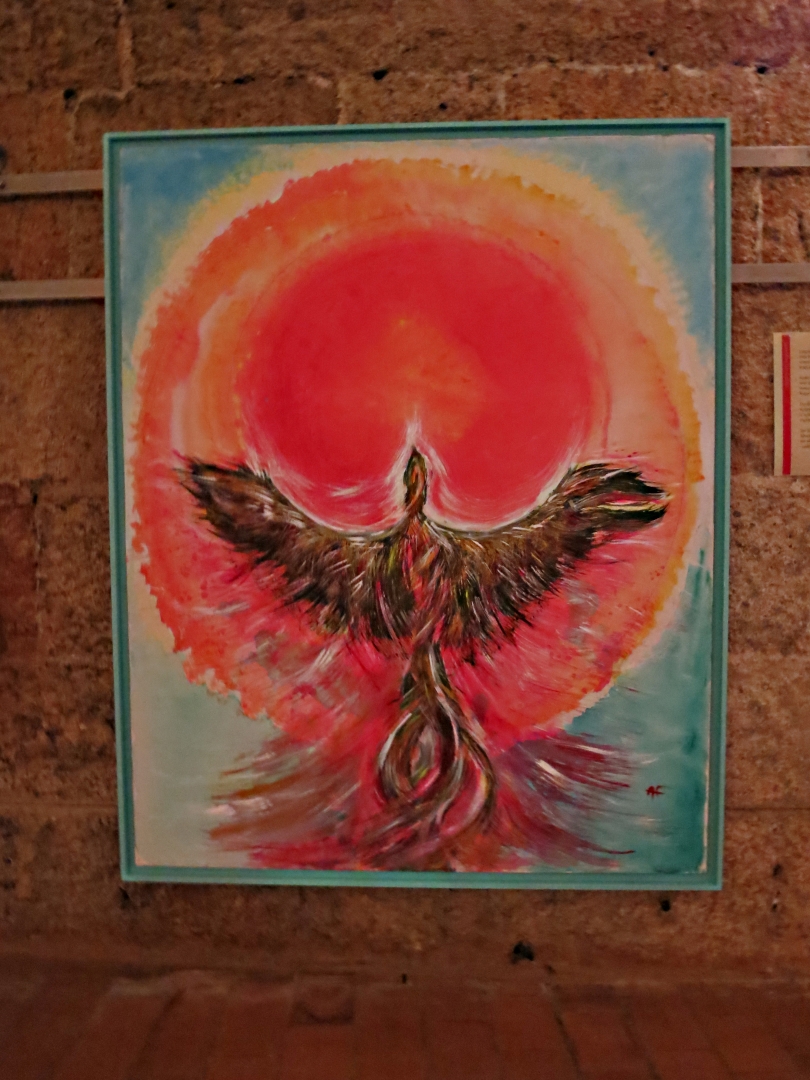
One of the paintings by Rozina Koroni-Steliou in an exhibition in the stone gate house

One of the paintings by Rozina Koroni-Steliou in an exhibition in the stone gate house

13Rhodes15w1755jpg

…very varied

13Rhodes16w1757jpg

… and graphic

Immediately outside the exhibition.  She eased what must have been cramped muscles by bowing deeply whenever anyone dropped coins into her box

Immediately outside the exhibition. She eased what must have been cramped muscles by bowing deeply whenever anyone dropped coins into her box

Eyeing a plane tree

Eyeing a plane tree

... which someone had spotted is actually a reindeer

… which someone had spotted is actually a reindeer

13Rhodes28w1793jpg

Cat and mouse chase

A stone owl keeps watch on the live pigeons in Socrates Square

A stone owl keeps watch on the live pigeons in Socrates Square

Sea horse fountan in another square

Sea horse fountain in another square

Heading out of the walled city

Heading out of the walled city

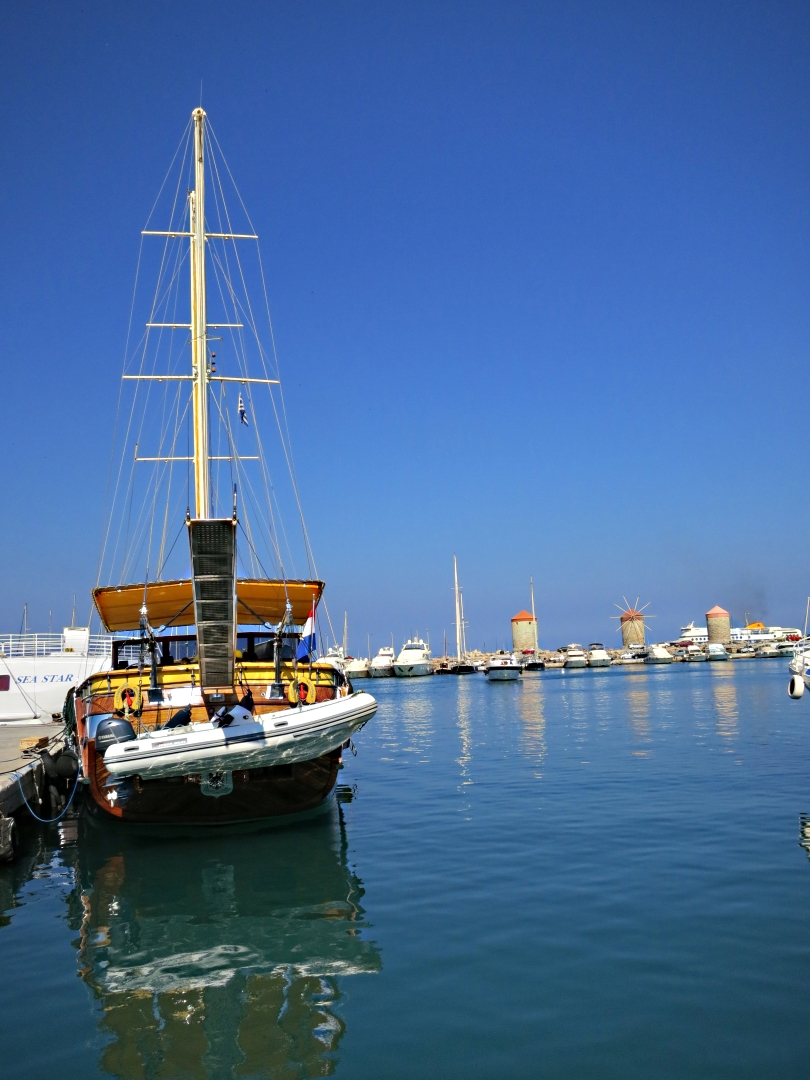
Reflecting in Mandraki Harbour

Reflecting in Mandraki Harbour

I’m now on Tilos but more about that again.

Posted in Art, Greece | Tagged , , , , , , , , , , , , | 2 Comments

Greece: to Rhodes

The flight to Rhodes was uneventful if, as all flights, tedious.  The taxi ride to the old town was, as ever, an opportunity to tune my ear to the language with the driver doing me the courtesy of speaking Greek the whole way but making sure that I was following him by enunciating clearly and repeating when necessary.  Even so my Greek is still very limited otherwise I would have told him that the Lions had just beaten the Wallabies thanks to a strong Welsh contingent in the team.

Having parked my bags in the hotel I hit the town, still vibrant at 23.00 in marked contrast with when I was here at the same hour in April when streets were near-deserted.

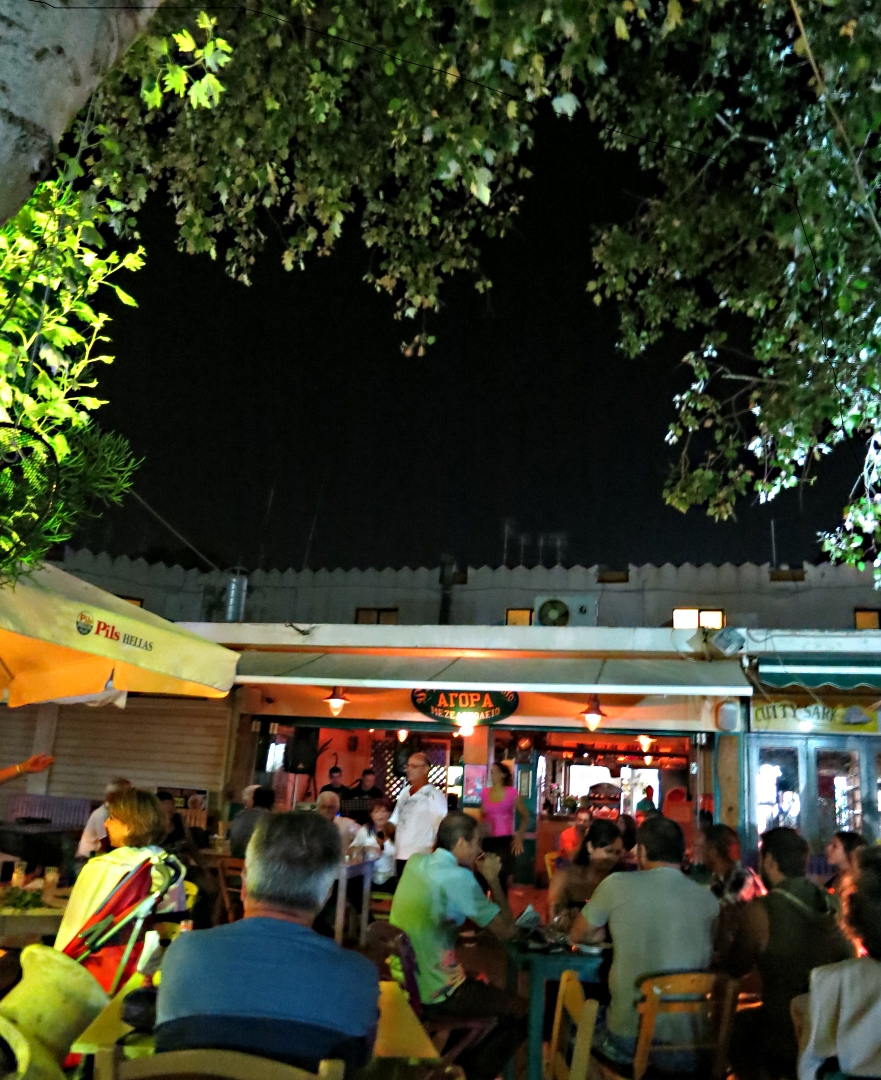
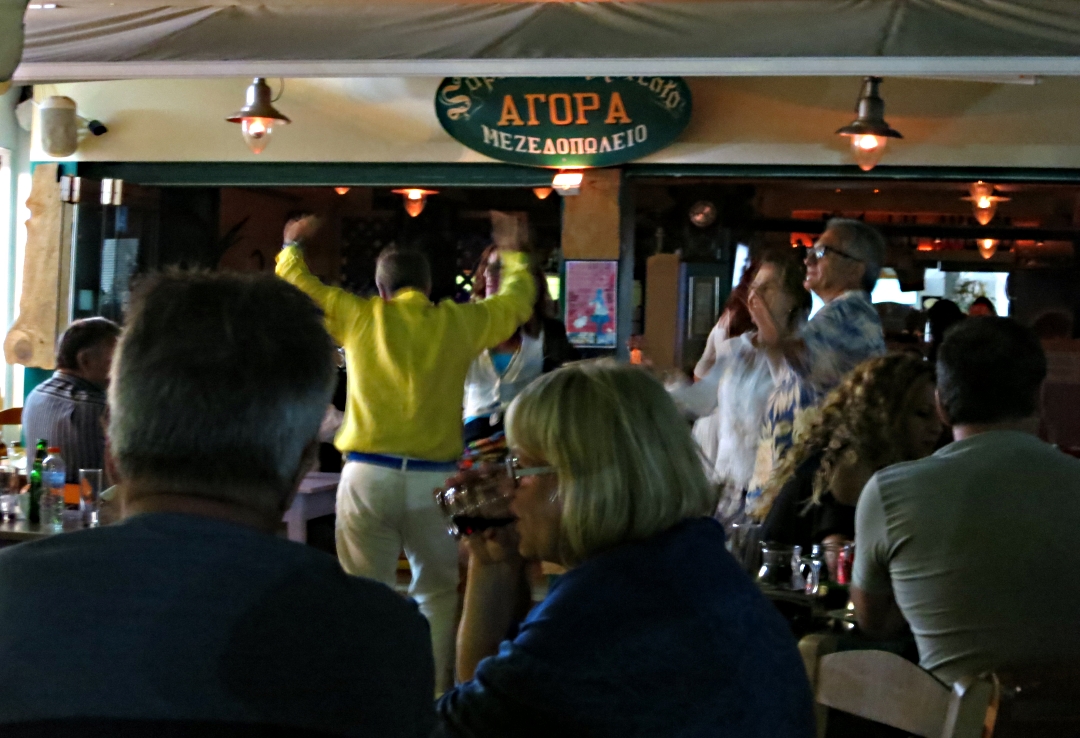
I ambled around the old walled town for a while but then, not in the mood for retail therapy, at close to midnight even less so than normal, I found my way into the old ‘New Agora’ for a drink.  The action was just getting going in an ouzeri with very good Greek music.  The not-very-young male singer moved from table to table singing passionately to the female customers, then a not-very-young female singer took over and roved her microphone from table to table getting the same female customers to take the lead in the singing.  Both were good.

Spontaneous dancing broke out and tables were moved aside to create a larger floor as the not-very-young dancers weaved around in intricate traditional Greek set pieces arms aloft or around each other’s shoulders.

One of the dancers, a man in a vivid yellow shirt, retaining his skill and style but fitness diminished and physique enlarged by good-living, retired back to his table wiping his brow and, accosting an itinerant rose-vendor, bought roses for all the females in the ouzeri.  After a while he bought the entire stock – a lot of roses – and tearing off the petals scattered them like confetti over the dancers and the singers and the waitresses.

Not a professional display, just a bunch of Greeks enjoying themselves.  And the odd onlooker.

The pace was slowing when I left at 01.30.

Close to midnight and crowds still eating and shopping

Close to midnight and crowds still eating and shopping

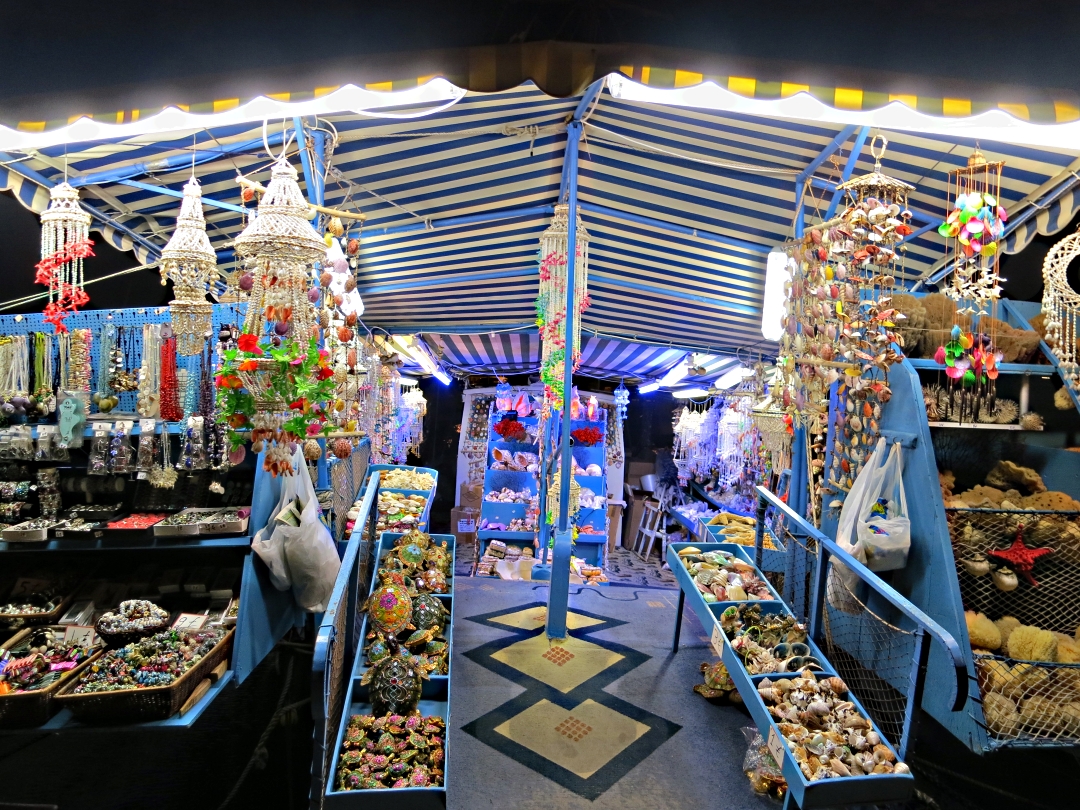
One of the boats moored in the harbour selling nothing but shells and associated sea-life

One of the boats moored in the harbour selling nothing but shells and associated sea-life

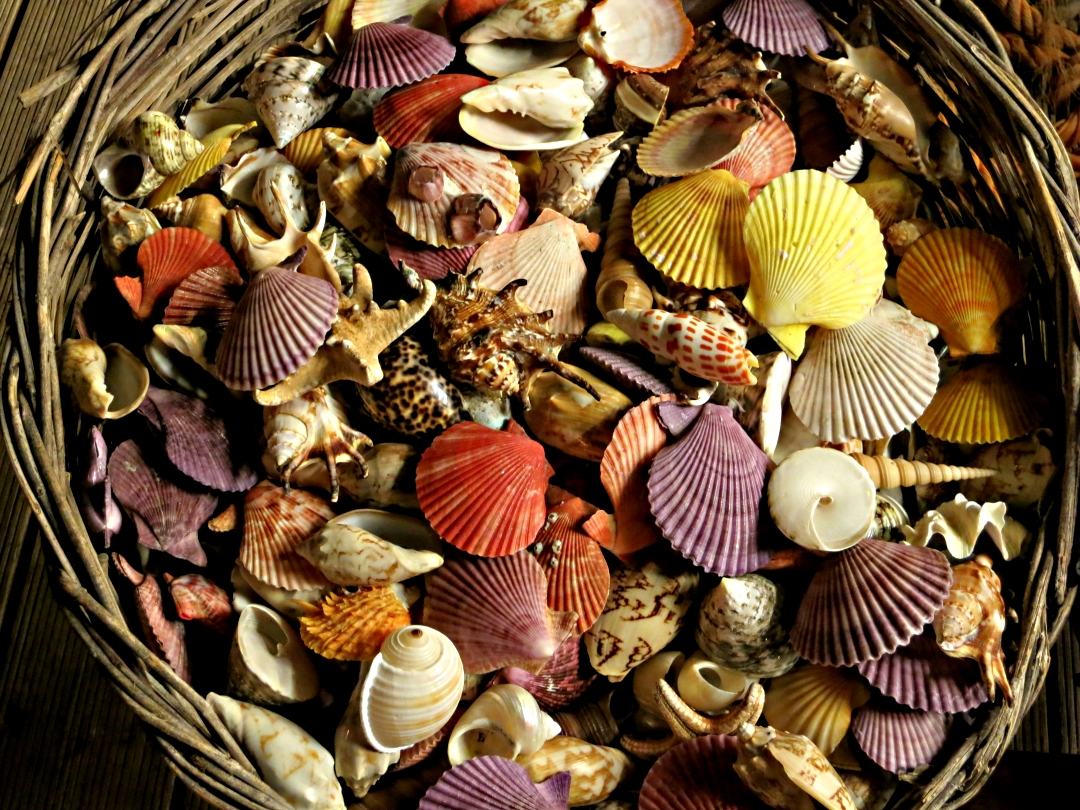
Basket of shells

Basket of shells

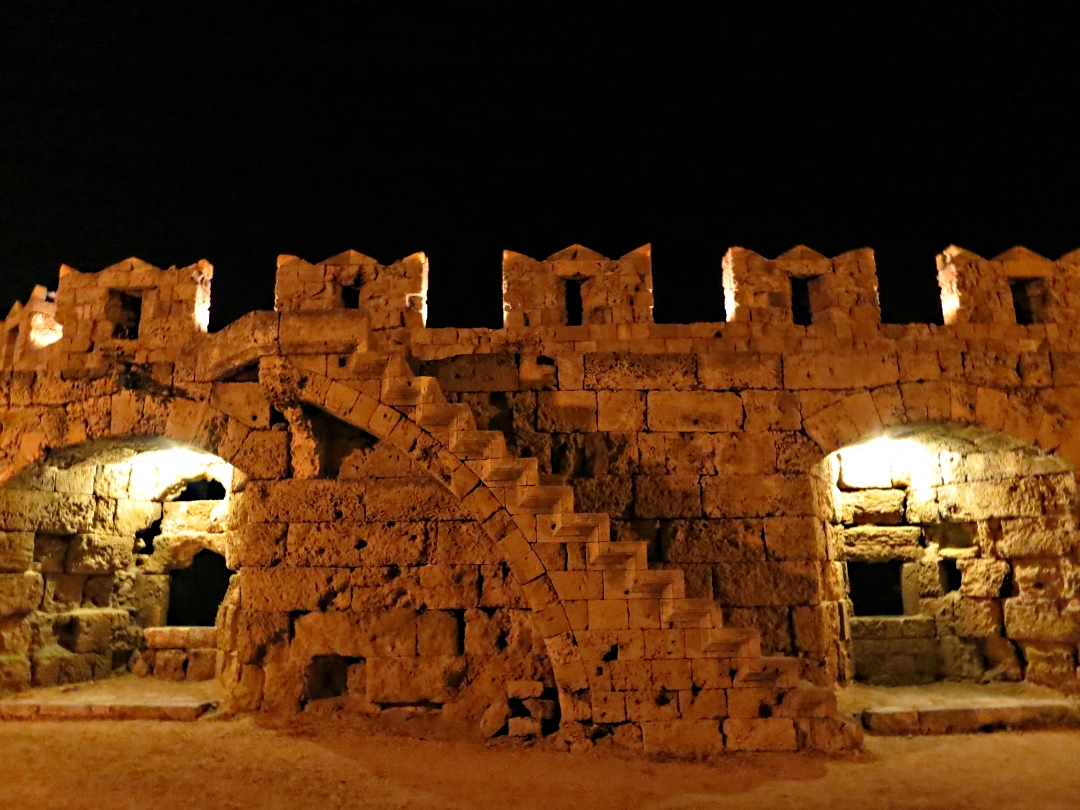
A small part of the old town walls

A small part of the old town walls

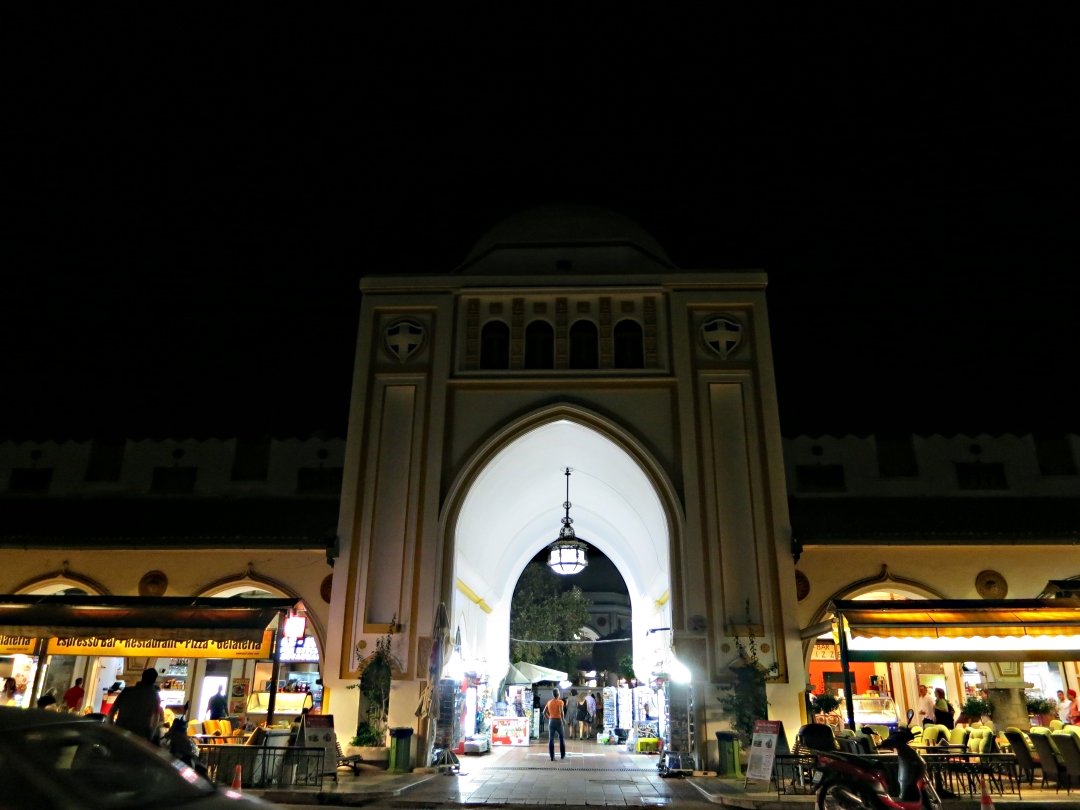
Entrance to the Agora from the harbour front

Entrance to the Agora from the harbour front

13Rhodes11w1746

Singer at the Agora Ouzeri

13Rhodes12w1742jpg

Spontaneous dancing breaks out

x

Posted in Greece | Tagged , , , , , , , , , , , , | Leave a comment

Greece: wild walks or soft fruit?

After a delayed spring and weeks of very indifferent weather it seems that I am about to leave Wales just as a heatwave is promised.

Health issue resolved, I have been hesitating to go back to Greece because of the higher prices of flights and accommodation now we are in High Summer.  However, I eventually tracked down affordable options and fly out on Saturday (6 July) for 3 weeks, staying on the small but mountainous Dodecanese island of Tilos.

Walking recently has been under leaden skies and I look forward to unbroken sunshine and baked, barren mountains.

The only regret is that I will be unable to harvest the very heavy crop of soft fruit, raspberries and blackcurrants in particular will be lost to the birds. I’m hopeful that hot, sunny weather forecast for Thursday afternoon and Friday will bring on the redcurrants sufficiently to harvest them before I go.  Swings and roundabouts.

To give a flavour of Tilos, below are a few photos below from previous visits.

Agios Andonis w

On the top of the highest mountain on Tilos to the tiny harbour of Agios Andonis

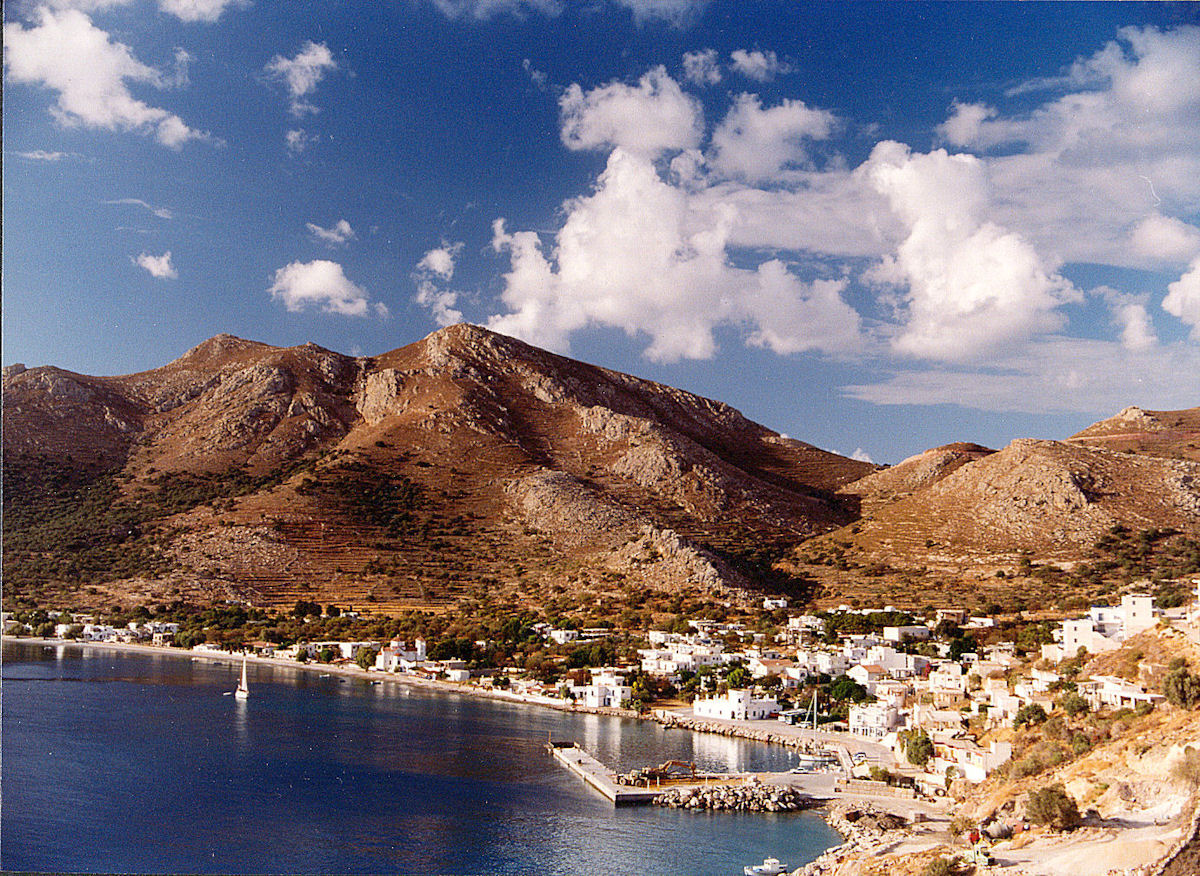
Looking down to Livadia, the largest settlement on Tilos

Looking down to Livadia, the largest settlement on the island

Tilos 25 Pr Ilias from Castle w

The mountain of Profitis Ilias seen from the mountain-top castle oposite

Peace and quiet on the seafront, Turkey across the water

Peace and quiet on the seafront, Turkey across the water

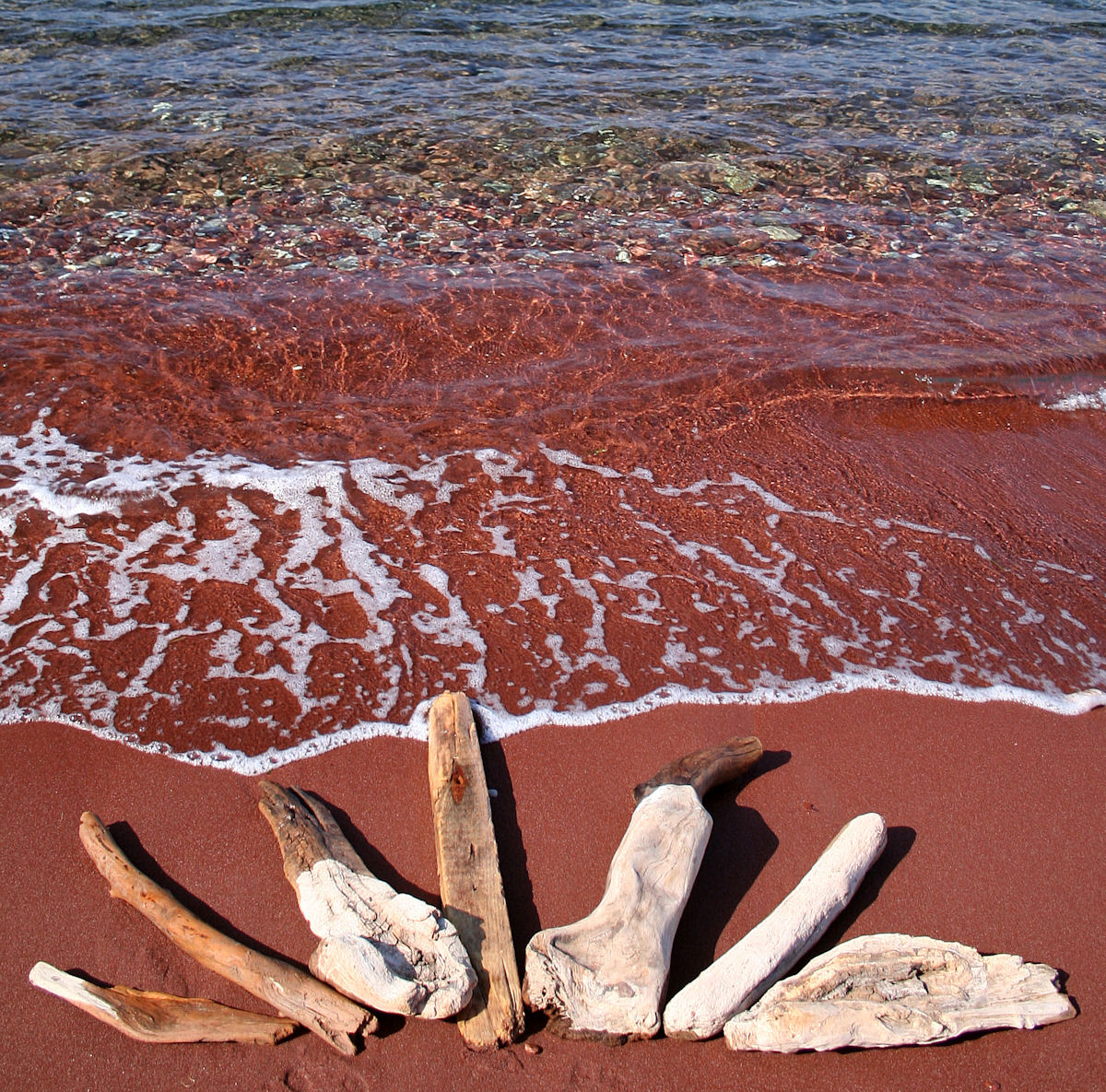
Being creative on the beach relieves the tedium of just lying in the sun

Being creative on the beach relieves the tedium of just lying in the sun

T07 red beach art 14w - 6362

…. and after a swim ….

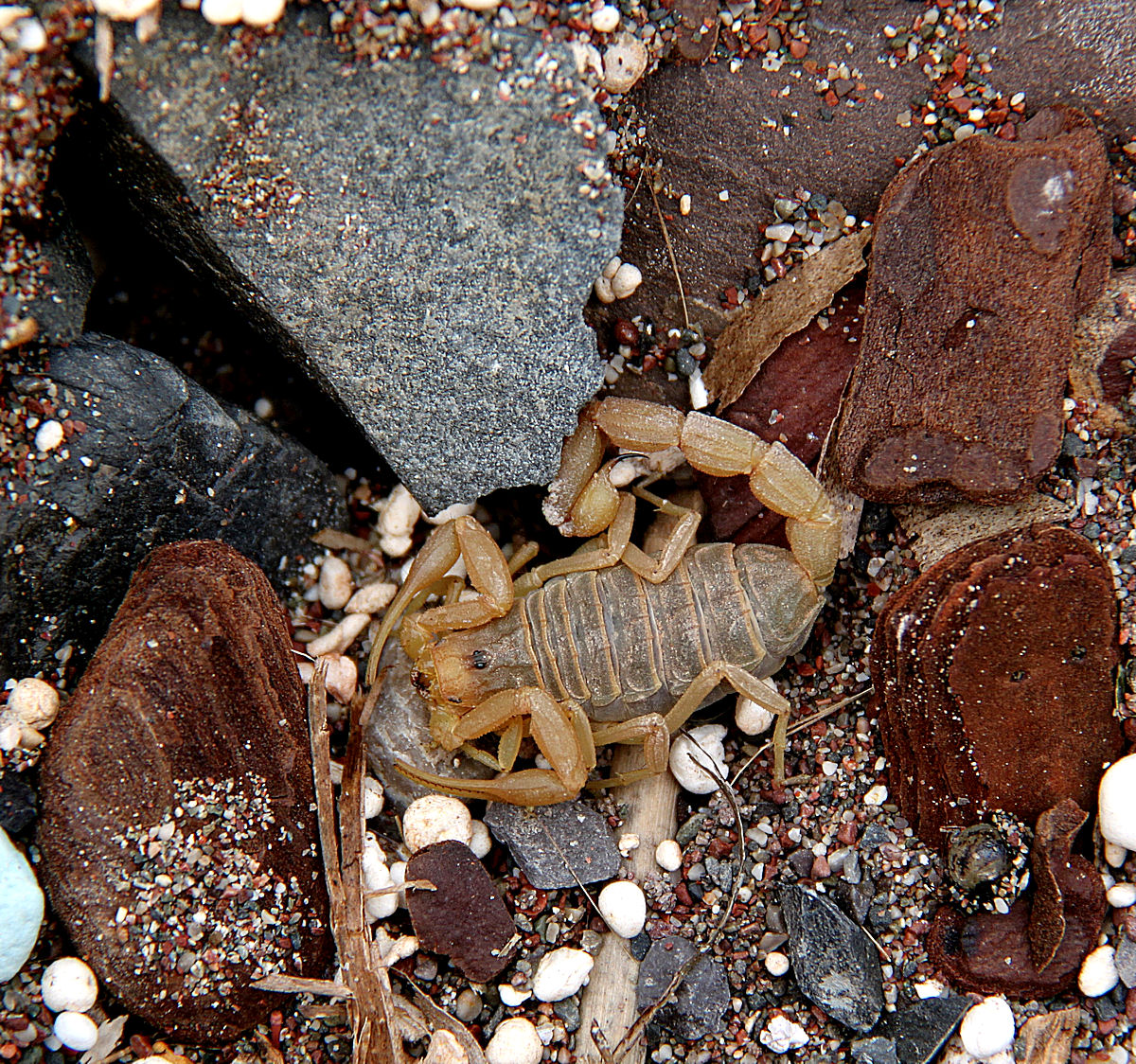
Dangerous creatures lurk behind the rocks

Dangerous creatures lurk behind the rocks

..... and under the stones

….. and under the stones

x

Posted in Art, Greece, Mountains | Tagged , , , , , , , , , , , | Leave a comment

Wales: wild wet walks

Sunday and I had to get out into the mountains.  All week I had been concentrating on construction work in the garden, laying paths and humping rocks around for landscaping and I needed to stretch my legs, get to the top of something. Despite the weather.

From Salisbury Terrace, a tiny settlement high on the western flank of the valley of the Afon Lwyd (the ‘Grey River’) I dropped down to the valley floor and then up the other side to follow the easternmost ridge of the South Wales Coalfield southwards.  The ridge-line, mostly at about 1,500 feet dropping down to the Folly Tower at about 1,000 feet, is the western boundary of the the southern tip of the Brecon Beacons National Park and the views are expansive.  But not on Sunday.  Low cloud was just above the ridge and as it swirled about, depositing alternately drizzle and light rain, visibility and clarity were considerably reduced.
The top of the path down to the valley floor, heading the ridge-line opposite

The top of the path down to the valley floor, heading for the ridge-line opposite

Crossing the Afon Lwyd

Crossing the Afon Lwyd

After the steepest part of the climb there is a sink hole at the side of the path, about 15 feet deep and always dry even in the wettest of conditions.  On the furthest side is a trickle of water which simply disappears underground through a loose jumble of rocks.  On Sunday the volume of flow was about equivalent to a domestic tap but, as on occasions when I’ve seen water gushing into it after prolonged heavy rainfall, no sign of any water body building up.  My guess is that it joins underground passages which are part of Ogof Draenen (Hawthorn Cave), a system which suddenly ‘went’ in October 1994 after years of unproductive digging of boulder-choked passage and now, at 66 kilometres, the second longest in the UK.  There is at least one other sink hole in this part of the mountain and I’m told there is a resurgence in the Afon Lwyd a few kilometres downstream.  Needless to say I stopped for another look.

The swallow-hole, water disappearing down the jumble of rocks at the back

The sink-hole, water disappearing down the jumble of rocks at the back

13Pontypool059w1667

Close up: water volume about that of a domestic tap

As I reached the ridge-top winds were light and sky larks were very much in evidence, singing their hearts out in defiance of the cloud and the wet.  It wasn’t a day for hanging about to admire the view but I didn’t hurry, I find it deeply satisfying being on the top of a mountain in conditions which keep everyone else indoors.  John Ruskin said: Ther is no such thing as bad weather, only different kinds of good weather”.  Making a practical point rather than commenting on the need for a positive attitude, it is often said in mountaineering circles that “there is no such thing as bad weather, only the wrong clothes”.  Thankfully I have all the right clothes for most conditions and the only attitude problem I have is leaving the mountain top and coming back down to street level.   I took my time.

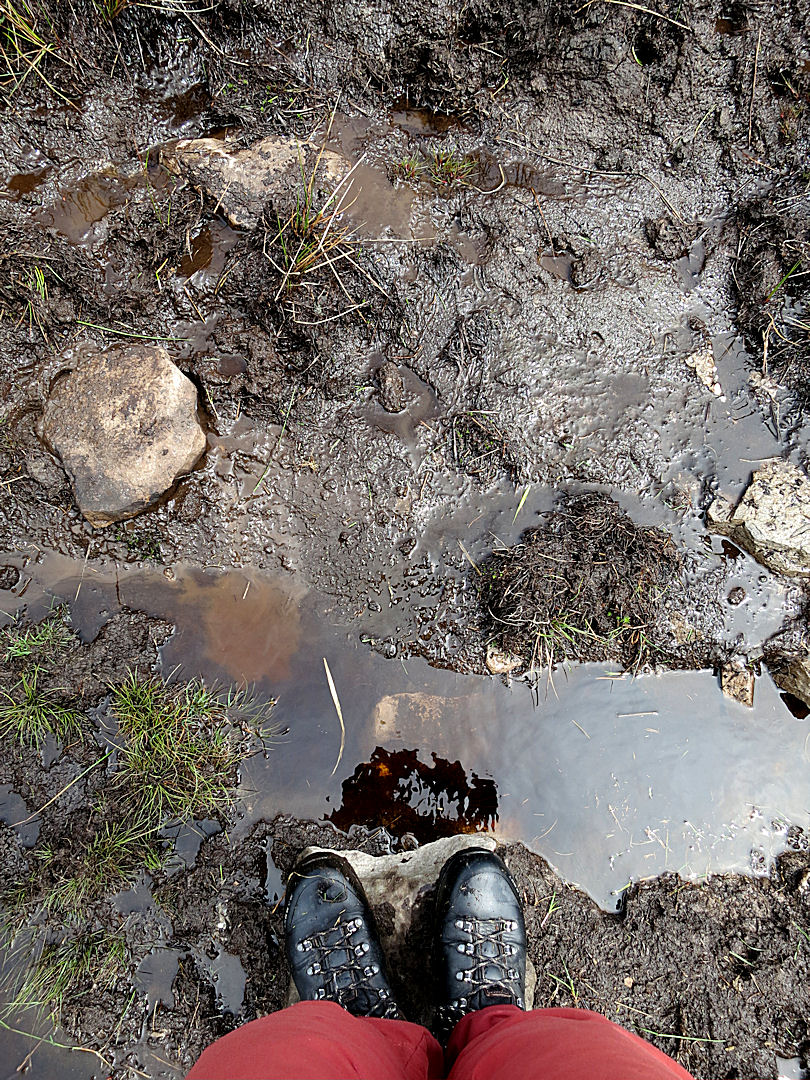
Not even the muddy bits put me off

Not even the muddy bits put me off.  Note trousers billowing in the strong wind

As I headed down the ridge I looked over my shoulder, a black cloud hanging with rain was chasing me southwards before eventually catching me up.  As it did so the wind picked up to gale force and the skylarks dived to the shelter of the low moorland vegetation.

Black cloud hanging with rain chasing me down the ridge.

Black cloud hanging with rain chasing me down the ridge.

Getting lower into the ridge-top fields, and to the west another rain shower chokes a side-valley

Getting lower into the ridge-top fields, and to the west another rain shower chokes a side-valley

In contrast seagulls, about 100 of them, took off to play in the squally wind accelerated by the venturi effect as it hit the ridge, eddying as its flow was distorted by trees and rock outcrops.  The gulls soared and swooped, wings motionless, borne up on rising air.  I love watching them and always wish I could fly my paraglider as effortlessly and in such gnarly conditions.  I have flown with kestrels but only in mellow conditions, paragliders stay in the bag in conditions like this.

Seagulls playing in the swirling wind

Seagulls playing in the swirling wind

As I reached the Folly Tower close to the end of the ridge the rain eased, just a few bursts drumming onto my cag, and a thin blue line appeared briefly over the Bristol Channel.   I dropped off the ridge, walked the couple of hundred metres back to the house and sat in the garden in the sunshine between whizzing clouds.

Brief glimpse of blue sky

Brief glimpse of blue sky

On another note, the health issue which precipitated my early return from Greece and prevented me returning at the beginning of June has been resolved.  Return visit to the hospital in 6 months. No further medical intervention required in the meantime.  A relief.

Now I’m checking out options for going back to Greece.  The original plan spanned two months so is nolonger viable but I’m looking at alternative itineraries.  One problem is that I will be travelling in ‘High Season’ with correspondingly high prices for accommodation.  It may be that I decide to stay at home and do more wild walking in Wales until I return to Greece at the end of August (already planned and booked).

Posted in Grey Britain, Mountains, Pontypool, Wales | Tagged , , , , , , , , , , , | 1 Comment

No wild walks in Greece: taking a positive view.

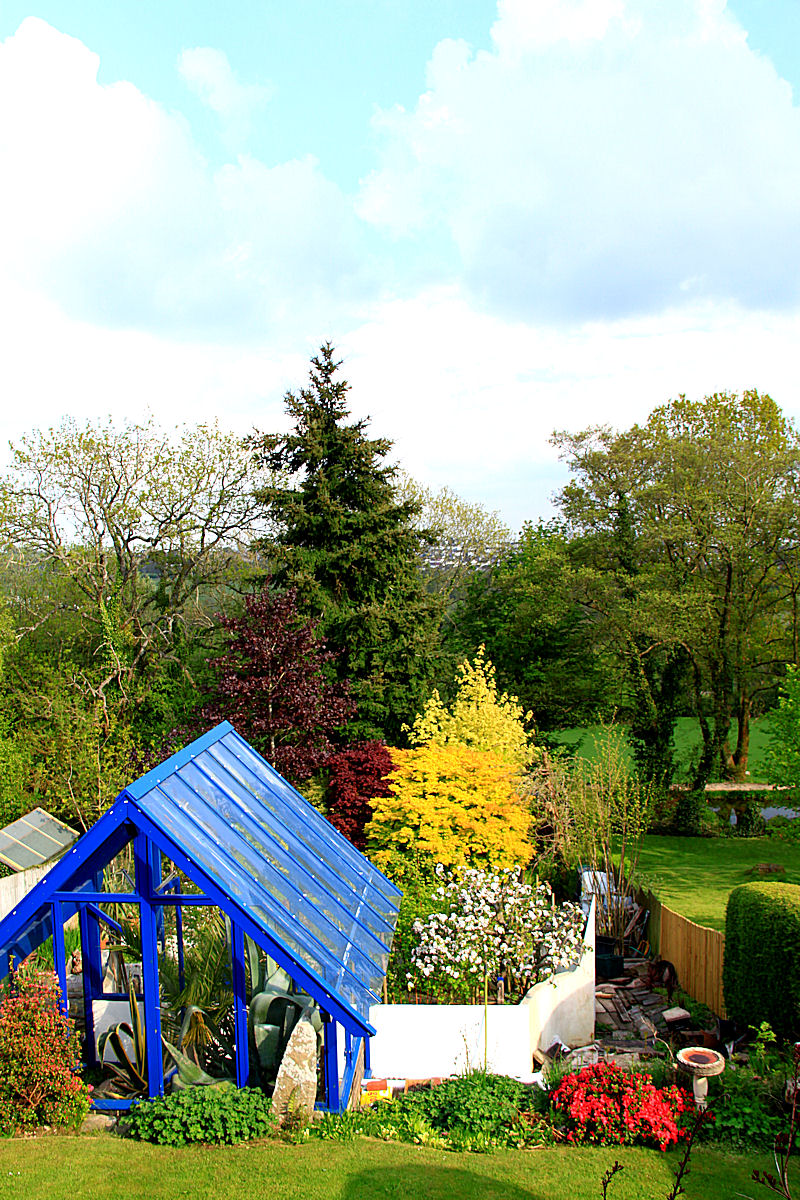
One of the inevitable consequences of spending the last three summers trekking in Greece has been that the garden has been neglected.  It’s about ¼ acre, a lot to neglect.   

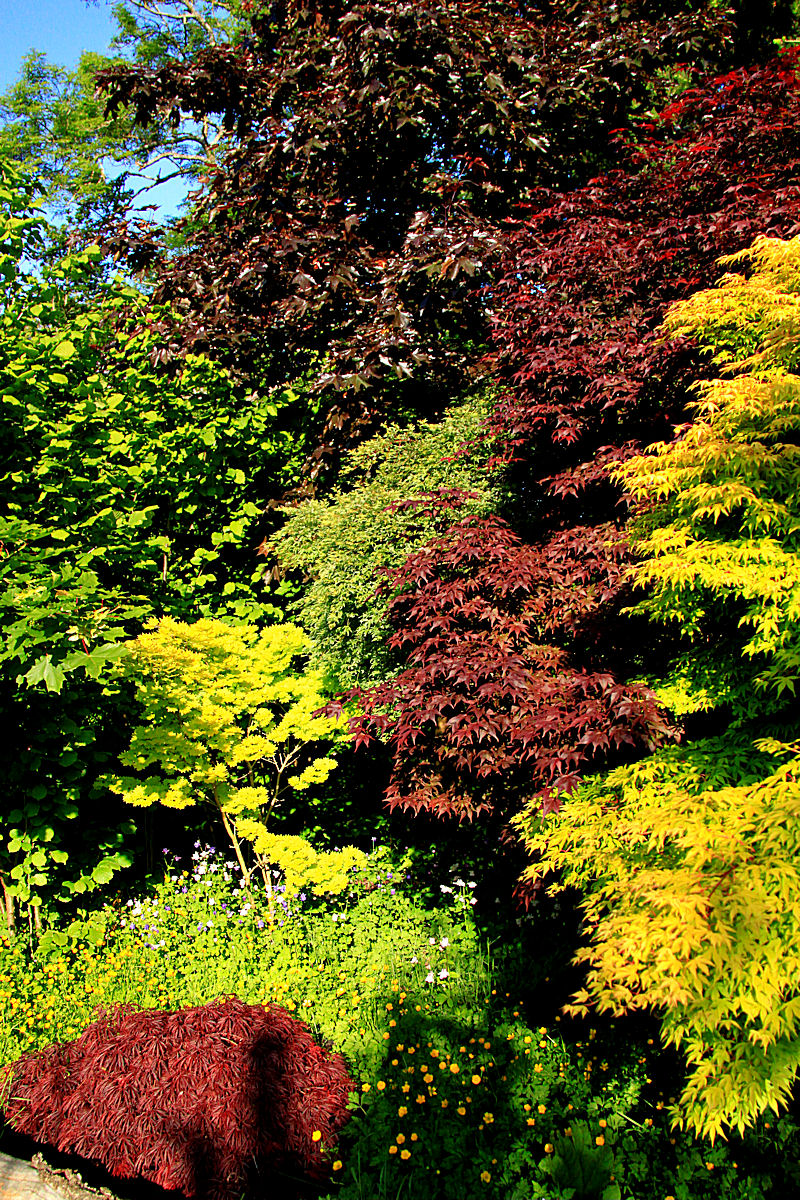
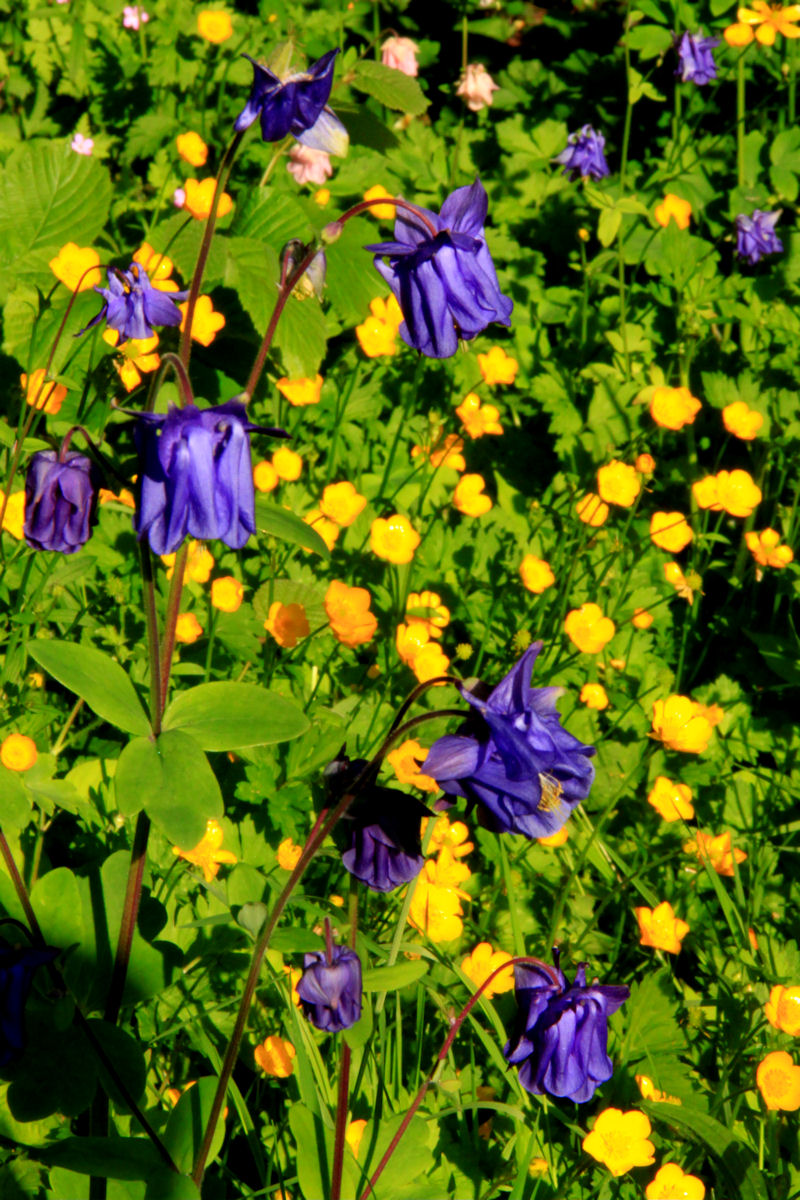
Many people living nearby have moved as they got older, unable to manage the upkeep, especially as neighbouring houses are on a hillside with a fair old slope.  Not wanting to move, some years ago I started a programme to reduce the amount of maintenance required in the garden. First step was to plant the bottom with a variety of acers to give colour and inhibit vegetation underneath.  One of the pleasing things about being home this year has been to see how effective that strategy is proving to be.  A micro ‘acer glade’ with understory of wild flowers.

Looking towards the acer planting from the balcony

Looking towards the acer planting from the balcony

13CherryHinton009w9890

A closer view of one side of the acer garden

13CherryHinton010w9893

Understorey of Aquilegia vulgaris (a species of columbine) and buttercups

I had turned the middle section of the garden into a series of stone terraces for vegetables and a walled fruit garden.  For the last 3 years I have been planting only winter veg as I wasn’t around to harvest anything in the summer.  Now I can plant summer veg as well. Looking forward to courgettes, French beans, tomatoes, lettuce and the rest.

Unfortunately I have not been here to harvest the soft fruit and so for 3 years raspberries, strawberries, gooseberries, blueberries, redcurrants, blackcurrants have all gone to waste.  This year looks like being a heavy crop, probably a response to the longer than usual winter and one of the coldest springs on record.  My freezer will be bursting at the seams …. as long as I can keep the birds off.

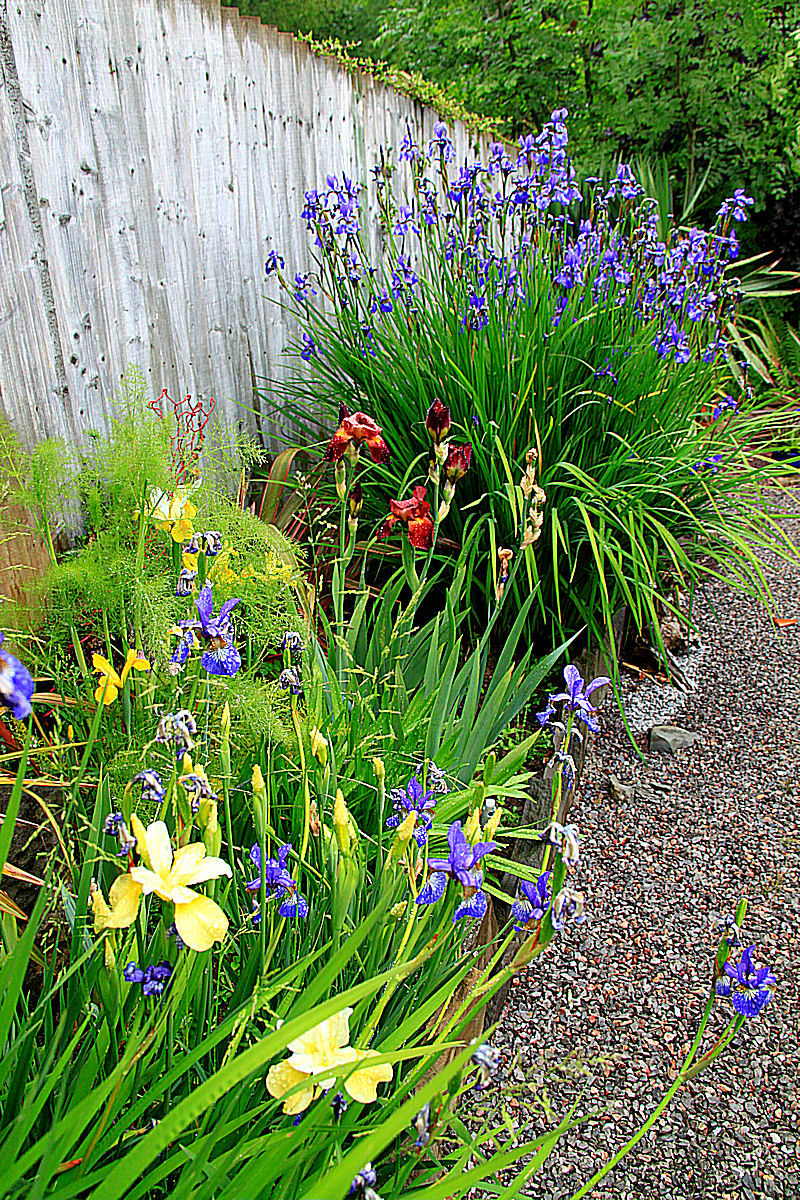
I have also missed the flowering of perennials in the borders.  Not so this year, they are quite spectacular.  It has been especially satisfying to see the variety of irises which I’m gradually accumulating.

Looking down the iris bed alongside a new gravel path

Looking down the iris bed alongside a new gravel path

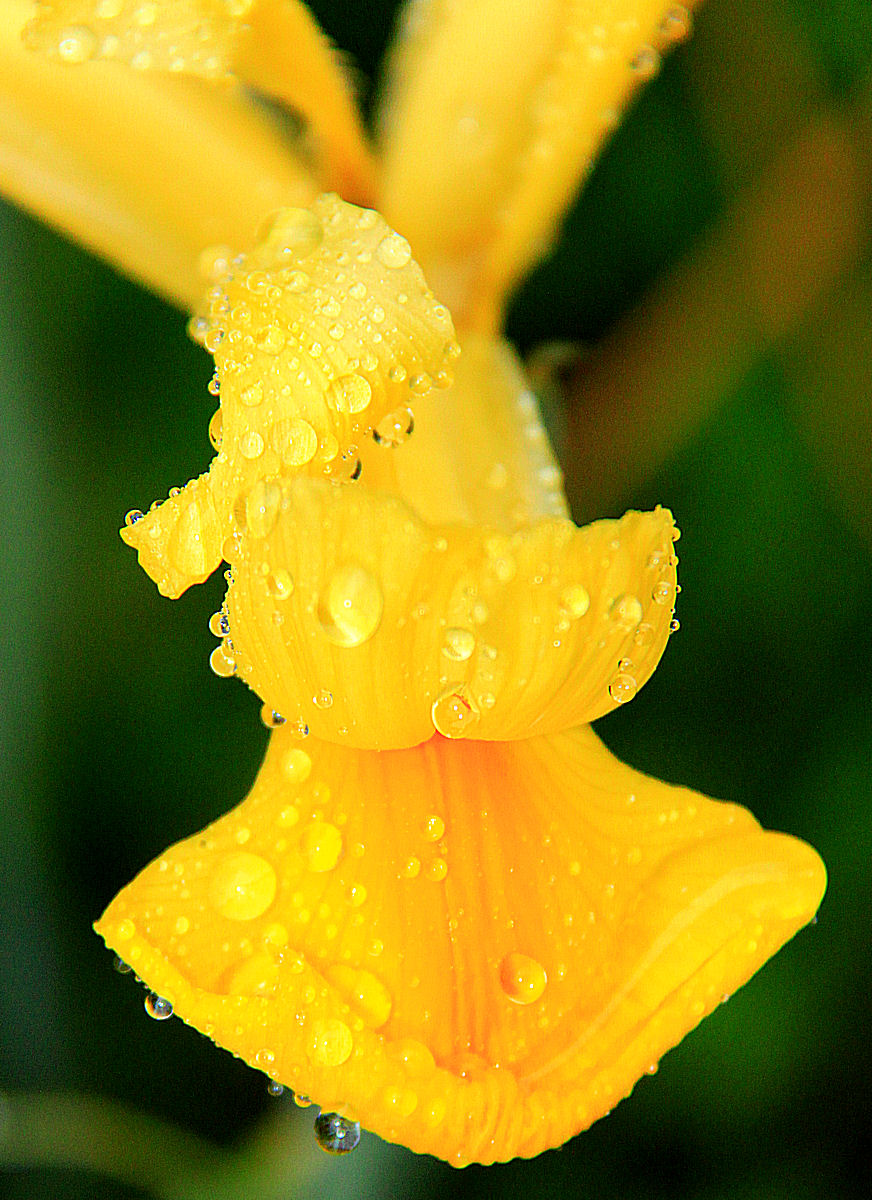
Even on a gloomy, wet day the iris's are spectacularly coloured

Even on a gloomy, wet day the irises are spectacularly coloured

13CherryHinton012w9906

Dutch irises are going rampant

13CherryHinton013w9907

Some colours are especially bright

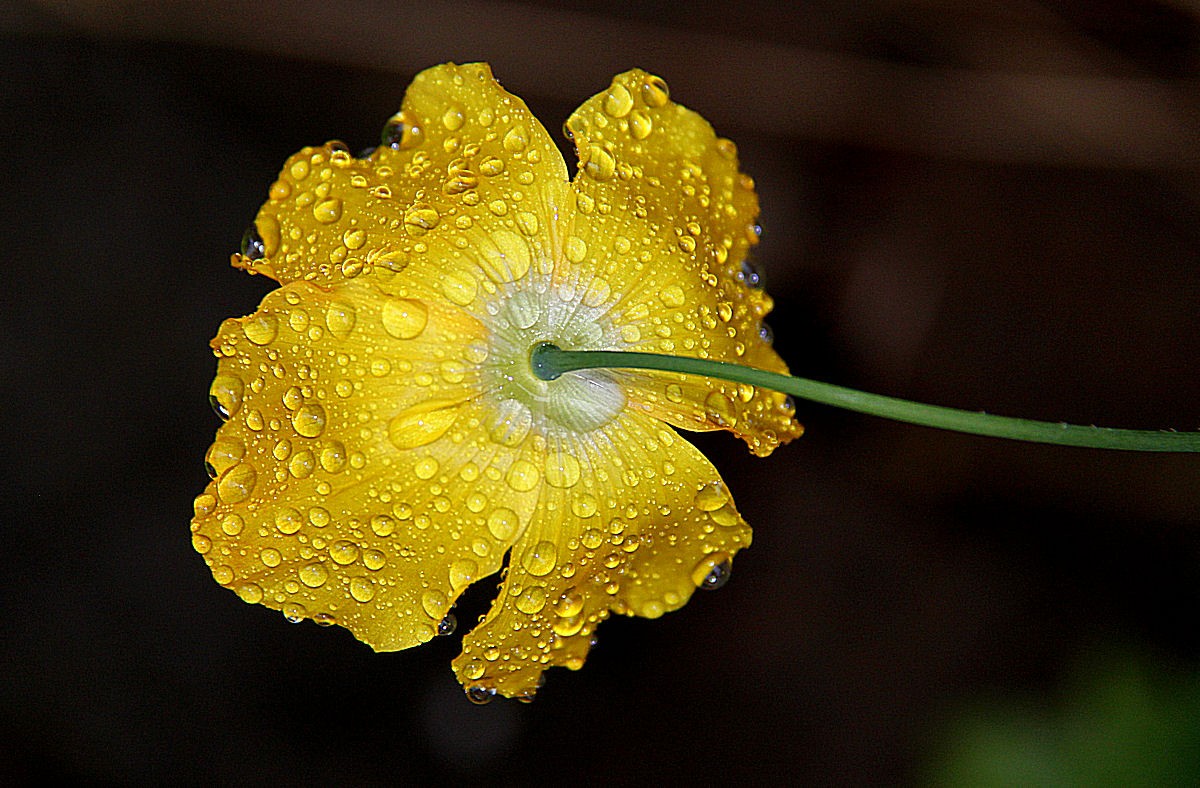
A Welsh Poppy bows its head under the rain

A Welsh Poppy bows its head under the rain

The long term strategy of applying the minimum maintenance stage further and further up the garden had stalled in recent years but is now back on track.  I have been keeping fit by humping rocks, paving blocks, sand and gravel around and laying paths.  I must admit that I find large-scale landscaping projects more creative and satisfying than maintenance. Not what I expected to be doing this summer but, as they say, it’s good to make a virtue out of a necessity.

Posted in Pontypool, Spring, Wales | Tagged , , , , , , , , , , , , | Leave a comment