Getting the grey out of my brain: Kinder Plateau, trespass and a lot of history

After climbing Cadair Idris in Snowdonia on Friday, I stayed with my daughter and her husband in the Manchester area and, with a better-than-expected weather forecast, on Saturday I headed for the Peak District.

I was brought up in Salford in an area dubbed by Friedrich Engels ‘The Classic Slum’ (yes! that Friedrich Engels … he had a cotton mill round the corner from where I was brought up).  It is also the title of a book by Welshman Robert Roberts.  Born and brought up there I never thought of the area as a slum but was somehow subconsciously aware of it as claustrophobic.  From the age of 12, a number 77 bus into Manchester and a train from Piccadilly Station let me escape into The Peak District.  When I could afford the fare.  There in the mountains was freedom, I could breathe.  That was my world, somewhere I felt at home and at peace.

Sometimes I would go with a group of friends, often on my own.  I loved the isolation in the mountains.  I learned from a number of potentially fatal experiences how to assess risk.  I learned not to follow snow remnants up a gully because on one occasion I fell through the crust 15-20 feet into the waist-deep plunge-pool of a waterfall. I learned not to try to cut across the Kinder plateau in low cloud because of the danger of falling prey to the disorienting peat hags (deeply eroded peat bog, nothing to do with Macbethian hags).  I learned the dangers of crawling into small limestone caves with nothing but a woolly hat and a torch with decaying batteries. And I learned the very great, immeasurable ‘suck-it-and-see’ pleasures of being alone and responsible for my own actions in the mountains.

That may be all a long time ago but we are all products of our own history.  It shapes what we become, what we are now.  What I didn’t realise at the time was the pivotal role that the Peak District and the Kinder Plateau in particular played in the UK history.

It all goes back to William the Conqueror.  After 1066 the UK was divided up between his chums.  The entire surface area of Britain was deemed by law to belong to one or other of his mates.  And it still does.  So, if the Lord of the Manor, in this case  the Duke of Devonshire, decreed that the Kinder Plateau was only to be trodden on by himself and his pals for the purpose of shooting grouse, a particularly large and sluggish bird making an easy target for boozed up aristocrats of limited ability, then peasants were to be kept orf.

Urban peasants from the huge, smoky, dirty  urban conglomerations of the Manchester and Sheffield areas got increasingly fed up with being denied access to the pleasures of a stroll in the mountains and on 24 April 24 1932 they organised a Mass Trespass. About 400 of them met up in an old quarry on the outskirts of Hayfield and set out to walk past the Kinder reservoir, up William’s Clough and onto the Kinder Plateau.  There they were met by armed gamekeepers and violence ensued.

Strangely, only protestors were arrested by the police and only protestors were charged.  Trespass was not then and is not today a criminal offence in Britain so protesters were charged with violence and affray.  A number were sentenced to between 2 and 6 months in prison.  In 2002, Andrew, the 11th Duke of Devonshire, publicly apologised at the 70th anniversary celebration event of the Kinder trespass at Bowden Bridge for his grandfather’s ‘great wrong’ in 1932.  He said: “The trespass was a great shaming event on my family and the sentences handed down were appalling.  When push comes to shove even the aristocracy recognises an elephant at the door.

The Trespass seemed to achieve nothing for many years but became the focal point of a long struggle which eventually, 17 years later under the Post-War Labour government, resulted in the National Parks and Access to the Countryside Act of 1949, a major turning point in UK environmental and social history.  That Act not only changed public access rights, securing the ‘right to roam’, but also saw the designation of National Parks throughout Britain, the first of which was the Peak District designated in 1951.  Today there are 15 national parks in all, covering 19.9% of the land area of Wales, 9.3% of the England and 7.2% of Scotland.  Attitudes to access to the mountains gradually changed more and more over the decades and saw the passing of the Countryside and Rights of Way Act in 2000, again under a Labour government, which gives rights of access way beyond those of the 1949 Act.  The Kinder Trespass is rightly seen as an icon of the struggle for access which culminated in the 2000 Act.

The walk I chose to do on Saturday was the route of that 1932 Kinder Trespass.  It was a kind of homage to the efforts of those early ramblers and activists and a re-visiting of my own past.  I was too young to have any part in the struggle but know from my own experience how slow to change were attitudes of landowners and their lackeys.  In the late 1950’s as a young teenager, I was forcibly removed from a path outside Glossop by a gamekeeper with a dog and a shotgun.  You don’t argue legal rights with a guy carrying a gun on an isolated mountain path.

Bowden Bridge Quarry, the start point for the walk is now a car park with a plaque commemorating the Trespass ….. and a van selling bacon butties. The weather was appropriately kind with some good spells of sunshine interspersed by the odd light shower.

The weather wasn’t the only contrast with Cadair Idris on Friday. There I had been the only person on the mountain.  On Kinder there were people in sight the whole time and I must have passed well over 100 others out walking these iconic paths.  I love the isolation of mountains but it seemed somehow appropriate that there should be a lot of people on this mountain, a breathing space for the millions in the massive urban areas surrounding it.  This was what the pioneers had fought for and achieved.

A great day.

The plaque commemorating the 1932 Kinder Trespass
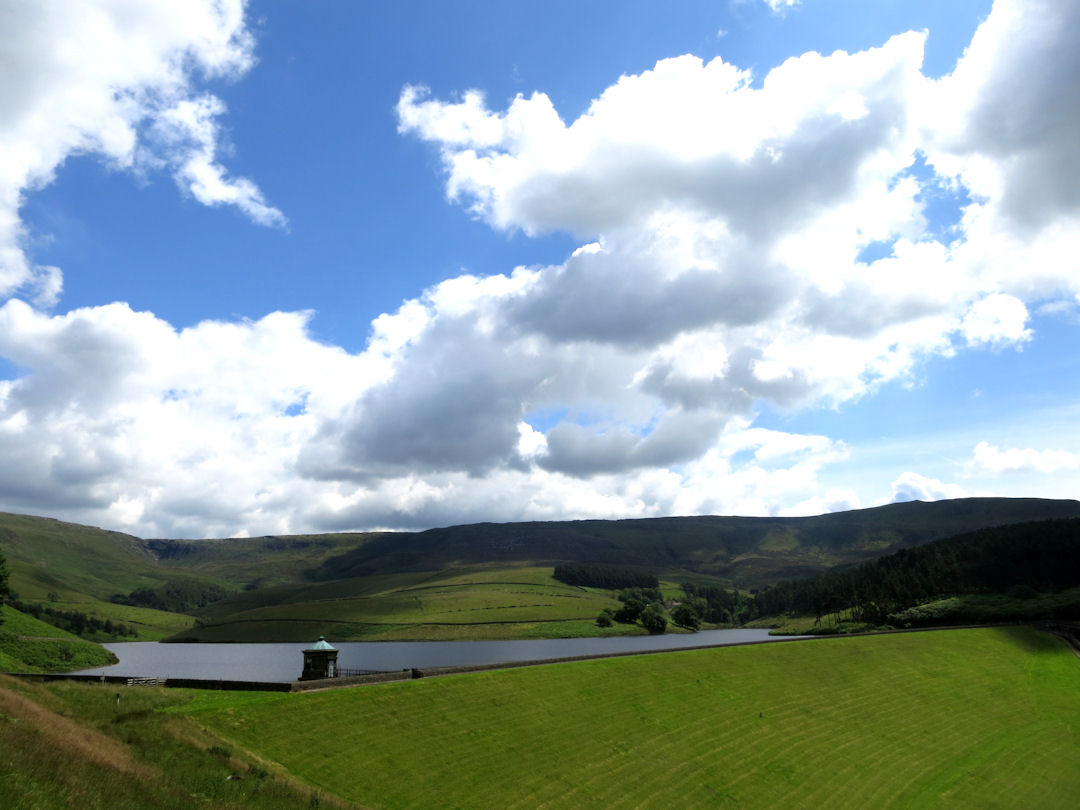
Looking across Kinder Reservoir, 100years old this year, to the edge of the Kinder Plateau

The stream is crossed and recrossed as the path winds its way up Williams Clough

Looking back down Williams Clough from the col

Following the steep edge of the plateau

Nature-sculpted rocks outlined against the darkening sky as a shower approaches.

Just a couple of the hundreds of weird shaped rocks on the plateau

Kinder Downfall

The edge of the Downfall with the stream far below

The stream is discoloured by peat

Stone Building in Field.
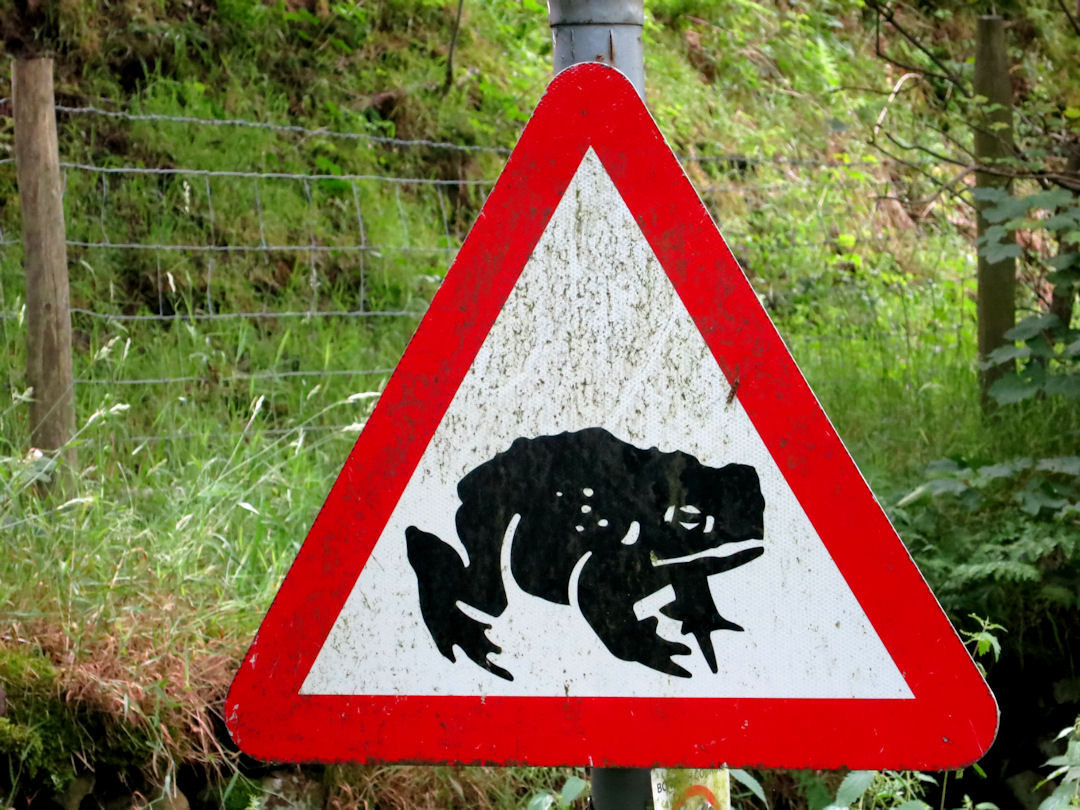
Beware! Grumpy frogs!

National Parks: http://www.nationalparks.gov.uk/press/factsandfigures.htm

Kinder Trespass Walk: http://www.trekkingbritain.com/kinderdownfallfromhayfield.htm

Posted in Grey Britain, Reflections | Tagged , , , , , | Leave a comment

Getting the grey out of my brain: Cadair Idris on a grey day

Concerned that having just arrived back from 2 months of completely new and very interesting experiences and activity in Greece I am determined that I do not want to slip back into old habits.  I need to inject new challenge into the daily routine, drive out the greyness from the brain.  So I decided to go ‘Up North’ for the weekend to stay with my daughter and her husband near Manchester.  But, crucially, I decided that as part of that trip, rather than the usual route up the tedious motorway traffic congestion of the M5/M6, I would go via Mid Wales and Cadair Idris.

Cadair Idris is the southernmost peak in the Snowdonia National Park.  At 893 metres (2,930 feet) it is not the highest peak in Wales, that distinction goes to Yr Wyddfa (Snowdon) at 1085 metres (3,560 feet).  But Cadair is a mountaineers mountain.  Snowdon is totally prostituted by having a railway to the summit, a newly redeveloped café on the top and myriads of tourists many of whom tackle it completely ill-equipped and lacking in mountain experience.   Cadair Idris certainly attracts many visitors, particularly in summer months, but the vast majority are experienced walkers or mountaineers.  It is also a serious undertaking for two reasons. First, when tackled from the south side the start point is close to sea level, unlike most ascents of Snowdon which start at significantly higher altitudes. Second, horizontally the summit is very close to the start point …. so it’s a very steep and demanding ascent.

The OS 1:25,000 map of the mountain

click on image to enlarge this and others

I was introduced to the mountain in my first year in university on a field trip to look at the classic glacial erosion features such as cwmsmoraines, striated rocks, and roches moutonnées.  I have loved the mountain ever since and climbed it many times but not in recent years.  I like it especially in winter and took to only going up there when it was encased in snow and ice.  I have been on top when it was so cold that my sandwiches froze before I could finish eating them.  Then a turning point.  About 10 years ago I drove up there for a day’s climbing in winter and bought a new ice-axe on the way which action triggered  a succession of very mild winters.  The only hard winter in recent years was when I was in Canada.

No fear of snow and ice this time, just grey and wet.  Better weather would certainly have helped but was not forecast.  Instead the forecast for Friday’s weather improved from weather-warning torrential rain (forecast on Tuesday) to light rain (forecast Thursday) to cloudy but dry (Friday morning).  I was determined to do the climb whatever the weather so I packed my bags, sorted out wet weather gear sufficient for any eventuality, and headed North.

Digression.  For two months in Greece I travelled by bus and train.  I was therefore obliged by practicality to ‘pack light’ and was used to thinking which items of clothing would cover most eventualities.  Travelling by car I could just chuck as much as I wanted in the back.  A completely different mind-set and a little unnerving as the frugal-packing habit was deeply ingrained.  In the end I threw in a few extras ‘just in case’: extra pair of walking trousers, extra shoes, two cags ….. End of digression.

I had driven much of the route up North hundreds of times but not for some years and layers of other memories obscured it.  Though as I set out the I couldn’t remember the way, recollections came back as I progressed northwards:  Abergavenny, Talgarth, Builth Wells, Rhayader, Llangurig and then eastwards to Lanidloes before north again to Machynleth and the final leg to Minfordd at the foot of the mountain.  Even when I’m at home I go most places by bus, leaving the car in the garage except for a few local trips, so I was  a little apprehensive about once again driving longer distances on narrow winding roads.  However all went well and I arrived in the car park at 13.00, 2½ hours after setting off.

I was going up the Minfordd Path as far as the corrie lake of Llyn Cau surrounded by a dramatic amphitheatre of  towering cliffs.  Still relatively fit from walking in the Pindus and Taygetos Mountains  I got to the lake in 45 minutes and was well pleased, this was certainly banishing the grey from the brain.  Ironic really given that the serrated rim of cliffs surrounding the lake was completely lost in thick, grey cloud.  I guessed the peaks were still up there because I had seen them, and photographed them, so often in the past.

Much of the next stage of the climb would be lost in greyness. The plan was to leave the path at the lake and climb up one of the steep gullies in the back wall of the corrie.  Maps are no use in situations like this because the contours are so tightly packed  and are in any case obscured by ‘cliff’ symbols.  It was a matter of going around the edge of the lake and then striking up into the gully which I knew could be followed increasingly steeply upwards to a point in the col between the main summit of Penygadair and Craig Cau.  In winter the top of the gully is overhung by a snow cornice which necessitates going off to the side to find a point where it can be breached safely with an ice axe but on Friday it could be followed to its top.   Then it was a simple matter climbing out of the gully to  rejoin the Minfordd Path and following it to the summit, aided in the thick cloud by giant stone cairns which had been heaped up by generations of walkers. In good visibility these cairns seem overkill but in poor visibility they mark the way ahead as the route meanders over the rocky ground.

It took just over 1½ hours to the top from the car park.  Short banana break in the mountain refuge on the top and then time to head back down, this time keeping to the Minfordd Path all the way as it follows the horseshoe of cliffs around the corrie lake far below.  It is always more dangerous going down than up steep slopes  and, with the cloud cover making the rock very wet and slippery, going back down the gully seemed a risk too far.

I must admit to  a certain euphoria coming off the summit and I started to bounce down the rocks.  Until I took a bit of a tumble and popped one of the cartilages in my ribs.  Minor discomfort but nothing could detract from the joy of being up there.  I had the mountain entirely to myself.  I was well chuffed.  I was surrounded by thick grey cloud but the grey had been banished from my brain.

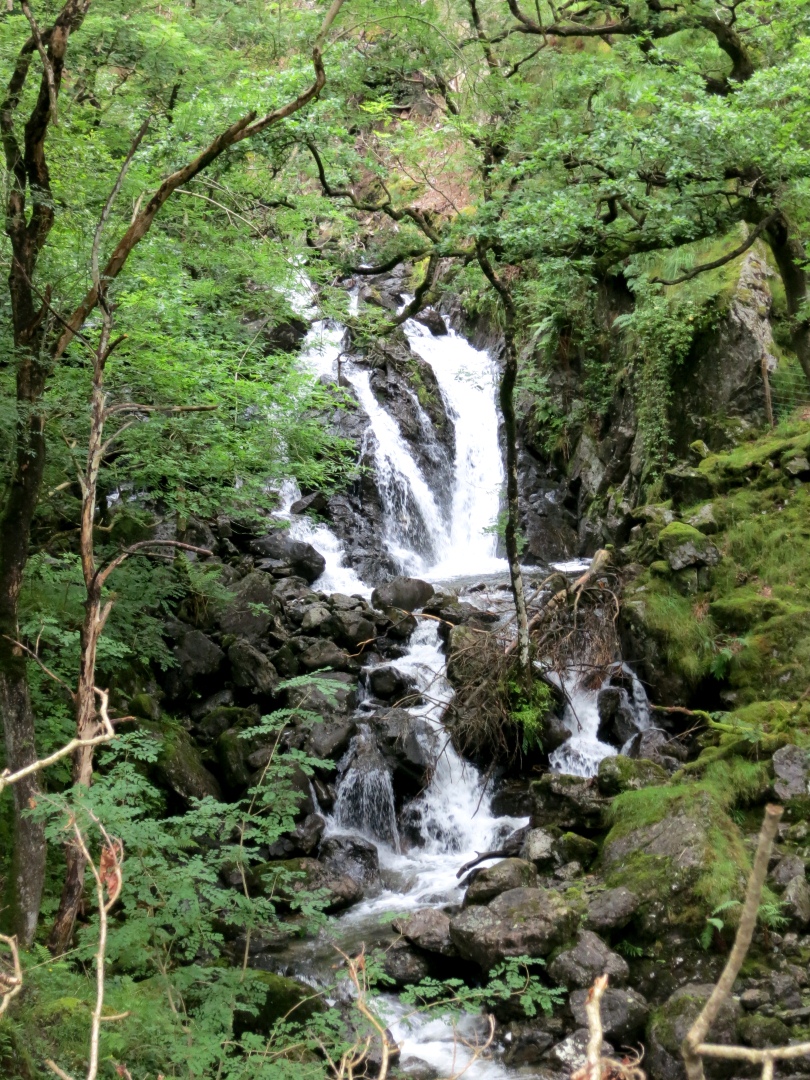
The start of the climb is steeply up through woodland alongside a rushing stream

Famous roche moutonnée on the way up to Llyn Cau

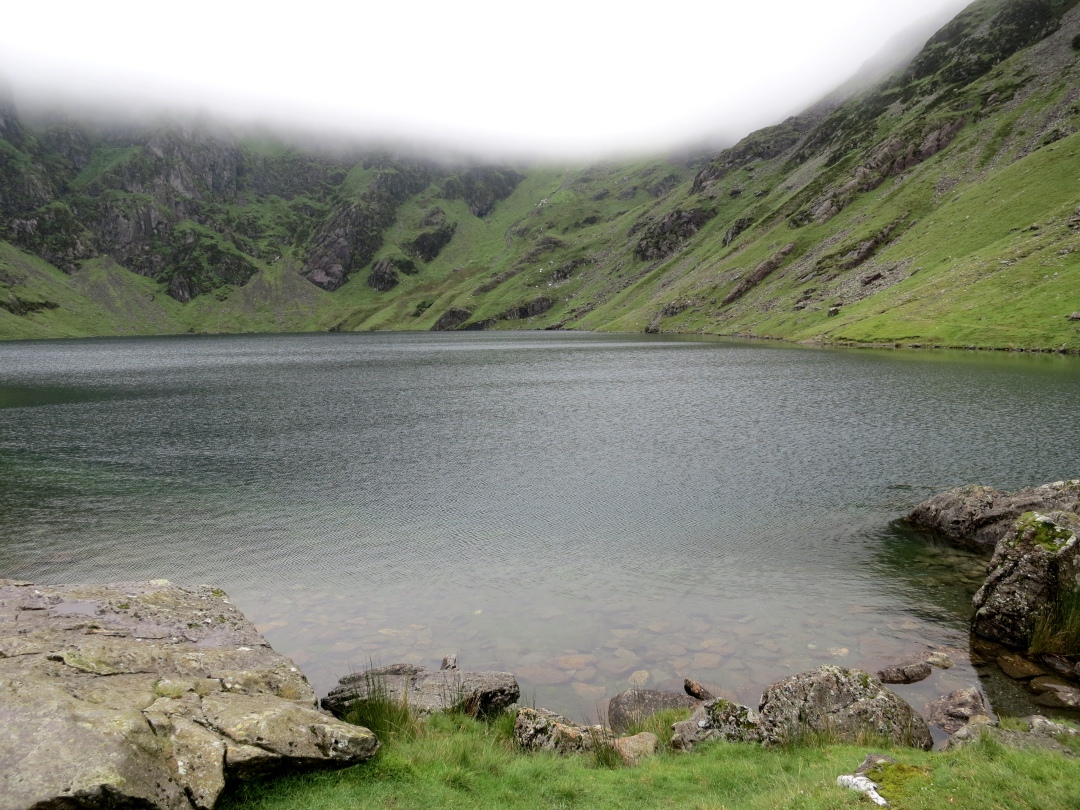
Looking across Lyn Cau, the summit of Craig Cau lost in the cloud (compare photos on aartworld.com web site)

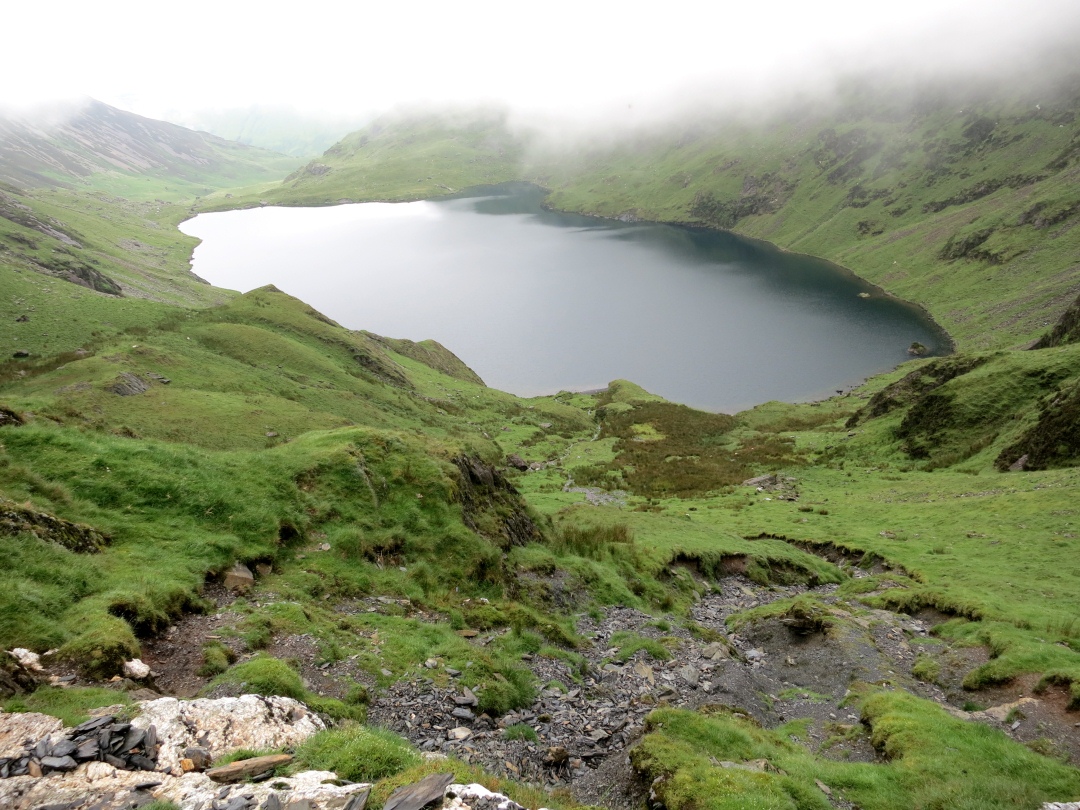
Looking down across Lyn Cau just before disappearing up into the cloud

At the top of the gully which I climbed up into the col.

The summit of Penygadair, the mountain refuge on the left

One of the gullies dropping straight down into Llyn Cau

Looking across Llyn Cau from just below cloud base to the summit of Penygadair (compare with images on aartworld.com website)

I used to go scree riding on those scree slopes

Introduction to Cadair Idris:

http://en.wikipedia.org/wiki/Cadair_Idris

Images of Cadair from my past:

http://www.aartworld.com/Snowdonia.htm

The Minfordd Path:

http://www.trekkingbritain.com/cadairidristheminfforddpath.htm
Posted in Grey Britain | Tagged , , | Leave a comment

New habits dying hard: greyness in the brain

Whether we like to think so or not, habits are an integral part of life for most of us.  Apart from anything else they are the lubricant which we use to cope with the boring, everyday stuff.  It is also a way of speeding things up if we react out of habit rather than having to think about everything fresh each time.

As an extreme example, when I was canoeing regularly I spent one evening in the practice pool doing nothing but left hand eskimo rolls in order to get the actions so engrained in my subconscious that when I needed to roll up after capsizing I could do so on the left as well as the right without having to think about it. When you’re upside down on a white-water river or in the surf you don’t want to waste time before getting back up to where you can breathe.  It worked.

On a more mundane level, an everyday survival habit is the ritual for the first few minutes after I wake up in the morning which helps me transform back into a human being. The first few minutes of any day are on autopilot: loo, teeth, quick wash, coffee, sit and read.  I emerge at the end of that 30 minutes with my brain once more intact and in gear for the day ahead.

Arrival back in Grey Britain means that I’m not only having to re-acclimatise to grey, wet weather but to a whole different set of habits, the old habits.  Because intervening months have been so packed with new and interesting stuff life in the UK seems a distant memory and the old habits have to be consciously remembered.   Problem is that new habits have formed and are fondly remembered.

Much of the time I was in Greece things were very fluid with very little time to drop into any kind of rut.  Travelling was very uncertain and many plans had to be changed, some literally at the point of departure.  I moved on 12 times in 2 months and the longest I was in any one place was 2 weeks in Kardamili.  Somewhere new each time and every day new places to explore, new mountains to climb.  Little opportunity for habits to form.

Yet in a sense, the constant change and practical problem solving became the habit.  I got used to dealing with transport difficulties, slipping easily into sussing out timetables and ticketing arrangements.  I got used to dealing with the multiple variations of bad plumbing in hotels: as a rule of thumb the more modern the bathroom fittings the less well they worked (the old fashioned plug-on-a-chain was invariably most efficient in wash basins …. and I carried my own ‘universal plug’).  I got used to the constantly changing breakfast menu, rarely anything remotely like I have at home or my yogurt-honey-fruit breakfast of choice in self-catering.  I got used to tracking down a good, cold pint of draught beer in a pleasant location at the end of a long, hot walk.  I got used to finding restaurants which offered traditional Greek menus at affordable prices.

Despite the constant change days did tend to follow a sort of pattern.  08.00 breakfast.  09.00 access e-mails and post blog.  10.00/10.30 set out for a walk via a periptero (kiosk) to buy ice cold water and a supermarket to buy fresh bananas.  13.00/14.00-ish banana stop preferably on a mountain top, cliff overlooking the sea or monastery courtyard.  17.00/18.00-ish get back to hotel.  Shower, change then 18.00/19.00-ish beer and read a book on the Kindle. 19.30/20.30 download photos from camera to computer and edit.   20.30/21.00 meal.  22.30/23.00 nightcap and read more on the Kindle.  This sounds pretty regimented but it was far from that, it was simply how the day seemed to unfold with some regularity.

And that’s why in a sense the general pattern of the day over 2 months became a habit.  It was also a habit that as much as possible was done outside in the warmth of Greek sunshine, or warm Greek shade.

That pattern, that habit, was dislocated when I got back and it has been, and still is, hard to adjust.  The strange thing is that it is the absence of constant change and variation which has been most difficult to adjust to.  There is a much more steady rhythm to life at home.  The old habits of the day are coming back slowly but are not so welcome and are a bit unnerving.  I’ve slotted back to old early-morning ritual to bring me new into the world each day. Everyday-rituals seem somehow more comforting now that the distinctly depressing thoughts in my head when I get up are about household chores, coping with the grey weather, and sorting out the rampant garden rather than going out under cloudless blue sky to new places with the prospect of seeing new things.

There are of course the detailed habits to break.  It happened to me yet again in the first few days back home, a visit to the loo saw me standing in the middle of the floor clutching used paper with my brain unable to communicate to my hand that I should throw it in the pan and flush.  Instead I was casting around for the bin.  (for those who haven’t been to Greece, the sewerage system there requires paper to be thrown in a bin, not flushed away).  It becomes habit very quickly which, after a couple of months, is difficult to break.  It seems wrong and unclean to put paper in the loo.

The old habits will creep back and gradually take over.  If I’m not careful.  As I wrote previously, the trick is going to be to introduce new challenge into the daily routine.  Deal with the chores but inject challenge.  Habit can be part of and reinforce the greyness of life.  It’s important to keep the greyness out of the brain.

Better weather would help.  A week or two of reliable blue sky instead of grey and wet would be far more tempting to outdoor activity.

So would affordable prices in UK accommodation.  I thought I would break the mould this weekend and go somewhere I haven’t been before or somewhere I have been but want to revisit.  The UK was to be my oyster.  Pembrokeshire to walk the coast path.  North Wales to climb my favourite mountain, Cadair Idris.  Cornwall to revisit St Ives and fulfil a long-held ambition to visit the Eden Project. I checked out accommodation options on-line and knocked the idea firmly on the head.  The cost of two nights in a cheap B&B or hotel is roughly equal to a week in Greece in good quality accommodation.  It seems that rip-off prices are a habit in Britain.

But I’m determined to come up with something.  Watch this space.

Posted in Greece, Grey Britain, Grumpy Old Men | Tagged , , , , | Leave a comment

Down to earth with a squelch, naked garlic, blue sky thinking

Arrival back in the UK from Athens was not as unpleasant as the avuncular pilot predicted at takeoff.  Rather than raining and 14oC, the weather in Manchester was about 18oC, dry with sunny intervals and there was a modest amount of sunshine on and off over the weekend.  Still a bit of a shock after 30-35oC and cloudless skies for a month in the Mani.

Arrival home in South Wales on Monday afternoon was quite a different story.  It was raining so heavily when I parked the car on the hard-standing outside the house that I sat in it for while before dashing the few yards to the house.  It has been raining ever since with not the slightest glimpse of blue sky, merely varying shades of grey.  Grey may once have been the new black but this isn’t a fashion show!!

Before I left Areopoli a local, on learning that I was going to Athens the next day, described the city as dirty and hot.  I didn’t find it to be so.  I certainly prefer it to this grey wetness.

One of the reasons for coming home a little earlier than originally planned was to try to get the garden under control and to make progress with development work on the landscaping.

I don’t think I have ever seen the garden so wet.  Not only is the soil saturated but the taller plants and those laden with fruit are bending right down in total dejection rather than lifting their heads skyward in search of the sun.  Mares’ tails and willowherb, which I had blitzed before I went, away are now rampant.  In contrast, the Mediterranean plants which I have been planting over the years are still alive but not at all happy.

Looking around I reckon that given good weather for 4 or 5 days I could get more or less back to square one, replant some of the veg devastated by pests and then get on with development work.

I waited for what I thought (wrongly) was the end of the rain on Wednesday morning and then went try to harvest the garlic which looked in most urgent need of attention.  I have so far harvested two rows and have never seen anything like it. The foliage has rotted away leaving the garlic heads in the ground but completely naked.  The outer sheaf made up of layers of thin skins which tightly drape the curving white cloves within have rotted away completely leaving the individual cloves exposed and, in the soggy ground, starting to shoot.

There is a good crop and they taste very good (I crushed a few cloves and mixed them into some soft cheese and had it on toast for my midday snack: delicious!) but I doubt that they will ‘keep’ well. On the positive side my guess is that as I chomp through them I will have little trouble from vampires for the next couple of months and I am unlikely to suffer with colds and other such infections.  Unfortunately I also suspect that friends will suddenly discover that they have an urgent engagement elsewhere when we meet up.

Naked garlic spread out to dry

I can’t help but think back only a few days to walking the mountains of the Mani around Kardamili, Areopoli and Gerolimenas and then plunging into the cooling waters of the Aegean. Fabulous.

But life isn’t only about sunshine, mountains and sea, new experiences and pleasures revisited.  It has been great to be back with family.  Trying to catch up with rapidly growing grandchildren.  Sharing aspirations and hopes.  Meeting up with and enjoying the company of friends (those who stick around despite the garlic).  And, necessary but not so enjoyable, getting on with the ordinary things of life.

Looking back it is difficult to remember the early part of this Greek odyssey. Meteora and Metsovo, Ioannina and Igoumenitsa are distant memories yet were less than 8weeks ago.  Time has warped.

But life isn’t only about looking back.  We have the great pleasure of looking forward.  “To travel hopefully is better than to arrive”, as Robert Louis Stevenson wrote.  I temper that with the thought that we shouldn’t only look to some pleasure in the distant future but, linking to the words attributed to Alexander the Great, “Life is only made worthwhile by challenge”.   Challenges are to be faced and met now, in the present.

I am back in the UK for 8 weeks before returning to Greece for the 2012 Greek Odyssey Part 2.  The challenge is to make that 8 weeks count for as much as the last 8 weeks.

My pedometer tells me that while I was away I walked over 500 miles, much of it with a seriously vertical component in the Pindus and Taygetos Mountains.  I am now pretty fit and acclimatised for walking in the heat.  There is little prospect to covering that amount of ground before I go back, no hope whatever of staying in condition for the heat.  It will be interesting to see how much walking I manage to do and how relatively fit/unfit I am when I go back.  More than that, it is a challenge to do worthwhile stuff while I’m home and to sort out the humdrum, ordinary things of life.

Blue sky thinking?  While I was wandering the Taygetos I harboured the hope that while I’m back in the UK I can get to do some more paragliding.  It is a while since I last flew and I would very much like to do so again.  Maybe take the grandchildren rock climbing again.   For either of those things the weather will have to change pretty significantly.  Maybe just stick my head in the ground and do some caving.

Posted in Greece, Grumpy Old Men, Reflections | Tagged , , , , , , , , , | 1 Comment

Leaving Athens: the end of the trip

I woke up ahead of my alarm going off on Friday with one  of those crystal-clear wakenings which renders the ‘snooze’ button pointless.

Written large in the early-morning grogginess was the inescapable message “Going home today”.  That stark message meant that there was no dozing back to comforting sleep even though I knew there was no great hurry, I didn’t need to be at the airport until 11.15 and it was now 07.00.  Plenty of time.

As is often the case, at the point of going home emotions are mixed.  There is certainly a looking forward to seeing family and friends, checking how the fruit and veg are doing and to what extent the garden has gone rampant.  There is also sadness that the visiting of new and interesting places and doing new things has come to an end.  Exchanging the  warmth of Greek sunshine for the damp dreariness of  Grey Britain in summertime is never appealing.  Nor is leaving behind the very great pleasure and privilege of swimming in the Aegean every day.

With the exception of when we first came to Greece in 2000, this has been the first time that everywhere I have been has been new to me.  I had decided to try to do the whole trip by public transport and, with minor exceptions had more or less succeeded.

Looking back over the two months, questions inevitably arise:

With the benefit of hindsight, would I undertake the same trip again?

Which of the places I have been would I go back to?

Would I make another trip in Greece relying on buses and trains?

Did the trip come within budget?

Was the language a problem in more remote areas?

What was the effect of the economic and political crisis?

What lessons did I learn and would I do anything differently?

The germ of idea for the trip began with an intention to visit the Mani peninsular in the Peloponnese coupled with a long-time ambition to see Meteora.  I then embellished the trip with all sorts of ‘good ideas’: walking in the Pindus Mountains and checking out a ski resort; stopping over in the Ioannina fortress-home of the infamous Ali Pasha; visiting Parga on the recommendation of a friend and walking the gorge of the River Styx; visiting friends in the Ionian islands;  heading down to the Mani; from there crossing by ferry to Crete …….

Conclusion: the original plan was too optimistic.  It proved impossible to properly explore areas in a short time before needing to move on. Would I undertake a similar trip again?  Probably yes but I would reduce the distance covered in order to more properly explore locally.  For example, I missed out on not taking time to visit the Vikos Gorge in the Pindos Mountains and the legendary River Styx near Parga.

With the sole exception of Patras which I didn’t take to at all, a feeling reinforced by the theft of my camera, there was nowhere that I regretted visiting.  One area which I would certainly hope to go back to is the Mani, the original and primary objective of the trip. .  It is very much my kind of area, wild with a combination of mountains and sea. I walked a good bit of it but by no means all that I would have liked to and much of what I did I would like to revisit.   Other areas which I would probably go back to include Meteora whose pinnacle-top monasteries are mesmerising, Parga with the river Styx to the south and nearby Paxos where I have friends.

Altogether I travelled about 1500 kms by bus and to a limited extent by train.   At times it was frustrating but I would nevertheless travel around Greece by bus and train again.  With certain qualifications.  It is a very cost-effective way of travelling long distances.  The most I paid was about €25 for a 5 or 6 hour trip and there were significant reductions for under 18s and over 65s on the train and Athens Metro.  The total I paid was somewhat less than €150 so a rough average of 10 kms per €1.

The downside is that public transport inevitably takes longer than travelling by car, 5 hours from Areopoli to Athens compared with 3½ hours for example, but is way more relaxing.  Travel is also constrained by the exigencies of the timetables, information about which is not always easy to find.  As rule the more remote the area the less frequent the service and the more difficult to winkle out information.  There is no on-line source of bus route and timetable information comparable with the UKs ‘traveline’.

Despite the frustrations I would do it again because I’m now happy to adjust to the slower pace of travel by public transport as I don’t have to fit everything into a 2 week holiday.

The overall cost of the trip came within budget.  Concerns were being expressed in the media about the rising costs in Greece likely be consequent on political and economic uncertainty but this proved to be unfounded.  I generally stayed in ‘mid-range’ accommodation, clean and comfortable but not opulent.  I ate a good breakfast and my midday meal of choice was always banana and nutbar, not so much because it was cheap, which it was, but because it was easily packed in the rucksack for carrying into the mountains and had very high food value.  In the evenings I ate in restaurants which, as long as I avoided having the fish, worked out in most places at a reasonable price.  For some reason, even at restaurants on the harbourside, the price of fish is unacceptably high.  One evening I decided to have mullet and the meal cost more than double the amount I had spent on any other meal in two months.

One of the problems that we have experienced in Greece over the years is that attempts to speak Greek have not been too successful, largely because most Greeks we met spoke good English and either wanted to practice their skills or didn’t have the time to waste on our floundering.  This trip, more than any other in Greece, I spent time in villages somewhat more remote from the tourist trail.  Not surprisingly there was less English spoken than in the hotels and restaurants of the coastal strip.  This meant more people spoke little or no English. Not only did this not cause me much of a problem with my faltering Greek but got me more into the way of thinking a little more in Greek and ‘tuning-in’ my ear to the language.  Altogether a positive experience linguistically.

Despite dire warnings from concerned friends and doomsayer media pundits the effects of the political and economic uncertainty was negligible.  If anything, rather than being a problem, it had only benefits.  The number of visitors being well down on previous years meant that there was no problem in arranging accommodation and finding a table in restaurants. Prices were definitely competitive and nearly everywhere staff were even more friendly and welcoming than usual.

Lessons learned?  Very many.  First and foremost I guess I learned to be more realistic in drawing up an itinerary.  Looking ahead two months seems a relatively long time and the temptation is to try to cram too many things in.  Travelling time needs to be factored in with a long bus journey and checking in and out of hotels taking up most of a day. However, I now feel relatively competent at finding out options for bus routes, timetables and ticketing systems.

I learned that researching hotel options on the internet before I travel helps overcome the problem of having to lug a Big Bag around looking for somewhere suitable and affordable.  With two of us one could stay with the bags while the other went off on a hotel hunt; being on my own creates a problem in that respect (as well as many others).  An alternative is to use a web site which will show locations of hotels on a map and prices.  This doesn’t cover all options but is s good starting point.

One thing I would definitely build into the plan next time is hiring a car for part of the time.  Guide books and web sites had said that hiring a car would greatly facilitate properly exploring the Mani.  In my determination to do everything by bus I ignored that advice.  I won’t do so again.  Ideally I would travel by plane/bus into the area I wanted to explore and then hire a car for say 4/5 days.  I would probably hire a car in either Kalamata or Kardamili if I go back to the Mani.  Apart from anything else that would make it possible to climb Profitis Ilias, the highest peak in the Taygetos.

That’s it for this Greek rambling.  I will continue posting blogs over the next few weeks until the next stage of Greek rambling 2012 which begins towards the end of August.

Posted in Greece, Reflections | Tagged , , , , , , , | Leave a comment

Areopoli to Athens: tower houses to tower blocks

Thursday and unfortunately time to leave the Mani.  The staff of the family-run hotel, the ‘Areos Polis’ always very helpful and obliging, had arranged the full range of breakfast for me an hour early so that I could be on time for the 08.00 bus to Athens.

The long distance buses have a strange role in Greece.  They take a few people like me from The Deep South of the Peloponnese to Athens, from one world to another, and they also pick up and drop off locals at the wayside en route.  Sometimes there is a little ‘stasi’ (bus stop) sign at the side of the road but not always.  Sometimes in the towns there is a proper ‘stathmos’ (bus station) with ticket office, information centre and café;  sometimes it is counter in the corner of an ordinary commercial café; sometimes there is nothing.  You just have to get used to the fact that it varies and go with the flow.

The whole journey to Athens was a cross section of this wide variation.  In Geithio on the east coast of the Mani peninsula,  the first non-wayside stopping point, the bus simply pulls up in the street outside a café for 10 minutes or so.  By contrast in Sparti there is a big KTEL bus station.  At one point, I’m not sure where but about 75 kms from Athens, the bus stops for 15 minutes at a one of a series of 24 hour transport cafs close to an exit from the motorway.  Apparently, where the bus stops and where it goes has a long history of family connections and ‘who knows who’, spiced in latter years by EU safety requirements on driving hours I’m sure.  But somehow it works well.

Arrival at the outskirts of Athens was both perplexing and frustrating.  Rather than going directly to the ‘central’ bus station it meanders off and heads for Piraeus, passing some of the most squalid conditions I have seen in Greece, and then does a complete tour of the harbour dropping off people and parcels at the various gates each indicating whether it services the Dodecanese, Cyclades and so on.  It pulled up at one gate and waited.  Then a car pulled up on the opposite side of the busy dual carriageway road and a guy zigzags across through the traffic, collects a small box tied up with ribbon which the driver fishes out from the ‘hold’  underneath the bus, signs an A4 form in colour in triplicate, throws his copy into the nearby rubbish bin, and zizags back across the road.

Getting into the bus station took about an hour from the outskirts of the city.  The driver described it as the ‘central’ bus station though what it is central to I have no idea.  It is certainly not anywhere close to the centre of Athens nor does it seem to be central to the geographical limits of the urban area.  But then the word ‘geographical is from the Greek anyway so they should know..

You will have gathered that once we were out of the mountains the journey was pretty mundane, hence the rambling about other things.  The first hour of the nearly 6-hour journey was certainly interesting, passing through the Taygetos Mountains and then with views of them for a while as wide left them behind.  They are dramatic, well worth seeing and even more worth walking.  But they have the unfortunate effect of making everything else look a little ordinary and mundane afterwards.

The contrast between Athens and Areopoli could hardly have been greater.  I had a few hours in Athens in the afternoon before meeting Theo for coffee so I ambled along to Monastiraki less than 10 minutes from the hotel via Iroon Square (pronounced ‘earo–on), then around to the Acropolis, up onto the Areopagus and then to the Hill of the Muses.

The road between the hotel and Iroon Square delights in the name of ‘Odos Aristophonous’ (Aristophonese Street) which aficionados of the Beiderbeck Trilogy will know well …. except that the one in Yorkshire was in the process of being demolished whereas the Athens version is merely run-down, extremely run down.  Theo is concerned about me staying there.  When I told him that it was extremely good value for money he said that it was cheap because it’s really an ‘adventure holiday’.  I have to admit that walking around the area I was more alert this time than last because of my experience in Patras.  I dressed down when I went out in the evening (it’s difficult doing anything else with a limited wardrobe at the end of 2 months away), took barely enough cash and no cards, and carried my Kindle under my T-shirt.  Very defensive.

I headed for the Areopagus adjacent to the Acropolis partly because if affords good views of the Acropolis and partly to stand where St Paul stood 2000 years before to preach the sermon which was a symbolic turning point in world history  I’ve been there now 3 or 4 times and each time it is just as impressive.  Not far away, about 5 minutes walk, is the prison where, it is reputed, Socrates was imprisoned.

The Acropolis and its various structures have been surrounded by scaffolding and cranes for a long time and it seems unlikely that it will be free of such additions in the foreseeable future as I guess restoration work slows with budget cutbacks.  Some parts are standing out vividly now as the clean, white marble gleams in the sunlight.  But apparently this is completely alien to what it would have looked like when it was built as the whole would have painted in strong primary colours.

The views form the any of the 4 huge rocky outcrops at the centre of Athen, the Areopagus, the Acropolis, the Pnict or the Hill of the Muses is dramatic with the vast city spread out for miles in all directions, climbing up the surrounding hills and gleaming white in the sun.  I couldn’t help but reflect on the contrast with the views from the mountains of the Taygetos looking down over the few small villages and olive-green and golden brown of dried vegetation on the coastal plateau of the Mani.

On the Areopagus with the Acropolis behind

The Acropolis from the Hill of the Muses

Alien hordes on the Acropolis

Tower blocks spread out for miles in all directions

High rise on a hill, vaguely reminiscent of the feud towers of Vatheia but a world apaert

Looking across Monastiraki in the late afternoon sun

One dominant feature I noticed while wandering around the core historical area was the huge number of teenage Americans, most of them, though not all, doing their best to reinforce the stereotype. One lad apologised for being in the way of the photo I was composing when he realised that, while I was waiting for him to move, his place had been taken by 4 girls, his compatriot, who then spent 20 minutes posing for each other with the Acropolis as a backdrop.

Apparently the number of visitors to Athens, as to the rest of Greece, this summer is significantly down on last year with a particularly large drop in the number of Brits and other North Europeans.  Had it not been for a sharp increase in the numbers of Russians the situation would have been even worse.  The view has been expressed that they are welcome for the money which they bring, particularly as they don’t demand the same high standards as North Europeans, but there is a certain wariness and coolness in their reception. One group of visitors which now get a polite if somewhat cool reception is the Germans.  The only time I have heard a roar like the one which greeted Italy’s first goal over Germany in the semi-finals of the Euro Cup on Thursday evening was when Greece beat Russia on 16 June.  One headline in a newspaper a woman was reading in the bus asked “where are the Germans driving us” (it was a Greek newspaper, I hope you are impressed) and on another page was a not very flattering photo of Angela Merkel.  What a complicated, xenophobic world we live in.

This trip to Greece is very nearly over now.  I hope to take a final look back tomorrow and draw some thoughts together from these ramblings.

Posted in Greece, Reflections | Tagged , , , , | Leave a comment

Areopoli: Last day in the Mani, a grumble about footpaths, and a new word for the language

PHOTOS ADDED (for those who have difficulty with the words)

Wednesday, the last day in the Mani and the Exit Strategy looming.

First task after breakfast was to trot around to the bus station and book my ticket on the bus to Athens tomorrow morning.  There is a strange agglomeration of ticketing strategies in Greece.  In some places you have to buy a ticket before you get on the bus in a periptero (all-purpose kiosk) or local shop and have it ‘verified’ (torn in half) on the bus.  In some places you buy them on the bus.  But that’s oversimplifying it, it can be very complicated.

When I travelled from Kardamili to Areopoli I bought a ticket to Itilo on the bus and then another from Itilo to Kardamili on the bus.  When I travelled from Areopoli to Gerolimenas I got sent off the bus to but buy a ticket in the ‘stathmos’ (bus station office) which was then scrutinised and ‘verified’ (torn in half) 3 metres away when I got back on the bus.

Not wanting to be caught out again travelling back from Gerolimenas, when I passed the bus parked in the ‘stathmos’  in Gerolimenas, just a one-bus sized parking space at the end of the street and with no office at all, I thought I would enquire of the driver who was doing bus-cleaning chores.  The reason for my enquiry was that with no office it raised the possibility that I may have to buy the ticket in the supermarket 100 metres or more away.  I used my very best Greek and he simply yelled at me petulantly “No speak English!!!” and adding in Greek that the bus left at 14.30 and waved me away dismissively.

I knew the bus left at 14.30 but didn’t know about the ticket purchasing system, so I repeated my enquiry but more slowly and enunciating more clearly.  He repeated his yelling at me, to which I replied in my best, if very irritated, English:  “I’m speaking Greek!!  Obviously futile words.  I guessed that he was one of those people who, when faced with a foreigner panics and assumes they are speaking some alien language that they don’t and cannot understand and just don’t listen to what you say.  I stood my ground, looked him in the eye and said loudly and clearly, one – word – at – a – time: “agorazo” (do I buy), and when a light of recognition of the vowels coming out of my mouth dawned across his face carried on “to isiteirio”  (the ticket)… “sto leoforeo”  (on the bus)…. “ee”  (or)…. “sto magazi” (in the shop).  Even though by now it was clear that I was speaking in Greek and he had understood what I had said, he didn’t say a word but just pointed aggressively at a ticket machine on the dashboard and carried on with his cleaning duties.

I didn’t want the same problem for the trip to Athens hence the reason I went to the  bus station ticket office a day early to book a ticket for “avrio” (tomorrow) at “ochto to prowee” (8 in the morning).  The contrast couldn’t have been much greater.  The guy clearly spoke adequate English but was pleased I was speaking Greek (indicated by a “bravo!”) and I was invited behind the desk to view a seating plan for the bus on the computer screen and choose my seat.  As there were only two tickets sold at that point I had plenty of choice.  Very satisfactory experience.  The cost of a ticket from Areopoli to Athens?  €22.

Then it was off for a walk.  I had sussed out that the coldest bottled water in the town was from the periptero in the main square a few feet from the hotel so armed with that I set off to follow a path to the Areopoli caves.  Yet another story of map showing  a path and no sign of it on the ground.

I digress once again.  The numbers of visitors has been low everywhere I have been and people who know the places say that numbers are significantly down on last year when they were significantly down on the year before.  It is lean times and all because of the adverse publicity in the media, scaremongering about the Greek economy and engendering a fear of civil disturbance.  The guy in the Akrogiali Hotel in Gerolimenas said that he regularly has 4 walking groups from the UK 3 of which have cancelled bookings for this year because of uncertainty arising from media scaremongering.

It is a hard path in Greece at the moment.  For those who care I simply say that I have been here for 2 months and no hint of any problems whatever. A real bonus is that that the exchange rate between Sterling and the Euro is better than at any time in the last 3 years ( I haven’t looked back further than that).

But there is no point in simply being negative about these things.  Positive action can slowly make changes.  From my experience in the last 2 weeks, one problem in the Deep Mani, around Areopoli and Gerolimenas, is that footpaths are very, I emphasise, very, poorly maintained.  What is on the maps in many cases does not match what is on the ground. If properly addressed more people might be attracted as the walking experience is improved by simple actions like clearing and signing footpaths properly.  Around Kardamili it is 95% there.  Improvements on the ground to match the footpaths mapped in the Areopoli/Gerolimenas area could have a dramatic effect , especially if fed back into marketing the area.

I bang on about this because today, my last day, I set out to follow paths and tracks to the Areopoli caves.  The caves may be there, I don’t know.  I struggled a bit on one section of path connecting two tracks but then the final section of path just didn’t exist, lost among thorn bushes and cow paths.  I had enough of being lacerated so I packed, it in backtracked and walked to Diros Bay for a swim.  And a very great pleasure that was!!!!!

On the walk back up to Areopoli I kept stopping to look around at the sea, at the beaches, at the mountains I had climbed, at the tower villages I had visited.  I nostalged.  There, it’s written.  It seems to be that there should be a verb in the language to encompass the feeling of nostalgia.  It wasn’t simply something which came over me , it was something I positively did.  At one point I walked backwards up the hill to look back at the beach where only 20 minutes before had been swimming.  I deliberately ‘nostalged’.  The sense isn’t conveyed adequately by ‘reminisced’.  I’ll miss the Mani.  I’ll definitely miss swimming in the Aegean.

About 18 kms walking in increasingly hot and unusually humid weather so really looked forward to a beer in the very good taverna in the top corner of the main square.  And yet another Ryan Giggs moment.  Interesting chat with the owner, Kostas, in my increasingly confident, if not always accurate Greek, and yet again when responding to the enquiry where I was from he said “Ah Yes!  Wales.  Ryan Giggs!”  When we finished chatting he went inside for a few moments and came back with two contact cards, one for me and one, with a gleam of humour in his eye, to pass on to Ryan Giggs.

I tokk a large number of photos as I nostalged to try to capture the moment.  As yet no time to sort them out.  If time permits I’ll edit the blog and add them later.  Being on holiday is very time-consuming!!!!

Early start Thursday.  Apparently with the long distance route to Athens passengers need to be at the ‘stathmos’ 15 minutes before departure.  Fits in nicely with the seat allocation process.  I wonder if the hostesses will do the safety drill in the aisles.

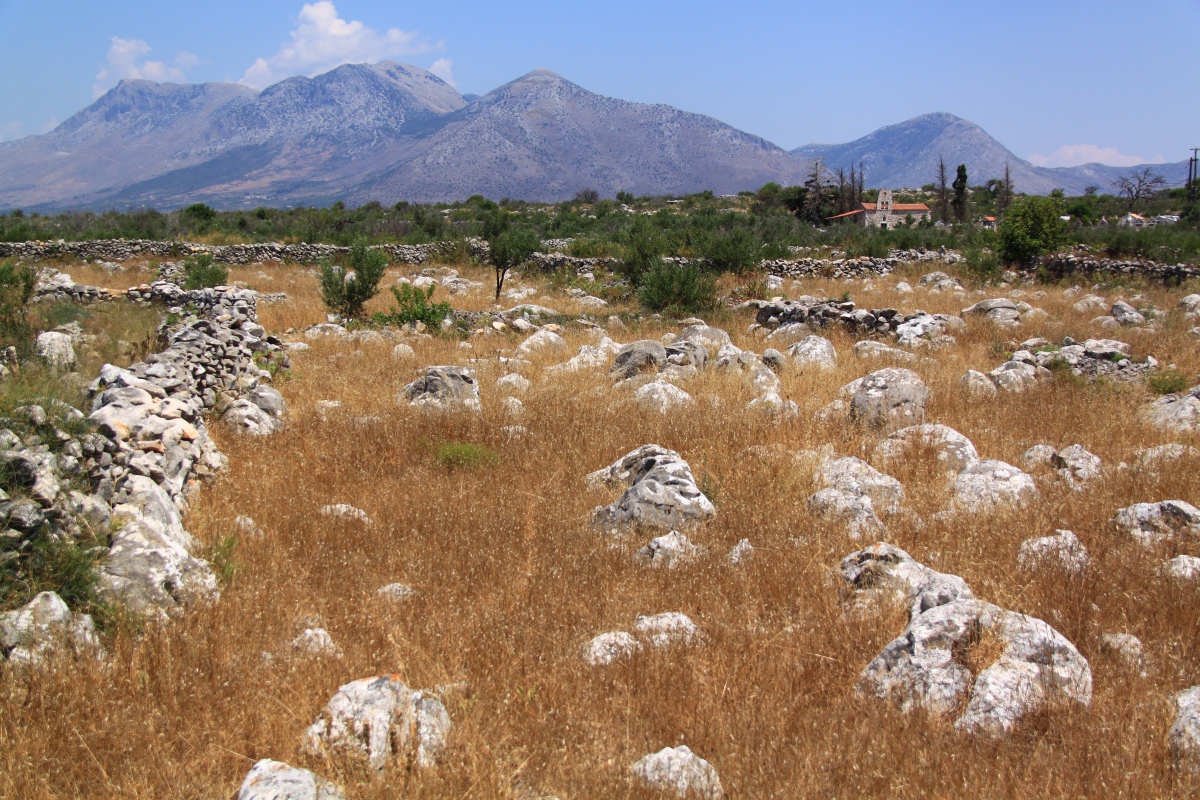
Typical landscape on the coastal plateau: rocky fields, stone walls, small churches, thorns and olives …. against a mountain backdrop

Stone bridge carries the old path over a deep gully

Densely packed thorn bushes everywhere

In case anyone doubts the problem they create, each of those thorns is at least an inch long

Photographer in the gully

This olive grove which I passed on the path to/from the beach reminds me of the stunted oak woodland above Cwmystwyth in Mid Wales where red kites took refuge. Here I watched eagles.

Looking back to the beach where I went for swims and the mountain above Pirgos Dirou which I climbed.

Coming into Areopoli, one of the few places round here where the church rises above the feud towers

A very colourful corner on the way into Areopoli

And finally from Areopoli …. Black Michael raises his hand in greeting as increased humidity sees cloud forming on the mountain

x

Posted in Greece | Tagged , , , , , | 2 Comments

Gerolimenas to Areopoli: things new, things familiar, and the Exit Strategy

Tuesday, the setting in motion of the Exit Strategy to get me back to the UK ….  and, a new experience for this trip, I was going back to a place I had been before!  Until today every single place I have been has been new and unknown.  With the sole exception of Paxos, where I had been met on the harbourside by friends who knew the island intimately, in every instance I had no idea of the layout of the place at all  This was the first time in nearly two months that I arrived somewhere and knew the layout and exactly where I was going.

As I rambled on about in an earlier blog, constantly changing locations has the effect of distorting the perception of time so that looking back it seems that I have been away from home for considerably longer than I actually have.

But in a strange way it is also very draining of energy, constantly dealing with new problems as well as enjoying new places and interests.  This is especially the case travelling on one’s own, no-one to help with problem-solving or look after the Big Bags while a decent hotel is tracked down. There is something very comforting and relaxing in the familiar.  Familiar places, familiar people, familiar everyday situations all contribute to wellbeing.  I think a healthy balance between the new and the familiar is ideal, but how that balance is drawn depends on the individual.

That’s very much how it struck me today.

Strange as it seems, the first bus of the day to Areopoli from Gerolimenas is at 14.30, the second, and only other, at 17.30.  There must be a rationale there somewhere.  I had breakfast, packed, sat on the balcony and read … a very arduous start to the day!  Then I checked out of the hotel, left my Big Bag in the restaurant and ambled along the coast, rock-hopping across some amazing geology, intent on not wasting time just loafing around.  I found a secluded spot in the rocks where I could have a swim.  It needed to be secluded because I had packed my swimming gear in my Big Bag.

White rock, blue sea and crystal clear water

Strange kind of conglomerate rock with what seems to be chunks of fossilised wood

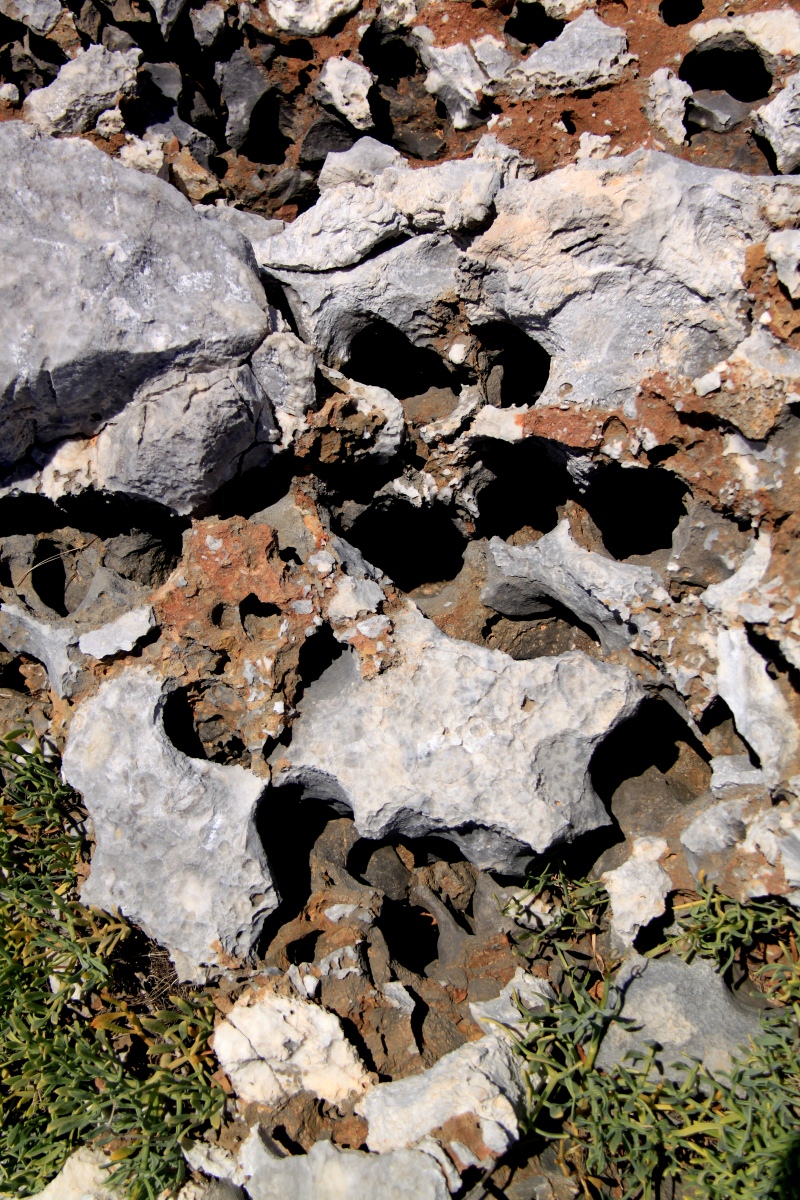
The rock seems to vary between smooth sea-washed marble and highly eroded razor-sharp limestone

After that there was just time to sit and relax with a frappé on the hotel terrace.  And that was when it struck me that Gerolimenas had become ‘comfortable’, the place and the people were now familiar and I would miss it and them.  The hotel, the ‘Akrogiali’ is at the junction of the beach and the small quayside, probably the most ideally located place I have stayed.  Come back from a long, hot walk, straight off the other end of the hotel terrace onto the beach and within a couple of metres into the sea.

And there had been good company.  I had met and enjoyed chatting to a guy from Switzerland and the hotel owners and waiters were very friendly and ready to stop and chat.  Turns out that one of the owners had lived and studied in Swansea for 3 years and spoke very fondly of South Wales.  Sitting there gazing at the bay I knew that it was time to move on but I also knew that I would miss the place and I had only been there 3 days!  That’s time-warping for you.

When I arrived in Areopoli on the bus, only half an hour away but a different world, busy and almost cosmopolitan in comparison, I felt almost at home.  I knew where I was going, knew the people at the hotel were very friendly and helpful and that there was the prospect of internet connexion in the room so I could Skype family.

Having had an idle day so far, after unpacking a few things I headed down to a beach.  Areopoli is at 250 metres ASL and so any walk to the sea is hard going but I was glad to stride out and stretch my legs.  Barely 45 minutes later I was in the sea.  Good refreshing swim than back up to the hotel for a shower.  All the time it was bearing in on me that I would only be able to do this once more on this trip.  Wednesday is my last day here.  Then the Exit Strategy gets into full swing.

Posted in Greece, Reflections | Tagged , , , | 1 Comment

Gerolimenas: more tower-house villages and scree-running.

Monday and I resorted to the plan originally pencilled in for Sunday, a long walk from Gerolimenas taking in some tower-house villages and a mountain top.

My ambition for the whole trip has been to travel by public transport rather than hiring a car and, with some swift thinking and changes of tactic, have more or less succeeded.  Taking a taxi to Vatheia was a compromise but worth it.  Tuesday begins the Exit Strategy so come Monday I was determined to do one last good walk.

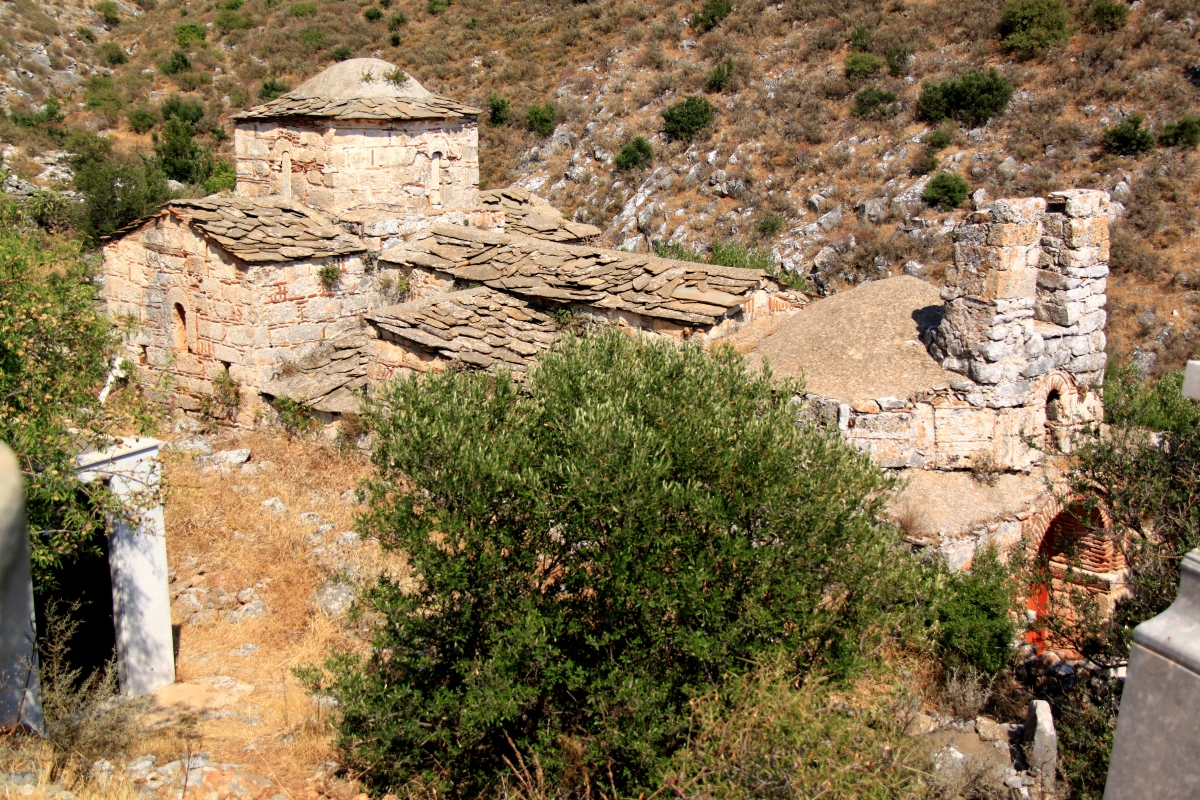
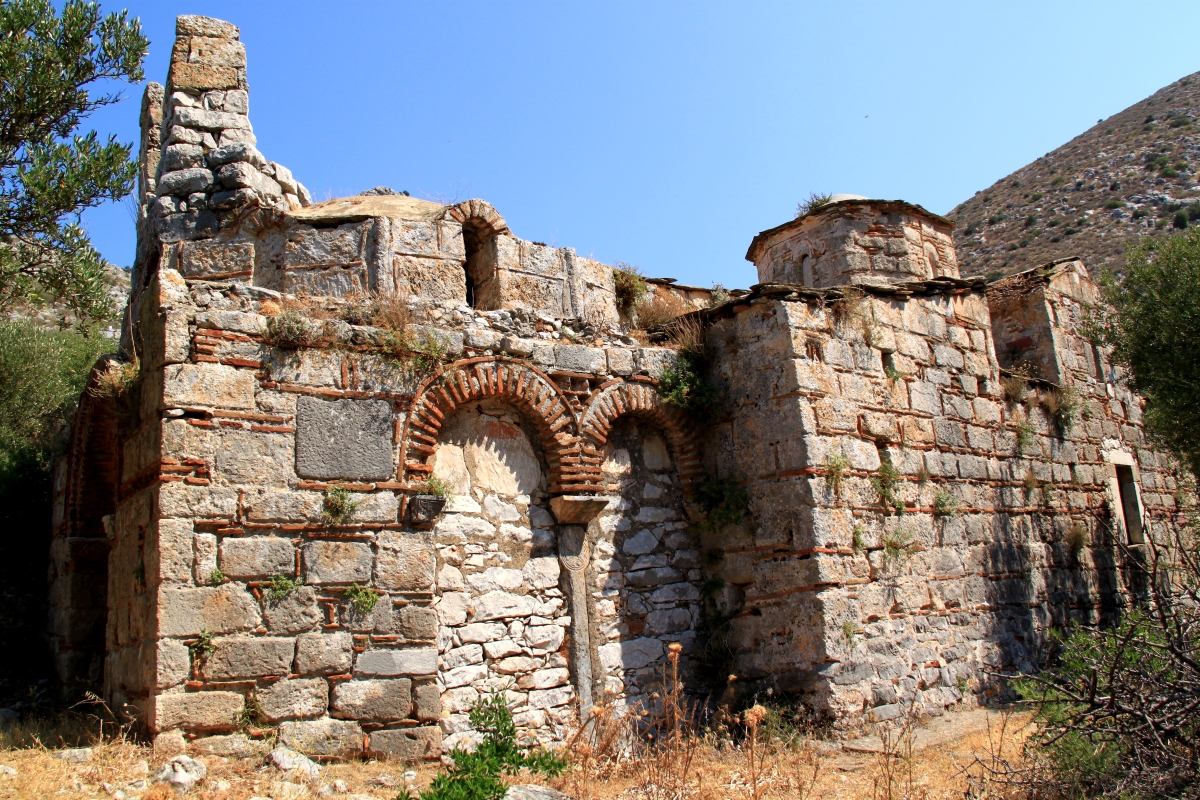
First leg was to I walk up to a village on the lower slopes of the mountain shown on the map to have a Byzantine church at the point where the road runs out and a footpath begins.  The church is at the lower edge of a small cemetery of the ‘beach chalet’ style and very difficult to access.  It is clearly very old but, as is so often the case, locked behind new wooden doors. Apparently some of these old churches date back to the 12th Century.  I’m pretty sure that the churches I found in  Ochia on my first day in Gerolimenas could well be that old but I’m not sure this one goes back that far.  It’s difficult to tell, information being generally completely lacking, and many structures, as in the UK and elsewhere in Greece have many later ‘add-ons’.  Whatever, this church was as impressive from the outside as was Likaki monastery in the Viros Gorge but was obviously being cared for and in much better state of repair.

The Byzantine church

….. and the other side

From there I dropped back down to a track contouring the mountain to a point between two other ‘tower-house’ villages with the intention of heading up a footpath to a mountain top for a spot of banana and nut-bar.  That’s where the plan began to unravel.

The village at the foot of the mountain I was heading for

One of the major problems with EU funding, and corresponding national government ‘match funding’ to suck in the opportunities the EU money affords, is that it only covers capital projects.  If you are clever enough at filling in the 3-inch thick application form to meet the criteria set for the particular fund you are trying to access you can get oodles of money for building or erecting lots of different things.  But there is no money whatever for maintenance and ongoing running costs.

Why do I mention this?  It seems clear that the municipal councils in the Mani have got funding for erecting footpath signs.  They pop up all over the place in Greek and Greeklish.  But, with the exception of the area around Kardamili there is no additional support on the ground.  In short, and finally getting to the point, I took what I thought was the path going up the mountain … and had yet another epic.  Which I’m going to bore you with.

The initial problem was a herd of about 50 free range cows which seemed to panic at the sight of a human.  Maybe it was because I exuded Welshness and not Greekness and they sensed the superiority of Welsh Blacks as a breed.  However, they ran everywhere including out through a gate onto the mountain onto what seemed to be path.  In the absence of any other indication of the path shown on the map at more or less this point I went for it.  In short, it wasn’t.

I have never before come across cow-paths on a mountain.  I have been misled by goat paths and sheep tracks before but never cow paths.  And have you ever wondered about the similarity between the words ‘path’ and ‘pat’.  Try following  a cow path up a mountain and the similarity will strike you immediately.  And have you ever wondered about the thickness of a cows hide compared to human skin?   Pushing up through the thorn bushes clearly presented no problem for them but it did for me.  The lacerations on my legs and arms multiplied exponentially.

Eventually, after several hundred metres height gain I gave up trying to follow the cows and took to the rocks.  I’m much more at home climbing rock than scrambling up loose scree covered in cow poo.  Isn’t everyone?

I climbed up to the visible crest, knowing full well it wasn’t the summit but at least a clear and obvious target …. and hard, sharp edge limestone all the way.  It wasn’t the top.  The top was clearly in view and under normal circumstances I wouldn’t have hesitated and continued up the last 100 metres.  But I had been conscious of a few things: it was unusually hot; there was no breeze; it was the middle of the day; my legs had been complaining they were tired;   I needed to eat; and last but no means least I knew that the walk down would be far more problematic than the walk up.  I sat and ate my banana and nutbar on the rocky crag I had reached and, having a second attack of commonsense this trip, decided that enough was enough and headed back down.

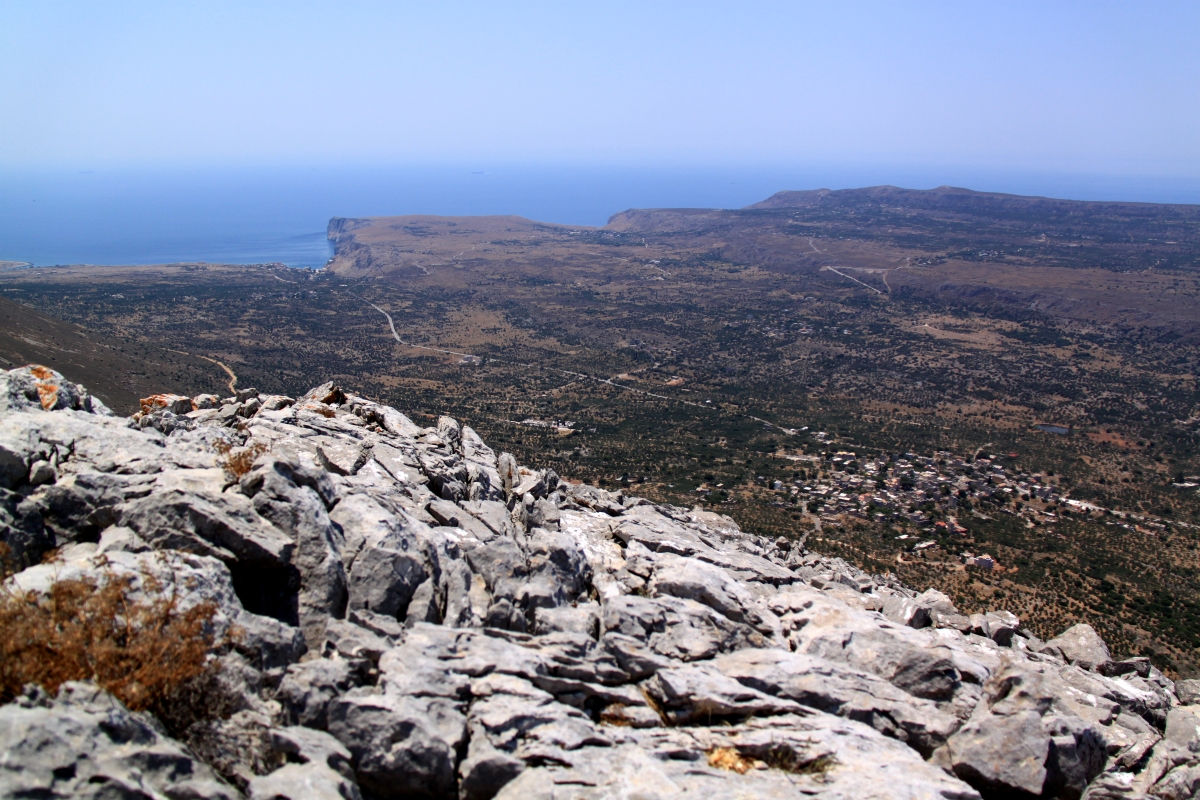
From the top of the crag looking towards Gerolimenas

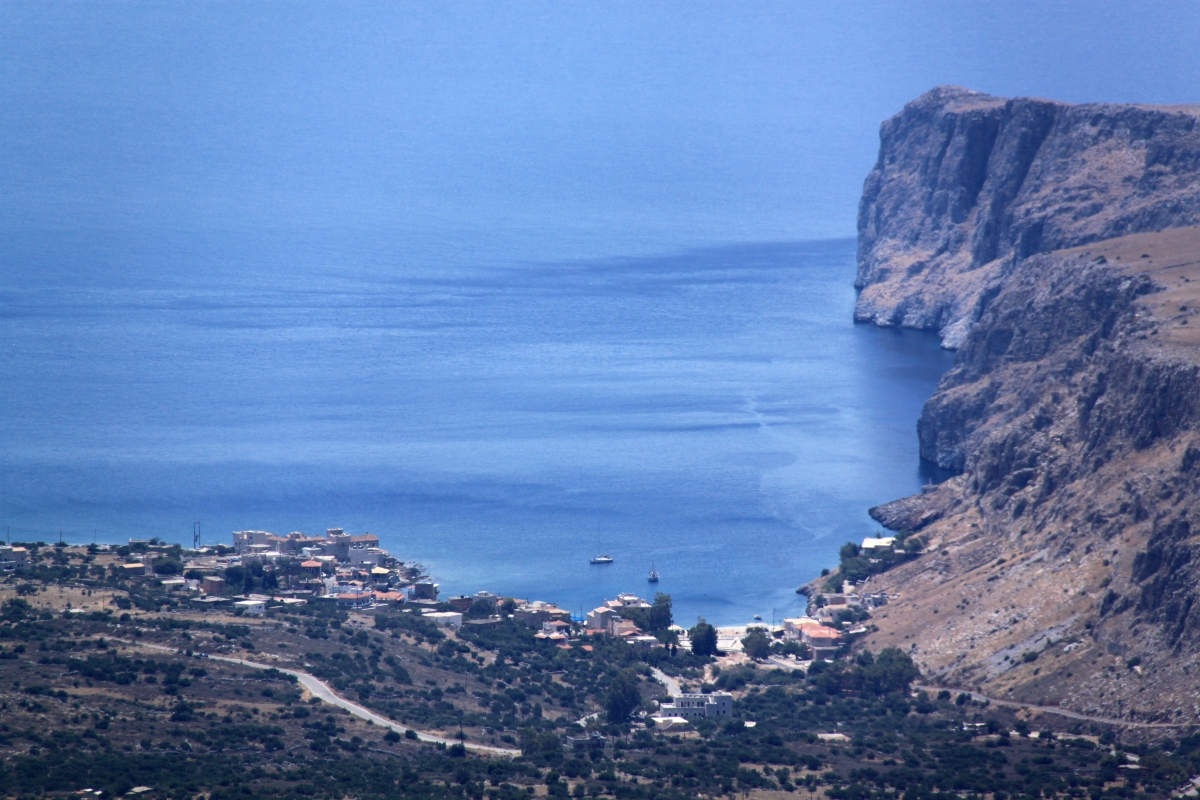
…. and zooming in on the village.

Though very steep, the first bit was easy, hopping, albeit in a very focused manner, from rock to rock.  That dropped me down about 150metres.  I gave up on trying to find the cow path after yet another slide in which a thorn on a stout branch impaled my finger as I continued to slide.  Difficult extraction job as my hand had to move upwards as I was hanging from the impaled finger while my feet continued slithering on the scree..

Instead I opted for thorn-free scree running.  When I was younger I used to go scree running a lot in the Lake District  (Green and Great Gable in particular) and in Snowdonia on Cadair Idris.  There seem to have been few opportunities in recent years because the practice caught on and all the scree got pushed to the bottom.  There are two techniques.  One is to drive in the inside edge of the downhill foot and slide with the scree until it slows up and then jump hard onto another loose patch and set that in motion.  The second is to hop on board a big chunk of rock, preferably flat, and surf.  Crazy fun.  But not in sandals on virgin scree!!!!

For years I have defended the advantages of sandals over boots for walking in the Greek mountains.  This was the first time in 12 years that sandals have been a problem.  But it was only for 40 minutes (though it seemed a lot longer) and I arrived on the track at the bottom with only superficial cuts.

I decided to head down to Koita, the larger and lower of the two tower villages nearby but fist stopped in the shade of a tree to clean up the blood on my arms, feet and legs.  I couldn’t appear in a village looking like an escapee from Dartmoor or Alcatraz.  I hoped that Koita would have somewhere to buy a frappé, I felt in desperate need of a cold drink (my bottled water was by now warm) and a caffeine fix.  It had, I found a tiny ‘locals’ Kafenion and had two frappés!!  With the second one I was given a 1½ litre bottle of water with a core of ice in it.  My thirst must have been very evident.

I returned to Gerolimenas by the route I had come, partly because I didn’t want to walk along the main road, the alternative, and partly to return to the Byzantine church to take photos with the sun at on a different side of the building.

Then what has become the usual pattern in the few days I have been here: swim; shower; beer.  It still niggled me that I didn’t reach the summit of the mountain, ‘pretty close’ doesn’t do it for me.  But I took some small consolation from the fact that even the guy from the hotel thought it was particularly hot today.

Posted in Greece, Grumpy Old Men | Tagged , , , , | Leave a comment

Vatheia: the inescapable past.

Quick change of plan over breakfast Sunday morning.  I had hoped to do a couple of things while based in Gerolimenas.  Pencilled in mentally for Sunday was a long walk taking in some tower-house villages and a mountain top.  I was all geared up for that until a taxi pulled in at the end of the hotel terrace.

I had sussed out that there was no bus from Gerolimenas to Vatheia, the archetypal and iconic tower house settlement about 8 kms to the south.  There is a bus from Areopoli but it skirts around Gerolimenas without stopping.  So I temporarily abandoned my breakfast, indicating wildly to the very attentive waiters that I hadn’t finished and so not to clear the rest of my yogurt and coffee, and went to ask the driver how much it would cost for a taxi to the village. It’s not very far, 8kms there and the same back is well within my capability for walking, but it was all on tarmac which is not very exciting.  So I agreed the price of €13 and a time of 10.00 ‘peripou’ to set out.

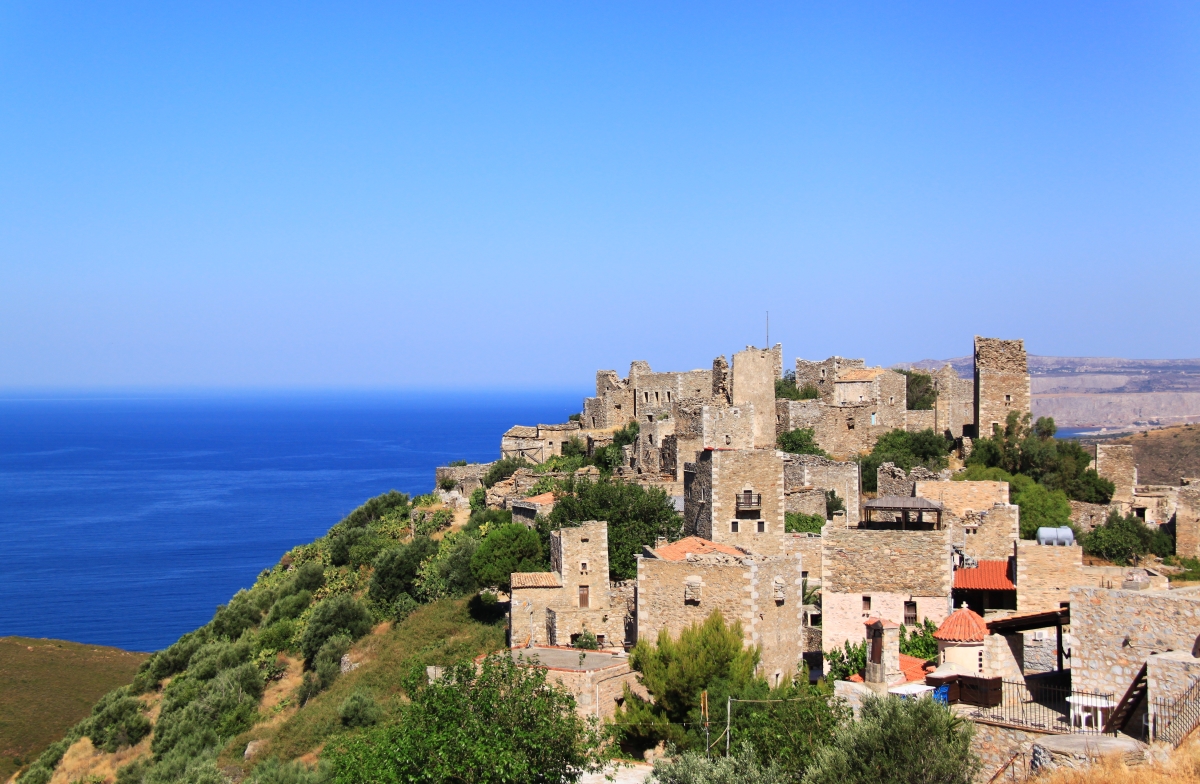
It was indeed worth the money.  A few people I have met and chatted to have raved about Vatheia as the only really true example of what blood-feud/tower house Mani was all about.  I can’t confirm that because I haven’t yet seen many other tower-house villages but most certainly Vatheia is not to be missed and I guess it’s true that the new-build  in the tower house vernacular does detract from the authenticity of places I have seen.  I’m very glad that I went.

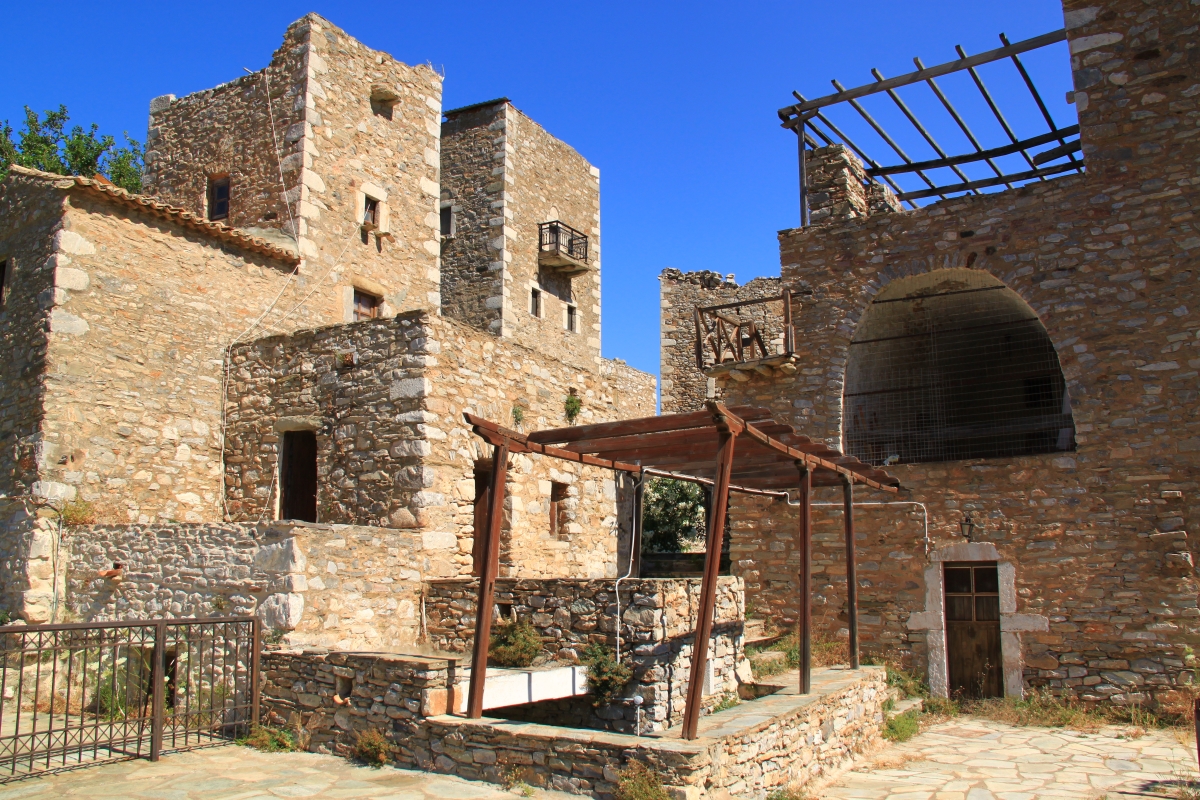
The taxi dropped me off at the edge of the village.  First I wandered around on the uphill side of the village to get the morning sun on the hilltop setting, then I wandered the ‘streets’ of the village.   A few of the towers have been renovated and are lived in but not many.  Some were renovated as part of a scheme to develop tourist accommodation by EOT the Greek tourist organisation but that never worked and is bankrupt, towers all closed up.  A tower renovated as a ‘new’ taverna lies empty with rotting timbers, presumably the ‘seasonal; café noted in the 2012 edition of the Rough Guide to Greece.  There was no indication of any other beverage establishment.   I wish they would get their facts right!!!!!  I really fancied a frappé in a historic setting, it would have been very poignant sipping a cold drink where, on a historical timescale, not long ago blokes were trying to shoot each other and smash each other’s marble roofs.

There was a path around the outside of the village with lots of paths heading inwards to the core and plenty of abandoned towers to wander into and climb up inside …. having first  judged the soundness of the remaining structure.   Cadw and English Heritage would have cordoned the whole pace off on Health and Safety grounds.

I was glad that I didn’t visit it on a bus trip from Areopoli as that would have severely constrained the time for wandering around.  One minibus trip came and went while I was there, staying not more than half an hour I guess. As it was I finally left after about 2 hours and then only because I was conscious of the fact that I had to walk back Gerolimenas  and there was just the possibility that I might call in at one of the small coves and have a swim.

It is amazing that people should have lived in these towers, tightly crammed in cheek by jowl so close physically and yet so distant from each other socially.  I think it’s most unlikely that any number of the many remaining semi-derelict and unoccupied towers will ever be restored.  Modern expectations of living accommodation would be too difficult to achieve while preserving the character of the buildings, floorspace being tightly constrained and windows very small, doors very low, stairs narrow and ladder-steep.  Most have little space outside the building though at least one has renovated some open space as a very pleasant garden.  Vehicles have to be parked at the edge of the village, no access into the village would be possible.  I can’t see development of the place as a ‘themed’ tourist accommodation working for the same reason ….. as it clearly hasn’t, the board announcing ‘Vatheia Appartments’ rusted over and lying forlornly.

But this is no different from the castles in Wales. They will never be restored to living or tourist accommodation (with the exception of Manorbier) The major difference there being that castles are one single structure whereas the tower houses are individual and presumably separately owned to complicate matters even further..

As a vivid example of how things were Vatheia has to be see.

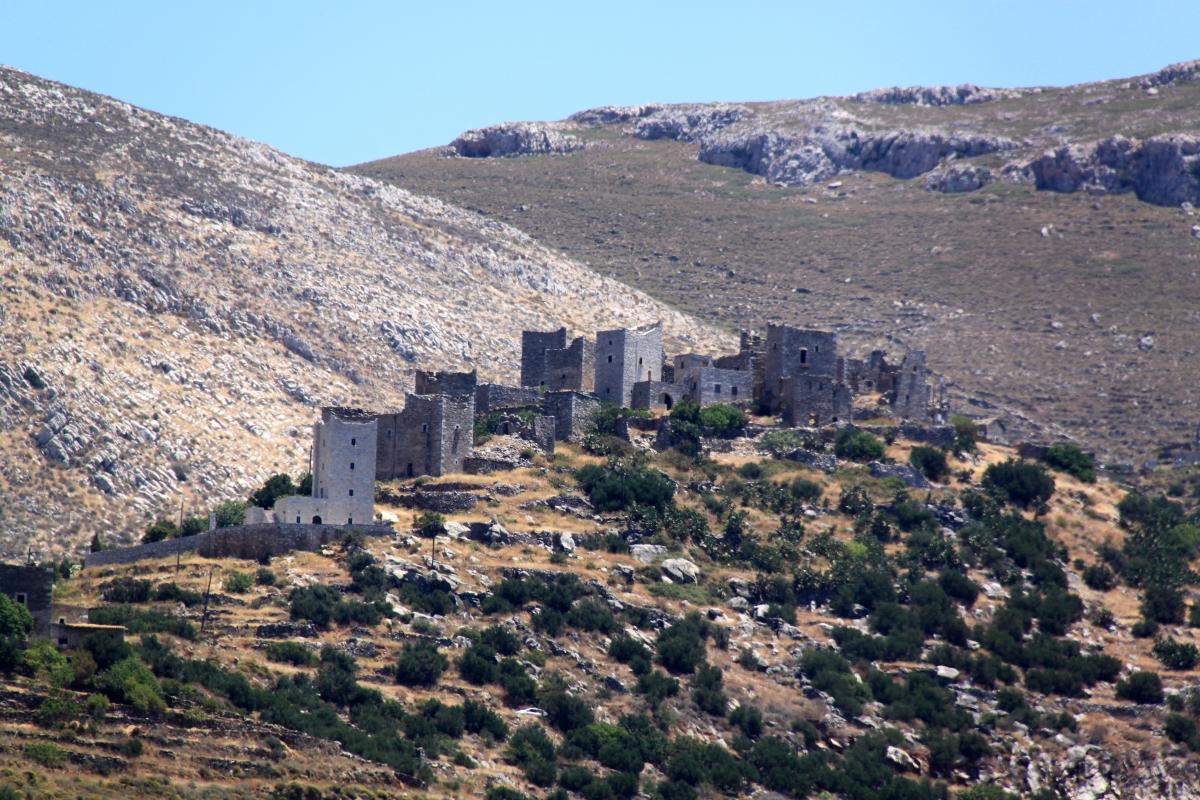
Looking down on the hilltop setting of Vatheia

Another angle

…. and zooming in

Church at the entrance to the village

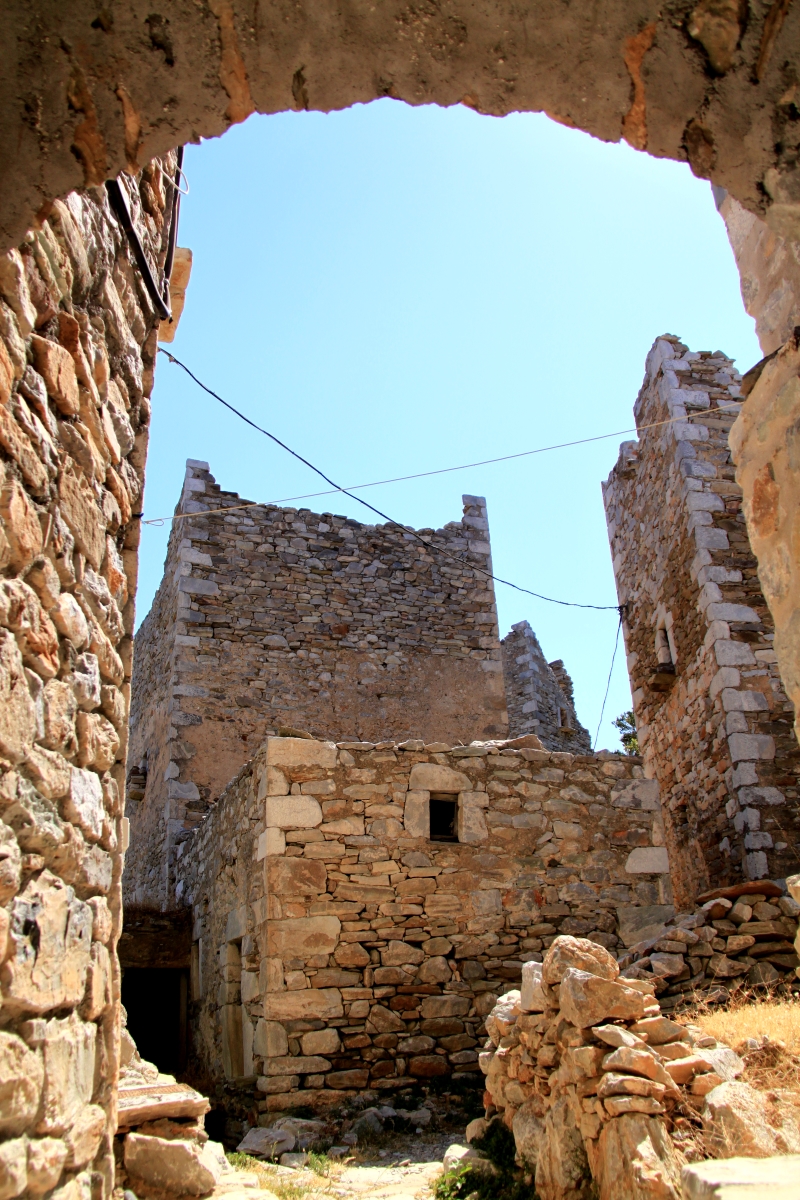
Entering the maze of alleys between the towers

The closed-up tower taverna on the right

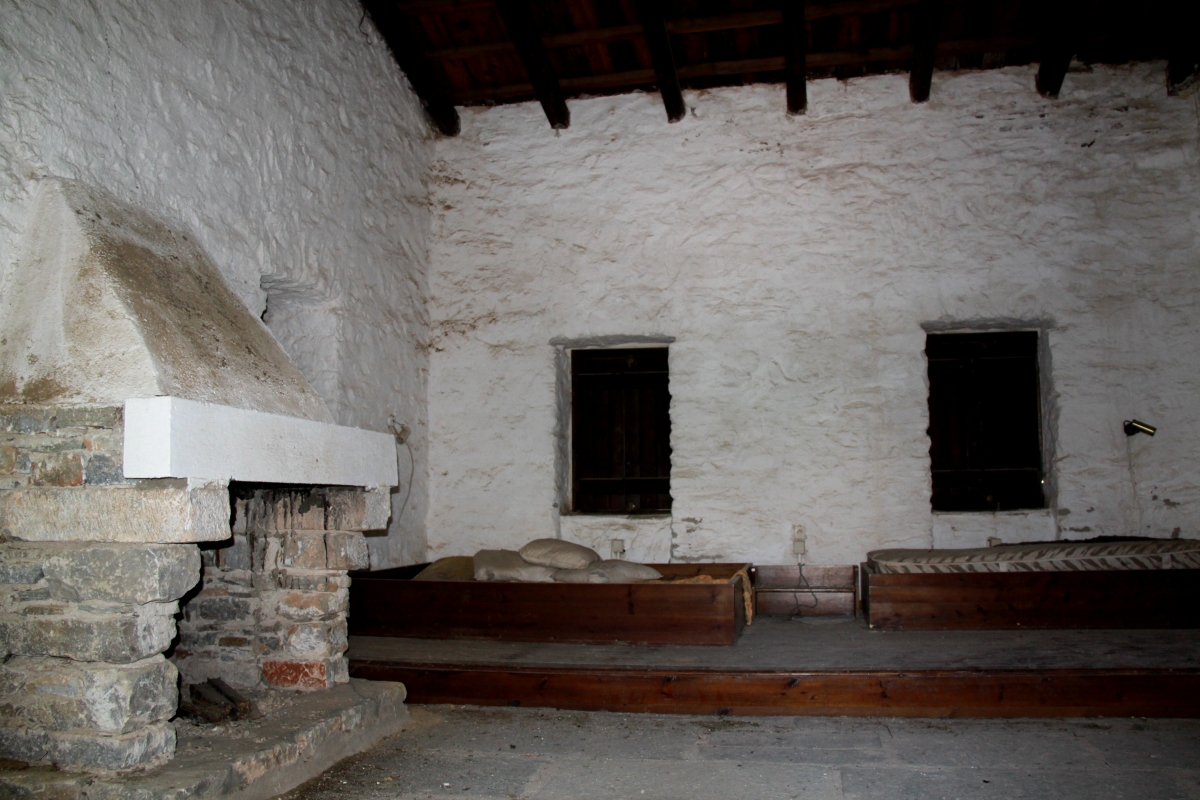
Inside one of the restored but now unoccupied towers

Tightly constricted stairways

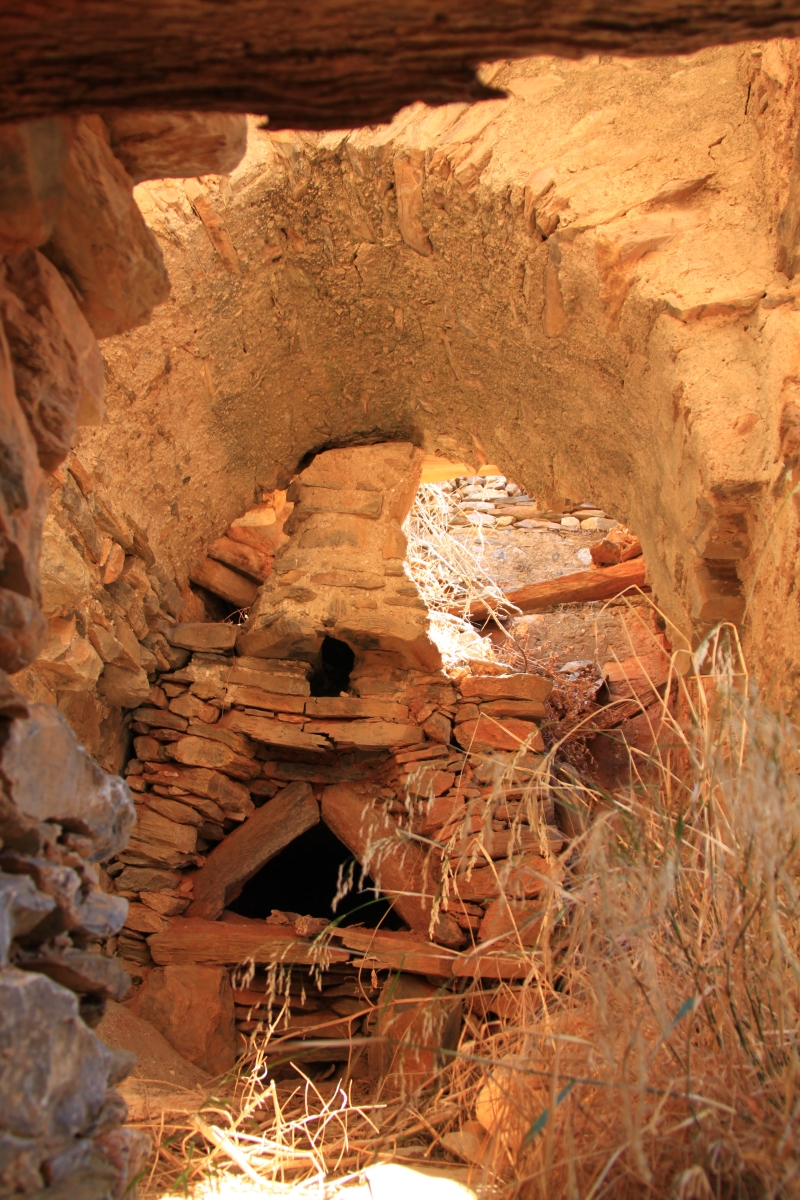
Crumbling roofs, empty houses

More narrow alleys and archways than you can shake a stick at

Occupied house with garden

Looking back at the hilltop setting

On the way back I did indeed call in at a fabulous, very quiet ‘locals’ pebble beach.  Had a swim.  Ate a banana.  Got hot.  Had a swim.  Gets repetitive doesn’t it.

Arrived back at Gerolimenas in time for a frappé before yet another swim and then ambling around the village with the camera. But all the time the memory of Vatheia was there in the mind.  It’s one of those places you don’t forget.  Grey images haunt you.  The brightness and colour of Gerolimenas in the evening sun couldn’t push them away.

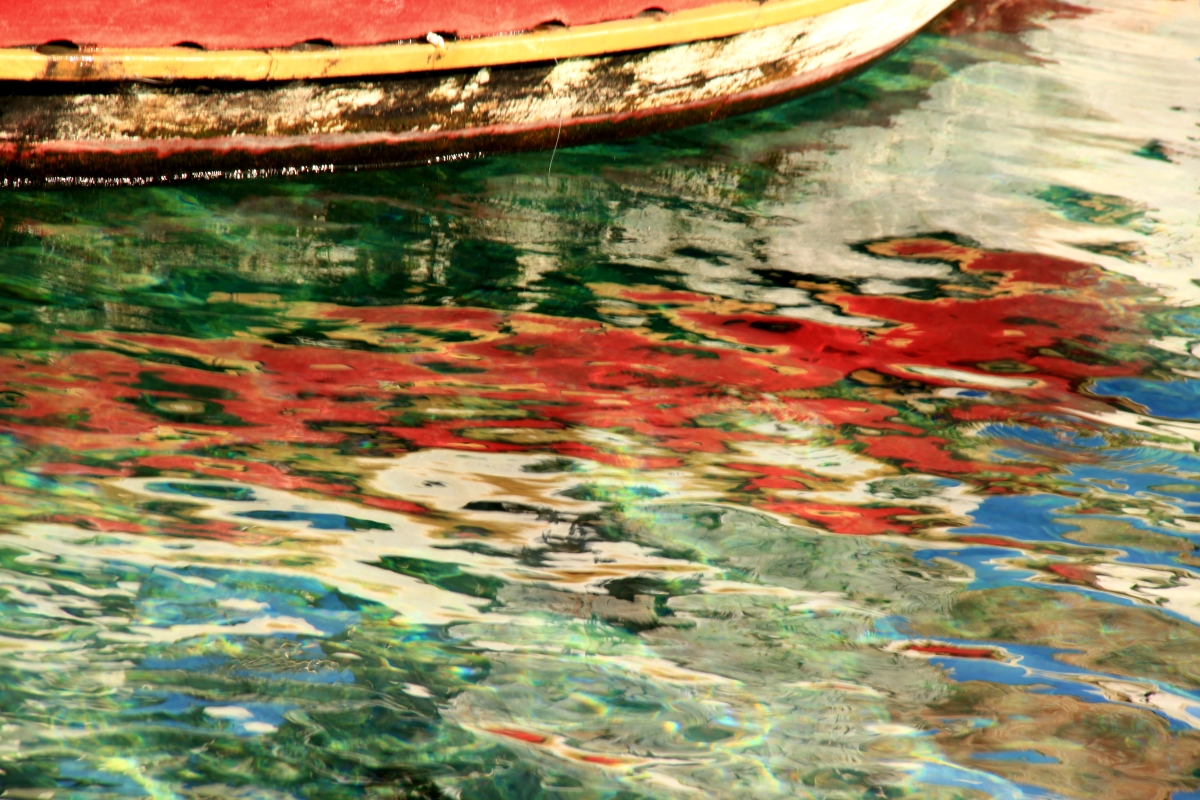
Flat calm in the bay

Reflecting again

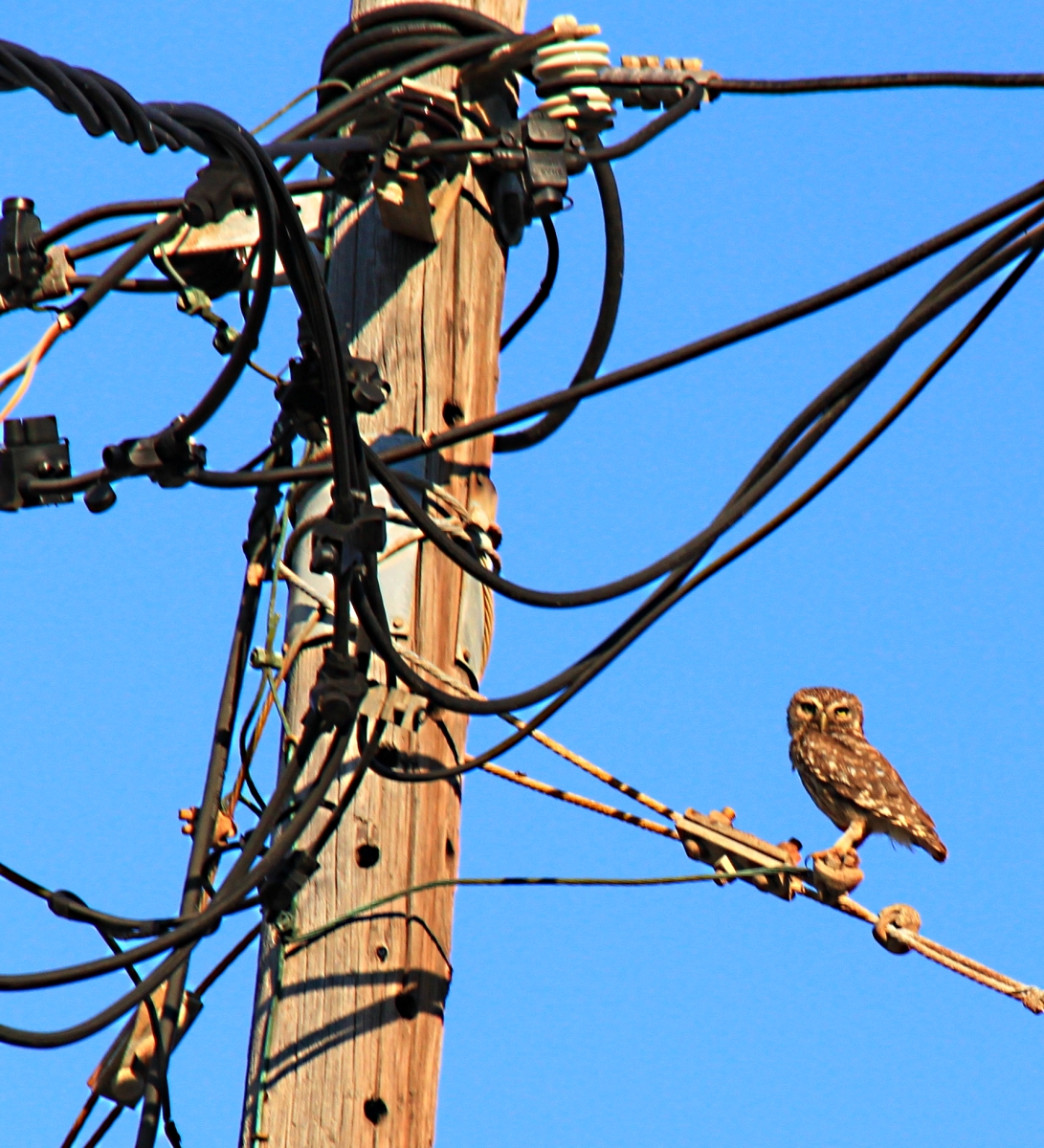
Little owl watching what is going on

PICS

Posted in Greece | Tagged , , , , | 2 Comments